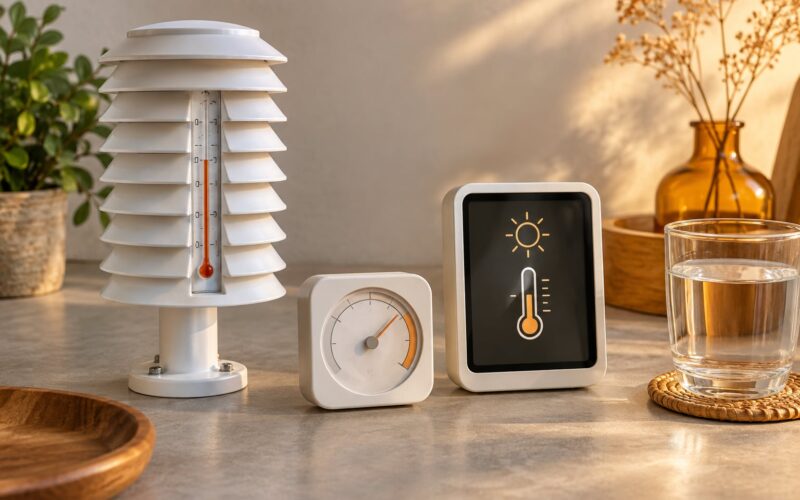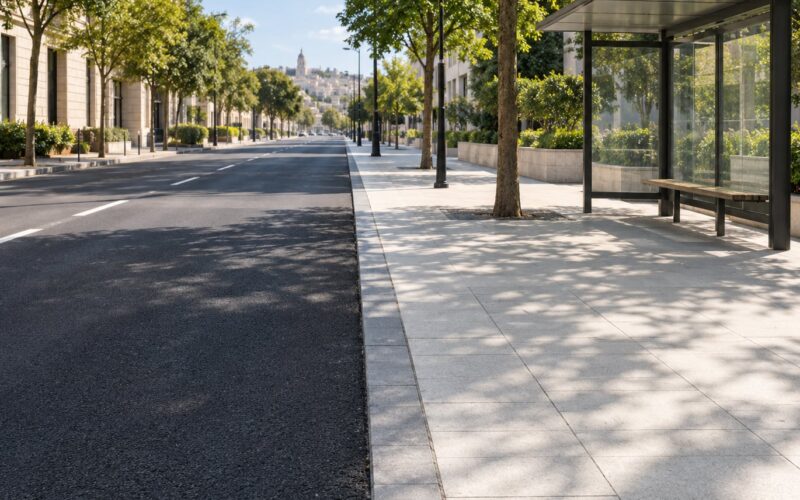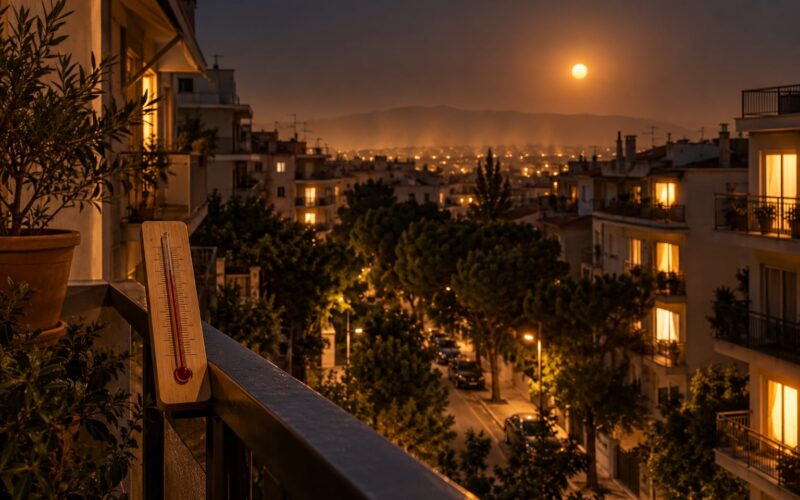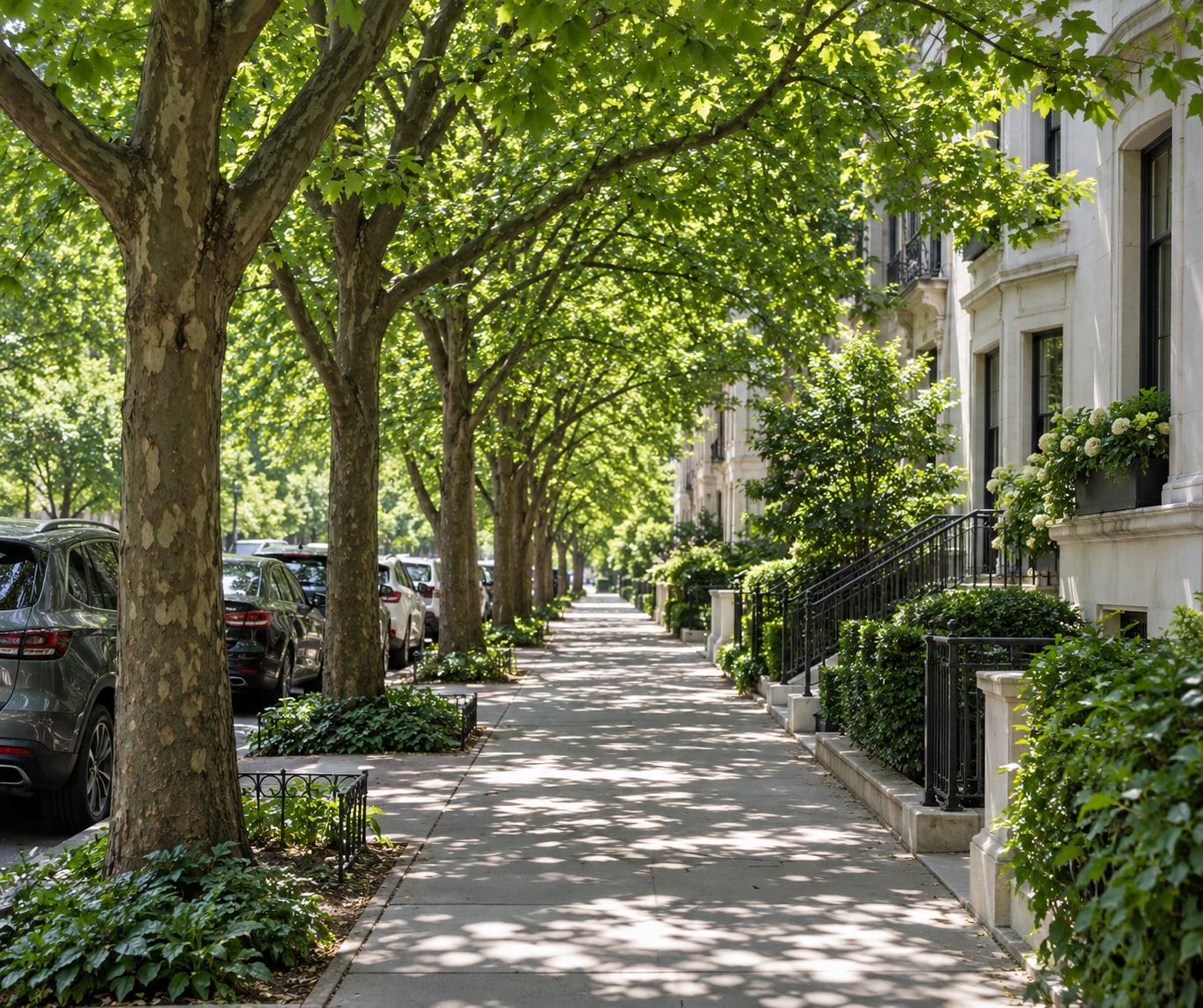
Street trees lower neighborhood temperatures two ways at once. They cast shade that stops asphalt, concrete and rooftops from absorbing solar radiation, and they push water from the soil through their leaves and out into the air as vapour, a process called evapotranspiration that carries heat away with it. Shade alone can make a shaded sidewalk feel 10 to 12 °C cooler than an exposed one, while the air itself typically cools by a smaller 2 to 3 °C. Both numbers are real; they just measure different things.
Why planting street trees lowers neighborhood temperatures is not really a mystery once you separate those two mechanisms and stop treating “temperature” as one single quantity. It also explains the disappointment some people feel: a stick in a bucket of soil does almost nothing, while a mature canopy over a bus stop changes how a whole block feels in August.
Table of Contents
- How much do street trees cool a neighborhood?
- How do trees lower temperatures through shade?
- Leaf area index and the value of a continuous canopy
- What role does evapotranspiration play?
- How do street trees improve airflow and reduce heat buildup?
- Why planting street trees lowers neighborhood temperatures over time
- Which trees and planting conditions work best?
- Planting criteria worth checking before you choose a species
- What limits the cooling effect of street trees?
- How can communities plant trees that cool more effectively?
- Frequently Asked Questions
- Do street trees cool a neighborhood at night as well as during the day?
- Are palm trees as good as broadleaf trees for cooling a street?
- How long before a newly planted street tree provides real shade?
- Is it worse to plant trees in leafy neighborhoods and cut them in hot ones?
- What is the 10/20/30 rule for urban trees?
- How can a neighborhood measure whether its trees are actually cooling?
- Conclusion
How much do street trees cool a neighborhood?
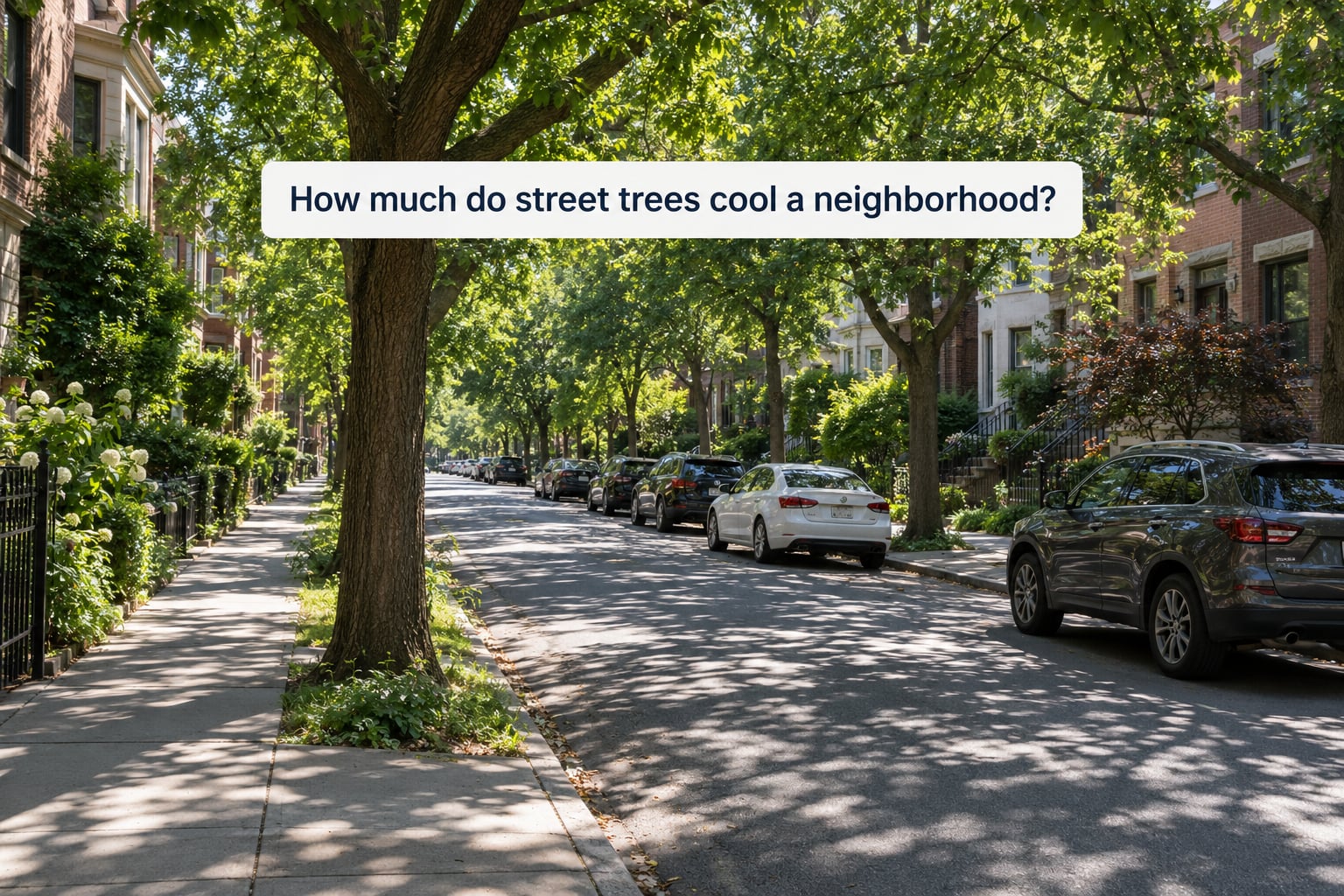
The honest answer depends on what you measure. Inside a tree canopy, researchers at the TU Braunschweig Institute of Geoecology report air temperatures roughly 2 to 3 °C below the surrounding area, and conditions people actually feel up to 10 to 12 °C cooler because the sun is no longer heating their skin and the surfaces around them. Surface temperatures tell a third story: shaded asphalt can sit dramatically cooler than exposed asphalt a few metres away, which is why a thermometer on a dashboard and a thermometer on the pavement never agree.
At neighbourhood scale the effect is real but partial. Research from the FIU Institute of Environment reports that trees can cool urban areas by as much as 10 degrees, and that the figure depends heavily on which tree you plant. Whole-district cooling is modest compared with the change a single shaded footpath delivers to the person standing on it, and that gap is worth keeping in mind when cities set canopy targets.
| What you measure | What it means | Typical reduction near street trees |
|---|---|---|
| Ambient air temperature | The air a few metres above the ground, measured by instrument | About 2-3 °C inside and downwind of a canopy |
| Mean radiant temperature | How much heat your body absorbs from sun, sky and hot surfaces; this drives what people actually feel | Up to 10-12 °C under a good canopy, and much of that benefit is shade |
| Surface temperature | The temperature of pavement, roofs and walls | Large gaps between shaded and exposed surfaces on the same street |
| Indoor conditions | Attic and upper-floor heat gain, and air-conditioning load | Meaningful mainly when shade lands on the building itself or on walls and windows |
The same physics produces real benefits and real constraints. Reading both sides is more useful than a slogan.
| What street trees do | Where it helps | Where it falls short |
|---|---|---|
| Block solar radiation | Sidewalks, bus stops, playgrounds, parked cars, west-facing windows | Depends on canopy size and sun angle; a sapling shades almost nothing |
| Release water vapour | Air inside and downwind of the canopy | Stops during drought stress; needs soil volume and regular water |
| Intercept rainfall | Stormwater runoff into drains | Only as much as the canopy and soil volume can take |
| Lower building heat gain | Homes and shops near the street | Weak for houses set far back or shaded by other buildings |
| Change airflow | Reducing the amount of hot surface generating rising heat | Dense canopies can slow air movement and trap pollutants in narrow street canyons |
How do trees lower temperatures through shade?
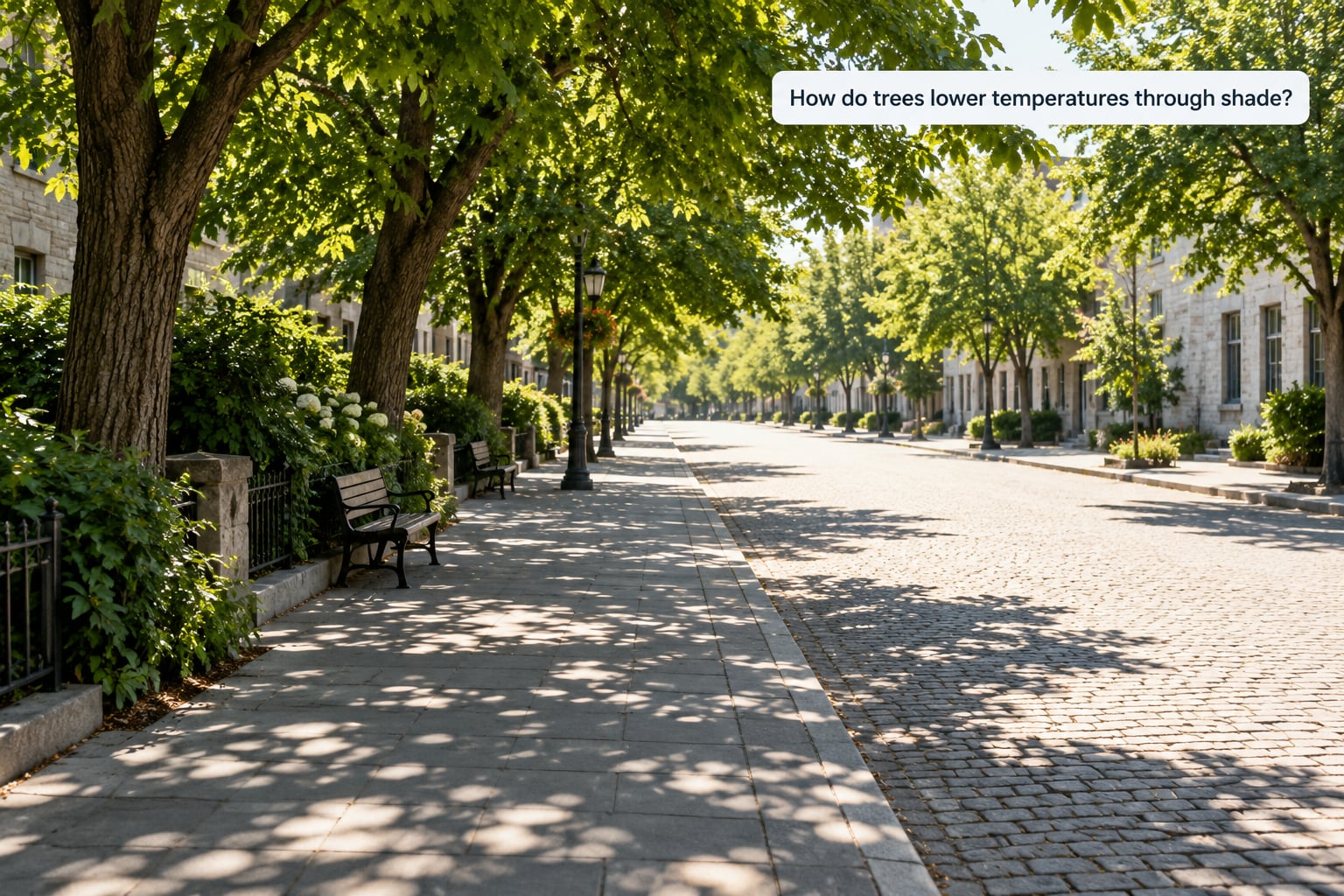
Shade works by intercepting sunlight before it ever reaches a surface that stores heat. A leaf canopy does something a roof overhang does: it cuts the incoming solar radiation, and surfaces that never receive that energy stay cooler. That is the whole mechanism, and it matters enormously in a street where the majority of what you see is asphalt, concrete and brick.
Two different things happen at once. Shade on surfaces lowers surface temperature, which lowers the amount of heat those surfaces later release into the air. Shade on people lowers radiant temperature directly, because the body stops receiving shortwave and infrared radiation from the sun and from hot surfaces around it. The second effect is why a shaded pavement feels so much better than the thermometer suggests.
Leaf area index and the value of a continuous canopy
How well a canopy blocks sun is often described by leaf area index, the ratio of leaf surface area to ground area beneath the tree. A sparse ornamental planted for the view has a low value and filters little light. A broad, dense street tree has a high one, and if crowns overlap along the block they form a near-continuous roof of leaves. Continuous canopy is what turns a row of trees into shade infrastructure rather than a row of individual objects.
Sun angle matters too. Midday sun is steeper and easier to block; low late-afternoon sun rakes down a street and reaches facades, which is why west-facing walls and windows stay the hottest part of a typical block.
What role does evapotranspiration play?
Evapotranspiration is the process by which trees move water from the soil, up through the trunk, out through tiny openings in the leaves, and into the air as vapour. Evaporation of that water takes energy from the surroundings, which is why the air inside a healthy canopy runs a few degrees cooler than the air above it. Combined with the small amount of water evaporating from the soil itself, it is the second cooling engine, and unlike shade it works on the air rather than only on surfaces and bodies.
Aminaipouri and Srebric’s work on urban tree planting for outdoor thermal comfort puts it plainly: vegetation raises the evapotranspiration rate of a land surface, and that absorbs the radiant energy that would otherwise warm it.
The part people miss is the water requirement. DW reporting on tree water needs gives a minimum of roughly 10 to 15 litres per day, rising to as much as four times that for a mature tree in full foliage during hot weather. A tree that cannot get that water closes its stomata, transpiration drops, and the cooling effect largely switches off. That is the hinge between a mechanism people find abstract and a practical rule: healthy trees cool, stressed trees mostly just stand there.
How do street trees improve airflow and reduce heat buildup?
The link between trees and air movement is less intuitive than shade, and it runs in both directions. Neighbourhoods get hot partly because they are covered in heat-absorbing surfaces that absorb solar radiation all day and release it slowly, and partly because that hot air rises. Removing or shading those surfaces reduces the amount of heat being generated in the first place, and canopy surfaces transfer moisture rather than storing solar energy.
Shade and wind are different tools, though, and mixing them up causes planning mistakes. A large canopy parallel to a street can act as a sail. In a narrow canyon lined on both sides with dense trees, researchers have observed reduced air circulation, which can keep vehicle pollutants from dispersing. That is a real trade-off, not a talking point against planting, and it is manageable through species choice, crown height and spacing.
Airflow also depends on what the wind is carrying. Where a street carries hot, dry inland air, a treed block is markedly cooler and more comfortable than its neighbour. Where the surrounding land is already green and the street corridor is enclosed, planting adds less. Humidity rises slightly under a canopy, which is uncomfortable for some people in humid climates and useful in dry ones.
Why planting street trees lowers neighborhood temperatures over time
The first reason is ordinary growth. A newly planted tree has a small crown, a low leaf area index and a root system that is still finding its footing. Each year it adds crown, leaf surface and transpiration capacity, so the cooling contribution rises with it rather than appearing on planting day.
The second reason is soil. Street tree pits that survive long-term get better over time as roots and organic matter break down compacted fill. Better soil holds more water, which supports the transpiration that does the cooling. It also behaves more like a sponge when it rains, which helps the tree through dry spells.
The third is accumulation. Cooling is strongest where canopy is continuous, so a street with mature street trees on every block behaves differently from one with scattered young trees. That is the argument for planting many on the same streets rather than scattering saplings thinly across a whole district.
And the fourth is equity. Neighborhood temperature differences track canopy differences closely, because canopy was historically planted first in the places that had time, money and land. Closing that gap is the case for prioritizing the hottest, least-shaded streets, not the ones where planting is easiest.
Which trees and planting conditions work best?
A good street tree is not the one with the biggest catalogue description. It is a tree with a broad or otherwise useful canopy, tolerance of heat and drought, roots that stay inside the planting area, resistance to the pests already established in the region, and a mature size that fits under wires and beside sidewalks. Work through that list in order and species choice gets much easier.
| Tree type | Cooling contribution | Strength | Weakness |
|---|---|---|---|
| Large broadleaf (live oak, fig, gumbo limbo) | Highest | Large dense canopy, high transpiration, long life, wide shade | Large roots, needs soil volume, some are vulnerable to storms or specific pests |
| Medium shade tree (many small to medium street trees) | Good | Fits under wires, moderate water need, easy to keep alive | Less total shade per tree, so a whole block needs more of them |
| Palm | Low for cooling | Hardy, salt and drought tolerant, familiar in warm climates | Little leaf surface to transpire, limited shade, short useful lifespan compared with broadleaf shade species |
| Small ornamental | Minimal | Cheap, quick to establish, limited root conflict | Casts little shade; contributes little to neighborhood cooling |
The FIU research makes that hierarchy concrete: FIU researchers found that palms and royal poinciana deliver far less cooling than live oak and gumbo limbo, which is why planting programmes aimed at heat relief have started counting canopy rather than trees planted. Miami-Dade County carries a 30 percent canopy goal while sitting near 20 percent, which is the gap that programme is trying to close.
Planting criteria worth checking before you choose a species
| Criterion | What to check | Why it matters |
|---|---|---|
| Mature canopy size | Crown width and height at maturity against sidewalk, wires and sightlines | Determines how much shade the tree will ever cast |
| Root behaviour | Non-lifting, non-invasive tendencies | Protects paving, pipes and nearby foundations |
| Water need | Drought tolerance versus local summer rainfall | Drought-tolerant trees keep cooling through dry months |
| Soil volume | Root volume available at maturity, ideally structural soil or suspended pavement | Small pits cap canopy growth and shorten tree life |
| Pest and disease exposure | Problems already present in the local urban forest | A species that is not diverse enough is vulnerable to a single outbreak |
| Species diversity | No more than 10 percent of one species, 20 percent of one genus, 30 percent of one family | The 10-20-30 rule from the US National Arboretum limits the damage from one pest or disease |
What limits the cooling effect of street trees?
The honest limits deserve more space than they usually get, because they explain most failed planting programmes.
Young trees are the first limit. A sapling provides very little shade or transpiration, and researchers at the Swedish University of Agricultural Sciences have pointed out that it can take 40 to 50 years for a newly planted tree to deliver full function. The arithmetic that follows is sobering: replacing one mature tree with a 20 m crown circumference takes on the order of 400 saplings. Trees that are already mature are not a renewable resource on a project timeline.
Drought is the second. Water restrictions and heat waves hit young street trees hardest because they have the least root system and the least stored water, and a failed establishment period usually ends in death.
Compacted soil is the third, and it is mostly self-inflicted. Sidewalk construction and utility work compress soil, reducing pore space so roots cannot get air or move water. Small planting pits cap the same damage more permanently.
Poor species selection is the fourth, and it is the one that looks like success on planting day. Palms, small ornamentals and trees chosen for the sightline rather than the shade deliver almost no cooling, and a planting count that ignores canopy reports success for a decade before anyone notices the streets are still hot.
Construction damage and neglect are the fifth. Building work routinely removes street trees, and residents in places like r/chicago ask each other to water newly planted trees because aftercare is the part that quietly disappears.
One recurring objection deserves a direct answer. The claim that you should not plant trees is not a scientific finding; it is a distorted version of real arguments about planting the wrong trees, planting too many of one species, or treating planting as a substitute for reducing emissions. Those are arguments for planting properly, not arguments against planting. A well-chosen street tree cools a city, stores carbon, slows stormwater and lives for decades. A badly chosen one is a stake in the ground with leaves.
How can communities plant trees that cool more effectively?
Start with site selection. Put trees where people wait and where heat accumulates: bus stops, school gates, crossings, plazas, playground edges, long unshaded stretches of sidewalk, and parking lots where shade falls on parked cars. Shade that lands on a person standing still for four minutes is worth more than shade that falls on an empty roadway.
Then prioritize. Work with canopy and surface temperature data rather than convenience, and plant hardest in the blocks that currently have the least canopy and the highest measured temperatures. Miami-Dade’s move to count canopy instead of counts of trees follows that logic.
Fix the soil before the tree arrives. Give it real volume, use structural soil or suspended pavement under new sidewalks where the city can, and stop compacting the backfill. Cornell’s Urban Horticulture Institute has spent decades showing that suspended pavement and gravel-based structural soil extend street tree life in situations where compacted pits would not support a long-lived tree at all.
Plan the aftercare. Water young trees deeply and less often rather than shallow and daily, roughly the 10 to 15 litres per day minimum rising for mature trees in full leaf, and use a watering bag so the water stays where the roots are. Assign ownership of watering explicitly. Ambiguous responsibility is why so many plantings die in their second summer.
Protect existing canopy. Mature trees deliver the cooling that takes decades to grow, and a single mature street tree removed for a driveway is a loss no planting programme replaces on any realistic schedule. Require construction plans to show how existing trees are protected, and enforce it.
Measure what happened. Use fixed sensors under canopy and in the open on the same block, compare surface temperatures on the same route, and keep planting records by species and survival rate. The USDA Forest Service’s i-Tree Streets is the standard modelling tool for this kind of estimate, and heat mapping has already shown block-to-block temperature gaps in cities like Manhattan that residents can see for themselves. Measuring is what converts a planting ceremony into a program with results.
Frequently Asked Questions
Do street trees cool a neighborhood at night as well as during the day?
Mostly during the day. Shade and evapotranspiration both depend on incoming solar energy, so their effect peaks when the sun is out and drops at night. At night the cooling comes from stored heat: shaded surfaces never absorbed as much during the day, so they release less after sunset. Canopies also slow the release of stored heat from pavement, which keeps nights marginally warmer in some settings.
Are palm trees as good as broadleaf trees for cooling a street?
No. Palms carry far less leaf surface and transpire less than broadleaf shade trees. FIU researchers found that palms and royal poinciana deliver much less cooling than live oak and gumbo limbo. Palms earn their place for durability, salt tolerance and appearance in warm climates, but they are a weak answer when the goal is lowering neighborhood temperatures.
How long before a newly planted street tree provides real shade?
Useful shade usually starts around 10 to 15 years, and full function can take 40 to 50 years. Until then the tree is mostly growing roots and crown. That gap is why planting programmes need to protect mature trees rather than treat them as interchangeable with new ones, and why young plantings must survive their first few summers to contribute anything at all.
Is it worse to plant trees in leafy neighborhoods and cut them in hot ones?
Yes, that inverts the whole point. Removing canopy from already-shaded streets and planting into the coolest blocks raises heat exposure exactly where people are most vulnerable. The useful measure is canopy and temperature in the hottest, least-shaded blocks, not a total tree count across a city. Counting trees rather than canopy hides this failure well.
What is the 10/20/30 rule for urban trees?
It is a species diversity guideline developed by Frank Santamour at the US National Arboretum in the 1990s: no more than 10 percent of one species, no more than 20 percent of one genus, and no more than 30 percent of one family in an urban planting. The point is to prevent a single pest or disease from reaching the proportion of the population it needs to spread.
How can a neighborhood measure whether its trees are actually cooling?
Put matched sensors in shade and in the open on the same block and compare readings across a summer, then repeat on a shaded street against a comparable unshaded one. Surface temperature readings from a vehicle route are a cheap supplement. Keep planting records by species and survival rate, and re-measure canopy coverage as trees mature.
Conclusion
Why planting street trees lowers neighborhood temperatures comes down to shade, evapotranspiration, and the surfaces that generate and store heat between them. Canopy cuts incoming solar radiation and cools the air through the water it moves out of the soil. The result shows up as roughly 2 to 3 °C of ambient cooling and up to 10 to 12 °C of cooling that people actually feel. None of that appears in the first decade of a sapling’s life, so the first practical step is choosing healthy, climate-appropriate species with large mature canopies, giving them real soil volume and a clear watering responsibility, and putting them where shade and vapour reach the most people on the hottest blocks.
This guide is part of our coverage of climate science and green living, including how cities adapt to rising heat.