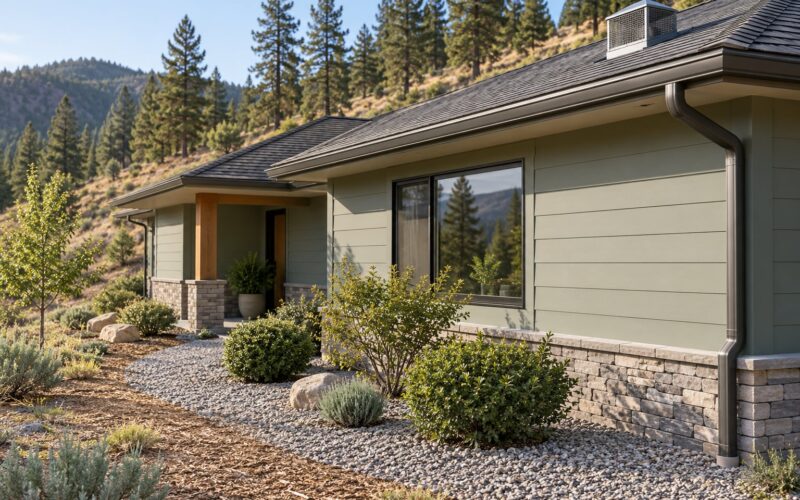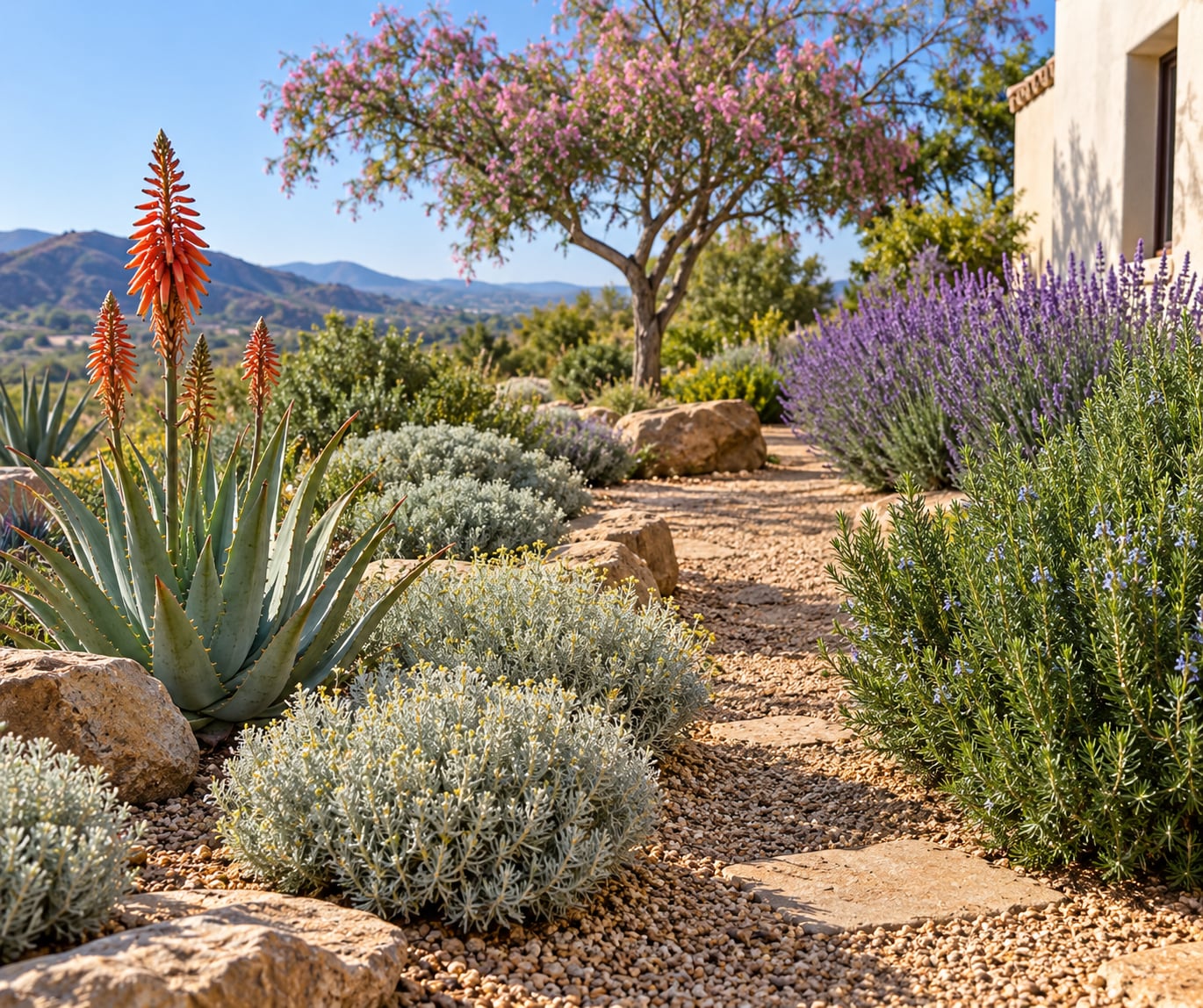
Fire resistant landscaping plants for dry climates are low-fuel species that hold moisture in their foliage, carry little resin or wax, and grow open enough that flame cannot climb from one plant into the next. In practice that means succulents, low flowering perennials, and sparse-canopy trees spaced well apart, kept watered during the dry season. No plant is fireproof, and the spacing between plants matters more than the name on the label.
This list covers the ten most reliable performers in hot, dry, fire-prone areas, with sun exposure, water needs, mature size and honest fire notes for each. I have leaned on what university extension services and state fire agencies actually recommend, including their spacing numbers, because that is the guidance inspectors measure against.
Table of Contents
- Fire Resistant Landscaping Plants for Dry Climates at a Glance
- 1. Rosemary for Drought-Tolerant Kitchen Gardens
- 2. English Lavender for Sunny Borders
- 3. Sage for Low-Water Mediterranean Planting
- How to prune sage without killing it
- 4. Santolina for Dry Rock Gardens
- 5. Yarrow for Pollinator-Friendly Dry Borders
- 6. Red Yucca for Hot, Exposed Gardens
- 7. Palo Verde for Warm, Low-Water Landscapes
- 8. Desert Willow for Large, Sunny Sites
- Using fire resistant landscaping plants for dry climates in containers
- 9. Aloe Vera for Containers and Rock Gardens
- 10. Dwarf Fountain Grass for Structured Dry Beds
- Frequently Asked Questions
- Which plants are safest near a house in a fire-prone area?
- Are fire resistant plants completely safe during wildfires?
- Should drought-tolerant plants be watered every day?
- What should I plant after a wildfire on my property?
- Can fire-resistant landscaping replace native vegetation?
- How much space should I leave between plants and buildings?
- Start With Spacing and a Safer Site
Fire Resistant Landscaping Plants for Dry Climates at a Glance
| Plant | Sun | Water need | Mature size | Fire note | Best use |
|---|---|---|---|---|---|
| Rosemary | Full sun | Low once established | 4-6 ft, upright or trailing | Aromatic, woody; keep open and pruned | Kitchen beds, path edges |
| English lavender | Full sun | Low | 18-24 in tall, 24-36 in wide | Good when green; woody and drier as it ages | Border edging, low walls |
| Sage | Full sun | Very low | 2-5 ft depending on species | Open grey-green foliage, low fuel | Gravel gardens, dry borders |
| Santolina | Full sun | Very low | 12-24 in mound | Compact, low, little dead material | Rock and gravel gardens |
| Yarrow | Full sun | Low | 18-30 in, spreads by rhizome | Fine foliage, low fuel, no ladder | Pollinator borders |
| Red yucca | Full sun | Very low | 4-6 ft, stalk to 9 ft | Water-filled succulent leaves | Hot exposed slopes and courtyards |
| Palo verde | Full sun | Very low | 15-30 ft, open canopy | Airier than most trees, sheds fine leaves | Large lots, shade by canopy |
| Desert willow | Full sun | Low after establishment | 12-25 ft | Sparse branching; needs annual pruning | Large sunny sites, parking areas |
| Aloe vera | Full sun, acclimated | Very low | 1-3 ft, pups freely | Moist succulent mass | Containers, rock gardens |
| Dwarf fountain grass | Full sun | Low to moderate | 2-3 ft | Standing dry stalks are dead fuel | Accent only, cut back hard |
Read the fire column as a maintenance note, not a rating. A lavender hedge kept green and irrigated behaves very differently from a neglected one, and extension services are blunt about that: species matters less than spacing, watering and upkeep. That caveat runs through everything below.
1. Rosemary for Drought-Tolerant Kitchen Gardens
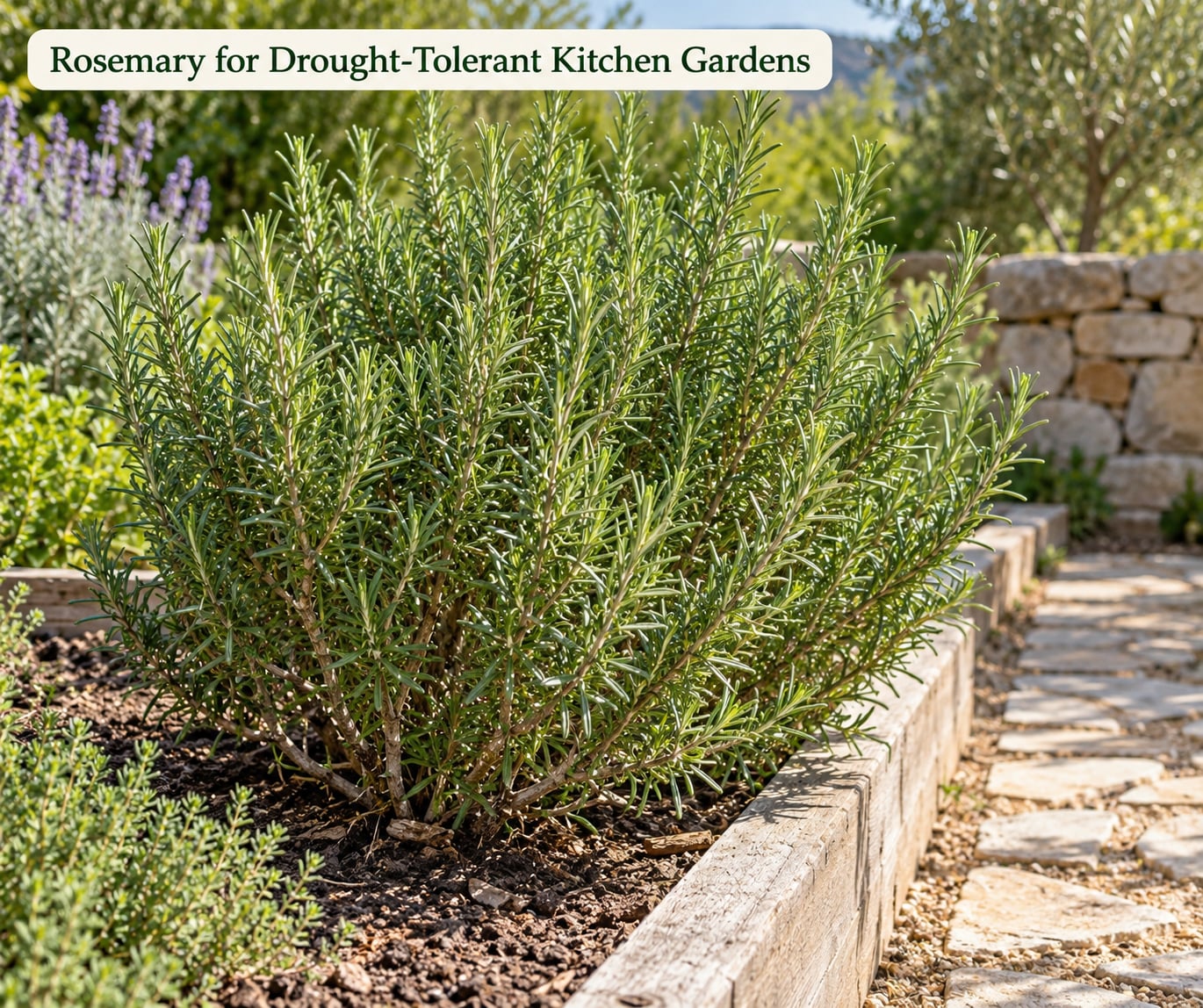
Rosemary (Salvia rosmarinus, still widely sold under its older botanical name Rosmarinus officinalis) is the first plant most gardeners reach for, and it earns the spot because it does two jobs at once: it survives a neglected summer, and it naturally grows as a woody, open shrub rather than a dense hedge.
Give it full sun, sharp drainage and room around it. Wet feet cause root rot faster than anything else in a dry climate, so a raised bed or a slope beats a flat lawn strip. Once established it needs water roughly every two to three weeks in peak summer, far less in shoulder seasons.
Choose the form that matches the space. ‘Arp’ and ‘Hill Hardy’ stand up to colder inland winters, ‘Tuscan Blue’ makes a broad shrub, ‘Prostratus’ trails over an edge, and ‘Blue Spires’ grows narrow enough for a side yard. Skip the soft, fast growth of fresh nursery plants and pick the woody, well-branched specimen.
Place it near paths, low walls and outdoor seating, not against the house and not in a corner where it will be squeezed from both sides. Rosemary is aromatic, and that oil load is worth naming honestly: it is not the least flammable plant on this list. It performs well because its woody structure is open, its leaves are small, and it is easy to keep trimmed. Cut out dead interior wood each spring and you remove the dead fuel that turns an aromatic shrub into a problem.
2. English Lavender for Sunny Borders
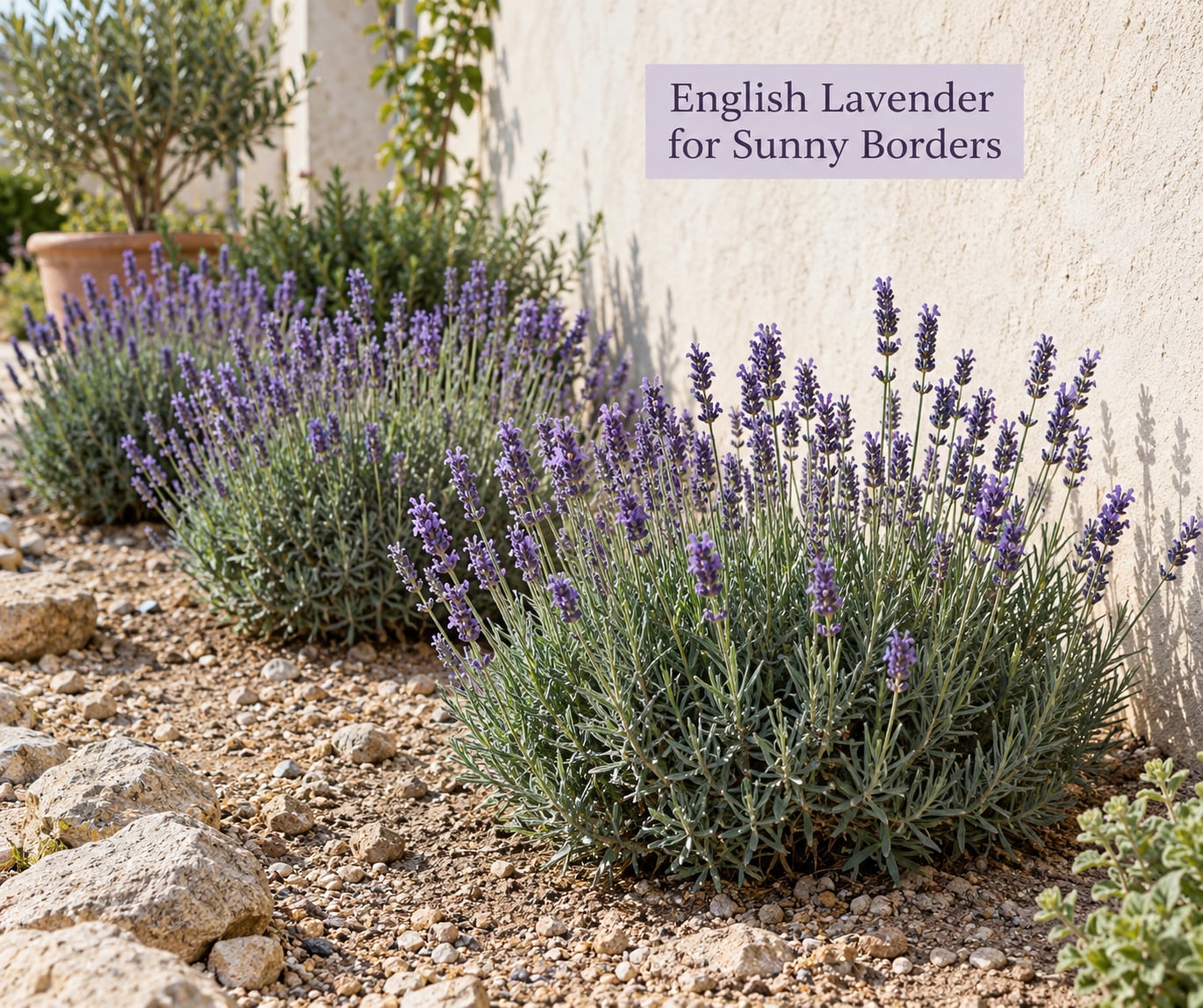
English lavender (Lavandula angustifolia) is genuinely drought tolerant and forms a low, loose mound about two feet across, which makes it a natural edge plant for a dry border.
The species matters more here than with almost any other plant on this list. Spanish and French lavenders (Lavandula stoechas, L. dentata) grow into tall, dense, woody shrubs that carry far more fuel and are the wrong choice near a structure. English lavender stays compact and stays green at the base when it is happy.
Soil should be lean, gritty and slightly alkaline. In rich, moist ground English lavender gets soft, sprawling and prone to fungal problems, none of which help it through a hot, dry August. Space plants 24 to 36 inches apart so air moves between them, and keep them along paths and low walls where you can reach them to shear off the spent flower stems.
Here is the part most lists skip. Cal FIRE warns that aging lavender shifts from lush and green to woody and considerably more flammable as the plant declines. Every three or four years, cut old plants back hard or replace them. A fresh, evenly spaced row of young plants is both prettier and safer than one thick, half-dead clump.
3. Sage for Low-Water Mediterranean Planting
Sages (Salvia species) cover more height than most people expect, from compact 2-foot Salvia greggii forms to 5-foot Russian sage (Salvia yangii) that reads as a shrub all summer.
All of them want the same conditions: full sun, gravelly or sandy soil, and restraint with the hose. They carry grey-green, aromatic foliage that holds moisture and burns slowly, and they flower on tall spikes that bring bees and hummingbirds through the hottest weeks when nothing else is open.
Russian sage is the most useful of the group for firescaping because it goes completely dormant and drops its foliage in a hard winter, leaving little live fuel. It does spread by seed, so pick a sterile cultivar if seed volunteers are a concern where you live.
How to prune sage without killing it
Pruning is the whole game with sages, and the timing is not negotiable. Wait until late winter, just before new growth pushes out, then cut stems back to 12 to 18 inches.
Never saw into bare old wood with no green showing, because sages rarely resprout from completely dead stems and you will lose the plant. Remove a third of the growth each year rather than cutting hard every season, and strip dried flower stalks in summer so they do not become thatch.
Use sages in gravel and rock gardens, along dry borders, and in the middle distance between a building and larger shrubs. Their open habit is exactly what breaks up a continuous fuel bed.
4. Santolina for Dry Rock Gardens
Santolina, or cotton lavender (Santolina chamaecyparissus), forms a silvery-grey mound 12 to 24 inches high that keeps its shape through a dry summer without a drop of irrigation once established.
It belongs in rock and gravel gardens because that is the drainage it wants. In heavy soil, especially in a wet winter, crowns rot from below and the plant dies in a way that looks sudden and confusing. Build the site the way you would for a scree bed: coarse material, a slight mound, minimal organic matter.
Two maintenance habits keep it low-fuel. Trim off the small yellow button flowers before they set seed, and shear the mound lightly at the end of each season so it stays dense rather than sprawling into its neighbour. Unlike lavender, santolina does not develop a thick woody trunk, so it carries much less dead material as it ages.
It is a good choice for pool surrounds, entry beds and the dry strip between a wall and a path, where you want something under two feet that still looks deliberate through August.
5. Yarrow for Pollinator-Friendly Dry Borders
Yarrow (Achillea millefolium) is one of the workhorses of a dry-climate border: 18 to 30 inches tall, flat-topped flowers, ferny foliage that stays low, and a tolerance of heat and lean soil that surprises people who first meet it in a damp meadow.
Its flammability profile is good for a simple reason. The foliage sits near the ground as a low green mass, the stems are thin and open rather than woody, and the whole plant dries down without holding a dense thatch. Nothing in it climbs into the canopy.
Two cautions. Yarrow spreads by rhizome and will quietly take over a small bed, so divide clumps every two or three years and be honest about where you put the first one. And plant it in the middle and back of a border, never climbing a wall or pressing into a roofline, where it could bridge upward.
The pollinator case is strong on its own. Flat flower heads are an easy landing platform for hoverflies and small bees, and yarrow blooms over weeks when most dry-climate perennials have finished. A border of yarrow, sage and penstemon keeps insect activity going through late summer, and insects are a good reason to keep a yard alive rather than stripped bare.
6. Red Yucca for Hot, Exposed Gardens
Red yucca (Hesperaloe parviflora) is not really a yucca, and it does not need a yucca’s protection. It handles exposed, reflective heat and long dry stretches that kill softer perennials.
It forms a 4 to 6 foot clump of upright sword-shaped leaves, each one packed with water, and sends up a flower stalk that can reach 9 feet in season, covered in red-orange tubes that hummingbirds work from top to bottom. That tall stalk is worth planning around. Put it where it is not shading a doorway, not under an eave you need to keep clear, and not where a falling stalk would land on a path.
Drainage is everything, exactly as with the sages and santolina. Once rooted in the first season it needs almost nothing, and it will rot in rich, irrigated soil.
Red yucca spreads slowly by rhizome and forms a wider clump over time, which is a feature in a dry border and a nuisance in a small one. Before buying, check the mature spread with your local nursery and confirm the hardiness range suits your winters. It is generally hardy in USDA zones 6 to 11, though colder sites see leaf damage that recovers.
7. Palo Verde for Warm, Low-Water Landscapes
Palo verde (Parkinsonia species) is the closest thing a hot arid yard has to a firewise shade tree. Its canopy is airy, its leaf cover is sparse by design, and it puts almost no demand on irrigation once its roots are down.
Which species you pick decides how much trouble it is. Foothill palo verde (P. microphylla) stays low and slow, reaching 15 to 20 feet with small leaflets. Blue palo verde (P. florida) is fast, airy and common in desert gardens. Jerusalem thorn (P. aculeata) is invasive in many regions and avoided in good practice; check your local agricultural or water district before considering it. Spiny barkbarks carry thorns on the branches, so keep them away from paths and play areas.
Plan for litter as well as shade. Palo verde drops small leaflets and papery seed pods through the dry season, and while that is a far lighter fuel load than pine needles or palm fronds, it does need raking before the season ends.
Because the canopy is so open, it is a tree you can plant close to a building compared with a dense crown like ash or elm, provided you keep branches off the roof and prune to the 15-foot clearance that extension guidance calls for. Mature palo verde can be a broad 30 feet, so check the spread before you pick the spot.
8. Desert Willow for Large, Sunny Sites
Desert willow (Chilopsis linearis) is not a willow and does not need a stream. It is a fast, showy flowering tree for big, hot, sunny yards, with trumpet-shaped blooms that put colour on the tree from late spring into early fall.
It wants full sun, deep soil and room, reaching 12 to 25 feet with a broad, irregular shape. Water it through establishment, roughly the first two growing seasons, then let dry conditions do most of the work.
Desert willow is a little fussier than palo verde, and the reason is its maintenance. It grows twiggy and messy, drops seed pods through the season, and needs a light annual prune to keep an open shape and clear dead interior branches. That pruning is also the fire-safety work: remove dead wood, thin crossing branches, and keep foliage back from structures.
Use it for parking areas, wide setbacks, and sites where you want flowering colour with a modest water footprint. Avoid planting it against a wall where you will be tempted to let it lean into the roofline.
Using fire resistant landscaping plants for dry climates in containers
Trees are usually the expensive part of this project, so container plants make sense where a bed is too close to the building for anything woody. Aloe, small sages, thyme and low succulents all work in pots. Keep containers on a noncombustible base, away from a fence line, and irrigate them properly rather than letting them go dry and brittle. A neglected container is dead fuel sitting one ember away from your deck.
9. Aloe Vera for Containers and Rock Gardens
Aloe (Aloe vera) is a sculptural focal point that stores its own water, needs almost no irrigation, and does well in rock gardens and pots. It suits frost-free climates roughly USDA zone 9 and warmer.
Two practical notes. First, it needs intense sun, but a plant moved from a shaded nursery into full summer sun can scorch badly in a week. Acclimate over two or three weeks. Second, in a pot, drainage holes are not optional, and the pot should sit on stone or paving rather than on a wooden deck where roots and moisture sit against combustible material.
Aloe produces pups around its base and will quietly expand a container beyond what you planned. Remove them and repot the mother plant every couple of years.
And treat the plant as toxic. The latex inside the leaves contains aloin and is an irritant to pets and children if ingested, so place it where nobody chews on it. That is not a reason to skip aloe, it is just a placement decision to make deliberately rather than discover later.
10. Dwarf Fountain Grass for Structured Dry Beds
Dwarf fountain grass (Pennisetum alopecuroides, sold as ‘Hameln’ and similar) adds vertical texture to a dry bed that is otherwise all soft mounds. It is also the most misunderstood entry on this list.
Standing dried ornamental grass is dead fuel, and it burns fast and high. Fountain grass left standing through winter and into spring is among the worst fuel in a suburban yard, and it is the plant most often named in reports of homes lost behind the front hedge. Treat this as an accent plant, not a firescape plant.
If you want the texture, the rules are simple. Cut it back hard to a few inches in late winter before new growth starts, keep clumps divided so they do not form a continuous bed, and place them away from structures, fences and other vegetation rather than at the edge of a planting. Local weed ordinances in many regions already restrict fountain grass because it reseeds readily, so check before planting and choose a sterile cultivar where one is offered.
On an actual firescape, low grasses with finer foliage and better water habits make more sense than this. But used sparingly, cut back hard and placed with clearance, it earns a spot for structure.
Frequently Asked Questions
Which plants are safest near a house in a fire-prone area?
The safest choices are succulents and low groundcovers: aloe, ice plant, sedum and dwarf agave, plus irrigated lawn and noncombustible gravel or stone. In the Home Ignition Zone from 0 to 5 feet, keep the surface noncombustible. Between 5 and 30 feet, use low perennials and groundcovers under about 12 inches. Trees and shrubs belong beyond 30 feet, spaced apart and pruned away from the roofline.
Are fire resistant plants completely safe during wildfires?
No plant is fireproof, and flammability testing is not standardised across species. Cal FIRE and university extension services both warn that a plant’s behaviour depends as much on watering, pruning, spacing and age as on its species. A well-spaced, irrigated, well-maintained plant slows fire and reduces ember output. That improves your odds during an ember attack; it does not guarantee survival.
Should drought-tolerant plants be watered every day?
No. Most plants on this list need water only during establishment and then deeply but infrequently, roughly every two to three weeks in peak summer depending on soil and heat. The goal is deep roots and steady, not shallow daily sprinkling. The exception is that a drought-tolerant plant allowed to become severely stressed and brittle is more flammable, so water during extreme dry spells rather than letting it desiccate.
What should I plant after a wildfire on my property?
Start with noncombustible ground: gravel, stone and hardscape within the first few feet of any surviving structure. Then reintroduce low, irrigated, succulent groundcovers before shrubs or trees. Replant native species adapted to your region where possible, and check soil conditions first, since heat can volatilise surface chemicals and change pH. Your local fire district and extension service will usually review a planting plan before you start.
Can fire-resistant landscaping replace native vegetation?
It can add to it, and mixing the two usually works better than either alone. Native advocates make a fair point: the real dry-fuel problem in many yards is introduced pampas and fountain grass, not native chaparral species. Well-spaced natives chosen for open structure and kept irrigated do well in firescapes. Just verify that each species actually suits your soil, water supply and local fire conditions.
How much space should I leave between plants and buildings?
Extension guidance for the Home Ignition Zone calls for a clear, noncombustible surface for the first 0 to 5 feet, low vegetation for 5 to 30 feet, and trees and shrubs starting beyond 30 feet. Keep foliage out of the 5 to 30 foot band entirely, maintain roughly 15 feet of vertical clearance between branches and a roof, and space individual plantings about 10 feet apart so flame cannot jump between them.
Start With Spacing and a Safer Site
Pick plants that suit your soil, your winter and your water supply, then place them where a fire behaviour officer would want them: low and irrigated near the building, spaced generously through the middle distance, and open-canopy trees at the back. Fire resistant landscaping plants for dry climates work because of where they go and how well they are kept, not because of a label.
If you do only five things this season, make them these. Keep the ground within 5 feet of the building noncombustible, gravel, stone or paving. Clear woody shrubs out of the 5 to 30 foot band, starting with juniper-type hedges, the most common inspection failure homeowners report. Remove or heavily prune any tree whose branches touch the roof, aiming for 15 feet of vertical clearance. Cut back ornamental grasses and remove dead wood before the fire season, not in spring. Space plantings about 10 feet apart so flame has to cross open air instead of running through a continuous hedge.
Then confirm it with your local fire district before you buy anything. They will tell you what they measure, and several will review a plan or point you to a local plant list built for your zone. If removal costs are a worry, sequence the work over two or three seasons and start with the plants closest to the house.