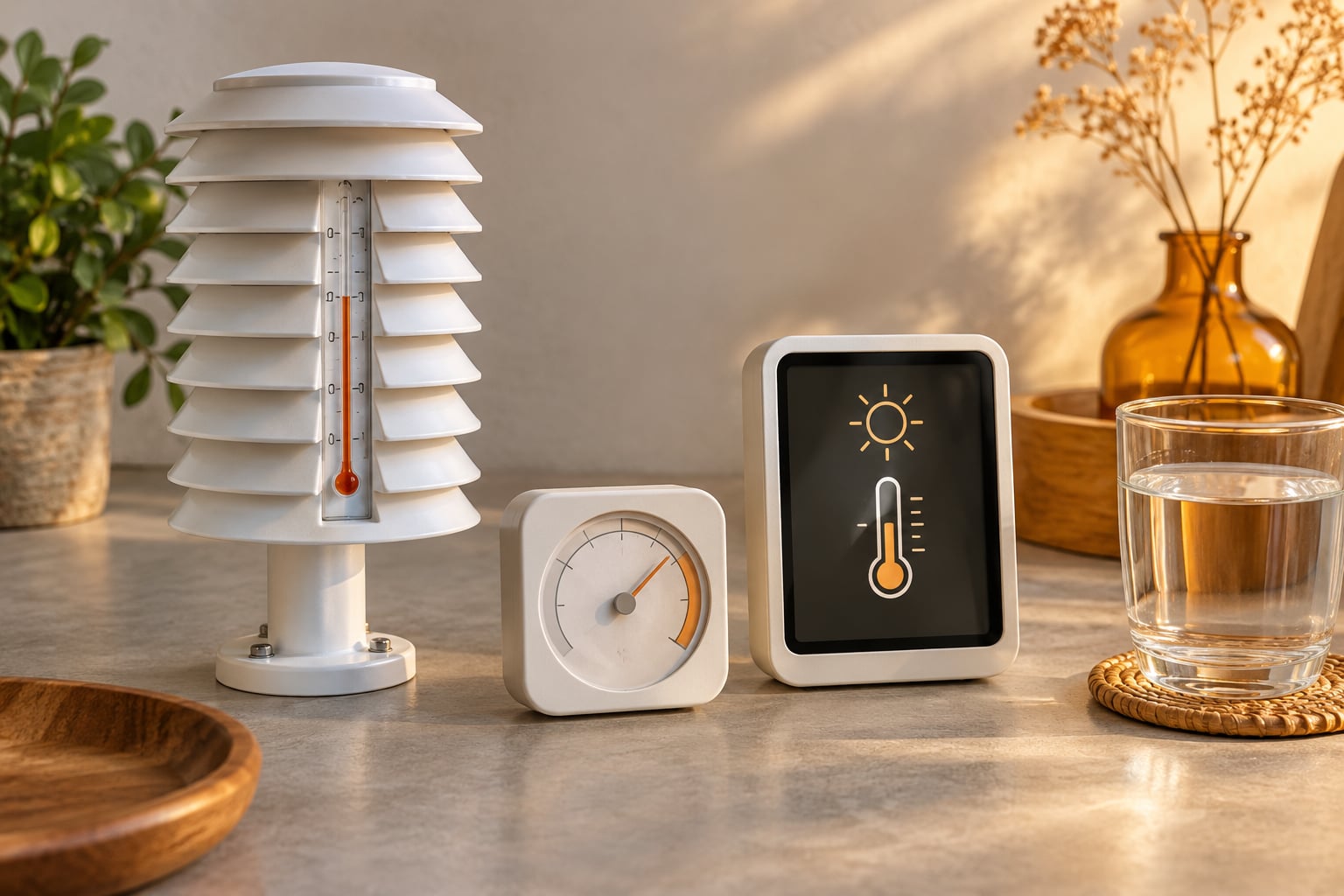
Air temperature is what a thermometer reads: the temperature of the air itself, measured in a shaded instrument screen. The heat index is an apparent temperature that adds relative humidity to that reading to estimate how hot it feels to the human body. The heat index equals air temperature in dry air, climbs above it as humidity rises, and can sit slightly below it in very dry air.
That last part is the one that catches people out. A 110F afternoon in Phoenix is not the same hazard as a 95F afternoon in Houston, and the gap between those two numbers is where the actual health risk lives. Weather services issue their heat advisories and warnings on the index, not the thermometer.
Below is what each measure covers, where the two disagree, and which one to act on for a specific decision.
Table of Contents
- Heat Index vs Air Temperature: What the Difference Means at a Glance
- What Is Air Temperature?
- What the thermometer leaves out
- Where forecasts get the number
- What Is the Heat Index?
- Where it came from
- The assumptions baked into it
- Where the equation breaks down
- How Humidity Changes the Way Heat Feels
- Relative humidity and dew point are not the same thing
- The same 90F, four different afternoons
- Heat Index vs Air Temperature: The Main Differences
- Source and calculation
- Variables included
- Biological meaning
- Geographic use
- Limitations
- How to tell when a forecast is quoting the index
- How to Read Both Numbers in a Forecast
- Find the air temperature first
- Find the heat index for the same hour
- Add the things neither number holds
- Check the risk category
- Check the local alert, not just the national category
- What Each Measure Does Not Tell You
- Terms people mix up
- Blind spots common to both numbers
- Which Should You Choose?
- Frequently Asked Questions
- Why does the heat index feel higher than the air temperature?
- Is 35C air temperature more dangerous than 35C heat index?
- Does the heat index apply on dry, sunny days?
- Why can the heat index be different from what I feel in direct sun?
- Should I use the heat index for children, older adults, or people with medical conditions?
- Does heat index affect air conditioning?
- What to Do First
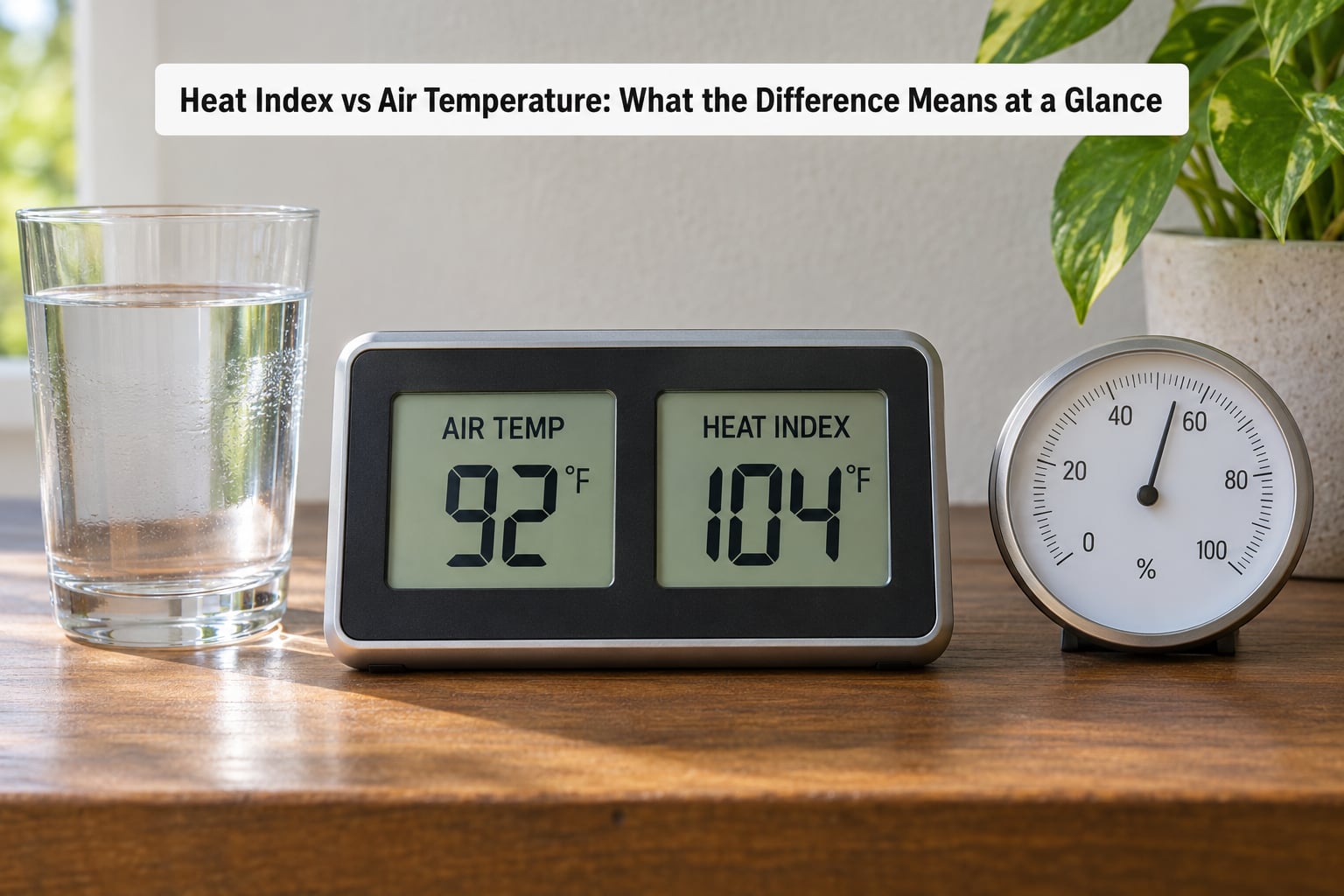
Heat Index vs Air Temperature: What the Difference Means at a Glance
| Criterion | Air temperature | Heat index |
|---|---|---|
| What it measures | The temperature of the air itself | How hot conditions feel to the human body |
| Inputs | One measurement | Air temperature plus relative humidity |
| Role of humidity | Not included at all | The entire reason the number moves |
| Where it comes from | Thermometer in a standard, shaded observation screen | A regression equation applied to the temperature and humidity readings |
| What it ignores | Humidity, radiant heat from the sun, wind, clothing, exertion | Wind, direct sunlight, clothing, exertion, your own physiology |
| Typical use | Describing the weather, sizing HVAC equipment, checking crop and indoor conditions | Deciding when hot weather becomes dangerous for people |
| Direction of the gap | Baseline value | Equal, higher, or slightly lower than air temperature |
Read the table as two questions rather than two competing measurements. Air temperature answers “how warm is the air?” The heat index answers “how hard is it on a person right now?” Neither one describes a parked car’s dashboard or a hot pavement surface.
What Is Air Temperature?
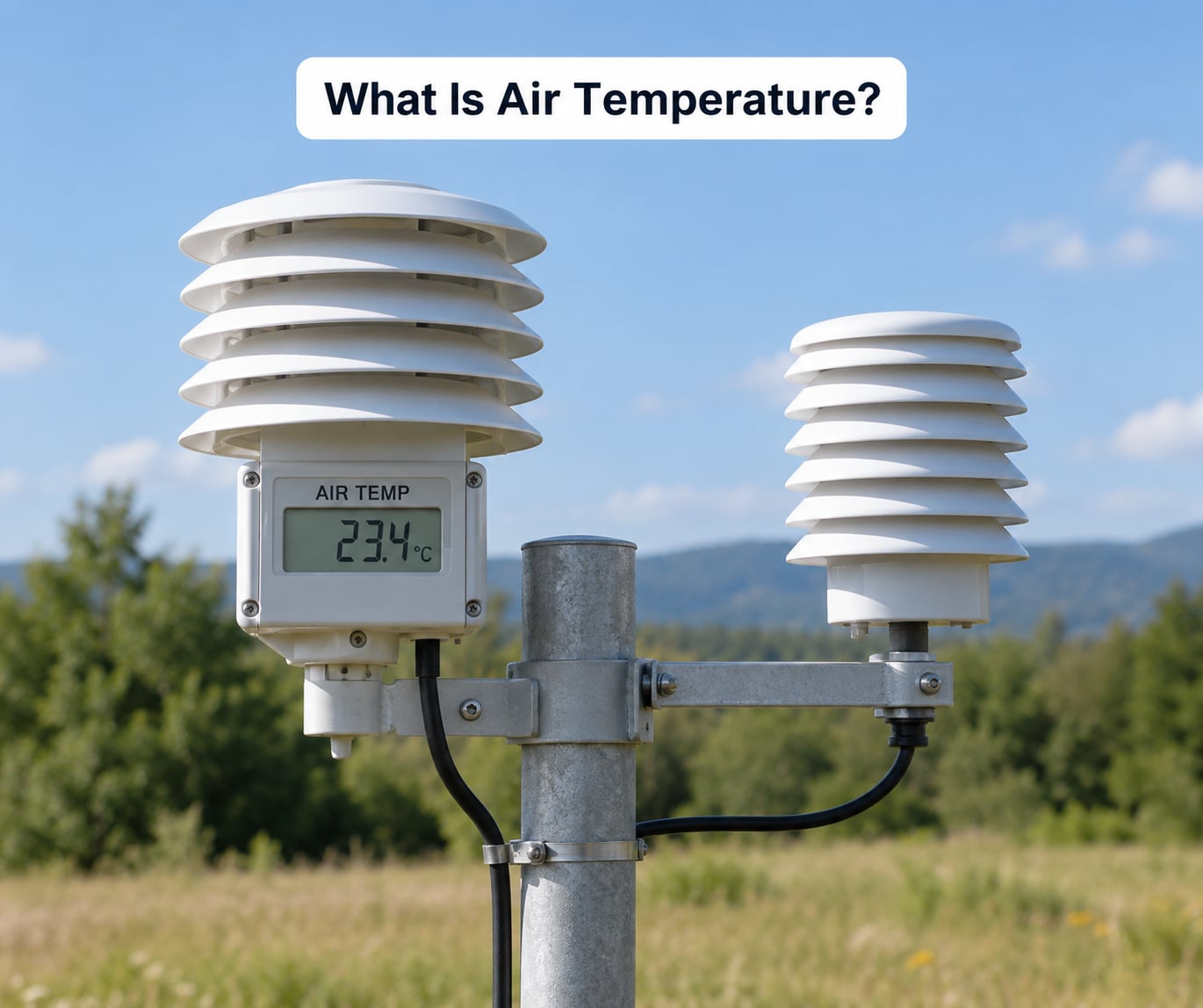
Air temperature is the temperature of the surrounding air, read by a thermometer. Standard observations are taken at about 1.5 metres above the ground inside a ventilated white shield that keeps sun and rain off the sensor, which is why forecast numbers are comparable between stations.
It is a clean physical measurement, and it is the right number for describing conditions. It is also a genuinely partial description of anything a person feels in the heat, because it carries no information about humidity, radiant heat from direct sun, wind, clothing, or how hard someone is working.
What the thermometer leaves out
Humidity is the big one: 90F in dry air and 90F in saturated air are the same number and completely different experiences. Radiant heat matters too, because a thermometer in a shaded screen reads lower than the same air in full sun, where surrounding surfaces radiate heat onto you. Wind is missing, since air temperature says nothing about whether moving air is carrying heat away from exposed skin.
Where forecasts get the number
Air temperature usually comes from a nearby station, an airport, or a model grid cell rather than from your exact location. On a clear, still afternoon those readings can differ noticeably over short distances, because pavement, grass, and rooftops heat at different rates. On a cool, windy morning the gap between your street and the official station is usually small.
What Is the Heat Index?
The heat index is an apparent temperature: a single number produced by feeding air temperature and relative humidity into a fitted equation. The National Weather Service publishes it as the official “feels like” value for hot conditions, and it is the figure that drives heat advisories, watches, warnings, and the NOAA heat index chart risk colours.
Where it came from
Meteorologist Robert Steadman developed the index in 1979 from his research on what the body actually feels. The National Weather Service refined his work into the regression published in 1990 that forecasters use today, usually referred to as the Rothfusz regression. People ask to see the maths because they don’t trust a number with no visible basis, and there is a real equation behind it.
The assumptions baked into it
The standard heat index assumes a shaded, indoor-style exposure with light wind, and it assumes an adult who is not doing strenuous work. Direct sun adds substantially to the felt load, commonly estimated at up to about 15F on top of the reported index for someone standing in full sun. Real outdoors conditions in light wind can also exceed the shaded figure.
Where the equation breaks down
The regression is only reliable in its design range, roughly 80F to 112F with humidity of 40% or more. Below about 13% relative humidity the equation tends to overstate the felt heat, so the NWS applies a downward adjustment, and a 100F reading at 5% relative humidity produces an index near 92F rather than 100F. Below 80F the Weather Service uses a simpler approximation instead, because sweating is not the body’s main cooling problem there.
How Humidity Changes the Way Heat Feels
Cooling by sweating only works if sweat can evaporate. Evaporation needs vapour pressure difference: the gap between how much moisture the skin surface holds and how much the surrounding air already holds. When the air is already close to saturated, that gap shrinks and sweat beads on the skin instead of drying.
Once evaporation stalls, blood flow to the skin drops to conserve fluid, and the body cannot dump heat into the air effectively. Core temperature rises, the felt temperature rises with it, and the heat index records that rise.
Relative humidity and dew point are not the same thing
Relative humidity is the share of the air’s current capacity that is filled with water vapour, so it changes as air warms even when the moisture in the air does not change. Dew point is the temperature at which the air would be saturated, and it is a direct readout of how much moisture is actually present. The heat index formula uses relative humidity, which is one reason the same dew point produces different index values on different days.
The same 90F, four different afternoons
| Air temperature | Relative humidity | Heat index (approx.) | NOAA risk category |
|---|---|---|---|
| 90F | 40% | 91F | Extreme Caution |
| 90F | 60% | 100F | Extreme Caution |
| 90F | 70% | 106F | Danger |
| 90F | 80% | 113F | Danger |
| 100F | 5% | 92F | Extreme Caution |
One thermometer reading, four very different afternoons. This is the contrast that explains most of the confusion people raise on r/explainlikeimfive, where the same question keeps coming back: why does the air read 90F while the app says 106F?
It is not a mistake in the forecast. Both numbers are correct, and they describe different things.
Heat Index vs Air Temperature: The Main Differences
Once you accept that the two values answer different questions, the disagreements between them become much easier to handle.
Source and calculation
Air temperature is a direct measurement, which means it can be wrong only through instrumentation or siting problems. The heat index is derived: an equation fitted to laboratory data on human thermal comfort, which means it carries the assumptions and the errors of that fitting process.
Variables included
Air temperature uses one variable. The heat index uses two, and humidity carries so much of the weight that the same air temperature can map to a 20-degree spread in the index. Australia’s apparent temperature is a different formula again: it includes wind speed, so it will not match the heat index even in humid conditions.
Biological meaning
The heat index is an estimate of the thermal strain on a working human body under specific assumptions. Air temperature has no biological meaning at all; it is a state of the air. Neither value describes the temperature of objects, which is why neither one predicts the temperature inside a car left in the sun.
Geographic use
Air temperature is the universal reference, published everywhere. The heat index matters most in humid regions and during coastal heat waves, where the danger comes from moisture rather than from the peak number on the thermometer. In arid climates the index is often lower than air temperature, and humidity becomes a secondary concern.
Limitations
Both numbers describe conditions, not individuals. Acclimatisation, age, health, medication, clothing, workload, and how long someone has been exposed all change the outcome without changing either figure. Two people standing at the same 95F reading can be having very different afternoons.
How to tell when a forecast is quoting the index
Watch for the label, not just the number. A television segment that says “it’s a 97, but the heat index is 108” is quoting both. A phone app showing a single temperature next to a humidity reading is usually showing air temperature, with the feels-like value on a second line. If a figure arrives with no label and no humidity near it, treat it as air temperature.
How to Read Both Numbers in a Forecast
Find the air temperature first
This is the row labelled temperature, the number the thermometer station reported. Note it, because it is your baseline and every other figure is compared against it.
Find the heat index for the same hour
The index changes fast. Pairing a 90F afternoon temperature with a 90% overnight humidity reading gives you a number that never existed. Read the humidity column that belongs to the same hour on the forecast, or use the index the service already computed for that hour.
Add the things neither number holds
Direct sun, wind, clothing, exertion, and duration all sit outside both figures. Someone on a roof in full sun is working hard, wearing dark clothing, and will be out for hours. Their exposure is far above the printed index, and that gap is where outdoor work injury happens.
Check the risk category
| NOAA risk category | Heat index range | What it means for health |
|---|---|---|
| Caution | 80F to 90F | Fatigue possible with prolonged exposure and exertion |
| Extreme Caution | 91F to 103F | Heat cramps, heat exhaustion and related symptoms possible |
| Danger | 104F to 115F | Heat exhaustion or heat stroke likely with any exposure; heat stroke can occur with little exertion |
| Extreme Danger | 115F and above | Heat stroke or death probable with any exposure |
Symptoms progress with the index. Heat cramps and heavy sweating come first. Heat exhaustion brings headache, nausea, dizziness, cool clammy skin, and a weak pulse, and it means get out of the heat and cool down. Heat stroke is different: skin hot and possibly dry, confusion, and a body temperature at or above 103F. That is a medical emergency, and you should call emergency services rather than trying to cool someone down at home.
Check the local alert, not just the national category
Each NWS office sets its own thresholds. A Tampa Bay excessive heat warning can trigger at a lower index than the warning in a cooler climate, because the overnight humidity there never lets people recover. The four alert types run from excessive heat outlook through advisory, to watch, and finally warning, escalating as conditions worsen and persist.
What Each Measure Does Not Tell You
Neither number is a complete description of your exposure, and the overlapping vocabulary makes that worse than it needs to be.
Terms people mix up
- Air temperature: the measured temperature of the air. No humidity, no sun, no effort.
- Heat index: apparent temperature from air temperature plus relative humidity, assuming shade and light wind.
- Apparent temperature: the term used in Australia and by some other services, built from air temperature, humidity and wind. Not the same formula as the heat index.
- Feels like: a plain-language label that apps apply to whichever of the above their provider favours.
- Dew point: the temperature at which the air would be saturated. A moisture reading, not a heat reading.
- Wet bulb globe temperature: combines humidity, radiant heat and wind, and is the basis for military and occupational work-rest schedules.
- HeatRisk: an experimental NWS and NOAA tool on a 0 to 4 colour scale that also accounts for sun, wind, and how much heat the body has carried over several days.
Different services legitimately publish different feels-like values for the same moment, because they use different formulas. A disagreement between two apps is not evidence that one is broken.
Blind spots common to both numbers
Shade versus full sun changes the felt load substantially while the air temperature stays put. Indoor conditions are frequently several degrees cooler and less humid than outdoors, so the outdoor index can overstate exposure indoors and understate it in a greenhouse or a parked car. Nighttime matters too: when the index stays high overnight, the body never gets the recovery it needs, and risk accumulates across days rather than within one.
Individual vulnerability is the other blind spot. Infants, children, adults over 65, pregnant people, and people with heart or kidney conditions, or who take certain medications, tolerate heat worse than the average adult at exactly the same number. Follow your clinician’s advice for those situations rather than the general population figures, and check what the CDC says about recognising heat illness.
Which Should You Choose?
Use air temperature when you are describing the weather, sizing or checking equipment, or tracking conditions where no people are present: crops, livestock, pavement materials, and indoor HVAC setpoints. It is the stable, reproducible number, and it is what building standards and equipment ratings are written against.
Use the heat index when you are making decisions about people in humid heat: outdoor work shifts, youth sports and practice times, whether to walk or run, school and camp scheduling, and when to move vulnerable relatives into air-conditioned space. In those cases the index is the more conservative number, and it is the one attached to official alerts.
When it is hot enough to matter, use both and add the missing context. In dry desert conditions the index is the better number even when it reads lower. During extreme conditions, follow your local NWS office and OSHA or CDC guidance on water, rest and shade schedules rather than relying on either figure alone.
Frequently Asked Questions
Why does the heat index feel higher than the air temperature?
Because humidity blocks sweat from evaporating. Evaporation is how your body dumps heat into the air, and humid air already holds nearly all the moisture it can, so sweat stays on the skin instead of drying. The body cannot cool itself, core temperature rises, and the heat index reports that rise as a higher number. That is why 90F at 70 percent humidity reads as roughly 106F.
Is 35C air temperature more dangerous than 35C heat index?
Yes, considerably. 35C is about 95F. An air temperature of 95F with 70 percent humidity gives a heat index near 106F, in the Danger band. To see a heat index of 95F you would need an air temperature closer to 85F at the same humidity. The heat index is always equal to or above the air temperature in normal humid conditions, so comparing the same number for both measures compares a real hazard with a milder one.
Does the heat index apply on dry, sunny days?
Yes, but it often reads lower than the air temperature, which surprises people. In very dry air the index is adjusted downward because the standard equation overstates felt heat below roughly 13 percent relative humidity. Around 100F at 5 percent humidity, the index lands near 92F. Direct sun still adds real felt load on top of that figure, often estimated at up to about 15F, so a dry desert afternoon is not automatically safe for hard activity.
Why can the heat index be different from what I feel in direct sun?
The published heat index assumes a shaded exposure with light wind. Standing in full sun adds radiant heat from surrounding surfaces, and estimates commonly put that at up to about 15F above the reported index. Wind, clothing, workload, and how long you have been out add further load that neither number captures. This is the gap that matters most for roofers, farmers, and anyone working outdoors for hours.
Should I use the heat index for children, older adults, or people with medical conditions?
Yes, and treat their exposure as lower than the number suggests rather than higher. Children, adults over 65, pregnant people, and those with heart or kidney conditions or on certain medications tolerate heat worse than the average adult at the same index. Use the index as the base reading, add sun and exertion, and follow your clinician’s guidance for that person’s condition. Heat stroke is a medical emergency and needs emergency services, not home treatment.
Does heat index affect air conditioning?
Not directly. Your air conditioner responds to air temperature, or to wet bulb temperature in humid conditions, not to the heat index. The index matters to you rather than to the equipment: on a humid afternoon your thermostat may read 88F outside while the index says 100F, and that is why the same 78F indoor setpoint feels inadequate. If an outdoor unit struggles in extreme heat, set the thermostat a little higher and run fans, and get the unit serviced rather than lowering the setpoint.
What to Do First
Read both numbers from the same forecast and the same hour, then add the context the index leaves out: direct sun, wind, clothing, and how hard you or someone else will be working. When the index is elevated, follow your local NWS heat alert, work-rest and water schedules, and treat heat stroke as an emergency.