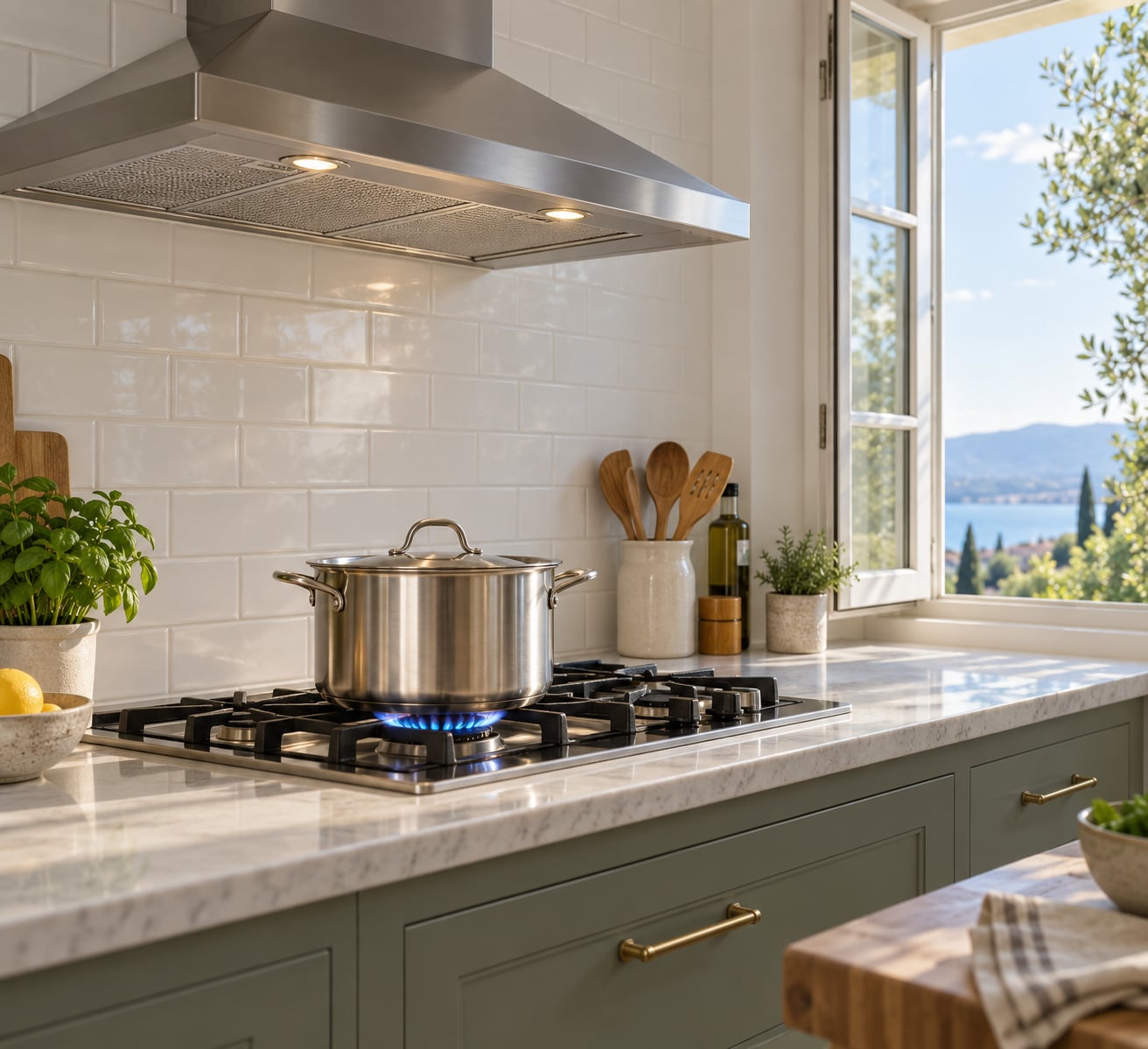
Gas stove pollution is the mix of gases and fine particles a gas range releases into your kitchen, mainly nitrogen dioxide, carbon monoxide, benzene and methane. The burners make most of it while you cook, and loose fittings leak unburned gas even when everything is switched off. A range hood that vents outdoors handles the first problem; only a technician can fix the second.
That is the honest version, and it is the version most headlines leave out. Gas cooking is not a crisis, and a well-ventilated kitchen with a working hood is a genuinely different room from a sealed one with a recirculating hood that does nothing. What follows is what the researchers actually measured, how to check what your own kitchen is doing, and the low-effort changes that make the biggest difference before you ever shop for a new appliance.
Table of Contents
- What Pollutants Does a Gas Stove Produce?
- Which Indoor Air Pollutants Matter Most?
- Who ends up with the most exposure?
- How Can Ventilation Reduce Gas Stove Pollution?
- What Ventilation Setup Works Best for Home Cooking?
- How Do You Reduce Pollution Without Changing Your Cooking Habits?
- Keep a lid on what allows it
- Match the burner to the pan
- Keep the burners clean and correctly tuned
- Cook at moderate temperatures
- Move the task out of the room
- Is Induction a Cleaner Alternative for Home Cooks?
- What the gas industry says
- What Safety Checks Should Home Cooks Know?
- Frequently Asked Questions
- Do gas stoves cause indoor air pollution even with a range hood?
- What is the safest way to ventilate a gas stove?
- Should I leave a range hood on after cooking?
- Does an open window replace a range hood?
- Are gas cooktops safer than induction for indoor air quality?
- How do I know if a gas stove has a carbon monoxide problem?
- Conclusion
What Pollutants Does a Gas Stove Produce?
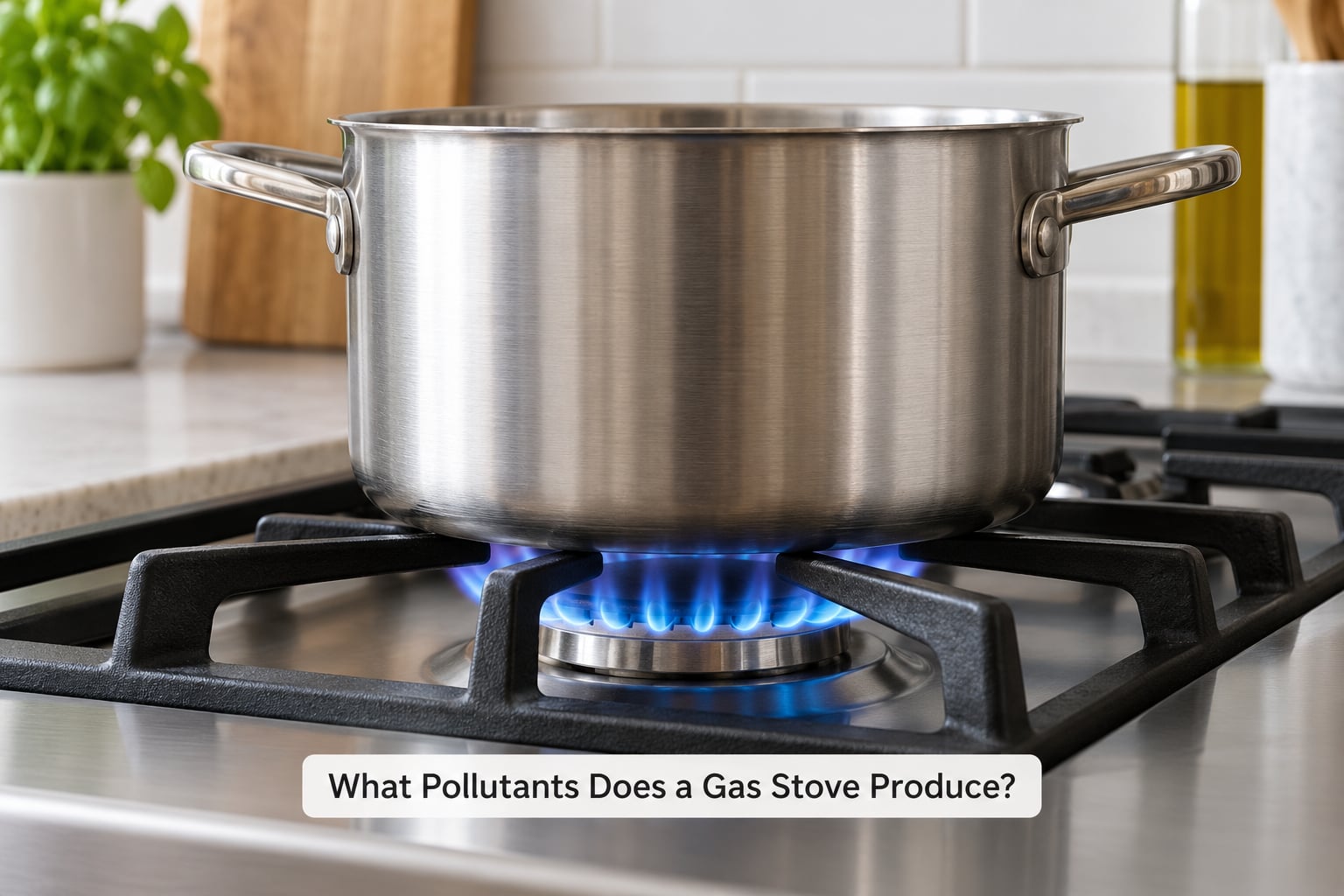
Two separate things get called gas stove pollution, and they come from two different places. Combustion emissions come off the flame while a burner is lit. Leakage comes from valves, fittings and connectors across the whole appliance, whether or not anything is burning.
The second pathway is the surprise. Studies that measured US gas stoves, including work published by PSE Healthy Energy, found that roughly 0.8 to 1.3 percent of the gas a stove uses escapes unburned, and more than 75 percent of that methane is released while the burners are off. A stove with a continuously lit pilot can emit more than one with electronic ignition, because the pilot itself burns constantly.
Cooking smoke is a third category, and it is not the stove’s fault. Searing meat, frying in oil or burning toast produces fine particles, acrolein and polycyclic aromatic hydrocarbons on any heat source, induction included. A gas burner adds the combustion gases on top.
Which Indoor Air Pollutants Matter Most?
Nitrogen dioxide is the one researchers come back to most, because it is a respiratory irritant that reaches the breathing zone of people standing at the stove. It is also the easiest to measure, which is why so much of the published work uses it.
| Pollutant | Where it comes from | Why it matters |
|---|---|---|
| Nitrogen dioxide (NO2) | High-temperature combustion of gas | Irritates airways; linked to asthma symptoms in children |
| Carbon monoxide (CO) | Incomplete combustion, faulty burners | Blocks oxygen delivery; odourless, so a detector matters |
| Benzene | Combustion by-product | Carcinogen; one burner on high has been measured above secondhand smoke levels |
| Methane | Unburned gas escaping fittings, mostly when off | Main concern is climate warming, not toxicity at household levels |
| Formaldehyde and other VOCs | Combustion plus cooking oils at high heat | Irritant; formaldehyde is a known carcinogen at higher exposure |
| Fine particles (PM2.5) | Food, oil and vapour from the pan | Produced by any heat source; worse when food smokes |
Indoor NO2 in homes with gas stoves has been measured at levels several times higher than outdoor air quality guidelines, which are written for outdoor air. Researchers at the University of Utah have described cooking dinner on gas as a comparable exposure to breathing secondhand smoke, and researchers in California have reported roughly a 42 percent greater chance of asthma in children in households cooking with gas.
Long-term links to respiratory infection, heart and lung disease, and some cancer sites are still being studied, and honest researchers say the long-term attribution is not settled. The strongest evidence sits with children and with anyone who already has asthma or COPD.
Who ends up with the most exposure?
Height decides a lot. Small children breathe faster and closer to the plume, so they take in proportionally more than an adult at the same stove. Cooking in a small enclosed kitchen concentrates what would otherwise disperse. An open-plan living room means nobody gets a break either, because the plume travels.
Lower-income households are exposed more often and can do less about it, which is the least comfortable part of this whole subject. They are more likely to cook with gas, more likely to be in rental housing without an outdoor-vented hood, and least able to replace the appliance.
How Can Ventilation Reduce Gas Stove Pollution?
Ventilation works by moving air from the cooking zone to somewhere else. It has to be moving air out of the kitchen, not just circulating it around the ceiling.
- Find out where your hood sends air. Follow the duct or the round vent pipe from the hood. If it exits through the roof or an outer wall, it vents outdoors. If it loops back into the ceiling, or if there is no duct at all, it recirculates. This is the single most common confusion in kitchens and the one that matters most.
- Turn the hood on before the flame, not after. Give it a couple of minutes to clear the air, then leave it running for another ten to twenty minutes after cooking. Most people run it for the ninety seconds it takes to wipe the counter.
- Cook on the back burners when you can. The hood is centred over them and captures the plume far better than it captures air from a front burner.
- Open a window or two on opposite sides. Cross-ventilation gives the room somewhere to push air. A window behind the stove is more useful than one across the room, because it catches the plume on its way up.
- Use the bathroom exhaust fan as a second outlet. It pulls from the same hallway air space, which helps move kitchen air out, but it does not capture anything itself.
A simple test tells you more than the manual. Turn the hood on and hold a tissue near the hood lip; it should pull toward the vent. Do the same at a closed window with a bathroom fan running and watch for the curtain or a strip of paper near an exterior door to move.
What Ventilation Setup Works Best for Home Cooking?
Outdoor venting is the one that works. Everything else is a partial measure, and some are worse than people assume.
| Option | What it does well | Limits | Installation notes |
|---|---|---|---|
| Hood vented outdoors | Removes combustion gases and most cooking smoke at source | Needs make-up air in a tight house | Duct must run outdoors and be sealed; long duct runs and tight elbows weaken it |
| Recirculating hood | Reduces grease and some odour | Filters do nothing for NO2 or CO; often only a fan | Check for a charcoal or advanced filter rather than a plain metal mesh |
| Open window | Cheap, immediate, adds make-up air | Lost in cold weather; one window alone can backdraft a gas water heater | Pair with a second window or a fan to get cross-flow |
| Bathroom exhaust fan | Moves air out of the house | Captures nothing; depends on the pathway | Useful as support, not a replacement |
| Outdoor-vented downdraft or island hood | Works if sized for a wide cooktop | Expensive and rarely retrofit-friendly | Get the duct run designed before committing |
Two warnings worth knowing. First, adding extraction in a tightly sealed home without adding supply air can pull combustion gases back down through a nearby gas water heater or furnace, a problem called backdraft. If you have ever smelled gas in a hall or near a water heater, stop increasing extraction and talk to a gas fitter. Second, a hood on the lowest setting is often little more than a fan. Higher speed with an outdoor vent is what moves the volume.
How Do You Reduce Pollution Without Changing Your Cooking Habits?
Some of this is close to free, and most of it helps even if your hood is doing nothing.
Keep a lid on what allows it
A lid on a pot of boiling water cuts the vapour that leaves the pan, and it saves gas doing it. Lids are awkward for searing, which is exactly the task that produces the most airborne cooking smoke, so use them where they fit rather than everywhere.
Match the burner to the pan
A large pan on a small burner sends flame past the sides, heating air rather than food and creating more combustion by-product for the same pot of soup. If the flames lick up the outside of the pan, that burner is too big.
Keep the burners clean and correctly tuned
A yellow, sooty or uneven flame is burning incompletely and makes more carbon monoxide than a clean blue one. A blue flame means the fuel is burning efficiently; it does not mean there is no pollution, because NO2 and benzene come from complete combustion too.
Cook at moderate temperatures
Pans left on high heat produce more acrolein and more particles than food gently browned at a lower flame. When a recipe says medium-high, medium often works and the kitchen stays cleaner.
Move the task out of the room
Boiling water for tea or coffee does not need the stove at all. An electric kettle fills in seconds, uses less energy and adds nothing to the kitchen air. That one swap removes several high-output burner hours a week.
None of this replaces ventilation. It lowers the amount your hood has to deal with.
Is Induction a Cleaner Alternative for Home Cooks?
Induction is cleaner at the cooktop because there is no flame, which means no combustion gases from the burner itself. The pan still gets hot, and food still smokes, so cooking emissions remain.
| Factor | Gas | Electric coil | Induction |
|---|---|---|---|
| Cooktop emissions | Nitrogen dioxide, carbon monoxide, benzene while burning; methane leakage when off | None from combustion | None from combustion |
| Kitchen air while cooking | Needs outdoor venting to be comfortable | Clean at the cooktop | Clean at the cooktop |
| Cooking behaviour | Instant, visible flame, responsive | Slower to heat, retains heat well | Fastest to heat, very responsive, precise at low temperatures |
| Cookware | Any metal | Any flat-bottomed metal | Needs magnetic base: stainless steel or cast iron, not aluminium or copper |
| Pan handling | Standard | Standard | Cooktop stays cool enough that a stray touch is less likely to burn, but pans heat fast |
The honest part for cooks who are sceptical: induction heats differently, and the learning curve is real but short. People who have switched describe searing and stir-frying as comparable once they adjust technique. The one real adjustment is wok cooking, where gas flame control has no direct equivalent. Anyone replacing a working range should weigh that, along with the price of new cookware and the electrical work a circuit may need.
What the gas industry says
Cooks who defend gas are not imagining the trade-off. The American Gas Association argues that residential gas ranges contribute to recognised pollutants only in some degree, that range hoods and open windows handle emissions effectively, and that properly maintained burners operating in ventilated kitchens are not the dominant indoor air quality problem. That view deserves a hearing, and it holds up as a description of a well-ventilated kitchen with an outdoor-vented hood. It is a much weaker description of a sealed rental with a recirculating hood and no working detector.
What Safety Checks Should Home Cooks Know?
Carbon monoxide is the one hazard that can kill without anyone noticing, because it is colourless and odourless. Gas itself is odourised with sulfur compounds, which is how most leaks get found, but a leak small enough to be dangerous does not always smell strong enough to trust.
- Keep a working carbon monoxide detector near sleeping areas. Standard detectors are designed to alarm at levels associated with fatal poisoning, not at the low, chronic levels of everyday cooking, so treat them as an emergency alarm and not a comfort measure.
- Never use the stove or oven for heat, and never leave a burner unattended.
- Watch for warning signs: a yellow or flickering flame, soot above burners, a burner that will not stay lit, or a smell of gas anywhere near the appliance.
- If you smell gas, do not switch anything on or off. Leave the building and call the gas utility or emergency services from outside.
- Follow the manufacturer’s manual for cleaning intervals, burner caps, ignition and any conversion between natural gas and propane.
- Get annual leak surveys where the utility offers them, and use a licensed gas fitter for any work on the appliance or the flue.
Nobody should diagnose a health problem from an article. Anyone with asthma, COPD or persistent cough who suspects their kitchen should speak with a doctor, and landlords or buyers should have combustion appliances inspected rather than guessed at.
Frequently Asked Questions
Do gas stoves cause indoor air pollution even with a range hood?
Yes, though the hood reduces it a lot. A hood vented outdoors captures and removes most combustion gases at the source, which is why researchers treat it as the main mitigation. A recirculating hood filters grease and odour but does very little for nitrogen dioxide or carbon monoxide. And no hood handles leakage from fittings while the burners are off, which is where most of the methane comes from.
What is the safest way to ventilate a gas stove?
Run an outdoor-vented hood on a higher speed before you light the burner, leave it running for ten to twenty minutes afterwards, and cook on the back burners. Add a cross-breeze with windows on opposite sides of the kitchen. If your home is tightly sealed, check how other gas appliances are taking their air before increasing extraction, since backdraft can pull exhaust back into the house.
Should I leave a range hood on after cooking?
Yes. A hood run for the ninety seconds it takes to wipe a counter clears very little of what a burner released. Ten to twenty minutes of running afterwards lets the room finish clearing, and leaving it on low or off while you cook means it never sees the plume at all. Running it before the flame matters just as much as running it after.
Does an open window replace a range hood?
Not on its own. An open window is genuinely useful because it gives the room somewhere to push air, and in a small kitchen it makes a real difference. But it depends on weather, and a single window can pull combustion gases back down a nearby gas water heater. A hood that vents outdoors is the more reliable capture, and an open window works best alongside it.
Are gas cooktops safer than induction for indoor air quality?
On cooktop emissions, yes, gas is the worse option. A gas burner produces nitrogen dioxide, carbon monoxide and benzene while it burns, plus methane leakage when it is off. Induction involves no combustion at the cooktop, so it adds nothing to the room from the burner. Cooking itself still creates smoke and particles on either heat source, so ventilation still matters after switching.
How do I know if a gas stove has a carbon monoxide problem?
A flame that stays consistently blue and clean is the good sign. Yellow, orange or flickering flames, soot above the burners, a burner that will not hold, or a smell of gas all point to a problem worth investigating. Keep a working carbon monoxide detector near sleeping areas, and have a licensed gas fitter inspect anything that looks off rather than adjusting it yourself.
Conclusion
Start with one thing this week: follow the duct from your range hood and find out whether it exits outdoors. If it does, use it on a higher speed before and for fifteen minutes after cooking. If it recirculates, treat every use of it as a fan rather than a filter, and open a window across the room while you cook.
Beyond that, induction is the cleaner cooktop for anyone who cooks often enough for the difference to matter, especially in a small kitchen or a house with young children. It is worth it only when you are replacing the appliance anyway, because new cookware and electrical work are part of the deal. Gas stove pollution explained for home cooks comes down to this: you cannot vent combustion gases out of a stove that has none, but you can clear a well-ventilated kitchen most of the way.