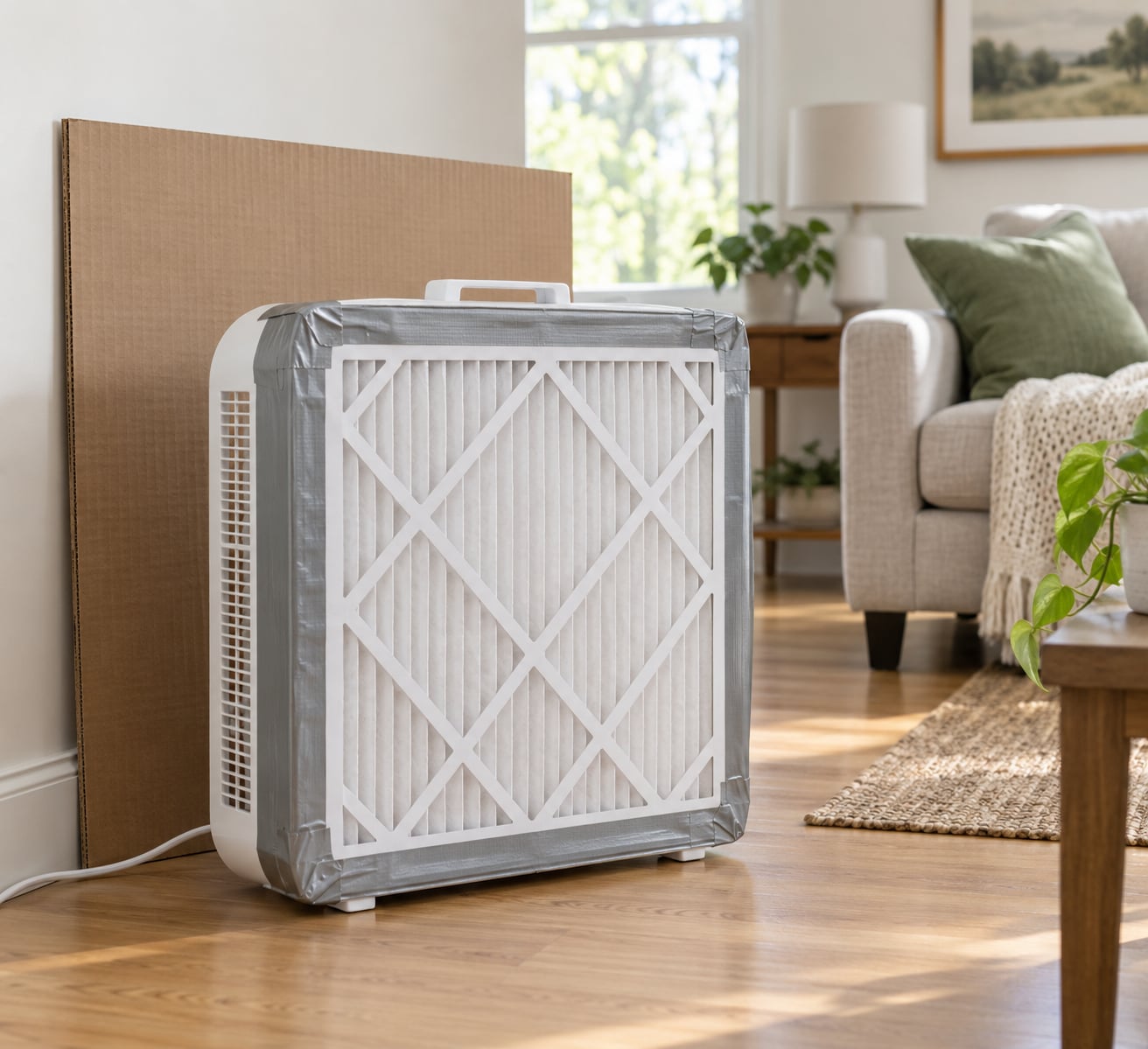
A DIY box fan air filter is simple: a 20-inch UL or ETL certified box fan, a 20x20x1 MERV 13 furnace filter taped to the intake side with the airflow arrow pointing at the fan, sealed on all four edges, and plugged straight into a wall outlet. It takes about 30 minutes. In US EPA chamber testing, that single-filter build moved 111 cubic feet of clean air per minute against wildfire smoke on high speed, which is real protection for one closed room.
What it cannot do matters just as much. Pleated media catches particles such as PM2.5. It does not remove carbon monoxide, and it does not remove the gases and vapours that make smoke smell like smoke. If your smoke is from a fire inside the house, leave.
Table of Contents
- What You Need to Build a DIY Box Fan Air Filter for Smoke
- Step-by-Step
- How to Build the Filter: Prepare the Box Fan
- Choose and Cut the Filter
- Attach the Filter to the Fan
- Set the Airflow Direction and Test the Unit
- Use the Filter Safely During Smoke Events
- Mistakes to Avoid During Assembly
- Common Mistakes
- Frequently Asked Questions
- What kind of filter should I use in a DIY box fan for smoke?
- Can a DIY box fan air filter protect against wildfire smoke?
- How fast should the box fan run when using a furnace filter?
- Is it safe to leave a DIY box fan filter running overnight?
- Will activated carbon in the filter remove smoke gases?
- What should I do if someone has trouble breathing during a smoke event?
What You Need to Build a DIY Box Fan Air Filter for Smoke
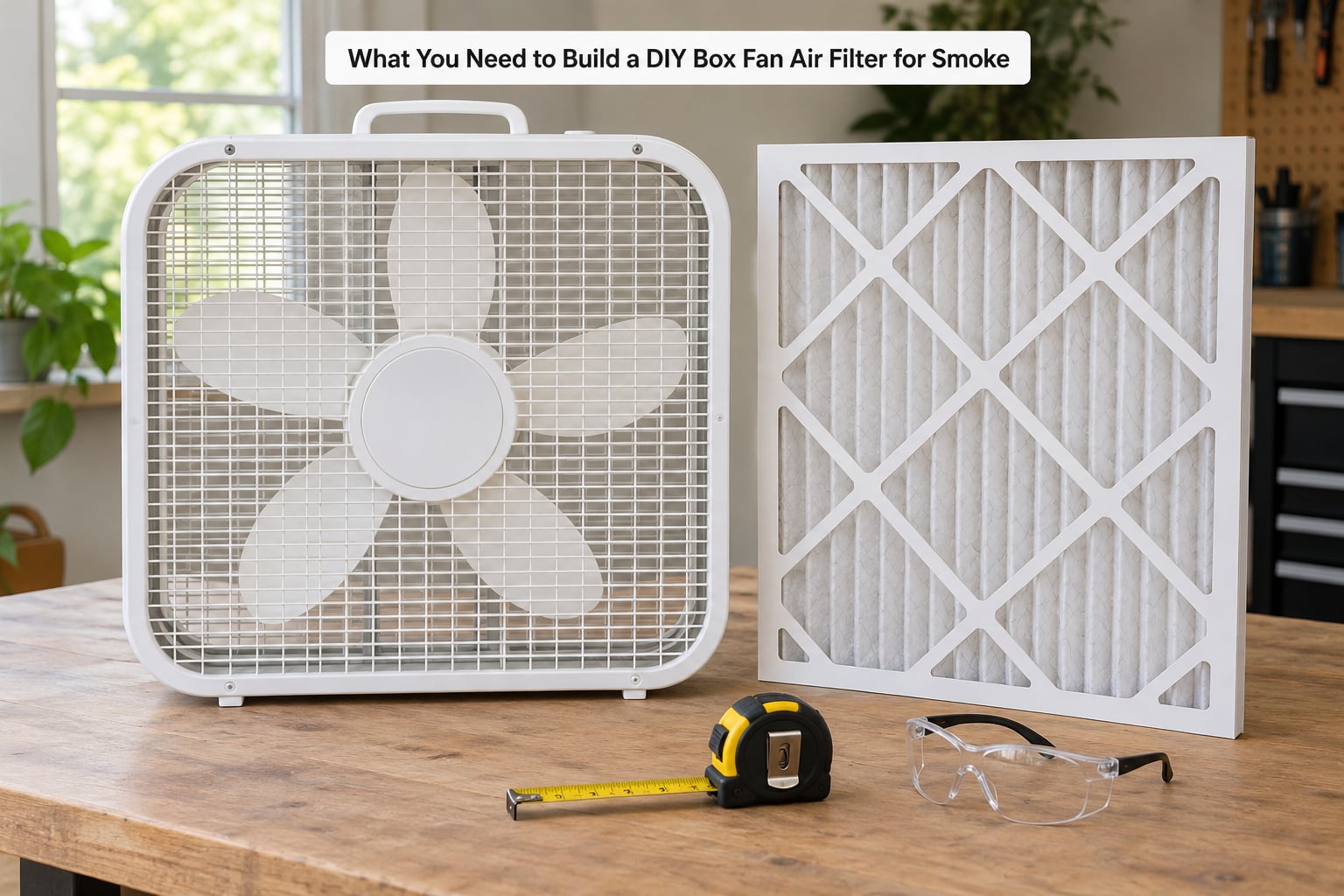
Most builders end up with four things. Everything else is optional.
- A 20-inch box fan built to the current UL or ETL standard. Look for the mark printed on the housing. Newer fans use a fused plug and a thermal cutoff, which is why age matters.
- One 20x20x1 MERV 13 pleated filter. Buy spares. Stores sell out during fire season, and a dirty filter is worse than no filter.
- Attachment hardware: four large clamps, duct tape, or bungee cords.
- A tape measure and safety glasses. The glasses are for pleat dust and staples.
Optional but useful: a sheet of corrugated cardboard for the shroud described below, an activated-carbon filter pad sized 20×20 for odour, and a small pre-filter to catch dust so the MERV 13 lasts longer.
Filter grade decides how much smoke you actually catch. A MERV 11 filter on the same fan lost roughly 43% of the clean air delivery rate that MERV 13 delivered in the same chamber study. Cheap fiberglass filters at MERV 1 and 4 are for dust, not for fine smoke particles, and on this build they deliver very little.
Skip filters that arrive wet, crushed, torn, or treated with odour spray or chemicals. Skip anything from a garage with a heavy solvent or paint smell. Those media release whatever they absorbed, right into your air.
Step-by-Step
How to Build the Filter: Prepare the Box Fan
Unplug the fan before you touch anything. Set it on a flat surface, shake it out and dust the housing, and look at the blades through the grille. Check the housing and cord for cracks, fraying, or heat warping, and discard the fan if you find any. A fan that has already been through a smoke event is the wrong tool for another one.
Find the intake side. On most 20-inch box fans the intake is the larger opening with the grille squares; on many smaller or newer models both sides look similar, so the manual or the airflow arrow printed on the housing settles it. Hold a hand an inch from each side while the fan runs briefly on low, and the pulling side is your intake.
The check that worked for me: unplug the fan, hold a tissue against each side, and plug it in for two seconds. The side that sucks the tissue in is the intake. Write the airflow rating on a piece of tape on the housing if you can find it, because that number is what lets you size the setup to a room later.
Choose and Cut the Filter
Measure the fan opening, then measure the filter. A filter labelled 20x20x1 is usually about 19.5 by 19.5 inches, which is smaller than the opening it is supposed to cover. That half-inch gap is why the seal has to run onto the fan housing rather than onto the filter frame alone, and it is the single most common reason a first build leaks air around the edge.
Most of the time you should not cut anything. If the filter is a few inches oversized in one direction, trimming the cardboard frame with a utility knife is fine. If it is oversized in both directions, buy the right size instead. Cutting into pleated media creates ragged edges and gaps, and those gaps let clean-looking but filtered-poor air slip past.
Keep one thing in mind as you handle it: the pleats point toward the fan when the filter is installed, but they should stay pointed the same way in the package. Pressing the pleats flat to make it fit reduces the surface area the media can use and drops output noticeably.
Attach the Filter to the Fan
Hold the filter against the intake side with the printed airflow arrow pointing toward the fan. Then seal it. Three methods work well.
- Clamps give the tightest seal and the best resistance to the fan pulling the filter off. Large stainless hose clamps or spring clamps around the housing lip are the strongest option.
- Duct tape is the fastest and the easiest to replace. Run it across all four edges and patch the corners twice, because corners are where seals always fail first.
- Bungee cords hold a filter for a quick test and for moving the unit room to room, but they are not a permanent seal. Expect air to leak around the edge.
Leaning is not attaching. Plenty of builders simply prop the filter against the back of the fan, as people describe on r/HomeImprovement, and it works for an afternoon. It stops working the moment the fan vibrates the filter loose and the media bows inward.
The failure mode to design against is the filter itself being pulled into the housing. If the frame can flex inward, the pleats touch the blades, and you get noise, vibration and a fan running hotter than its design. A frame-sized filter that rests against the housing lip and cannot enter the opening solves it. If your filter fits loosely inside the opening, add a purpose-built filter support ring or a rigid frame.
Set the Airflow Direction and Test the Unit
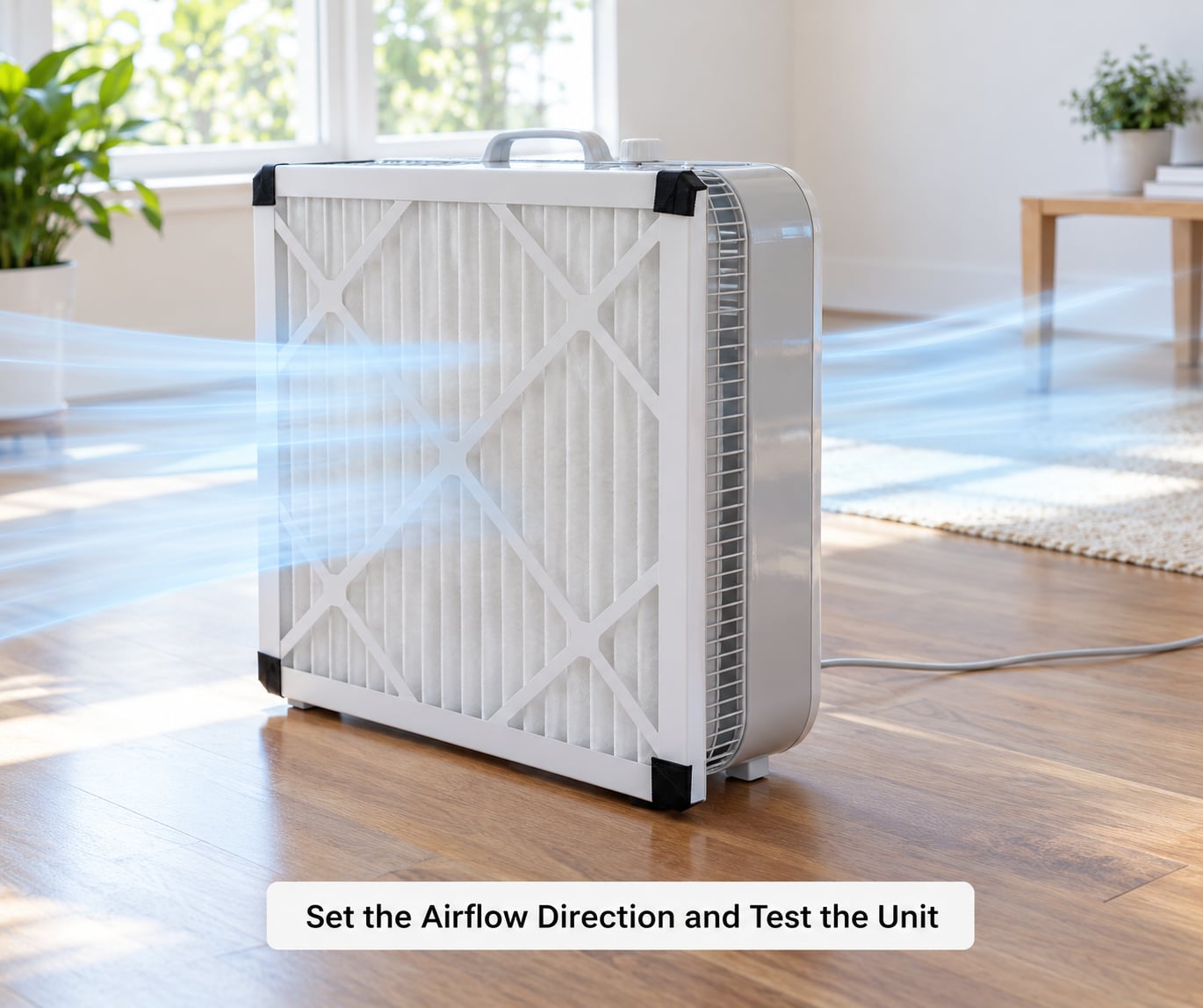
Air always flows through a pleated filter from the wide end of the pleats to the narrow end, and the printed arrow on the filter frame marks that direction. Point the arrow at the fan. If you reverse it, the filter still catches particles but you have collapsed the pleat spacing on the intake face, so resistance climbs and output falls.
Before you plug it in, run your hand across the media and confirm air has an obvious path through it with no bypass. Then run the unit on low for two minutes with the room door closed. Watch and listen for these four things:
- The fan does not vibrate or rattle against the housing.
- The housing does not get noticeably hotter than usual.
- There is no burning or electrical smell.
- The outlet and plug stay cool to the touch.
Shut it down and unplug it if any of those appear. A rattle usually means the media is touching the blades. Heat or smell means stop using the unit. Then move up through the speeds and run it on high for ten minutes, rechecking the housing temperature.
Once it runs clean, move it to the room you want protected and close the windows and doors in that room. Shut the unit off before you move it. If it is going in a bedroom, the low setting is usually enough to hear in a quiet room without waking people, and the big drop in noise from low to high is why running on low while you are awake nearby is the sensible habit.
Use the Filter Safely During Smoke Events
Set expectations first. This build reduces particles in one room. It does not remove carbon monoxide, and it does not remove the gases and vapours that carry the smell of smoke. That is why a room can read much cleaner on a particle sensor and still smell like a campfire.
For the smell, add a 20×20 activated carbon pad on the intake side of the MERV 13. Carbon adsorbs gas-phase contaminants that pleated media passes straight through. Loose charcoal in a pillowcase does almost nothing by comparison, and it does nothing about particles. Carbon media also saturates faster than you would expect, so treat it as a consumable.
Do not run the unit while you sleep, and do not run it unattended. Plug it directly into a wall outlet, never into an extension cord or power strip, because the added resistance makes the fan draw more current over longer cable runs. Keep children and pets away from the grille and from the filter, and keep every other surface at least three feet away.
Know when to leave instead of filtering. If smoke is inside the building, if you have no room you can close off, or if anyone is wheezing, short of breath or confused, get out and call emergency services. A fan cannot make an unsafe room safe.
For anyone with asthma, COPD or another respiratory condition, filtered air helps with particles but does not replace medication or medical care. Check the AirNow Fire and Smoke Map for local readings, follow your local public health guidance, and talk to your doctor about a plan for smoke days.
Mistakes to Avoid During Assembly
Five things go wrong repeatedly. Each has a direct fix.
- Air leaking around the perimeter. A 19.5-inch filter on a 20-inch opening bypasses the media entirely. Tape onto the housing, not the filter frame, and double the corners.
- Cheap filter grade. MERV 8 and below lets most fine smoke particles straight through. Use MERV 13 or higher.
- A filter that can be pulled into the blades. If the media flexes into the housing, replace it with a frame-compatible size or add a support ring.
- Extension cords and unattended running. Both increase fire risk for no benefit. Wall outlet, and only while someone is awake in the room.
- Too close to a wall, curtain or furniture. A box fan in a corner pulls little air and gets hot. Leave clearance on all sides.
Common Mistakes
The most damaging error is the one nobody notices: a filter that is still attached but has stopped moving air. In the chamber study behind the CADR figures, a smoke-loaded MERV 13 filter fell to 4.3 cubic feet per minute after collecting only 10 milligrams of smoke, and it still looked clean to the eye. Pleated media carries an electrostatic charge that helps capture fine particles, and smoke neutralises it. Output collapses long before the filter looks spent.
So check by feel and by ear, not by appearance. Hold a hand in front of the outlet grille and compare the airflow to what the same fan delivered when the filter was new. If it has dropped a lot, swap the filter. During an active smoke event that means checking daily, and having a spare already in the house.
Other recurring mistakes, with fixes:
- Running a wet or bent filter. Wet media blocks airflow and grows mould. Damaged frames leak. Replace either immediately.
- Ignoring the dirt on the rest of the system. The filter captures particles, so the fan exhaust and the room surfaces need attention too. Wipe the housing and damp-wipe hard surfaces when the smoke event ends.
- Leaving the rest of the house open. One cleaned room in a leaky house loses ground through the door. Close the windows and doors in the protected room and the room next to it.
- Expecting whole-house coverage. One 20-inch unit covers a bedroom well and a large open-plan living room badly. To work out what you actually have, multiply the clean air delivery rate in cubic feet per minute by 60, divide that by the room volume in cubic feet, and you get air changes per hour. A 111 CFM unit in a 12×14 room with 8-foot ceilings moves about 5 air changes per hour.
If you want more output from the same fan, the cheapest gain is a cardboard shroud, a cut panel that sits around the filter and blocks the part of the intake that leaks around the edge. The same 1-inch MERV 13 build measured 156 cubic feet per minute with a shroud. A 20x20x4 deep pleat filter instead of the 1-inch version reached 248. The four-filter Corsi-Rosenthal cube, where four filters are taped into a cube sitting on top of the fan, reached 401 and can often run on a lower, quieter speed. Do not upgrade the household HVAC filter to MERV 13 to chase this instead. A dense filter on a system sized for a lower grade can reduce airflow enough to freeze the coil and strain the blower motor.
Frequently Asked Questions
What kind of filter should I use in a DIY box fan for smoke?
Use a 20x20x1 MERV 13 pleated furnace filter, or higher. MERV 13 is the lowest grade that captured meaningful smoke particles in chamber testing, and a MERV 11 filter on the same fan lost roughly 43% of the clean air rate. Keep the pleats undamaged, and add a 20×20 activated carbon pad on the intake side if odour matters to you.
Can a DIY box fan air filter protect against wildfire smoke?
Partly, for one room. In US EPA chamber testing, a 20-inch box fan with a 1-inch MERV 13 filter delivered 111 cubic feet of clean air per minute against wildfire smoke on high. That lowers PM2.5 in a closed room. It removes no carbon monoxide and no gases or vapours, so it is a particle control, not a safe shelter, and no room is safe while smoke is inside the building.
How fast should the box fan run when using a furnace filter?
Start on low, listen for vibration or heat, then work up to high for the fastest cleaning. High is where the 111 cubic feet per minute figure was measured. Low is noticeably quieter, which is why many people run it on low during the day for general filtration and on high when the air is worst or right before the family comes home.
Is it safe to leave a DIY box fan filter running overnight?
Public health guidance is clear: do not run it overnight or while you sleep, because a fire or overheating would go unnoticed until it was serious. Keep it running only while you are awake and on the premises, plug it directly into a wall outlet with no extension cord or power strip, and leave clearance from walls, bedding and furniture on every side.
Will activated carbon in the filter remove smoke gases?
Carbon adsorbs some gas-phase contaminants, so it helps with smell, but it is partial and it saturates. Pleated media and carbon solve different problems: the filter removes particles, the carbon reduces odour. Neither one removes carbon monoxide. If the smell is the main problem, a carbon-rated unit or a sealed cleaner air room will serve you better than more MERV 13 alone.
What should I do if someone has trouble breathing during a smoke event?
Stop the exposure and get help. Move the person into the cleanest air available, ideally a closed room with the filtered unit running, and call emergency services for wheezing, shortness of breath, chest tightness or confusion. Do not rely on the fan as a reason to stay inside a smoky building, and follow your local public health alerts and your own doctor or pharmacist’s advice.
Start with the filter and the fan, not the tape. Buy a MERV 13 pleated filter in the size that matches the fan opening, confirm the UL or ETL mark, and pick the room you are willing to close off. Build it on the floor, seal the edges onto the housing, run it for ten minutes on high while you watch the plug and the housing, and only then decide where it lives for the smoke season. Buy a spare filter before the smoke arrives, because that is the thing you cannot get during the event.
The figures here come from US EPA chamber work reported by Holder and colleagues in Indoor Air in 2026, UL’s fan safety testing, and CDC data on smoke-related emergency visits. We do not sell filters or fans.