Cool roofs are roof surfaces engineered to reflect sunlight and radiate heat away instead of absorbing it, and a well-chosen one typically shaves roughly 7% to 15% off your annual cooling costs. In hot, sunny regions with air conditioning and a dark shingle roof, savings can reach 30%. The rest of this guide explains where those numbers come from, which ones apply to your home, and what a cool roof will not fix for you.
Cool roofs are not a new invention. Cities have specified them for decades, mostly for their effect on neighbourhood temperatures rather than on any single household’s bill. What has changed is how cheap and simple the materials have become, and how much more people are now looking at energy bills line by line.
Table of Contents
- What Is a Cool Roof?
- The definition, in plain words
- How a cool roof works: reflectance and emittance
- Cool roof vs. green roof: the difference search results keep blurring
- What can you put on a roof to reduce heat?
- How Much Do Cool Roofs Lower Cooling Bills?
- Cool roofs explained and how much they lower cooling bills, in four numbers
- Where the savings actually land on your bill
- Cool Roof Savings by Climate and Home Type
- How to Estimate Your Own Cooling-Bill Savings
- 1. Isolate your cooling usage
- 2. Apply a percentage from the climate table above
- 3. Scale the result to the cooling season
- 4. Check it against your measured data
- What a cool roof will not do for you
- What Determines the Savings?
- Cool roof materials compared
- Cool Roof Costs, Lifespan, and Maintenance
- Coating now, or wait for replacement?
- Reflectance is not permanent
- Cool Roofs vs. More Insulation
- Are Cool Roofs Worth It for Your Home?
- The winter question, answered honestly
- Frequently Asked Questions
- Does cool roof paint really work?
- Will a cool roof raise my winter heating bills?
- Is a roof coating a good idea?
- What colour roof is coolest?
- How long does a cool roof last, and does it need maintenance?
- What is a green roof, and how is it different from a cool roof?
- What to Do First
What Is a Cool Roof?
The definition, in plain words
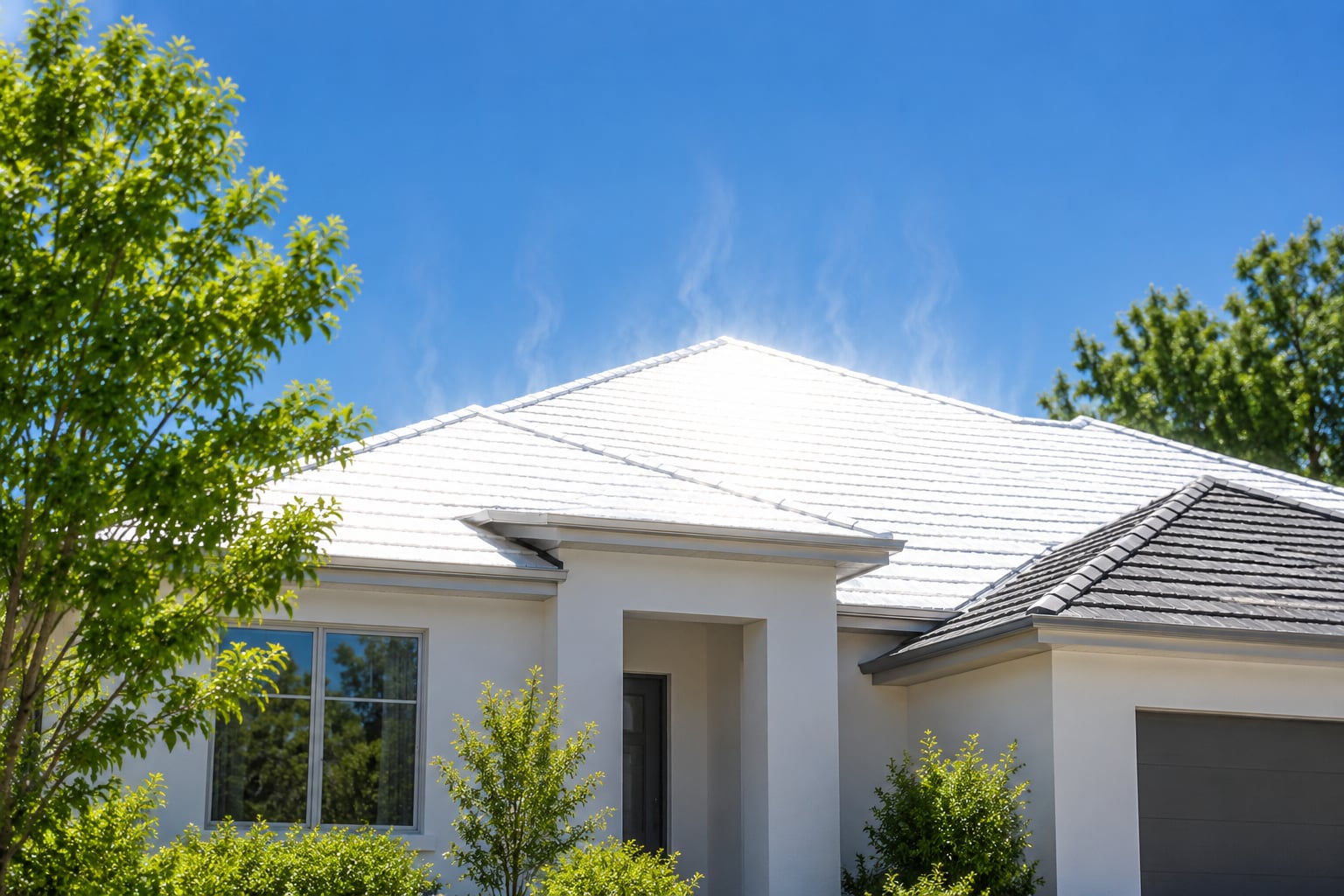
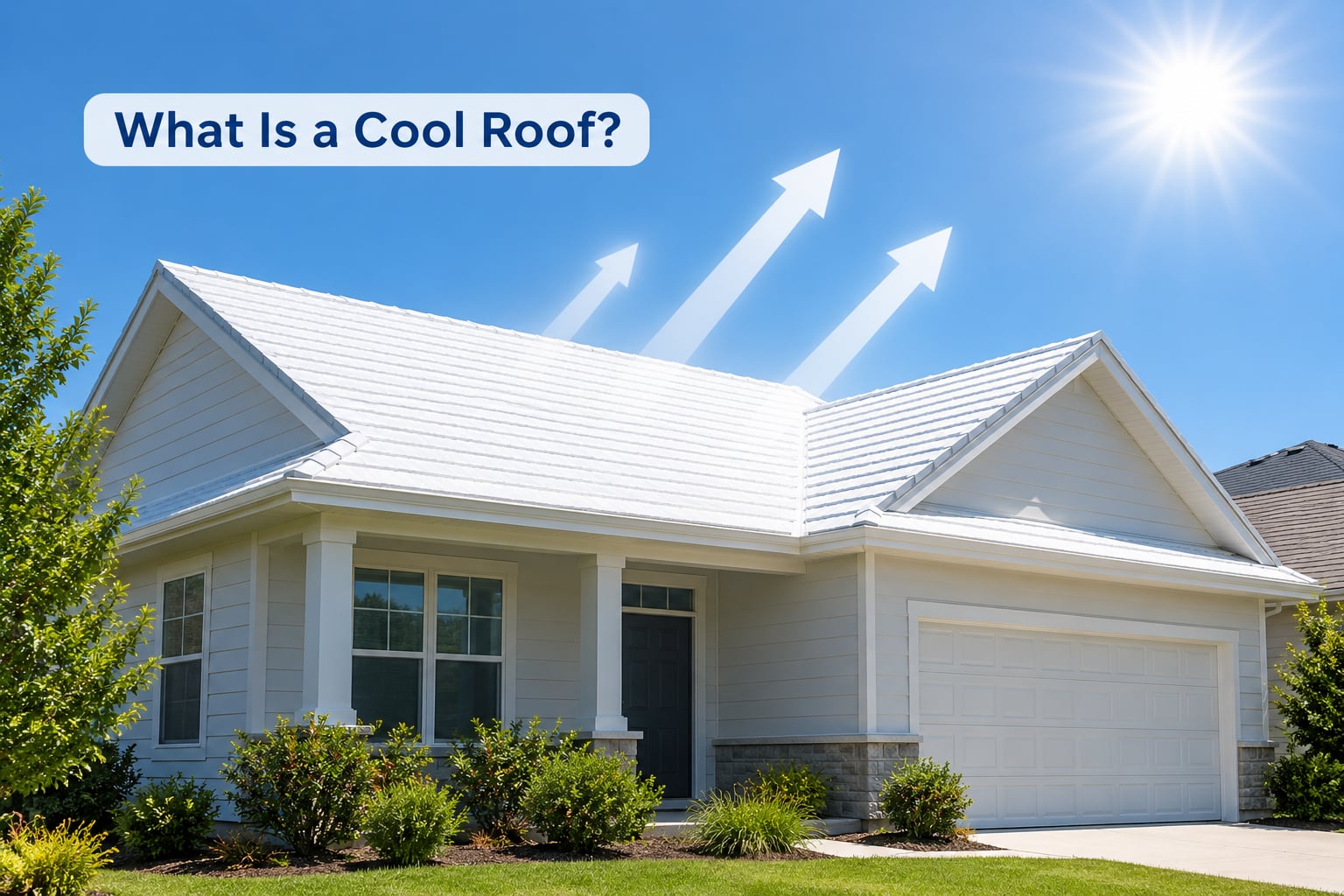
A cool roof is any roof surface with a surface that reflects a large share of incoming solar radiation and emits absorbed heat efficiently, so the roof itself stays markedly cooler than a conventional one. The result is a cooler attic, less heat pushed down into the living space, and a smaller load on the air conditioner during the hottest hours of the year.
How a cool roof works: reflectance and emittance
Two numbers do most of the work. Solar reflectance is the share of sunlight the surface bounces back instead of turning into heat. Thermal emittance is how readily the surface radiates heat back out to the sky on a clear night. A surface that is highly reflective but poorly emissive still stays hot, which is why the second number gets ignored in most marketing copy.
The Cool Roof Rating Council combines the two into the Solar Reflectance Index, or SRI, which is the number you will see on product data sheets. A white TPO membrane or a white elastomeric coating will sit near the top of the range; dark architectural shingles will sit near the bottom. Look for the cool roof rating on the CRRC label and check the aged reflectance, not just the new-build number. That single field tells you more than most brochures do.
Cool roof vs. green roof: the difference search results keep blurring
A green roof is a structural system: soil, plants and drainage layers built onto the roof deck, typically 4 to 12 inches deep. It holds water, supports vegetation and insulates by mass. A cool roof is a surface treatment or a roofing material, and it works by reflecting radiation. A green roof reduces heat too, but it is a landscape element with structural load, irrigation needs and maintenance, and its cost is measured in tens of dollars per square foot rather than single digits.
If you want the surface to run 50 to 60°F cooler than a dark roof on a hot afternoon, a reflective coating gets you there. If you want habitat, stormwater retention and a garden on the roof, that is a green roof project.
What can you put on a roof to reduce heat?
- Reflective coating. A white or light-coloured acrylic, silicone or polyurethane coating sprayed or rolled onto an existing roof. The cheapest reversible option.
- Cool asphalt shingles. Granules blended with infrared-reflective pigment. They look like ordinary shingles, so there is no aesthetic compromise.
- White single-ply membrane. TPO or PVC, standard on flat and low-slope roofs. High reflectance from day one.
- Standing seam metal. Already highly reflective, and coatings now boost the aged values.
- Clay and concrete tile. Air gaps beneath the tiles and the tile itself both slow heat transfer.
- Green roof. The heavyweight option, chosen for stormwater and habitat as much as temperature.
How Much Do Cool Roofs Lower Cooling Bills?
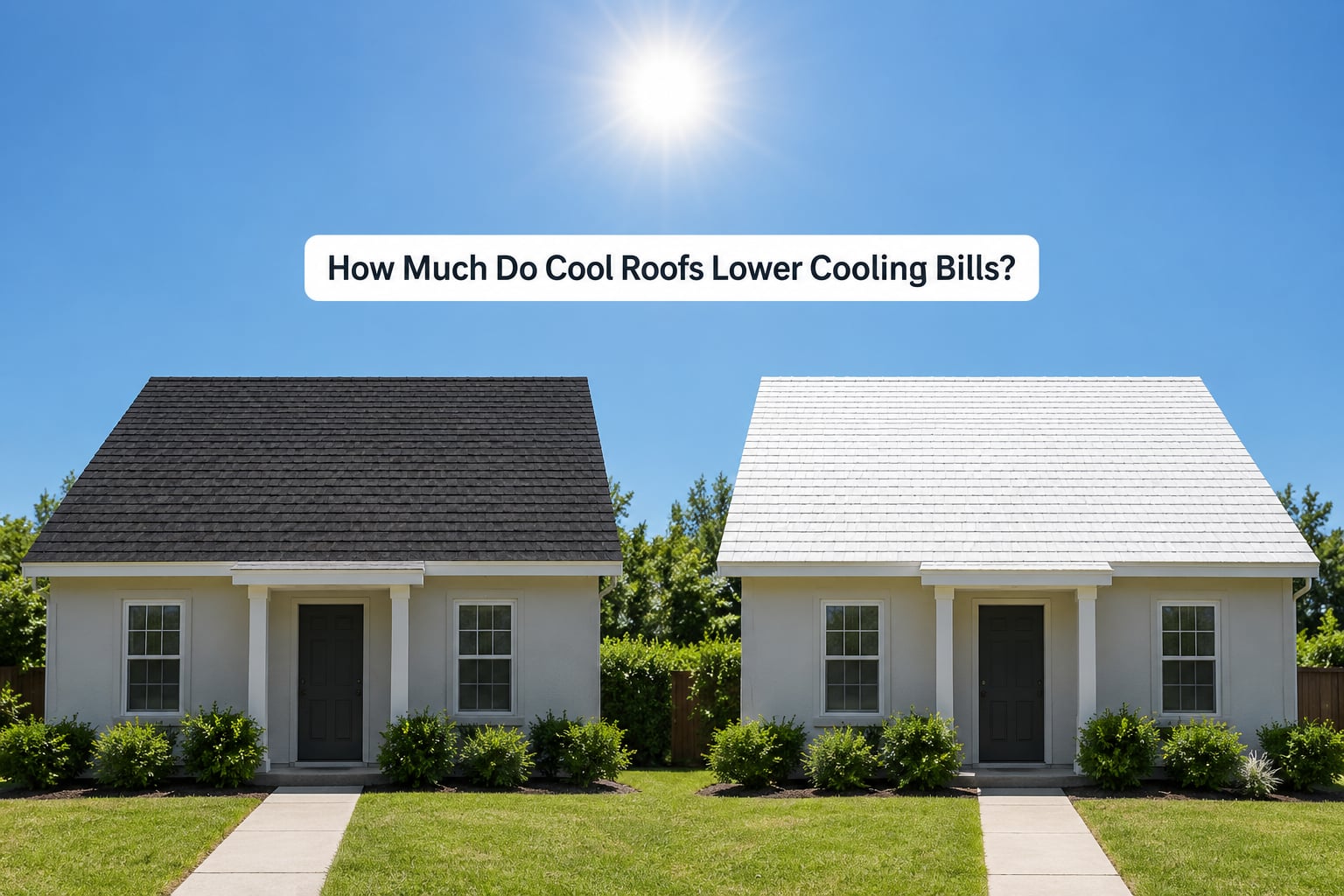
Cool roofs explained and how much they lower cooling bills, in four numbers
The widely cited headline: cool roofs cut cooling costs by roughly 7% to 30%, depending on climate, existing roof colour and how well the rest of the building is insulated.
- 7% to 10% is a conservative whole-bill estimate that includes heating and non-cooling electricity. This is what most homeowners report as a modest, believable change.
- 15% to 20% is the common range for cooling-only costs in hot climates with air conditioning, a dark starting roof and a low-to-moderate insulation level.
- Up to 30% applies to the cooling portion of the bill in hot, sunny regions where the original roof is dark asphalt shingle.
- 14% to 38% appears in older research for total electricity demand in very hot zones. Treat this as an upper bound measured in laboratory conditions, not a promise for a suburban house.
Those figures look contradictory until you notice they measure different things. A percentage of cooling cost and a percentage of the whole bill are not the same number, and a hot-arid city and a temperate coastal one have different cooling seasons to save money in.
Where the savings actually land on your bill
Almost all of it arrives between late morning and early evening on the hottest days, and in a lot of homes it shows up as a shorter compressor run rather than a visibly cooler house. Homeowners on homebuilding forums describe the same pattern: the peak afternoon strain eases, the attic stops turning into an oven, and the annual change is real but not dramatic.
One further effect is worth naming. On a hot afternoon a reflective roof also reduces the peak electrical draw of the whole house at the exact moment the grid is most strained, which matters if your utility bills include a demand charge. That single line item can sometimes be worth more than the kWh savings.
Cool Roof Savings by Climate and Home Type
The same 15% means very different things in different places. These ranges are realistic cooling-cost reductions for a typical air-conditioned single-family home that starts with a dark shingle or tar roof.
| Region | Expected cooling cost reduction | What drives the result |
|---|---|---|
| Hot and humid (Gulf Coast, Southeast) | 10% to 20% | Long cooling season and high humidity mean long run times; the savings accumulate steadily rather than in a few peak weeks. |
| Hot and dry (Southwest, inland West) | 15% to 30% | Very high solar exposure on an unshaded roof, plus clear nights that let a high-emittance surface radiate heat away. The strongest case for a cool roof. |
| Temperate (mid-Atlantic, upper Midwest, Pacific coast) | 7% to 12% | Real but modest. Short hot season; the roof is only one of several heat gains. |
| Cool or cold (northern states, mountain towns) | 0% to 8% | Limited cooling to save money on, and a winter heating penalty is likely to offset whatever is gained. |
Three home characteristics matter more than almost anything else. First, the roof-to-floor ratio: a two-storey home has roughly twice the roof-to-floor ratio of a one-storey ranch of the same floor area, so the roof is a bigger share of the envelope. Second, how much the roof is shaded, by trees or by the building itself. Third, whether the home is air-conditioned at all, since a home cooled only by fans will see almost nothing.
How to Estimate Your Own Cooling-Bill Savings
Run it in four steps and you will end up with a number you can defend, rather than one borrowed from a roofing website.
1. Isolate your cooling usage
Pull twelve months of bills and find your summer months, roughly June to September. Multiply your monthly kWh usage by the current electricity rate to get cooling cost. If your bill shows a separate cooling line item, use that instead.
2. Apply a percentage from the climate table above
Use the figure for your region, not the national headline. Then adjust it slightly by roof type: subtract a few points for a light-coloured existing roof, add a few for a dark shingle roof on a two-storey home.
3. Scale the result to the cooling season
The percentages above are annual cooling cost, so they already account for season length. If your local summer is unusually mild, discount the result by the number of cooling degree days you actually had last year, which your utility usually publishes.
4. Check it against your measured data
The honest version is a before-and-after comparison. Record your peak kW and total kWh monthly, install the cool roof, then compare the same months the following year. Adjust for a hotter or cooler summer, since raw bill comparisons are how people end up with wildly wrong conclusions.
| Home floor area | 7% reduction | 15% reduction | 30% reduction |
|---|---|---|---|
| 1,000 sq ft | Small single-digit reduction | Modest reduction | Meaningful reduction |
| 1,500 sq ft | Modest reduction | Clear reduction | Large reduction |
| 2,000 sq ft | Clear reduction | Large reduction | Very large reduction |
| 2,500 sq ft two-storey | Clear reduction | Large reduction | Very large reduction |
Those cells describe the size of the effect, not currency, because the outcome depends on your tariff. The 30% column applies to a dark roof in the hottest regions; the 7% column is what a well-insulated, light-roofed home in a mild climate should expect.
What a cool roof will not do for you
It will not fix leaky ductwork, missing attic insulation, unsealed penetrations or an undersized air conditioner. In forum discussion after forum discussion, the most common finding is that homeowners who paired a cool roof with attic insulation and air sealing saw the larger change, while those who coated the roof and stopped there saw the smaller one. A reflective surface blocks heat arriving from outside; insulation and sealing stop heat escaping from inside. They are not substitutes.
What Determines the Savings?
Ten variables move the number, and understanding them explains why estimates online disagree so much.
- Starting roof reflectance. Going from dark asphalt shingle to white membrane is a bigger step than white to white.
- Solar reflectance and thermal emittance. The two properties behind the CRRC rating.
- Climate. Cooling degree days, solar exposure and night-time humidity set the ceiling on savings.
- Roof pitch and area. A flat, large roof gains more than a steep, small one.
- Attic insulation R-value. Heavy attic insulation cuts off most of the heat before it reaches the rooms.
- Air leakage. Unsealed attics pull conditioned air into the hottest space in the building.
- Attic ventilation. On hot days a vented attic can exceed outdoor temperature.
- Cooling system efficiency. An undersized or old unit limits how much you can convert a cooler attic into a lower bill.
- Electricity rate structure. Flat rates reward kWh savings; demand charges reward peak reduction.
- Occupancy and appliances. Internal heat from people, lights and appliances increasingly sets the cooling load.
Cool roof materials compared
| Material | Relative reflectance | Typical service life | Best suited to |
|---|---|---|---|
| White TPO or PVC membrane | Highest | 20 to 30 years | Flat and low-slope roofs, full replacements |
| White elastomeric or acrylic coating | Highest when new | 10 to 20 years, recoatable | Extending the life of a sound existing roof |
| Standing seam metal | High | 40 to 60 years | Long-lived roofs, steep pitches |
| Clay or concrete tile | Moderate to high | 50 years or more | Tile-look aesthetics, hot dry climates |
| Cool asphalt shingles | Moderate | 20 to 30 years | Homes where the roof must look conventional |
| Standard dark shingles | Low | 20 to 30 years | The baseline the others improve on |
Scepticism about “insulating” paints is well founded. Low-emissivity marketing claims are hard to verify, and the general view in building forums is that only genuinely whitish, high-reflectance coatings deliver a measurable change. Ask for the aged solar reflectance number, and treat anything below 0.5 as marketing.
Cool Roof Costs, Lifespan, and Maintenance
A retrofit coating costs a small fraction of a full roof replacement and typically runs into a few dollars per square foot including labour. A cool single-ply membrane on a new roof sits between that and a full replacement, and you pay for the roof you would have bought anyway plus the performance. Full replacements run into double digits per square foot. All of these are typical US ranges that shift by region, roof access and contractor availability.
Coating now, or wait for replacement?
If your roof has five or more good years left, a high-quality white coating is the sensible move. Surface preparation is most of the job: cleaning, fixing lifted edges, replacing fasteners, and a primer where the manufacturer requires one. If the roof is already showing worn granules, failed flashing or multiple layers, a coating will not rescue it.
If your roof is due for replacement within a couple of years, specify the cool material then. You pay the same labour and get the performance for the whole life of the new roof, which is the better deal by a wide margin.
Reflectance is not permanent
New reflectance is a sales number. Aged reflectance is the real one, and coatings lose it through chalking, dirt and algae in three to five years depending on the coating and the climate. Annual or biannual gentle cleaning, keeping vegetation off the surface, and recoating when the aged value drops below the level you bought for keep the savings intact. Budget for a maintenance cycle you did not have before.
Cool Roofs vs. More Insulation
They solve different problems. Insulation slows heat moving from inside to outside, in both directions, which is why it cuts heating bills as well as cooling ones. A cool roof only reduces heat gain from the sun, so its benefit is confined to the cooling season and it does nothing for winter heating.
That difference is the whole argument. In a climate with long hot summers and mild winters, a cool roof returns more per dollar spent. In a climate with hot summers and cold winters, insulation is usually the better investment because it works year-round. On an air-conditioned home with adequate insulation already in place, the cool roof is what lets the air conditioner stop working so hard.
Are Cool Roofs Worth It for Your Home?
The decision comes down to five questions.
- Is your roof being replaced in the next few years? If yes, specify a cool material now and stop thinking about it.
- How hot does your local summer actually get? Look at cooling degree days for your city, not at a national map.
- What does your roof look like now? Dark asphalt shingle gives the largest gain. Already light, less so.
- Is your home air-conditioned? Without a compressor there is no cooling bill to reduce.
- Are there incentives? Many utilities offer rebates for qualifying cool roof installations, and building codes increasingly require minimum reflectance on new roofs. Rules change by state and utility, so check your local programme and your tax situation before budgeting.
The winter question, answered honestly
Yes, there is a winter heating penalty. A reflective roof loses some of the free solar gain a dark roof absorbs in winter, so heating costs can rise slightly in cold climates. In practice the penalty is small, and in most of the southern US it is outweighed by the summer savings several times over. It only becomes a serious argument in northern states with high heating loads.
Frequently Asked Questions
Does cool roof paint really work?
A genuinely white, high-reflectance coating works. The coating keeps the roof surface close to 50 to 60°F cooler than a conventional dark roof at peak sun, which cuts attic temperatures and reduces how much heat the air conditioner must remove. The failures come from low-reflectance products dressed up with reflective marketing, and from poor preparation, not from the physics. Ask any contractor for the aged solar reflectance figure before you sign.
Will a cool roof raise my winter heating bills?
It can, slightly. A reflective roof gives up some of the free solar heat a dark roof absorbs in winter, so heating costs may tick up. In most of the southern US the summer cooling savings outweigh that by a wide margin. The penalty only matters in northern states with long, cold winters and high heating bills, where a full year of modelling is worth having before you decide.
Is a roof coating a good idea?
It is when the roof under it is still in good condition and has five or more years left. A coating costs far less than a replacement, extends the roof’s life and cuts cooling costs in the meantime. It is a poor bet on a roof with worn granules, failed flashing or several layers already. Roof condition, not coating technology, decides the answer.
What colour roof is coolest?
White and near-white are the coolest, because solar reflectance is highest when no visible light is absorbed. Among coated colours, lighter shades with infrared-reflective pigments beat darker ones, but the gap is large: white reflects roughly three-quarters of sunlight while a dark shingle reflects perhaps a fifth. That is why colour is the single biggest driver of the savings difference between two otherwise identical roofs.
How long does a cool roof last, and does it need maintenance?
A white single-ply membrane typically lasts 20 to 30 years and cool shingles match that, while a spray or roll-on coating generally gives 10 to 20 years before it needs recoating. Reflectance fades over time through chalking, dirt and algae, often noticeably within three to five years. Gentle cleaning, keeping vegetation clear of the surface and periodic recoating keep the performance close to what you started with.
What is a green roof, and how is it different from a cool roof?
A green roof is a built system of soil, plants and drainage layers, usually 4 to 12 inches deep, that holds stormwater and insulates by mass. A cool roof is a surface treatment or roofing material that works by reflecting sunlight and radiating heat. Green roofs also cool a building and reduce the urban heat island effect, but they cost far more, add structural load and need irrigation and plant maintenance.
What to Do First
Start with your own bill rather than a savings percentage. Pull twelve months of utility data, find what you actually spent on cooling, and check your local cooling degree days. If your roof is due for replacement in the next couple of years, specify a cool material on that job and the decision is finished.
If the roof has years left, get a white coating quote against a replacement quote, ask both contractors for aged solar reflectance figures, and confirm whether your utility offers a rebate. Add attic insulation and air sealing to the scope either way, because that is where the other half of your summer savings is sitting.