A family evacuation plan for wildfires is a written, rehearsed document that tells every person in your home what to do, where to go and what to take if fire forces you to leave. It names two escape routes, a meeting point outside, an out-of-area contact, a go-bag for each person and a job for each member, so nobody has to think under pressure.
Building one takes an evening. Most of the work is deciding things now that you would otherwise be deciding at 2 a.m. with smoke on the balcony and phones at four percent.
Table of Contents
- What You Need Before You Write the Plan
- Step-by-Step: Build Your Family Wildfire Evacuation Plan
- Step 1: Identify Local Wildfire Risks
- Step 2: Set Clear Evacuation Triggers
- Step 3: Plan Primary and Backup Routes
- Step 4: Assign Family Roles
- Step 5: Prepare Go-Bags and Important Documents
- Step 6: Make a Communication and Reunification Plan
- Step 7: Plan for Children, Pets, and Medical Needs
- Step 8: Rehearse and Update the Plan
- Common Mistakes That Delay Evacuation
- Frequently Asked Questions
- When should a family evacuate during a wildfire?
- Should we wait until we can see flames or smoke?
- What should a family emergency go-bag contain?
- How should we evacuate if we have children or pets?
- What should we do if our primary evacuation route is blocked?
- How can family members contact one another during a wildfire evacuation?
What You Need Before You Write the Plan
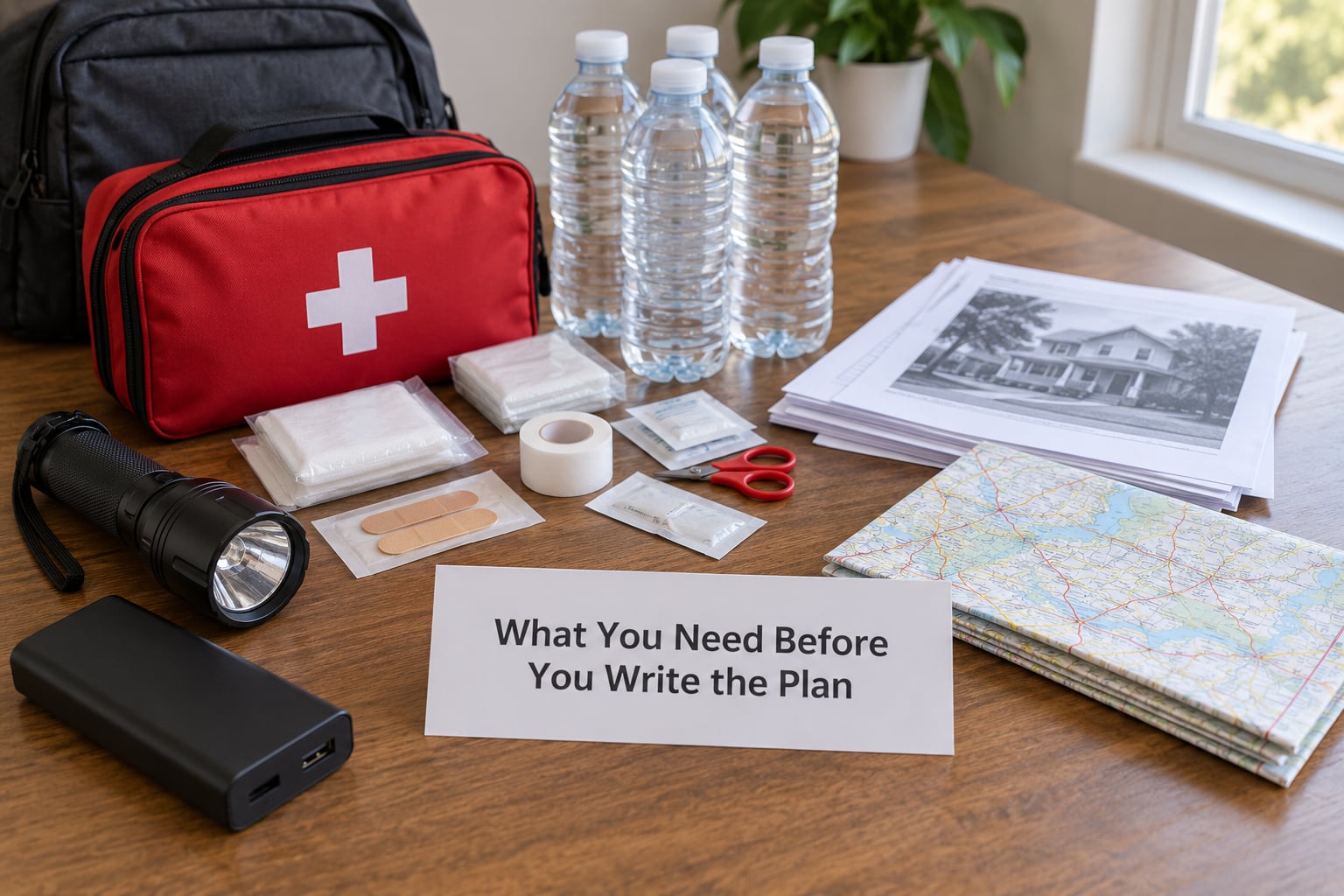
Gather these four things first, because the steps that follow depend on them:
- Local alert sources. The fire service and civil protection agency for your area, the regional wildfire service, your municipality’s official site, and the weather service. In Spain that means your ayuntamiento notifications, the 112 emergency line and the regional wildfire service such as Infoca in Andalusia. Sign up for text or app alerts from all of them.
- Paper and copies. A printed map of your neighbourhood with your address marked, a second map covering the wider area, and photocopies of identification, insurance documents, the property deed or rental contract, and medical records.
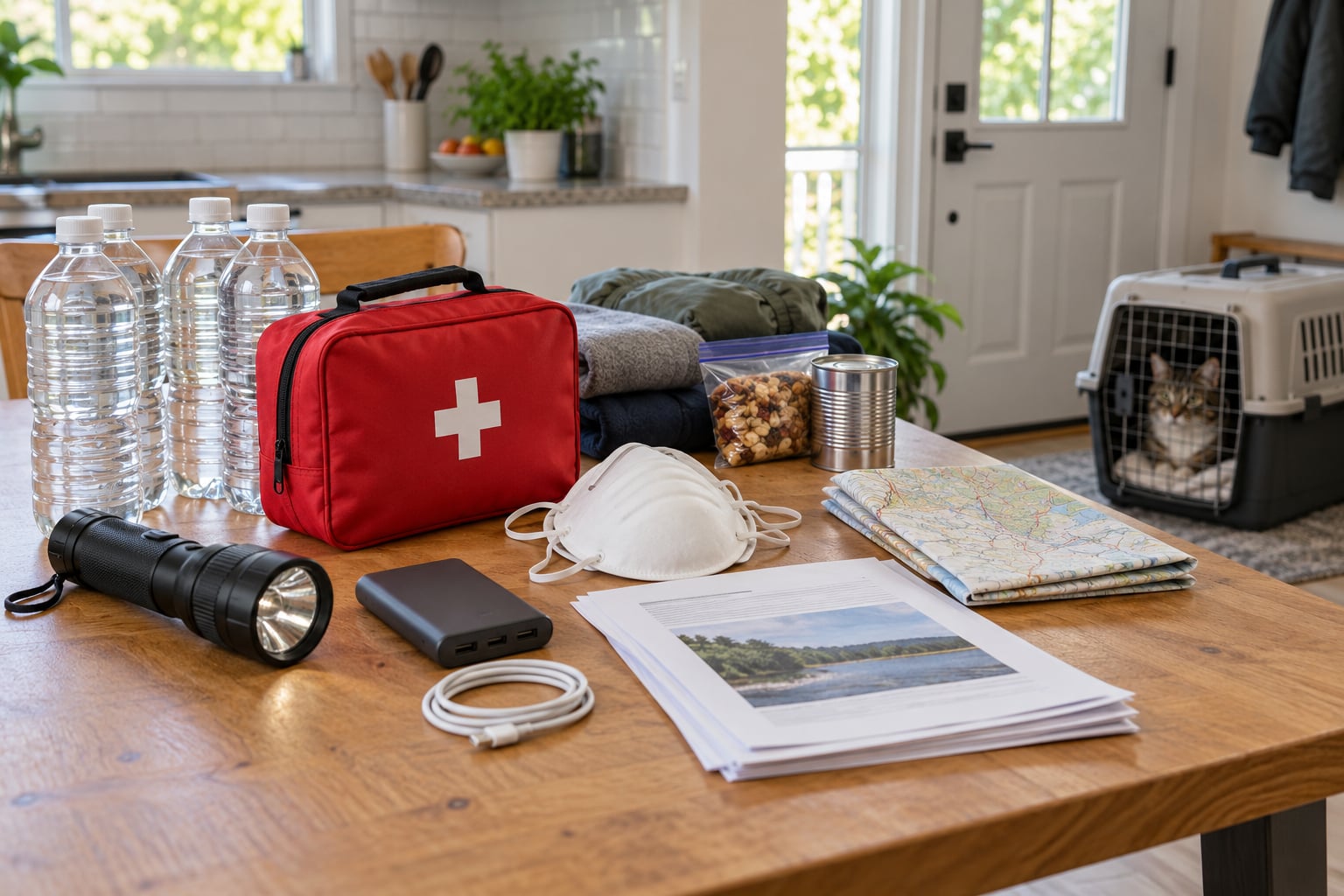
- Supplies. Three days of water at one gallon per person per day, ready to drink, food that needs no cooking, torch or flashlight, a battery power bank, a portable radio, N95 respirators sized for each adult and child, and a basic first-aid kit.
- Route information. Two ways out in each direction from your street, printed on the paper map, plus the distance and travel time to each one. Note which routes run through vegetation or narrow roads, because those close first.
- Details about your household. Every person’s name and phone number, school and workplace addresses, medical conditions, prescriptions, mobility needs, pet names and veterinary contact.
Official local emergency guidance always outranks anything in this guide, including your own plan. The document records decisions; the authority gives the order.
Step-by-Step: Build Your Family Wildfire Evacuation Plan
Step 1: Identify Local Wildfire Risks
Start with the hazards around your home: which direction the vegetation sits, where the nearest fuel breaks or firebreaks run, which roads have a single lane or a bridge that can be cut, and where your nearest staffed fire station is. The regional wildfire service publishes daily fire danger ratings and seasonal restrictions; note where you read them and bookmark it.
Then check the history of your own area. Ask neighbours which streets flooded traffic last time, and where the fire actually came from. Those two details shape everything that follows.
Step 2: Set Clear Evacuation Triggers
Write down what makes your family leave, before you need to decide it. Different regions use different words: an evacuation advisory means stay alert, an evacuation warning means leave now, and an evacuation order means leave immediately by the most direct safe route. Some Spanish services use a Ready, Set, Go structure, where Ready means prepare, Set means leave soon and Go means the route itself may no longer be passable.
Add your own household triggers alongside the official ones: smoke visible from the drive, an air quality index reading that triggers symptoms, the fire visible from the school run, or a neighbour leaving early. Survivors on wildfire forums consistently say the same thing: leave on the first warning, not on the order. The order often arrives after the road is already full.
Step 3: Plan Primary and Backup Routes
Map at least two ways out in each direction, so you always have one that does not cross the fire’s path. Mark them on the paper map and write the estimated time to each safe stopping point. Choose stopping points that are away from vegetation, not in a canyon or ravine, and not somewhere the fire could overrun.
Decide now, in advance, how you pick between them. A simple rule works: take the most direct route that does not head toward the fire or cross visible smoke. If you cannot see smoke from the window facing that way, it is usually the safer choice.
Step 4: Assign Family Roles
Write one line per person. The person who manages the pets. The person who carries the toddler’s go-bag. The person who handles the wheelchair or oxygen concentrator and pre-arranges any powered equipment. The person who accounts for everyone at the meeting point.
Give children real jobs by age. A four to eight year old can fetch a go-bag and put shoes on. A nine to twelve year old can check the gas off and help load the car. A teenager can text the out-of-area contact and manage a sibling. Naming the job in advance means nobody freezes.
Step 5: Prepare Go-Bags and Important Documents
One bag per person, stocked and closed, kept where it can be reached without searching. Two go-bags for a two-parent household is not enough if one parent is at work when the alert comes.
Per person: water, a change of clothes, shoes, medication and a copy of the prescription list, identification, phone charger and power bank, N95 respirator, small torch, tissues and any comfort item a child will insist on. Per household: spare keys, first-aid kit, radio, printed maps, cash in small notes, copies of insurance and property documents, and a bag of pet food and bowls.
Refreshing matters more than packing. Families on preparedness forums talk about go-bags that stayed packed for three years with expired food and a toddler’s clothes outgrown twice. Put a calendar reminder on the same day each year to eat one item, replace the medication and re-fit children’s clothing.
Step 6: Make a Communication and Reunification Plan
Choose one out-of-area contact, ideally someone 80 kilometres or more away and not in the danger zone. Everyone texts that single person, because a long chain of calls fails when towers are overloaded. In the Tubbs Fire survivor checklist that circulated afterwards, an out-of-area contact outside the threat zone was a fixed item, and the reason is simple: local networks fail first.
Set a meeting point somewhere obvious and outside the fire zone, such as a specific petrol station or school car park away from the direction of travel, and a second one if the first is unreachable. Agree what happens if someone is not at the meeting point by a set time: contact them, then contact emergency services, then keep looking. Write the rule down so nobody argues about it during the drive.
Step 7: Plan for Children, Pets, and Medical Needs
For infants, pack formula, bottles, nappies, wipes and a change of mat. Toddlers need a comfort object and somewhere to sit that is not a car seat the whole way. For pets, decide now who loads them, keep carriers by the door, and put a lead and a bowl in the go-bag. Large dogs that will not load are a recurring regret, so practise it once a quarter with a treat.
For medication that needs refrigeration, ask your pharmacist now how to transport it in a cooler for 72 hours. For anyone who moves slowly, build extra time into the plan and decide in advance whether a neighbour, a relative or a medical transport service does that leg. For oxygen concentrators or powered wheelchairs, note the battery runtime and the charging location in the go-bag.
Step 8: Rehearse and Update the Plan
Run the drill twice a year: once in spring as a readiness check, once at the start of the season under harder conditions. Time it. The target for leaving a house and reaching the vehicle is two minutes, and for everyone out of the neighbourhood, twenty minutes. Do the harder version once a year: dim the lights, tap exits with tape, try it with the toddler awake at night, and run it with phones off.
Review the plan whenever a route, phone number, health need, pet or school changes. Keep one paper copy taped inside a kitchen drawer and one in each go-bag. Families who print the plan report it cuts panic more than any other single thing they did, because the anxiety in an evacuation is not the fire, it is not knowing.
Common Mistakes That Delay Evacuation
Relying on one route. One mapped road is a single point of failure, and it is often the road that closes. Fix: two routes per direction plus a walking route if the household can get out on foot.
Waiting for the order. Orders arrive late for people at work, at school or asleep, and for anyone who missed the first alert. Fix: define your own leave triggers in Step 2 and treat them as binding.
Packing documents at the last minute. Digging out a deed costs twenty minutes you do not have. Fix: photocopies in every go-bag, and a digital copy uploaded somewhere reachable.
Flat or dead phones. The text plan collapses when the battery is at three percent. Fix: power banks charged monthly, car chargers, a battery radio, and paper contact cards in each bag.
Leaving pets behind. Going back for an animal costs time that may not exist. Fix: assign the pet job, stage carriers at the door, and pack food and bowls for at least three days.
Ignoring mobility and medical limits. The hardest twenty minutes of any wildfire evacuation is lifting an adult with limited mobility into a car in the dark. Fix: practise that lift, pre-arrange who assists, and know who to call.
Two habits close most of these gaps. Keep the go-bag where you can grab it, not in a high cupboard. And keep a clean-air room prepared: a small room with windows and doors closed and taped, an N95 for each person, and enough air to stay put when the air quality is bad but no order exists. Smoke often arrives hours before the fire does, and a household with a prepared room can wait out the worst of it instead of driving blind through it.
Frequently Asked Questions
When should a family evacuate during a wildfire?
Leave on the first official warning, not the order. An order usually arrives after the roads are already congested, which is when evacuation becomes dangerous. Practical triggers include an evacuation warning, visible smoke from your street, an air quality reading that affects anyone in the house, or fire visible from the school run. Write those triggers into your plan before fire season so nobody is weighing them while the sky changes colour.
Should we wait until we can see flames or smoke?
No. Smoke routinely arrives several hours before the fire front and can block a road long before flames reach it. Ember attack can also reach homes well away from the main fire, starting spot fires in yards and on roofs. Treat smoke you can smell, ash falling, or an orange sky as a leave signal, and pair it with the official warning for your area. Waiting for visible flames is the single most common mistake in survivor accounts.
What should a family emergency go-bag contain?
Per person: three days of water, non-perishable food that needs no cooking, a change of clothes and shoes, prescription medication with a copy of the prescription list, identification, a phone charger and power bank, an N95 respirator, a small torch and a comfort item for children. Per household: spare keys, first-aid kit, battery or hand radio, printed paper maps, cash, copies of insurance and property documents, and pet food, bowls and carriers. Refresh the contents twice a year.
How should we evacuate if we have children or pets?
Assign the job by name before fire season: who carries the infant’s bag, who puts shoes on the four-year-old, who loads the dog. Keep pet carriers and leads by the main exit, not in a cupboard. Pack formula, nappies and bottles for infants, and at least three days of pet food. Practise the dog loading into the car once a quarter, because a large dog that refuses to get in is the moment most families remember badly.
What should we do if our primary evacuation route is blocked?
Switch to the second route mapped in the direction away from the fire. The rule to decide in advance is simple: take the most direct route that does not head toward the fire and does not cross smoke you can see. If both mapped routes are blocked, stay in phone contact with emergency services, keep windows and doors closed, and shelter in an interior room with a prepared clean-air room rather than driving blind into smoke. Never drive through a wall of smoke.
How can family members contact one another during a wildfire evacuation?
Text, do not call, and send every update to one out-of-area contact chosen in advance who is far enough away to be outside the danger zone. Agree a meeting point and a time, then a rule for anyone who is missing: contact them, call emergency services, keep looking. Carry a power bank, a car charger and a printed list of numbers in each go-bag, because networks congest or fail exactly when the phone matters most.
Start this week, not in August. Pick one evening, write down your two routes in each direction, choose the meeting point and the out-of-area contact, and put one go-bag by the front door. Then set the rehearsal for twice a year and turn on the alert notifications your fire service uses. How to make a family evacuation plan for wildfires takes a couple of hours the first time, and about twenty minutes each time you refresh it after that.