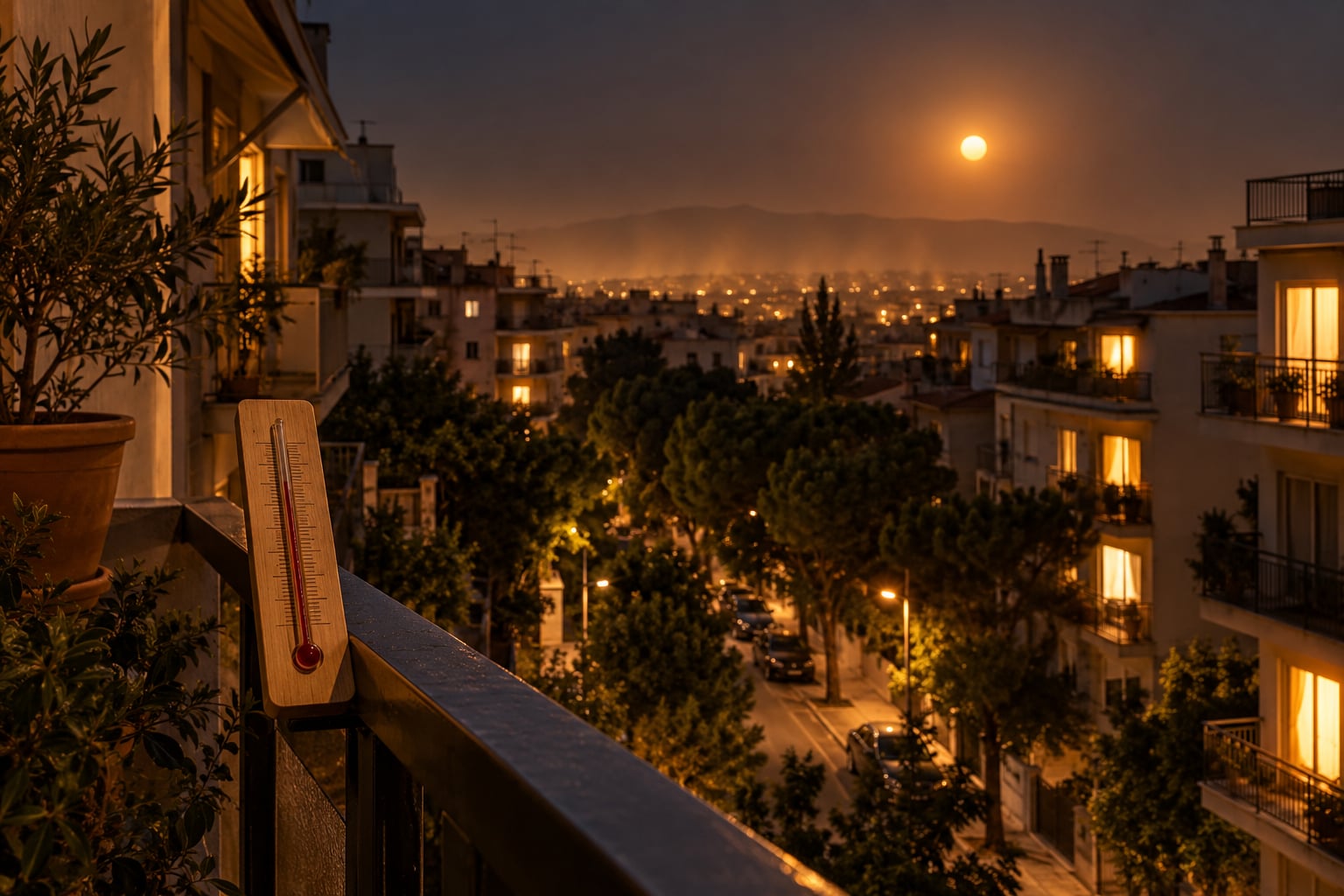
Heat waves are more dangerous at night because your body depends on several hours of cool darkness to bring its core temperature back down, and a hot night removes that recovery window entirely. Daytime heat is the stressor; the overnight low is what decides whether you recover or accumulate damage. The National Weather Service and the CDC both treat the overnight minimum as a warning signal in its own right, not just an overnight footnote to the daytime high.
That single fact explains almost everything that feels odd during a heat wave. People cope better on day one than on day three. Deaths and hospital admissions cluster on the second and third day rather than the first. A forecast of 38°C feels manageable until you notice the overnight low is 27°C and the bedroom walls are still radiating heat at midnight.
The rest of this explainer covers what happens in the body between sunset and sunrise, why indoor temperatures stay high long after outdoor ones fall, who is most exposed, and what households and neighbourhoods can realistically do about it.
Table of Contents
- Why heat waves are more dangerous at night
- How the body cools down after sunset
- The 7 main reasons nighttime heat raises health risks
- 1. No recovery window: why heat waves are more dangerous at night than the daytime high suggests
- 2. Indoor temperatures can stay high after sunset
- 3. Hot nights break the sleep that the recovery depends on
- 4. Heart and kidney strain can last longer
- 5. Dehydration becomes harder to correct
- 6. Nighttime heat is harder to notice
- 7. Recovery is harder for vulnerable people
- How hot is too hot overnight?
- Why some neighbourhoods are more exposed
- What communities and households can do
- Watch the overnight low, not just the daytime high
- Build a check-in list
- Use the ventilation window properly
- Use fans sensibly
- Create a cool room for sleeping
- Know the warning signs before you need them
- Frequently Asked Questions
- Why is nighttime heat more dangerous than daytime heat?
- Are hot nights dangerous even when temperatures are below daytime highs?
- Should I use a fan during a nighttime heat wave?
- Who is most at risk from hot nights?
- How can I cool a home safely at night?
- When should someone seek medical help during extreme heat?
- Conclusion: Treat the whole heat wave, not just the afternoon
Why heat waves are more dangerous at night
Your core temperature follows a daily rhythm. It drifts down through the evening, reaches its lowest point in the small hours, and climbs again before you wake. Cooling happens mostly at night, and a night that never gets cool shortens that period to nothing.
On top of that, hot nights stack. A single uncomfortable night is recoverable. Three nights in a row where your heart rate never drops to its resting baseline is a cumulative strain, which is why emergency department admissions and deaths lag a day or two behind the hottest afternoons.
Add humidity and the picture gets worse rather than better. Sweat only cools you when it evaporates, and warm, humid air slows that down. People often report that a night feels worse after an afternoon thunderstorm than before it, because the humidity spikes while the temperature barely drops.
How the body cools down after sunset
During the day you gain heat from sunlight and from your own metabolism, and you lose it four ways: sweat evaporating off the skin, blood flow moving heat toward the surface, heat leaving by radiation, and heat leaving by breathing.
Once the sun goes down, the first three shrink. There is no solar gain, blood flow to the skin reduces, and the air is the only real route out. Your body becomes a passive cooler sitting in warm air, and warm air is a poor place to be a passive cooler.
That is where the circadian rhythm comes in. In the hour or two before sleep, core temperature drops by a small but meaningful amount, and that drop is part of how sleep starts. Blunt or reverse that drop and you lie awake with a high heart rate and a warm core, which is exactly why heat makes sleep shallow and broken rather than simply uncomfortable.
A quick illustration. At 21°C overnight, a lightly clothed adult loses enough heat through the skin and lungs to reach the pre-sleep low. At 30°C, the net loss slows sharply and sweat production continues instead, which costs fluid and keeps the heart working to move blood to the skin.
Humidity shifts the effective number again. Air at 30°C with high relative humidity reads as a much higher heat index than the same air dry, and evaporative cooling barely progresses at all.
The 7 main reasons nighttime heat raises health risks
These overlap, and some reinforce each other. A hot bedroom produces poor sleep, poor sleep raises next-day core temperature, and a higher starting temperature makes the following afternoon easier to reach dangerous levels.
1. No recovery window: why heat waves are more dangerous at night than the daytime high suggests
Physiologists describe the overnight period as the recovery window, and it is roughly six to eight hours long on a normal night. During it, core temperature, heart rate and blood pressure all drift down toward resting values.
When the night stays warm, that drift stops early or never happens. Heart rate sits higher through the small hours, sweating continues, and the body starts the next day closer to its limit rather than at a fresh baseline.
2. Indoor temperatures can stay high after sunset
Concrete, brick, tile and internal walls absorb heat through the day and release it slowly for hours afterwards. In a flat that reached 34°C inside by late afternoon, the indoor peak often arrives two to three hours after sunset.
Furniture and bedding hold heat too, so the room stays warm even once outside air has dropped. Top-floor apartments and lofts sit under the roof, which is the hottest surface in the building, and they cool far more slowly than a ground-floor room.
3. Hot nights break the sleep that the recovery depends on
Repeated waking fragments sleep even when total hours in bed look acceptable. Fragmented sleep means more time awake in a warm room, and more cardiovascular strain during exactly the hours the body should be at its lowest.
It also compounds the next day. Poor sleep reduces judgement about heat, thirst and activity, so people push harder and drink less than they should.
4. Heart and kidney strain can last longer
Sweating and widening of skin blood vessels to shed heat increase the work the heart does and shift fluid out of the bloodstream. Kidneys then have less circulating volume to work with, which changes how water and electrolytes are handled.
For someone with heart disease, kidney disease or diabetes, that extra workload is harder to absorb. This is general information about physiology, not advice about your condition. Your doctor or pharmacist can tell you what your own risk profile means and how any medicines should be managed in the heat.
5. Dehydration becomes harder to correct
Losing fluid through sweat overnight is easy to underestimate because it happens while you are asleep. People wake up tired, headachy and thirsty, and by then a deficit has already built.
Correction is not always simple either. Drinking a large volume late at night means repeated waking to use the bathroom, so there is a real trade-off between hydration and unbroken sleep. Small, steady amounts earlier in the evening usually work better than one large dose at midnight.
Access matters as much as intention. Someone in a top-floor flat with no bathroom access during the night, or no safe way to reach a cooling space, is managing the same physiology with far fewer options.
6. Nighttime heat is harder to notice
Darkness reads as relief, and people use the end of a hot day as the signal to stop worrying. Most warnings are issued for afternoon peaks, so an overnight emergency can arrive with no alert behind it.
Heat illness also has a delay. The uncomfortable period is the day, and the symptoms can surface the following night or morning, which leaves people treating the wrong moment.
7. Recovery is harder for vulnerable people
Older adults have a weaker response to heat and may not feel thirsty when they should. Infants and young children have immature thermoregulation. Pregnant people, people with obesity, and people on some medicines have altered heat responses.
Then there is the built environment. Households without reliable cooling, top-floor flats, and people without a car or a safe way to travel to a public cooling space face the same temperature with a much thinner safety margin. If a person in this group lives alone, a single unanswered phone message can be the only warning sign anyone gets. Ask your local health service what support is available in your area rather than guessing.
How hot is too hot overnight?
There is no single temperature that is safe for everyone, because humidity, duration, health and housing all change the arithmetic. Duration is the multiplier people miss: the same warm night after four mild nights is a different situation from the fourth warm night in a row.
The table below is a rough guide to the overnight minimums health agencies use when they talk about elevated heat risk. Local agencies set their own thresholds, so check the alert your regional service issues.
| Overnight low | Risk level | What it means and what to do |
|---|---|---|
| Below 21°C (70°F) | Lower risk | Normal overnight recovery for most people. Keep curtains closed if the sun returns early and check on anyone who is unwell. |
| 21 to 24°C (70 to 75°F) | Moderate | Recovery is reduced. Open the home early if the outside air is cooler, and check on older or isolated neighbours. |
| 24 to 27°C (75 to 80°F) | High | Core temperature may not fall far. Treat any cooling space, centre or shaded public place as a genuine option rather than a last resort. |
| Above 27°C (80°F) | Very high | Little or no overnight recovery. Repeated nights at this level carry the most serious risk, particularly for the groups listed above. |
A night where the temperature never drops below 20°C (68°F) is often called a tropical night. The World Meteorological Organization and national climate services have tracked a clear trend of more of these nights and fewer nights that deliver real relief. The Fifth National Climate Assessment has described warm nights as rising faster than hot days across the United States, and the same pattern shows up in Mediterranean summers.
In southern Spain the nights that matter are the ones with no wind and high humidity, when coastal influence fails inland and the inland minimum stays well above the previous day’s maximum. Local names such as noche tropical and noche tórrida come from this concern, not from daytime highs.
Why some neighbourhoods are more exposed
Overnight heat is unevenly distributed, and two streets can differ by several degrees after midnight. Dense urban areas release the day’s stored heat slowly through concrete and asphalt, producing an urban heat island effect that peaks after dark rather than in the afternoon.
Areas with little tree cover hold less moisture in the soil, so less of the day’s energy leaves by evaporation. Wide roads and dark roofs add to the stored heat. In older housing with poor ventilation, opening windows may not help because the air outside is itself warm.
Access to cooling decides what happens next. Households with working air conditioning have a controllable indoor temperature; households without it are dependent on building design, wind and luck. That gap is why heat waves are consistently a health equity issue and not simply a weather event.
What communities and households can do
These are general safety measures rather than medical guidance. Public health agencies such as the CDC and local health services publish the specifics for your area.
Watch the overnight low, not just the daytime high
Most forecasts show the overnight minimum, and that number is the one that predicts recovery. When the minimum stays high for several nights in a row, treat the whole stretch as one event rather than a series of separate hot days.
Build a check-in list
Include older relatives, neighbours living alone, anyone with a heart, kidney or respiratory condition, and households without working cooling. A phone call at a fixed time each evening is more reliable than waiting to be contacted. Agree in advance what you will do if someone does not answer.
Use the ventilation window properly
Open windows and doors when the outdoor air is cooler than the indoor air, usually in the late evening and pre-dawn, and close them once outdoor temperatures start climbing. During the hottest hours, keep shutters closed on the sun side to hold the stored heat outside.
Use fans sensibly
A fan feels effective because it increases air movement and evaporation over the skin. Most health guidance notes it stops helping once air temperatures approach 35°C (95°F), and it can add heat rather than remove it in an enclosed room. Fan use becomes a question of air movement and hydration rather than cooling, and it is not a substitute for a genuinely cooler space.
Create a cool room for sleeping
If one room stays cooler, sleep there. Cross-ventilate the space early in the morning and again after sunset. Damp skin or a light cotton layer helps evaporation, and a wet towel or a cool pack placed on the neck or feet gives temporary relief.
Know the warning signs before you need them
Heat exhaustion typically brings heavy sweating, headache, muscle cramps, nausea, dizziness, weakness and a fast pulse. Heat stroke is a medical emergency: skin may be hot, confusion can appear, and the person needs emergency services immediately. Call your local emergency number, begin cooling them while waiting, and do not give fluids to someone who is confused or having trouble swallowing. If you are unsure, treat it as an emergency. Local health services can tell you which warning signs apply to any medicines you take.
Night-shift workers who sleep through the hottest hours face the same physics in reverse. Schedule sleep in the coolest part of the cycle where possible, and treat the sleeping room as the priority space rather than the living room.
Frequently Asked Questions
Why is nighttime heat more dangerous than daytime heat?
Daytime heat is the stressor, but the night is where your body repairs itself. Core temperature, heart rate and blood pressure normally fall during several hours of cool darkness, and that drop is what lets you tolerate the next afternoon. When the overnight minimum stays high, that recovery window closes and heat strain carries forward into the following day, compounding across nights.
Are hot nights dangerous even when temperatures are below daytime highs?
Yes. What matters is how long your body stays hot, not the single highest number of the day. An overnight low of 24 to 27°C may sit well below a 38°C afternoon peak, yet it can leave core temperature and heart rate elevated for hours. Repeated nights in that range carry far more risk than one high day followed by a genuinely cool night.
Should I use a fan during a nighttime heat wave?
A fan helps while air is warm but below roughly 35°C (95°F), because moving air over damp skin speeds evaporation. Above that, most public health guidance notes that a fan adds little cooling and can raise heat in a closed room. Use it alongside water, light bedding and a cool room, and treat a genuinely cooler indoor space or public cooling centre as the better option when one is available.
Who is most at risk from hot nights?
Adults over 65, infants and young children, pregnant people, and people with heart, kidney or respiratory disease, diabetes or obesity face the highest risk. So do outdoor and night-shift workers, and anyone whose home lacks reliable cooling or a safe way to reach a public cooling space. Households with an older or isolated person who lives alone deserve particular attention overnight.
How can I cool a home safely at night?
Ventilate the home in the late evening and pre-dawn while outdoor air is cooler than indoor air, then shut windows and shutters when outside temperatures start rising. Sleep in the coolest available room. Damp skin or light cotton bedding helps sweat evaporate, and a wet towel or cool pack on the neck or feet gives short-term relief. Most important, do not delay using a public cooling space if one is available.
When should someone seek medical help during extreme heat?
Seek help immediately for confusion, fainting, seizures, or very hot skin, which are signs of heat stroke and require emergency services. Cool the person while waiting and give fluids only if they are fully alert. Heat exhaustion with heavy sweating, headache, cramps, nausea or dizziness also warrants prompt medical attention, especially in older adults or anyone with a heart, kidney or respiratory condition.
Conclusion: Treat the whole heat wave, not just the afternoon
Why heat waves are more dangerous at night comes down to one missing thing: recovery time. When the overnight minimum stays high, your core temperature never fully resets, sweating continues while you sleep, and each day starts closer to the limit than the last.
The first thing to do is check the overnight low in tonight’s forecast, not only tomorrow’s high, and set a recurring evening check-in with anyone older, isolated or living without reliable cooling. Everything else, from window timing to fan use, comes after that.