To prepare your home for wildfire smoke season, you do three things: buy respirators and filters while shelves are still full, close off the three pathways smoke uses to get indoors, and set up one filtered room you can retreat to when the Air Quality Index climbs. Most of this takes an afternoon plus a few supply runs, and the expensive part is doing it weeks before the first smoke event rather than during one.
The reason it matters is that wildfire smoke is mostly fine particulate matter, PM2.5, small enough to reach deep into the lungs and into the bloodstream. Unhealthy smoke days have also become far more common: Oregon recorded roughly 15 times as many of them in Portland and 17 times as many in Bend between 2000 and 2012 as between 2013 and 2025.
What follows works in any smoke-prone region, whether you are in a California valley, a Mountain West town, the Pacific Northwest or the urban-wildland interface outside a city. Nothing here is specific to one state, because the physics of smoke entry are the same everywhere.
Table of Contents
- What You Need
- Step-by-Step: How to Prepare Your Home for Wildfire Smoke Season
- Check Your Local Smoke and Fire Risk Information
- How to Prepare Your Home for Wildfire Smoke Season Indoors
- Protect and Check Your Heating and Cooling Systems
- Seal Gaps, Cover Vents and Reduce Smoke Entry
- Protect Clean Air Spaces and Sensitive Belonging
- Prepare for Power Interruptions and Ventilation Failures
- Clean Smoke-Soiled Surfaces Without Spreading Ash
- Create a Household Smoke Readiness Plan
- Common Mistakes
- Frequently Asked Questions
- How long does wildfire smoke stay in your lungs?
- How do I keep wildfire smoke out of my house?
- Should you run AC with wildfire smoke?
- What air quality index is dangerous for health?
- Should I open windows when wildfire smoke is bad outside?
- Do Corsi-Rosenthal boxes work for wildfire smoke?
- Conclusion
What You Need
The essentials are cheap and the optional upgrades are not. Buy the essentials in the first list during the quiet weeks, because N95 respirators, furnace filters and portable air cleaners routinely disappear from shelves within days of the first smoke event, and a plan that depends on buying something later is not a plan.
Before smoke arrives, you want these ten items:
- A supply of N95 or KN95 respirators, one per household member who spends any time outdoors, plus a few spare. A cloth mask or a loose surgical mask will not filter fine particles.
- Two or three spare furnace or HVAC filters at your system’s highest supported MERV rating, commonly MERV 13. Filters are the cheapest particle control in the house and the easiest to overlook.
- At least one portable air cleaner with a true HEPA filter, sized for the room you plan to use as your clean air room rather than for the whole house.
- An activated carbon or other adsorbent filter for that air cleaner, if smoke odour is your main complaint. HEPA traps particles, not gases, so smell lingers without one.
- A small particle counter or indoor air quality monitor, so you can see whether your own air is actually improving instead of guessing.
- Weather stripping and door sweeps for the doors and windows in the room you will use as a refuge.
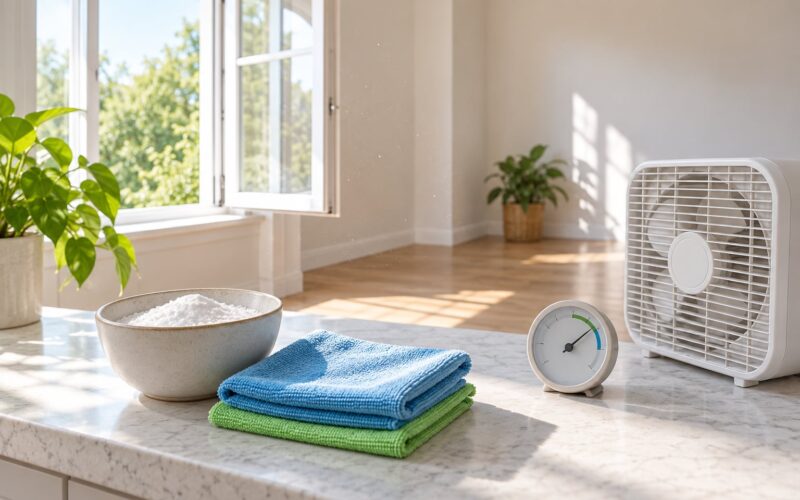
- Rolls of painter’s tape and clean towels, for temporary sealing of gaps you cannot fix permanently.
- Your local emergency alert list: evacuation routes, the air district phone number, your utility’s outage number, and sign-ups for text or email warnings.
- Two documented escape routes out of your neighbourhood and a meeting point outside the fire danger zone.
- A go bag per person with medication, a change of clothes, water, copies of insurance documents and a charged power bank.
Those are the ten that matter. The optional upgrades come after: a larger portable cleaner for the main living space, a DIY Corsi-Rosenthal box, door-sweep upgrades, and spare cabin filters for the car. If your budget covers only three things, cover respirators, spare furnace filters and one correctly sized HEPA cleaner.
Step-by-Step: How to Prepare Your Home for Wildfire Smoke Season
Work through these in order. The early steps happen once, weeks before smoke; the later ones are the behaviours you repeat for the duration of an event, and the final steps cover what to do after the air clears.
Check Your Local Smoke and Fire Risk Information
Know where the official numbers come from before you need them, because during a smoke event the first thing most people do is scroll through social media instead of checking a real measurement. The federal Air Quality Index, published at AirNow.gov, is the reference every local air district reports against.
Save two or three things to your phone: the AirNow site or app, your state or county air district page, and your emergency management office. Then sign up for the alert system your county uses, and write down the numbers for evacuation orders and your power utility while the lines are quiet.
Learn the alert vocabulary before the season rather than during it. A fire weather watch means conditions are possible. A red flag warning means extreme fire behavior is expected and ignition sources are more likely to start a fire. Extreme fire behavior refers to fire that is growing faster and behaving more aggressively than expected. None of these three is an evacuation order, and treating them as one sends people driving into smoke unnecessarily.
How to Prepare Your Home for Wildfire Smoke Season Indoors
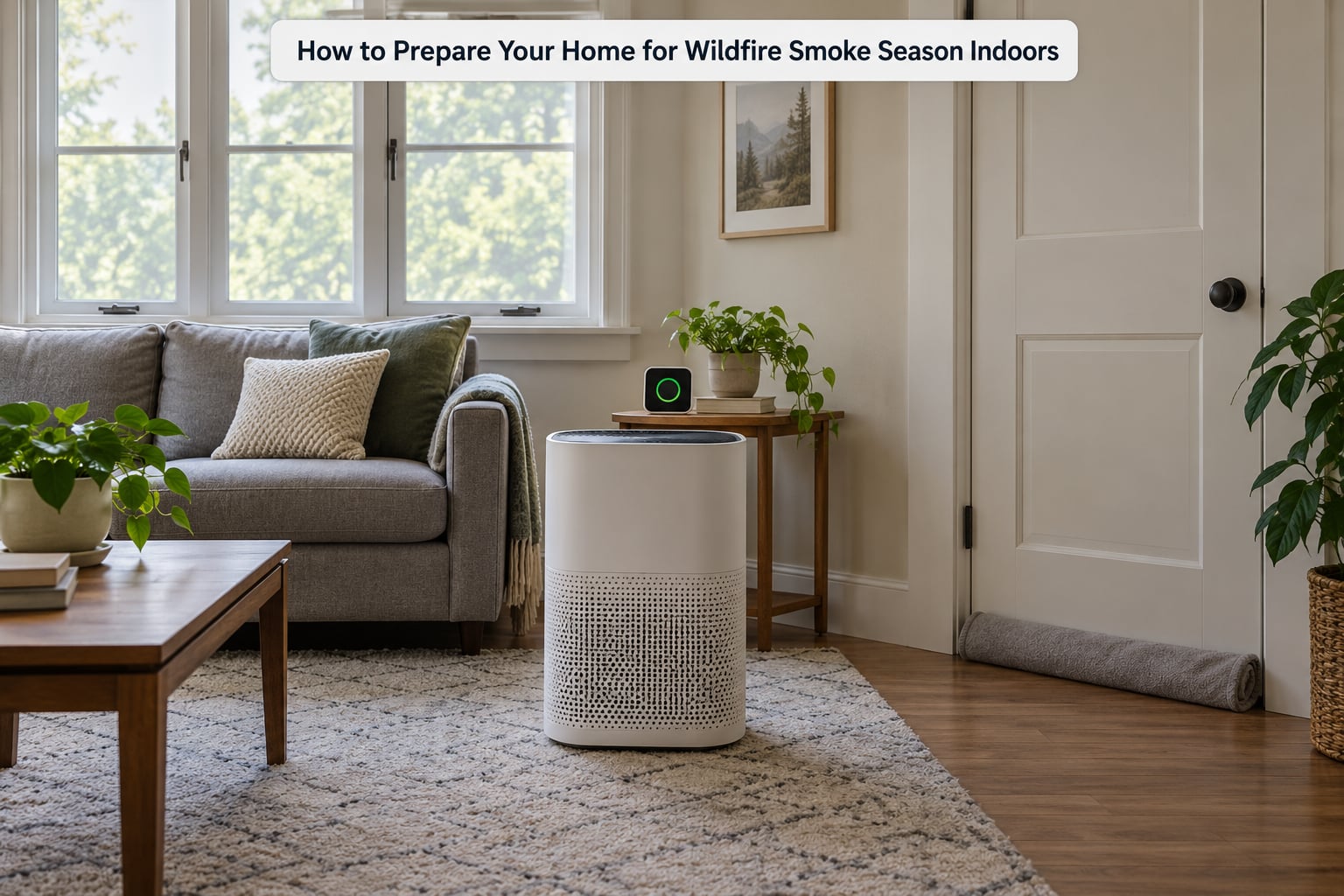
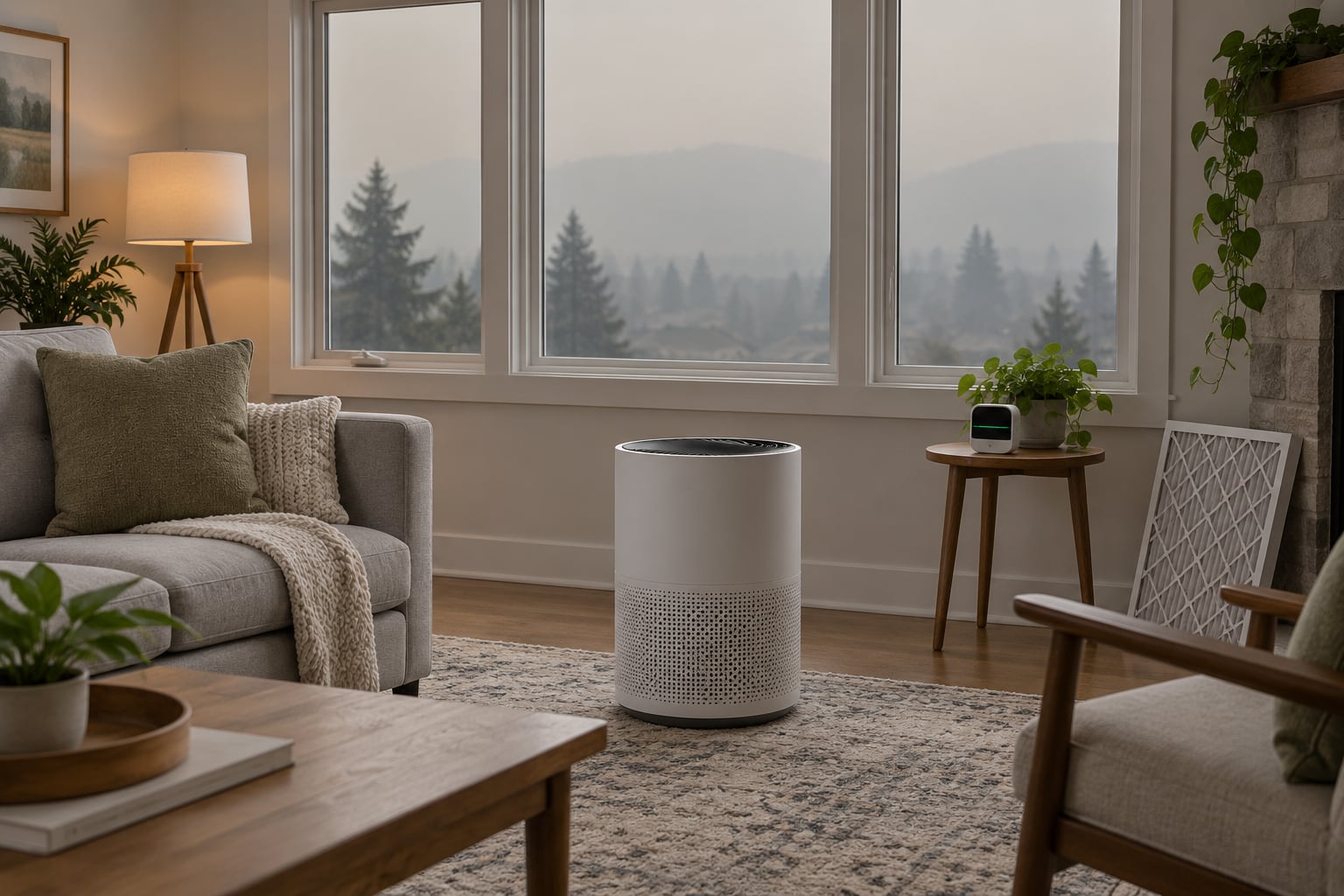
The core indoor method is simple: stop smoke coming in, filter the air already inside, and pick one room to defend properly rather than spreading a weak filter across the whole house. A single room with a properly sized cleaner and sealed gaps beats four rooms with one undersized machine between them.
Close all windows and exterior doors once outdoor air turns smoky, and do not reopen them for what feels like fresh air. On a bad day, opening a window is how you convert a filtered house into an unfiltered one. Keep interior doors closed as well, because that is what makes one room work as a barrier.
Do not run bathroom or kitchen exhaust fans during smoke. Those fans move air from inside to outside, and with the house closed up, the negative pressure they create pulls additional outdoor air in through every gap. This is the pathway most people forget, and it is why a house can smell worse after someone runs the shower fan on a smoky afternoon.
Size your air cleaner with the Clean Air Delivery Rating rather than by room square footage alone. Multiply the room’s area by the ceiling height for the volume, then choose a unit whose smoke CADR covers that volume several times over, ideally with the unit running on high while you are inside it. If the cleaner’s CADR is below the room volume for smoke, it cannot keep up and the particle count will keep climbing.
| AQI reading | Category | What to do at home |
|---|---|---|
| 0 to 50 | Good | Normal activity. Windows can stay open while outdoor air is this clean. |
| 51 to 100 | Moderate | Unusually sensitive people should reduce long outdoor exertion. Run the cleaner in the refuge room. |
| 101 to 150 | Unhealthy for sensitive groups | Everyone reduce prolonged outdoor exertion. Sensitive groups stay indoors with windows shut and filtration running. |
| 151 to 200 | Unhealthy | Stay indoors with windows shut. Sensitive groups avoid outdoor activity entirely. N95 required for any trip outside. |
| 201 and above | Very unhealthy to Hazardous | Remain in the filtered room. Only essential trips outside, with an N95, and reschedule everything else. |
Run the central system on recirculate rather than on fresh air whenever your equipment allows it. Recirculate moves indoor air through the filter without drawing outdoor air in, and even a basic MERV 13 filter removes a meaningful share of particles on each pass. Run the fan continuously during a smoke event rather than cycling it with cooling, because continuous filtration is what actually lowers the particle count.
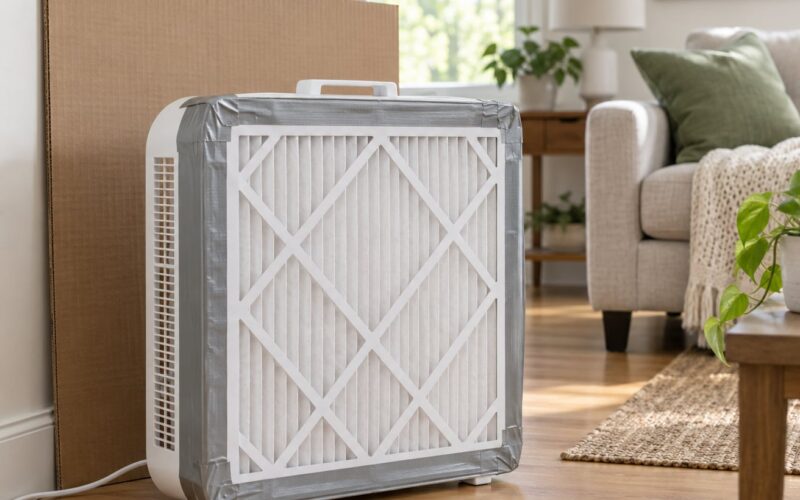
If you are comfortable with a small build project, a Corsi-Rosenthal box is a widely used community solution: a fan, a square of filter media and a box. It works well as a supplement in one room. Two safety caveats matter. Use a purpose-built filter sleeve or furnace filter rated for the fan, because loose media can shed and the fan must be rated for continuous running, and never wire it into an electrical circuit you have altered yourself. A licensed electrician should handle any new circuit.
Be realistic about odour. Particle filters capture the solids in smoke but leave the gases and vapours, which is why a house with everything closed can still smell strongly for days. An activated carbon pre-filter is the practical fix. Note that new carbon media often carries its own faint chemical odour, so wash or rinse it following the manufacturer’s instructions before you rely on it.
Protect and Check Your Heating and Cooling Systems
Your HVAC system is the one piece of equipment that filters a large volume of your home’s air, and it is also the biggest single pathway for smoke to enter. Replacing its filter before smoke season is a ten-minute job that pays off for weeks.
Fit the highest MERV rating your system is designed to accept, which is commonly MERV 13. A higher rating is not automatically better, because an over-restricted filter can freeze the coil or drop airflow. Check the manual or ask a licensed HVAC technician if you are unsure what your unit supports.
Set the thermostat to recirculate, and be clear with yourself about what cooling does. Air conditioning does not make outdoor air safe, and a window or packaged unit pulls outdoor air in by design. Running the AC to keep the house cool is reasonable, but the filtration benefit comes from the filter, not from the cooling itself. In a house without central cooling, keep the refuge room as cool as you can with closed blinds and a fan, and consider spending the first smoky days there.
During an event, check the filter visually through the access panel every few days. If it looks grey and loaded, replace it. Do not open panels, remove blower housings or touch anything electrical while smoke is present or a technician would be needed to fix a mistake. Anything beyond a filter swap and a thermostat setting belongs to a licensed professional.
Seal Gaps, Cover Vents and Reduce Smoke Entry
Smoke reaches your indoor air by three routes, and you have to close all three. Natural ventilation is open windows and doors. Mechanical ventilation is the HVAC fresh-air intake and any bath or kitchen exhaust fan running outdoors. Infiltration is leakage through cracks, joints and gaps around closed windows, doors, attic access hatches and utility penetrations.
Find the leaks with light rather than guesswork. With the house dark and a single bright lamp or flashlight outside a window at night, you can see thin lines of light around the frame. Close the curtain or blinds the next day and those lines mark the gaps worth sealing. Look for the same pattern under exterior doors, at the attic hatch, around dryer and bathroom vents, and where pipes and cables enter the wall.
Apply temporary measures with materials you can remove later. Folded towels wedged under a door, closed-cell foam tape on a window frame and removable weather stripping on a sweep all work and none of them is permanent. Do not caulk or permanently seal anything you may need for ventilation, and never block a combustion appliance vent, a dryer exhaust or a required ventilation opening. A house that cannot vent moisture and combustion gases is a different and more serious problem than smoke.
For homes in the urban-wildland interface, the exterior side of this conversation is worth a separate afternoon. Clear vegetation and dead material from the structure, keep a non-combustible first five feet around the house where you can, and fit 1/8-inch metal mesh over attic vents and other openings where embers can enter. That is structural hardening rather than smoke protection, and it belongs to your local fire department’s guidance for your specific construction type.
Protect Clean Air Spaces and Sensitive Belonging
The clean air room is a single bedroom or small living space you treat as a refuge, and it is the most effective indoor strategy because concentrating filtration in one place lets you actually reach low particle numbers.
Set it up in seven steps. Choose the smallest room that comfortably fits the people at highest risk. Close its door and keep it closed. Stop all indoor smoke and combustion sources in that room, which means no candles, no smoking, no gas or wood-burning heater and no frying that sets off the range hood. Run the portable cleaner continuously on high while the room is occupied. Run the central system on recirculate so the supply air through that room is filtered. Spend the smoky hours there rather than moving around the house. And wear a well-fitted N95 or KN95 for any trip outdoors, removing it indoors where it is not needed.
Store medicines, inhalers and medical equipment in a drawer or cabinet inside that room, and keep a week’s supply of anything you cannot replace quickly. Bedding, clothing and upholstery in an open closet will pick up odour and fine particles, so put them in sealed bins rather than relying on washing later.
Documents, photographs, paper records and electronics belong in lidded plastic containers or a sealed tote, since ash and fine particles lodge in ports and crevices and are tedious to remove. For pets, keep an indoor room available, bring in water, bowls and litter well before the event, and check with your veterinarian if any animal has a respiratory condition, because smoke affects animals the same way it affects people. If you have questions about a specific animal or a specific medical condition, ask your vet or your doctor rather than a forum.
Prepare for Power Interruptions and Ventilation Failures
Some smoke events take out power, and a power cut takes your clean air room with it if you have not planned for it. Assume the central system and any plug-in air cleaner stop, and plan the room around that.
Choose at least one cleaner that can run on battery or a small inverter, and keep that battery charged. If you have a portable unit only, place it where it can be recharged from a power bank or car inverter. Keep a flashlight, spare batteries and a battery radio in the refuge room, since a power cut also kills Wi-Fi and, after a few hours, mobile service can get congested.
Never run a generator, grill, camping stove, propane heater or car in a garage, shed or closed space, and never use candles or oil lamps for cooking or light during an outage. Carbon monoxide kills silently, and smoke already makes it harder to judge whether air is safe to breathe. If you need heat, a listed electric heater is the safer option, kept clear of anything that can burn.
If your system loses power and does not restart cleanly, do not troubleshoot it with the panel open. Shut the system down at the thermostat, note the time and what happened, and call a licensed technician once conditions ease.
Clean Smoke-Soiled Surfaces Without Spreading Ash
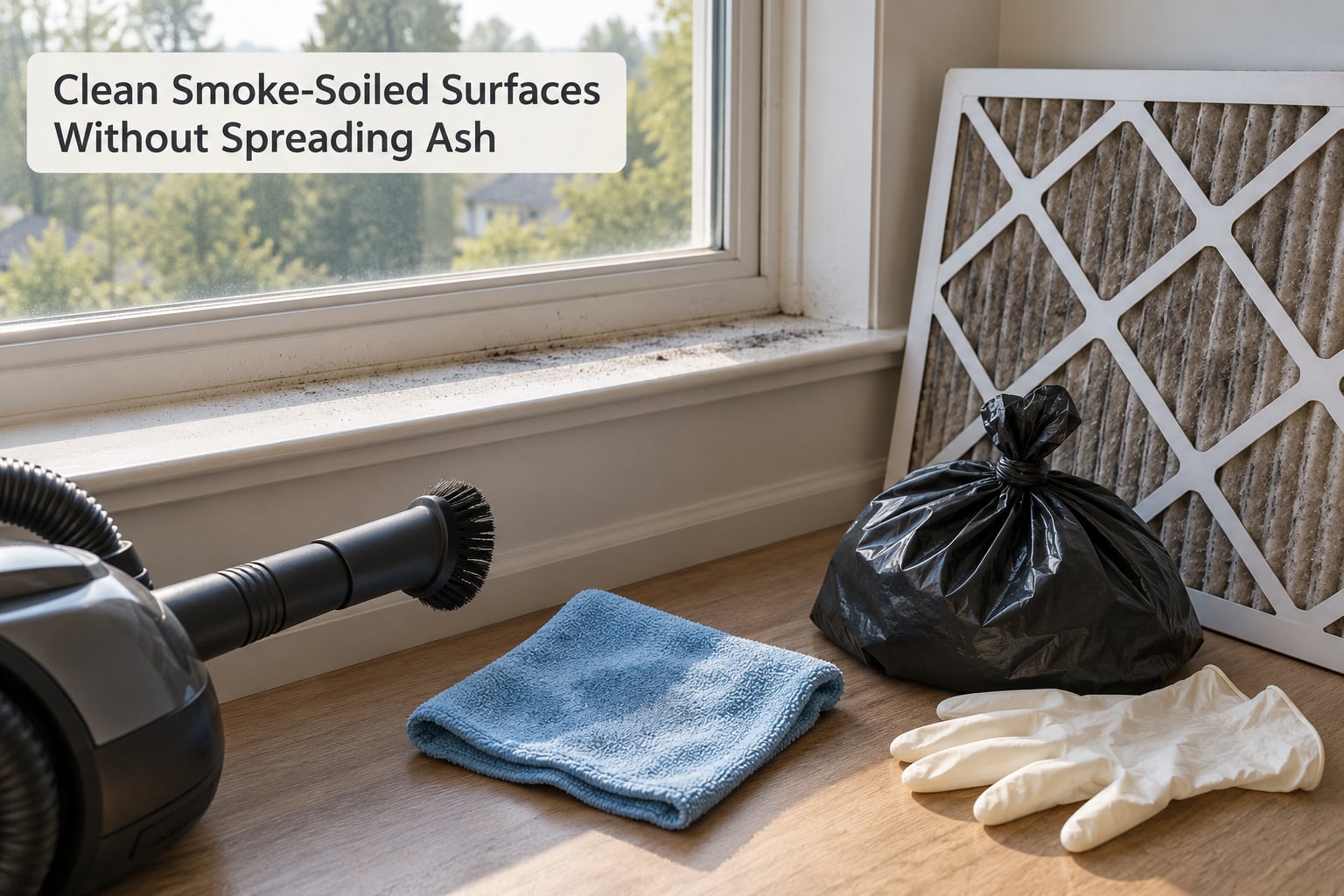
Cleaning is the step people get wrong under pressure, and the wrong move makes the air worse for everyone while you work. The rule is simple: do not disturb settled ash until the outdoor air has improved, and never put it back into the air.
Until the air clears, leave ash where it lies. Do not dry sweep it, and do not run a standard household vacuum over it, because both lift fine particles straight back into the room. A vacuum with a HEPA-rated attachment is the exception, used gently and with windows closed, if you must clean before the air improves.
Once AQI has dropped, clean wet first. Wipe horizontal surfaces with a damp microfiber cloth or a barely damp rag, working from the far corner of the room toward the door so you do not re-step on what you have cleaned. Wipe blinds, sills, shelves and the tops of cabinets. Do not let water run into electronics or saturate carpet and upholstery.
Collect the residue and the spent filter in a sealed bag and put it in your outdoor waste bin rather than your household recycling. Wash soft furnishings only when the outdoor air is genuinely clean, because putting a smoke-loaded load through a machine while the air is still poor releases trapped particles back into the room. Replace the furnace filter once the event is over, since a loaded filter is no longer doing useful work.
Call a professional rather than doing it yourself when soot is heavy or widespread, when it sits inside an appliance or duct, when you suspect water or electrical damage from a firefighting effort nearby, or when anyone in the household has asthma severe enough that dust and stirring are a serious risk. A restoration contractor with proper containment can do this far more safely than an open window and a damp cloth.
Create a Household Smoke Readiness Plan
A plan only works if everybody in the house knows their part, and that conversation is worth having once, calmly, before smoke season rather than at the worst moment of an event.
Assign roles. One person monitors AirNow and the alert system. One person handles the refuge room, including the filter check and the supply of masks. One person owns the go bags and the pet supplies. If your household includes someone with mobility limits, oxygen, a powered wheelchair or a home health worker, plan that person’s needs specifically, including whether backup power for their equipment is covered.
Decide your triggers in advance. Write down the AQI reading at which the family moves into the refuge room, and the conditions under which you relocate outside the region entirely. Include the number to call for evacuation orders and the decision about who drives whom, especially if you do not have more than one vehicle. Practise the route once, at night, so the turns are familiar.
Plan for communication, not just escape. Sign up for two different alert channels in case one fails, keep a battery radio in the refuge room, and agree on a single family chat thread rather than relying on individual calls. Talk to children in plain terms about why the air is orange, and keep the routine predictable. Long smoky stretches are stressful for adults and for kids, and normal meals and bedtimes matter more than most people expect.
Finally, know when leaving is the answer. If your area is under an evacuation order, leave early while routes are open. If your home cannot be made safe to breathe in, has lost power and cooling, or has structural damage, being somewhere with filtered air is the correct response. Residents who are at higher risk should have a plan to relocate before conditions deteriorate, not after.
Common Mistakes
Almost every smoky-week regret falls into one of a handful of predictable categories, and each has a simple correction.
Opening windows for fresh air. If the outdoor AQI is above about 100, outdoor air is the problem, not the solution. Keep windows closed and run filtration. Open them only while the outdoor AQI is 50 or below, which is the best time to air out the whole house after a passing event.
Running exhaust fans. Bathroom and kitchen fans move air outdoors and pull replacement air in from cracks. Leave them off during smoke, and close the vent flaps on the way out.
Wearing a cloth or surgical mask. These do not seal to the face and do not filter fine particles. Use a well-fitted N95 or KN95, and check that it is genuinely certified and not a loose dust mask.
Forgetting the HVAC filter. A clogged filter quietly reduces airflow and filtration. Buy spares in advance, and swap them when they look loaded rather than on a fixed annual schedule.
Using the system on fresh air. Fresh air mode pulls outdoor air in through the intake. Recirculate is the setting that filters what is already in the house.
Running a generator or stove indoors. Carbon monoxide is odourless and lethal, and a smoky house makes it harder to notice poor ventilation. Outdoors, far from openings, or not at all.
Dry sweeping or vacuuming settled ash. Both put particles back into the air. Wait for clean outdoor air, then wipe wet and collect in a sealed bag.
Expecting a HEPA cleaner to fix the smell. Particle filters do not remove gases and vapours. Add activated carbon if odour is the issue, and pre-wash it per the maker’s instructions.
Waiting until the air is bad to shop. Respirators, filters and portable cleaners vanish quickly once the smoke arrives. The whole point of this guide is to finish the buying beforehand.
Doing nothing to the exterior. If your home sits in the urban-wildland interface, smoke season is also fire season. Defensible space, cleared vegetation and ember-resistant vents protect the structure itself, and your fire department has local guidance for the construction types in your area.
Frequently Asked Questions
How long does wildfire smoke stay in your lungs?
Fine particles from smoke can reach the gas exchange surfaces of the lungs within hours of breathing them in, and the irritation can persist for days afterward. Some of the burden is long-lasting: the fine fraction of PM2.5 passes into the bloodstream, which is why repeated exposure is linked to cardiovascular risk as well as to coughing and airway irritation. If you have asthma or COPD, talk to your clinician about a written action plan before the season rather than waiting for symptoms.
How do I keep wildfire smoke out of my house?
Close all windows and exterior doors, close interior doors to your refuge room, set your HVAC system to recirculate instead of fresh air, and turn off bathroom and kitchen exhaust fans. Seal the obvious leaks with removable weather stripping or towel folds under doors, especially at night when you can see light coming through gaps. Then run a properly sized HEPA cleaner in one room with its door closed. That combination addresses all three entry routes: open windows, mechanical ventilation and infiltration.
Should you run AC with wildfire smoke?
You can, and keeping the house cool matters most for young children, older adults and anyone with a respiratory condition, but the cooling itself does not clean the air. A window or packaged air conditioner brings outdoor air indoors by design, and a fresh-air or heat setting does the same. Run the system with the thermostat on recirculate and a MERV 13 filter if your equipment allows it, and keep the refuge room closed and separately filtered. Your unit’s manual is the right place to confirm what modes it supports.
What air quality index is dangerous for health?
There is no safe threshold for wildfire smoke specifically, because particles come from burning organic material rather than from a pollution standard. As a practical guide, AQI 101 to 150 already triggers advice to cut back on outdoor exertion, 151 to 200 means sensitive groups should stay indoors, and anything above 200 is a signal to remain in a filtered room and make only essential trips outside. People with heart or lung disease, pregnant people, children under five and adults over 65 should treat lower numbers as more serious than average.
Should I open windows when wildfire smoke is bad outside?
No. On a smoky day, opening a window is the fastest way to bring PM2.5 into a house you have just filtered and sealed. The rule of thumb is to open windows only when the outdoor AQI is 50 or below, and the best moment for a full airing-out is right after a smoke event passes, on the first clean or moderate day. Before a season starts, find and seal the leaks around your windows and doors so closing them actually works, since a closed window that leaks around the frame helps you very little.
Do Corsi-Rosenthal boxes work for wildfire smoke?
They work reasonably well as a supplementary cleaner for a single room, and they are popular because they are cheap and can be assembled from a fan, a box and filter media. They are not a substitute for a sealed room, a closed door or a properly sealed HVAC system. Use filter media in a proper sleeve or a furnace filter rated for the fan, make sure the fan is rated for continuous running, and do not modify your electrical wiring or add new circuits yourself. Have an electrician handle any hardwiring, and expect more noise than a commercial unit.
Conclusion
If you do five things, do these: buy respirators, spare MERV 13 filters and one correctly sized HEPA cleaner while everything is easy to find; save AirNow and your local alert sign-ups to your phone; identify and seal the leaks around your doors and windows; choose one room and set it up as a filtered refuge with the door kept closed; and write down your AQI threshold, your two escape routes and your go bag location.
Everything after that is repetition, and repetition is the whole skill. Check the AQI, keep the windows shut, recirculate, stay in the refuge room when the number climbs, and only clean the ash once the outdoor air is clean again. Keep your purifier running, your filters fresh and your go bag where you can reach it, and check on anyone in your household who breathes more easily than the rest of us.