You can cut water heating costs without a new water heater by attacking two things: the heat your tank loses while it sits idle, and the amount of hot water your household burns through. Turn the set point down toward the manufacturer’s recommended temperature, cut gallons used, and insulate the accessible pipe runs. A dripping faucet or a toilet that runs silently is often worth more than any of them.
Water heating sits somewhere between 14 and 25 percent of a typical US home’s energy bill, per the US Department of Energy. That makes it the second-largest thing most households pay for, after space heat, and it is the one most people leave alone for years.
This guide is deliberately repair-first. Nothing here requires replacing the unit, and nothing here asks you to open a gas burner, move an electrical panel or cut into a wall. Where a job crosses that line, the answer is a licensed plumber or a water-heater technician, and I say so at every step.
Table of Contents
- What You Need
- Step-by-Step: How to Cut Water Heating Costs Without a New Water Heater
- Step 1: Find Where Hot Water Is Being Wasted
- Step 2: Repair Leaks and Drips
- Step 3: Use Low-Flow Fixtures Correctly
- Step 4: Insulate Accessible Hot-Water Pipes
- Step 5: Shift Some Uses to Cold Water
- Step 6: Adjust the Water-Heater Settings Safely
- Step 7: Improve Insulation and Airflow Where Permitted
- Step 8: Measure Savings and Keep Up Good Habits
- Common Mistakes
- Tips for Renters and Landlords
- Frequently Asked Questions
- Can I save money on an electric water heater without replacing it?
- Is it cheaper to repair an old water heater than replace it?
- What can a renter do to reduce water-heating costs?
- Will low-flow showerheads lower my water pressure too much?
- How do I lower water-heating costs on a heat-pump water heater?
- Conclusion: Start With Leaks and Everyday Demand
What You Need
Start with a baseline, because you cannot tell whether a change worked if you never measured the starting point. Pull three months of utility bills and find the water-heating line item. Then note the meter readings, or photograph the meter dial, on the same day and at the same time of day.
You also need:
- Your bills and a meter reading to establish the baseline.
- The manual or model number for your heater, so the set-point guidance you read matches your unit.
- One or two kitchen thermometers to check delivered water temperature. Two let you measure hot and cold at the same time.
- A cup and a dye tablet for a toilet leak test, plus a small flashlight and adjustable wrench for visible fixture checks.
- Your plumber’s number and, if you rent, your landlord’s, written down before you need it.
- Written permission if you rent, for anything beyond a bulb or an aerator screen.
Anything involving gas valves, burner assemblies, the flue, combustion air, the electrical breaker panel, or plumbing inside a wall belongs to a qualified professional. So does anything that involves cutting into a stud or moving a clearance requirement. Knowing where that line sits before you start saves a lot of hesitation.
Step-by-Step: How to Cut Water Heating Costs Without a New Water Heater
Work in this order because the early steps are free and the later ones cost money. If you stop after step three, you will still have taken the largest share of the available saving.
Step 1: Find Where Hot Water Is Being Wasted
Measure before you change anything. Time a few showers with a stopwatch, note how many loads of laundry you run hot, and check whether the dishwasher runs on a heated cycle or a cool one. These three numbers explain most of a household’s hot-water demand.
Then look for the loads nobody counts: a spigot left running while someone brushes teeth, an outdoor hose on a timer, a hot tap feeding a washing machine during the rinse, a second shower running while the first person is still in the shower. Continuous loads are the easiest waste to find because they run when nobody is looking.
Write your estimate down. Three weeks later you will compare it against the same three numbers, and the comparison tells you whether you changed anything real.
Step 2: Repair Leaks and Drips
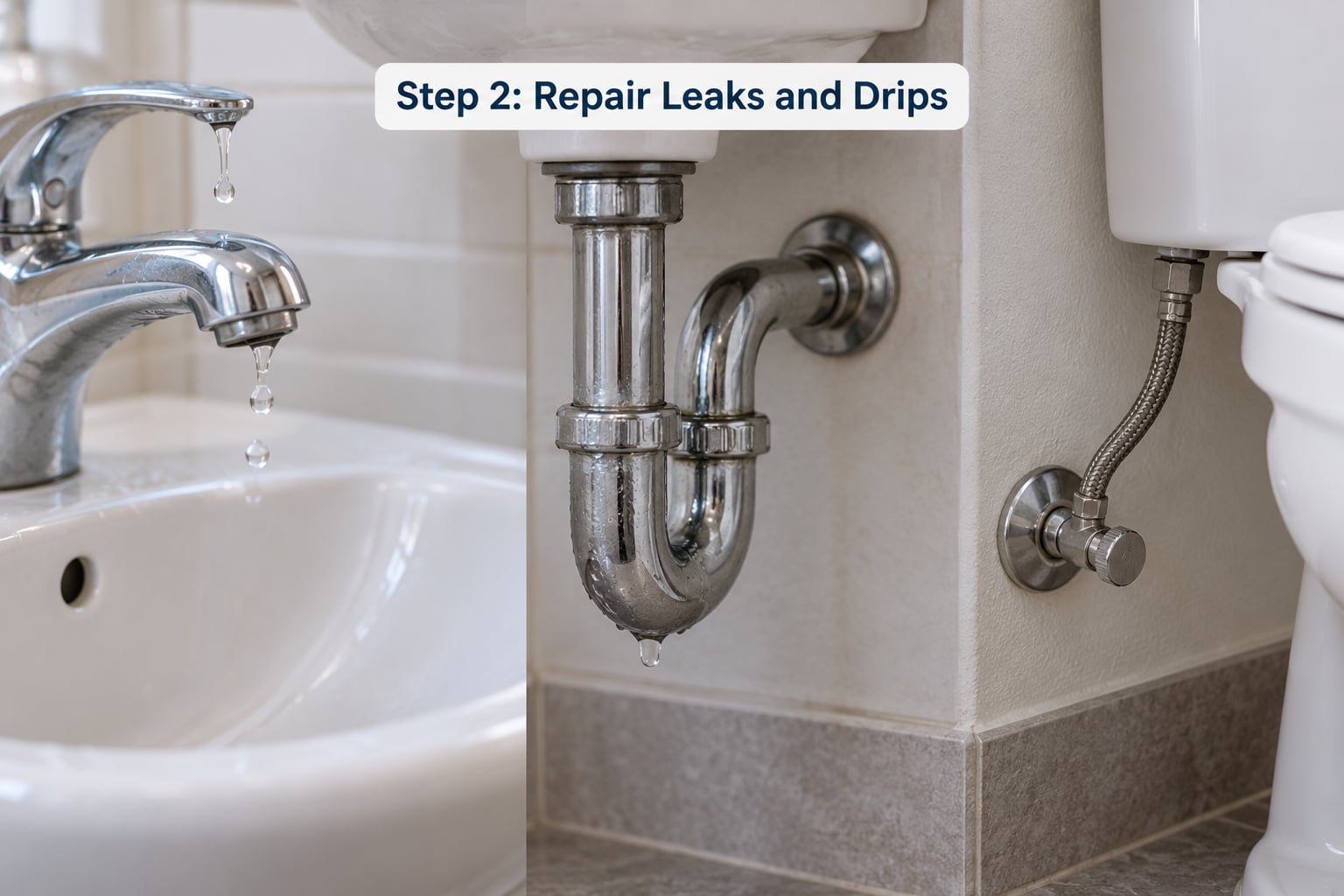
A single dripping faucet can add a surprising amount of heated water over a year, and it is pure loss. Put a cup under the drip for an hour and time how many drops land in it; that gives you the rate without any tools.
Toilets waste more and hide it better. Drop a dye tablet in the tank, flush, wait ten minutes and come back. Colour in the bowl means a leak. The same trick catches a toilet that keeps running after a flush: if the water keeps moving, the flapper or fill valve is passing.
Toilets also work as a whole-house detector. Turn off every tap, close the toilet lid, and watch the meter. If the dial keeps moving, something is leaking upstream, and the meter is telling you so while you sleep.
Safe fixes stay inside the fixture: replacing a dripping faucet cartridge or worn washer, tightening a loose supply connection with a quarter turn, replacing a toilet flapper or fill valve. Signs that mean stop and call a licensed plumber are a leak inside a wall, water staining on a ceiling or floor, a slab or foundation leak, a slow drain that never catches up, or anything frozen. A shower valve behind tile is not a weekend job.
Step 3: Use Low-Flow Fixtures Correctly
Cut gallons at the fixture, not by turning the pressure down. A showerhead rated at 2.0 gallons per minute instead of 2.5 removes roughly 7.5 gallons from a ten-minute shower, and across a household of four that adds up to thousands of gallons a year. An aerator screen costs about a dollar and does the same job at a bathroom sink.
Check the result instead of trusting the label. Fill a one-gallon container in the shower and time it; 2.0 gpm should take about 30 seconds, 2.5 gpm about 24. If your new head barely trickles, the household pressure is low and you may have tightened the wrong end of the system.
Two mistakes to avoid. Do not compensate for a weak shower with a longer shower, which wastes the saving and then some. And if you own a tankless unit, note the minimum flow rate in its manual: many tankless heaters shut down or throw error codes when demand drops too low, and a very low-flow head can trigger that.
Step 4: Insulate Accessible Hot-Water Pipes
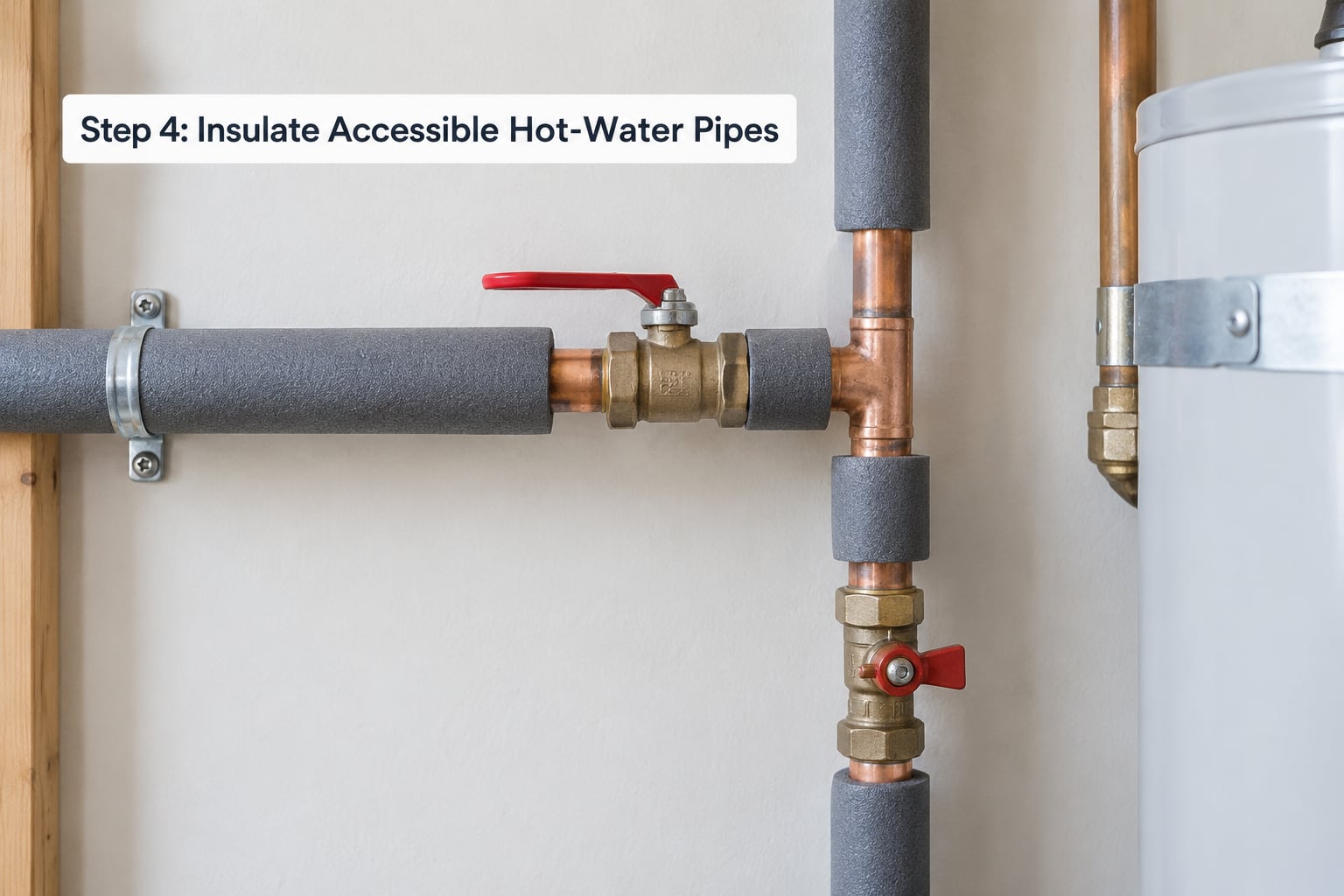
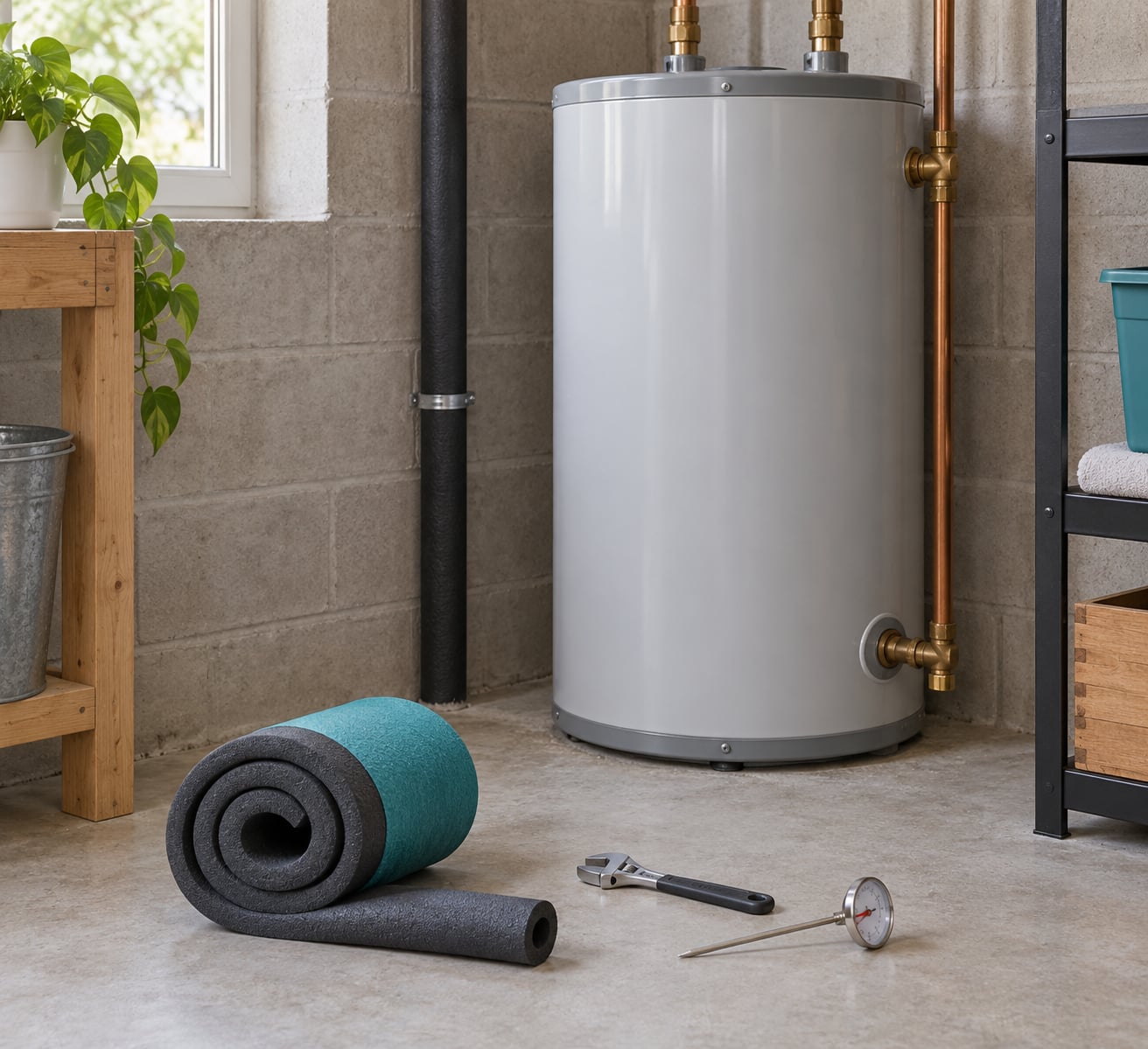
Insulating accessible distribution pipe does not cut energy use. What it cuts is the wait: less heat escapes between the tank and the faucet, so the tap runs cold for a shorter time before hot water arrives. Shorter wait means shorter showers, and shorter showers cut fuel.
For runs you can reach in a crawlspace, basement, garage or under a sink, use closed-cell or rubber foam sleeves sized to the pipe. Fit them snugly, cut them at clean angles at each joint, and leave every valve, fitting and cleanout accessible. Secure them with tape or cable ties so they do not slide off, and seal the seams well since air gaps defeat the point.
Skip anything hidden in a wall, ceiling or floor, and skip anything you would have to cut a hole to reach. Keep sleeves well clear of any gas line or gas vent. If you find a section you cannot safely reach, write it down and let a plumber quote it alongside any other work.
Step 5: Shift Some Uses to Cold Water
More of your household’s water use can be cold than most people assume. Rinsing dishes after a scrape, rinsing produce, handwashing at a cool tap, brushing teeth and cold-cycle laundry all take nothing from the tank. Run the dishwasher on its heated cycle when the loads are heavily soiled, and cold otherwise.
Some tasks need hot water, and guessing wrong here costs you. Laundry for young children, bedding, towels and anything sanitised needs warm or hot water. Do not cool a wash that has to sanitise.
The fuel source decides how much this saves. On an electric or gas storage tank, a cold wash is a straight reduction in fuel burned. On a heat-pump water heater, a cold wash is also less runtime on a heat pump, so it helps more. On an electric resistance unit, the tank has to reheat after every draw, and cutting draws cuts reheating cycles directly.
Step 6: Adjust the Water-Heater Settings Safely
Most tank heaters leave the factory at 140F, and many households never move the dial. The manual states a recommended range for domestic use, and the middle of that range is almost always lower than the factory setting. Where a manufacturer or local code specifies a minimum, follow it, and treat that minimum as a floor rather than a suggestion.
Adjust only what is meant to be adjusted: the temperature dial or the display, the vacation or low setting, and a timer control already designed for the unit. Do not remove covers, do not change wiring, and do not touch anything on a gas or heat-pump unit that is not a user-facing control.
Think about who uses the water. Water at or above 130F can scald skin in seconds, and children, older adults and anyone with reduced sensation are the ones at risk. If your household includes any of them, a thermostatic mixing valve at the tub and a showerhead with a high-temperature block handle are safer than compensating for a hot tank with a stricter routine at the tap.
Call a technician when you see a thermostat that will not hold set point, a burner that cycles on and off repeatedly, a tank that is leaking from the relief valve, water that smells or tastes metallic, or a pilot that will not hold. Those are symptoms, not settings, and no amount of adjusting will clear them.
Step 7: Improve Insulation and Airflow Where Permitted
Older tanks often have thin or missing insulation, and in an unheated garage, basement or exterior closet the tank loses heat faster than anything else in the home. Where the manufacturer’s instructions and local code allow a tank insulation jacket, an R-8 or better blanket can cut heat loss noticeably. Read the warranty first, though: a poorly fitted blanket can trap moisture against the tank, and that has been reported back as a warranty problem.
Airflow in the room matters too. A water heater needs air at its intake and a clear path for combustion gases, and an approved installation depends on that clearance. You may be able to seal a drafty wall or an uninsulated door near the unit, but you may not block a vent, reduce a clearance or alter combustion air. On a gas unit, treat the flue, the draft and anything above the jacket as off limits entirely.
Step 8: Measure Savings and Keep Up Good Habits
Compare comparable periods, not adjacent ones. A cold January and a warm March will convince you that your change worked when it did nothing, so subtract seasonal effects by comparing the same billing period across years. A gas household wants a weather-normalised usage figure rather than a raw total.
Change one variable at a time where you can. If you turn the set point down, install a new showerhead and fix a faucet in the same month, a good result tells you nothing about which change did the work. That matters when you decide what to keep next year.
Then keep the habits that worked. The behaviour changes, the dye tablets, the shorter showers, the cold laundry, those cost nothing and they survive a move or a bad month. Settings drift and need a check, so look at the tank controls twice a year.
Common Mistakes
Setting the heater far below the recommended temperature. Below the manual’s range, demand for hot water rises because more people run the tap longer to get comfortable water, and you spend the saving on wasted water. Fix: use the recommended range, not the coldest the dial offers.
Covering a vent, draft or intake. This is a combustion risk, not a saving. Fix: leave every vent and clearance exactly as the manufacturer and code require.
Changing gas or electrical parts yourself. Thermocouples, igniters, elements, breakers and wiring belong to a licensed professional. Fix: schedule the repair and keep trimming the water use in the meantime.
Insulating a hot or combustion-related component. A jacket over a flue connector, a draft or an intake can trap heat where it does not belong. Fix: blanket the tank only, and only where the instructions and warranty allow it.
Installing incompatible fittings or low-flow heads. A fixture below a tankless unit’s minimum flow rate, or a thermostatic cartridge that fights an older system, causes failures. Fix: check the manual for the flow range before you buy.
Judging results from one unusually warm billing period. Fix: compare the same season year over year, and read the meter before and after each change.
Tips for Renters and Landlords
Tenants can still do real work without touching the tank. Aerator screens, a low-flow showerhead, a dye-test leak report with dates and meter readings, cold laundry, shorter showers, a cold dishwasher cycle and a report of a running toilet are all tenant-level changes or evidence. Send the evidence in writing and keep a copy. When a request arrives without a measurement, it is much easier to ignore.
Ask the owner about a timer control, a vacation setting or an insulation jacket rather than trying to install them. Responsibility shifts when the fix is structural or in the common system: a leak inside a wall, the heater itself, the flue, the panel, or insulation in a shared utility area.
Landlords get more from a fixed order than from a reminder. Fix leaks first, because wasted water is wasted fuel and it keeps running. Then upgrade fixtures to low-flow, which cuts demand permanently and reduces the load on every appliance. Then check the tank insulation and the approved air and combustion clearances. Then service the unit, and set up a schedule for the annual sediment flush that hard water makes necessary. Track what each step cost and what it returned; that record is the argument for the next round of repairs.
Frequently Asked Questions
Can I save money on an electric water heater without replacing it?
Yes. An electric resistance tank pays for every gallon you heat and for heat escaping the tank walls, so both levers work well: use the manualu0026#8217;s recommended set point rather than the factory setting, and cut gallons with shorter showers, low-flow fixtures and cold-cycle laundry. Add a jacket if the warranty allows it, and flush sediment in hard-water areas. Never open the element housing or panel yourself.
Is it cheaper to repair an old water heater than replace it?
Often, for the repairs you can do quickly. Replacing a cartridge, a flapper, a fill valve or a sacrificial anode is cheap next to a new unit, and it can restore efficiency on a tank that still holds water. Once a tank leaks from the tank body, the relief valve fails repeatedly, or the burner or elements are at the end of their life, repair costs stop making sense. Get a technicianu0026#8217;s diagnosis before you decide.
What can a renter do to reduce water-heating costs?
You control demand, not equipment. Switch to low-flow showerheads and aerators, wash laundry cold, run the dishwasher cool except for heavy loads, and keep showers to five or six minutes. When you suspect a leak, run a dye test or watch the meter and report it in writing with dates and readings. Ask the owner about a timer, a vacation setting or a tank jacket rather than installing them yourself.
Will low-flow showerheads lower my water pressure too much?
Not usually. A low-flow head limits the headu0026#8217;s maximum output, not the householdu0026#8217;s supply pressure, so other fixtures keep running normally. If your new shower feels weak, test it by filling a one-gallon container: about 30 seconds means 2.0 gallons per minute, about 24 seconds means 2.5. On a tankless unit, check the manualu0026#8217;s minimum flow rate first, because some units shut down below it.
How do I lower water-heating costs on a heat-pump water heater?
A heat-pump unit has a storage tank, so the same set-point guidance and hot-water discipline apply, and the savings compound because the tank reheats with electricity. Beyond that, keep the air filter clean and the airflow path clear, keep the unit in a space where the surrounding air is not freezing, and avoid running a second electric resistance backup element. Check the manual for its low-demand settings before changing anything.
Conclusion: Start With Leaks and Everyday Demand
Most households can move a real amount of money without ever shopping for a water heater. Learn how to cut water heating costs without a new water heater by starting in this order: repair the leaks and running toilets, then reduce the low-value hot water you use every day, then check the temperature setting and the insulation on the pipe runs you can safely reach. Those three cost little, require no gas or electrical work, and compound each other.
Keep the habit of measuring. Meter readings before and after, and the same billing season year over year, tell you far more than a warm month. And when the next step is gas, electrical, combustion air, the flue or a leak inside a wall, stop and call a licensed plumber or water-heater technician first.