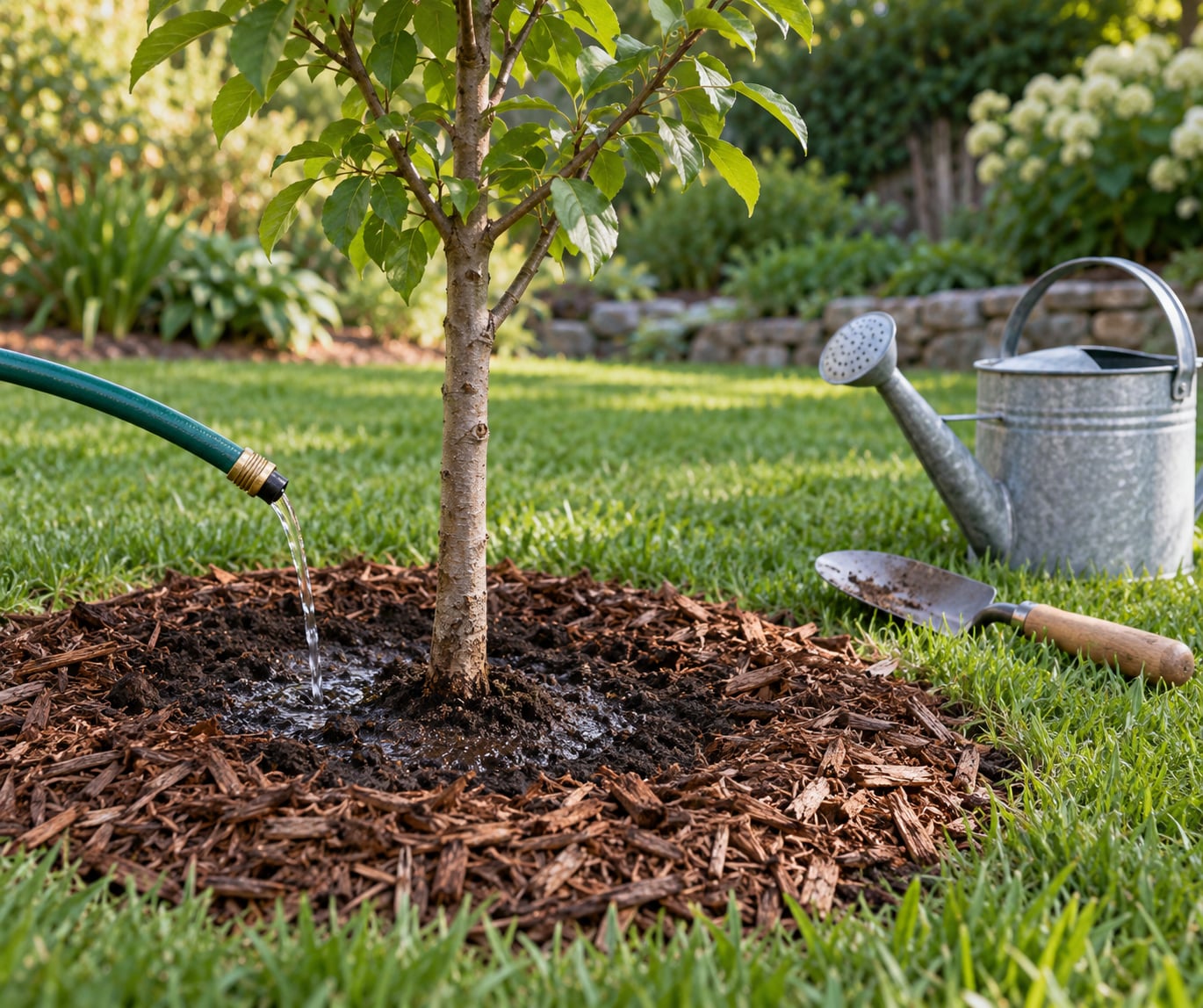
To water a newly planted tree correctly, apply water slowly and deeply over the root zone, using about 1 to 1.5 gallons per inch of trunk caliper each time, every one to three days for the first 12 weeks, then weekly until the roots are established. The whole routine takes about 20 minutes of your attention and no special skills, but getting the amount, the pace and the placement wrong is what kills most new trees.
I have buried a lot of young trees badly and watered a few even worse, so I am going to give you the routine I use now rather than the vaguer advice most nurseries hand out. The short version is that less frequent and longer beats daily sprinkles every time.
Table of Contents
- What You Need
- Step-by-Step: How to Water a Newly Planted Tree Correctly
- Check the soil before watering
- Water slowly and deeply
- Add mulch without touching the trunk
- Watch for signs of too much or too little water
- Set a schedule and adjust it
- Adjust the schedule for soil, climate and season
- When to stop watering a new tree
- Common Mistakes
- Frequently Asked Questions
- How often should I water a newly planted tree?
- How much water does a newly planted tree need each time?
- Should I water a newly planted tree every day?
- How do I know if my newly planted tree is getting too much water?
- Can I use a sprinkler or soaker hose for a new tree?
- When should I stop watering a new tree?
- Start Here: The First Thing to Do Tomorrow
What You Need
You do not need irrigation equipment or a big budget. You need somewhere for water to come from slowly, a way to check the soil, and a mulch ring.
- A watering can with a rose, or a garden hose with a flow-controlled nozzle or a diffuser
- A soaker hose or a few dripper stakes for larger trees and repeat visits
- A 5-gallon bucket with small holes drilled in the base, which is a serviceable poor-man’s watering bag
- A hand trowel or a soil moisture meter, and optionally a wooden dowel or chopstick to probe deeper
- A 2 to 4 inch layer of arborist wood chips or shredded bark, not plain pebbles
- A hose timer, so a long soaker session can run while you are elsewhere
Skip the decorative river rock mulch. It does not hold moisture the way bark does, and it can heat the root zone on a hot afternoon.
Step-by-Step: How to Water a Newly Planted Tree Correctly
Four steps, in this order, every time you water. The first one is the one people skip, and it is the reason their schedule never works.
Check the soil before watering
Do not water on a calendar alone. Push a finger or a trowel into the soil about 4 to 6 inches down, right at the edge of the rootball, and see what comes back.
If it comes out cool and damp and clumps hold together, the tree does not need water yet. If it is warm, dusty and falls apart as you lift it, it is time. In a damp soil you can push a wooden dowel 8 to 12 inches down and pull it out to check deeper, though a proper soil moisture meter gives you a quicker reading without the guesswork.
Do this on the same side of the tree each time, at roughly the same depth. You are looking for a trend, not a number.
Water slowly and deeply
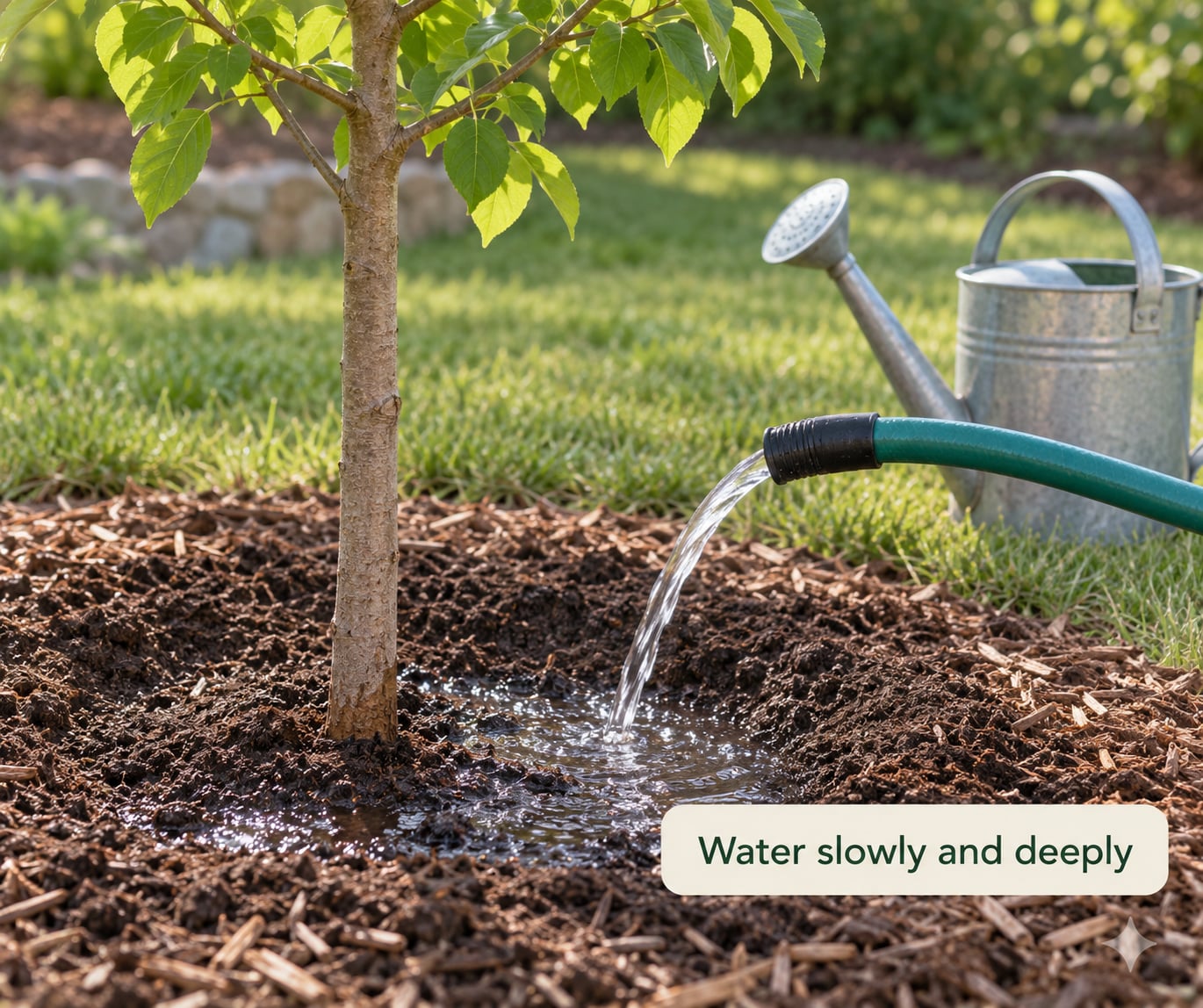
Watering slowly and deeply means the water soaks in rather than running off, and it means it reaches the bottom of the root zone, roughly 12 inches down for a young tree. University of Minnesota Extension gives the volume as 1 to 1.5 gallons per inch of trunk caliper at every watering; Denver Water uses 10 gallons per inch of trunk diameter spread across the season, which lands in the same range once you divide by the number of waterings.
| Trunk diameter (caliper) | Gallons per watering | Litres per watering | Estimated time to root establishment |
|---|---|---|---|
| 1/2 to 1 inch | 1 to 2 gallons | 4 to 8 litres | 1.5 years |
| 1 to 2 inches | 2 to 3 gallons | 8 to 12 litres | 2 to 3 years |
| 2 to 3 inches | 3 to 5 gallons | 12 to 20 litres | 4 to 5 years |
| 3 to 4 inches | 5 to 7 gallons | 20 to 26 litres | 6 to 7 years |
| 4 to 6 inches | 7 to 10 gallons | 26 to 40 litres | Up to 9 years |
Where the water lands matters as much as how much. During establishment, concentrate it on the rootball and the backfill hole, then widen the circle as roots grow outward. University of Minnesota Extension notes that new roots extend roughly 18 inches a year, so the wetted area you used at planting is far too small by the end of summer.
Spread the volume around the trunk rather than in one spot, and keep water off the trunk itself. Water sitting against the bark invites root and crown disease, which UC Cooperative Extension Master Gardeners call out specifically for landscape trees.
Now the pace. Turn the hose down to a trickle you could barely hear from a few feet away, or set a soaker hose flat on the soil. UC ANR Master Gardeners advise moving a hose around every few hours rather than letting one spot soak. A practical rule is that the session should last long enough to deliver the volume at your device’s flow rate, and that is usually 15 to 30 minutes for a small tree.
If water pools and runs off into a gutter instead of soaking in, you have compaction or clay. Do not add more water and volume. Use cycle and soak instead: run for five minutes, stop for fifteen to twenty, run again, and repeat until the volume is delivered. A 3 to 4 inch soil mound at the edge of the root zone, which UMN Extension recommends, slows the water enough to hold it.
Add mulch without touching the trunk
Spread 2 to 4 inches of shredded bark or arborist chips over the root zone, and pull it back so it never sits against the trunk or covers the root flare. Mulch piled against the trunk traps moisture at the bark, which is how you get root rot in a tree that looks perfectly watered.
During establishment, keep mulch off the freshly disturbed rootball itself rather than heaping it over the top, and stay under about 4 cm until the planting has settled. Beyond the mulch ring, get rid of grass and groundcover out toward and past the drip line, the outer edge of the canopy, for at least the first couple of growing seasons. Turf competes for the same water and keeps the surface damp in a way that discourages the deep rooting you are aiming for.
One mulch job, done properly, cuts your watering frequency noticeably through a dry summer.
Watch for signs of too much or too little water
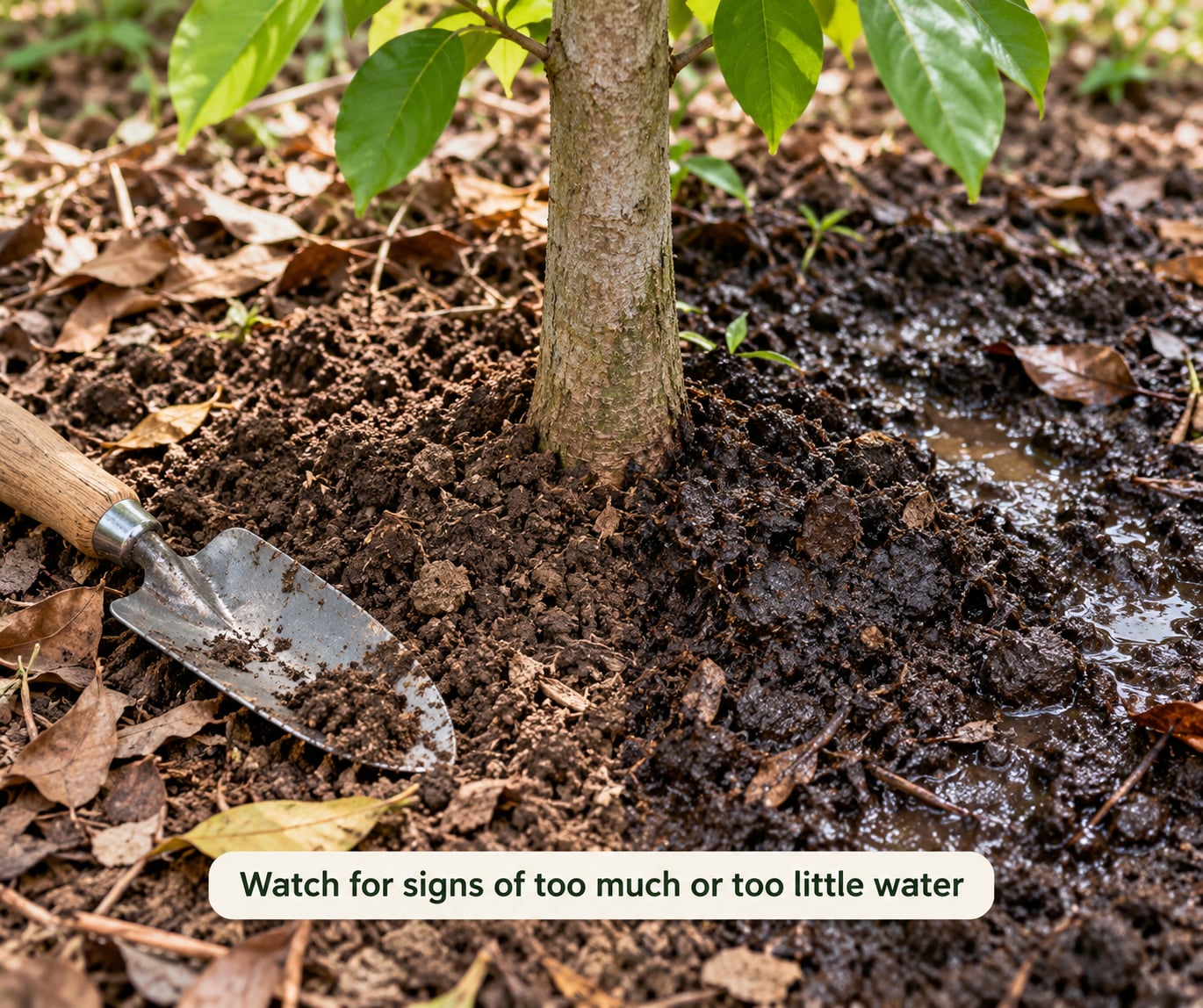
Overwatering kills more new trees than underwatering does, and the two look confusingly similar in week two. Judge by the soil and by how quickly the tree responds, not by leaf colour alone.
| What you see | Too little water | Too much water |
|---|---|---|
| Soil at 6 inches | Dry, dusty, falls apart when squeezed | Saturated, heavy, may smell sour |
| Leaf tips and margins | Brown, crisp, scorched | Yellow, soft, dropping early |
| New growth | Stalled, small leaves | Weak, pale, spongy foliage |
| Ground around trunk | Dry crust, pulling away from soil | Moss, algae, standing water |
| Recovery after watering | Visible within a day or two | No response, or decline continues |
| Roots if you check | Dry and brittle, fine roots shrivelled | Soft, brown, foul-smelling, sloughing |
If a tree wilts in the heat but the soil is wet, that is not thirst. It is root damage from too much water, and adding more will finish the job. Gardeners keep running into the same case: a yellowing new cherry or citrus that everyone assumed needed more water, and that turned out to be root rot from a daily sprinkling habit.
A tree stressed by too little water usually perks up within 24 to 48 hours of a proper soak. A tree in waterlogged soil can take months to recover, or it may not. If you suspect overwatering, stop, check the drainage in the planting hole, and let the root zone dry between waterings.
Species matters too. California ceanothus and some salvias are killed by summer watering, and UC ANR notes that established native oaks prefer summer water kept away from the root crown. Check what your species actually wants before you copy any schedule.
Set a schedule and adjust it
Here is the starting point UMN Extension uses for a new tree in a temperate climate with loam soil. Treat it as the first guess and correct it with the soil test every single time.
| Weeks since planting | Frequency | Volume | Where |
|---|---|---|---|
| Weeks 1 and 2 | Daily | 1 to 1.5 gallons per inch of caliper | Rootball and backfill hole |
| Weeks 3 to 12 | Every 2 to 3 days | 1 to 1.5 gallons per inch of caliper | Widening ring, moving outward |
| After 12 weeks | Weekly | Same volume, or a little more | Out toward and past the drip line |
A widely used variation of the same idea is the 10/20/30 rule: for a tree up to 10 feet tall, 10 gallons a week in the growing season; 20 gallons for a larger tree or sandy soil; 30 gallons for a large tree in sandy soil, drought conditions or a heat wave. Either way, volume per session stays the same and frequency drops as roots spread.
You can skip a watering after substantial rain, UMN Extension says, if you get more than about an inch of rain in a day. Count the rain that actually lands on the root zone, not the whole forecast total for your neighbourhood.
Adjust the schedule for soil, climate and season
- Clay. Water infiltrates slowly and puddles. Water less often and longer, always with cycle and soak, and never water a tree standing in a puddle. Raised planting or a post-plant soil mound fixes the underlying problem.
- Sand. It drains fast and holds little. Shorter, more frequent soaks, and a heavier layer of mulch to stretch the interval.
- Loam. This is what the numbers above assume. Nice, and uncommon on new construction sites.
- Heat waves. Check the soil every day instead of following the schedule. Watering early morning loses less to evaporation, and a 100 degree week is exactly when a newly planted tree can wilt in 48 hours.
- Fall. Keep watering into fall so the tree enters dormancy hydrated, then taper. In cold climates, water when temperatures are above about 40°F and there is no snow on the ground, following Denver Water’s winter guidance.
- Dry-winter climates. Cambridge City Council suggests roughly 20 litres a week, with more during hot weather, which lines up with the temperate table.
- Restrictions. Newly planted trees are exempt from most municipal watering bans. Check your utility’s rules, then use buckets and a soaker hose, which are usually permitted on any day.
When to stop watering a new tree
You stop thinking about it on a schedule when the tree has finished the establishment period for its trunk size, which runs from about 18 months for a 1 inch caliper to as long as 9 years for a 4 to 6 inch specimen. In practical terms, most gardeners of a small new tree are watering manually for the first one to two growing seasons.
After that, your rule changes rather than stops. Check soil moisture during dry spells and water deeply during drought. Mature trees in the ground for three years or more rarely need irrigation outside extended drought, and in some climates they should not get any.
Common Mistakes
Sprinkling every day. Daily shallow watering keeps roots near the surface, where they dry out and where lawn competition beats them. Fix: water every 2 or 3 days, and let the soil dry slightly between sessions, which pushes roots deeper.
Watering the trunk. A jet aimed at the base wets the bark and runs straight off the rootball. Fix: aim at the root zone, and move the stream around the whole circle.
Mulch touching the trunk. Trapped moisture at the bark causes rot. Fix: pull the mulch back to leave a gap, and keep the root flare visible.
Sharing the lawn’s irrigation. Turf systems deliver light, frequent water that keeps the surface wet and the rootball comparatively dry. Fix: give the tree its own deep watering, and remove grass out past the drip line.
Never expanding the wetted area. Watering the same 2 foot circle all summer confines the roots. Fix: widen the ring by roughly 18 inches a year, out toward the drip line.
Counting rainfall that misses the tree. A storm that waters the neighbour’s lawn and not your rootball does not count. Fix: watch what lands on the ring, and use a simple rain gauge.
Using one fixed volume for every tree. A 5 inch specimen and a 1 inch sapling have very different needs. Fix: measure your trunk caliper an inch above the soil and use the table.
Watering the same day, every week, in a heat wave. Schedules built for June fail in July. Fix: keep checking the soil instead of the calendar.
Frequently Asked Questions
How often should I water a newly planted tree?
Water daily for the first two weeks after planting, every two to three days from week three through week 12, then once a week. This is University of Minnesota Extension’s schedule for a temperate climate and loam soil. Always let the soil check override it: if it is still moist 4 to 6 inches down, skip the session. In sandy soil or a heat wave, water more often, not more heavily.
How much water does a newly planted tree need each time?
About 1 to 1.5 gallons per inch of trunk caliper, measured an inch above the soil. A 1 inch caliper tree needs roughly 1 to 2 gallons; a 4 inch tree needs 7 to 10. Apply it slowly over the rootball so it soaks to about 12 inches deep instead of running off. Split large volumes into several cycle-and-soak passes if the soil puddles.
Should I water a newly planted tree every day?
Only for the first one to two weeks after planting, and only if the soil test says so. After that, daily watering keeps the roots near the surface and can suffocate them, and overwatering kills more new trees than underwatering does. Every two to three days for weeks three to twelve, then weekly, matches what most extension services and tree care professionals recommend.
How do I know if my newly planted tree is getting too much water?
Check the soil 6 inches down. Saturated, heavy or sour-smelling soil is the clearest sign, usually with yellowing soft leaves, weak new growth, moss on the surface and no improvement after a soak. Too little water looks different: dry dusty soil, crisp brown leaf margins and visible recovery within a day or two of watering. Wilting with wet soil means root damage, not thirst.
Can I use a sprinkler or soaker hose for a new tree?
A soaker hose laid flat on the soil around the root zone works well, since it delivers a slow, even trickle with no digging needed. Run it long enough to hit the volume in the table, roughly 15 to 30 minutes for a small tree. Overhead sprinklers are the least useful option, because much of the water lands on leaves and evaporates before reaching the root zone.
When should I stop watering a new tree?
Stop the scheduled watering once the tree has finished its establishment period, which runs from roughly 18 months for a 1 inch caliper to as long as 9 years for a 4 to 6 inch specimen. Most small trees need about two growing seasons of attention. After that you do not stop entirely, you check soil moisture during dry spells and water deeply only in extended drought.
Start Here: The First Thing to Do Tomorrow
Push a finger into the soil 4 to 6 inches down at the edge of the rootball before you do anything else. That single check is the difference between watering a newly planted tree correctly and following a schedule that was written for someone else’s soil.
Then measure your trunk caliper an inch above the ground, get your volume from the table, and set the hose to a trickle long enough to deliver it over the whole root zone. Check the soil 4 to 6 inches down again before the next session, and widen the ring as the season goes on. Overwatering kills more new trees than underwatering, so when in doubt, wait until the soil actually dries.