Choosing the right tree for your yard comes down to matching a species’ mature size, sunlight needs, soil tolerance and purpose to the spot you have. Measure first, decide what you want the tree to do second, and buy third. Get that order right and a sapling planted this month can still be standing in fifty years.
The reason people end up with the wrong tree is rarely bad taste. It is that a nursery tree is 8 inches tall in a pot, so nothing about it hints at the 40-foot canopy that will be scraping the roof gutter in 2040. Mature size cannot be renegotiated later, which makes it the single number worth obsessing over.
Here is the sequence I walk homeowners through, whether they have a suburban lot or a 20-foot city strip: document the site, define the job, measure against mature size, check clearances, confirm climate and soil, weigh the maintenance, then inspect the actual tree before you pay for it. It takes about an hour of work spread over a week, and it removes most of the expensive mistakes.
Table of Contents
- What You Need
- Step-by-Step: How to Choose the Right Tree for Your Yard
- 1. Assess Your Yard’s Growing Conditions
- 2. Decide What the Tree Needs to Do
- 3. Match the Mature Size to the Space
- 4. Check Climate, Water and Soil Compatibility
- 5. Consider Maintenance, Pests and Lifespan
- 6. Inspect and Buy a Healthy Tree
- Common Mistakes
- Frequently Asked Questions
- What kind of tree is good for a small backyard?
- How far from a house should I plant a tree?
- What is the 10/20/30 rule for trees?
- How do I tell if a nursery tree is healthy?
- What trees grow well in clay or dry soil?
- Conclusion
What You Need
Gather these before you visit a nursery, because once a salesperson hands you a plant in a cart, every other reason wins.
- Your USDA hardiness zone. The USDA Plant Hardiness Zone Map is free and public; most nurseries and county extension offices can tell you your zone in a phone call.
- Yard dimensions. Measure usable planting space in feet, including the distance from the house wall, fence line, patio and any paved path.
- Sun hours. Note which parts of the yard are in full sun, partial shade or full shade through the growing season.
- A soil test. Most county extension offices run them for a few dollars, and you get a pH number plus nutrient results you can act on.
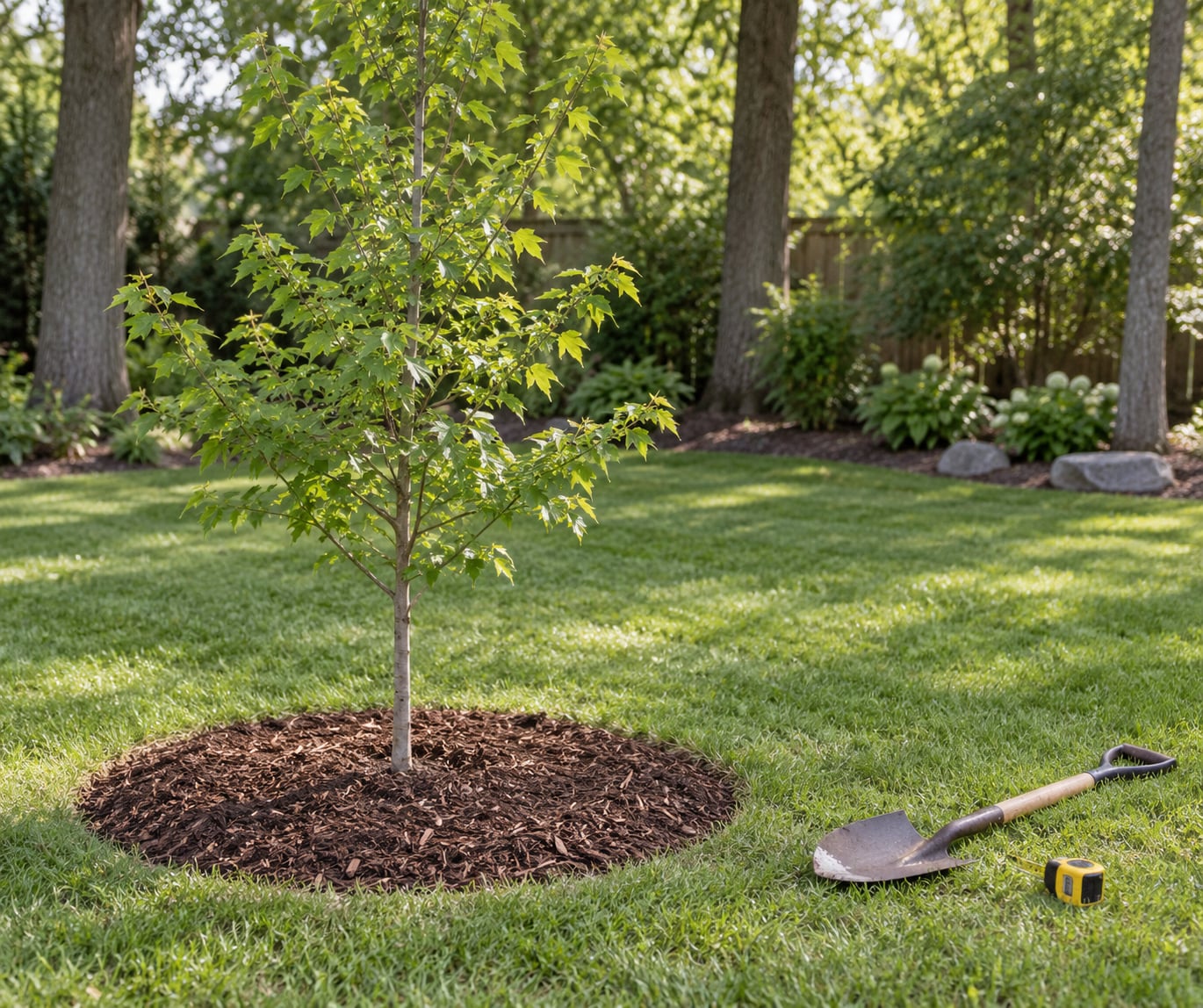
- A tape measure, a shovel and a bucket. The bucket is for the drainage test: dig a hole 12 inches deep, fill it, and see how long it takes to empty.
- Your utility and setback rules. Call 811 before you dig anywhere near buried lines, and check your city ordinance or HOA rules before you pick a species.
- A local nursery or extension office. A tree that already grows well on your street is the most reliable recommendation available, and it is free advice.
Step-by-Step: How to Choose the Right Tree for Your Yard
1. Assess Your Yard’s Growing Conditions
You can only pick a tree that tolerates the conditions you actually have, so start by measuring the site rather than browsing catalogues. Track the sun across the yard on a clear day in midsummer, note where shadows fall from the house and neighbouring trees, and check whether water pools after rain.
Soil texture matters as much as sunlight. Rub a damp handful between your fingers: gritty and it drains fast, sticky and it is clay, and somewhere in between is loam, which is what most trees prefer. Watch the prevailing wind direction too, since a young tree planted on an exposed corner puts more stress on its root system before it has one.
2. Decide What the Tree Needs to Do
Decide the tree’s single main job before you look at species, because the job rules out whole groups of options. Shade, privacy screening, fruit, pollinator habitat, stormwater capture, wind protection and a focal point each pull the selection in a different direction.
The job also tells you how many trees to plant. The 10/20/30 rule, promoted by the Morton Arboretum and repeated widely in extension literature, is a useful target for a yard or a neighbourhood: no more than 10 percent of your trees from one species, no more than 20 percent from one genus, and no more than 30 percent from one family. Diversifying at that level slows the spread of a single disease or pest, because it cannot reach the next host tree easily.
| Category | Typical mature size | Sun | Best use |
|---|---|---|---|
| Large shade trees | 50-80 ft tall, 40-60 ft spread | Full sun | Cooling a lawn or west-facing wall |
| Medium shade trees | 25-40 ft tall, 25-35 ft spread | Full sun to part shade | Street tree or suburban lot |
| Flowering trees | 15-30 ft tall | Full sun | Spring colour, pollinator forage |
| Ornamental trees | 8-20 ft tall, narrow or vase-shaped | Full sun to part shade | Small yards, courtyards, entry points |
| Evergreen screening | 6-40 ft tall, dense | Full sun to shade (varies) | Year-round privacy and wind blocking |
| Small-yard and container trees | Under 15 ft, or 6-10 ft in a pot | Varies by species | Patios, terraces, narrow strips |
Add this to the mix: fruit trees need more sun and more pruning than most owners expect, and a privacy screen placed too close to a neighbour’s fence creates a boundary dispute you will not enjoy.
3. Match the Mature Size to the Space
Match the species’ mature height and canopy spread to the room you have, with generous margin. Compare the eventual footprint against every fixed feature, not just the empty patch of lawn you are imagining today.
Large shade trees typically need at least 15 feet between the trunk and a building to avoid foundation and roof damage. Fast-growing species such as silver maple and willow need more room than most people expect, and weak wood plus a large canopy is a bad combination in a storm-prone area. If you are unsure, an arborist can pull up the species’ expected spread at 20 and 40 years in minutes.
| Feature | Guideline |
|---|---|
| House wall | 10-15 ft from trunk for most trees, more for large species |
| Property line or fence | 5 ft is a common minimum; check local setback rules, which often exceed it |
| Overhead power lines | Keep all growth clear, or choose a low-growing species and keep the utility company’s trimming in mind |
| Sidewalk, patio or paved path | 8-10 ft, because roots lift paving and sidewalks become trip hazards |
| Septic drain field | Avoid planting over it; treat the required setback as a hard limit |
Call 811 before any digging. Underground lines, irrigation and drainage runs are not visible from the surface, and a strike costs far more than the tree was worth.
4. Check Climate, Water and Soil Compatibility
Cross every candidate species against your hardiness zone, your rainfall pattern and your soil, and drop anything that fails. A zone number is a winter-cold band, so a tree listed for zones 5 to 7 in a zone 8 yard will struggle every year it freezes.
Soil pH narrows the list further. Most ornamental and fruit trees prefer slightly acidic to neutral soil, roughly pH 5.5 to 6.5, while a small number tolerate alkaline conditions near pH 7.5. Rather than rebuilding your soil, it is usually easier to pick a species that already suits what you have.
Drainage eliminates candidates fastest of all. If your bucket test takes more than four hours to drain, you have poor drainage and either need a species that tolerates wet feet or you need to fix the drainage before planting. Clay-heavy yards and sandy coastal yards fail in opposite ways, and neither responds well to wishful thinking.
5. Consider Maintenance, Pests and Lifespan
Choose a tree you can realistically maintain for as long as you own the house. Look at annual pruning needs, fruit and litter drop, pollen, mess after storms, drought tolerance and expected lifespan before you fall for the shape of the leaves.
Some species are known nuisances. Callers on landscaping forums describe Chinese elm as nothing but trouble, mostly because of constant twig drop, and weak-wooded species such as silver maple, Bradford pear, willow and cottonwood snap readily in wind and ice. That does not make them unusable everywhere, but it is worth asking about storm resistance before you commit to one over the house.
Lifespan matters too. Street-addressed trees that get confined to a small strip of compacted soil may decline in twenty years, and replacing a mature tree costs far more in removal than planting a young one ever did. Ask the nursery staff directly about disease resistance and pest susceptibility, and use an ISA Certified Arborist or county forestry service when you want a neutral opinion.
6. Inspect and Buy a Healthy Tree
Inspect the tree itself before you pay. Look for a single strong central leader, branches spaced 8 to 12 inches apart, wide-angle crotches where branches meet the trunk, and a visible root flare where the trunk widens into surface roots. A tree with two competing co-dominant trunks is already a structural problem, and one whose roots circle tightly inside the ball will girdle itself over time.
For trunk caliper and root ball, a workable nursery ratio is roughly one inch of trunk diameter for every 12 inches of root ball width. If the trunk is noticeably thicker than that, the root system has been cut back too hard and the tree may never recover. Skip any tree circling its roots in the container, and check for loose soil at the top of the root ball, which usually means it has been sitting too long.
| Format | What it is | Best for |
|---|---|---|
| Bare root | Dormant tree with roots exposed, wrapped in damp material | Planting in late winter or early spring; widest range of varieties; must be planted quickly |
| Ball and burlap | Root ball lifted with soil and wrapped in burlap | Larger specimen trees; plant in spring and untie or cut the burlap at the base |
| Container grown | Rooted in a plastic pot | Small to medium trees, summer planting, easy transport |
Ask the grower to price the tree in its pot and in the ground. Container trees that have been held too long in the same pot spiral their roots and become permanently pot-bound, so read the tag and check whether the roots have filled the container.
Common Mistakes
Most bad plantings trace back to a skipped step rather than a bad tree. These are the ones I see repeatedly, with the correction for each.
| Mistake | Correction |
|---|---|
| Choosing on height alone and ignoring canopy spread | Compare mature spread with the width of the space, then add margin for the tree’s next fifty years |
| Buying by flower colour | Filter first by size, zone, soil and sun; let the flowering follow |
| Planting in soil that has not been tested or drained | Run a drainage test and a soil test before you buy anything |
| Planting too close to a structure, fence or utility line | Measure the clearance, then call 811 and check local setback rules |
| Planting a tree in the wrong amount of sun | Track sun hours through the season; pick a shade-tolerant species for north sides |
| Overplanting one species across the yard | Apply the 10/20/30 rule so a single pest cannot take everything at once |
| Ignoring local rules | Check the city ordinance, HOA covenant and any street-tree requirements first |
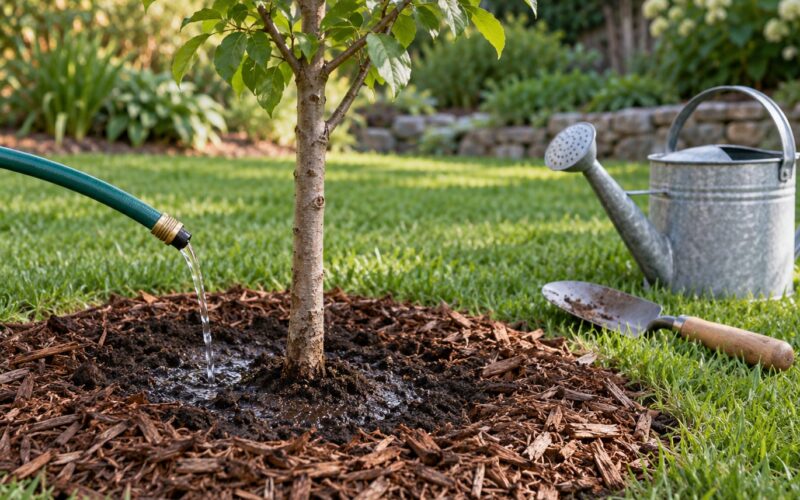
| Forgetting first-year care | Plan for steady watering, 2 to 4 inches of mulch and no fertilizer in year one |
One more thing worth checking is what already grows nearby. Homeowners on gardening forums consistently point to the trees on their own street as the best local guide, because a specimen surviving thirty feet away has already proven it handles your soil, rainfall and winter.
Frequently Asked Questions
What kind of tree is good for a small backyard?
Most small yards do best with ornamental or columnar trees that stay under 20 feet at maturity, or dwarf fruit trees for edible harvests. Match the species to your sun hours, since most ornamentals need six or more hours of direct sun. Check the mature spread before you buy, and keep clearance from fences, paving and overhead wires.
How far from a house should I plant a tree?
A common guideline is 10 to 15 feet between the trunk and a house wall, with larger species needing more because their roots lift paving and their canopies catch wind. Small ornamentals can go closer if the variety is genuinely compact. Never plant over a septic drain field, and keep all growth clear of overhead power lines.
What is the 10/20/30 rule for trees?
It is a diversity target for planting: no more than 10 percent of your trees from one species, no more than 20 percent from one genus, and no more than 30 percent from one family. Spreading your choices across families slows the spread of a single disease or pest, because the organism cannot move easily between unrelated hosts.
How do I tell if a nursery tree is healthy?
Look for one strong central leader, branches spaced 8 to 12 inches apart, wide-angle crotches and a visible root flare where the trunk meets the surface roots. Avoid circling roots inside the pot or ball. As a quick check, one inch of trunk diameter for roughly 12 inches of root ball width is a workable starting ratio.
What trees grow well in clay or dry soil?
Clay soil is heavy and slow to drain, so pick species that tolerate wet feet in winter rather than fighting your drainage. Sandy, dry soil suits drought-tolerant species with deep roots. Test both with a bucket: dig a hole 12 inches deep, fill it, and time how long it drains. More than four hours means you need a wet-tolerant species or better drainage.
Conclusion
Start by spending an hour documenting your yard: sun hours, soil test, drainage, usable space and the clearances you must respect. Then write down the single job you want the tree to do, and shortlist species that fit your hardiness zone and mature size.
That is how to choose the right tree for your yard without guessing. Check the trees already thriving on your street, buy a specimen with one strong leader and an intact root ball, and give it steady water and 2 to 4 inches of mulch through its first growing season. Updated for 2026.