How to tell if a tree is dying or just stressed comes down to two things: whether living tissue is still present, and whether the decline repeats season after season. A stressed tree is alive and reacting badly to a temporary condition such as drought, heat, root damage or pests, and it usually recovers once that condition eases. A dying tree has lost the living tissue it needs to recover, so the canopy keeps shrinking year after year.
That distinction matters because the two problems call for opposite responses. Treating a stressed tree like a corpse wastes a mature canopy you did not need to lose, and waiting too long on a declining one puts falling limbs over your roof. A careful look takes 30 to 60 minutes, needs no special equipment, and can be done by anyone willing to get a ladder out.
One warning before you start: the anxiety that comes with a browning canopy is real, and seasonal leaf and branch drop is normal. Most alarming-looking canopies turn out to be ordinary shedding, drought, or root damage from trenching a few years earlier. Diagnose the pattern before you decide anything.
| What you see | Stressed but living | In decline |
|---|---|---|
| Leaves | Scorched edges, wilting at midday, colour change a few weeks early, drop in one season | Progressive loss from the tips inward, thinning canopy every year, no return of healthy growth |
| Buds | Present, small, sometimes slow to open after a cold spring | Absent at bud break two springs in a row |
| Bark | Normal shedding in patches, surface cracks in drought | Falling away in strips, dry brown wood beneath |
| Trunk | Old wounds calloused over, minor surface cracking | Deep cracks, splits, cavities, fungal conks, bleeding |
| Roots and base | Dry or compacted soil, minor root damage, no fruiting bodies | Severed or decaying roots, mushrooms or honey fungus at the flare |
| Timing | One bad season, then recovery or a plateau | Three consecutive seasons of the same decline |
Table of Contents
- What You Need
- Step-by-Step: How to Tell if a Tree Is Dying or Just Stressed
- Check the Tree’s Overall Pattern
- Look for Dieback From the Tips Inward
- Examine Leaves, Buds, and New Growth
- Inspect Bark, Trunk, and Major Branches
- Check the Roots and Soil Moisture
- Look for Pests or Signs of Disease
- Compare Change Over Time and Decide If the Tree Is Dying
- Common Mistakes
- Frequently Asked Questions
- Can a stressed tree recover without new leaves?
- Should I cut off dead branches on a dying tree?
- Are brown leaves enough to prove that a tree is dying?
- How long does a stressed tree take to recover?
- Conclusion: What to Do First
What You Need
Nothing here is specialised. The useful part is the record you assemble before you touch the tree.
- Recent weather and watering history. Note the last three months of rainfall or irrigation, any heat wave, and how deep you actually watered. Drought stress often shows up a season or more after the event, so the timeline matters more than today’s weather.
- Ground history. Any digging, trenching, paving, grade change, new lawn or construction within the last few years. Root severing is one of the most common causes of sudden decline and owners rarely connect the two.
- Pruning and treatment history. Heavy topping, wound dressing, pesticide or fungicide applications, and the dates of each.
- Photographs from earlier seasons. The same corner, the same view, phone camera, taken from a fixed spot. Old pictures beat memory because nobody remembers last year’s canopy accurately.
- Optional: a soil moisture meter and a clean knife or sharp tool for the scratch test. A folding rule or tape measure helps you record how deep you watered.
Keep the notes somewhere you will find them in 30 days. Most of the wrong calls happen because someone assesses a tree once, panics, and forgets to check again.
Step-by-Step: How to Tell if a Tree Is Dying or Just Stressed
Work through these in order, from the whole tree down to a twig. Each step builds on the last, and stopping early is how people misdiagnose a tree as dead when a single limb has died.
Check the Tree’s Overall Pattern
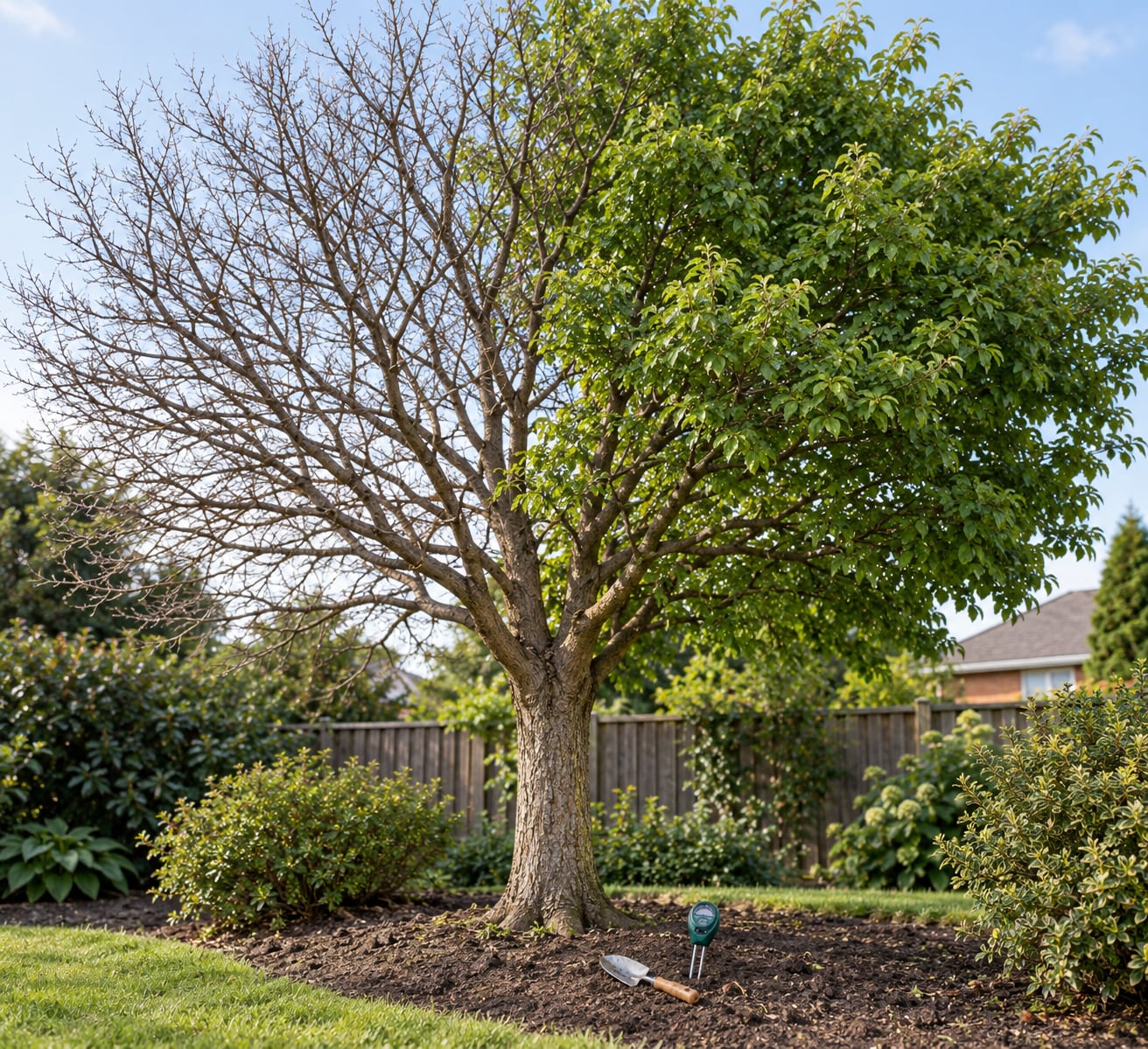
Start at 20 paces and look at the whole crown before you walk over to it. Decline spread across the entire canopy is far more serious than damage confined to one side or one limb, because a healthy tree can isolate a single dead branch and keep the rest of itself alive.
Then find a comparison. A tree of the same species, same age and same soil nearby and doing well tells you more than any textbook, because it controls for local weather and soil. If your tree is thinner than its neighbour and was not last year, that is a pattern rather than a symptom.
One more thing here: species identification is the single biggest blocker to home diagnosis, and stress tolerance varies widely between them. What looks alarming on one species is normal for another. If you cannot name the tree, take a photo of the leaf, bark and overall habit to a local extension service or a nursery identification desk.
Look for Dieback From the Tips Inward
Dieback is the technical word for death starting at the outer tips of branches and moving inward, and it is the clearest sign in the whole assessment. Walk the crown and check how far back the dead wood reaches.
Isolated dead twigs on otherwise healthy branches usually mean a borer, a mechanical break or a lightning-strike injury, and the tree will seal the wound. When the dead zone advances branch by branch, year after year, into larger limbs and spreads across the crown, you are looking at a tree whose vascular system is failing. That is decline, and it does not reverse on its own.
Examine Leaves, Buds, and New Growth
Leaves are the loudest signal and the least reliable one, because almost every cause produces the same three or four symptoms. Leaf scorch with brown margins usually points to water deficit or root damage. Wilting that recovers overnight suggests the same, while wilting that never recovers points to root rot or vascular disease. Discolouration, red or bronze autumn colour weeks out of season, and premature leaf fall all show up under water, heat, compaction and construction damage.
Buds tell the longer story. Check the buds at the ends of branches in late winter or early spring, before leaves hide them. Buds that are present but small mean a stressed tree that is alive. No buds at bud break across two consecutive springs is the strongest single indicator that the tree is dead rather than dormant.
New growth is the confirmatory sign. Healthy new shoots come out firm and full-sized with properly spaced leaves. A stressed tree often pushes out weak, short extension growth with leaves crowded together, or skips a year of leaf-out entirely and holds its buds. A tree that looks sparse but buds out vigorously in the next season was stressed, not dying.
Inspect Bark, Trunk, and Major Branches
A healthy tree sheds bark in patches. A declining tree loses bark in long strips or plates, and when you look underneath you find dry, brown, crumbly wood rather than the pale green of live tissue. Deep cracks that run the length of the trunk, splits at unions, and cavities that go into the heartwood all point to structural decay that has moved past the point of treatment.
Look for fungal fruiting bodies too. Bracket conks, shelf mushrooms and clustered mushrooms at the root flare or on the lower trunk mean a decay fungus is working inside the wood. Bleeding or dark oozing stains on the bark, particularly on stone fruit and other stone trees, usually accompany a canker rather than plain drought stress.
Safety rule, and it is not negotiable: never drill into the trunk, never peel bark to look inside, and never climb a tree you are unsure about. Dead limbs on a stressed tree can snap without warning. A ground-level inspection with binoculars or a phone zoom covers everything that matters.
Check the Roots and Soil Moisture
Root problems are where most home diagnoses go wrong, because the commonest cause of decline in a young or newly planted tree is almost always in the root zone rather than the crown. Use a hand trowel and dig one small hole 30 to 45 cm from the trunk, no deeper than 20 cm, and keep it tidy. Never trench or excavate around the tree, which is exactly the damage you are looking for.
Dry, crumbly soil a hand’s depth down points to water deficit. Soil that is wet and sour-smelling points to prolonged saturation and root rot, which looks identical to drought from the canopy. Hard, compacted soil that a trowel cannot penetrate points to construction damage or foot traffic. Roots cut with clean straight edges are a sign a trench went through the root plate, and they do not grow back.
Check for stability, too. A tree that moves or rocks when the trunk is pushed has root plate movement, which is a hazard problem rather than a health problem and needs an arborist urgently. Healthy roots should be firm and pale with a fibrous outer layer; rotted roots are brown, soft and shed easily.
Look for Pests or Signs of Disease
Borers leave small round exit holes, frass that looks like sawdust at the base, and dieback in a characteristic pattern on the crown. Some insects are not the culprit at all: a fair share of samples sent to extension services turn out to be drought stress, which is why identification before treatment matters.
Honey fungus is worth knowing about. It produces pale mushrooms near the base in late summer and autumn, white fungal sheets under bark near the roots, and a honey-scented decay in the wood, and it kills woody plants outright. Because the roots spread well beyond the tree, check any legal obligation to remove infected material before you start, especially where infected trees sit near neighbouring shrubs.
The point of this step is identification, not spraying. Take photographs and samples to an extension service, a certified arborist or a reputable plant clinic, and avoid treating on the spot. A tree that looks like it needs chemicals often needs water.
Compare Change Over Time and Decide If the Tree Is Dying
This is where stress becomes decline, and the answer comes from time rather than any single sign. Take four photos from the same four angles today, add the date, and repeat every 30 days through the growing season, then again at bud break the following spring.
Use the rule of three seasons: one bad season is stress, two is a warning, and three consecutive bad seasons with the same pattern is decline. That is not a law of nature, but it matches what tree care professionals report. It also corrects the most common misdiagnosis, which is blaming this summer’s canopy on a drought that ended two years ago.
While you monitor, fix one clear stressor at a time where you safely can: deep watering during dry spells, a 5 to 8 cm layer of mulch kept away from the root flare, and removing grass from around the trunk to widen the effective root zone. Stop there. Do not fertilise a declining tree on the hope of a boost, and do not prune healthy wood to tidy it up.
Call an ISA Certified Arborist when decline is spreading rather than plateauing, when the tree is leaning toward a structure or a powerline, when there are large dead limbs in the crown, when fungi are fruiting at the base, when the trunk has cracks, splits or cavities, or when you simply want an answer you can trust. Look for the ISA Certified Arborist or TRAQ credentials and proper insurance, and treat anyone who recommends removal without naming a diagnosis with caution.
Common Mistakes
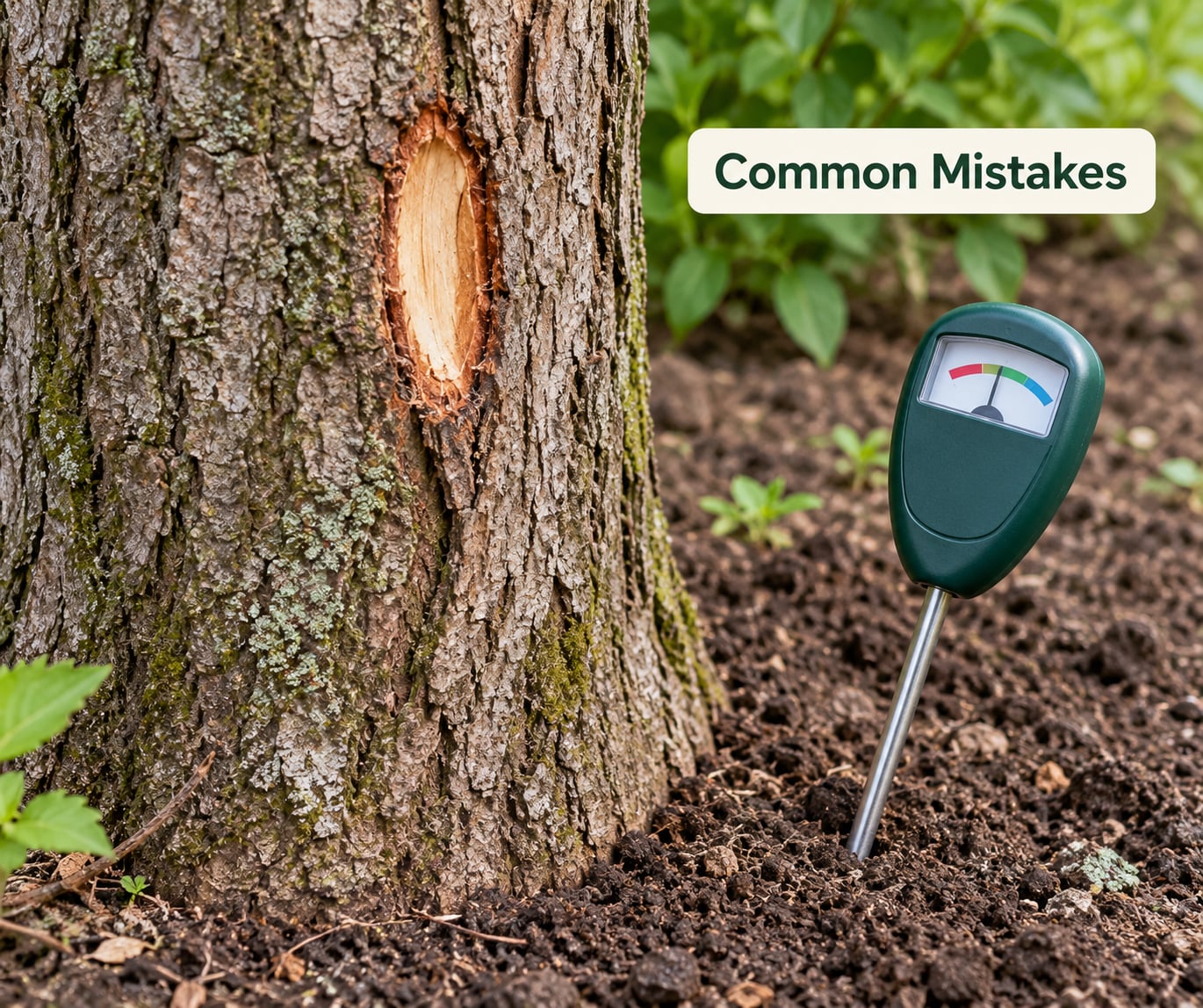
Almost every wrong call comes from one of these.
Diagnosing from a single symptom. Brown leaves in July prove nothing on their own. Look for the distribution, the timeline and whether buds or new growth return.
Watering an already wet tree. Plenty of declining trees are overwatered rather than underwatered, especially young ones on heavy soil. Check the soil at 20 cm before you add anything.
Fertilising without testing. A tree in decline is usually short of water, roots or growing season, not nitrogen. Feeding a tree with root rot makes the problem worse and the symptoms harder to read.
Cutting into healthy wood. Pruning back past the branch collar into live tissue opens wounds that decay fungi exploit. If deadwood needs removing, cut back to the branch union and use clean sharp tools.
Reading normal annual leaf drop as death. Deciduous trees drop leaves on a seasonal schedule, and some hold dead leaves through winter in a habit called marcescence. Check buds before you panic.
Diagnosing a tree you cannot safely reach. If a limb hangs over a roof or fence, stay away. Deadwood on a declining tree is the most common cause of serious injury in garden work, and that is a job for someone with a credential and the right equipment.
Frequently Asked Questions
Can a stressed tree recover without new leaves?
Yes. Some stressed trees survive and resume growth once water, heat, construction damage or another temporary pressure eases. Buds and live tissue may remain even when the canopy looks sparse, and the tree can put out a full flush the following season. Check buds at the branch tips in late winter and scratch the cambium on a small patch of bark before deciding anything. If green, moist tissue is present, the tree is alive and worth supporting through another season.
Should I cut off dead branches on a dying tree?
Do not climb or saw hazardous branches without qualified help. If the tree is otherwise stable and the dead wood is small, prune back to a healthy branch union with clean, sharp tools and leave the collar intact. Removing dead limbs tidies the tree and reduces future snag risk, but it does not slow decline in the roots or the trunk. Large dead limbs in the crown interior, a tree leaning toward a structure, or any branch over a powerline are arborist work, not weekend work.
Are brown leaves enough to prove that a tree is dying?
No. Brown leaves can come from underwatering, drought scorch, waterlogged roots, pests, nutrient problems, frost or ordinary seasonal change. Look at the distribution of the damage, whether buds or inner growth stay healthy, and whether the same thing happens next season. A tree that browns at the edges and drops leaves in one hot month, then leafs out normally, was stressed. A tree whose canopy thins every year with no buds at bud break is in decline.
How long does a stressed tree take to recover?
It depends on species, cause, severity and how much live tissue remains. A newly planted tree often needs one or two full growing seasons to get past transplant shock, while an established tree with root damage may take several years. Drought symptoms can appear a season or more after the stress itself, so recovery is often judged over several years rather than months. Correct the cause, keep watering deep through dry spells, mulch away from the root flare, and re-check at bud break each spring.
Conclusion: What to Do First
Photograph the whole tree from four fixed angles, write down the date and the last few years of weather, digging and pruning, and check the cambium plus the buds. That record is the single most useful thing you can build, because it turns a worry into something you can measure.
Then correct one clear stressor at a time and re-check in 30 days. One bad season is stress, and a stressed tree usually comes back. If the decline repeats across three seasons, or if a limb is hanging over a structure, stop assessing and call an ISA Certified Arborist or TRAQ-qualified professional. Waiting is a valid action, but only when you are watching for change rather than hoping for it.