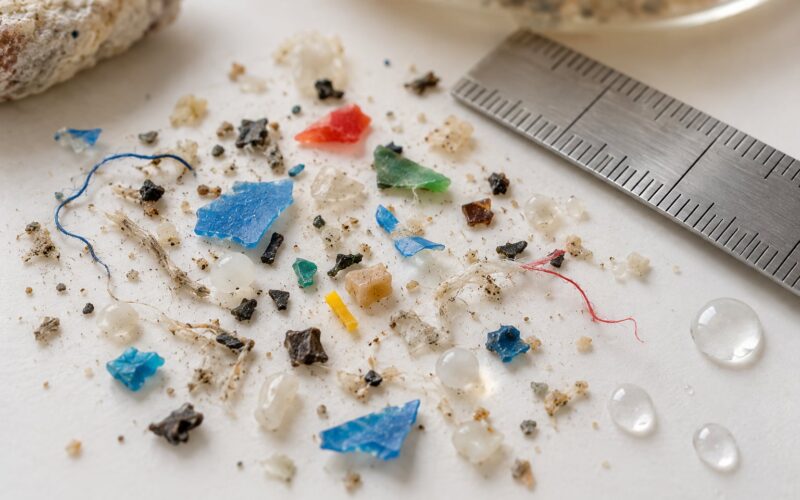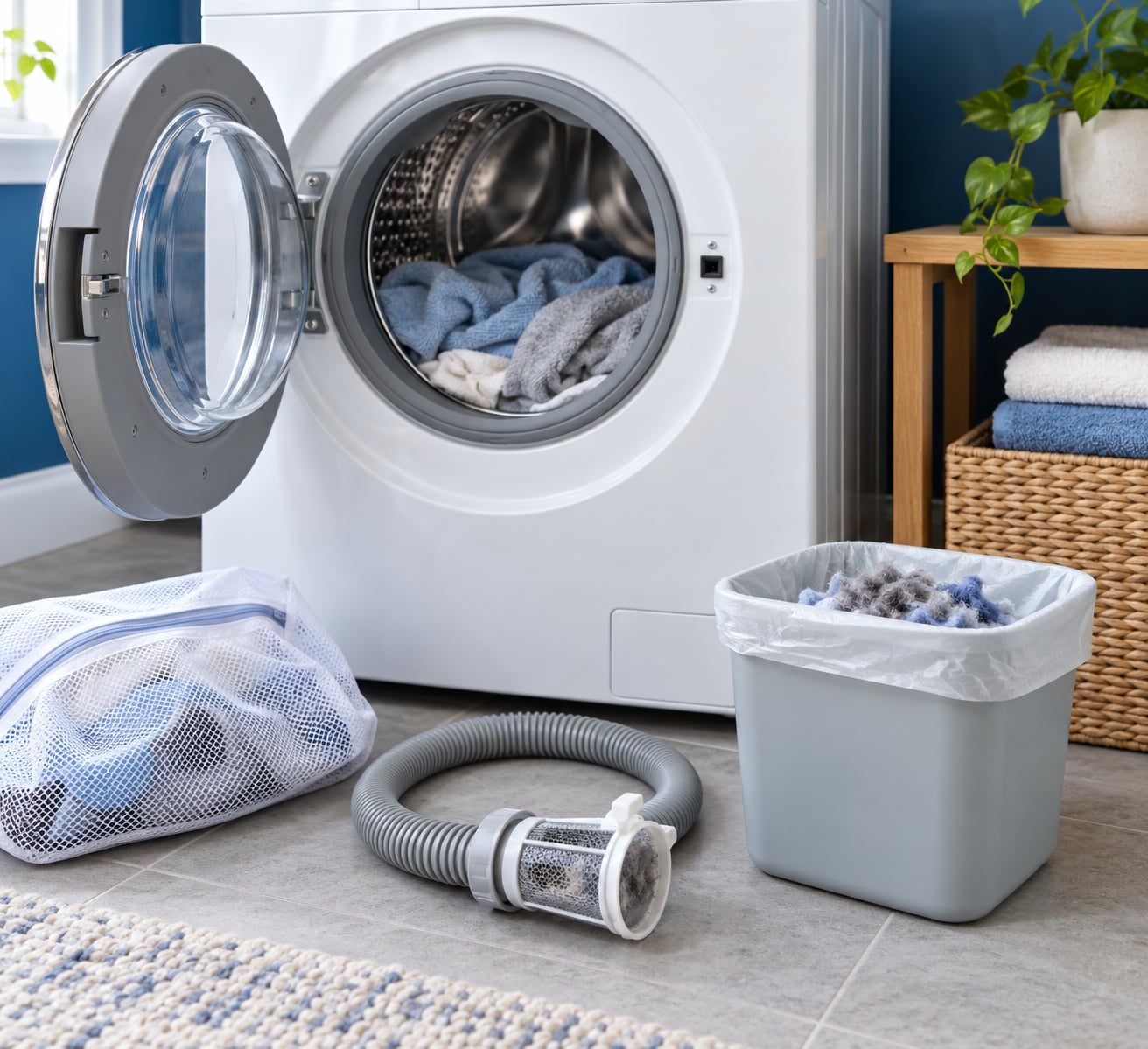
To reduce microplastics from laundry you need three things: less friction against synthetic fabric, a way to catch the fibres that break loose, and a bin for what you catch. A single load of polyester clothing can release up to 700,000 microfibers, and synthetic textiles are estimated to account for roughly a third of the microplastics reaching the ocean.
Most of that comes from ordinary laundry behaviour rather than from industrial waste, which is why household changes matter at all. You do not need specialist equipment to make a real dent, though a few optional tools help. The whole routine takes under a minute of setup per wash.
Here is the short version:
- Wash less and wash kinder — abrasion is the mechanism, so fewer washes and gentler cycles mean fewer fibres break free.
- Get the settings right — cooler water, slower spin, right-sized loads and a front-loader all cut shedding.
- Capture what does come loose — a drain-hose filter, a microfibre wash bag or a fibre-collecting ball intercepts fibres before the water leaves.
- Bin it, never rinse it away — captured lint goes in the household trash, never down the drain or into the toilet.
The rest of this guide walks through each step in order, plus the habits that quietly undo the work.
Table of Contents
- What You Need
- Step-by-Step: How to Reduce Microplastics From Laundry
- 1. Wash Synthetic Garments Less Often and With Care
- 2. Choose Detergent and Washing Conditions Carefully
- 3. Capture Fibres Before They Enter the Water
- 4. Reduce Shedding From High-Risk Fabrics
- 5. Dispose of Captured Fibres Responsibly
- Common Mistakes
- Frequently Asked Questions
- Does washing polyester release microplastics?
- Which fabric has no microplastics?
- How can I remove microplastics from my laundry?
- Which washing machine sheds the least microplastics?
- Can microplastics from clothes reach your body?
- What should I do with lint and filter contents?
- Conclusion
What You Need
You need almost nothing to start. Reduce the number of washes, choose gentler settings, and put a kitchen bin next to the machine so collected lint has somewhere to go other than the drain. That alone covers the first and last steps of the routine.
Beyond that, three optional tools do the capturing for you. All three are simple, non-powered add-ons:
- An external microfibre filter fitted between the washing machine’s outlet hose and the drain. It catches fibres from the whole load, not just the items inside a bag.
- A microfibre wash bag for individual high-shedding garments such as fleece, sportswear or a new polyester shirt. Small mesh bags capture around 90% or more of what the item releases; the Guppyfriend bag is the widely cited example.
- A fibre-catching laundry ball such as the Cora Ball, a moulded ball with internal channels that gathers lint and hair through the wash cycle. Independent testing puts its capture rate far lower than a filter or bag, around 31%.
Third-party tests of the filter category report capture rates in the high 80s to around 90%, with one widely cited model rising toward 100% as the lint mat thickens. Capture percentages are not permanent properties of the device. They depend on load composition, how full the filter already is, and whether you emptied it last time.
| Tool | Reported capture rate | Covers | Maintenance burden |
|---|---|---|---|
| Drain-hose microfibre filter | High 80s to around 90% in third-party tests | Every synthetic item in the load | Empty every 2 to 3 loads; fit can be fiddly |
| Microfibre wash bag | Around 90% for the item inside | One or two garments per wash | Empty bag into the bin after each wash |
| Fibre-catching laundry ball | Roughly 31% in testing | Loose lint across the load | Remove clumps every few washes |
| Lint roller on damp clothes | No published rate | Surface lint before washing | Peel and discard the sheet each time |
If you only buy one thing, buy the filter. If your budget is tight, a couple of microfibre wash bags for your fleece and activewear will handle the worst offenders for very little.
Step-by-Step: How to Reduce Microplastics From Laundry
The routine has five parts, and they work in this order because each one is cheaper than the next. Reducing shedding at the source means fewer fibres exist to catch. Capturing them keeps them out of the wastewater. Disposing of them properly keeps them out of the drain. Buying habits decide how much future shedding you create.
One warning before you start: a filter that never gets emptied solves nothing. A saturated filter reduces performance, and pulling that clump out is the step most people skip. Budget for it.
1. Wash Synthetic Garments Less Often and With Care
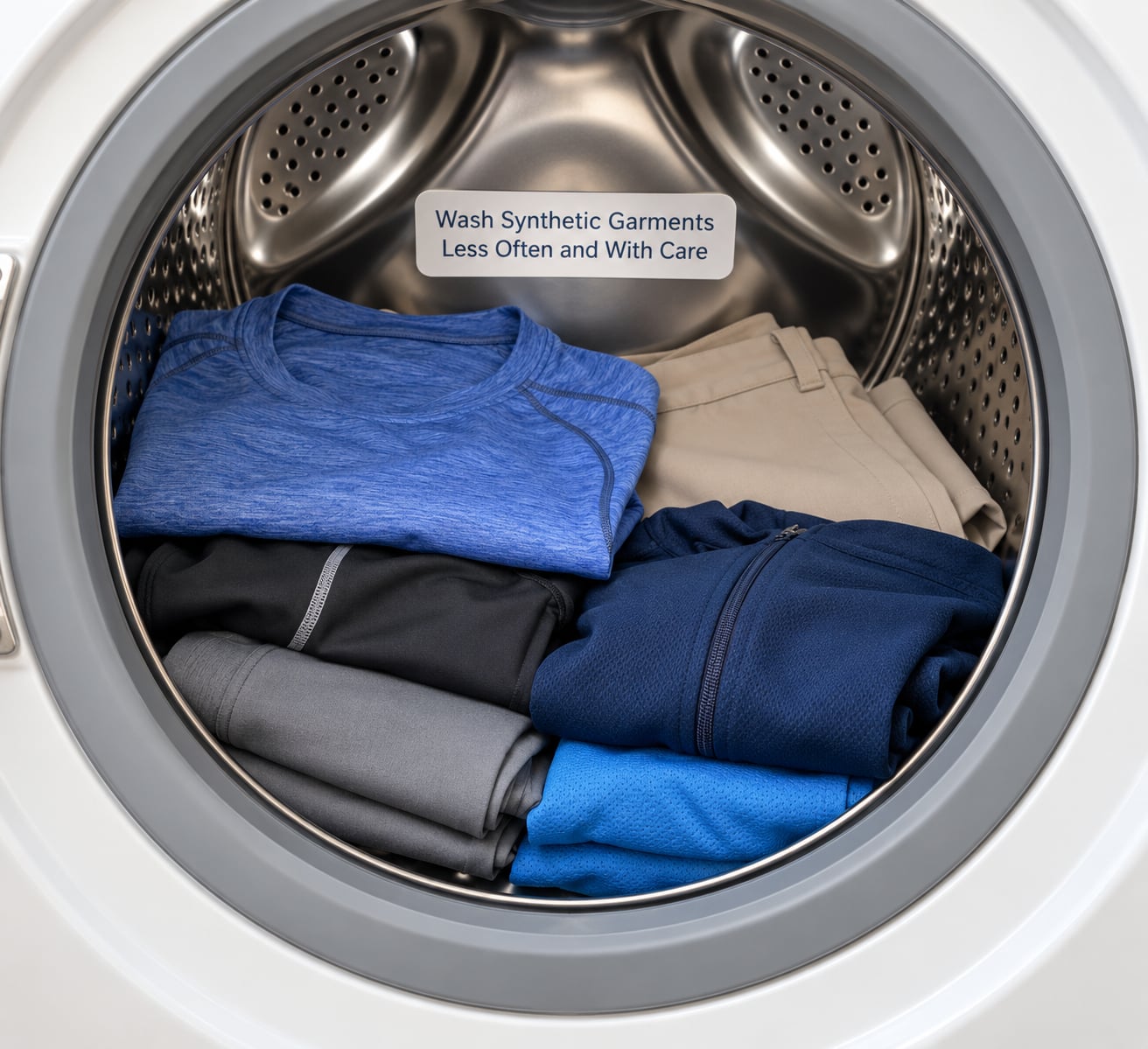
Friction is the engine of microfiber shedding. Fibres break loose through abrasion between fabric and fabric, fabric and drum, and fabric and detergent solution. Every wash cycle repeats that abrasion, so the single largest lever you control is how often a synthetic garment sees a drum at all.
Wear leggings and sports bras through two workouts instead of one and washing after each. Air out a fleece jacket overnight rather than putting it straight back in the basket. Spot-clean small marks with a damp cloth instead of running a whole load. Each avoided wash is a full cycle of wear avoided for that garment.
Then, when you do wash:
- Follow the care label. Garments labelled for a gentle or delicate cycle were tested for a reason.
- Turn items inside out where the label allows it. The abraded inner surface faces inward and fibres stay in the garment longer.
- Keep loads right-sized, not crammed. An overstuffed drum cannot agitate properly, so items rub against each other more than against the water.
- Close zips and fasten Velcro. A zip left open drags its metal teeth across fabric for the entire cycle.
You also lose less if you stop rewashing things that were only rinsed. If a load smells clean, that load was clean.
2. Choose Detergent and Washing Conditions Carefully
Detergent, temperature, agitation and spin speed all influence how much fibre breaks free. Change more than one variable at a time and you will never know which one helped.
Temperature. Heat speeds up the weakening of synthetic fibres. Cold or warm cycles generally shed less than hot ones. There is one honest caveat: some detergents and soils need warmth to dissolve and work properly, and a cold wash that leaves residue is its own problem. Wash warm when the label or the load calls for it, and cool when it does not.
Cycle and agitation. A gentle or cotton cycle for synthetics, especially knits and anything containing elastane. Long soak cycles and heavy-duty programmes generate more mechanical action than most clothing needs.
Spin speed. Spin cycles whip wet fabric against the drum wall at high speed, which is one of the most aggressive moments in the whole wash. If your machine lets you choose, choosing a lower spin for a synthetic load is a cheap, real reduction.
Washer type. A front-loader moves clothes through a tumbling drum and generally sheds less than a top-loader with a central agitator, where clothing is dragged around a central post under constant mechanical stress. An impeller top-loader sits between the two: no agitator, but the same sustained swishing motion. If you have a choice of machines, a front-loader is the gentler one.
| Machine type | How it moves clothes | Relative shedding |
|---|---|---|
| Front-loader | Tumbling lift-and-drop through a perforated drum | Lowest |
| Top-loader with impeller | Swish plate rotates low in the tub | Middle |
| Top-loader with agitator | Central post drags items through repeated twisting | Highest |
Detergent format. This is genuinely contested, and honest sources say so. Powder can act as a mild abrasive and loosen more fibres in some tests. Liquid disperses more fully and leaves less undissolved residue, at the cost of plastic packaging. Concentrated formats cut the packaging waste.
And the one to watch is the sheet. Laundry detergent sheets marketed as plastic-free are usually polyvinyl alcohol, a synthetic polymer that dissolves in water and then travels to the wastewater stream with everything else. Plastic-free on the wrapper does not mean plastic-free in the drain.
Load size. A part-full drum means items slide and rub more freely. A full drum means less movement per item. Neither extreme works: an overstuffed drum cannot tumble at all. Fill it properly and you change two things at once, which is less useful than changing one.
3. Capture Fibres Before They Enter the Water
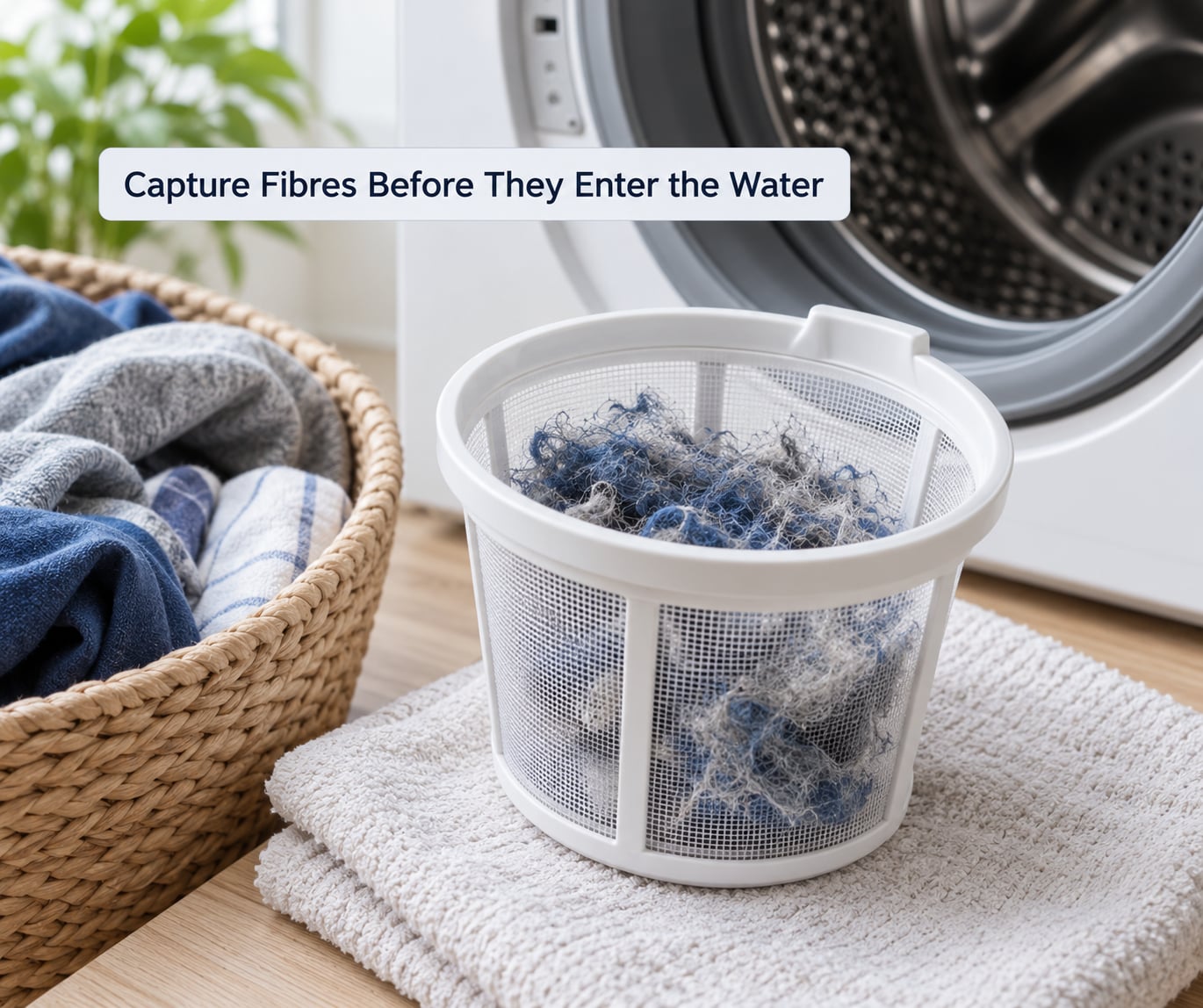
Once fibres are in the water, they travel. The drain hose from your washer typically empties into a standpipe, then a branch pipe, then the sewer, and the treatment plant downstream catches most but not all of what arrives. Capturing fibres at home puts them in your hands instead.
Filters sit between the washer outlet hose and the drain. Installation is usually a matter of cutting the hose, attaching the filter body and refitting the hose, though fittings vary and some setups are awkward behind a stacked machine. The payoff is that the filter sees every synthetic item in the load, including the ones you forgot were synthetic.
Bags work per garment. You put a fleece or a sports top in a microfibre mesh bag, wash it, and the released fibres stay inside. Bags are the right choice for a single high-shedding item, and for new clothes in particular, since first washes release the most loose fibres.
Balls such as the Cora Ball sit loose in the drum with channels that collect lint and hair from the load water. Independent capture rates are much lower than filters or bags, so treat them as a useful supplement rather than a solution.
Forum threads on r/environment and r/gadgets show genuine interest here. The Matter Industries at-home filter story drew hundreds of upvotes and dozens of comments, and the recurring practical complaint is the same one: installation is fiddly and people forget to empty the thing. Write the emptying date on the filter housing with a marker pen. It genuinely helps.
A common doubt worth answering: filters do not merely catch lint that would have gone down the drain anyway. Lint in the drum is a fraction of what actually breaks loose at fibre scale. Microfibers are too small to see and mostly invisible in the water, and that is the material a filter is designed to intercept.
4. Reduce Shedding From High-Risk Fabrics
Not all clothing behaves the same way. Synthetic fibres shed far more than natural ones, and within synthetics, blends and pile fabrics shed more than tight weaves.
| Fibre | Derived from | Shedding |
|---|---|---|
| Polyester | Petroleum-based plastic | High |
| Nylon | Petroleum-based plastic | High |
| Acrylic | Petroleum-based plastic | High |
| Elastane (spandex, Lycra) | Petroleum-based plastic | High, especially in blends |
| Microfibre and fleece | Often polyester or nylon pile | Very high |
| Recycled polyester | Recovered plastic bottles | High, still plastic |
| Bioplastics such as PLA | Renewable feedstock, plastic polymer | Sheds; compostable only at industrial facilities |
| Cotton | Natural plant fibre | Negligible plastic shedding |
| Linen and hemp | Natural plant fibres | Negligible plastic shedding |
| Wool | Natural animal fibre | Negligible plastic shedding |
| Lyocell and viscose | Wood pulp | Negligible plastic shedding |
Three practical points follow from that table. Check the care label before washing, since items with elastane or a brushed pile are the ones that suffer most from hot, fast, frequent cycles. Air out high-shedding garments between wears so a wash can be skipped rather than repeated.
For future purchases, favour natural or wood-pulp fibres for skin-contact pieces and anything washed often, and choose more durable synthetics over thin ones for the occasional item. The garment you keep for five years sheds across five years of washes. The garment you replace every season sheds far more in total.
Thrifting deserves its own note, because it is where good intentions and shedding collide. A second-hand nylon top is one of the highest-shedding garments you can own, and it is often one you would rather not throw away. Wash it less, wash it cool, and bag it for the first few washes. Thrifted synthetics are not a reason to stop buying second-hand.
Recycled and bio-based labels do not change the shedding picture much. Recycled polyester is still polyester. A bioplastic is still a plastic polymer, and PLA only biodegrades at industrial composting temperatures, which no domestic wash creates.
5. Dispose of Captured Fibres Responsibly
This is the step that decides whether the whole routine worked. Fibres lifted out of a filter, a bag or a lint screen go into the household trash. Not the sink, not the shower, not the toilet. Rinsing a clump of lint away just moves the problem downstream and adds the water and detergent it was carrying.
Make the routine easy enough that you actually do it:
- Every 2 to 3 loads, open the filter, peel off the lint mat and bin it. A clean filter is a working filter; a saturated one pushes water past the capture surface.
- After every wash, empty a wash bag into the bin and check the ball for clumps.
- After every dryer cycle, empty the lint screen into the bin rather than into the sink or outside.
If you are on a septic system, this matters more, not less. A septic tank is not designed as a solids separator for plastic fibre, and fibres that reach the drain field can work their way into the surrounding soil and groundwater. Filtering at the machine is the first line of protection for the tank itself.
One worry people raise on forums deserves a practical answer rather than a reassurance. Emptying a lint screen means handling a cloud of fine particles, and the instinct is to do it quickly and wash your hands afterwards. Wet the clump slightly, or peel it into a sealed bag at the machine, rather than letting it billow. Then wash your hands and get on.
Common Mistakes
Mistake 1: Believing cold water alone solves it. Temperature is one lever among five, and a cold wash on a full, fast, high-agitation cycle still sheds plenty. Fix: change the load size and the cycle too, then re-test.
Mistake 2: Stuffing the drum. An overstuffed drum cannot tumble, so garments slide against each other more than they would in a properly filled one. Fix: fill to the level line and wash two smaller loads instead of one jammed one.
Mistake 3: Installing a filter and forgetting it. This is the most common failure in the whole topic. A filter that has never been emptied gives you the reassurance of an action with none of the effect. Fix: a date on the housing and a bin beside the machine.
Mistake 4: Rinsing collected lint away. It feels like tidying and it undoes the entire routine. Fix: bin it, every time, including the dryer screen.
Mistake 5: Assuming detergent sheets are plastic-free. Most sheets are polyvinyl alcohol, a synthetic polymer that dissolves into the wastewater. Fix: choose a powder or liquid and look at the ingredient list rather than the front of the packet.
Mistake 6: Rewashing new synthetics on repeat. New garments shed the most in their first few washes, so washing one repeatedly before you have worn it is shedding with no benefit. Fix: wash new synthetics once, in a bag, then wear them.
Mistake 7: Replacing your entire wardrobe. The most common objection on sustainability forums is that most households cannot afford a fully natural wardrobe, which is a fair point and a bad reason to do nothing. Fix: keep what you own and manage it well, and change your fibre choices at the next natural replacement rather than through a purge.
Mistake 8: Treating filters as a complete answer. They reduce what reaches the wastewater; they do not reduce what a garment sheds overall. Only washing less and buying differently reduce the source itself. Fix: run the routine in the order this guide gives, source first.
Frequently Asked Questions
Does washing polyester release microplastics?
Yes. Washing is where most shedding happens, because friction between fabric, drum and detergent solution weakens and breaks synthetic fibres free. A single load of polyester clothing can release up to 700,000 microfibers, and they travel with the wash water to the drain. The more often you wash a synthetic garment and the hotter, faster and fuller the cycle, the more comes loose.
Which fabric has no microplastics?
Natural and wood-pulp fibres shed negligible plastic microfibers: cotton, linen, wool, hemp, and lyocell or viscose made from wood pulp. They lose fibres like any natural material does, but those are not plastic. Polyester, nylon, acrylic and elastane shed the most, and microfibre and fleece fabrics shed more than almost anything else in a wardrobe.
How can I remove microplastics from my laundry?
You cannot remove fibres that are already embedded in a garment, but you can stop most new ones. Wash synthetics less often, use cooler water with a gentle cycle and a lower spin, and capture what does come loose with a drain-hose microfibre filter or a wash bag. Reportedly 87 to 90 percent capture rates come from third-party tests of filter designs, not from brand claims alone.
Which washing machine sheds the least microplastics?
A front-loading machine generally sheds the least. It tumbles and drops clothing through a perforated drum, which is gentler than the sustained dragging action of a top-loader with a central agitator. An impeller top-loader sits between the two, since it has no agitator but still swishes the load continuously. Spin speed matters as much as drum type, so choose a slower spin for synthetics.
Can microplastics from clothes reach your body?
Microplastics have been detected in human blood, lung tissue and placenta, but researchers still debate how much of that comes from clothing versus food, drinking water and airborne fibres. Animal and lab studies suggest particles can enter through skin, hair follicles and sweat glands, particularly on damaged skin. Health effects are not yet established, so reducing exposure is a reasonable precaution rather than a proven medical necessity.
What should I do with lint and filter contents?
Put them in the household trash. Never rinse collected lint down the sink, pour it into the shower or flush it, because that sends the fibres straight into the wastewater stream you just filtered them out of. Empty a filter every two to three loads, a wash bag after every wash, and the dryer lint screen after every cycle. Keep a bin next to the machine so it is the path of least resistance.
Conclusion
If you do two things this week, make them these. Cut one wash from your routine, the next time a synthetic garment is not actually dirty. And put a bin beside the machine so the next filter you empty, or the next dryer screen you clean, has somewhere to go that is not the drain.
After that, work down the list in order: wash less, wash cooler and gentler, capture what still comes loose, and bin it. Over time, shift your buying toward natural fibres for the pieces you wash most often. None of that solves the problem on its own, and the honest limits are real, but it is the part of the problem a household controls completely.