Beach lighting confuses sea turtle hatchlings because it replaces the single cue they navigate by. A hatchling crawls toward the brighter horizon over the water and away from the dark dune silhouette behind it. Artificial light makes the landward horizon brighter, so the brightest direction now points into the dunes.
Most nesting happens under cover of darkness for a reason. The hatchlings that emerge from a nest late at night have no map and no landmarks, only a wide open horizon split into a bright half and a dark half. Anything you add to the landward half of that split changes where they go.
Below is the mechanism first, then what happens to the ones that go the wrong way, then the lighting fixes that hold up under scrutiny, including the ones people get wrong.
Table of Contents
- Why Beach Lighting Confuses Sea Turtle Hatchlings
- How Sea Turtle Hatchlings Find the Sea
- Why Beach Lighting Confuses Sea Turtle Hatchlings: The Core Mechanism
- Which Lights Can Cause Problems?
- What Happens When Hatchlings Go the Wrong Way?
- How Beaches Can Reduce Lighting Impacts
- What Visitors Can Do at Night
- Simple Ways to Make Nesting Beaches Safer
- Frequently Asked Questions
- Do turtles like red light?
- How does moonlight affect hatchling orientation?
- What light colour does not attract sea turtles?
- What should I do if I find a baby turtle crawling the wrong way?
- How far inland does city skyglow affect turtle nesting beaches?
- How can local governments and businesses reduce lighting on nesting beaches?
- Conclusion: Keep the Sea the Brightest Horizon
Why Beach Lighting Confuses Sea Turtle Hatchlings
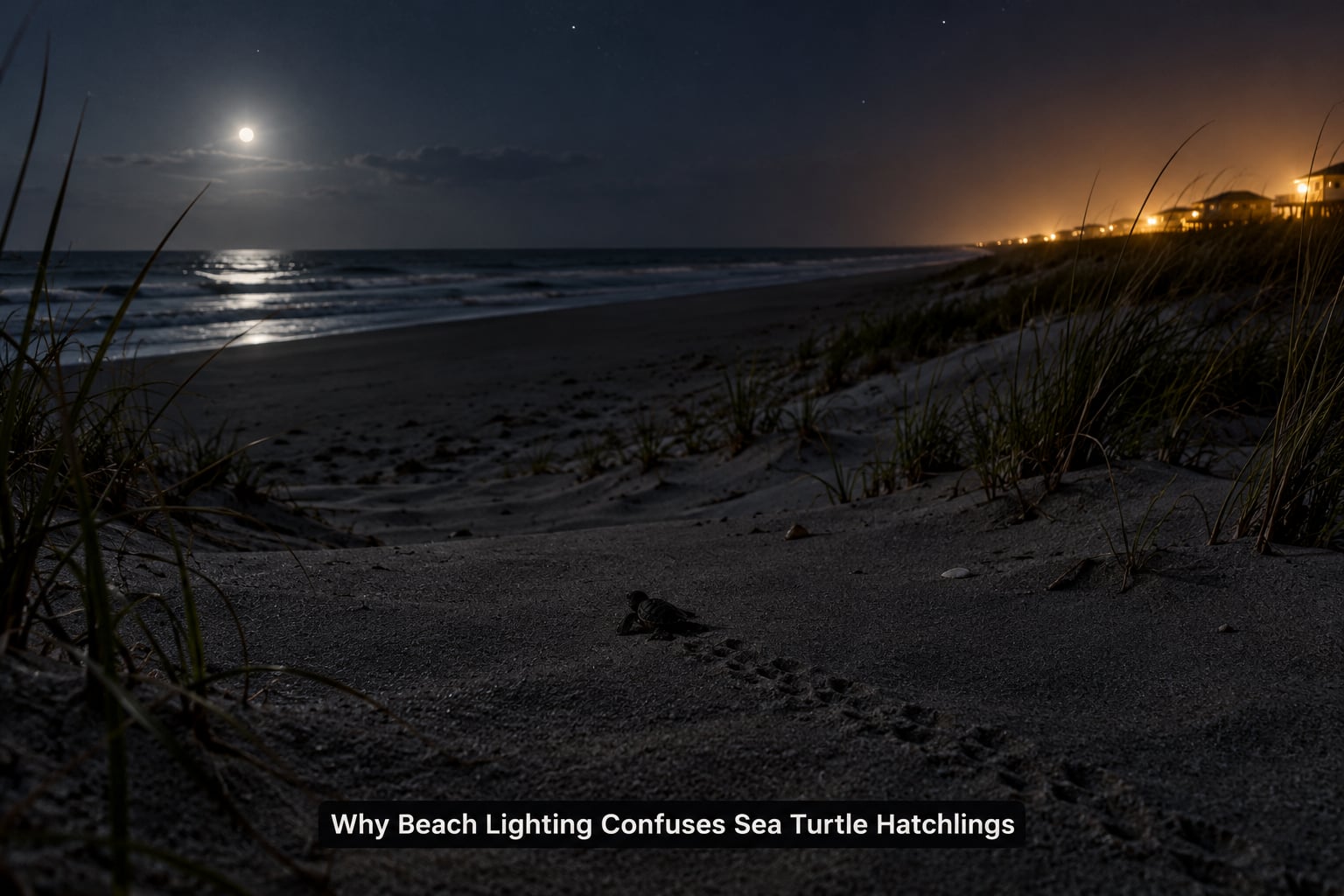
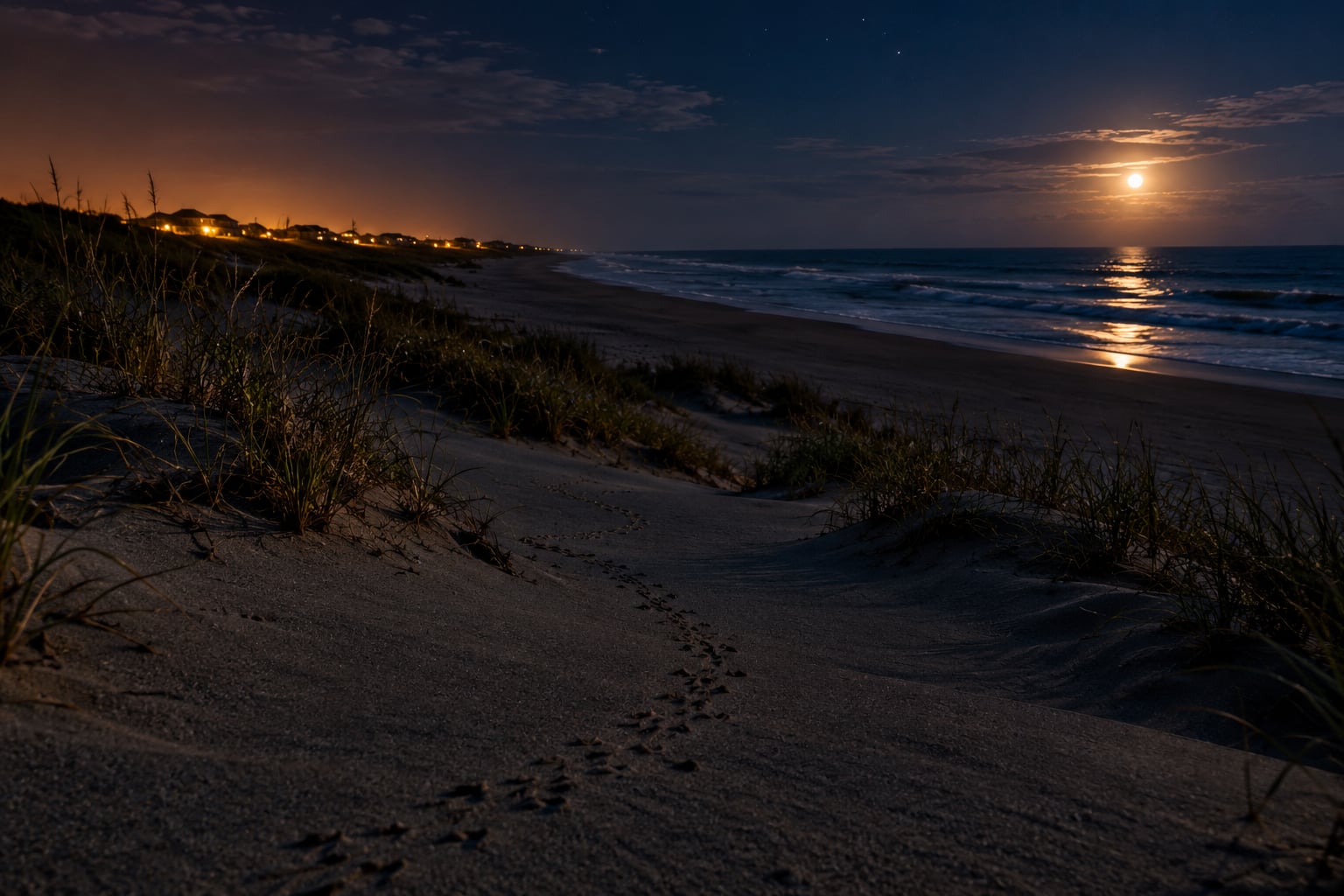
Beach lighting confuses sea turtle hatchlings because it breaks a contrast they depend on. On a naturally dark beach the sea is the brightest part of the horizon, because water scatters starlight and moonlight back at the sky. The dunes behind the turtle are darker. Artificial light adds brightness inland, and the hatchling follows the brightness.
It is worth being precise about what the hatchling is and is not doing. It is not computing a bearing and comparing it against a coastline. It is moving toward the brightest open direction it can see and away from the dark mass behind it, which on an undeveloped beach happens to be the correct answer.
The confusion arrives in a small number of recognisable ways:
- Brightness override. A lit window, a floodlit terrace or a streetlamp becomes brighter than the sea, and the strongest cue wins.
- A false horizon inland. Bright light beyond the dunes creates the visual signature of an open sea, so hatchlings crawl toward what looks like open water over the street.
- Loss of the dark silhouette. Flooding the vegetation behind the nest with white light erases the dark landward backdrop entirely, leaving no contrast to steer by.
- Skyglow wash-out. Lighting in a town tens of kilometres inland brightens the sky above the beach and lifts the whole horizon, which flattens the natural gradient the hatchlings rely on.
- Light with no source. Headlights sweeping across the sand, phone screens and screens on a terrace cause the same problem even though nobody installed a lamp for the beach.
- Short wavelengths. Blue-rich light pulls hatchlings harder than light at the warm end of the spectrum, so a brighter blue-white source and a dimmer deep amber source are not interchangeable.
DarkSky International puts the same mechanism in one line: hatchlings have evolved to locate the sea by seeing the brighter horizon over the ocean and moving away from landward silhouettes. Every light you can see from the beach adds something to that silhouette.
How Sea Turtle Hatchlings Find the Sea
Sea-finding happens almost entirely at night. A nest usually opens after sunset, and the hatchlings inside push upward through the sand over a couple of nights before emerging. Darkness is not a hazard for them; it is the condition they are built for.
The available light on a natural beach is faint and low. Starlight and moonlight hit the water surface, and water reflects a large share of what lands on it, so the sea reads as a lighter band along the seaward arc of the horizon. Land, dunes and vegetation reflect far less, and the tall stuff also blocks the low sky behind it, which reads as a dark mass. A hatchling moving down that gradient ends up in the water without ever needing to know the word ocean.
Because the cues are faint, they are fragile. A bright moon helps, because it raises the contrast between the reflective sea and the dark land. A new moon or a heavy cloud deck removes that advantage, and on an overcast night with no moon the horizon can be almost flat and featureless. Those are the nights when a single lit window is enough to redirect a whole emergence.
Why Beach Lighting Confuses Sea Turtle Hatchlings: The Core Mechanism
The core mechanism is a contest between one cue and another, and the winner is whichever side of the horizon is brighter. This is why brightness and direction matter more than anything else, and why a dim, well-shielded, downward-facing lamp poses less of a problem than a bright one pointed across the sand.
Two terms are used for what happens next, and keeping them apart makes the consequences clearer. Misorientation means the hatchling moves in the wrong direction but keeps moving. Disorientation means it reverses, turns back toward the direction it came from, or crawls parallel to the shore, and ends up moving away from the sea entirely. The second is far harder to recover from.
A useful way to picture it: the hatchling is not asking where the sea is, it is asking which way is lighter. Artificial light does not have to be on the beach to answer that question wrongly.
Which Lights Can Cause Problems?
Almost any light source can, because the hatchling responds to apparent brightness rather than to the intentions behind the fixture. What varies between sources is how much brightness reaches the beach, how far it travels, how long it stays there, and how much of the short-wavelength end of the spectrum it contains.
Sea Turtle Conservancy summarises the design side of this as three rules: keep it low, keep it shielded and keep it long. Low means the lowest output that still does the job. Shielded means the fixture sends light down to the task and not out to sea or across the dune. Long means wavelengths of 560 nanometres or beyond, which read as amber, orange or red and disturb turtles least.
| Light source | Typical spectrum | Disorientation risk | Practical verdict |
|---|---|---|---|
| Unshielded white LED streetlight | Broadband, blue-rich | High | Re-aim or shield; replace with a long-wavelength fixture |
| Shielded downward white LED | Broadband but contained | Moderate; skyglow remains | Acceptable where needed, at the lowest output that works |
| Phosphor-converted amber LED | Narrowband, long wavelengths | Minimal for flatback hatchlings; some effect on loggerhead orientation at higher intensities | The best streetlight option available, intensity still matters |
| Deep amber or red bulb | 560 nm and beyond | Less disturbing to hatchlings, but still artificial light | Restricted on many nesting beaches during the season |
| Interior window light | Broadband, spilling outward | Moderate to high | Curtains or window film at 15 to 30 percent visible light transmittance; lights off |
| Car headlights and phone screens | Broadband white, short wavelengths | High, and moving | Park back from the dunes; screens off near the nesting zone |
| Roads and car parks behind the beach | Broadband, low mounted | High at the edges of the emergence zone | Full cutoff fixtures, lower mounting height limits |
| Skyglow from inland towns | Diffuse, all directions | Cumulative, hard to attribute | Reduce outdoor lighting inland; it reaches further than people expect |
Two caveats on the table. First, colour seen by the human eye is not the same as spectral purity: a lamp can look warm and still carry enough blue and violet output to matter, which is why specialists measure the spectrum rather than trusting the appearance. Second, a red filter stuck on a torch does not change the wavelength the torch emits. It only changes what the torch looks like to you, and it dims the light just enough that people stop worrying about it.
What Happens When Hatchlings Go the Wrong Way?
The costs start immediately, because a hatchling leaves the nest with a fixed energy budget and no way to refuel. Everything it spends crawling inland is taken from swimming, feeding and surviving the first days at sea.
In practice, a disoriented hatchling crawls much farther than it should, gets caught in dune vegetation or beach debris it cannot climb over, dries out, and ends up moving slowly in the open where gulls, crabs, raccoons and dogs can take it. Road mortality adds a further risk on beaches where the emergent zone meets a car park. Frequently the cause of death is dehydration and exhaustion rather than a predator strike, which is the harder number to notice and the easier one to prevent.
The attraction does not switch off at the waterline. Work published by Thums and colleagues in 2016 found that artificial light on the water remained strongly attractive to loggerhead hatchlings during their near-shore residency, keeping them in the shallows instead of moving offshore. That matters because hatchlings which are not moving offshore are not dispersing, not growing and not escaping the nearshore zone where almost all predation occurs.
Real incidents show how total the effect can be. A recent news report from Atlantic Beach, North Carolina described hatchlings again travelling away from the ocean under artificial light, decades after ordinances were written. A rescuer quoted in a public thread about Folly Beach, South Carolina described roughly 125 hatchlings tracked on one night with every track running the opposite direction. Threads from the Cayman Islands report hatchlings killed after lights drew them away from the water.
How Beaches Can Reduce Lighting Impacts
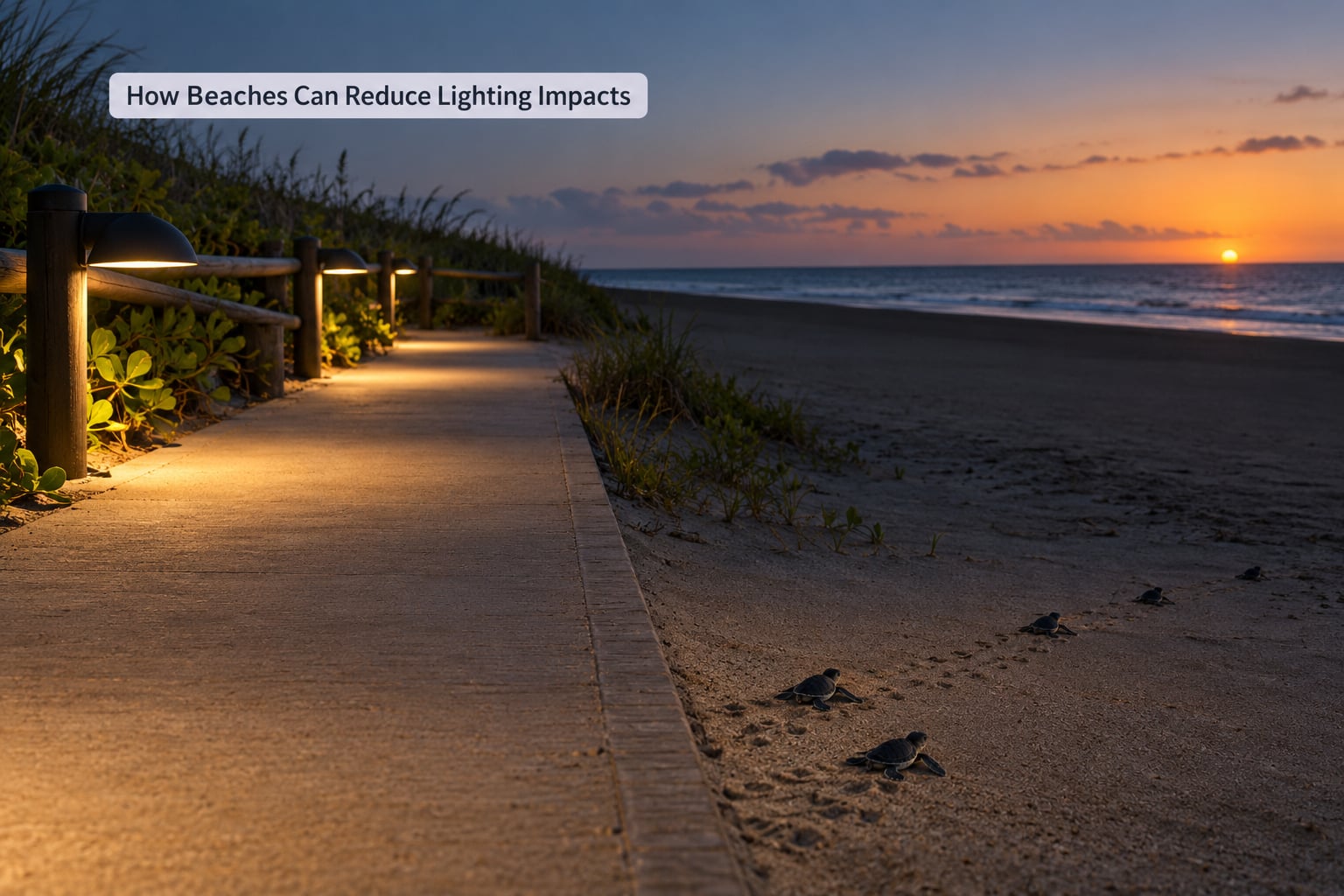
Fixes that work are mostly boring and mostly about physics: lower the output, block the view, change the spectrum, and switch it off when the beach is in use by turtles. Where it is done properly, no one notices the difference until the light is switched off.
For municipal authorities and coastal managers, the useful list is short:
- Shield every fixture so light goes to the task, using full cutoff fittings that cut off the upward and seaward components.
- Set the lowest intensity appropriate for the task, and put lights on timers or dimming controls rather than running them at full output all night.
- Filter or replace short-wavelength output, since blue, violet and ultraviolet content is what makes a source so attractive to hatchlings.
- Use non-reflective surfaces around fixtures, because a pale wall or a wet path bounces light further than the fixture itself throws it.
- Switch lighting off, or dim it to a minimum, during the local nesting and emergence window.
- Survey the beach at night during the emergence season and record which fixtures and which horizon directions are the culprits.
For property owners, interior light is often the biggest single source and the easiest to fix. Close the curtains, turn off anything visible from the beach, and where that is not enough, apply window film. Florida Fish and Wildlife research cited by Sea Turtle Conservancy found that film at 30 percent visible light transmittance or less is markedly less disruptive, with 15 percent or lower preferred.
Distance matters as well as brightness. Sunshine Coast Council in Australia states that lighting within 50 kilometres of the coastline contributes to skyglow that distracts hatchlings. That number is the answer to the objection that an inland resident has nothing to gain by switching off a garden light. On a long coastline, apparently irrelevant fixtures add up to a bright band over the nesting beach.
What Visitors Can Do at Night
If you are on a nesting beach after dark, the default is simply to carry no light and no screen brightness. Torches, phone screens and camera flashes all belong in a bag until you are well away from the dune line.
Some people object that one torch cannot matter much. It rarely is the only source, but it is often enough, because the hatchling is responding to the brightest cue available and a torch at head height is the brightest thing in its field of view. On Folly Beach the tracks ran the wrong way for a whole emergence, not because of stadium lighting but because of accumulated low-level brightness.
If you do need light, red-tinted or very dim light is the least disruptive option, with the honest caveat that in some jurisdictions red light is treated as artificial light and is not permitted on the beach during nesting season without a permit. Where you cannot be sure of the local rule, the safest choice is no light.
Park away from the dune line, keep dogs off the sand after sunset, and if you come across a hatchling moving inland, do not pick it up to carry it to the sea. Contact a licensed rescue group or your local wildlife authority instead. Rescue groups work under protocols that keep the corridor ahead of the turtle dark, and a well-meaning pair of hands carrying a hatchling across a lit area undoes most of what a good night achieved.
Simple Ways to Make Nesting Beaches Safer
If you take one action from this page, make it the one in your own control tonight. Switch off the light that can be seen from the beach. Everything else on this list is worth doing, in this order of impact:
- Kill any light visible from the sand, starting with interior light in beach-facing rooms and holiday lets.
- Re-aim or shield exterior fittings so nothing points seaward or across the dune.
- Drop the brightness to the lowest level that still does the job, and add timers.
- Swap short-wavelength fittings for long-wavelength ones when a replacement is due.
- Drive slowly at night near the emergence zone, with dipped headlights on approach.
- Support the local group that patrols the beach, because volunteers are the ones who find nests early and move hatchling groups safely.
None of this works as a private gesture. Hatchling orientation depends on the whole horizon, so a neighbourhood where every house is dark except yours protects the same turtles as a neighbourhood where nobody is. That is also why ordinances tend to land better than they first appear: the rules apply to everybody, which means no single household carries the cost.
Frequently Asked Questions
Do turtles like red light?
Not exactly. Sea turtles are least attracted to wavelengths at or beyond 560 nanometres, so red and amber sources disturb them less than blue-rich white light. Two things are often confused here: a red filter on a torch does not change the wavelength it emits, only its appearance, and in places such as Florida and Brevard County red light is still classed as artificial light and is not permitted on the beach during nesting season without a permit.
How does moonlight affect hatchling orientation?
Moonlight helps. A bright moon raises the contrast between the sea, which reflects moonlight, and the dark dunes and vegetation behind the hatchling, sharpening the gradient it follows. Under a new moon or heavy cloud the horizon goes nearly flat, the hatchling has almost nothing to steer by, and a single lit window can redirect the whole emergence.
What light colour does not attract sea turtles?
Light at 560 nanometres and beyond disturbs hatchlings least, so amber, orange and deep red are the least disruptive options. Recent work is more nuanced: phosphor-converted amber LED streetlights had minimal impact on flatback hatchlings but still affected loggerhead orientation at higher intensities. No artificial light is risk-free, so shielding and lower output still matter.
What should I do if I find a baby turtle crawling the wrong way?
General guidance only, since licensed groups follow their own protocol: do not use flashlights, including red-filtered ones, and keep your phone screen dark. Do not approach, handle or move the hatchling yourself. Keep people, pets and headlights off the beach near it, and contact a licensed sea turtle rescue group or local wildlife authority so a trained team can move it along a dark corridor.
How far inland does city skyglow affect turtle nesting beaches?
Sunshine Coast Council reports that lighting within 50 kilometres of the coastline contributes to skyglow that distracts hatchlings and can lead to death from exhaustion, dehydration and predation. Skyglow is the cumulative scatter of artificial light in the night sky, so it comes from many small sources rather than one obvious one, which is why individual inland households are told their garden lights matter.
How can local governments and businesses reduce lighting on nesting beaches?
Shield fittings so light goes downward to the task, cut brightness to the lowest useful level, remove short-wavelength output, use non-reflective surfaces and dim or switch off lighting during the local nesting and emergence window. Hotels, restaurants and holiday lets get the most from terrace lighting, car park lamps and interior light, since those sit closest to the dune line.
Conclusion: Keep the Sea the Brightest Horizon
Beach lighting confuses sea turtle hatchlings for one reason: it puts brightness where the hatchling expects darkness. The sea has to stay the brightest thing on the horizon and the land has to stay the darkest, and the cheapest way to protect every hatchling on a beach is to make sure that stays true at night.
Start with the light in your own control tonight. Everything after that, shielding, dimming, long wavelengths, timing, ordinance writing, is downstream of the same principle.
Your local conservation group or wildlife authority will know the nesting window for your stretch of coast, which fixtures have already been replaced, and who to call when a hatchling is found. On the Andalusian and Mediterranean coasts, the nesting season runs through the warm months and the species differ from those in Florida, but the orientation rule does not.