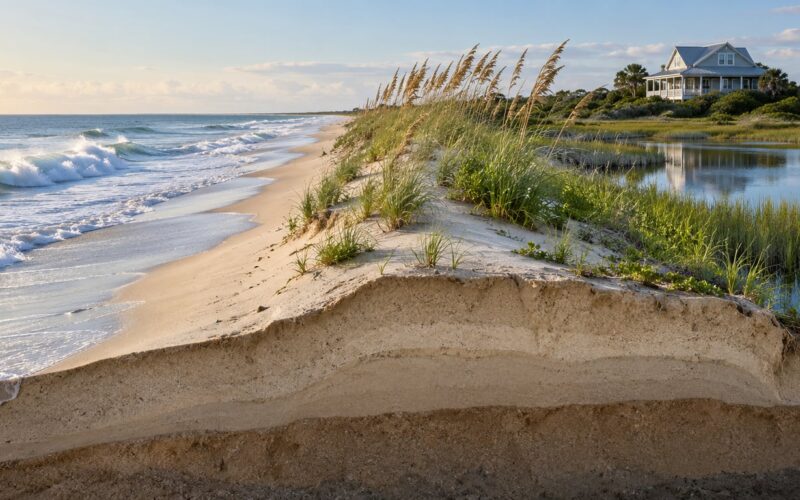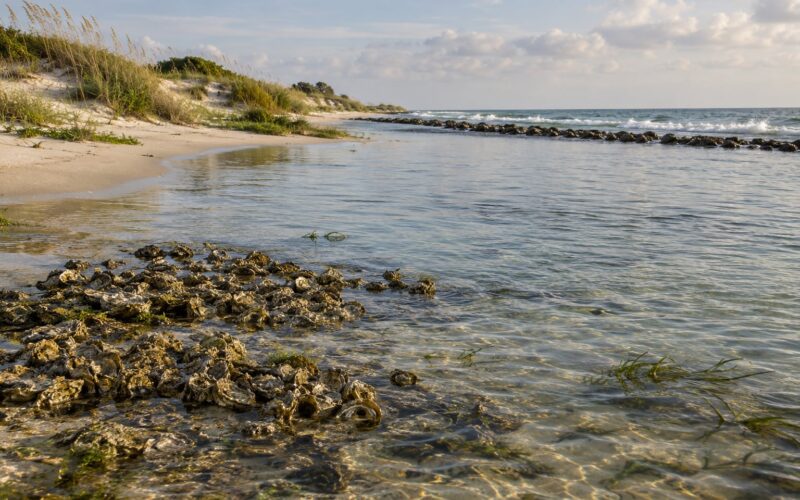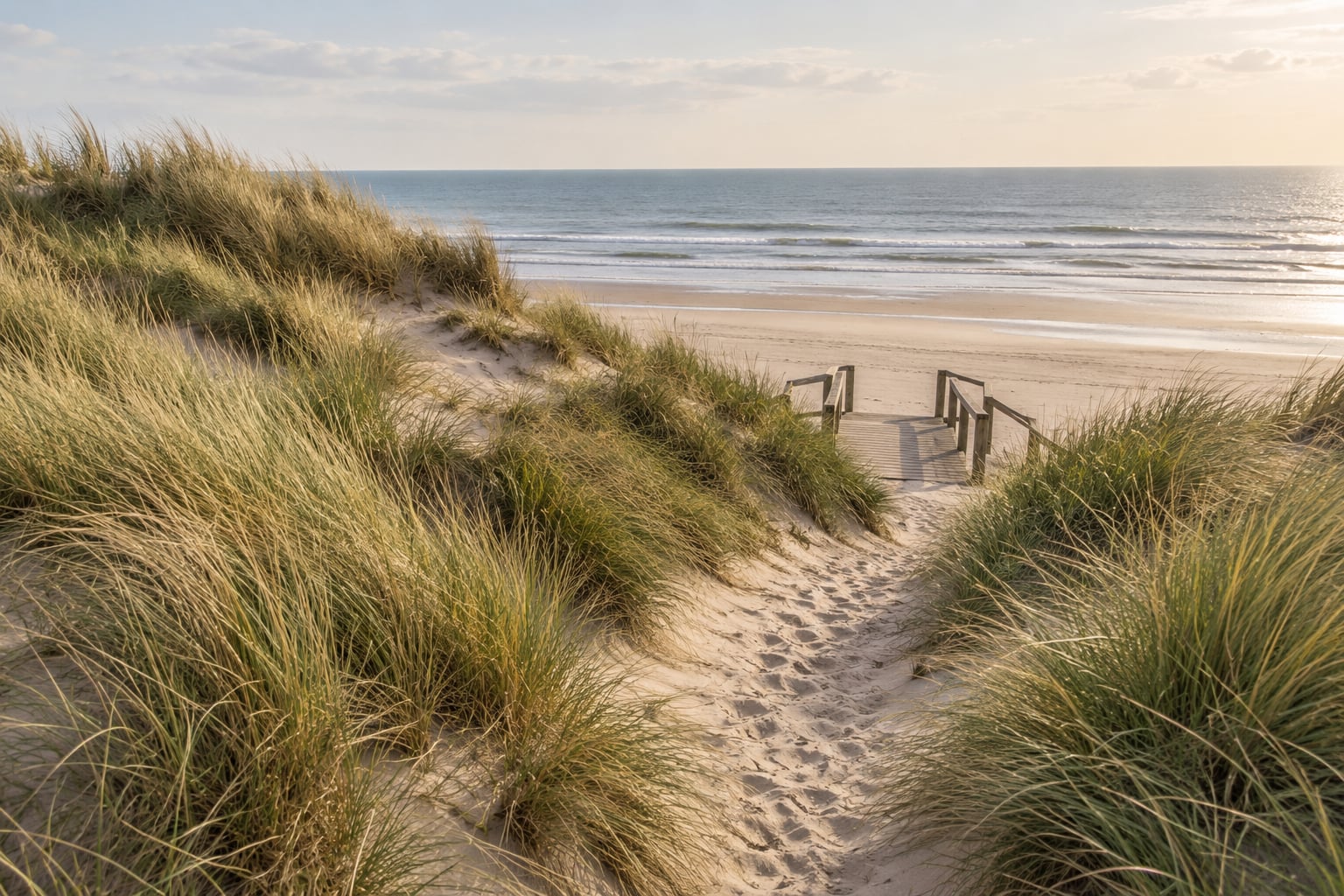
A coastal dune only exists because plants hold it in place. Marram grass and sea oats trap windblown sand in their stems and bind it with deep roots, so a loose pile stops shifting and starts absorbing wave energy. Feet crush those plants, and the dune loses the only part that was keeping it together.
That is the whole answer to why walking on dunes causes so much damage. The sand itself is constantly on the move, and it is the living cover that turns a moving pile into a barrier. Once the cover is gone, wind scours the bare surface, rain and storm surge funnel down the path that feet created, and the dune starts shedding sand faster than wind can bring it back.
The usual objection is that a dune is just sand, so what harm can a few footprints do. It is a fair question and worth taking seriously, because the damage is not instant and it rarely looks dramatic. One person crossing a dune does very little. A few hundred people taking the same line across the same summer does a great deal, and the bill arrives as a blowout months later.
Table of Contents
- Why walking on dunes causes so much damage
- What happens when people walk across a dune?
- Which dune habitats are most vulnerable?
- Young fore-dunes
- Established, heavily vegetated dunes
- Dune slacks and low points
- Nesting areas and restoration zones
- How much damage can one visit cause?
- Why walking on dunes causes so much damage even in a single afternoon
- Why are dune plants so important?
- What is the difference between walking on the beach and walking on a dune?
- Why firm sand matters more than most visitors realise
- How can people visit dunes without damaging them?
- How do damaged dunes recover?
- Frequently Asked Questions
- Why are you not supposed to walk on sand dunes?
- Are sand dunes safe to walk on?
- Do humans make beach erosion worse?
- How long does it take for a trampled sand dune to recover?
- What is marram grass and why is it planted on dunes?
- How can I report a damaged dune or a missing boardwalk?
- Conclusion: protect the dune by choosing the right route
Why walking on dunes causes so much damage
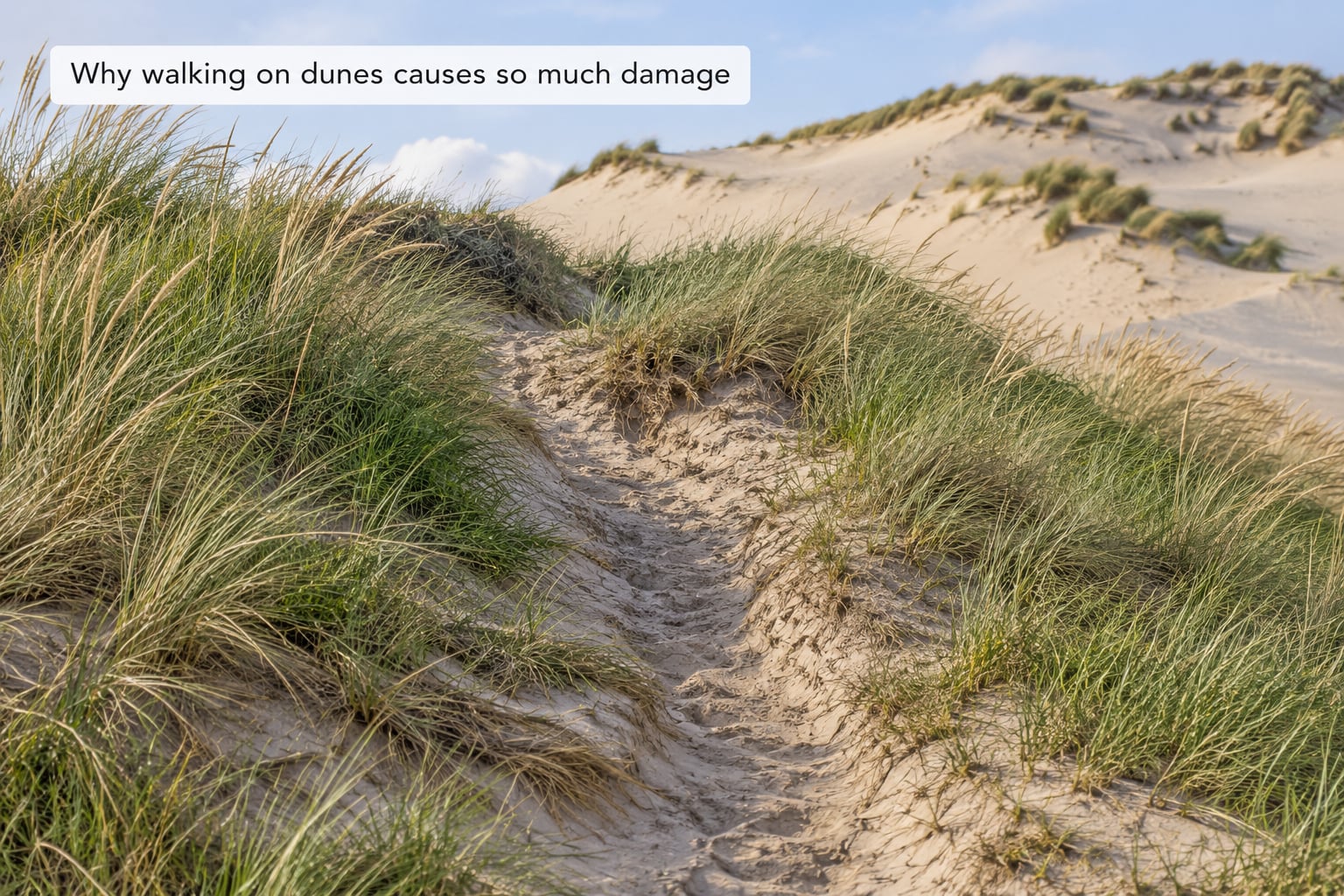
Dunes are aeolian landforms, meaning they are built by wind. Sand grains in the 0.1 to 1.0 millimetre range are pushed inland from the shoreface, pile up against the beach, and start building a foredune. On their own they would spread back out into a flat sheet within a season or two.
What stops that is vegetation. Pioneer species take the least stable, most saline, most wind-scoured sand and hold it, and in doing so make conditions tolerable for everything that follows. Coastal Wiki describes this as psammosere succession, the staged process by which sand-binding plants build a soil surface slowly enough for later species to move in. The result is a living net that anchors sand, slows wind at the surface, intercepts rainfall and takes the first hit from storm surge.
Feet, bicycle tyres, kite lines and vehicles all cut that net in the same way. Marram grass is a tall, tough plant with an underground network that is far wider than the tuft you see above ground, and it grows through sand by pushing new shoots upward. Crush the stems and the plant cannot photosynthesise well enough to replace them, so it dies back. Pull the sand away from the roots and the roots dry out and die. Either way the binding structure is lost, and it is lost over an area much larger than the footprint that caused it.
What happens when people walk across a dune?
The sequence matters more than the single step, because each stage makes the next one easier. Six mechanisms do most of the damage, and they tend to arrive in this order.
- Vegetation crushing. Stems are bent flat or buried under churned sand. The plant loses leaf area, weakens, and a patch that looked green from the boardwalk opens into bare sand.
- Path formation. Repeated use compacts the surface into a firmer, smoother track. That feels like an improvement underfoot, which is exactly why the path grows.
- The funnel effect. A path concentrates and directs energy toward whatever lies beyond it. Dune experts use a hose thumb for the same idea: cover part of a hose opening and the pressure at the rest of it rises. A compacted trail does the same to wind and to a storm surge, cutting deeper every time water runs along it.
- Blowout development. Where the path breaches a ridge, erosion digs a channel into the dune. This is the named failure mode, and once a blowout exists it tends to widen year after year rather than heal itself.
- Wind and water erosion. Loose, unvegetated sand is scoured by wind and stripped by runoff. The material that leaves the dune no longer traps new sand, so the system stops accumulating and begins retreating.
- Sand compaction. Even where plants survive, trampling packs grains together and drops the pore space between them. Less rainfall soaks into the dune, more runs off the surface, and the moisture regime the plants depend on changes underneath them.
Compaction is the mechanism most often left out of the conversation, and it is the one that explains why a dune can keep degrading after foot traffic has stopped. Nothing looks broken. The plants are thinner, the surface is hard, and the water is running the wrong way.
Which dune habitats are most vulnerable?
Vulnerability depends on how much cover there is, how wet the sand is, what grows there and whether anything is protecting it. Four settings stand out.
Young fore-dunes
The first and lowest ridge, closest to the beach, is often barely vegetated and is taking the full force of wind and wave run-up. Sand here is loose and saline, and any disturbance arrives before the plants have established. Coastal Wiki treats the shoreface, beach and dune as one three-compartment system, which is a useful warning: damage that starts in the dune works back through the other two.
Established, heavily vegetated dunes
These look robust, and they are more resilient per square metre than the young ones. But that is exactly where visitors concentrate, because the walking surface is better and the view is better. A concentrated route through a mature dune can strip a corridor that the surrounding vegetation then takes years to close.
Dune slacks and low points
Slacks are the damp, sheltered hollows between ridges, and they hold the wettest soil on the whole system. That moisture is what supports the densest plant cover and the richest invertebrate community. Because the sand is soft, people sink there, and because the ground is wet, trampling leaves deeper and more lasting marks.
Nesting areas and restoration zones
Ground-nesting birds, shorebirds and nesting sea turtles treat dune vegetation as cover, and a path through it removes both the cover and the nesting substrate. Restoration sites are fragile for a different reason: the plants there were just placed by hand, sometimes only a season old, with sand fencing holding sand against a wind that wants to take it back.
How much damage can one visit cause?
It depends on the number of visitors, footwear, season, slope, soil moisture and whether people keep to established routes. Footwear matters more than most people expect. Flat shoes and bare feet spread load across a wide area and shear stems low. Heels, cleats and bike tyres punch through the surface and dig in, so a soft footprint in wet sand can do more structural damage than a heavier step on a hard-packed path.
Season changes the ground. Wet and dry cycles matter, and wet sand near the toe of a dune holds together better than dry sand up on the ridge, which is loose and easily churned. Slope decides how fast water moves down a path, and therefore how fast a path cuts. Above all, repetition is the multiplier: the same few metres used once a day through a summer is a completely different proposition from one person crossing once.
Why walking on dunes causes so much damage even in a single afternoon
Because the mechanisms reinforce each other. A path that begins as compacted sand lowers infiltration, which concentrates runoff, which cuts the path deeper, which lets more wind scour the exposed sides. That afternoon’s damage is mostly setup work, and the visible loss happens later when wind or a storm finds the weakness.
| Type of use | What it does to the dune | Approximate recovery |
|---|---|---|
| Staying on boardwalks and designated access points | Concentrates use onto structures built for it; vegetation either side stays intact | No damage to repair |
| Light traffic on already bare, firm sand | Minor compaction, little vegetation loss | Days to a season |
| Repeated walking across vegetated sand | Crushed plants, path formation, funnel effect, compaction, possible blowout initiation | Several years before full cover returns; longer where a ridge is breached |
| Vehicles, quad bikes and long-term parking | Deep rutting, root destruction across a wide area, direct sediment loss | Decades, and often beyond local capacity to repair |
Those timescales are broad rather than precise, and local species, climate and sediment supply change them. What holds across systems is the ordering: bare sand recovers faster than crushed vegetation, and crushed vegetation recovers faster than a breach in the ridge.
Why are dune plants so important?
Marram grass, Ammophila arenaria, is the plant most visitors hear about, and it earns it. It grows from a deep, wide, web-like root system, produces stiff stems that catch moving sand, and keeps growing upward as sand piles against it. Sea oats, Uniola paniculata, does the same job on the Atlantic and Gulf coasts with a taller, more arching habit. Elymus fractus is another widely used species in restoration work.
What these plants do is easy to underestimate because it looks like nothing is happening. Stems roughen the surface so wind cannot pick up sand smoothly. Roots bind grains into a coherent mat. Dead stems and leaf litter accumulate as thatch, which further breaks up the airflow at ground level. Together they make the surface rough enough that wind drops sand instead of carrying it away, and the dune grows upward rather than drifting.
They also build habitat. Dense cover holds warmth and shelter for invertebrates, which feed everything above them, and it gives ground-nesting birds somewhere to hide. On the shore side it is the first structure a wave meets, absorbing run-up before it reaches a wall or a house. Vegetation is not decoration on a dune. It is the dune.
The troubling part is how a small wound spreads. A crushed plant dies, the sand around it is no longer trapped, and the bare patch gives wind a low-resistance route into the stand. Neighbouring plants lose sand from around their roots and weaken in turn. The patch grows sideways, then joins another, and after a few seasons you have a corridor rather than a trail.
What is the difference between walking on the beach and walking on a dune?
Beach sand is compacted by tides, waves and gravity, so it is firmer and slightly wet. It carries footsteps without holding much vegetation anyway, and it heals quickly. Dune sand is drier, looser, full of air, and carrying the only living cover on the whole system. That is why the same walk costs almost nothing on the beach and a great deal a few metres inland.
Why firm sand matters more than most visitors realise
On the beach, a path is the path. On a dune, a path is a defect in a living structure. The dry sand of the ridge is where the roots are and where the seeds are, so that is exactly the ground that cannot afford it. The contrast also explains why visitors get contradictory advice: firm sand near the water is genuinely more forgiving, but the safest route is whatever the local signs and fences say, because those mark the nesting sites, the restoration plots and the slopes that fail badly.
Beach walking is not impact-free either. Piping plovers and terns nest on open sand above the high tide line, and their nests are almost impossible to see. A dog off its lead can flatten a scrape in seconds. Local rules usually reflect this, so follow them rather than working out your own compromise.
How can people visit dunes without damaging them?
Six habits cover almost all of it.
- Use the boardwalk and the marked access points. They exist to take your feet off the vegetation. If a route has no boardwalk, treat that as a sign to change route rather than to improvise across the dune.
- Walk on the firm, damp sand near the water line. That is the resilient part of the profile, and walking there keeps routes out of the vegetated ridge.
- Stop at a viewpoint instead of climbing the ridge. A photograph from the bottom of a path is worth more than one from the top, because the top is where the sand is loosest and the cover is thinnest.
- Respect seasonal closures. Nesting season restrictions and fenced restoration areas are temporary, and the fence is usually there because something inside it cannot defend itself.
- Keep dogs on the lead, or off the dunes entirely. A dog on a lead still digs and digs up, and an off-lead dog can do more damage in ten minutes than a hundred careful steps.
- Never drive or park on a dune. Vehicles remove root systems across a wide area and push sand sideways, and that damage tends to last decades rather than seasons.
The honest difficulty is the missing boardwalk. Plenty of sites have signage pointing at a soft sandy slope with no path on it, and no marked way down to the water that avoids the vegetation. If that is the situation where you are standing, do not cut your own line and do not drive through the fence. Take a photo with a landmark in frame and report it to the local authority or the beach management service, because a broken access arrangement rarely changes until somebody puts it in front of the right person.
How do damaged dunes recover?
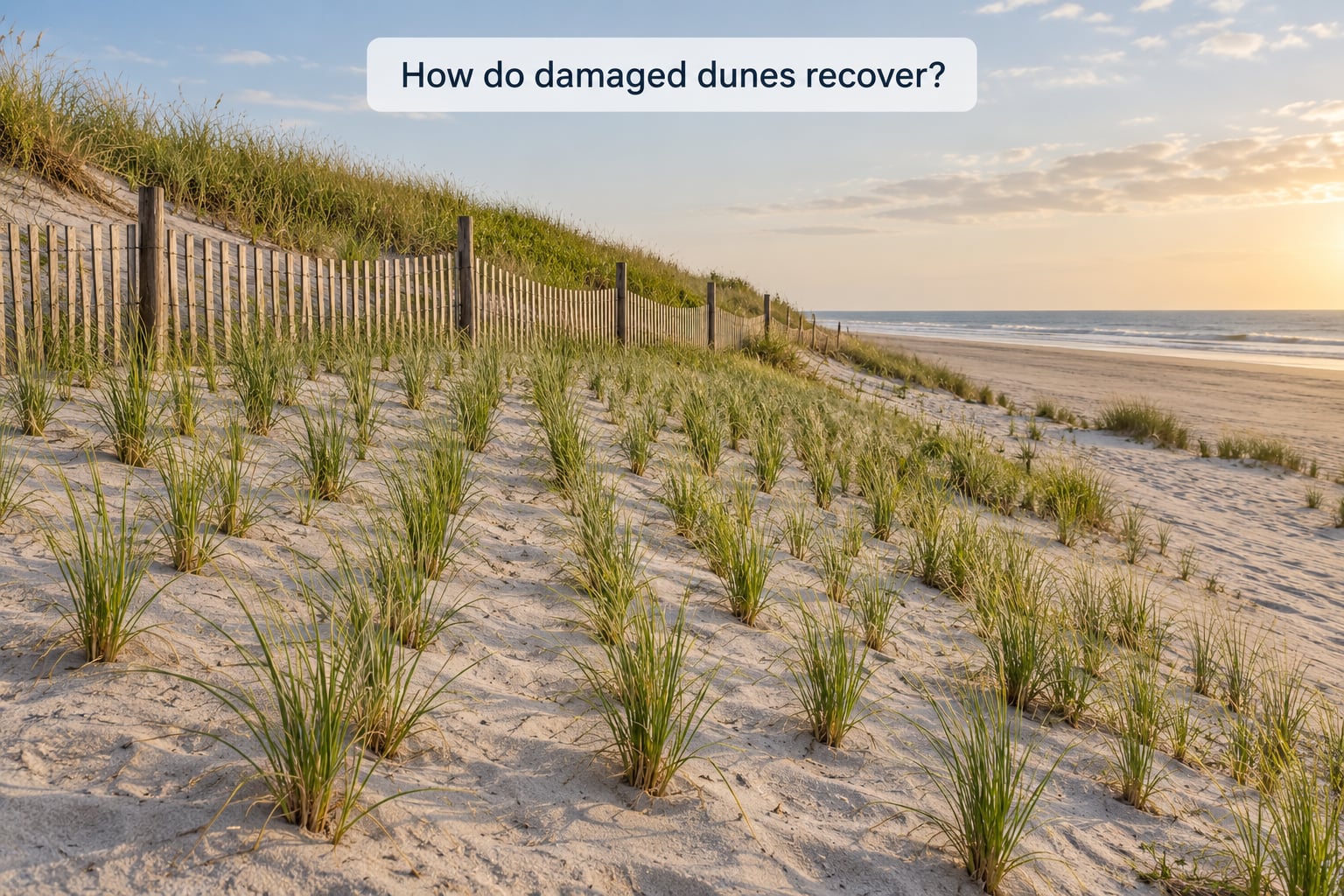
Small damage recovers on its own. Where vegetation has been crushed but the sand is still in place and foot traffic stops, pioneer species recolonise within a few growing seasons, often from plants just outside the damaged patch. That is the case the phrase several years covers.
Once a blowout has formed, recovery moves to decades. The breach has to be stabilised before anything can grow across it. Depending on the site, managers close access, install sand fencing or ganivelles to trap moving sand, replant with species suited to the local sediment and exposure, and sometimes lay biodegradable geotextiles to hold the profile while the plants establish. Where the sediment budget is negative and the shoreline is retreating, nourishment or managed realignment is the larger answer rather than a dune repair.
None of this waits for the site to be convenient. The next storm does not care that the planting is two seasons old, which is the uncomfortable part of the economics. Restoration is paid for by the community, and it is often triggered by damage caused by people who will never pay for it.
Coastal Wiki notes that nearly three-quarters of Mediterranean coastal dunes have been damaged or destroyed, with tourism development the main driver. That figure covers construction, vehicle access and everything else, so it is not a measure of foot traffic on its own. It does show how quickly a slow process can add up once access is easy and stopping it becomes politically awkward.
Dunes are living infrastructure that protects a coast and takes decades to repair, and the cheapest time to deal with a path is while it is still only a path.
Frequently Asked Questions
Why are you not supposed to walk on sand dunes?
Because dune sand is only stable when plants hold it. Walking crushes stems, buries seedlings and cuts the root mat that binds grains together. Bare sand is then scoured by wind and stripped by runoff, and the path funnels storm water toward whatever lies beyond it. The plants grow back over years; a ridge breach can take decades.
Are sand dunes safe to walk on?
Physically, a dry dune is loose sand that takes real effort to cross, and steep loose sections can give way underfoot. Ecologically, it is the least forgiving part of a beach. Firm, damp sand near the water line is more resilient, but nesting birds and restoration plots can be anywhere on the profile, so the local signs and fences are the deciding factor, not your own judgement of the sand.
Do humans make beach erosion worse?
Beach erosion is driven mainly by reduced sediment supply, rising sea levels and storm conditions, so people are rarely the primary cause. What people do is remove options. Trampling removes vegetation, so the dune stops trapping fresh sand and starts shedding it, and damaged dunes give up storm protection earlier. Vehicles and parked equipment do far more damage per visit than walking does.
How long does it take for a trampled sand dune to recover?
Crushed vegetation on stable sand often recolonises within a few growing seasons once foot traffic stops. Sand compaction is slower to undo, because the pore space stays reduced even after plants return. A formed blowout or a vehicle rut is a different order of problem again and commonly takes decades, and it needs fencing, replanting and access control rather than patience alone.
What is marram grass and why is it planted on dunes?
Marram grass, Ammophila arenaria, is a tall dune grass with a deep, wide root system and stiff stems that trap moving sand. It grows upward as sand piles against it, binding the surface and making it rough enough to stop wind picking grains up. Coastal Wiki names it, along with Elymus fractus, as a standard species in restoration planting.
How can I report a damaged dune or a missing boardwalk?
Photograph it with a landmark in frame and report it to the local authority or the beach management service that holds the dunes, since rules and access points vary by coastline. Mention fencing that has been breached or moved, off-road vehicles on the dune, and nesting-season closures, because those need acting on quickly. Locals have reported finding chairs and equipment left on private dunes and having to clear them themselves.
Conclusion: protect the dune by choosing the right route
The reason why walking on dunes causes so much damage is not that sand is delicate. It is that a dune is a structure held together by plants, and trampling removes the part that does the holding. What follows is slow and hard to point at, which is exactly why it goes on happening.
If you do one thing differently, use the boardwalk or the marked access point even when it is a longer walk, and stay on the firm sand near the water rather than cutting up onto the vegetated ridge. Watch for the dogs, respect seasonal closures, and keep vehicles and equipment off the sand entirely.
Signs are usually placed there by people who would like visitors to enjoy the beach, not to catch them out. Following them is the cheapest contribution anyone makes to a piece of coast that takes decades to put back together.