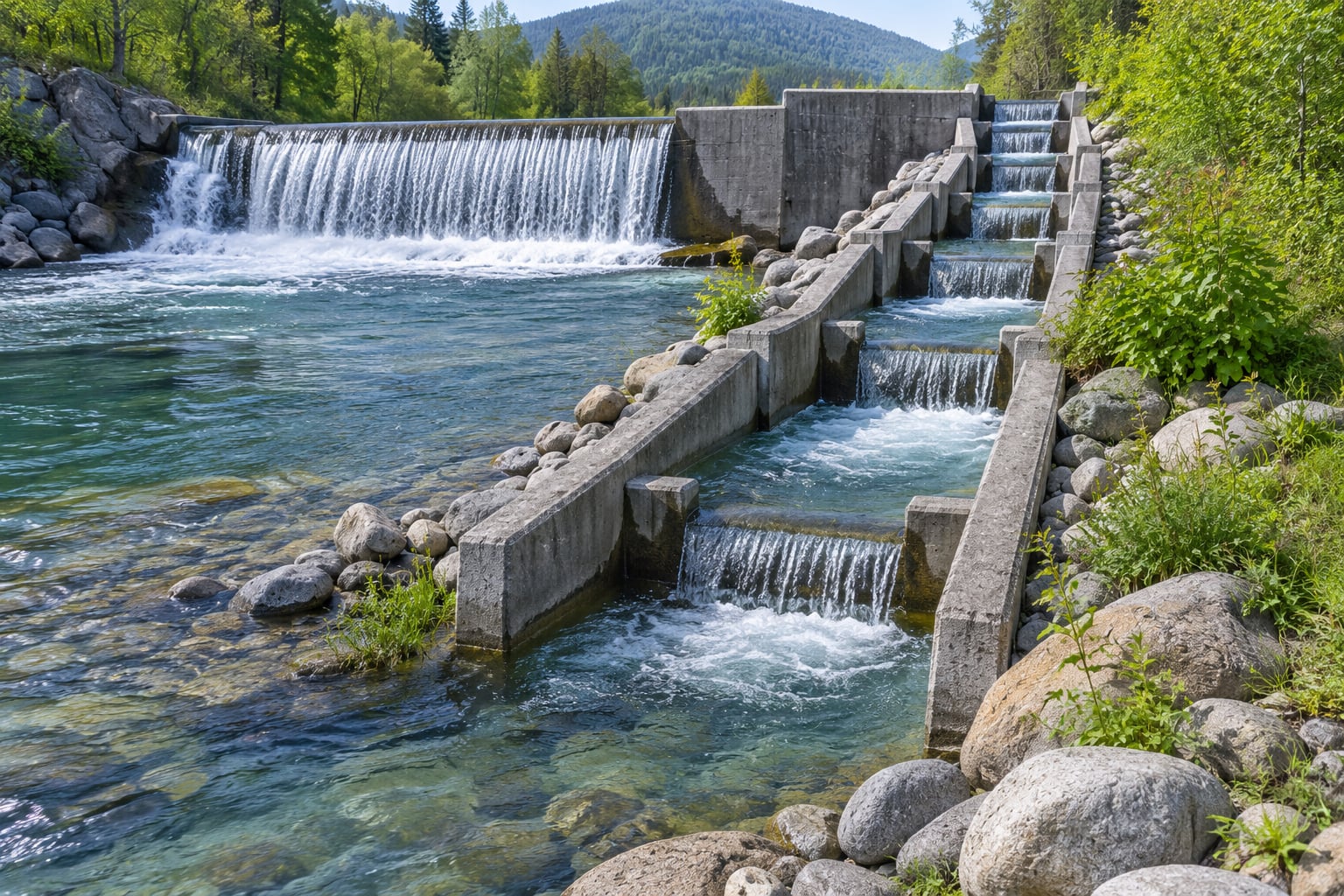
A fish ladder is a sloping channel built beside a dam or weir, made of a run of pools that each sit slightly higher than the one below, so a migrating fish can climb past the barrier in a series of short moves instead of one impossible wall. To understand how fish ladders work and why some fail, the useful lens is not the concrete but the flow: where the water goes, how fast it moves, and whether the target fish can find the entrance and hold position inside.
Most ladders succeed for salmon and trout and disappoint everyone else. Passage efficiency figures gathered in a 2023 meta-analysis put salmonids near 70 percent, while cyprinids such as carp and chub sat around 42 percent, and some migrations see far less of that. The failures are rarely dramatic collapses. They are slow leaks of connectivity, and they usually trace back to a handful of repeating design mistakes.
This guide walks through the mechanism, the parts, the failure modes, the biology behind them, and what a river manager actually checks to know whether a crossing is doing its job.
Table of Contents
- How Fish Ladders Work
- The Main Parts of a Fish Ladder
- The entrance and its attraction flow
- The collection pool
- The stepping units
- Resting areas and velocity refuges
- The exit
- Flow controls and monitoring gear
- Why Some Fish Ladders Fail
- What Makes Fish Passage Difficult?
- Swimming ability and leaping ability are separate skills
- Species differences are large
- Conditions on the day matter as much as the drawing
- Ladders only solve the upstream problem
- How to Tell Whether a Fish Ladder Is Working
- Signs it is working
- Warning signs it is failing
- How Fish Ladder Designs Are Evaluated
- Hydraulic modelling
- Species and site data
- Field observation before the concrete is poured
- Monitoring results after commissioning
- What genetics add
- Maintenance and Adaptation for Changing Rivers
- Routine inspection
- Triggers for redesign
- When removal makes more sense
- Designing for a river that is changing
- Frequently Asked Questions
- What are the downsides of fish ladders?
- Do fish ladders really work?
- What are the different types of fish ladders?
- What is the purpose of a fish ladder?
- Why is it called a salmon ladder?
- How successful are fish ladders?
How Fish Ladders Work
The whole idea is subtraction. A dam raises the water surface by a height no migrating fish can clear in one go, so the ladder removes that single barrier and replaces it with dozens of small ones, each within a fish’s comfort range.
Take a modest weir that lifts the water surface three metres. Straight across, that is a wall. On the ladder beside it, the same three metres is spread over a slope gentle enough that the water breaks into a staircase of pools, each perhaps a fraction of a metre higher than the last. A fish holds station in the slow water of a pool, gathers itself, and moves up into the next one.
- The fish finds the entrance. It follows a current that draws it toward the bottom of the ladder rather than continuing along the dam face.
- It enters the first pool. The pool is deep enough that a fish can stop swimming and simply hold in the current, which costs far less energy than fighting it.
- It moves up to the next level. Depending on the design, that means leaping a low weir crest, squeezing through a vertical slot, or climbing a series of angled baffles.
- It rests. Each pool is a resting place as much as a step. Without these pauses, a fish exhausts itself before it clears even half the structure.
- It repeats. The number of pools depends on the height to be gained and the species being targeted. A short drop needs a handful; a tall dam needs dozens or hundreds.
- It exits at the top. The final pool discharges back into the river at a level that lets the fish continue upstream to spawning habitat instead of being dumped into a dead end.
Two different measurements describe whether that sequence works, and confusing them explains a lot of disappointed dam owners. Attraction efficiency is the share of approaching fish that find and enter the entrance at all. Passage efficiency is the share of those that enter and reach the top. A ladder can post respectable passage numbers while attracting almost nothing, which looks like failure from the riverbank.
The Main Parts of a Fish Ladder
Read a ladder in the order a fish meets it, from the riverbank upward.
The entrance and its attraction flow
The entrance is the single most consequential part. A discharge of moving water, called the attraction flow, is released near the tailwater to pull fish off the dam face and toward the opening. If it is too weak, sits on the wrong side of the structure, or points downstream, fish swim past an open door without noticing it.
The collection pool
Water lands in a pool with enough depth and low enough velocity that a fish can orient itself instead of being slammed downstream. This is where a lot of lost attempts happen: analysis of passage at Bloede Dam in Maryland found field observations of fish appearing confused in this first pool, with efficiency varying widely from approach to approach.
The stepping units
Above the first pool sits the repeating section, and its geometry is the design’s core. Pool-and-weir arrangements use a low overflow weir over each pool. Vertical slot designs use one or more narrow vertical openings that a fish must rise through. Denil and steeppass designs use closely spaced angled baffles that break a steep drop into a rough, climbable surface.
Resting areas and velocity refuges
Pockets of slack water sit at the base of each weir, in the corners of slots, and behind baffles. These are where a spent fish recovers. When a design leaves no slack water, every step costs more energy than the fish has, and passage success collapses.
The exit
The upper pool has to return fish to the river at an elevation and in a direction they will accept. An exit that discharges into slack water beside the wall, or that lets fish fall back into the ladder, wastes successful climbs.
Flow controls and monitoring gear
Gates, orifices, and adjustable weirs set how much water moves through each pool, and a good design holds those settings across the range of river levels the dam will actually see. Counting stations, viewing windows, cameras, and sometimes trap-and-haul facilities sit at the entrance or the exit so managers can count what comes through and compare it to what should have.
Why Some Fish Ladders Fail
Failure modes repeat across continents. If you are assessing a crossing, these are the checks I would want answered first.
- Attraction flow too weak or badly placed. The ladder opens and nothing enters it. This is the most common cause of a ladder that looks fine and gets no fish.
- Entrance confusion. Even after entering, fish mill about in the collection pool and turn back. Designers have had to reconfigure entrances after watching exactly this pattern.
- Velocities and turbulence above what the species tolerates. A ladder sized for adult salmon can be physically impassable for small-bodied fish, and juveniles are the ones whose loss changes a population fastest.
- Jump heights that exclude non-leapers. A crest a salmon clears with room to spare may stop a herring or a chub outright. Designs that depend on leaping simply do not serve fish that do not leap.
- A design tuned to one species. Vertical slot fishways in particular have been criticised in the research literature for failing smaller, weaker fish. Single-species assumptions are the quiet cause of a lot of empty ladders.
- Flow outside the design window. A 2021 review by the Connecticut Department of Energy and Environmental Protection found passage efficiency beginning to decline at 500 cubic feet per second on the system reviewed, and close to non-existent below 200 or above that range. Ladders calibrated for one discharge fail at the edges.
- Sediment and debris. Pools silt up, orifices clog, and the resting areas that made the design work disappear. Wood and ice do the same thing on a northern river every winter.
- Nothing downstream of the ladder. A passage that delivers fish into a reach with no spawning substrate solves the barrier and creates the next one. Connectivity has to be assessed in both directions.
One failure mode is not a fault at all. Anglers around the Columbia River have long observed that the ladders at Locks and Dams 1 through 15 were rarely, if ever, used, because during flood conditions larger, stronger fish simply swim over the inundated dam. That structure had a problem no ladder could fix.
What Makes Fish Passage Difficult?
Design is really a negotiation with fish biology, and the terms differ by species and by conditions on the day.
Swimming ability and leaping ability are separate skills
A fish that can hold position in a fast current may be hopeless at clearing a vertical step, and the reverse is also true. Ladders that rely on leaps suit strong jumpers. Ladders built on slack-water steps suit sustained swimmers. Trying to serve both from one geometry is where compromises show up later as low efficiency numbers.
Species differences are large
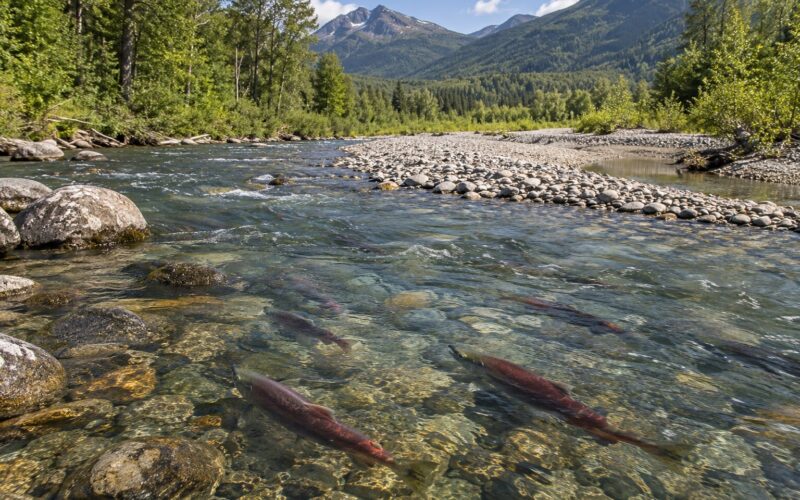
Salmonids such as salmon, steelhead, and trout are strong sustained swimmers, which is why classic ladders were built with them in mind. Cyprinids and many small-bodied species are not, and their numbers suffer for it. Shad, river herring, alewife, American eel, and lamprey each behave differently again: some ascend in tight groups, some travel at night, some tolerate the ladder that stops others.
| Design | How it works | Suits | Main weakness |
|---|---|---|---|
| Pool and weir | Series of pools separated by low overflow weirs | Salmon, trout, shad | Jump height can exclude weak and small fish |
| Vertical slot | Water passes up through narrow vertical openings | Larger-bodied strong swimmers | Known to shut out small, weaker species |
| Denil or steeppass | Closely spaced angled baffles break a steep drop | Short drops, small structures | Needs a steady supply of flow to work |
| Nature-like or rock ramp | Sloped riffle channel with roughened bed and boulders | Wide range of species, often many at once | Takes more space and more flow than a concrete chute |
| Fish elevator or siphon | Lifts fish in a tank, or moves them through a rising column | Tall barriers with little room for a slope | Mechanical parts wear out; needs staffing |
Nature-like designs are the interesting case here. A naturally structured bypass channel at Rheinfelden passed roughly 40,000 fish of 33 species in a single season, according to field observation from Eawag, a number no conventional concrete ladder on the same system came close to.
Conditions on the day matter as much as the drawing
Cold water, turbidity, and a flood or a drought each change the problem. Low flow can leave a ladder dry at the bottom and too deep at the top. High flow can drown the attracting current and push fish past the mouth. Sediment-laden water blinds a fish’s short range and removes the visual cues it was using to navigate. Migration timing decides whether a fish is in condition to attempt the climb at all, which is why some facilities are now operated only during the breeding window. At Baguari Dam, research recommendations went as far as suggesting the facility run only during the reproductive period.
Ladders only solve the upstream problem
Downstream passage is a different engineering problem with different injuries, and it gets almost no attention in public discussion. A ladder that helps fish climb says nothing about the smolt and adults dropping over a spillway.
How to Tell Whether a Fish Ladder Is Working
You do not need lab work to get a first read on a fishway. You need to know what success looks like and what the failure signatures are.
Signs it is working
- Fish are visible entering the collection pool and climbing in steady numbers, not isolated individuals.
- Counting data shows a rising passage efficiency that holds across seasons rather than collapsing after the first weeks of the run.
- Fish leave the top exit and carry on upstream, appearing above the dam in the species’ normal timing.
- More than one species uses it, with a species mix consistent with what the river system should hold.
- The passage season shows the pattern noted in monitoring studies, with stronger overall efficiency in autumn and more successful passage among active individuals.
Warning signs it is failing
- Fish gather below the dam at the tailwater and never enter, which points straight at the attraction flow.
- Fish enter, then leave the same pool several times without gaining elevation. That is entrance confusion or an unpassable step.
- Fish pile up at the foot of one particular weir or slot while the rest of the structure stands empty.
- Scour holes appear downstream of the outlet, or the collection pool has gone shallow and gravelly.
- Water is running fast on one side and nearly still on the other, which means uneven flow distribution through the pools.
- Debris, silt, or ice is visibly filling the pools where the resting areas should be.
- Weirs are damaged or notched, changing the heights the design was calculated around.
One 2023 study found overall fishway passage efficiency near 73 percent across a mixed set of monitored structures, but with wide variation between them. That spread is the point: a ladder’s name tells you nothing about its performance, and the only way to know is a count.
How Fish Ladder Designs Are Evaluated
Specialists judge a crossing with four kinds of evidence, and a design that has only one of them is a guess.
Hydraulic modelling
Engineers model velocities, energy dissipation, and depth across the full range of discharges the dam will see. This is where most design failures are caught on paper. It is also where the design window gets defined, and a window too narrow to match the river is a ladder that works only in a mild spring.
Species and site data
The target species set drives everything: their sustained swimming ability, their jumping behaviour, their size at migration, and the timing of their run. A site where several species migrate at once needs a design that serves all of them, which is usually less efficient for any single one than a dedicated structure would be.
Field observation before the concrete is poured
Fish-tracking studies, observations of approach behaviour at the tailwater, and analysis of where fish hold in the river reveal whether the entrance location and attraction flow actually work. The Bloede Dam experience shows the value of this: the problem was visible in fish behaviour, and the structure was reconfigured in response.
Monitoring results after commissioning
Counting facilities feed the numbers that decide whether a ladder stays as built or gets retrofitted. This is where fish ladders have quietly improved. Retrofits to existing ladders have demonstrably raised effectiveness and reduced passage delays, and the reason they work is that the original design assumed a species or a flow that turned out to be wrong.
What genetics add
Genetic work shows the long-term payoff that fish counts miss. In the Rhine catchment, ladders measurably reduced genetic isolation between chub populations, from the equivalent of roughly 100 kilometres of natural river separation down to about 12 kilometres. Real benefit, but not the same as an unblocked river, which is the honest limit of what passage structures can claim.
Maintenance and Adaptation for Changing Rivers
A fish ladder is not a structure that gets built and forgotten. It is a machine with moving gates, silt traps and weather-exposed surfaces, sitting in a river that keeps rearranging itself.
Routine inspection
Crews check that orifices and slots are clear, weir crests are at their design height, resting pockets still hold slack water, the exit is unobstructed, and the attraction flow is discharging properly at river stage. Debris removal after storms is the most frequent task. In cold climates, ice and frazil have to be cleared before a run starts.
Triggers for redesign
Several things should prompt a project to go back to the drawing board rather than to the toolbox: passage efficiency that stays low through a full season, an approach where fish consistently refuse the entrance, a flood or sediment slug that has changed the channel geometry, a new species arriving that the structure cannot serve, or a revised flow regime that moved the operating window outside what the design assumed.
When removal makes more sense
A ladder is a compromise, and it is not always the right compromise. Where a barrier is small enough to remove, or where the fish at stake can pass during high water without help, taking the barrier out restores free access in a way no ladder matches. On the Columbia, structures with ladders went largely unused because flood flows let fish over the dam naturally.
Designing for a river that is changing
Runoff patterns shift, and a ladder calibrated to historic flows can end up outside its window for more years than it sits inside it. Wider operating ranges, adjustable rather than fixed weirs, and designs that pass a wider range of sizes all reduce that exposure. Space is the other constraint: nature-like fishways need more room than a concrete chute, and that room is often what a site cannot spare.
Frequently Asked Questions
What are the downsides of fish ladders?
They solve only upstream passage, and often only for strong swimmers such as adult salmon. A ladder can attract almost no fish if its entrance flow is weak, and a vertical slot design can exclude small species entirely. Passage efficiency also falls sharply outside the flow range the structure was designed for, and silt, debris and ice fill the resting pools that make the climb possible.
Do fish ladders really work?
Yes, for the species they were designed around. A 2023 meta-analysis put passage efficiency near 70 percent for salmonids and about 42 percent for cyprinids, with a separate study reporting roughly 73 percent overall across monitored structures. The gap between those figures is the whole story: a ladder built for salmon often gives shad, chub, herring or small juveniles a poor deal.
What are the different types of fish ladders?
The main types are pool and weir, vertical slot, denil or steeppass, nature-like rock ramps, and mechanical options such as fish elevators and siphons. Pool and weir suits salmon and trout, vertical slot suits strong larger fish, denil works for short drops, and nature-like ramps pass the widest range of species but need more space and water.
What is the purpose of a fish ladder?
A fish ladder gives migratory fish a way past a dam or weir they cannot jump, so they can reach spawning habitat upstream and so populations separated by barriers can exchange genes. Also called a fishway, fish pass or fishstep. It restores connectivity in a river that has been split in two, which matters most to salmon, shad, herring, eel and lamprey.
Why is it called a salmon ladder?
Salmon were the fish these structures were first built for, and the earliest examples date back centuries, so the name stuck even though most modern fishways are built for many species. Other names you will hear are fishway, fish pass and fishstep. When a ladder is labelled a salmon ladder, it usually means it was designed around leaping adult salmon and may suit other fish poorly.
How successful are fish ladders?
It depends entirely on the structure and the species. Counting data shows wide variation between sites, and efficiency can hold near 70 percent for salmonids while sitting far lower for everything else. Genetic studies in the Rhine catchment showed ladders cutting the isolation between chub populations from about 100 kilometres of equivalent natural separation to about 12 kilometres, a real gain that still falls short of an unblocked river.
If you own or manage a river crossing, start with the entrance, not the concrete. Watch where fish hold in the tailwater, check that the attraction flow is discharging toward them at the current river stage, and count what actually enters over a full run. Almost everything else about a failing ladder becomes clearer once those three observations are in hand.