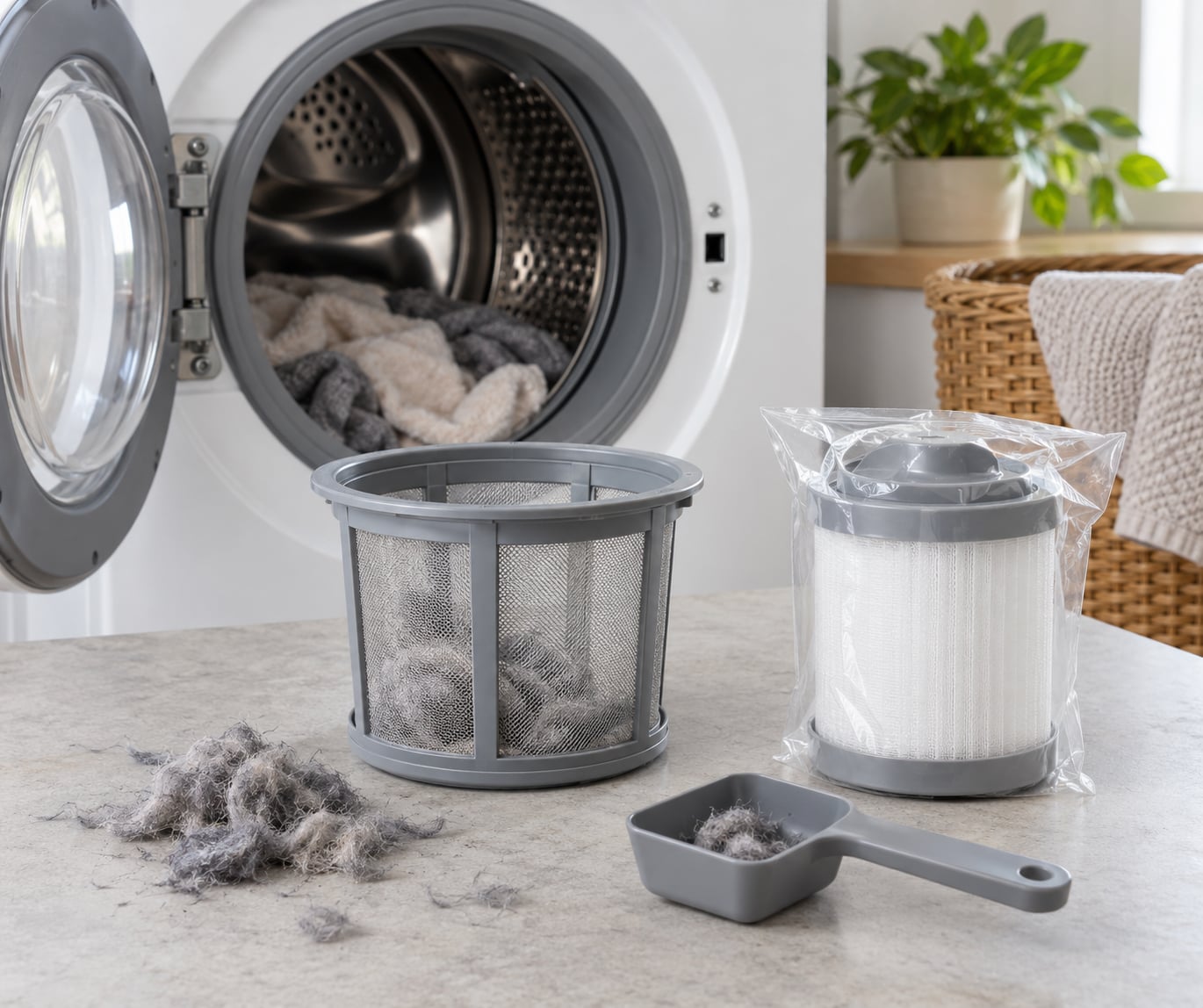
Short answer: yes, conditionally. A laundry filter can intercept a meaningful share of the microfibers your washing machine releases, most noticeably from synthetic-heavy loads, but it is one part of a problem rather than a solution. The honest case for buying one is source control at the drain. The weak case is anything about your own health.
Microfibers are tiny fragments of plastic shed from textiles, mostly polyester, nylon, acrylic and fleece. They leave a load in two places: the water that drains away and the air that moves through the dryer. A filter intercepts the first route only, which is exactly why dryers keep a lint screen and most washing machines do not.
For most households, the practical question is not whether a filter helps at all, but whether you will install it properly and empty it often enough to keep it working. A full collector that nobody checks quietly stops capturing anything.
Table of Contents
- Are Laundry Filters Worth It for Microfiber Pollution?
- How Effective Are Laundry Filters at Removing Microfibers?
- What Types of Laundry Microfiber Filters Are Available?
- How Do You Install and Maintain a Laundry Filter?
- Do Laundry Filters Make Washing Synthetic Clothes Safer?
- Are Laundry Filters Better Than Reducing Microfiber Shedding at the Source?
- Frequently Asked Questions
- Do laundry filters work in machines with hard water?
- Should I put a microfiber filter in the dryer as well as the washer?
- Can a laundry filter replace a wastewater treatment plant?
- How often should I empty and clean a reusable laundry filter?
- Are disposable microfiber filters worse for the environment than washing synthetic clothes?
Are Laundry Filters Worth It for Microfiber Pollution?
They are worth it for one specific outcome: keeping a measurable quantity of shed plastic out of household wastewater. They are not worth it as a general clean-living purchase, and they do almost nothing for the air in your laundry room.
You will see two figures quoted for the same class of product in the same week, sometimes 87 percent, sometimes 26 percent. Neither is fake. The gap comes from what was measured rather than from a lie, and understanding that gap is the whole buying decision.
Who benefits most:
- Households that wash polyester, nylon, acrylic or fleece regularly, especially sportswear, work uniforms and cheap fast-fashion items.
- People with a front-loader or a washer-dryer where the drain hose is accessible for an inline filter.
- Anyone who will empty the collector on a schedule rather than when it looks full.
- Households near a water body or on a septic-leaning system, where effluent path length matters.
Who gains the least:
- People who wash mostly cotton, linen and wool, which shed far less plastic in the first place.
- Renters who cannot modify the drain line or lack space behind the machine.
- Anyone hoping the filter will protect their skin, lungs or thyroid. That is a different problem with different evidence.
How Effective Are Laundry Filters at Removing Microfibers?
There is no single true removal rate, because published numbers describe different devices, fabrics, cycles and measurement methods. What follows are representative results reported for laundry filtration, with the test boundary stated, because that boundary changes the headline number more than the device does.
| Source of the figure | Device type | Reported result | What was measured | Caveat |
|---|---|---|---|---|
| Supplier material, widely quoted since 2019 | Inlet filter | About 87% fewer fibers in effluent | Fibers in discharge water | Not an independent trial; test boundary not always published |
| Marine Pollution Bulletin study, widely cited | Reusable ball-style filter | About 26% | Fibers in discharge water | Small passive device, no pump or housing |
| Peer-reviewed evaluation, 2020 | Inline filter | 65% to 74% efficiency across pore sizes | Complete effluent treated | Whole-flow treatment, the most honest boundary |
| Institute for Global Environmental Strategies case analysis, 2024 | Research filtration prototype | 98.09% efficiency | Filtered stream at the device | Laboratory prototype, not a retail household unit |
| Field work, 2025, three commercial point-of-use filters | Mixed commercial devices | Wide spread, no single figure | Emission plus device performance | Reflects how much fabric shedding varies by load |
Two measurement habits explain most of the spread. The first is count versus mass: a filter can remove a large percentage of particles while removing a small share of total fiber weight, because the biggest fragments are heavy and pass through. The second is the test boundary. A figure taken from the water leaving the device describes the device. A figure taken from the machine’s final effluent describes what a household actually changed.
Fabric matters more than most shoppers expect. A load of washed fleece behaves nothing like a load of cotton tea towels, so any percentage you read was measured on someone else’s wardrobe, not yours.
What Types of Laundry Microfiber Filters Are Available?
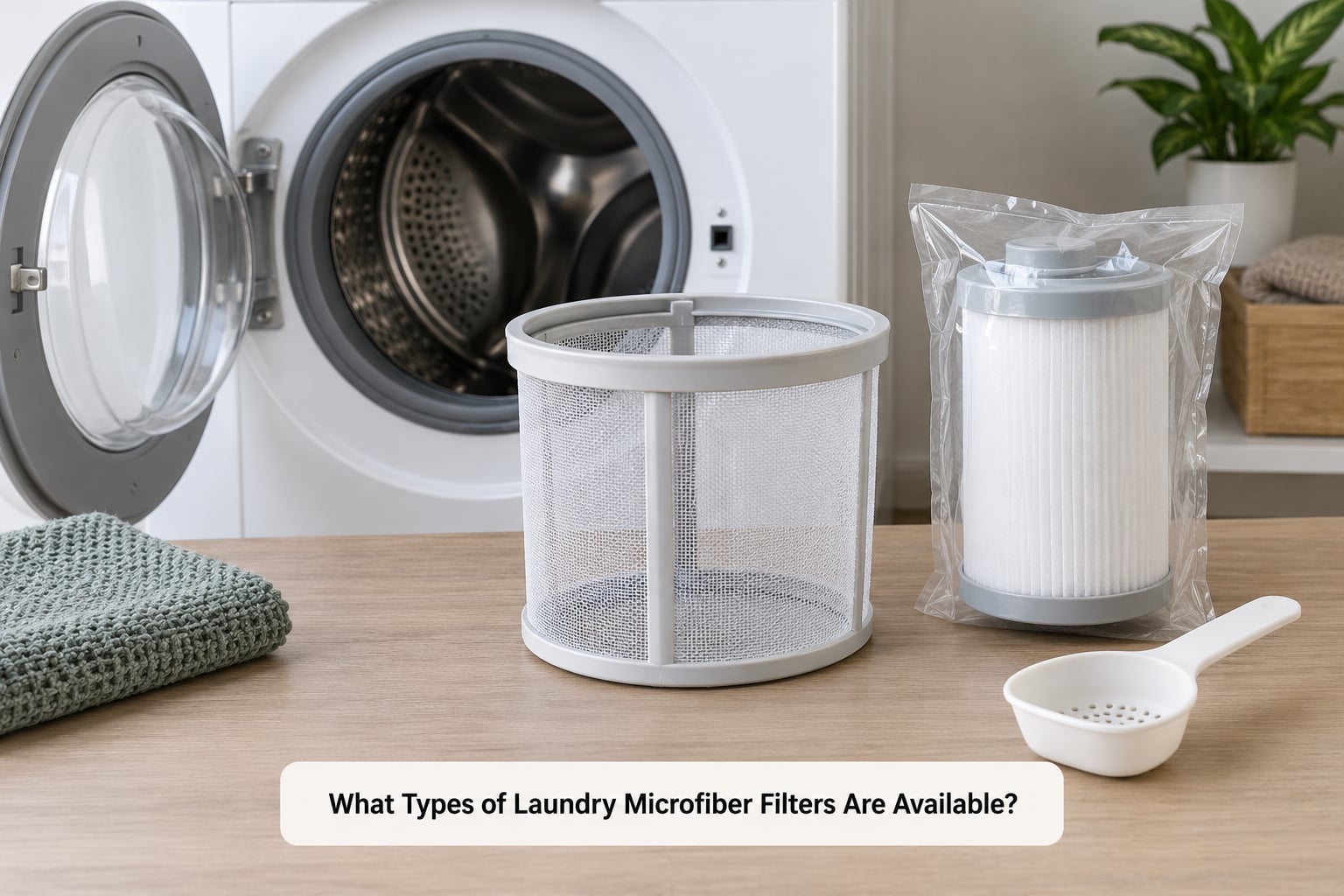
Four formats cover almost everything on the market, and they differ far more in upkeep and space than in capture rate.
| Type | How it captures fibers | Ongoing upkeep | Best for |
|---|---|---|---|
| Washable reusable mesh filter | Strainers fiber from the sump or inlet, reused after cleaning | No consumables; clean and dry every few cycles | Households wanting a one-time setup and low running burden |
| Disposable cartridge unit | Replaceable sealed cartridge inside a housing | Recurring cartridges plus a recycling or disposal question | People who want the highest capture and will not think about washing a filter |
| Inlet scoop filter | Sits at the hose-to-wall connection and catches what the machine releases | Emptying on a fixed rhythm | Renters and tight spaces, since nothing is plumbed permanently |
| External recirculating unit | Diverts part of the discharge through a finer screen and back | Cleaning the fine screen, more plumbing, more space | Synthetic-heavy households willing to give up cupboard space |
| Wash bag or wash ball | Contains fiber inside the bag rather than capturing it at the drain | Wash the bag, check it for wear | Low-cost entry point and one or two high-shedding garments at a time |
Device names in this category change often and marketing percentages are hard to verify, so judge the format rather than the badge. Owner communities tend to converge on the same ranking: bags for low effort, inline housings for higher capture and more fuss.
How Do You Install and Maintain a Laundry Filter?
Every fitting is different enough that the machine and filter instructions come first. A filter installed against the manufacturer’s guidance can block drainage, and blocked drainage is the failure mode people regret most. The general sequence looks like this.
- Check compatibility. Confirm the drain hose diameter, whether the machine is a combo unit, and whether the filter needs the hose cut or can clamp on. Behind a wall-hung washer, space is the real constraint.
- Cut and fit if required. Some inline units need the hose shortened and re-clamped. Others simply sit over the hose-to-wall connection.
- Run a short empty cycle. Water should drain at the machine’s normal pace. Any slowing means the housing is undersized for your flow.
- Empty on a schedule, not on appearance. Bypass happens well before a full-looking chamber stops working, so a weekly check is a better habit than a monthly glance.
- Clean, dry and reinstall. Held wet fiber grows biofilm and smells, so wash the screen, let it dry fully, and wipe the housing while you are there.
- Decide on disposal honestly. Collected fiber goes to household solid waste in almost all cases. There is no drop-off route for it in most areas, which is a real gap people rarely mention.
Follow the machine manufacturer’s instructions, and treat any filter that slows drainage, leaks or needs forcing into place as a mismatch rather than something to work around.
Do Laundry Filters Make Washing Synthetic Clothes Safer?
No. That is the clearest boundary in this topic, and the confusion causes real harm to honest products.
Controlling pollution and reducing personal exposure are separate goals with separate evidence. A filter at the drain reduces what enters wastewater. It does not reduce what you breathe during the spin cycle, what the dryer aerosolizes, or what sits against your skin while you wear the garment.
For sensitive skin, the practical levers are different ones: wash new synthetic garments before the first wear, use cool water and a shorter cycle, skip the dryer, wear loose breathable layers, and stop wearing garments that make you itch. Persistent rash, swelling or breathing symptoms are health questions, not laundry questions, and they belong with a doctor rather than with a filter catalog.
One more limit worth stating: a filter sees drain water only. The dryer is a separate and significant fiber source, and a much better maintained one, which is why air-drying or cleaning the lint screen has its own environmental case.
Are Laundry Filters Better Than Reducing Microfiber Shedding at the Source?
They are complementary, and most households should start with the free options because they cost nothing and help every load automatically.
Ranked roughly by how much they reduce released fiber per unit of effort:
- Wash new synthetics before wearing them. Most shedding from a fleece or performance garment happens in the first few washes. Washing it once removes a large share before the fibers ever reach a river.
- Use cooler, shorter cycles. Field work has put lower-temperature, shorter programs well below standard long hot cycles for released fiber mass, and it also saves energy.
- Run full loads. Friction and tumbling per kilogram of fabric rise when the drum is half empty, so partial loads shed proportionally more.
- Air dry or clean the dryer screen. A clogged lint screen turns a dryer into a fiber distribution system. This costs nothing.
- Wash less and keep clothes longer. Regional estimates put wash-derived fiber leaving a single metropolitan laundry sector in the tens of trillions of microfibers a year, which is a function of how often we wash.
- Contain high-shedding items. A wash bag is the low-effort version of a filter and works on one garment at a time.
- Then add a filter, if your machine allows it and you will keep the collector emptied. It sits on top of everything above rather than replacing them.
Wastewater treatment is the eighth layer and the one you do not control. A large share of wash-derived microfibers passes through conventional sewage processing intact, which is precisely the argument for intercepting fiber at the source rather than relying on infrastructure downstream.
Frequently Asked Questions
Do laundry filters work in machines with hard water?
Hard water affects the filter less than it affects the machine around it. Scale builds up on heating elements and hoses regardless of whether a filter is installed, and many people first notice a drainage slowdown during descaling rather than a change in capture. If your water is very hard, check that the housing is not scaling internally and rinse the screen on a schedule, since mineral deposits stiffen fine mesh and can push collected fiber toward bypass. A slow-draining machine is a plumbing and scale question first, and a filter cannot be judged fairly until flow is normal.
Should I put a microfiber filter in the dryer as well as the washer?
The dryer already has a lint screen, and it is the more effective of the two. Dryer screens and, on many machines, an extra vent-grille filter catch fiber before air is pushed outdoors, while a washer filter only intercepts drain water. Keep the dryer screen clean, and if you air dry, you get the largest reduction of all. Buying an additional dryer attachment rarely justifies itself unless your machine lacks a usable screen and the replacement screen is a known weak point.
Can a laundry filter replace a wastewater treatment plant?
No, and treating the filter as a replacement is how people end up with false confidence. Household filters work on one drain line, they only capture a share of what passes, and they are frequently installed then forgotten until they bypass. Municipal treatment is a much larger stage with different technology, and a substantial share of wash-derived microfibers passes through conventional sewage processing intact. Filtration at the drain and effective treatment downstream are complements, not substitutes.
How often should I empty and clean a reusable laundry filter?
Empty it weekly if you wash most days, and treat that as a floor rather than a ceiling. Capture drops well before a chamber looks full, because fiber packs down and water starts bypassing the screen before anyone would call it full. For most households, a fixed weekly habit outperforms a monthly inspection. Wash the screen in warm water, dry it completely to limit biofilm, and wipe the housing while you are there. Follow the filter maker’s stated cycle limits as well.
Are disposable microfiber filters worse for the environment than washing synthetic clothes?
It depends entirely on the balance, and neither side wins by default. A disposable cartridge adds manufacturing, packaging and a cartridge to solid waste for every unit of capacity, which is why forum users often report recycling obligations as the most confusing part of ownership. Reusable mesh filters have their own footprint in plastic housings and repeated cleaning. Both beat an unfiltered load of shedding synthetics per wash, and both are worse than washing new garments once before wearing them and cutting overall wash frequency.
Start by naming your own worst offenders. If it is fleece, performance tees and cheap synthetics, a filter is a reasonable purchase and the maintenance routine is the whole decision. If it is cotton and linen, put your effort into cold cycles, full loads and washing new garments before wear, and skip the hardware. Either way, judge the filter on measured whole-effluent results rather than on the biggest percentage a brand can print, and keep the dryer screen clean while you are at it.