Living shorelines are nature-based ways to hold a coast or lakeshore in place, using native plants, natural sediment and low structures such as marsh grass, coir logs, stone sills and oyster reefs to absorb wave energy rather than blocking it with concrete or rock. They beat seawalls on most sites because they dissipate energy instead of reflecting it, and because a soft, shifting edge keeps adapting as water levels rise. That is the short answer to what living shorelines are and why they beat seawalls, and the rest of this guide explains the mechanism, the exceptions and the practical questions owners and planners ask first.
One warning before we start: this is not a case for one answer everywhere. Some coasts have nowhere to put a marsh and nowhere for the sediment to go. On those sites a hard structure, or a hybrid of the two, is the honest choice.
Table of Contents
- What Are Living Shorelines?
- How Do Living Shorelines Protect Coasts?
- Why Do Living Shorelines Beat Seawalls?
- Living shorelines dissipate energy where seawalls reflect it
- They remove the failure mode that ends seawalls
- They store floodwater instead of redirecting it
- They build habitat and clean the water
- They gain elevation as sea level rises
- They cost less over a full lifecycle
- Living Shorelines vs. Seawalls: Which Performs Better?
- What Can Be Used to Build a Living Shoreline?
- Where Do Living Shorelines Work Best?
- How Do You Build or Restore One?
- What Are the Main Limitations and Risks?
- Frequently Asked Questions
- What are the benefits of living shorelines?
- What are the disadvantages of living shorelines?
- What are the advantages of seawalls?
- What are some examples of living shorelines?
- Do living shorelines really work in storms?
- How much does a living shoreline cost compared with a seawall?
- Conclusion
What Are Living Shorelines?
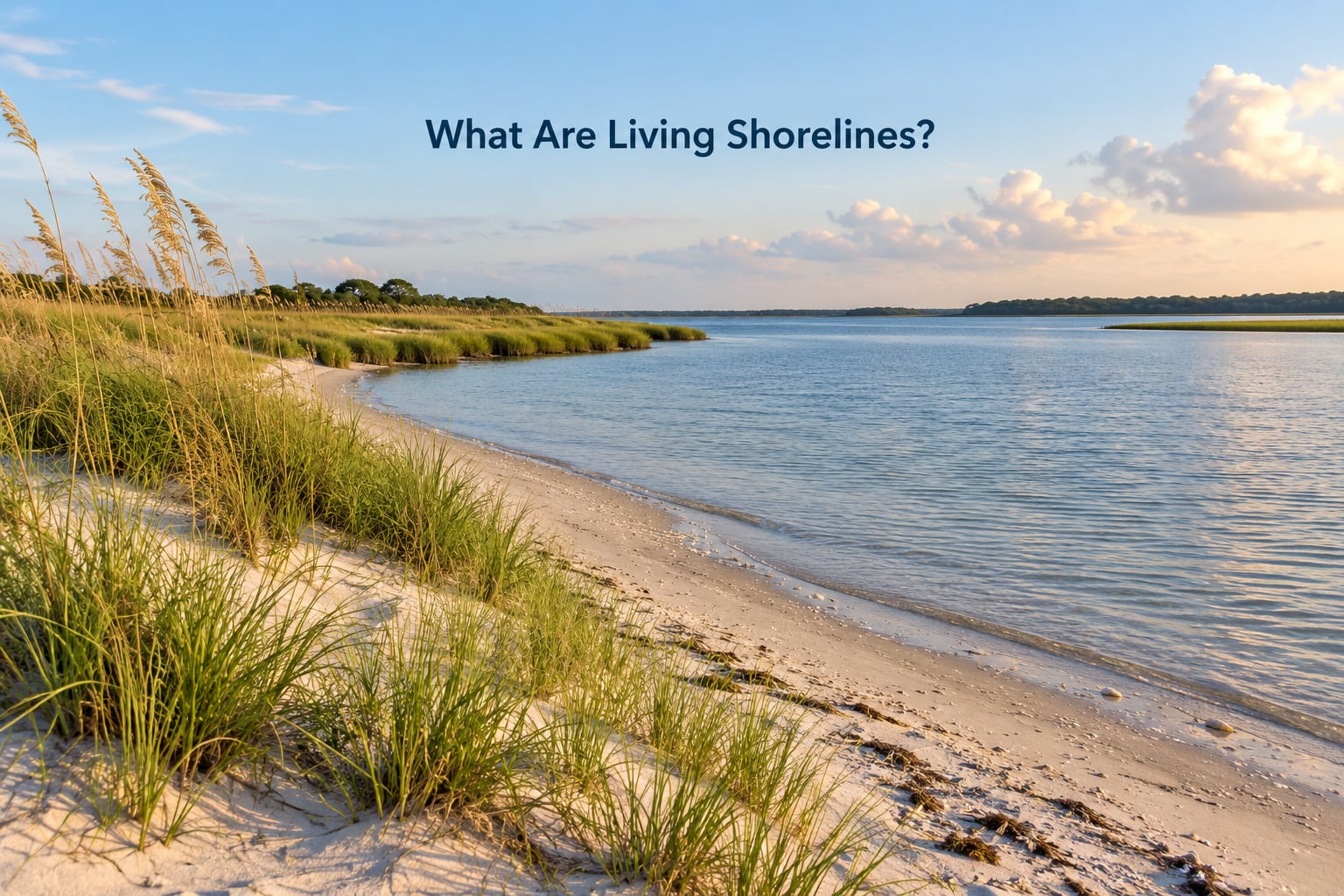
A living shoreline is a shoreline stabilization method that uses living plants and natural materials to reduce erosion while keeping the natural coastal processes that hold sediment in place still running.
That wording is close to the one NOAA uses, and the distinction matters more than it looks. A living shoreline is not a decorative planting scheme and it is not a wall with a few baskets of grass bolted to it. It is a functioning piece of coast: a sloping marsh platform, a dune field, an oyster reef or a planted bench that behaves like the natural system it replaces.
Designers usually group them into four families:
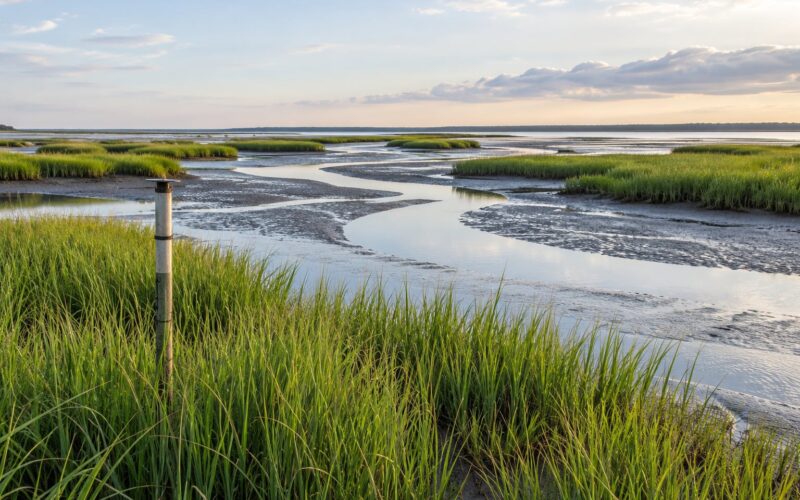
- Vegetated and marsh shorelines, built from salt-tolerant plants such as smooth cordgrass, Spartina alterniflora, on a regraded, gently sloping platform. This is the classic living shoreline and the one most people picture.
- Hybrid shorelines, where a low stone sill or small segmented breakwater sits offshore to knock down wave energy before it reaches a narrow fringe of marsh. Often the right answer where space is short but waves are moderate.
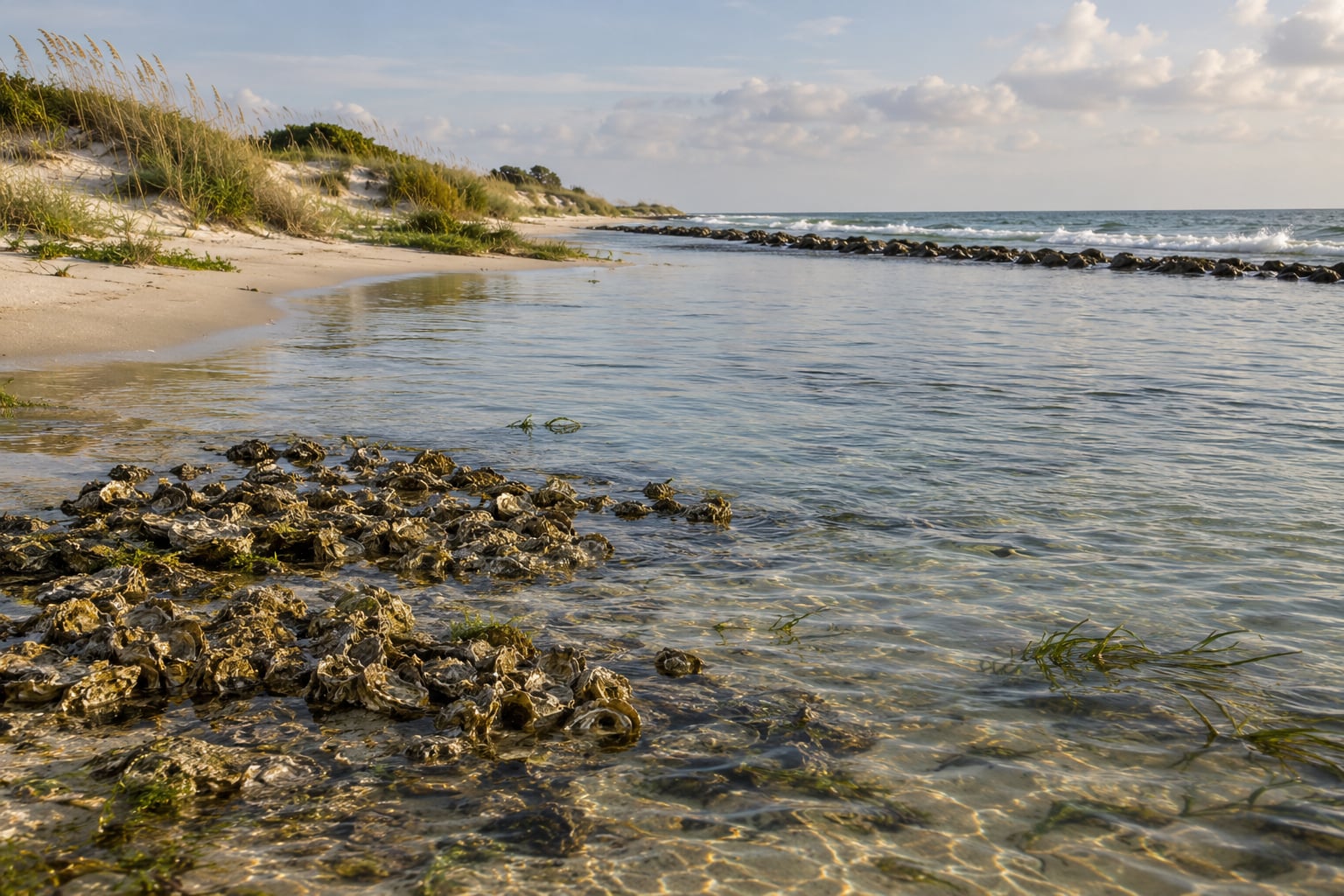
- Oyster reef and shellfish systems, natural or fabricated reefs that break waves, trap sediment and build new habitat as the colony grows.
- Living seawalls, a retrofit that adds texture, habitat benches and clinging organisms to an existing hard wall. Useful in dense urban waterfronts where a true living shoreline cannot physically fit.
That last one causes more confusion than anything else in this field. A living seawall is a hard structure with a soft layer on it. A living shoreline is a soft system that may or may not include a small hard element. When someone tells you they installed a living seawall, ask which of the four you are looking at.
How Do Living Shorelines Protect Coasts?
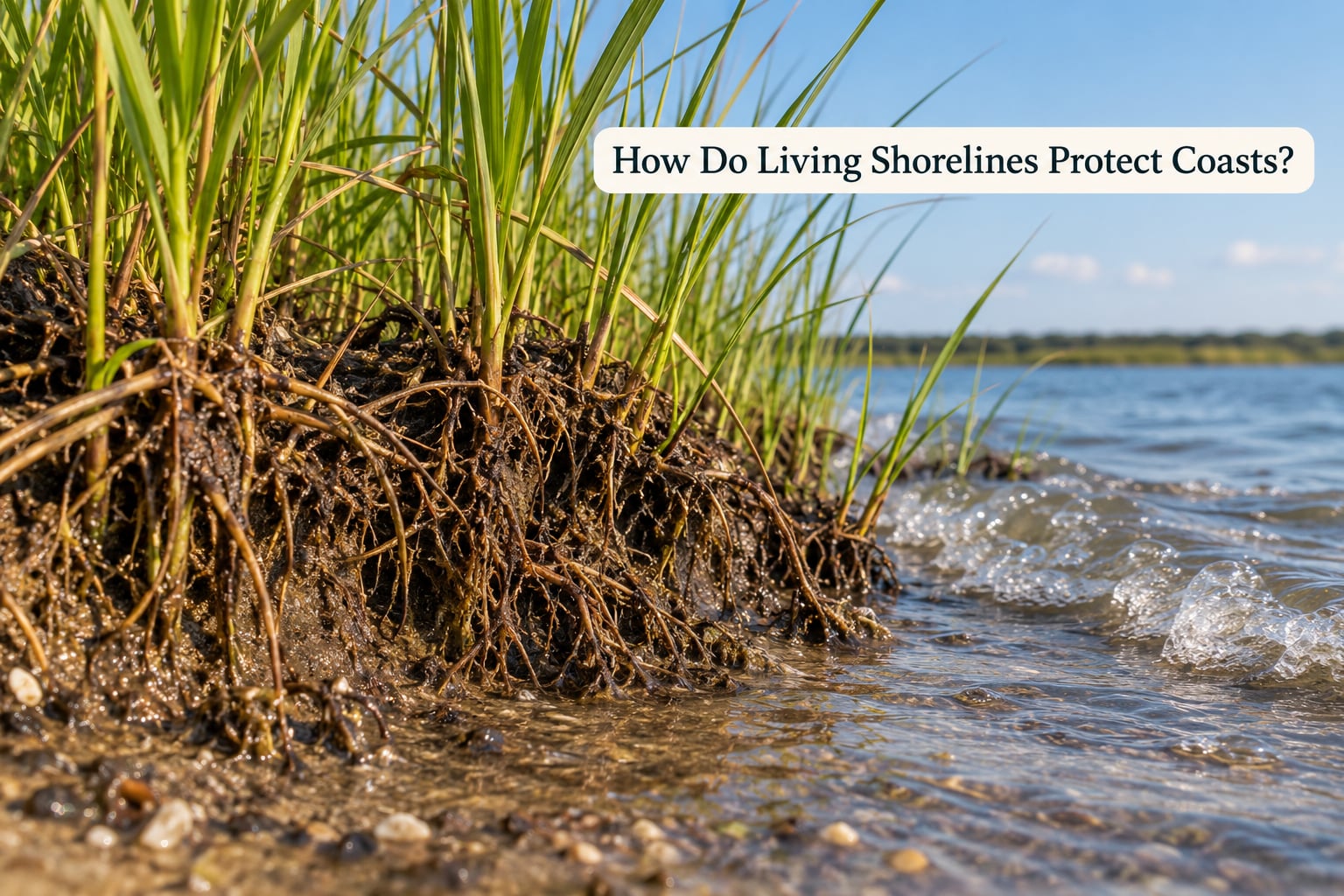
Living shorelines protect a coast by spending wave energy over a wide, rough, sloped surface, so that waves arrive at the bank already slowed, thinned and carrying less sediment.
A seawall does the opposite. Water hits a flat, hard, vertical face and rebounds, and the wave that comes back is often taller and more concentrated than the one that arrived. That reflected energy attacks the base of the wall in a process called toe scour, and it also drives sediment offshore from the pocket of beach trapped behind the structure.
Here is what the living version does instead, roughly in the order the energy arrives:
- Roughness and drag. Stems, coir logs and reef texture break up the smooth water layer, creating friction that converts wave motion into smaller, chaotic turbulence.
- Distance. A marsh platform tens of meters wide spreads the energy across an area instead of a single line. Wave height drops as it crosses.
- Root mass. Dense networks of roots bind soil particles together and hold the bank against current and wave drag, and they are living tissue that repairs itself after a storm.
- Sediment capture. Slowed water drops its suspended load. Sand and silt stay in the system instead of being carried offshore.
- Vertical growth. Marsh plants trap organic material, organic material builds elevation, and the shoreline gains height over years. That is the one mechanism a seawall can never perform.
The result is energy dissipation rather than reflection, which is the single sentence most useful to remember from this whole discussion.
Why Do Living Shorelines Beat Seawalls?
Living shorelines dissipate energy where seawalls reflect it
This is the core of the argument. Every unit of wave energy that bounces off a wall comes back as a concentrated hit, partly on the wall and partly on the beach next door. A sloped, vegetated surface absorbs that energy instead. Neighboring beaches do not pay for one property’s protection.
They remove the failure mode that ends seawalls
Seawalls fail at the toe and underneath. Storm surge scours the buried foundation, water moves under the wall and through the backfill, and the structure eventually leans, cracks or is undermined entirely. A living shoreline has no buried footing to scour out. Storm damage removes some plants and some sediment, and both can recover.
They store floodwater instead of redirecting it
A marsh platform is a shallow basin. Inundation spreads thinly and slows across a wide area, which lowers peak water depth behind it and reduces the volume that reaches buildings and roads. A wall does not store anything; it just decides where the water goes next.
They build habitat and clean the water
Salt marsh, mangrove and seagrass are among the most productive habitat types on the planet. They filter nutrients and suspended sediment, hold carbon in coastal soils for centuries, and provide feeding and nursery ground for fish and birds. A concrete face provides none of that, and it removes whatever was there.
They gain elevation as sea level rises
This is the long-term argument. A fixed wall of a given height protects a fixed place, and the design horizon keeps getting shorter. A marsh that accretes sediment and organic matter can keep pace with moderate sea-level rise for decades. A wall has no way to grow.
They cost less over a full lifecycle
Initial installation costs for a living shoreline and a seawall overlap heavily and vary enormously by site, width, permitting and access, so treat any headline figure with suspicion. The honest comparison is lifecycle: seawalls need periodic repair, re-arming and toe protection, and every repair involves heavy plant on a shoreline. Living shorelines need weeding, replanting and sediment top-ups, mostly in the first three years, and less as the system matures.
Living Shorelines vs. Seawalls: Which Performs Better?
Which one performs better depends on the site. On a low-energy coast with room to slope back, a living shoreline protects property and does things a wall cannot. On a high-energy, space-starved site facing a harbor or an ocean, hard protection or a hybrid is the defensible choice.
| Factor | Living shoreline | Seawall or bulkhead |
|---|---|---|
| Wave energy behavior | Dissipates across a wide sloped surface | Reflects off a hard vertical face |
| Toe scour risk | No buried footing to undermine | Primary failure mode under storm loads |
| Effect on the neighboring beach | Keeps sediment in the system | Pushes sediment offshore |
| Habitat value | Creates marsh, reef and nursery habitat | Removes or degrades existing habitat |
| Response to sea-level rise | Can gain elevation over time | Fixed height, fixed position |
| Storm damage profile | Localized plant and sediment loss, recoverable | Structural damage, overtopping, undercutting |
| Maintenance profile | Weeding, replanting, sediment top-ups for the first 3 years | Periodic inspection, repair and re-arming |
| Land required | A slope and a setback | A vertical line, minimal footprint |
| Best site conditions | Moderate wave energy, gentle slope, sediment supply, tidal exchange | High wave energy, confined sites, deep water close to shore |
| Visual and access result | Natural edge, usually walkable | Hard edge, often with a safety fence |
There are real advantages to hard armoring, and they deserve an honest paragraph. A seawall is predictable, measurable and immediately effective at holding a fixed line. It fits where space is genuinely unavailable: dense urban waterfronts, canals, marina basins, sites where structures sit within a few meters of deep water. It can be designed and inspected to a known standard. For a harbor authority protecting navigation and quay infrastructure, a wall is often the correct engineering answer.
The problem is not that seawalls are useless. It is that they transfer risk to somebody else and they do not adapt.
What Can Be Used to Build a Living Shoreline?
Designers mix these elements; no project uses only one. Each plays a different role in slowing water, holding sediment or building habitat.
- Dune systems and beach nourishment. Sand placed on the upper beach profile, planted with native dune grasses and fenced or signed to keep foot traffic off young plants. Dunes are the first line of defense and the cheapest way to add sediment to a system.
- Salt marsh and cordgrass platforms. A regraded slope planted with salt-tolerant grasses at the elevation the marsh wants to occupy. Marsh elevation is chosen to match local tidal range, not to look tidy on a drawing.
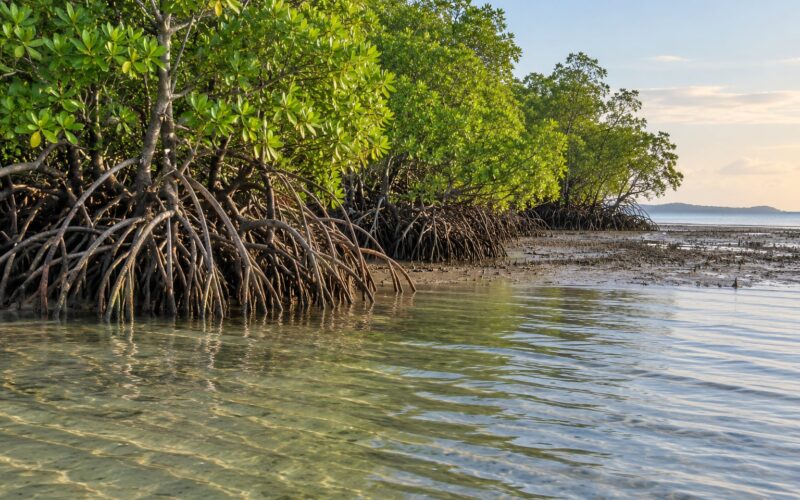
- Mangroves. In tropical and subtropical coasts, mangrove root systems are the strongest natural wave attenuator available, and they build new land as they spread.
- Seagrass and posidonia meadows. Bottom-rooted meadows damp waves over the nearshore seabed and stabilize sediment below the waterline, which protects the beach face from underneath.
- Oyster reefs. Rough reef structures break surf, trap sand and create hard habitat that other species colonize.
- Stone sills and segmented breakwaters. Low offshore structures in a hybrid design that reduce wave height before it meets the marsh, where planting space is too narrow for a full marsh platform.
- Coir logs, live stakes and fiber matting. Coir is a coconut-fiber product with high tensile strength when wet; rolled into logs it pins the bank during establishment and biodegrades within a few years as the grass roots take over.
Where Do Living Shorelines Work Best?
Living shorelines perform best where the coast is allowed to move. That means moderate wave energy, a gentle existing slope, a supply of sediment from somewhere up the system, and enough room to build a platform tens of meters wide.
A few more conditions matter in practice. Tidal exchange should be present, since a marsh or mangrove without flushing becomes a stagnant hole. The site should be free of aggressive invasive species that would outcompete the planting. And the uses around it have to be compatible: a marsh you cannot walk through is a marsh people will try to pave.
On the Mediterranean coast, where a lot of our readers are based, the same principles show up with different species. Coastal dune systems along the Spanish shoreline are restored with native marram grass and beach nourishment under programs run by regional governments. On the Ebro Delta, managing the mouth of the river means managing sediment and salinity, so shoreline resilience is inseparable from river engineering. In shallow sandy bays, posidonia meadows do the underwater work that marsh grass does above the tide line, and anchoring stress on them is treated as erosion upstream.
Where living shorelines fail is just as predictable: very high-energy open ocean coasts with a steep underwater profile, sites with no sediment supply and no room, and heavily urbanized waterfronts where the water is 2 meters deep right against the quay.
How Do You Build or Restore One?
The process is the same whether you are a municipality with 2 kilometers of coast or a homeowner with 30 meters of eroding bank. Seven steps, in order.
- Assess the coastal process. Map wave climate, fetch, tidal range, currents, sediment movement and existing erosion rates before designing anything. A design that fights the natural direction of sediment transport will fail quietly and expensively.
- Choose the type that fits. Full marsh, hybrid sill, reef-based, or living seawall retrofit. Match it to energy, space and adjacent uses.
- Design to local conditions. Set platform elevation against the local tidal range, set the marsh edge where the wave climate allows, and specify a structure tolerant of the sediment and salt conditions on site.
- Prepare the site. Regrade the bank to a gentle slope, place toe stabilization such as coir logs or fiber matting, and install access that allows maintenance without destroying what has been planted.
- Establish native species. Plant the right species in the right elevation band, using local genotypes where possible. Match planting density to the design wave climate.
- Monitor. Track bed elevation, plant cover, bank retreat and photo points through at least three growing seasons.
- Adapt. Fill erosion hotspots with sediment, replant gaps, widen the platform where waves are concentrated, and add a sill where monitoring shows waves arriving too hot.
Permitting runs in parallel and often takes longer than construction. In the United States, many small projects run under the Army Corps of Engineers Nationwide Permit 54, which streamlines authorization for structures in and under tidal waters. Elsewhere the equivalent approvals sit with national or regional coastal authorities, and in Spain with the relevant autonomous community and the coastal authority, often alongside a beach-management plan. Ask what your local authority will permit before you design anything.
What Are the Main Limitations and Risks?
The honest list, because “nature-based” should never be allowed to sound effortless.
- Establishment takes time. The first two to three years are the vulnerable window. Until roots fill in and the platform accumulates sediment, the system is doing less than the design assumes. A project that is judged at the end of its first summer looks like a failure even when it is on track.
- Maintenance does not stop at year three. It just gets cheaper. Someone has to inspect after every storm, and someone has to fund the weeding and replanting.
- Species selection is not optional. Planting the wrong species at the wrong elevation kills the project. This is the most common reason living shoreline installations stall.
- Sediment supply can dry up. A shoreline with nothing feeding it erodes regardless of what is planted on it. Upstream dams and coastal engineering are often the real cause.
- Extreme events will still do damage. A well-designed living shoreline reduces wave energy and flood depth; it is not storm-proof, and anyone who promises otherwise is selling something.
- Space is a hard limit. You cannot build a wide marsh platform on a narrow urban parcel, and pretending otherwise produces a token planting that fails in the second winter.
- Coastal squeeze. A fixed wall stops marsh from migrating inland as sea level rises, so the marsh is squeezed between rising water and a static boundary. It eventually drowns.
- Regulation cuts both ways. In some coastal commissions a seawall now needs a permit and a demonstration that armoring is the only option, and in others a hard wall is required outright. Check local rules before assuming either approach is allowed.
Where a seawall is still the right answer: high-energy sites, deep water close to shore, constrained urban frontages, harbor and navigation infrastructure, and any location where there is no sediment, no space and no tidal exchange to work with.
Frequently Asked Questions
What are the benefits of living shorelines?
Living shorelines reduce coastal erosion while adding habitat, water filtration, flood storage and carbon storage. Because they dissipate wave energy across a wide sloped surface instead of reflecting it off a wall, they also cut toe scour, protect neighboring beaches, and can gain elevation as sea levels rise. A seawall does none of that.
What are the disadvantages of living shorelines?
They need space and a supply of sediment, they take two to three years to establish, and the wrong species or the wrong planting elevation will fail. They do not stop extreme storms on their own, and on high-energy or confined urban sites they cannot physically be built. Maintenance is continuous, if lighter, for the life of the project.
What are the advantages of seawalls?
A seawall holds a fixed, predictable line in a small footprint, can be designed and inspected to a known standard, and protects quays, canals and dense waterfronts where there is no room for a sloped marsh platform. It is the right answer in confined, high-energy, heavily urban settings, and it fails loudly and visibly rather than gradually.
What are some examples of living shorelines?
Common examples include planted salt-marsh platforms, restored dune systems with beach nourishment, mangrove belts, seagrass and posidonia meadows, natural and fabricated oyster reefs, and hybrid designs where a low stone sill sits offshore in front of a narrow marsh fringe. Seattle’s Elliott Bay habitat shelf, a structure built in front of an existing seawall, is a well-known urban retrofit.
Do living shorelines really work in storms?
They reduce wave height, run-up and flood depth, and they fail less catastrophically than a hard wall, but they are not storm-proof and no credible source claims otherwise. In storms the usual damage is localized plant loss and eroded sediment, both of which recover. What they reliably do is take energy out of the wave before it reaches anything built.
How much does a living shoreline cost compared with a seawall?
Installation costs overlap heavily and swing widely with width, access, permitting, sediment transport and site preparation, so headline figures mislead. The clearer comparison is lifecycle: a seawall needs recurring inspection, repair and toe protection, while a living shoreline concentrates its cost in the first three years of weeding, replanting and sediment top-ups. Ask for both capital and 20-year maintenance costs.
Conclusion
Living shorelines beat seawalls wherever the coast has room to move, because they absorb wave energy instead of throwing it back, hold sediment instead of exporting it, and can keep gaining height as water levels rise. They lose where space, sediment or wave climate rules them out, and pretending otherwise helps nobody.
So the practical first step is small: before choosing an approach, spend real effort characterizing the coastal process at your site — energy, tidal range, sediment supply, slope and adjacent uses. Design to that, not to a preference. Most sites that get it right end up with a living shoreline, a hybrid, or a wall with a living layer in front of it, and the right answer will not surprise you once the data is in front of you.