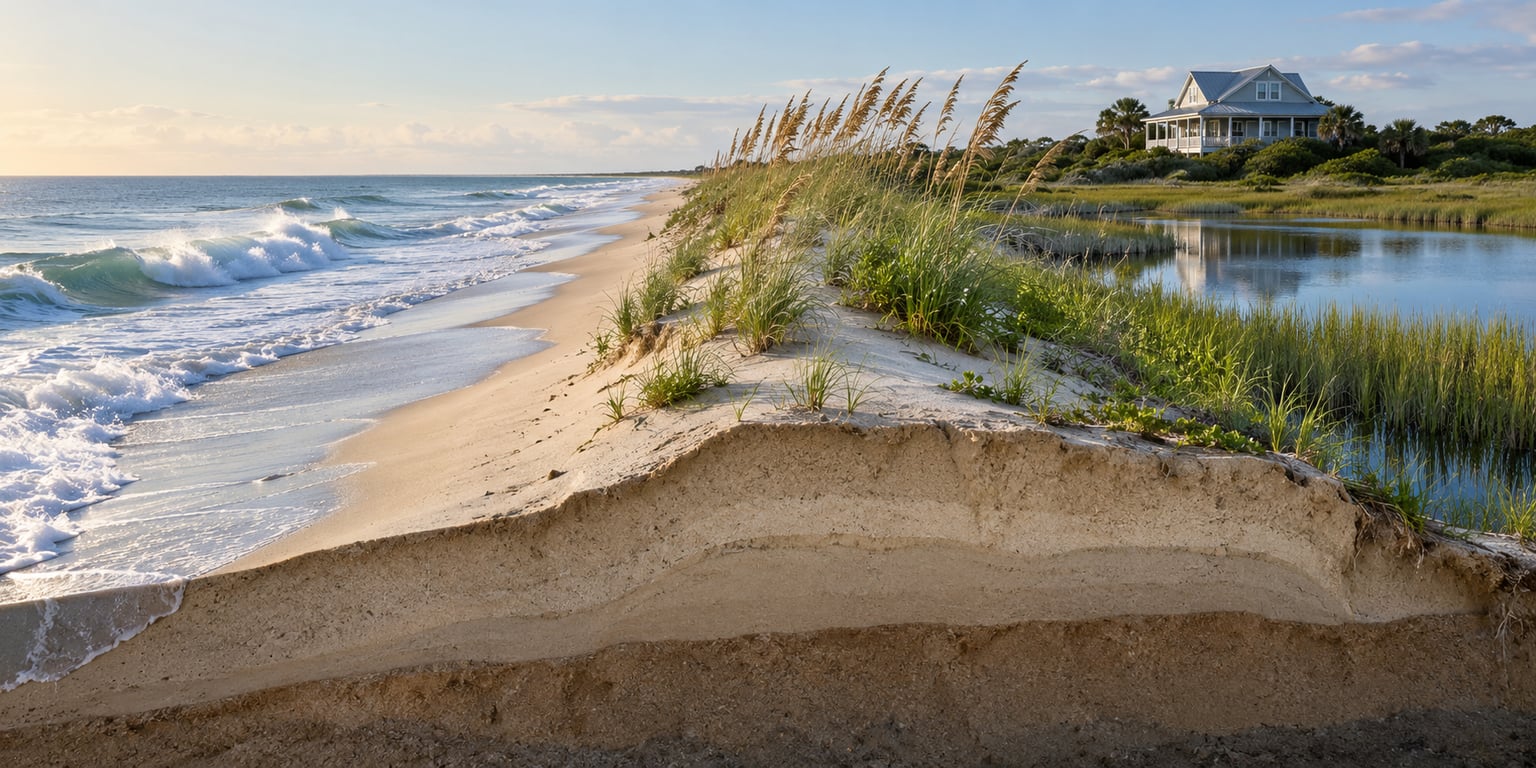
Sand dunes protect coastal homes by standing between the ocean and the house, absorbing and dissipating wave energy before it reaches anything built. A tall, wide, vegetated dune also raises the ground level so storm surge and wave run-up run out of room, and it traps wind-blown sand that rebuilds the beach after every storm. The honest part is that this is a buffer, not a guarantee. How well it works depends on the dune’s height, width, continuity, vegetation and the severity of the storm.
Most people notice dunes when they lose one. Walk the beach after a named storm and you can see the whole story in the sand: a low scraped patch where waves cut through the crest, a fan of sand spilled onto the road behind it, and the stumps of sea oats that did not come back.
This guide walks through how dunes form, what they actually do during a storm, what separates a resilient dune system from a fragile one, and the warning signs that a dune near your home needs attention.
Table of Contents
- How do sand dunes form along a coast?
- How sand dunes protect coastal homes
- Wave attenuation: the dune takes the energy first
- Freeboard: the dune raises the starting point for flooding
- Sand recycling: the dune feeds the beach
- Wind and salt spray: a barrier for airborne sand
- What happens during a storm?
- Why dune height and width matter
- What makes a dune system resilient?
- How do people and development weaken dunes?
- How are coastal dunes protected and restored?
- What warning signs should coastal residents watch for?
- Frequently Asked Questions
- How much does a sand dune need to protect a coastal home?
- Can sand dunes stop tsunami waves completely?
- Do seawalls make dunes better at protecting homes?
- What plants help keep coastal dunes stable?
- How do people know when a protective dune needs restoration?
- Conclusion
How do sand dunes form along a coast?
Dunes need four ingredients: a supply of sand, wind to move it, waves to push it back up the beach, and a coastal shape that lets it pile up rather than wash away. Where the shoreline is retreating faster than sediment arrives, you get a narrow beach and a thin dune. Where sand is plentiful and the shore is building, dunes grow tall.
Moving from the water inland, you usually meet dunes in this order.
- Beach. The flat sand apron between the water and the vegetation. Its width tells you how much buffer you have before waves reach the dune itself.
- Foredune. The first ridge, closest to the ocean, usually the tallest and most exposed. It takes the first hit from storm waves.
- Secondary or back-barrier dune. A second ridge behind the foredune, sometimes separated by a low swale or wet area. It stands behind the first line and is what a community relies on when the foredune is overtopped.
- Back-barrier. The landward side: maritime forest, marsh, bay or sound.
That seaward-to-landward sequence matters because protection is cumulative. Two modest ridges separated by a swale often perform better in a big storm than one tall ridge that gets overtopped early.
How sand dunes protect coastal homes
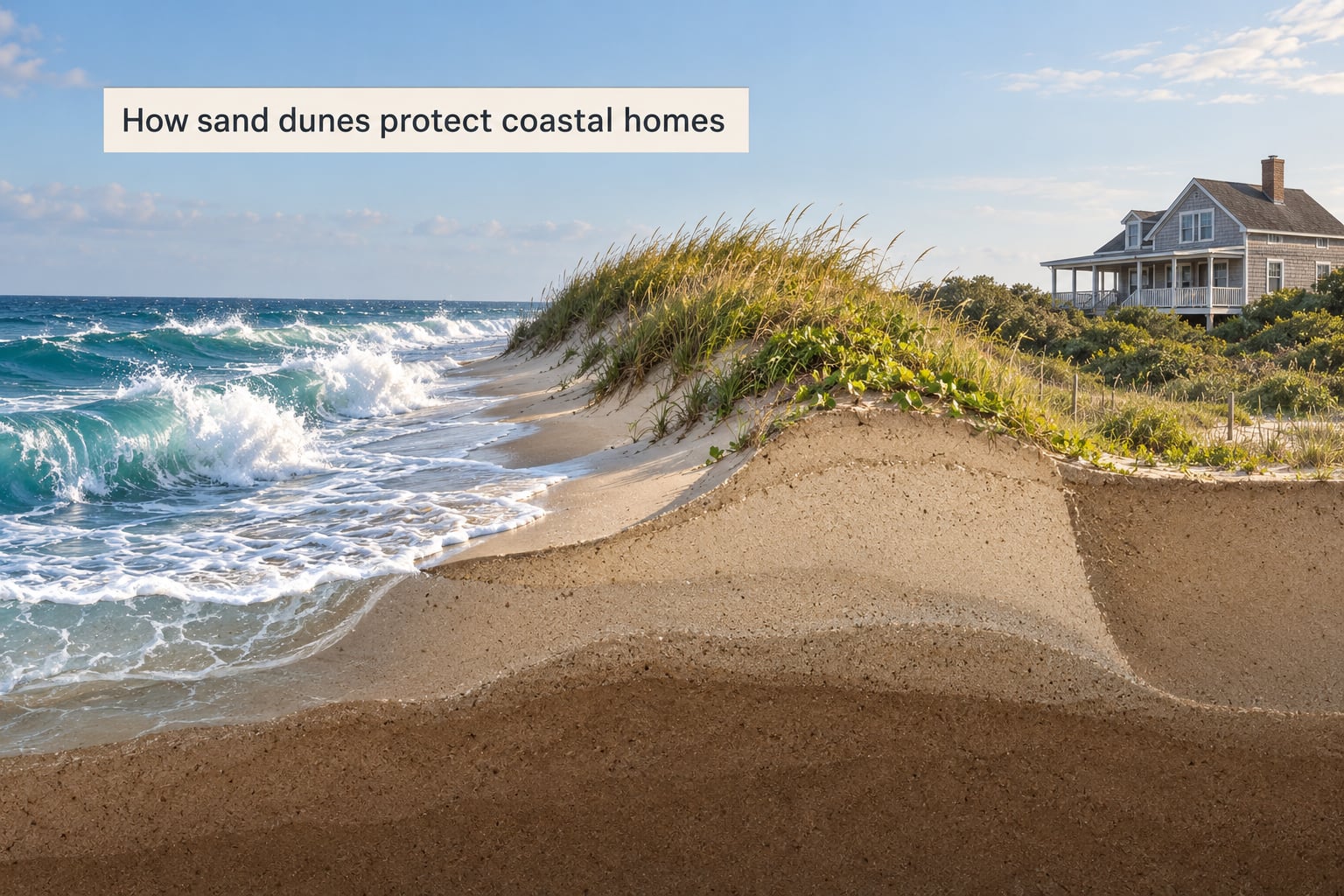
Four mechanisms do most of the work: they absorb wave energy, they provide freeboard above surge and run-up, they recycle eroded sand back onto the beach, and they block wind-blown sand and salt spray. Take away any one of them and the buffer performs noticeably worse.
Wave attenuation: the dune takes the energy first
A wave climbing a sandy slope loses energy fast. Friction against the sand, the dune’s roughness, and vegetation stems in the swash zone all steal energy from the wave. What reaches the buildings behind the dune is a weaker, flatter wave with less sediment carried in it.
Freeboard: the dune raises the starting point for flooding
This is the one homeowners underestimate. If your ground sits six metres above sea level and the dune crest sits at eight, wave run-up has to climb two metres further before water reaches the house. Freeboard is height you gain without building anything.
Sand recycling: the dune feeds the beach
Dune sand that erodes during a storm is not lost. Much of it washes back onto the beach and forms the base of the next berm. On a natural system this is a loop. Where sand is removed or blocked from travelling along the shore, the loop breaks and the beach narrows year after year.
Wind and salt spray: a barrier for airborne sand
Vegetated dunes trap wind-blown sand and add height over time, which is how a healthy system grows rather than wears down. They also filter salt spray, protecting the vegetation and the homes behind them from salt-driven decay and corrosion.
What happens during a storm?
The sequence is usually the same, and following it explains why a dune that looks fine on a calm day can fail in one night.
- Wave setup. Strong onshore winds pile water against the shore, raising the mean water level well above normal tide.
- Run-up and swash. Individual waves climb higher and higher up the beach face, washing over the berm and sometimes over the foredune crest.
- Overtopping. Water crosses the crest as a thin sheet. This is survivable for the dune. It kills vegetation, though, and roots that die stop rebuilding.
- Overwash and erosion. The seaward face is cut back into a steep scarp, and sand is carried landward and deposited as a washover fan.
- Breach. If overwash concentrates at one weak point, it cuts a channel through the ridge. That channel is the real emergency, because it lets waves reach the back-barrier directly.
So a dune does not prevent flooding. It spends the storm’s energy, absorbs overtopping and delays the arrival of water. A well-built system can take a severe storm and still be standing afterwards. A low, narrow, foot-trafficked one often cannot.
Why dune height and width matter
Height gives you freeboard; width gives you volume and time. A narrow ridge fails quickly because there is little sand in it to lose. A broad ridge can be eroded 20 metres landward and still be resisting waves.
| Dune system | Wave reach | Overwash risk | Recovery time | Area protected |
|---|---|---|---|---|
| Low, narrow, single ridge | Waves reach the crest in most moderate storms | High after a single major event | Slow, because there is little sand to redistribute | Only the first row of properties |
| Tall, broad, vegetated ridge | Most wave energy dissipates on the seaward slope | Lower, though not zero | Faster, because vegetation rebuilds the crest | A wider band of homes and roads |
| Two ridges separated by a swale | The second ridge catches waves that overtop the first | Lowest of the three for a given crest height | Moderate, as the swale stores storm sand | The whole barrier system behind it |
There is no universal safe height or width. Design depends on the local shoreline, sediment budget, storm history and flood maps, and it has to come out of local hazard data rather than a rule of thumb.
What makes a dune system resilient?
Resilient dunes share a handful of traits, and each one is missing from somewhere. Look for a continuous sediment supply moving along the shore, multiple ridges instead of a single crest, and native vegetation with deep rhizomes that knit the sand together.
Gentle landward slopes matter as much as height. A steep face on the back side collapses after a storm. Low foot traffic keeps the sand uncompacted and the plants intact.
A healthy back-barrier helps too. Marsh and maritime forest behind the dunes slow water that does overtop, and they hold their own soil in place. Meanwhile, hard structures that interrupt longshore sand movement starve the whole system, which is a topic worth its own section.
How do people and development weaken dunes?
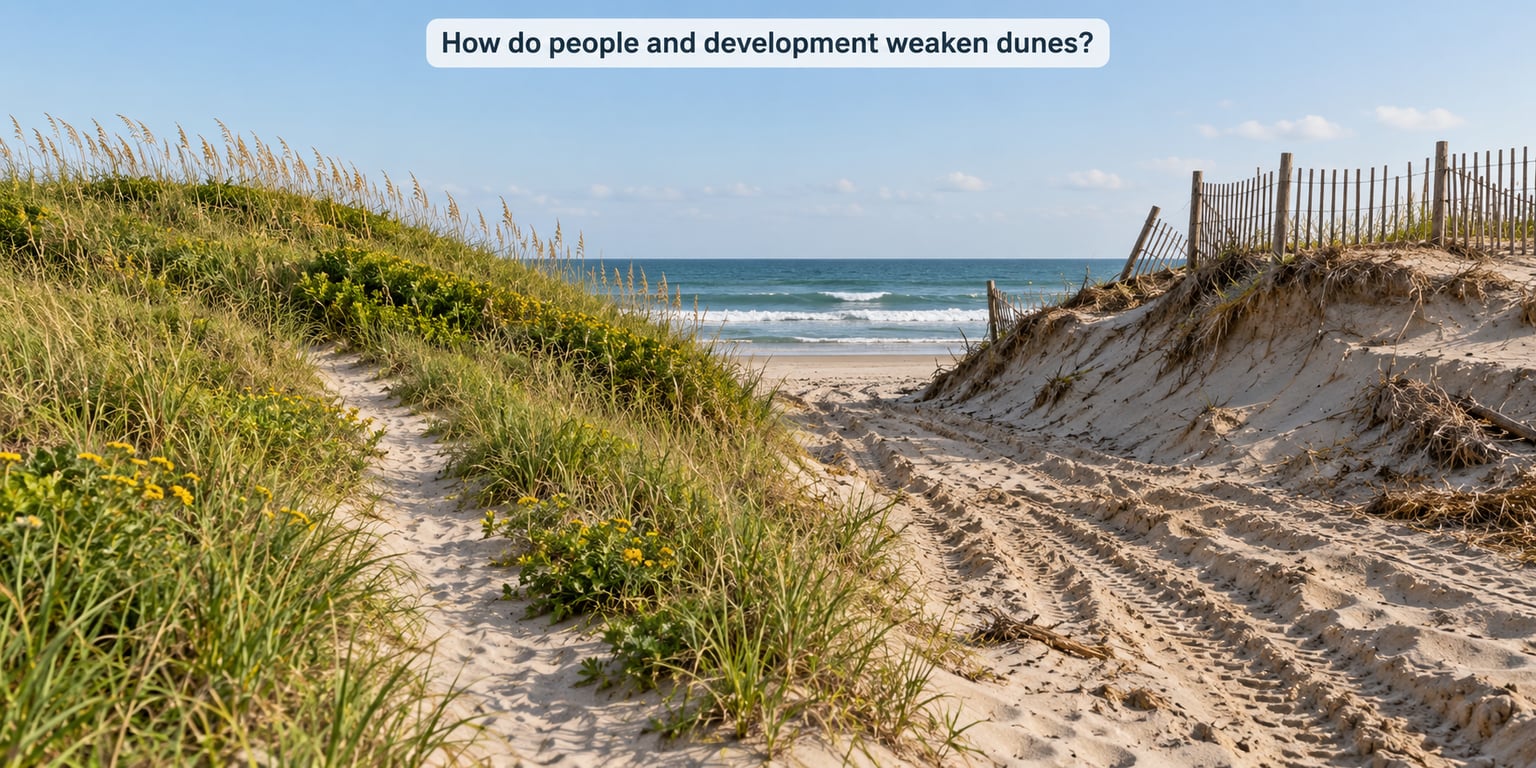
The damage is rarely one dramatic act. It accumulates from shortcuts, vehicles, construction and vegetation removal, then a storm finishes the job.
- Pedestrian shortcuts. One informal path becomes a corridor of bare, compacted sand. Even walking beside the plants, without stepping on them, damages the micro-organisms that hold the dune together.
- Vehicles. Driving a truck or a quad across a dune cuts ruts that channel water and sand straight through the ridge.
- Construction. Clearing a lot, grading a driveway or installing a bulkhead removes the sand that was doing the protecting.
- Vegetation removal. Losing sea oats or native beach grass to disease, salt, drought or a fill event leaves bare sand that moves in the first strong wind.
- Seawalls and groynes. A wall holds sand at one property while starving the beaches downdrift, which lose width and then lose their dunes.
- Blocked drainage and invasive plants. Water pooling behind a dune weakens it from the landward side, and invasive grasses can form dense mats that trap sand but collapse unpredictably.
Where sand is mined or redirected for construction elsewhere, the supply problem is structural rather than local, and no amount of replanting fixes it.
How are coastal dunes protected and restored?
Restoration ranges from a weekend of planting to a multi-year coastal management programme, and the approaches stack.
- Beach and dune nourishment. Placing compatible sand to widen the beach and rebuild the dune volume. It works well and it is temporary: the sand moves, so repeat placements are normal rather than a sign of failure.
- Native revegetation. Planting sea oats, sea beach grass, cordgrass, seashore paspalum or panicum, matched to the region, so roots rebuild the crest.
- Fencing and access control. Porous sand fencing slows wind and traps moving sand; boardwalks and designated crossings keep feet off the ridge.
- Dune restoration. Rebuilding a breached or overwashed ridge with imported sand, erosion-control matting and planting.
- Sediment bypass. Moving sand from an accumulating beach to a starving one around the headland.
- Integrated coastal management. Treating dunes, wetlands, water, roads and buildings as one system instead of separate projects.
Emergency repairs after a storm put sand back fast. Long-term resilience is slower work: it needs a sediment budget, a native plant list that fits the site, and a plan for who maintains it after the crews leave. None of this should be designed without local technical and ecological assessment.
What warning signs should coastal residents watch for?
You do not need instruments. Most trouble is visible to anyone who looks at the same stretch of dune twice a year.
- The beach profile is narrower than it was a year ago, so waves now break much closer to the dune toe.
- A vertical scarp is cutting into the dune face, which means erosion is outpacing the supply of sand.
- Roots are exposed and hanging in the air, so the plants are losing contact with the soil.
- Overwash channels keep reappearing in the same spot, which is how breaches start.
- Vegetation is patchy or dying back, especially after salt spray or a wet winter.
- New informal paths or vehicle tracks appear across the ridge.
- Drainage outlets behind the dune back up and hold water against the landward slope.
Photograph the same points each season from the same angle. Change over months is easy to miss week to week, and a dated photo series is genuinely useful to a coastal authority or an insurance assessor.
Frequently Asked Questions
How much does a sand dune need to protect a coastal home?
There is no single safe number, because the right height and width depend on the shoreline, the local sediment supply, storm history and flood maps. The useful question is whether the crest stands above the expected wave run-up plus storm surge for your stretch of coast, and whether a second ridge exists behind it. That calculation comes from local hazard data and a coastal engineer, not a general rule.
Can sand dunes stop tsunami waves completely?
No. A dune reduces wave energy and delays water arriving, which matters enormously for speed, force and debris. But a tsunami carries far more energy than ordinary storm waves, and a dune of any realistic size can be overtopped or cut through. Dunes belong in a layered coastal defence plan alongside evacuation planning, flood storage and warning systems, never as the only layer.
Do seawalls make dunes better at protecting homes?
Usually they do the opposite. A wall reflects wave energy back at the shore, scouring sand from the beach in front of it, and it interrupts the longshore drift that feeds beaches downdrift. Those beaches narrow, lose their dunes and eventually expose the properties that relied on them. Sand fences and vegetated dunes are soft engineering: they lose material gradually and rebuild, while a wall keeps a fixed line and moves the problem along the shore.
What plants help keep coastal dunes stable?
Native species adapted to salt spray, sand burial and drought. Sea oats and seashore paspalum are the classic choices on many Atlantic and Gulf shores, with sea beach grass, cordgrass and panicum grass used widely too. Regional lists differ, so ask your local coastal authority which plants are appropriate for your coast. Non-native grasses may look tough but often fail in storms or trap sand in unstable mats.
How do people know when a protective dune needs restoration?
Signs include a scarp cutting into the dune face, exposed roots, a narrowing beach in front of the ridge, repeated overwash in the same channel, dying vegetation and fresh tracks across the crest. Comparing photos from the same viewpoint across seasons catches changes that daily observation misses. Before acting, check with your coastal authority, because rebuilding a dune or placing sand on your lot usually requires a permit.
Conclusion
Dunes are a working buffer, not a wall. They protect coastal homes by spending wave energy, adding height above surge, feeding sand back onto the beach and stopping wind and salt spray, and they do it best when they are tall, wide, continuous, vegetated and untouched.
Start by looking at the whole system, not just your own lot: the dune, the beach in front of it, the paths people use and the water draining behind it. Photograph it through the year, and report erosion, damage or access problems to the responsible coastal authority before anyone builds or plants anything.