To know how to do a creek cleanup safely, the work starts before anyone picks up a single bag: check who owns the land, check the forecast and the water level, brief the group, and decide where people are allowed to stand. Then work from the bank with gloves, a litter grabber and heavy-duty bags, treating sharps, chemicals and undercut banks as absolute no-touch zones.
Most of the work is shore-side. That is not a compromise. Program coordinators in Pittsburgh report that several local rivers are genuinely dangerous to touch, which is exactly why their crews clean from the bank and never wade in.
Two hours of careful work beats a whole afternoon of injury. Allow about two hours for a small neighborhood stretch of creek, plus setup, and treat the safety briefing as part of the time rather than an optional extra.
One scope note before we start. Litter removal is not water treatment, and it is not creek landscaping. If you own a creek crossing your property and want to stabilize the banks or re-plant the channel, that is regulated restoration work handled by your local watershed authority, not a volunteer cleanup.
Table of Contents
- What You Need
- Step-by-Step: How to Do a Creek Cleanup Safely
- Check the Site, Permissions and Weather
- Choose a Safe Work Area
- Collect and Sort Litter Without Creating New Risks
- Finish with a Check, Safe Disposal and a Report
- Common Mistakes
- Frequently Asked Questions
- Is it safe to clean a creek?
- How should children participate in a creek cleanup?
- What should you do if you find a sharp object or unknown container?
- Do volunteers need to go into the water?
- Can all the litter collected during a creek cleanup be recycled?
- How can I find a creek cleanup event near me?
- Conclusion
What You Need
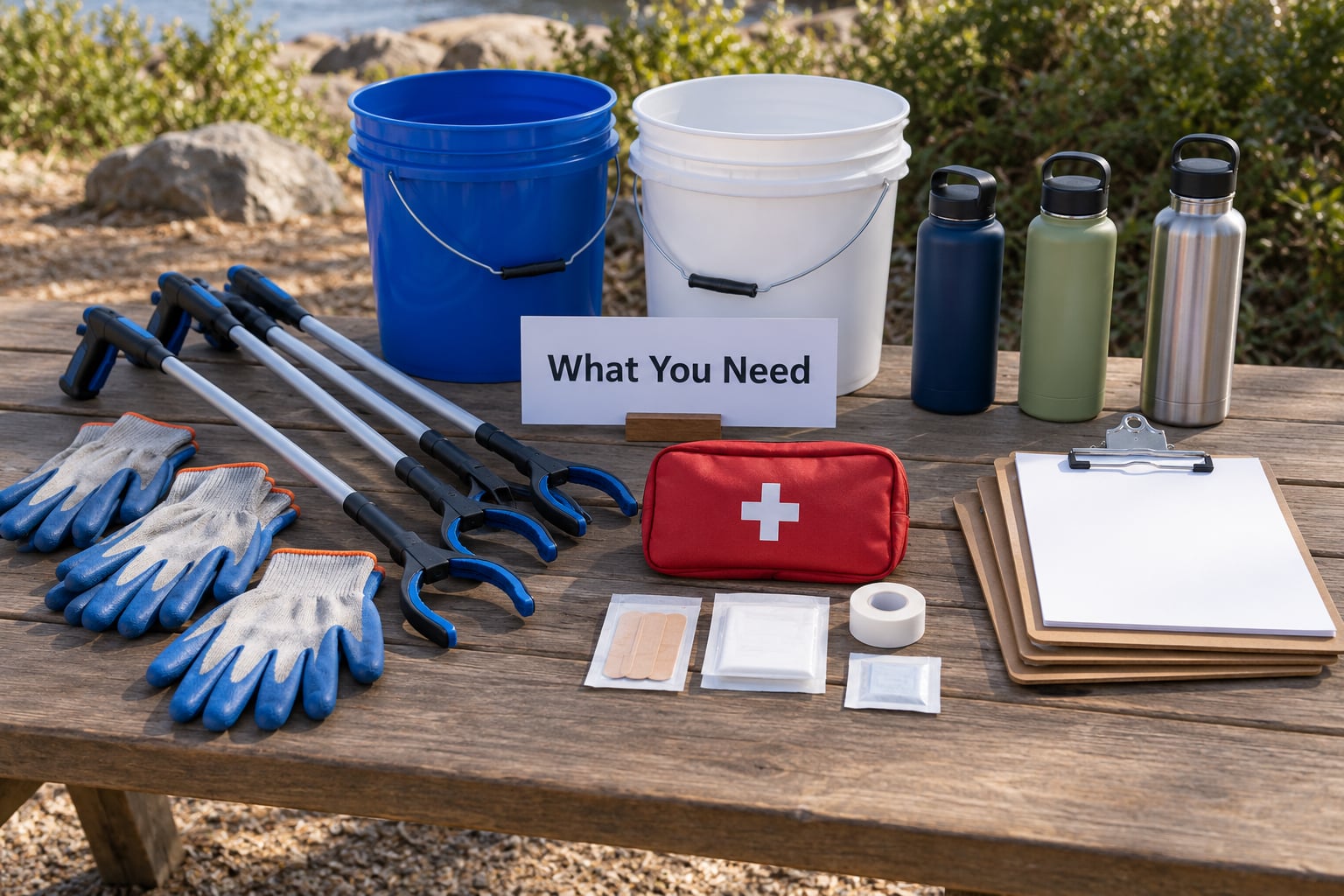
Most watershed groups supply a kit for free, and joining an existing event is the easiest way to get gloves, bags and a grabber without buying anything. If you are organizing your own, this is the working kit. Bring more water than you think and one spare pair of gloves per person.
| Item | Why you need it | Pro tip |
|---|---|---|
| Cut-resistant work gloves | Creek litter is mostly sharp edges, rusted metal and broken glass | Leather palms grip wet debris better than thin nitrile alone |
| Litter grabber with a hooked end | Lets you work without bending to the water and keeps hands off the mud | The hook matters more than the reach for pulling bottles out of crevices |
| Contractor-grade bags, heavy mil | Wet litter doubles in weight and thin bags split | Fill to about two-thirds, tie the top, never overfill |
| Onion mesh bags or rigid buckets | The only safe way to carry glass and other shard debris | Label them SHARDS so nobody squeezes them later |
| Closed-toe waterproof boots | Creek mud hides rocks, wire and broken bottles | Flip-flops and canvas shoes are the single most common cause of cut feet |
| High-visibility vest or bright shirt | Creeks often run under or beside roads | Especially important if you will be standing near a guardrail |
| First-aid kit | Cuts, splinters and insect bites are routine | Include antiseptic wipes, gauze, tape and any personal medication |
| Poncho or spare layers | You will be wet or muddy even on a dry day | A plastic pack poncho beats a wet jacket in late autumn |
| Sunscreen, insect repellent, water | Bank work is fully exposed with no shade | Repellent containing DEET or picaridin for tick-heavy reaches |
| Clipboards and a tally sheet | Counts are how the group proves impact to the watershed | Record bag counts by category before the truck leaves |
For a group of any size, add a rigid sharps container with a tight lid. A ventilated urine specimen container or an old coffee can with a taped lid works in a pinch, but a purpose-built container is better because it cannot be punctured by a needle.
Paperwork matters as much as gear. You need written permission from the landowner or the agency managing that stretch of creek, plus the contact details for the group leader, the landowner and the nearest urgent care. If a public road crosses your access point, note the cross street for emergency services.
Step-by-Step: How to Do a Creek Cleanup Safely
Check the Site, Permissions and Weather
Confirm access first. A creek running through private property needs the landowner’s explicit permission, and work on a public right-of-way may still require a permit from your city or county. If you cannot identify who manages the land, assume you do not have permission and ask before you set out.
Then check the weather and, more importantly, the water. Any rain in the days upstream matters, not just rain on your bank. Look at the gauge on the nearest USGS stream page, and check whether the flow has risen since your last visit. A creek that was ankle-deep on Tuesday can be over your head by Friday.
Postpone or narrow the cleanup when you see any of these: active high flow, muddy water running fast enough to undercut the bank, a flood forecast, thunderstorms, a heat advisory, or an ice cold morning with snowmelt. Narrowing means changing the site or the date, not shortening the briefing.
Walk the length of the stretch before anyone starts. Note undercut banks, culvert outlets, low-head dams, steep drop-offs, active traffic and any stretch where the ground gives way. If you find something that should not be there, a mattress or a car, that is a municipal or law-enforcement job, not a volunteer one.
Choose a Safe Work Area
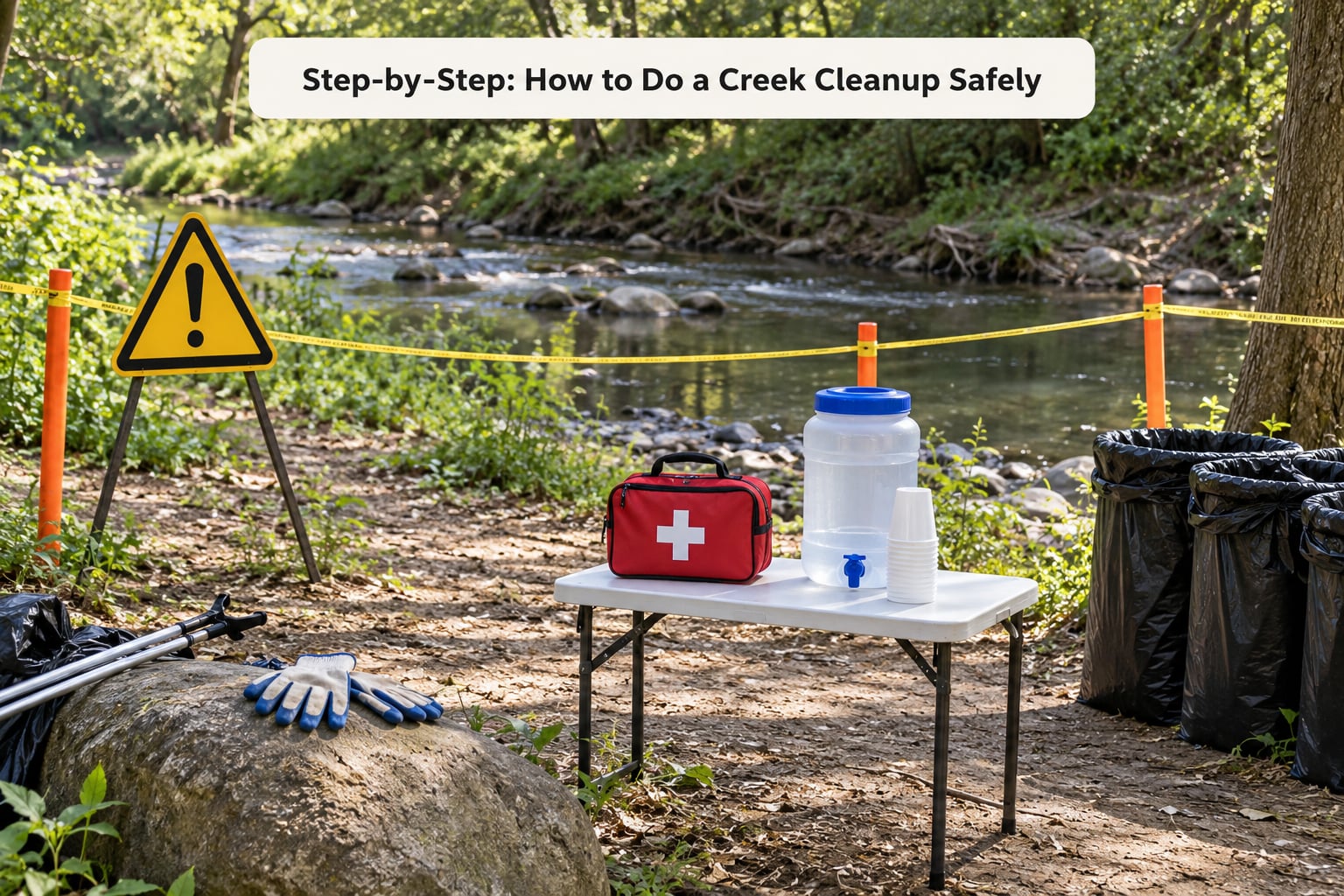
Set the boundary out loud and mark it. Tell everyone where the work zone ends, where the first-aid kit sits and who the zone captain is for their section. People drift, especially once they spot a tire or a shopping cart.
Work from ground that holds your weight without testing it. Stay well back from undercut banks, where roots and soil have been eaten away and the surface looks solid until your boot finds nothing. Skip steep eroded slopes entirely; a person carrying two wet bags downhill falls before they can stop.
Keep everyone in pairs and within sight of the group leader. Nobody walks the creek alone, nobody walks upstream out of sight, and nobody takes a shortcut across a bend. Face oncoming traffic whenever the creek runs beside a road, and if there is no shoulder, move to a safer section rather than working in the lane.
Watch what you reach for. Poison ivy often grows as fuzzy vines in a tree line, and multiflora rose sends thorny canes out across the bank. Neither is obvious until you are pulling litter out of the middle of it.
Collect and Sort Litter Without Creating New Risks
Hold bags from the top, never the bottom. A bag of creek litter can conceal a needle at the base, and squeezing it puts that needle straight into your hand. One organizer told me their volunteers learned that lesson the hard way.
Use the grabber for everything you can. Keep your back neutral by bending at the knees and hips instead of folding at the waist, and take frequent breaks if you are hauling bags up a slope. A two-hour session with proper lifting beats a morning of back complaints.
Sort as you go into at least three streams: general litter, recyclables your local program actually accepts, and shards in a rigid container. Glass is the most common and most dangerous creek litter. A volunteer on r/DeTrashed described deliberately hunting glass shards and pulling seven pounds of them in one session, which tells you how much of it is hiding in the gravel.
Leave these items in place and flag them for the zone captain:
- Hypodermic needles, syringes and anything that looks like drug paraphernalia
- Unknown containers, unlabeled bottles, drums and buckets
- Oily or sheened water, chemical residue and dead animals
- Batteries, propane cylinders, appliances, tires and heavy machinery parts
- Anything with a label suggesting it belongs to a business or agency
For sharps specifically: do not touch it, do not use a grabber on a loose needle, and never put one loose in a bag. Mark the location so others can find it, then tell the zone captain. The organizer records the spot and routes it to a sharps program or public health department.
You will sometimes find hazards the creek did not create. One neighborhood group reported that earlier cleanup work had left stumps about a foot tall with chewed-off sharp points along their creek, a danger made by the cleanup itself. Look for cut stumps and splintered branches and flag them the same way you flag litter.
Finish with a Check, Safe Disposal and a Report
Walk the cleaned stretch once more before anyone leaves. Look under root balls, inside culverts and along the high-water line, where debris collects and nobody thinks to look.
Secure the bags so nothing escapes. Tie them closed, move them to a shaded staging point, and weigh or count them by category: litter, recycling, shards, and the flagged hazards you are handing off. Loose plastic blowing out of a bag and back into the creek undoes the whole morning.
Route each category legally. Recycling only counts if your local program accepts that material, and many curbside programs take bottles and cans but not rigid plastic, film or anything contaminated. Sharps go to a sharps program. Batteries, e-waste, tires, appliances and cylinders go to your household hazardous waste or transfer station, not the landfill bin and not the creek.
Then close out the personal safety steps. Wash hands with soap and water; hand sanitizer is not a substitute when there is grit and animal waste involved. Check every volunteer for ticks, including the waistband, socks and behind the ears, and treat any attached tick promptly. Disinfect grabbers and buckets, and dry your gear before packing it so it does not mildew.
If anyone has an open cut or graze, they should not have been in the water or handling wet litter. Cover any wound, and tell your clinician about creek water contact if the cut is not healing, is red and swollen, or if you develop fever, muscle aches or headache in the following weeks. The CDC explains the water-contact disease risks, and the short version is that untreated creek water can carry bacteria that are hard to treat once they are in a wound.
Finally, submit your numbers. Most watershed programs accept volunteer hours, bag counts and category tallies, and those reports are how a small group becomes a line item in a watershed’s annual report. Send them within a couple of weeks while the counts are still real.
Common Mistakes
Wading into moving water. Volunteers get swept off undercut banks and lose footing on algae-slicked rock. Work from the shore; enter the water only when it is low, slow and explicitly allowed by the organizer.
Working alone. A creek bank is uneven ground with hidden hazards, and an injured person alone on a slope cannot self-rescue. Use the buddy system with no exceptions, including for experienced volunteers.
Bare hands. Gloves are the whole reason most cuts do not happen. Keep them on for the entire session, and use the grabber rather than your hand whenever an item has an edge.
Picking up unknown containers. Unlabeled drums, buckets and bottles can hold anything, including chemicals denser than water that have settled on the creek bottom. Neighbors in one group noted that such material shows up as an oil sheen when the bed gets disturbed. Leave it, mark it, report it.
Overfilling bags. A bag filled past the tie line splits, spills and can put a hidden needle in contact with someone’s back. Fill to two-thirds, tie the top, and hold bags from above.
Collecting wildlife or habitat. Nesting season, dead fish that might be a disease report, and large woody debris that shelters a stream are all reasons to stop and ask rather than pull. Dead animals usually belong to a local animal control or health department.
Assuming everything recycles. Recycling rules are local and narrower than people expect. Check your program before filling a separate bin you then have to landfilled anyway.
Skipping the briefing for experienced helpers. Veteran volunteers are the ones who touch the weird stuff because someone already warned them about it. Repeat the rules every time, including for people who have done this ten times before.
A few habits close most of the remaining gaps: set a hard end time so nobody works into the hottest or darkest part of the day, keep a bottle of water per person within reach, and hold a two-minute count before the group disperses.
Frequently Asked Questions
Is it safe to clean a creek?
A creek cleanup is safe when it is organized, permitted and done from the bank in good conditions. The risks are manageable: sharp litter, unstable ground, traffic, ticks and water-borne bacteria. Most injuries come from bare hands, flip-flops and working alone rather than from the creek itself. Check the forecast and water level first, wear gloves and closed-toe boots, work in pairs, and postpone when there is high flow or a storm in the forecast.
How should children participate in a creek cleanup?
Children can take part, but only on the bank, in a supervised zone away from the water and away from roads. A common rule is one adult per four to six children, with no child under about eight picking anything up. Give younger kids a job with no hazard exposure at all: tallying bags by category, filling in the data sheet, or watching for adults who need help. Brief the children separately, in language they understand, and keep them within sight of a zone captain.
What should you do if you find a sharp object or unknown container?
Stop and do not pick it up by hand. Mark the location so others can find it, tell your zone captain or organizer immediately, and keep other volunteers away from the spot. Never squeeze or lift a bag to check for hidden sharps, and never place a needle loose in a trash bag. Organizers route sharps to a sharps container and then to a public health or sharps program, and route unknown containers to the local hazardous waste service.
Do volunteers need to go into the water?
No, and most groups do not allow it. Litter on the creek bed and along the waterline can usually be reached from shore with a long-handled grabber, which removes the drowning, cold-water and footing risk entirely. If a site has litter that can only be reached by wading, organizers either narrow the work area, schedule a lower-flow day, or bring in trained staff with flotation. Program coordinators in Pittsburgh report that several local rivers are dangerous to touch at all.
Can all the litter collected during a creek cleanup be recycled?
No. Recycling acceptance is local and narrower than most people assume. Programs commonly take aluminum and steel cans, clear plastic bottles and some paper, while film plastic, foam, dirty containers and mixed-material packaging are rejected and go to landfill or waste. Glass collected from a creek is often contaminated with sediment and water, so many programs send it to a specific drop-off rather than the curbside bin. Check with your local recycling or solid waste service before sorting.
How can I find a creek cleanup event near me?
Search for your local watershed alliance, riverkeeper group or Adopt-a-Stream program, and check your city or county sanitation department for scheduled volunteer days. National River Cleanup Day is the largest organized date of the year and has events across the country. If nothing is listed, organizing one yourself is straightforward: pick a two-hour stretch you can access, confirm permission, borrow a kit, run a ten-minute briefing and tally your bags at the end.
Conclusion
Start with access, conditions and hazards. Confirm you may work there, check the water level and forecast, walk the stretch, and decide the boundary before a single volunteer arrives. From there the rest is routine: gloves, a grabber, work in pairs from the bank, mark sharps and unknowns instead of touching them, dispose of each waste type through its proper channel, and send in your numbers. Get that order right and a creek cleanup is genuinely one of the most useful things a group can do in a morning.