If you have ever wondered how mangroves protect coastlines, the answer is that they work as a natural, living breakwater. Their tangled roots, trunks and canopy absorb and dissipate wave energy, hold sediment in place so the shore stops eroding, and slow storm surge before it reaches the land behind. The result is less flood depth, slower water and, in some places, a coastline that actually builds itself back up over time.
That is the short version. The honest version has caveats, and I’ll come back to them, because a mangrove belt is a buffer, not a wall, and a degraded one can give people false confidence. Updated for 2026, this explainer walks through how the protection actually works, where it works best, what breaks it, and what protecting and restoring mangroves involves in practice.
Table of Contents
- What Are Mangroves and Why Do They Protect Coasts?
- How Mangroves Reduce Waves and Coastal Erosion
- How root density and vegetation drag slow the water
- How the root mat stops the shore washing away
- How Mangroves Protect Against Storm Surge and Flooding
- Why a mangrove belt blunts a surge
- Why mangroves work alongside seawalls, not instead of them
- What Other Benefits Do Mangroves Provide?
- Why Are Mangroves Especially Important for Climate Resilience?
- Where Are Mangroves Most Effective?
- What Can Damage or Destroy Mangrove Protection?
- How Can People Protect and Restore Mangroves?
- Four steps of mangrove restoration
- How long before a planted belt does anything
- Protecting existing stands
- Frequently Asked Questions
- What are the benefits of mangrove forests?
- How can we protect mangroves?
- What are the main causes of mangrove depletion?
- Are mangroves better than seawalls for coastal protection?
- How long do mangroves take to grow and start working?
- Can you eat mangrove fruit?
- Conclusion
What Are Mangroves and Why Do They Protect Coasts?
Mangroves are salt-tolerant trees and shrubs that grow in the intertidal zone of tropical and subtropical coasts, where they are flooded by brackish or salt water twice a day. They are not a single species but a guild of unrelated plants that evolved similar solutions to the same problem: living in saturated, salty, oxygen-poor mud.
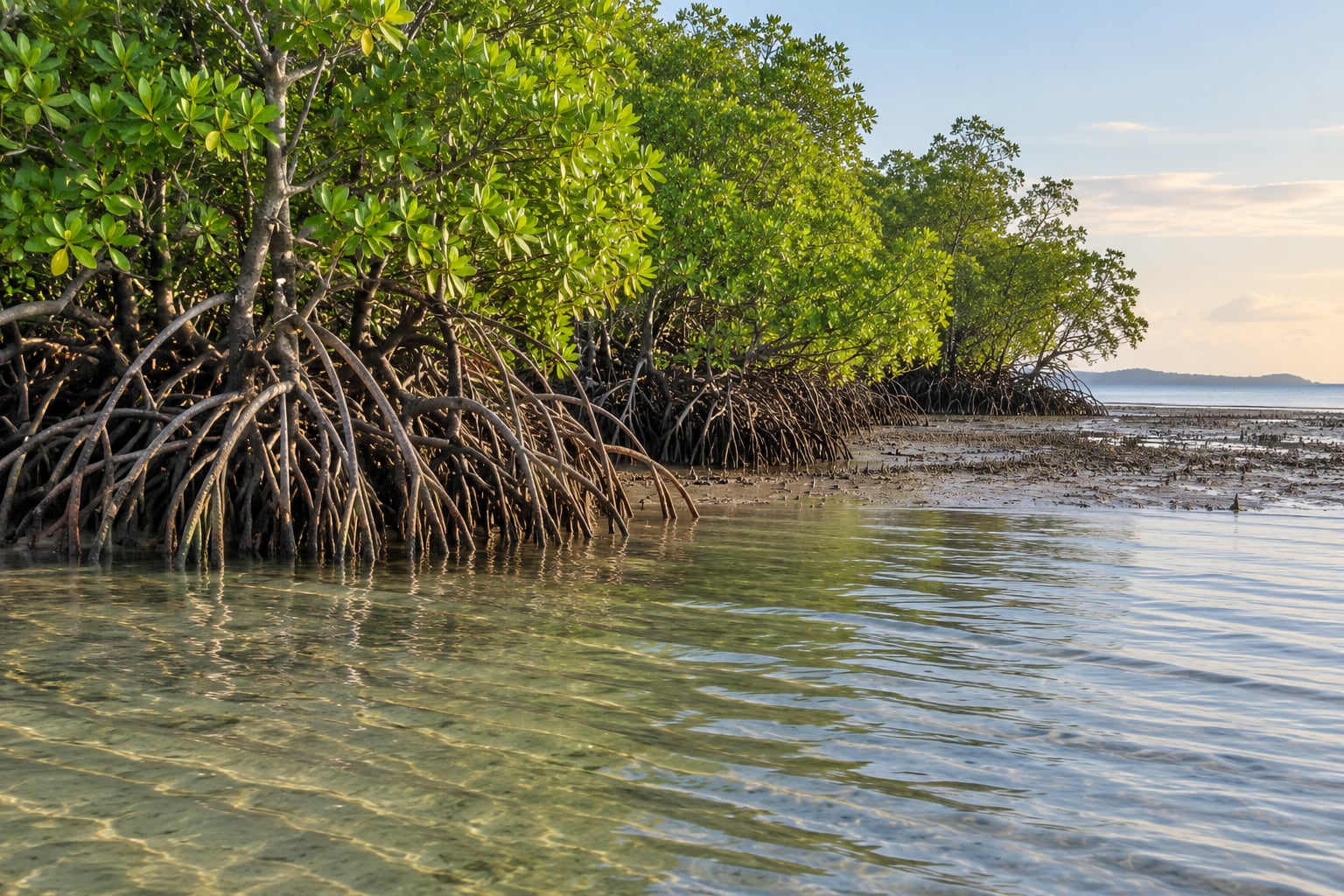
Those solutions are visible above ground. Instead of relying on a deep root system in soil that holds no air, many species push roots up and out into the air. Red mangroves grow stilt or prop roots that arc from the trunk into the mud. Black mangroves grow pencil-thin vertical spikes called pneumatophores, essentially breathing tubes for gas exchange. The tangled mat of stems and roots is what does the physical work of holding a shoreline together.
Worldwide, mangroves cover roughly 147,000 square kilometres across about 118 countries, and around three quarters of that sits in just 15 countries. Protecting those remaining forests matters far beyond conservation status, because studies led by The Nature Conservancy and other groups estimate that mangroves prevent on the order of 65 billion dollars a year in storm damage and shelter roughly 15.4 million people.
| Mechanism | What it reduces | Time to take effect |
|---|---|---|
| Wave attenuation | Wave height, wave energy and current speed | Immediately, scaling with the width of the stand |
| Root-mat soil stabilisation | Undercutting and shoreline erosion | As the root network develops, over years |
| Sediment trapping and accretion | Long-term land loss, and flood depth behind the belt | Continuous, best where sediment supply is healthy |
| Surge and tsunami buffering | Flood depth, velocity and impact energy inland | Strongest in wide, dense, multi-species stands |
| Blue carbon storage | Climate emissions, plus local subsidence from drained soils | Decades to centuries of accumulation |
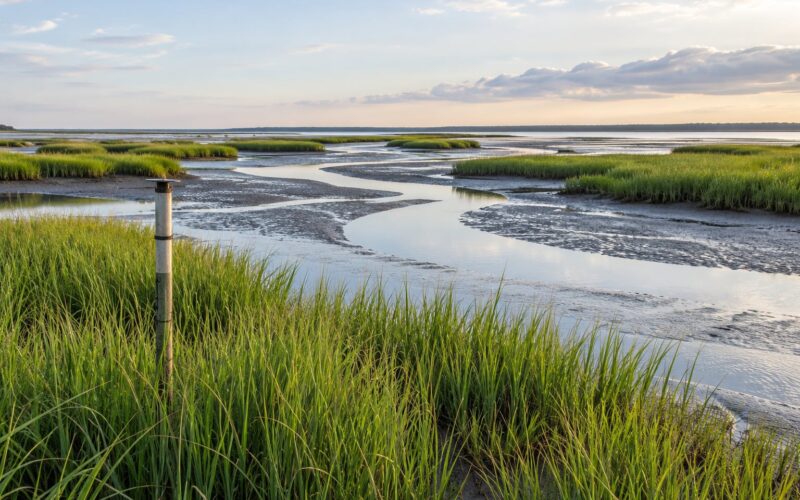
Mangroves rarely grow on open ocean beaches. They need shelter, and they usually arrive as part of a wider system: mudflats and tidal creeks, salt marshes and seagrass meadows, sand dunes, and offshore reefs that take the first hit before the water ever reaches the trees.
How Mangroves Reduce Waves and Coastal Erosion
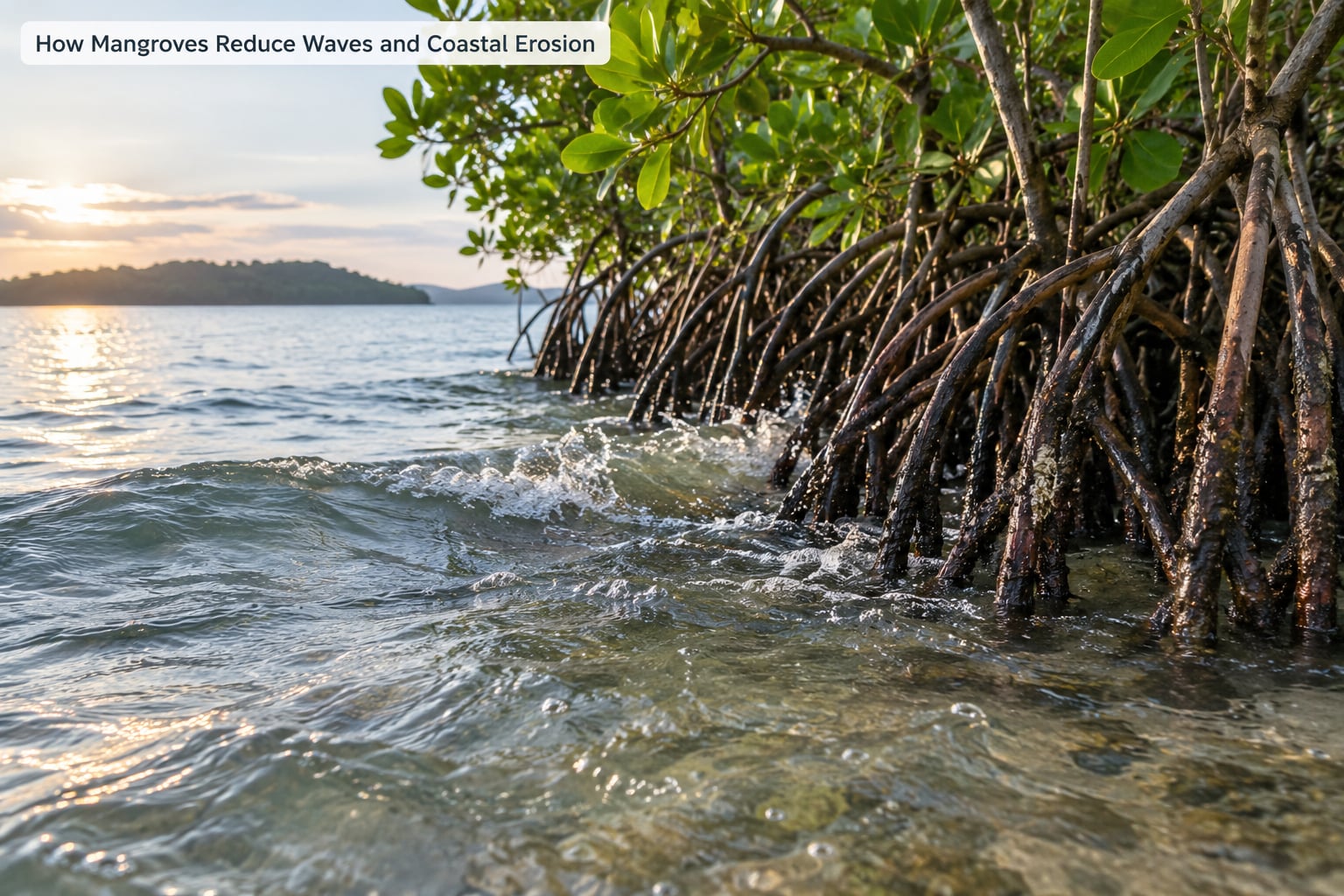
Wave energy is the main driver of coastal erosion, and a mangrove forest is very good at taking it out of the water.
How root density and vegetation drag slow the water
When a swell wave crosses from open water into a mangrove stand, it has to push through hundreds of stems per square metre of mudflat, plus everything below the waterline. That roughness, called vegetation drag, absorbs a large share of the wave’s energy and turns it into turbulence. The wave gets shorter and weaker as it travels inland, and the strongest effects show up within the first 100 to 200 metres.
Water level matters just as much as the plants. Waves passing over shallow flats lose energy through bottom friction before they even reach the stems, which is why many projects combine mangrove planting with restoring tidal flats and shallow channels. You cannot rebuild that bathymetry by planting seedlings alone.
How the root mat stops the shore washing away
Sediment is held in place by roots until waves and currents can no longer move it. Those roots also add roughness to the seabed, so the current slows further and drops more of its load. A healthy stand is effectively a living mesh over the mud that fails the shoreline.
The result is a lower erosion rate along that stretch of coast, and in many places net sediment accumulation. The land doesn’t just stop retreating. It builds up vertically as new silt, organic debris and root material settle, which raises the surface elevation the mangroves grow on. This is the quieter, everyday way mangroves protect coastlines, at work long before any storm arrives.
How much of this you get depends heavily on four things: the width of the belt, whether the stand is healthy and dense, how much sediment the system receives from rivers or the sea, and whether tidal flow is intact. A narrow, degraded or sediment-starved strip gives disappointing results, and that is where most of the public scepticism about mangrove restoration comes from.
How Mangroves Protect Against Storm Surge and Flooding
Storm surge is a wall of water pushed ahead of a tropical cyclone or severe extratropical storm. It arrives with a level, a speed and a duration, and those three things decide how much damage it does.
Why a mangrove belt blunts a surge
A wide stand of mangroves attacks all three. The rough, dense barrier slows the advancing water, the vegetation soaks up and dissipates part of its energy, and the elevation gained through accretion keeps the ground behind the belt higher. Water arrives inland slower, shallower and less energetic, which is precisely the combination that reduces damage to homes, roads and drainage systems.
The same physics applies to tsunami energy, and that is well documented from events in Southeast Asia. The trees will not stop a tsunami, and no credible source claims otherwise. What they can do is take the leading edge of the wave, reduce its height and force, and slow it enough that evacuation times improve. The published reviews on mangroves and coastal defence, produced by The Nature Conservancy, Wetlands International and the University of Cambridge, make this distinction repeatedly.
Mangroves also protect against everyday flooding, which matters more often than the headline storm. High tides, storm-generated swell and local wave action push water over the shoreline on ordinary days, and a vegetated belt turns that from a damaging overtopping event into a slow, damped arrival.
Why mangroves work alongside seawalls, not instead of them
Planners rarely treat mangroves or hard engineering as an either-or choice. Mangroves reduce risk, they do not remove it, and a design that relies on a young or thin belt to protect dense development behind it is a design with a poor risk profile.
| Approach | What it does best | Main limits |
|---|---|---|
| Mangrove belt | Slows waves and surge, traps sediment, builds land, stores carbon | Slow to establish, needs width and tidal flow, ineffective against extreme water levels alone |
| Seawall or revetment | Immediate, fixed protection with a predictable design life | Reflects wave energy, traps sediment, reflects the coast seaward, needs constant upkeep |
| Offshore breakwater or reef | Takes wave energy before it reaches the beach | Costly to build, upkeep-heavy, and can starve the shoreline of sediment |
| Hybrid living shoreline | Combines a low hard structure with marsh or mangrove in front and behind | Needs design care so the vegetation can establish and migrate |
A practical pattern, common in places like Singapore, puts mangroves in the sheltered intertidal zone, a low seawall or revetment behind them to stop erosion during establishment, and dunes or a raised road as the last line. Each element covers the others’ weaknesses. The hard structure also blocks the mangrove from migrating inland, which brings a problem worth naming now.
What Other Benefits Do Mangroves Provide?
Coastal protection is the argument that gets mangroves funded, but it is not the only reason they matter. Several of the other benefits are large enough to matter on their own.
Blue carbon. Mangrove soils are waterlogged and oxygen-poor, so plant debris decomposes slowly and carbon accumulates in the sediment for centuries. Global stocks are estimated at more than 21 billion tonnes of carbon dioxide equivalent, with an average of around 394 tonnes of carbon per hectare and much higher figures in productive stands such as those in the Philippines. Clearing a mangrove releases that stored carbon and can turn a carbon sink into an emissions source, which is why mangrove conservation counts as climate mitigation and not just adaptation.
Fisheries nursery habitat. The root mat is the sheltered nursery for juvenile fish and crustaceans that later move into deeper water. A working mangrove edge supports a productive fishery, which is why coastal communities frequently defend existing stands even without being asked to.
Water quality. Roots and sediment filter suspended sediment, nutrients and some pollutants before water reaches seagrass beds and coral reefs further along the coast. They also absorb excess nutrients from land runoff, which helps limit algal problems in neighbouring waters.
Biodiversity, culture and livelihoods. Mangrove forests are habitat for fish, birds, crocodiles and shellfish, and they supply timber, fuel, honey, medicine and coastal timber for boatbuilding. Plenty of people also value these forests for their own sake, which matters for whether a restoration project survives contact with the communities living beside them.
Recreation and tourism. Kayaking, birdwatching and guided walks bring income to communities and give people a reason to want the forest left standing.
Why Are Mangroves Especially Important for Climate Resilience?
Sea-level rise changes the arithmetic for every coastline, and that is where mangroves behave differently from a static asset.
A mangrove forest can grow vertically. Roots and sediment raise the forest floor over time, so the habitat keeps pace with rising water as long as accretion outpaces relative sea-level rise. That gives it a quality no seawall has: it can improve its own position. The catch is that accretion depends on continued sediment supply, and in many engineered coasts that supply has already been cut off.
That produces coastal squeeze. Seawalls, roads, docks, housing and reclamation box mangroves into a fixed strip. There is nowhere for them to migrate as the water rises, the belt narrows, and the protection quietly weakens while the development behind it keeps expanding. This is why forward-looking coastal strategy reserves land behind the existing mangrove for the mangrove itself.
There is a second link back to the protection argument. Drained and cleared mangrove soils decompose and lose volume, so the land surface subsides. Lower ground means higher flood risk for the same storm and higher relative sea level. Keeping the forests wet keeps the ground up, which protects everything else behind them.
Storm behaviour is also shifting, with more intense rainfall and stronger extremes in many regions. Buffers that reduce the depth and speed of floodwater are valuable precisely because they soften impacts that engineered defences alone will eventually be overwhelmed by.
Where Are Mangroves Most Effective?
Mangroves need a specific set of conditions, and picking the wrong site is the most common reason restoration projects disappoint.
They do best in sheltered tropical and subtropical settings with abundant sediment and reliable tidal flow: river deltas, estuaries, lagoons, sheltered bays behind barriers, and back-barrier swamps behind sand dunes. Wave energy needs to be low to moderate, because seedlings are easily washed out of high-energy sites. Salinity, tidal range and substrate all matter, and mangroves will not grow on strongly acidic, nutrient-poor or compacted fill.
Beyond the site, the outcome depends on the belt. A wider stand attenuates more, a denser stand with a mix of species and ages resists gaps better, and a stand with a healthy sediment budget keeps accreting rather than eroding. Connectivity helps too, since a long continuous fringe protects more shoreline than the same area in isolated clumps.
There is also a scale point. Mangroves deliver meaningful protection for small communities, low-lying villages, roads, farmland and water intakes. They are rarely sufficient on their own for dense, high-value urban coastlines exposed to major storm surge, which is why the serious coastal plans in those places pair them with hard structures and set-up for managed retreat.
What Can Damage or Destroy Mangrove Protection?
Protecting coastlines means protecting the forest. Almost every serious threat to mangrove function is something a person did to the tidal system, and each one leaves the shoreline more exposed than before.
Conversion to aquaculture. Shrimp and fish ponds are still the single largest driver of mangrove loss worldwide, because the trees are cleared, diked and then the water inside is managed. The result is a permanently flattened shoreline.
Conversion to agriculture and plantations. Rice paddies and oil palm or other tree plantations in former coastal forest remove the root mat entirely.
Drainage and impoundment. Cutting tidal channels and bunding a swamp to stop flooding removes the water movement that keeps mangroves alive and stops the sediment supply they depend on. Drained peat-like mangrove soils oxidise and sink.
Shoreline construction and reclamation. Seawalls, roads, ports and land reclamation destroy habitat outright and create the coastal squeeze described earlier.
Pollution. Sewage, heavy metals, pesticides, plastics and oil smother the roots and the sediment community, and oiled mangrove soil can take years to recover.
Altered river flow. Dams, upstream abstraction and sand mining cut the sediment that used to feed the delta. Many deltas are now sinking faster than relative sea level is rising, for exactly this reason.
Overharvesting and invasive species. Unsustainable cutting of timber and fuelwood degrades the canopy, and invasive species such as Sonneratia or Avicennia in some regions can crowd out the species that provide the best wave attenuation.
Climate stress itself. Drought, heat, storm damage and rising sea level exceed the physiological tolerance of individual trees, and combined with the pressures above they drive dieback.
Global mangrove cover has contracted substantially since the mid-20th century, and the rate of loss has slowed compared with the 1980s and 1990s as conservation expanded. Progress exists, but the total is still a fraction of what was there, and coastal protection depends on the remaining area being intact rather than on isolated new plantations.
How Can People Protect and Restore Mangroves?
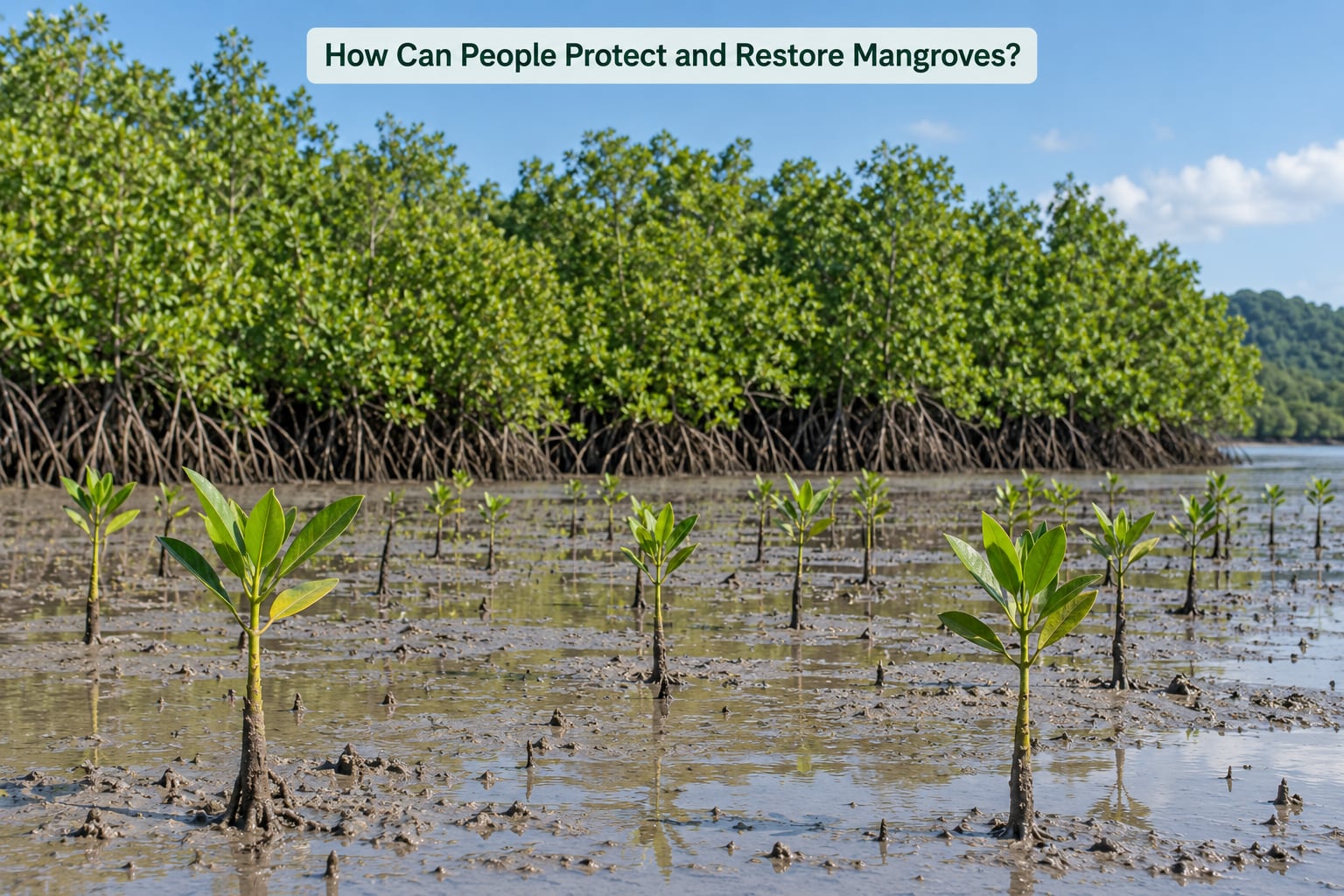
The cheapest protection is the forest you already have. Every hectare of existing, healthy mangrove is a hectare you do not have to build from scratch, and a mature stand has root systems, sediment stores and breeding populations that a new planting cannot match for years.
On that basis, the priority order is straightforward: stop the clearing, fix the hydrology, then plant only where planting will succeed.
Four steps of mangrove restoration
1. Collection. Harvest propagules, the long living seedlings, from healthy parent trees at the right time of year, and take the best of them rather than scraping a single stand. Seedlings that have already spent weeks in the water establish better than cuttings planted directly.
2. Preparation. Clear debris and existing failed growth, and fix the physical problem first. That means re-opening tidal channels, correcting salinity, and stabilising the substrate. On sandy or eroding sites, pioneering grasses such as vetiver are often planted to hold the ground until the mangroves establish. Where the coast is too dynamic, the site is stabilised or abandoned rather than replanted repeatedly.
3. Plantation. Plant propagules at the right density and spacing, at the elevation the species prefers, and anchor them properly. Mixed-species planting at several densities is more resilient than a single tidy grid of one species.
4. Establishment. This is where projects are usually underfunded, and where the forum complaints about abandoned restoration sites come from. Weeding, replanting failures, repairing channels and replacing lost material for several years is where the survival rate is actually won or lost.
How long before a planted belt does anything
Be honest about the timeline, because it is the most common disappointment. Propagules establish in months and put on measurable height within two to three years. Wave attenuation becomes significant once stems are dense, usually somewhere around the five to ten year mark, and the stand becomes structurally comparable to a natural forest over a timeframe measured in decades, often 15 to 30 years or more depending on species, site and the sediment supply.
Compare that with a seawall, which protects from day one but also needs constant maintenance and a fixed end point. Mangroves are a long investment, which is why funding them depends on patient capital and why a site that looks like bare mud at year two is not a failure.
Protecting existing stands
The fastest wins come from preventing damage: enforce protection on remaining forest, stop new clearing before it happens, secure community tenure and customary rights, and make local use compatible with the forest rather than criminalising it. Restoring tidal flow by re-breaching dikes and abandoned ponds is often far cheaper than planting and pays back quickly.
People who depend on the mangrove for fishing, fuel or construction need a livelihood inside the plan. Restoration projects that ignore local hydrology or local use tend to end up fenced off, ignored, or cleared again. Monitoring matters too, which means measured plot survival and elevation change rather than a photograph at the planting ceremony.
Frequently Asked Questions
What are the benefits of mangrove forests?
Mangroves reduce wave energy and storm surge, hold shorelines together against erosion, and trap sediment so the land surface rises over time. They also store large amounts of carbon in waterlogged soils, act as nursery habitat for fish and shellfish, filter nutrients and sediment out of coastal water, and support communities through fishing, timber and tourism. The protection value alone is estimated at tens of billions of dollars a year in avoided storm damage.
How can we protect mangroves?
Protect what remains first: stop clearing shrimp ponds and agricultural expansion on existing forest, and secure community tenure so local use is legal and sustainable. Then restore the hydrology, because re-opening tidal channels and re-breaching diked ponds often brings mangroves back faster and cheaper than planting. Plant only where salinity, elevation, substrate and wave energy suit the species, and budget years of weeding and replanting. Fund the long term or the site fails.
What are the main causes of mangrove depletion?
Conversion to shrimp and fish aquaculture is the largest driver worldwide, followed by clearing for rice, oil palm and other plantations. Dams and upstream abstraction cut the sediment deltas depend on, while drainage and impoundment kill the tidal flow mangroves need. Shoreline construction, seawalls and reclamation destroy habitat directly and block inland migration. Pollution, overharvesting, invasive species and climate stress degrade stands that are already stressed.
Are mangroves better than seawalls for coastal protection?
It depends on the exposure and what you are protecting. Mangroves slow waves and surge, build land and store carbon, and they improve over time as the root mat develops, but they take years to establish and cannot handle extreme water levels alone. A seawall protects immediately and predictably but reflects wave energy, traps sediment and does not improve. Most serious plans for populated, surge-exposed coasts combine both, with the mangrove belt in front of a low hard structure.
How long do mangroves take to grow and start working?
Propagules root within months and reach measurable size in two to three years. Wave attenuation only becomes significant once stems are dense, usually around five to ten years after planting, and the stand approaches the structure of a natural forest over 15 to 30 years or more. That slow build-up is the main reason projects get abandoned early and why hybrid designs with hard protection behind the belt are so common.
Can you eat mangrove fruit?
Yes, many species produce edible fruit, and several are already common foods. The red mangrove, common on tropical shores, carries viviparous propagules that are eaten raw or cooked in places from South America to parts of Asia and Australia. Other species produce oily seeds or fleshy fruit, and leaves, bark and honey are also used regionally. Availability and safety vary by species and place, so identify the species before harvesting anything.
Conclusion
That is how mangroves protect coastlines: by slowing water, holding sediment, building land and raising the ground they grow on. The protection is real and substantial, but it is gradual, it scales with width and health, and it does not eliminate flood risk on its own.
So the first action is the least glamorous one: stop clearing the mangroves that are still standing, and restore tidal flow where it has been broken. Plant where the conditions suit, budget for the decade of care it takes, and pair the belt with dunes, reefs or hard protection where the exposure demands it.