A sea turtle nesting season is the annual window, usually several months from spring into early autumn, when adult females haul out on beaches at night to lay clutches of eggs in warm sand above the high-tide line. Understanding how sea turtle nesting seasons work on public beaches matters because nearly every threat to a nest on a busy shoreline comes from people: lights, furniture, holes, dogs and litter.
A female lands after dark, finds a suitable spot, digs, lays, covers and goes back to sea. Roughly 45 to 60 days later, depending on sand temperature and species, the eggs hatch and the young crawl for the water. That is the whole story in two sentences. The rest of this guide unpacks the timing, the stages, the monitoring and the handful of rules that keep the whole thing working on a beach that also sells sunbeds.
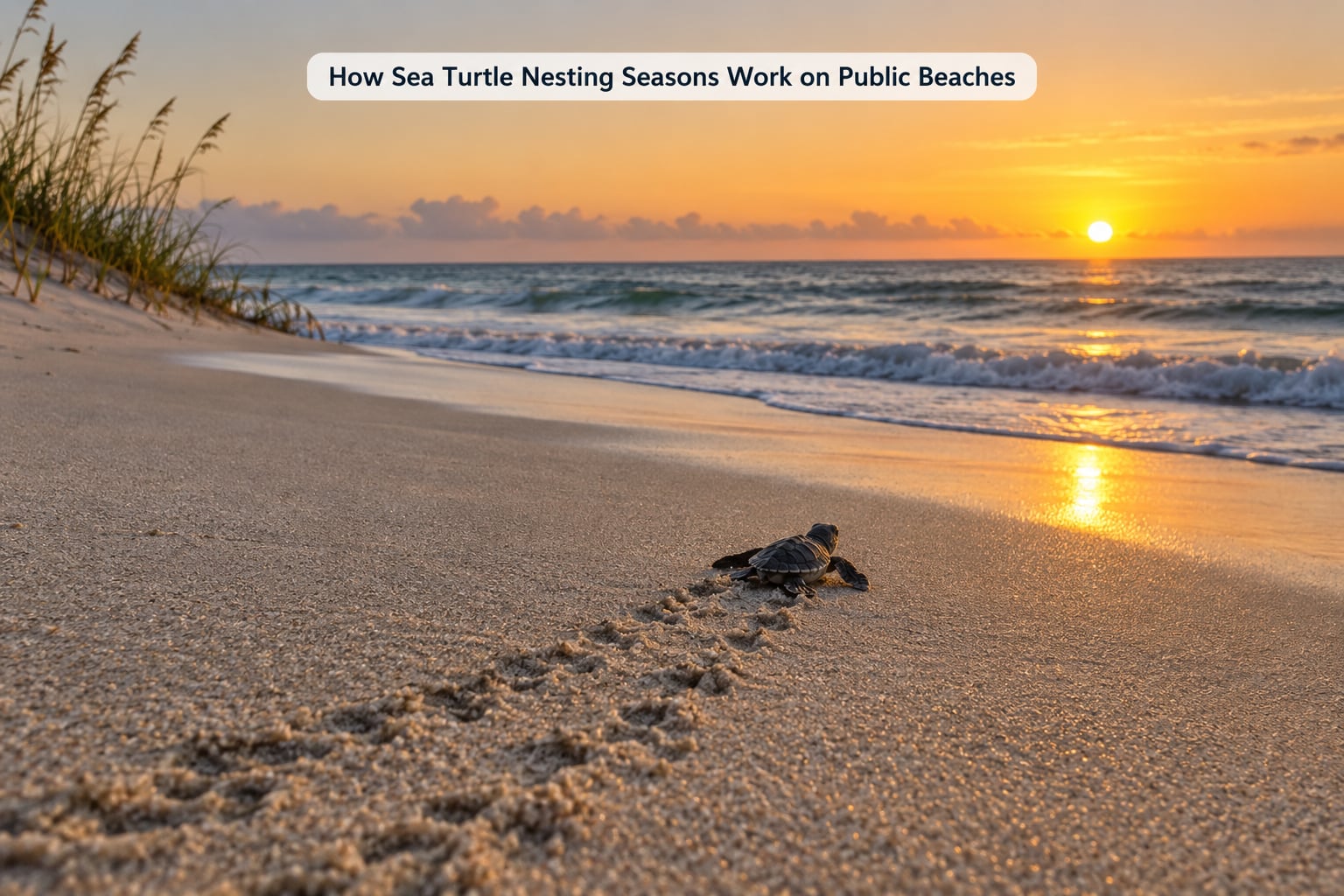
Table of Contents
- How sea turtle nesting seasons work on public beaches
- Which sea turtles nest on sandy beaches?
- Why does the nesting season occur at different times?
- How latitude and sand temperature set the calendar
- The nesting cycle from courtship to hatchling release
- How long do sea turtle eggs take to hatch?
- How to recognize a nesting turtle or an active nest
- How public beaches are monitored and protected
- What visitors should do when turtles are nesting
- What happens when hatchlings emerge at night?
- Why hatchlings follow the brightest horizon
- What can visitors do to protect nesting turtles?
- Frequently Asked Questions
- Can visitors walk on a beach where sea turtles are nesting?
- Should a sea turtle nest be moved if it is close to a path or high-tide line?
- Why do hatchlings usually come out at night?
- Can I use a flashlight to see a nesting turtle?
- What should I do if I see a turtle crawling toward the sea?
- How can I find out whether a local beach has a nesting season?
- What should you do first when you find a sea turtle?
How sea turtle nesting seasons work on public beaches
The season is not one global calendar. It is a local window that shifts by species, latitude, water temperature and whatever the monitoring crews recorded last year. Adults remigrate from feeding grounds to their natal beach, mate offshore, and then females come ashore one at a time, on a schedule shaped more by currents and ocean temperatures than by any calendar humans keep.
Each female usually nests several times in a season, roughly every two weeks, with a final clutch near the end. Between trips she goes back to sea to feed and rebuild. Once the last clutch is down, the beach quietly goes quiet again, even though nests underground may still be incubating for another month or more.
That gap between the last crawl and the last hatchling is where visitor habits matter most. A beach can look empty and still hold hundreds of nests, marked with a stake and a sheet of plywood so nobody parks a beach chair on top of them.
Which sea turtles nest on sandy beaches?
Most of the turtles that crawl up on a public sandy beach are loggerheads, green turtles, hawksbills, Kemp’s ridleys and leatherbacks. Conservation status depends on the listing body, and a species can carry a different category under the U.S. Endangered Species Act than on the IUCN Red List.
| Species | Typical clutch | US ESA listing | IUCN status | Typical nesting range |
|---|---|---|---|---|
| Loggerhead | around 80 to 120 eggs | Threatened | Vulnerable | Atlantic and Mediterranean coasts, from Florida to the Mediterranean |
| Green turtle | around 100 to 120 eggs | Endangered | Endangered | Florida, the Caribbean, the Mediterranean and nesting beaches in the Pacific |
| Hawksbill | around 130 to 160 eggs | Endangered | Critically Endangered | Caribbean and Central American reefs |
| Kemp’s ridley | around 100 to 175 eggs | Endangered | Critically Endangered | Texas, the US Gulf coast and a few Mexican beaches |
| Leatherback | around 50 to 100 eggs | Endangered | Vulnerable | Tropical and subtropical coasts, including Florida and the Mediterranean |
All seven sea turtle species lay eggs on land, but they are not interchangeable on a beach. Leatherbacks are the only ones that lay on beaches with coarse sand and shingle rather than soft sand. If you are on a public sandy beach, you are most likely looking at loggerheads, and on the Andalusian coast, loggerheads and green turtles are the two species that make up the local nesting population.
Why does the nesting season occur at different times?
Beaches do not share a season. Females come ashore when conditions suit the survival of their eggs, and those conditions are local. Southern nesting grounds open earlier than northern ones, and the number of nesting females in any given year swings with ocean currents, food availability and how warm the foraging areas have been.
How latitude and sand temperature set the calendar
Warmer water and warmer sand pull nesting earlier in the year and, in some places, extend the season. Sand temperature at nest depth drives egg development, so a warm spring pulls hatching forward. Weather events matter too: hurricanes and unusually cold snaps can wipe out a nesting beach in a week, which is why agencies publish a protected date window rather than a biological prediction.
| Region | Typical protection window | What the window usually covers |
|---|---|---|
| Florida east coast, including Broward and Indian River counties | March 1 to October 31 | Nest and hatchling protections plus beachfront lighting rules |
| Florida west coast, several counties | May 1 to October 31 | Overnight protection hours, often from about 9pm to 7am |
| Southern Spain and the western Mediterranean | roughly late May to the end of August | Loggerhead and green turtle nesting, with local beach regulations |
| Caribbean and Central American beaches | varied, often spanning most of the warm season | Species-dependent, with hawksbills nesting across much of the year |
Treat these as regulatory windows, not as predictions. Biologically, the first and last crawls often land outside the posted dates. The season has also been drifting earlier in several regions as the ocean warms, which is one reason conservation groups track dates as a climate signal and not just a permit schedule.
The nesting cycle from courtship to hatchling release
Mating happens in the water, not on the sand. Males often return to the same mating area each season, while females carry a magnetic and chemical memory of the beach where they hatched. Most females nest on the same stretch of sand where they were born, sometimes decades later.
| Stage | What happens | Timing |
|---|---|---|
| Remigration | Adults travel from feeding grounds back to the nesting area | Weeks to months before nesting |
| Courtship | Mating occurs offshore, usually at night | Short window before nesting starts |
| Landing | The female comes ashore after dark, usually above the high-tide line | Nightly, during the season |
| Dig testing | She tests the sand with her flippers, digs a body pit, then a deeper egg chamber | 15 to 30 minutes |
| Laying | Soft-shelled eggs are dropped into the chamber, roughly 80 to 120 in a typical loggerhead clutch | About 30 minutes |
| Covering | The chamber is filled, the sand is smoothed and camouflaged, and she returns to sea | 45 to 60 minutes |
| Incubation | Eggs develop underground in a temperature-controlled sand nest | About 45 to 60 days, varying |
| Emergence | Hatchlings dig upward, usually at night, and wait in a group for a wave to carry them off | One to three nights |
| Frenzy swim | Hatchlings paddle offshore, away from the surf, for a day or more before feeding | The first days of life |
One detail catches people out. If a female comes ashore and leaves without eggs, that is a false crawl. It is completely normal, and it happens often enough that monitor crews record both as signs of turtle activity when they survey a beach at dawn.
How long do sea turtle eggs take to hatch?
Broadly, 45 to 60 days, and that range is wide for a reason. Species matters, and so does sand. Eggs develop at a rate set by temperature, so a nest in warm sand runs ahead of a nest a few metres away in cooler, deeper sand. Egg condition and nest depth also shift the schedule, which is why monitors never give a hatch date as a promise.
Temperature decides another hidden outcome. Sea turtles have no sex chromosomes; the sex of each hatchling is set by the temperature the egg experiences during a middle stage of incubation. Each species has a pivotal temperature somewhere around 28 to 29 degrees Celsius. Cooler sand produces males, warmer sand produces females, and sand that gets hotter than it should can produce heavily female clutches and, at the extreme, failed nests.
Research on warming beaches links hotter sand to lower hatchling success even where the number of nesting females holds steady. That is the climate story behind the visitor rules: the sand is part of the climate-control system, so covering it with furniture or driving vehicles across it changes the outcome.
How to recognize a nesting turtle or an active nest
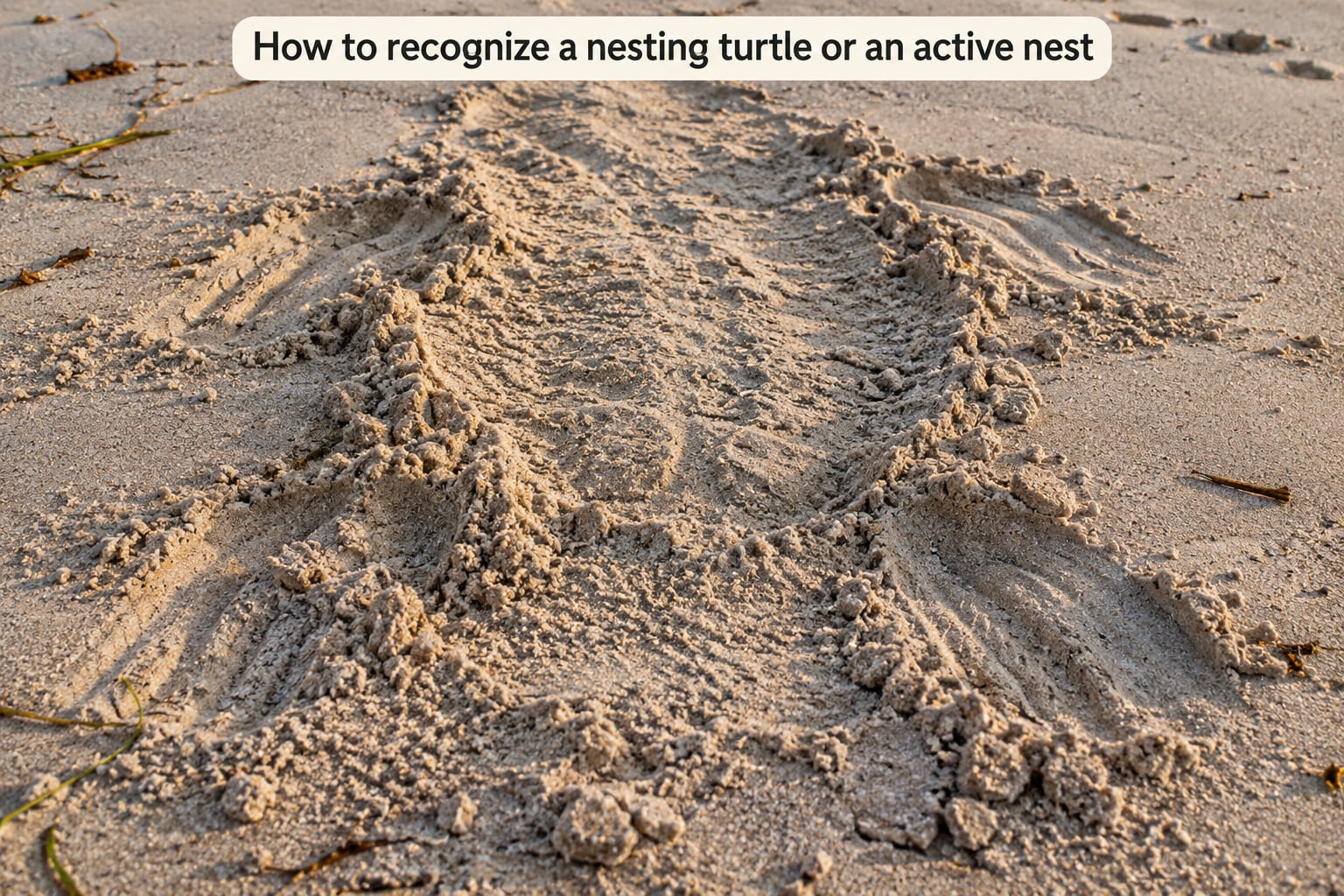
A turtle in the act of nesting is hard to miss: a broad, soft-shelled animal the length of a car tyre, dragging flippers above the tide line under a moon that is not doing much. She works slowly, stops often, and completely ignores you. Leave her alone, keep dogs and children back, and do not put a hand anywhere near her or the dig.
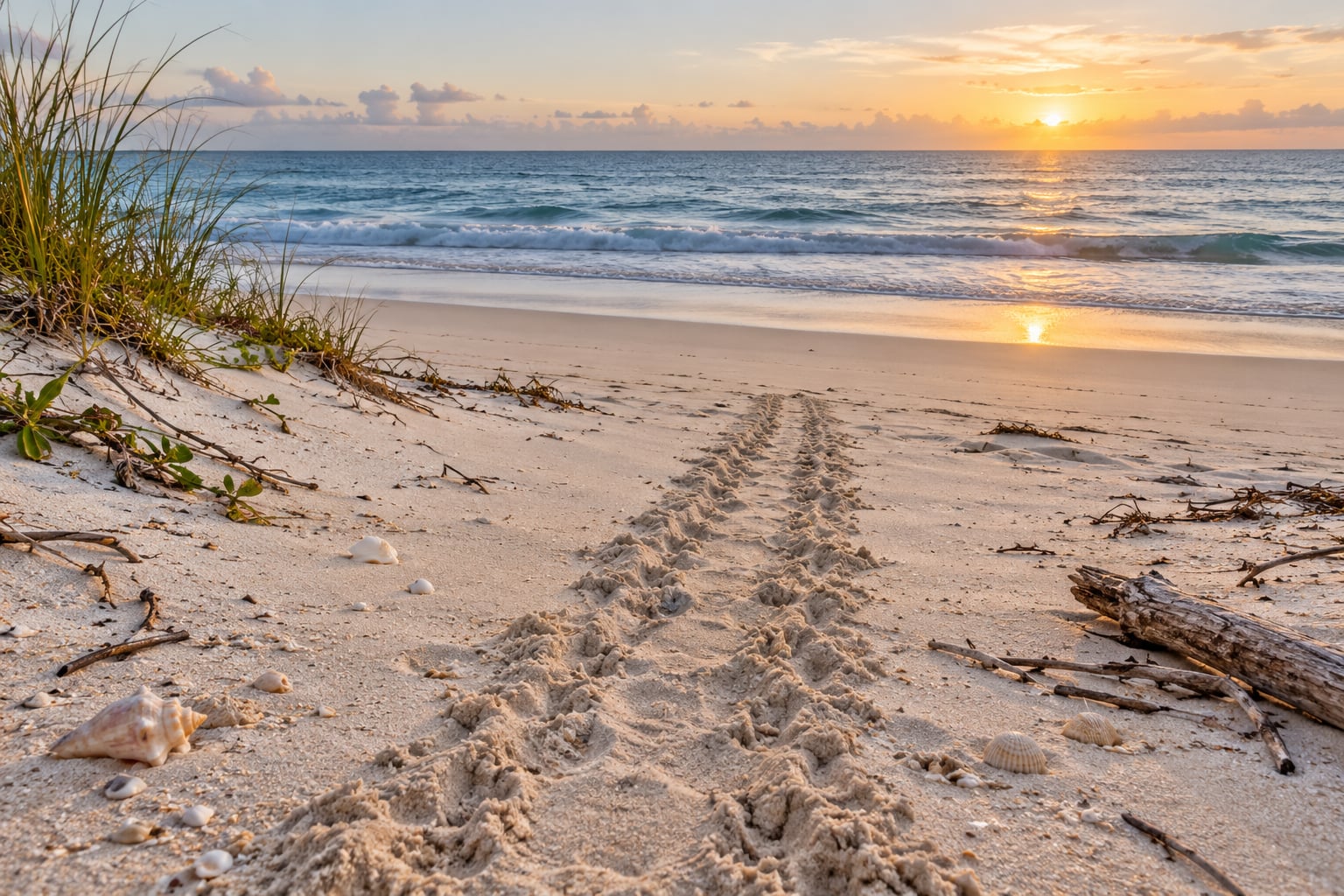
What is left behind is easier to misread. A body pit is a broad, shallow, sweeping depression about the width of a flipper, roughly the size of a small car, with a slightly raised loose mound of sand beside or behind it. A false crawl looks similar but has no mound and no egg chamber underneath.
Hatchling tracks are much smaller, a scatter of little flipper marks often heading in a straight line down to the water. A covered nest itself may look like untouched sand, which is the point: monitor crews find new nests by reading the tracks and the shape of the disturbed area, not by excavating.
Check with trained monitors rather than making your own call. If something looks wrong, the correct move is to protect the spot and tell the local authority.
How public beaches are monitored and protected
On nesting beaches, monitoring is a dawn routine. Crews walk the shoreline before sunrise, looking for new body pits, false crawls and hatchling tracks from the previous night, then map what they find. In South Florida that work is carried out by university teams and volunteers under a long-running coastal programme, and similar teams run on nesting beaches around the Mediterranean and the wider Atlantic.
A confirmed nest is normally marked with a stake and a small screen or sheet laid flat above it, so the location is obvious without the eggs being exposed. Depending on where the nest sits, crews may relocate it further up the beach before high water reaches it. After the hatchlings leave, the nest is sometimes exhumed so the empty shells and unhatched eggs can be counted, which is how survival figures for a beach and species are built.
Alongside physical protection, lighting is the other big management lever. Survey crews walk developed beaches at night to locate the fixtures that push bright light onto the sand, and the ones that keep properties close to a nesting beach face lighting rules, curfews or local ordinances.
Rules differ by country, beach and municipality, and the season window itself is a legal boundary rather than a biological one. Beaches usually stay open during nesting, with protection delivered through marking, signage and closures around marked nests rather than through shutting the whole shoreline.
What visitors should do when turtles are nesting
On a nesting beach, protect the animal, protect the sand, protect the dark, and put your rubbish in a bin. In practice that comes down to a short list, and most of it is closer to common sense than to law.
- Keep your distance. Around 50 feet, or roughly 15 metres, is the widely used buffer for nesting females and hatchlings. The same guidance gives shorebird flocks about 300 feet.
- Stay out of posted areas. Staked nests and marked Critical Wildlife Areas are off limits, even when the rest of the beach looks open.
- Use the low path. Walk on the firm wet sand below the high-tide line where you can. Nesting females choose the upper beach because the sand is firm and undisturbed, so your tracks cost her a site.
- No flashlights, no phone torches, no camera flashes. If you need light to walk at night, use a dim amber or red light, keep it pointed at the sand and keep it low. Some organised walks ban torches entirely, which tells you how seriously they take it.
- Fill in every hole. Sandcastles, deep footprints and buried buckets collapse into the shape of a nest, and a female that digs into somebody’s moat usually turns around and goes back to sea.
- Take furniture, toys, canoes, bicycles and umbrellas inland before dark. Anything left on the sand blocks a site and causes false crawls.
- Keep dogs off the sand or on a short leash. A loose dog will chase hatchlings, and it can also break up a nest.
- Carry your rubbish out. Food and rubbish draw raccoons, coyotes and stray dogs, which are the main egg predators on a monitored beach.
- Never touch, move or stand on a nest, and do not pick up hatchlings. If one is wandering, contact the local monitoring team.
What happens when hatchlings emerge at night?
Hatchlings usually emerge after dark, and the timing is not predictable to the minute. A nest may boil out in a single night, where dozens or more hatchlings come up together, or trickle out over several nights in smaller groups. Either way, the young spend a few hours in a loose group near the top of the beach, waiting for a wave that reaches high enough to carry them off.
Why hatchlings follow the brightest horizon
A hatchling’s route to the sea is simple and unforgiving: head toward the brightest, lowest part of the horizon. On a dark, undeveloped beach the sea is the brightest thing available, so the instinct works. Put a beachfront house, a pier or a floodlit promenade in the way and the hatchlings steer inland, into shadow, into vegetation, into dehydration and exhaustion.
This is why light rules are not about being considerate. Bright lighting discourages adult females from nesting in the first place, which means the damage happens before any egg exists. On top of that come barriers they cannot cross, stacks of beach furniture left overnight, and litter that blocks a wave from reaching a waiting group.
Where hatchlings are found wandering in the wrong direction, authorised teams may intervene. Visitors should not do it themselves: pick up a hatchling and you may be moving an animal away from water and into warmer sand.
What can visitors do to protect nesting turtles?
The science is settled on where human pressure shows up, and most of it is behavioural rather than political. Take your rubbish, including food scraps, to a bin rather than shovelling it under the sand. Bring the furniture in. Keep the sand you walk on low, compact and in the same place every day.
If you rent or own a beachfront property, treat your lighting as a nesting-season project rather than a night-time decoration problem. Use low, shielded fixtures mounted low and aimed down, prefer long-wavelength amber or red lamps over white, keep output dim, and close curtains and shutters so interior light does not spill onto the sand. In Florida, local ordinances go as far as restricting beachfront exterior lighting outright during the protection window, so check the rules for your own stretch of coast rather than assuming a general norm applies.
Support the people doing the counting. Volunteer survey walks, monitoring groups and university programmes depend on recurring pairs of eyes, and those are the same people who spot an eroding dune or a washed-out road before a whole clutch is lost. Cleanups count too, because a beach without food attracts fewer egg predators.
Share what you have seen, once. A single report of a turtle on the road, a nest washed out, or an injured animal is genuinely useful to a monitoring team. Twelve photographs of the same crawl from the same beach are not, and a crowd with bright red torches standing over a digging female can be the reason she abandons the nest altogether.
Frequently Asked Questions
Can visitors walk on a beach where sea turtles are nesting?
Usually yes, because most nesting beaches stay open. Protection comes from marked nests, posted boundaries, and how you use the sand. Walk on the low, firm beach below the high-tide line, keep out of staked nests and posted wildlife areas, and fill in holes. The upper beach is prime nesting habitat, so repeated traffic there causes females to abandon sites and turn them into false crawls.
Should a sea turtle nest be moved if it is close to a path or high-tide line?
No, not by you. Nest relocation is a job for trained monitors who know how to move a clutch without destroying the egg chamber and how to re-establish the right depth and temperature. Moving a nest on your own, or digging into it to check, will kill the eggs. If a nest looks exposed, protect the area, keep people off it and contact the local wildlife authority or monitoring team.
Why do hatchlings usually come out at night?
Night-time emergence reduces exposure to heat, dehydration and predators, and it works with their navigation: they head toward the brightest, lowest part of the horizon. On an undeveloped beach that is the sea. Artificial lighting turns the trick against them, sending hatchlings inland where they dry out and exhaust themselves. Emergence timing is not predictable, so nobody can tell you the hour in advance.
Can I use a flashlight to see a nesting turtle?
A bright torch can stop a female mid-dig and send her back to the sea without laying, and it will scatter hatchlings that are already out. If you need light on a nesting beach at night, use a dim amber or red light, keep it low and pointed at the sand, and keep your distance. Some organised turtle walks ban torches entirely, which is a useful hint about how much light the situation really does not need.
What should I do if I see a turtle crawling toward the sea?
Let it go, and give it room of about 15 metres. That crawl may be a female that has already laid, a male moving between females, a hatchling heading for the sea, or a false crawl with no eggs at all. Keep dogs away, keep children back, keep your light off, and do not lift or turn the animal around. If it is injured or heading the wrong way, contact the local wildlife authority.
How can I find out whether a local beach has a nesting season?
Ask the local authority rather than guessing from wildlife sightings. Town halls, regional wildlife agencies and the national fisheries service publish the protection window, overnight curfews and lighting rules for their beaches, because the dates and the rules are legal boundaries that differ from place to place. In Spain, the regional government and the ayuntamiento for that coastline publish the restrictions in force for each nesting beach.
What should you do first when you find a sea turtle?
Back off and give it space. Stay at least 15 metres away, keep dogs and children out of the picture, keep your phone light off, and let the animal finish whatever it started without an audience. Once you are clear of it, check the posted rules for that stretch of beach, because on a nesting beach the safe route and the legal hours are marked signs rather than good intentions.
Then tell somebody who can act. In Florida, the wildlife alert hotline is 1-888-404-FWCC, and the sea turtle emergency line run out of Nova Southeastern University is 954-328-0580. Elsewhere, contact the regional wildlife authority, the local town hall or the monitoring team that covers your beach. One clear report, made once, is worth more than a dozen flash photos.
That is the practical end of it. Understanding how sea turtle nesting seasons work is easy compared with what the turtles themselves do for a few dark hours on a beach that barely notices them, and every habit listed above costs a visitor almost nothing.