Removing a dam helps salmon and rivers because it undoes the physical changes that made the river unlike itself again. A reservoir flattens the current, traps the gravel, warms the water in the sun and cuts the river in half. Take the structure out and the channel, the spawning gravel and the cold, fast summer flows start coming back, which is why dam removal helps salmon at every life stage rather than only at the fish ladder.
That is a bigger lever than most people expect. Hatchery releases can add fish to a run without fixing the reason the run shrank. Removing the barrier fixes the reason, and the recovery shows up in fish counters, in temperature sensors and in the return of whole food webs.
Below is what actually changes, what it costs the river in the short term, and how planners decide whether removal is the right call. I have pulled the specifics from monitoring programs on the Klamath, Elwha and Sandy rivers, where the longest datasets exist.
Table of Contents
- Why Dam Removal Helps Salmon and Rivers
- Fish passage is restored
- The river gets its flow back
- Sediment moves again
- Water cools and oxygen rises
- Floodplains reconnect
- Why dam removal helps salmon and rivers more than hatchery releases
- How Dams Block Salmon Migration
- What Happens to Sediment and Water Flow
- Where the gravel actually goes
- What regulated flow does downstream
- Why warm water changes the chemistry
- How Removing a Dam Restores River Habitat
- The Difference Between Dam Removal and Fish Ladders
- What Happens During the First Years After Removal
- Is Dam Removal Good for Every River?
- Myths worth clearing up before you take a side
- How Communities Evaluate a Dam Removal Project
- The Main Benefits for Salmon and River Ecosystems
- Frequently Asked Questions
- Why did dam removal help Chinook salmon populations?
- Do dams affect salmon?
- What happens to a river when a dam is removed?
- Is dam removal good or bad for a river?
- Will salmon return after dam removal?
- How long does river recovery take after dam removal?
- Conclusion: Start with the River’s Biggest Barrier
Why Dam Removal Helps Salmon and Rivers
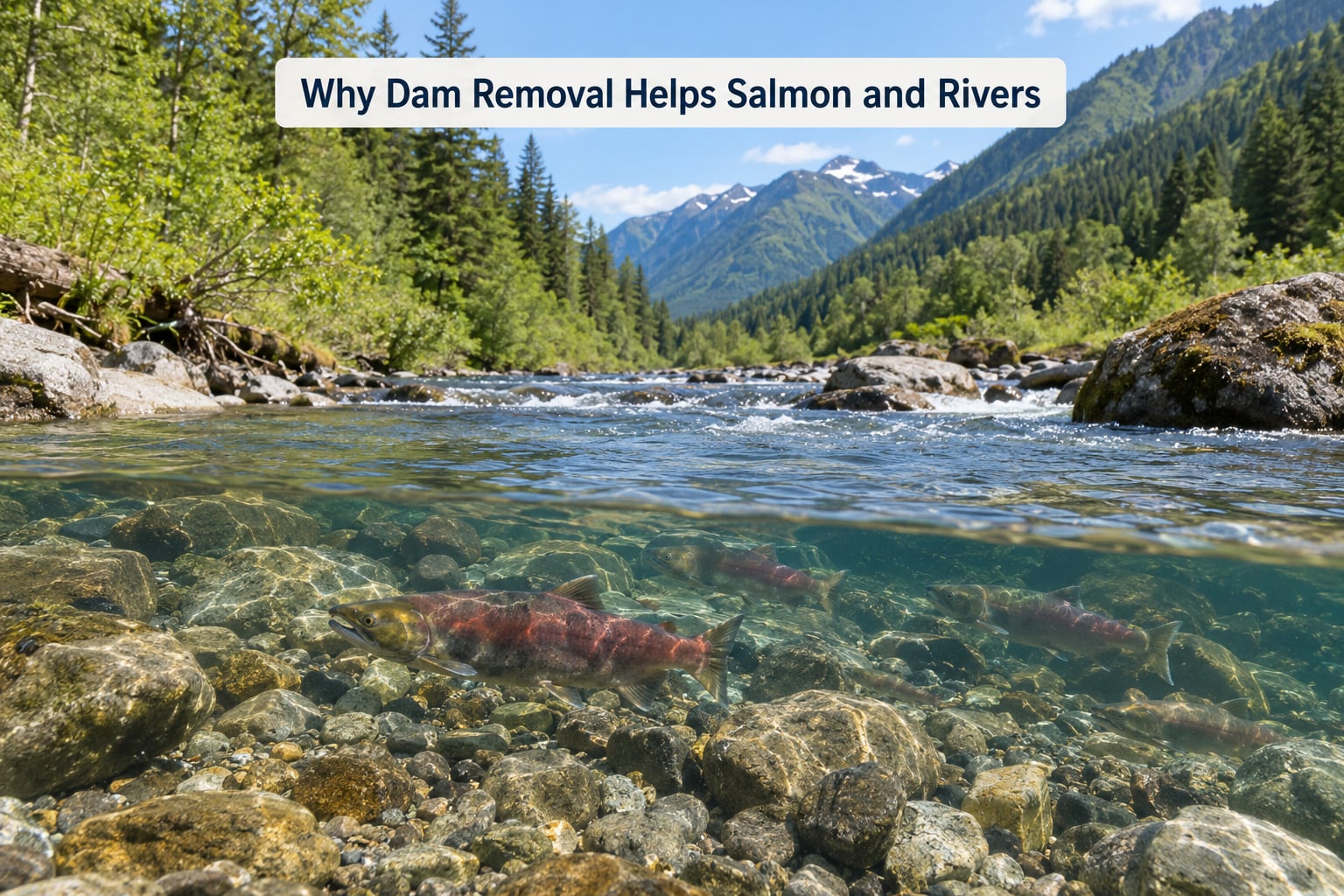
Five mechanisms do the work, and they reinforce each other.
Fish passage is restored
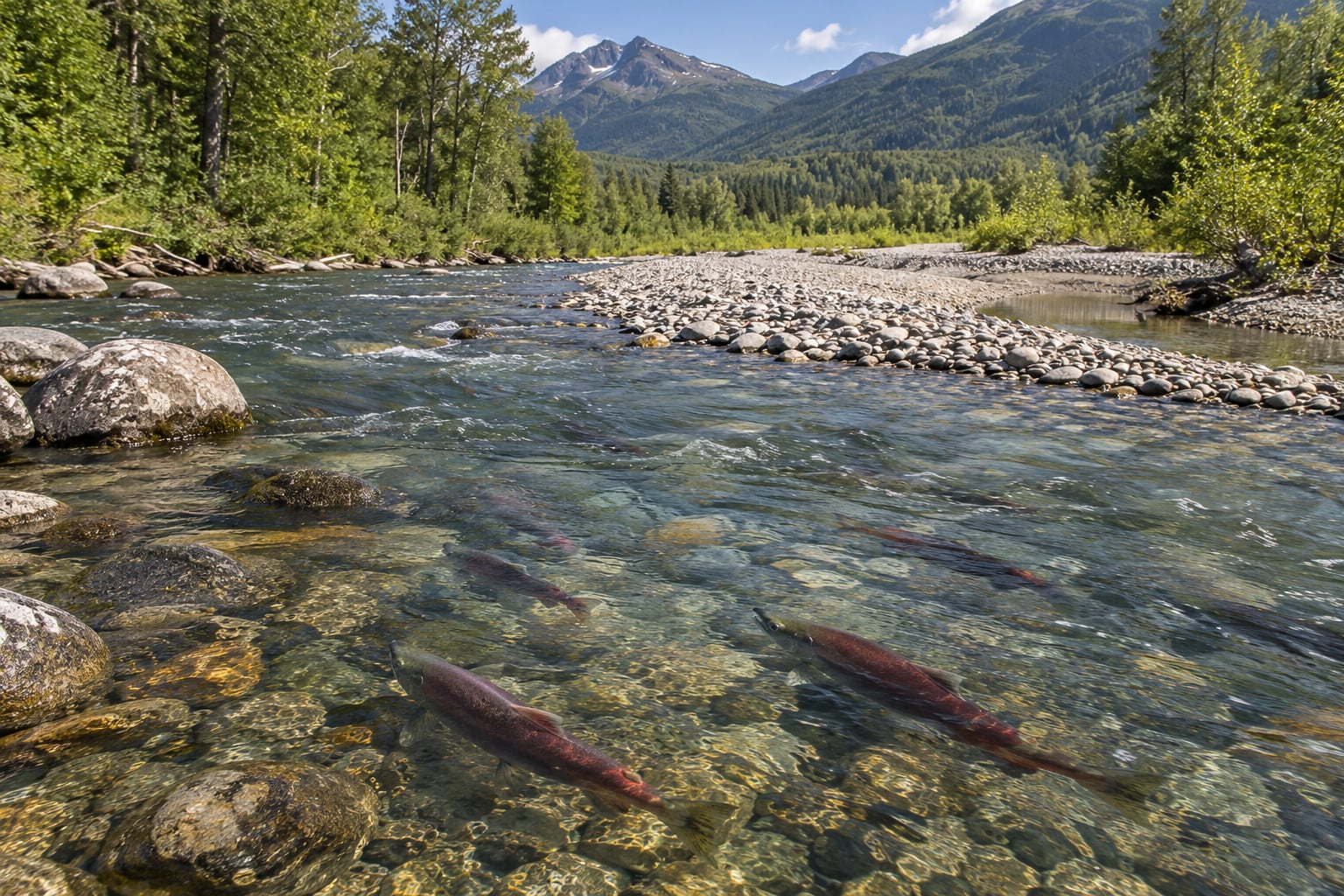
Salmon are anadromous: they hatch in fresh water, grow there, then migrate to the ocean and come back to spawn. A dam breaks that round trip at whichever barrier sits between the ocean and the spawning gravel. Remove the barrier and mature fish can reach habitat they have not used in a century, and juveniles can reach the estuary where they need to grow.
The river gets its flow back
A reservoir replaces a river’s pulse with a flat pool that rises and falls on a schedule set by operators. Free-flowing water means seasonal high flows that push gravel into place and low flows that hold water in the pools where juveniles shelter.
Sediment moves again
Reservoirs act as sediment sinks. Gravel, cobble and organic matter that a free-flowing river would carry downstream pile up behind the dam instead, leaving the reach below stripped. Once the dam is gone, that stored material works on the channel again.
Water cools and oxygen rises
Shallow river water warms in summer and cool tributaries moderate it. Deep reservoirs do the opposite: warm surface water is released to rivers below, sometimes above the threshold Chinook cannot tolerate. Free-flowing reaches also mix more readily, which keeps dissolved oxygen up.
Floodplains reconnect
With the impoundment gone, the river can spread onto its floodplain during high flows, cut side channels, drop large wood and rebuild gravel bars. Those features are nursery habitat, and they do not exist behind a dam.
Why dam removal helps salmon and rivers more than hatchery releases
Hatchery fish face the same water the wild fish face. If the gravel is gone, the water is too warm and the estuary is unreachable, extra juveniles die before they return. Removal changes the conditions rather than adding to a population that the conditions cannot support.
How Dams Block Salmon Migration
Salmon do not negotiate with concrete. A vertical drop of a few feet is enough; high dams are simply impassable, and even low ones are hard going because of currents, turbulence and the need to jump.
The damage compounds along the river. One barrier may remove only part of the historical range, but it removes it from the best spawning areas, which are usually the cold, high-gradient reaches with clean gravel. The runs that remain are squeezed into the few kilometres below the dam.
Fallback passages help, and they help more than sceptisers on forums assume. They also have limits worth stating plainly. Fish ladders and lifts are selective, they depend on maintenance and adequate river flow to work, and they only solve access. The pool above the dam stays a pool: no gravel, no side channels, no floodplain.
People who fish in these systems also point out something easy to miss. Juvenile fish die in passage systems, sometimes heavily in bad water years, so the structure that is supposed to be neutral is another source of mortality stacked on an already stressed run.
What Happens to Sediment and Water Flow
A free-flowing river is a conveyor belt. It picks up fine sediment and gravel where it has energy, carries them downstream and deposits them where the current slows. Dams interrupt that belt at both ends.
Where the gravel actually goes
Behind the dam, the reservoir slows the water until its load drops. Coarse gravel banks up near the upstream end, fine sediment settles throughout. Below the dam, the release is often clear and slow for the first few kilometres because it lacks the sediment load that built the reach in the first place.
That starved reach then behaves differently. Instead of rebuilding gravel bars, the channel often cuts down and narrows, and incision can undercut bridge abutments and banks. Projects plan for this, and most large removals now involve deliberate gravel placement and side-channel construction rather than waiting for nature to sort it out alone.
What regulated flow does downstream
Hatchery and irrigation releases also flatten the seasonal signal. Wild salmon evolved with spring freshets that push cold water and gravel through the system and with late-summer lows that concentrate fish in refuges. When the hydroduct is smoothed, both signals disappear.
Why warm water changes the chemistry
Warm water holds less oxygen, and slow warm pools with nutrient-rich inflow grow algae. On the Klamath, monitoring after the four lower dams came out found microcystin, the toxin produced by cyanobacteria, detected in 58 percent of samples before removal and undetectable in 82 percent of samples afterward. Algae blooms are a dam problem as much as a nutrient problem, because the impoundment is what creates the warm, slow, sunlit water they need.
How Removing a Dam Restores River Habitat
The gains show up in a predictable order, and the first one is the biggest: adult fish simply start arriving.
On the Sandy River, where the Marmot Dam came out in 2007 and Little Sandy a year later, a decade of monitoring by the Sandy River Basin Watershed Council and partners recorded Chinook up roughly 90 percent, coho up about 137 percent and steelhead up about 123 percent. Those are the kind of figures people expect from a decade of habitat work, not from a single structural change.
On the Elwha, removing the two lower dams after years of agitation reopened roughly 70 kilometres (43 miles) of river and let salmon past the former boundary of Olympic National Park. Fish that had been stuck below the dams worked their way upstream into tributaries that had been fishless for a generation.
The Klamath added the largest single data set yet. In the first season after the four lower dams were removed in 2024, crews using sonar, video weirs, boat surveys, telemetry and eDNA logged roughly 7,700 fish, about 96 percent of them Chinook, averaging around 588 fish a day. They also reported larger, older fish than the river had been producing, a side effect of cooler water and more feeding habitat.
The rest of the recovery is slower and quieter: gravel bars reappearing, side channels wetting for longer each spring, willows colonising the new bank, insect communities filling in, and lamprey and other native species returning ahead of the salmon.
The Difference Between Dam Removal and Fish Ladders
Both approaches open a barrier. They solve different problems, and the honest comparison is not fish ladder good, fish ladder bad.
| Approach | What it restores | What it does not restore | Best fit |
|---|---|---|---|
| Dam removal | Passage, sediment transport, natural flows, temperature, floodplain connection, gravel habitat | Nothing structural, but the reach may take years to stabilise and sediment release can spike turbidity | Obsolete dams, small or failing structures, licensed hydropower reaching licence end |
| Fish ladder or lift | Upstream and downstream passage for several species | Gravel supply, floodplain connection, flow regime, water temperature below the dam | Large dams that also provide water storage or power and must stay in place |
| Trap-and-haul or barging | Numbers of juveniles past a barrier temporarily | The lifecycle, the habitat and the cumulative effect of transporting tens of millions of fish | Very short term bridging while a permanent solution is built |
| Do nothing | No immediate disturbance | Everything the barrier causes, compounded over decades | Only where a dam has no measurable effect on the reach above it |
Read that table and the argument gets clearer. Passage infrastructure solves a gate problem. Removal solves a river problem, which is larger and takes longer.
There is also the accumulation effect. Passing a fish through a ladder at one dam does not help it at the next, and each passage system carries its own entrainment risk at a turbine. On a river with eight dams, removing the one that sits below the historic spawning reach can be worth more than upgrading all eight ladders.
What Happens During the First Years After Removal
Nobody involved describes the first years as smooth, and the sequence matters more than the dates.
Year one. The reservoir drains and the stored sediment moves. For weeks or months the reach below can run turbid, and project teams monitor fish and benthos through it. Vegetation that had been underwater for decades starts to die back, and the riverbed is exposed. Adult salmon move in almost immediately, because they do not need a settled channel, only water.
Years two to three. The channel begins organising. Gravel spreads, bars form, and the first planted or natural willow and alder take hold. In the Klamath, crews described a visibly calmer river and a rising fish count within this window.
Years three to five. Insect and invertebrate communities rebuild, which means better feeding conditions for juvenile salmon. Off-channel channels and pools start holding water later into the dry season.
Years five to ten. This is when population data becomes meaningful. The Sandy River’s decade of monitoring is the clearest published example of what the curve looks like once roughly two and a half salmon generations have passed.
Beyond ten years. Riparian forest matures, large wood structures create the pools that hold juvenile salmon through winter, and sediment supply reaches a steadier balance. Some reaches take decades rather than years to fully re-form, and a few never fully recover if the watershed above them is still degraded.
Is Dam Removal Good for Every River?
No, and anyone who says otherwise is selling something. Removal is the right tool for some barriers and the wrong tool for others, which is why the honest literature includes caveats.
Short-term turbidity is real. The sediment pulse released when a reservoir drains can smother redds in the reach below if the timing is wrong, and the biological data gathered in the first years is the least comfortable part of the record. Large modern projects deal with it by drawing the reservoir down slowly, managing the sediment deliberately and monitoring the affected reach rather than hoping.
Invasive species are a legitimate concern on some systems. Reopening a reach can give non-native fish access to habitat that was previously inaccessible, and the Elwha’s post-removal record includes attention to predation and invasive monitoring as well as recovery.
Water supply and flood control are deal-breakers in specific places. Where a reservoir provides municipal drinking water or regulates a floodplain downstream, removal may not be viable at all. The honest counter to claims that dams prevent all flooding is narrower: many older dams are not designed to provide meaningful flood control and were never relied on for it.
Myths worth clearing up before you take a side
Myth: removing dams means losing clean electricity with no replacement. Some removed dams produced little power. Capacity figures quoted for dam complexes are nameplate, and average output is far lower. Replacement is site-specific, and for a handful of large hydro projects the replacement question is genuinely unsettled, which is a fair thing for sceptics to press on.
Myth: removal floods the valley. What a dam already holds back, it eventually releases. Removing it returns the river to the hydrology the valley evolved with.
Myth: fish ladders solve the problem. Passage helps, but it leaves the reservoir, the temperature regime and the missing gravel in place.
Myth: trucking fish around dams is a solution. It moves juveniles past a barrier in a truck for one season. It does not rebuild a habitat, and the cost scales with the number of fish.
How Communities Evaluate a Dam Removal Project
Most removals start with a licence, a safety problem or a sediment-surplus finding rather than with an ecologist’s idea. The process usually looks like this.
Assess the dam. Engineers document structure condition, reservoir sediment volume, downstream channel stability and what the barrier actually blocks. They also check whether the dam still performs the function it was built for, since an expired licence and an unsafe structure are the two most common reasons a removal becomes unavoidable.
Consult the people affected. Tribes with treaty fishing rights, downstream water users, landowners, anglers and local governments all have a stake, and projects that skip this step tend to stall. The Klamath removals and the Sandy River project both involved dozens of organisations in the planning stages.
Model the sediment and the flows. Teams estimate how much material will move, over what period, and where it will settle. Regulators usually require a plan for turbidity limits, for fish rescue where pools will be stranded, and for channel work in the reach below.
Remove the structure and monitor. Fish crews count adults at fixed sites, juvenile sampling targets the reaches above the former barrier, and water quality stations track temperature, dissolved oxygen and turbidity. Most programmes run for at least a decade, because a single season tells you very little.
The Main Benefits for Salmon and River Ecosystems
Some of these show up in the first year or two. Most take a decade or more. Knowing which is which keeps expectations honest.
Within the first few years:
- Adult salmon return to habitat above the former barrier
- Warm surface releases disappear as the river stratifies naturally
- Algal blooms decline, as seen on the Klamath where microcystin dropped out of most samples
- Bank erosion and stagnant pools give way to a moving channel
- Juveniles reach estuary habitat without transport trucks
Over a decade or longer:
- Spawning gravel rebuilds into bars, crests and pockets
- Side channels and off-channel pools return as spring freshets spread out
- Large wood accumulates and forms the pools juveniles overwinter in
- Riparian shade and bank vegetation recover
- Insect, bird and mammal communities rebuild around a living river
- Water temperature drops far enough that larger, older fish are produced, as monitoring on the Klamath has already reported
Frequently Asked Questions
Why did dam removal help Chinook salmon populations?
Chinook were limited by habitat they could not reach, not by a shortage of fish. Removing the barrier gave them cold, gravel-bottomed spawning areas that hatchery programs cannot create, restored natural flows and summer temperatures, and cut mortality at the passage structures themselves. On the Sandy River, a decade of monitoring after the Marmot and Little Sandy dams came out recorded Chinook up about 90 percent.
Do dams affect salmon?
Yes, in several ways at once. Dams block migration routes, trap the gravel salmon need to spawn on, replace seasonal flows with a flat pool, and release warm surface water that Chinook cannot tolerate. Slow warm water also holds less oxygen and grows the algae that produce toxins. Even a well-run fish ladder addresses only the first of those problems.
What happens to a river when a dam is removed?
The reservoir drains, and the sediment stored behind it releases into the reach below, often raising turbidity for weeks or months. The channel then begins to rebuild: gravel spreads into bars, banks erode and reform, and vegetation colonises the exposed margin. Adult salmon usually arrive within the first season, and the channel tends to settle into a new balance over several years.
Is dam removal good or bad for a river?
It depends on the barrier and the river. Removal is a strong option for obsolete, unsafe or sediment-surplus dams with no remaining water-supply or flood-control function. It is usually the wrong call where a reservoir provides drinking water or meaningful flood regulation, and it can be complicated where non-native predators would gain access. The first year carries real short-term disturbance, mostly from sediment.
Will salmon return after dam removal?
In most documented cases, yes, and often faster than expected. Fish appear upstream in the first season because the habitat above the barrier still exists. Establishing a self-sustaining run takes longer, since it depends on gravel rebuilding, water temperature staying low through spawning season, and enough years of adult returns to replace what is taken. Decade-long monitoring, not a single season, is the fair test.
How long does river recovery take after dam removal?
Think in stages rather than a single finish line. Fish passage returns within months, channel and gravel adjustment over three to five years, and cold-water refuge and side-channel habitat over roughly a decade. Population trends become readable after around ten years, which is when two to three salmon generations have passed. Riparian forest and full channel maturity take considerably longer.
Conclusion: Start with the River’s Biggest Barrier
The reason dam removal helps salmon and rivers is that it restores processes, not just access. Gravel moves again, summer water cools, floodplains wet and side channels open, and every one of those things feeds a salmon at some point in its life.
None of that comes with a clean bill of health. The first year brings a sediment pulse and real disturbance, and some rivers depend on their reservoirs for flood control or water supply. What the monitoring on the Klamath, Elwha and Sandy shows is that where the case for removal is genuinely strong, the ecological return is large and it is still growing ten years later.
If you want to do something useful, start narrow: find the barrier on your river that sits between the ocean and the best remaining spawning gravel, and look at what that specific structure is still doing for anyone. If the honest answer is nothing, you have found your project.