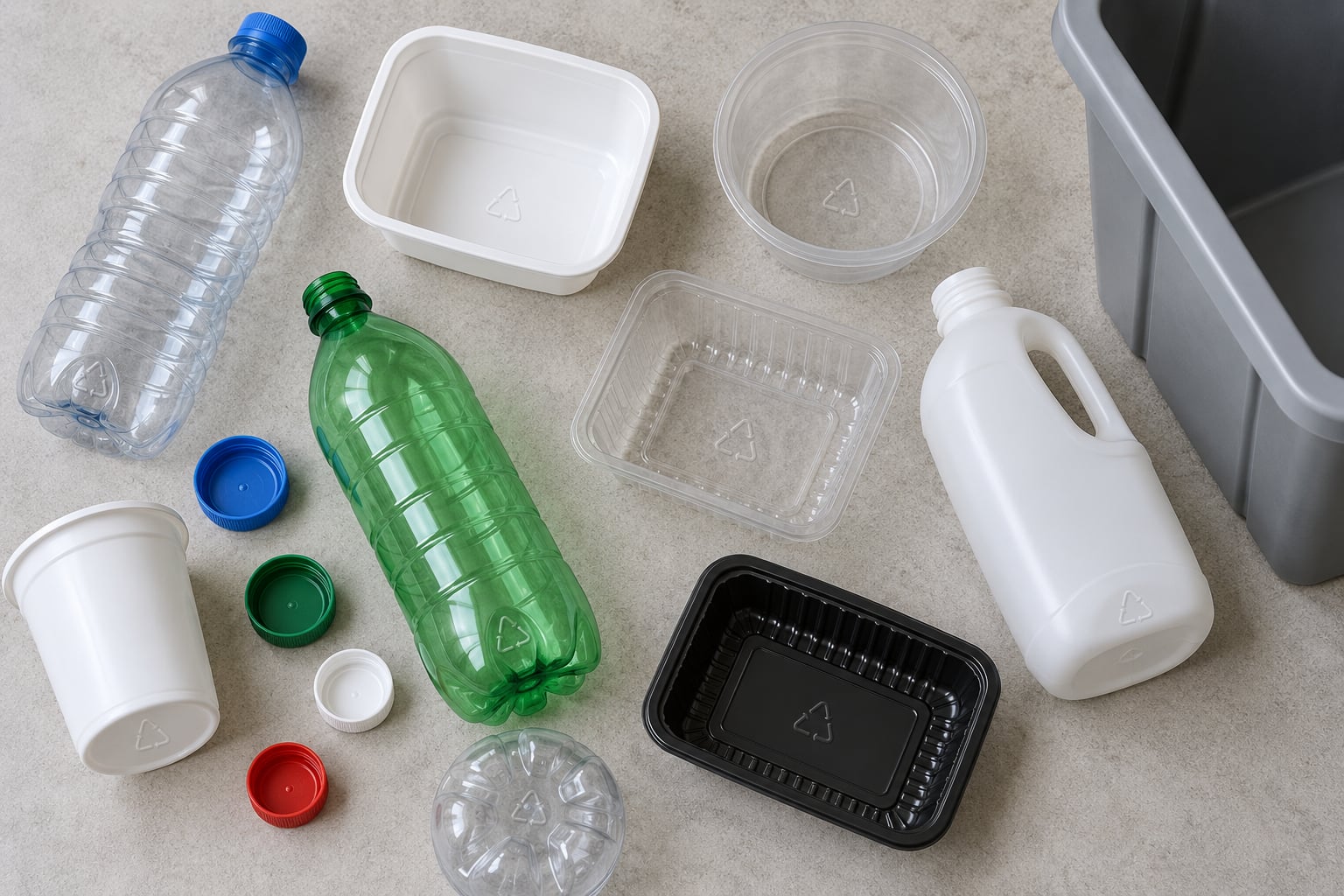
The numbers moulded into plastic are a resin identification code. They tell you which polymer an item is made from, and they say nothing about whether your recycling service accepts it. When you see a percentage instead, it refers to recycled content in the packaging, not to how much of it will be recycled.
The triangle that surrounds those numbers is also not what most people assume. It looks a lot like the recycling symbol, which is exactly why the confusion sticks around.
Table of Contents
- What the Recycling Numbers on Plastic Actually Mean
- How the resin identification number works
- What each number means at a glance
- What the percentage number means
- What the recycling triangle does and does not promise
- Why the same number can behave differently
- Which plastic numbers are most commonly accepted in Spain
- How to check and sort a plastic item
- Frequently Asked Questions
- Does recycling number 1 mean the plastic is always recyclable?
- Is the number inside the recycling triangle a recycling percentage?
- Why can two products with the same plastic number have different disposal instructions?
- Are plastic containers marked with a Green Dot accepted in household recycling?
- What should I do with multilayer plastic packaging that cannot be separated?
- Start With the Label, Then Check Local Rules
What the Recycling Numbers on Plastic Actually Mean
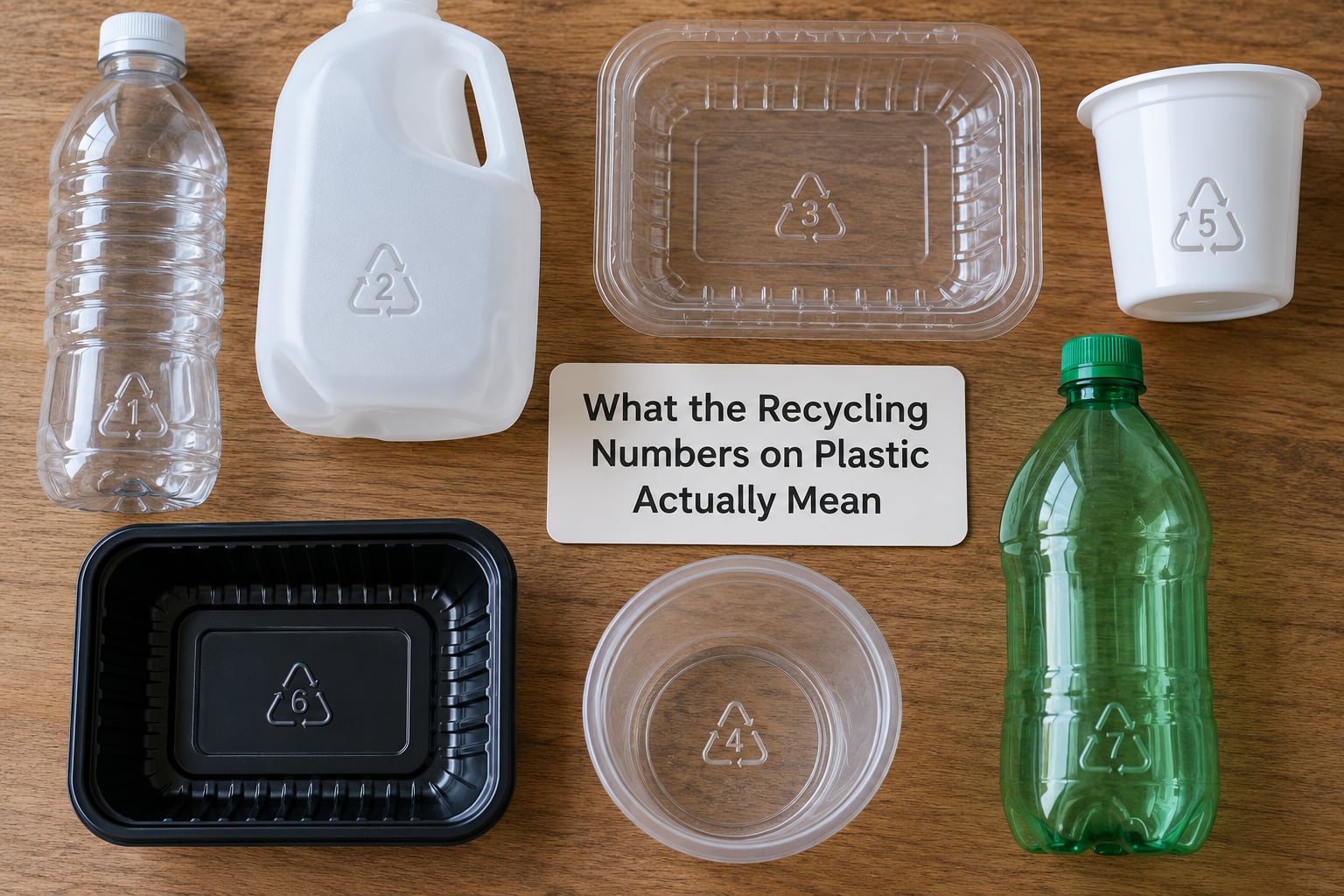
The digit inside the triangle identifies the plastic family, the letters name the polymer, and the surrounding mark tells you who set the standard. None of it tells you where the item should go. That decision belongs to the collection rules of the town you live in, the equipment installed at your sorting facility and the condition of the item in your hand.
Read the mark as a description of a material, not as a permission slip.
Myth: the triangle means the item can go in my recycling bin.
Fact: the triangle is a material identification mark used by the plastics industry since 1988. It is visually similar to the Mobius loop recycling symbol, but it is a different mark with a different purpose, and it carries no promise about local acceptance.
That distinction matters in ordinary kitchens across Spain. People rinse a yoghurt pot, drop it in the yellow bin and assume they have done the right thing, while the code on the base is doing its real job: describing a polymer to whoever sorts the load later.
How the resin identification number works
The Society of the Plastics Industry introduced this code in 1988 in the United States, when bottles were becoming the dominant packaging and recyclers needed one shared shorthand for six polymers that all melt at different temperatures. Later standardisation work turned it into ISO 16288 for Europe and ASTM D7611 in the United States, which is why the same digits appear worldwide.
Manufacturers emboss the code into moulds, so it shows up on the base of a bottle, the back of a tray or the underside of a cap. You will find an acronym next to it, such as PET, HDPE or PP, which is the short form of the chemical name.
Plastics split into two families. Thermoplastics soften when heated and can be remelted into new products. Thermosets, used in things such as melamine tableware and some electrical parts, cannot be remelted at all, so they can never enter a recycling loop. That single difference explains why some items stamped with the same digit have completely different futures.
What each number means at a glance
Here is the reference chart most people are looking for. Each row gives the number as moulded on the item, the plastic name and acronym, the household objects you will recognise, and what tends to happen to that material in a kerbside packaging stream.
| Number | Plastic name | Acronym | Common examples | Usually recycled? |
|---|---|---|---|---|
| 1 | Polyethylene terephthalate | PET or PETE | Water and soft drink bottles, salad and ready-meal trays | Yes, in most kerbside packaging streams |
| 2 | High-density polyethylene | HDPE | Milk and juice jugs, detergent, shampoo and bleach bottles | Yes, widely accepted |
| 3 | Polyvinyl chloride | PVC or V | Blister packs, cosmetic tubes, window frames and drain pipes | Rarely in household bins |
| 4 | Low-density polyethylene | LDPE | Shopping bags, bin liners, bread bags, squeeze bottles | No in household bins, check drop-off points |
| 5 | Polypropylene | PP | Bottle caps, yoghurt pots, takeaway tubs, straws | Varies by collection |
| 6 | Polystyrene | PS | Foam cups and trays, egg boxes, rigid CD and DVD cases | Rarely |
| 7 | Other | OTHER | Polycarbonate, acrylic, nylon, ABS, compostable PLA | No, keep compostables out of recycling |
A note on the numbers people misread most. Code 3 is unusual among rigid packaging because it contains chlorine, and burning PVC releases hydrogen chloride and dioxins, which is one reason local schemes exclude it. Code 7 is a catch-all rather than a material, and compostable plastics marked 7 behave badly when they land in a recycling stream.
What the percentage number means
A percentage on plastic packaging refers to recycled content. When a bottle says it is made from 50% recycled plastic, that describes roughly half of the plastic in the package by mass, produced from material that was already used once.
It does not mean half of the package will be recycled, and it does not mean the item is easy to recycle. The two ideas get mixed up constantly because the percentage often sits inside the same triangle, so it looks like a more emphatic version of the resin code.
You will mostly encounter these figures on flexible packaging, such as supermarket carrier bags, where recycled plastic has been used for years. Some marks show a percentage alongside a loop of arrows, which indicates recycled material in a similar way.
Everything else about the marking still applies. A recycled-content percentage sits alongside the resin code, it never replaces it, and it never tells you where the item belongs once you are finished with it.
What the recycling triangle does and does not promise
The chasing arrows triangle identifies material. It never guarantees collection, and it never guarantees that a recycling plant in your region will handle what you put in the bin. Since no universal not-recyclable symbol exists, an item carrying the triangle can still be refused locally.
Other marks answer different questions, and mixing them up is the root of most of the doubt you see in recycling discussions.
- Green Dot: the manufacturer pays into a packaging recovery scheme. It says nothing about the material or about your council’s rules.
- The tidyman figure: a disposal instruction meaning put the item in the bin, usually the residual bin, rather than littering.
- The loop of arrows on its own: a recycled-content or recyclable-material claim in some systems, without identifying which plastic it is.
- Labelled recycling marks from the UK and Australia: specific schemes such as OPRL and ARL do give real instructions, usually a phrase like recycle with caps on, or check locally.
- Compostable logos: a seedling mark usually points to industrial composting, and a separate home-compostable mark is needed for garden compost. Neither belongs in a recycling bin.
- Deposit scheme marks: tell you the container can be returned to a shop for a refund.
If a package carries none of these, nobody has claimed anything. In practice that often means a laminate or a material with no recovery route, which is useful information in itself.
Why the same number can behave differently
Two PET shampoo bottles with the same 1 can end up in completely different places. Colour and pigment come first, since some dark and black plastics carry colourants that make the recovered material useless in its previous market. Additives such as flame retardants and ultraviolet stabilisers can do the same.
Shape and size come next. Modern facilities in Spain and elsewhere run optical and near-infrared sorting equipment that reads material from the surface, so the moulded digit has become a human-readable backup rather than the deciding technology. A small rigid tub passes through the machinery; a crumpled bag wraps around a screen and jams it.
Construction is the third factor. A bottle with a sleeve label and a cap is not one object but three materials, and each component needs its own route. Multi-layer laminates such as pouches and sachets combine plastic with foil or paper in a bond that no separation machine can undo.
Contamination is the fourth. Food residue, liquid and the wrong polymer in the same load all reduce the value of a bale, and one bag of the wrong material can push a whole collection towards landfill or incineration. Global estimates from the OECD Global Plastics Outlook put plastic recycling worldwide at roughly 9% of plastic waste, which is why getting the bin right matters more than the digit.
This is exactly why local authorities often tell households to judge by shape rather than by number. Rigid bottles, jugs and tubs are usually fine. Film, bags, foam and black trays are usually not.
Which plastic numbers are most commonly accepted in Spain
Spain’s national container system gives you four streams, and plastics belong mostly in one of them. Yellow takes packaging, which includes plastic bottles, jugs, tubs and their caps. Blue takes paper and cardboard. Green takes glass, and brown takes organic waste.
In practice, codes 1 and 2 are the reliable ones. PET bottles and HDPE milk or detergent jugs are the backbone of every Spanish packaging stream. Code 5, polypropylene, is accepted in many municipalities because caps and yoghurt tubs arrive in volume, though some councils still exclude it.
Codes 4 and 6 are where households are most often told no. LDPE film and polystyrene foam stretch around sorting equipment rather than falling through it, so both usually go to a supermarket collection point or a punto limpio, where they exist. Code 3 and code 7 are effectively absent from household streams, and compostable items belong in organic waste only when the local service accepts industrial compostables.
Municipalities decide the detail inside the national framework, so rules genuinely differ between one town and the next, and they change. Before you rely on any list, check the website of your ayuntamiento or the mancomunidad that collects in your municipality.
How to check and sort a plastic item
Five steps cover almost every container that lands in your kitchen.
- Find the mark. Check the base, the underside of the lid, the back panel or the cap.
- Read number and acronym together. The digit names the family and the letters confirm it, which helps when a label has rubbed off.
- Judge the shape. Rigid containers are usually accepted, film and foam usually are not.
- Empty, rinse and close. A clean container with the cap back on sorts far better than a half-full one.
- Confirm acceptance locally. If your municipality does not publish a plastic list, ask them before you assume.
A few habits cover most of the rest.
Do separate caps from bottles when your municipality asks for it, and do put the whole rigid bottle in the bin rather than the label alone. Do keep cardboard sleeves off plastic pots so both streams stay clean.
Do not put recycling inside a plastic bag, since the bag jams the machinery before anyone reaches the bottle. Do not wash items aggressively, a quick rinse is enough. Do not assume a compostable pot can enter the yellow bin just because it looks like plastic.
On Reddit, the recurring practical advice in recycling discussions matches this: empty and rinse, keep the cap on, leave labels alone, and never bag your recycling. The number matters less to the plant than these small habits.
Frequently Asked Questions
Does recycling number 1 mean the plastic is always recyclable?
No. A 1 means the item is made from PET or PETE, a thermoplastic that is widely recycled and usually accepted in kerbside packaging streams across Spain and the EU. But the code describes the material, not your service: shape, colour, size and local rules still decide acceptance. An opaque black PET tray or an oversized bottle can be rejected even though the 1 is correct.
Is the number inside the recycling triangle a recycling percentage?
No, it is a resin identification number from 1 to 7 and it names the polymer. A percentage is a separate mark. When packaging shows something like 50% recycled inside the triangle, that figure describes how much of the plastic in the package, by mass, was made from recycled material. It says nothing about recyclability and nothing about what happens to the item after you bin it.
Why can two products with the same plastic number have different disposal instructions?
Because the code describes only the polymer. Disposal depends on colour and pigment, size, additives, whether the item is a laminate, and which equipment your local sorting facility runs. A rigid clear PET bottle and an opaque black PET tray both carry a 1, yet the tray may hold plastic the plant cannot use. Check the item in your hand, not just its digit.
Are plastic containers marked with a Green Dot accepted in household recycling?
The Green Dot tells you the manufacturer contributes financially to a packaging recovery scheme. It is not a material mark, it does not say the container is recyclable, and it does not mean your council accepts it. Plenty of containers sold in Spain carry the Green Dot whether or not the plastic suits your local stream, so treat it as a hint about who pays rather than an instruction to bin it.
What should I do with multilayer plastic packaging that cannot be separated?
Separate whatever you can: caps onto bottles, cardboard sleeves off, shrink wrap away from rigid trays. What remains, especially pouches, sachets and blister packs combining foil, paper and plastic, has no use in a packaging sorting line. In Spain these generally go to the residual bin, while clean hard film can go to supermarket collection points or a punto limpio that accepts it.
Start With the Label, Then Check Local Rules
Use the number for what it is: identifying the resin, so you can learn something useful about the object in your hand. Ignore it as an instruction. Before anything reaches the bin, empty it, give it a quick rinse, put the cap back on and confirm with your municipality which plastics the local stream takes. When you have a choice between two marks, trust the one that gives disposal instructions over the one that only names a material.