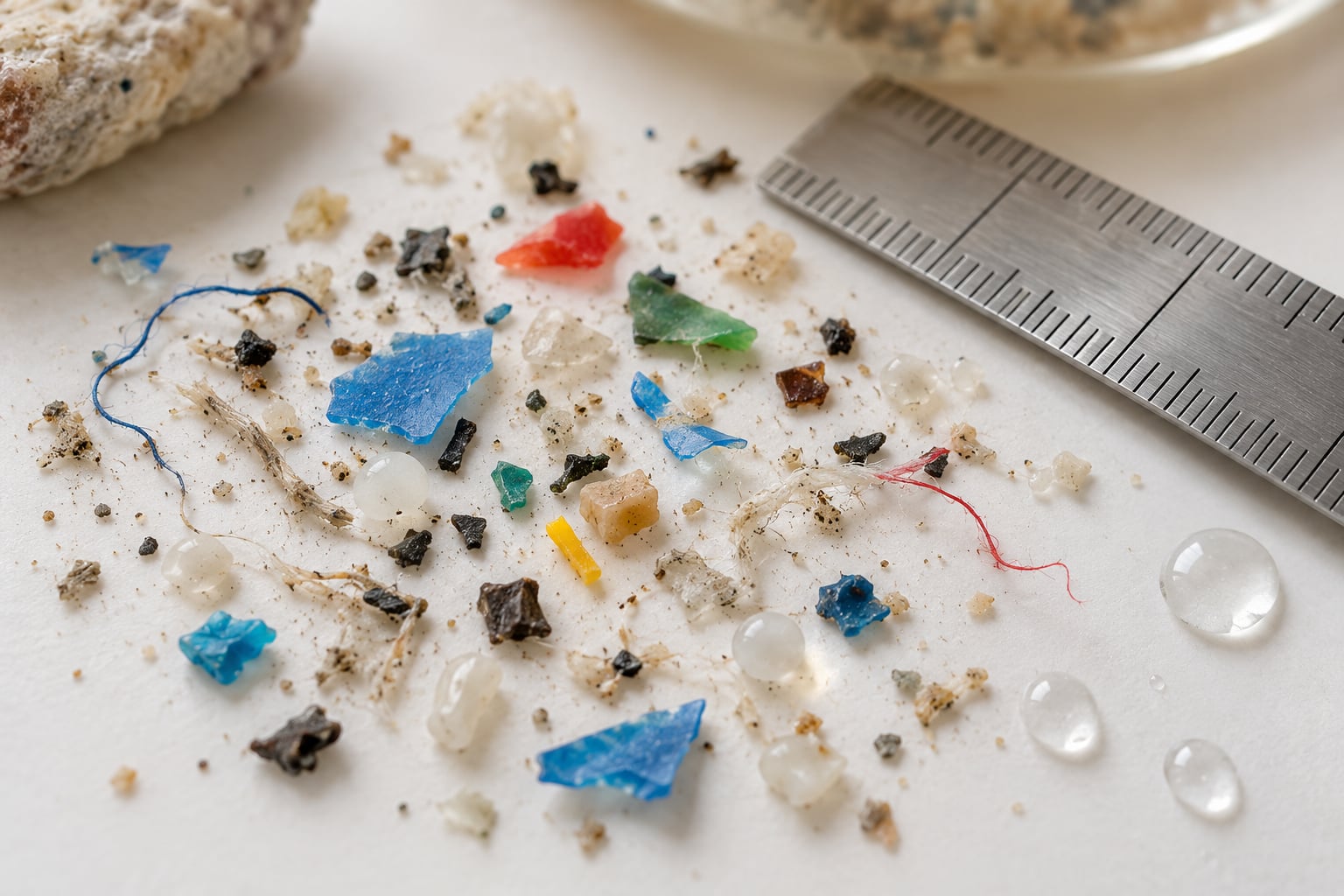
Microplastics are in almost everything now because plastic does not decompose. It breaks into smaller and smaller pieces under sunlight, heat, friction and abrasion, and those pieces are carried by wind, water, food chains and household dust into drinking water, food, air and living tissue. Once dispersed, there is no practical way to filter them back out of the environment.
The important nuance is that this is not a story about a handful of obvious offenders. Researchers have found these particles in sea salt, honey, tap water, rainwater, soil, Arctic snow, mountain peaks, human blood, lung tissue, placentas and breast milk. The source is often something you handled for five minutes that morning.
So the answer to why are there microplastics everywhere has two halves. The first is a property of the material itself: plastic is built to last, which means it does not break down the way wood, cloth or paper does. The second is where we put it. We have spent five decades making and using an enormous volume of cheap plastic for things we use once and throw away, and most of that plastic was never designed to be recycled.
This article walks through where the particles come from, how they travel, what the health evidence actually supports, and which steps make a measurable difference.
Table of Contents
- What Are Microplastics and Why Are They Everywhere?
- How Do Microplastics Get Into the Environment?
- Why microplastics end up in almost everything now
- Which Everyday Products and Activities Release Them?
- Well-established sources
- Sources that are often overstated
- How Do Microplastics Reach Food, Water and the Air?
- What Health Effects Are Known?
- What is reasonably well supported
- What is plausible but still under study
- How Can You Reduce Your Exposure?
- At home
- Beyond your kitchen
- Frequently Asked Questions
- Are microplastics in drinking water everywhere?
- How do microplastics get into the human body?
- Do plastic bottles contain microplastics when they are unopened?
- Can a home water filter remove microplastics?
- Are synthetic clothing and car tires major sources?
- What can governments and companies do to reduce microplastic pollution?
- The First Step to Reduce Your Exposure
What Are Microplastics and Why Are They Everywhere?
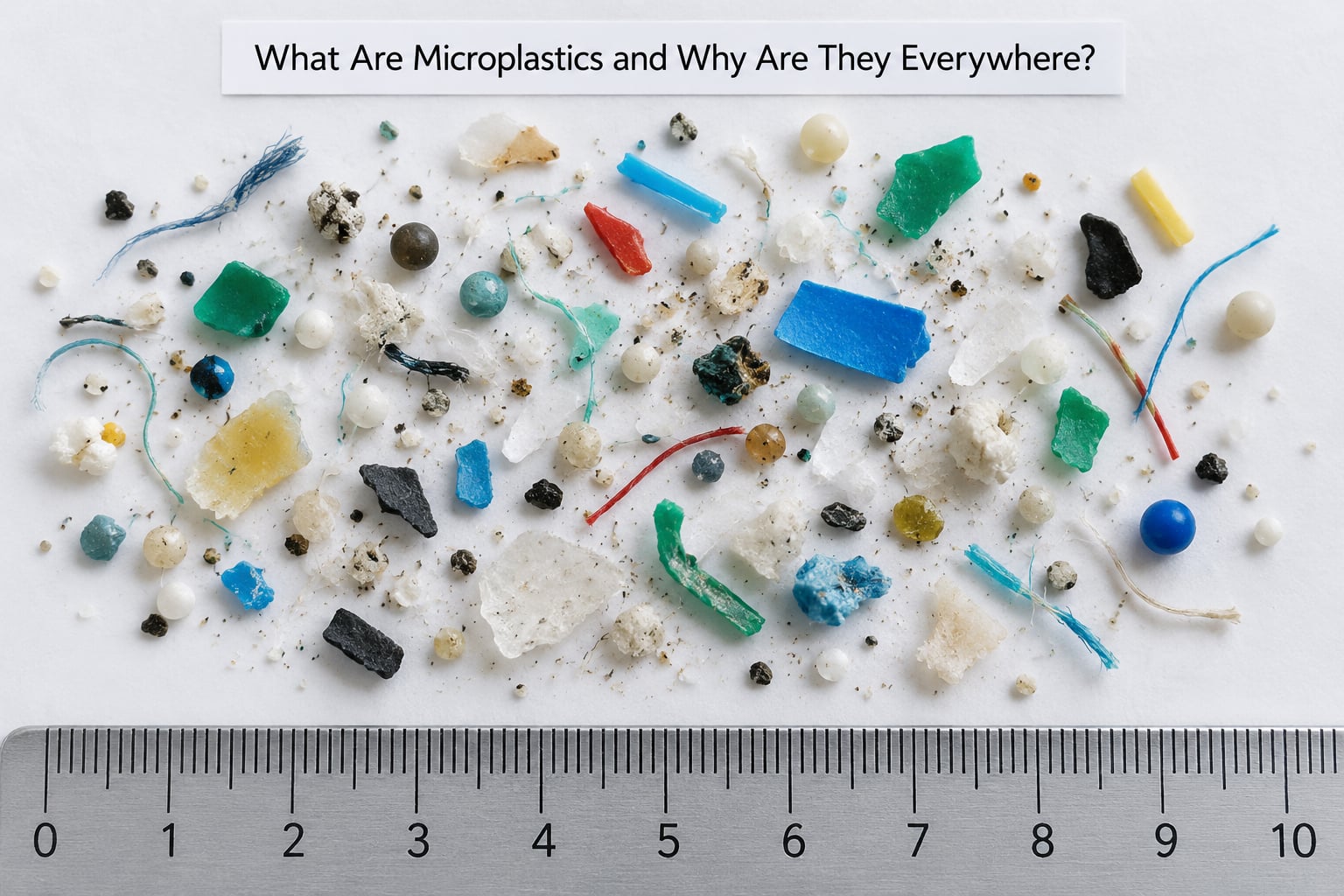
A microplastic is any plastic particle smaller than 5 millimetres, about the size of a sesame seed or smaller. Below roughly 1 micrometre, researchers use the separate term nanoplastic, and that smaller class is harder to detect because standard filters and spectroscopy methods were not built for it.
Microplastics come in two families. Primary microplastics are manufactured at small size and used directly, such as microbeads in rinse-off cosmetics and plastic pellets spilled during shipping. Secondary microplastics are fragments of larger plastic items that broke apart, which is the vast majority of what people mean when they say microplastics.
| Type | How it forms | Everyday examples | Avoidable at home? |
|---|---|---|---|
| Primary | Made small on purpose | Microbeads in scrubs, industrial plastic pellets, glitter fragments | Mostly yes, by reading labels |
| Secondary | Large plastic fragments under UV light, heat and abrasion | Packaging, bottles, synthetic clothing fibres, tyre and brake wear | Partly, through consumption and material choices |
| Microfibre | Thread-scale fibres shed from fabric or rope | Polyester, nylon, acrylic garments, carpet, fleece | Yes, largely, by choosing natural fibres |
| Nanoplastic | Particles below 1 micrometre, often absorbed onto larger ones | Not visible; measured in bottled water and bottled fish | No |
Two details make the ubiquity easy to understand. First, weathering accelerates as particles get smaller, so a bottle degrading in a river does not stop at gravel-sized shards; it keeps producing finer grains that wash further. Second, plastic carries chemical additives, and researchers at the World Health Organization note that more than 16,000 chemicals can be used across plastic production, many of them bound into the polymer rather than sitting on the surface.
That combination, permanence plus chemical cargo, is what worries researchers. The particle itself is an inert speck of polyethylene or polypropylene. What travels with it is a residue of whatever the plastic was designed to do, including flame retardants, colourants and stabilisers.
How Do Microplastics Get Into the Environment?
There is no single river that carries them all. Particles enter the environment at the point of production, at the point of use, and at the point of disposal, then they redistribute themselves through processes that do not care where they started. Roughly 10 trillion plastic pellets alone are estimated to enter the aquatic environment each year, according to U.S. PIRG, mostly through spills during manufacture, transport and handling.
Why microplastics end up in almost everything now
The short answer is that plastic production grew faster than the systems meant to contain it. Global plastic output runs into hundreds of millions of tonnes a year, and the material is designed to survive for decades in conditions far harsher than a landfill. Waste streams, storm drains, sewage treatment and tyre abrasion each move a portion of that material into a mobile state, and once a particle is mobile it travels.
| Source | How it enters everyday life | Route into the environment | Relative contribution |
|---|---|---|---|
| Tyre and brake wear | Every car and bus on the road | Road dust washed into drains, rivers and soil | Among the largest shares in European emission inventories |
| Microfibres from textiles | Washing polyester, nylon or fleece | Wastewater, treated incompletely, discharged to rivers | Second-largest share in several European studies |
| Single-use packaging and bags | Takeaway food, shopping bags, bin liners | Litter, street sweeping, drains, then fragmentation | Largest share of ocean surface plastic in some estimates |
| Paints and coatings | Marine anti-fouling paint, road markings, building paint | Direct loss to water during application and wear | Significant, especially in coastal and port areas |
| Industrial resin pellets | Manufacturing and shipping | Spills at ports, on roads, in drains | High local impact, estimated in the trillions of pellets annually |
| Cosmetics and personal care | Microbeads, synthetic gloss polymers in some formulations | Washed straight down the drain | Banned in several regions, still present in some markets |
| Fish and aquaculture gear | Fishing line, nets, rope | Lost or abandoned gear, breaking down at sea | Locally dominant in some fishing regions |
Two entries on that list are worth pausing on, because they are the ones people rarely picture. Measured emission inventories repeatedly put textile fibres from laundry at roughly 40 percent of microplastic releases, and tyre and brake wear at close to 30 percent. The bulk of the problem is not visible litter at all: it is fibre leaving a washing machine and fine rubber dust coming off a road.
That reframes the problem. Cleaning up a beach does almost nothing for tyre wear or laundry effluent, because those particles are already suspended in the water column and in the soil, not lying on the sand.
Which Everyday Products and Activities Release Them?
Some sources are well established and significant. Others get repeated online until they sound established. Separating the two is the most useful thing a reader can do, because the honest sources are the ones worth acting on.
Well-established sources
Synthetic clothing and laundry. Every wash cycle loosens fibres from polyester, nylon, acrylic, elastane and rayon garments. Fleece and sweaters shed heavily. Cotton sheds far less, though its dust is still a lung irritant, just not a plastic one. The particles go down the drain, and many wastewater plants do not remove them.
Driving and road dust. Tyres wear continuously, and the fine rubber-and-road composite that results contains synthetic polymer and steel particles. Brakes add their own pad wear. In urban areas, road dust often holds measurable concentrations of these particles, and rain washes them into drains within hours.
Single-use packaging. Bags, wrappers, takeaway containers, coffee cups and their plastic or wax linings fragment in the open environment within months rather than years, because sun and mechanical damage arrive long before a landfill liner would.
Food storage and heating. Scratching a plastic container with a metal utensil, and microwaving in plastic, both add particles. Heat accelerates the migration of additives into food, which is a chemical pathway rather than a particle pathway, but the two often get confused.
Personal care products. Microbeads were the famous case and are now restricted in many countries. The quieter version is in the ingredient list: polyethylene, polypropylene, polyethylene terephthalate, polyurethane, acrylates and polyvinylpyrrolidone appear in some hair sprays, scrubs, foundations, sunscreens and detergents, where they serve as glitter, film-formers or thickeners. Read labels, since the same ingredient name can also come from a non-microplastic source.
Sources that are often overstated
Reusable plastic bags and food containers produce less waste per use than their disposable equivalents, and the arithmetic usually favours reuse. Glitter made of plastic is a genuine but very small contributor relative to fibres and tyre wear. And boiling water poured into a plastic bottle is a real plastic use, but it is not among the dominant sources of environmental pollution.
How Do Microplastics Reach Food, Water and the Air?
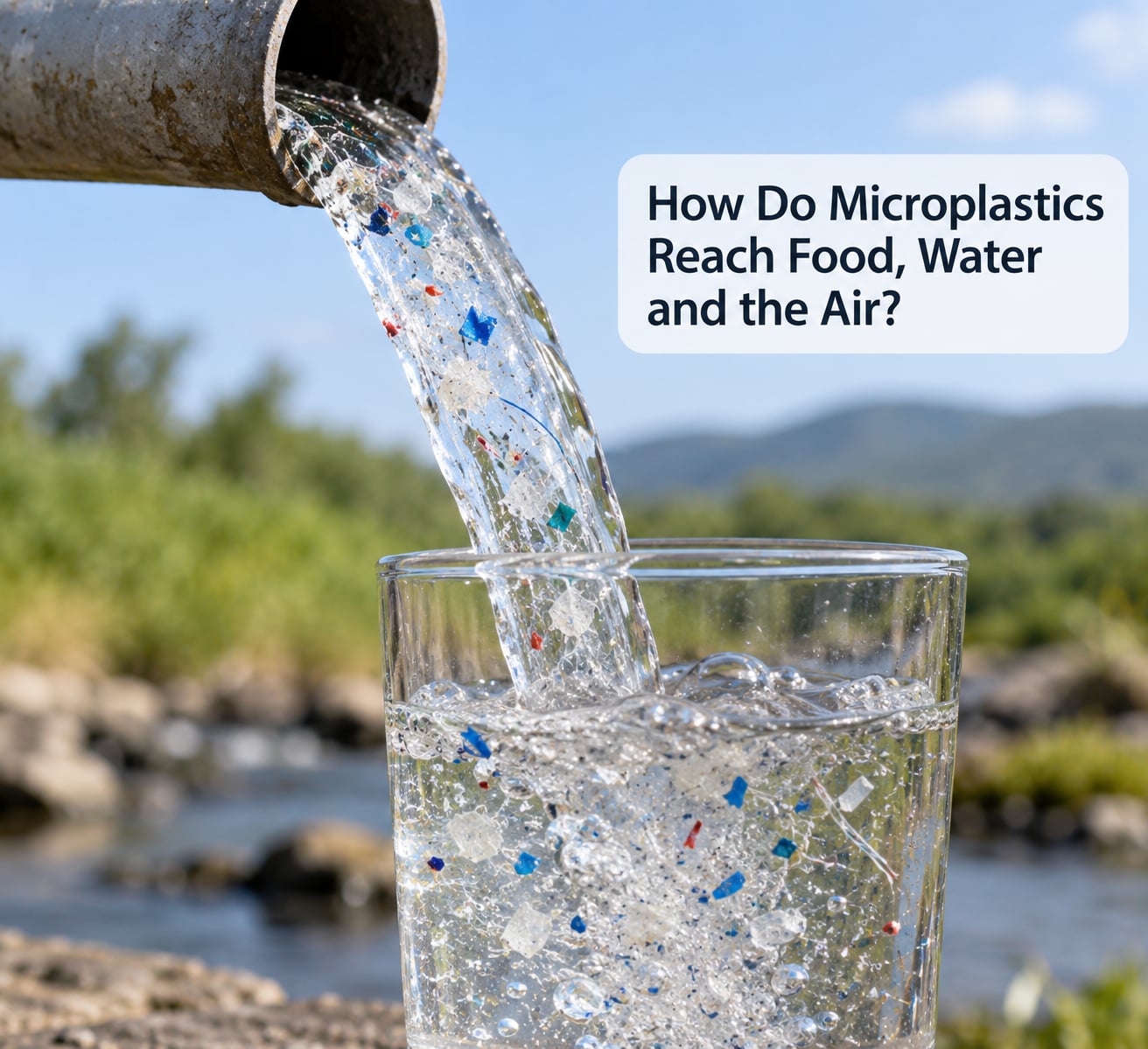
Exposure does not require you to use single-use plastic. Particles reach people through three routes at once: eating, drinking and breathing. The drinking water in many systems already contains measurable fibres, because surface water, groundwater and treated wastewater all contribute, and treatment plants were designed to remove organic matter, not synthetic polymer.
Food picks them up from soil and water rather than only from packaging. Farmland absorbs microplastics from irrigation, manure application, plastic mulches and atmospheric deposition, and crops take up the smallest particles through their root surfaces. Sea salt and honey were among the earliest foods shown to contain them. Salt is a good illustration of ubiquity: it is harvested, dried, processed and packaged, and each of those steps offers a chance for particles to enter.
Seafood is consistently the highest measured category. Small species eaten whole, such as sardines, anchovies and mussels, cannot have their plastic removed before the plate, and studies of supermarket seafood have found fibres and fragments in a meaningful share of samples.
Air is the least discussed route and probably the largest single one. Indoor dust carries fibres and fragments, concentrated in rooms with more carpeting, more synthetic textiles and more forced-air heating. Outdoor air samples near roads show higher readings than samples taken in rural settings, which links back to tyre and brake wear.
Estimates of intake vary widely depending on assumptions, but published estimates commonly land around 35,000 particles a year from food and up to 121,000 once inhalation is included. Treat those as order-of-magnitude figures rather than precise counts; measurement methods still differ between labs.
What Health Effects Are Known?
This is the part where sources conflict most, and the conflict is usually about certainty rather than direction. I am not a doctor and this is not medical advice; for personal questions about your own health, talk to a physician or a registered dietitian. What follows is a summary of what peer-reviewed work has and has not established.
Particles have been detected in human blood, lung tissue, liver, kidneys, carotid artery plaque, testes, placentas and breast milk. Detection tells you exposure happened. It does not by itself tell you what the exposure did.
What is reasonably well supported
Exposure begins before birth. Multiple studies have found microplastics in placental tissue, and the implication for developmental research is significant even where the measured concentrations are small.
Inflammatory response is the best-supported biological effect. In animal and cell studies, plastic particles provoke inflammation and oxidative stress. Microplastics are also efficient carriers for chemical additives already in the particle, and both pathways are active at once.
Particles cross biological barriers under experimental conditions. Studies have shown movement across intestinal and blood-brain barriers in models. What dose, what particle size and what duration matter for in humans is still being worked out.
Most ingested particles pass through the digestive tract and leave. That is reassuring in the way that true for most swallowed material is reassuring, and it is not the same as saying they cause no harm.
What is plausible but still under study
Links between microplastics and cardiovascular disease, neurological decline, reproductive effects and cancer are active research questions, with animal evidence that is sometimes concerning. No long-term human study has established that microplastics cause a specific disease in people. Claims that they do are unsupported. Claims that they are harmless are also unsupported. Neither extreme helps.
The honest position is a reduce-and-monitor stance: exposure is real and rising, some effects are mechanistically plausible, and the cost of lowering your exposure is low enough that doing so does not require any contested science.
How Can You Reduce Your Exposure?
Start with the mental shift, because the rest depends on it. You cannot eliminate exposure. Nobody can, and readers on forums who keep hunting for a perfectly clean week of air and water usually end the search more anxious than when they started. The winnable goal is to cut the sources you control, which mostly means fewer synthetic fibres in your laundry, fewer single-use items, and less plastic in contact with food and heat.
At home
- Wash synthetics less, and cool. Cold water and a full load shed noticeably fewer fibres. Wash fleece and sportswear separately so they do not grind against everyday clothing, and air-dry what you can.
- Switch the fibre when you replace a garment. Cotton, linen, wool and denim release plastic-free lint. If your wardrobe is mostly polyester, one item at a time is a real reduction.
- Filter the laundry effluent. A microfibre filter fitted to the washing machine drain or a fine-mesh filter in the outflow path catches a meaningful share of shed fibres before they reach the sewer. Simple mesh versions are cheap; the ball-catcher style ones are easier to install.
- Filter your drinking water. If you are concerned, check the filter type explicitly. Reverse osmosis and many fine-pore systems are the options most often designed to address microplastics. Standard carbon pitchers target chlorine and improve taste; they are not sold to remove polymer and should not be assumed to.
- Skip bottled water and single-use packaging. Tap water in most urban systems carries fewer particles than plastic bottles, and the packaging savings are real.
- Use glass, stainless steel or ceramic for hot food. This also removes the chemical migration pathway that comes with heat and plastic together.
- Dust wet, and ventilate. Damp cloths capture fibres that a dry cloth mostly pushes back into the air. Air out rooms after cooking and cleaning, and give your HVAC filters a look if your system recirculates.
- Read personal care labels. Avoid products listing polyethylene, polypropylene, polyethylene terephthalate, polyurethane, acrylates or polyvinylpyrrolidone if you want to cut the primary-microplastic share of your routine.
- Watch what goes down the drain. Nothing that dissolves in water should be flushed down the sink if a bin will take it, and that includes wipes, dental floss and product packaging.
Beyond your kitchen
The personal steps above address a fraction of total emissions. That is worth stating plainly rather than pretending otherwise, because it is where the larger levers sit, and readers who feel personally helpless tend to do nothing at all.
Producer responsibility is the most effective lever available. Extended producer responsibility schemes make manufacturers finance collection and recycling for their own packaging, which is how several countries now handle it, and the EU has gone further with binding limits on intentionally added microplastics and on pellet losses across the supply chain. For readers in Spain and across the EU, that framework, plus the single-use plastics directive, is the regulatory context to track rather than US state rules.
Public procurement is a lever ordinary people can pull. Schools, hospitals and municipal kitchens buy enormous volumes of packaging. Moving those buyers to reusable serviceware changes production incentives upstream in a way no individual household can. Workplace and campus catering contracts are the same argument in miniature.
On the waste side, better street sweeping, drain capture and wastewater filtration catch what individuals never see. River and coastal interception works too, at greater cost. None of it substitutes for reducing the plastic made in the first place, which is why production caps and reuse targets matter more than beach cleanups.
Frequently Asked Questions
Are microplastics in drinking water everywhere?
In many countries, yes, in detectable amounts. Studies from the US, Europe and Asia have found microplastic fibres and fragments in tap water, bottled water and treated wastewater. Not every sample and not every particle size shows up, because detection methods still have detection limits and nanoplastics in particular are hard to measure. A filter rated for microplastic removal can cut what reaches your glass.
How do microplastics get into the human body?
Through three routes, mostly at once. You ingest them in food, drinking water and salt. You inhale them as airborne fibres and fragments in indoor dust and outdoor air, with roadside levels higher than rural ones. Dermal contact through skin is likely the least significant route, since intact skin is a good barrier. Exposure starts before birth, since particles have been found in placental tissue.
Do plastic bottles contain microplastics when they are unopened?
They can. A sealed bottle of water stored for months can develop particles from two sources: the plastic itself, which sheds under heat and light, and contamination in the source water before bottling. Researchers have detected nanoplastics in bottled water, and concentrations in bottles stored at room temperature were higher than in refrigerated bottles. An unopened bottle is not a zero-exposure option, though a cold one stored briefly carries less risk than a warm one.
Can a home water filter remove microplastics?
It depends entirely on the filter. Reverse osmosis and fine-pore membrane systems are the ones designed to capture microplastics and particle-sized debris, and independent testing has generally found them effective. Standard activated carbon pitchers are sold to reduce chlorine and improve taste, not to remove polymer. If you buy a filter for this reason, check that the specification names microplastic or particle removal, and replace the cartridge on schedule.
Are synthetic clothing and car tires major sources?
Yes, and they are the two most under-estimated ones. Fibres shed from polyester, nylon, acrylic and fleece during washing pass through most wastewater treatment and reach rivers, with research from European studies attributing a large share of aquatic emissions to textiles. Tyre and brake wear adds a continuous flow of fine particles to road dust, which rain carries into drains. Neither involves litter, which is why both get ignored.
What can governments and companies do to reduce microplastic pollution?
Regulators can cap plastic production, require reuse targets, ban intentionally added microplastics in products, and treat pellet losses as a reportable industrial accident, as the EU now requires. Companies can redesign packaging for reuse, publish polymer and additive information, and finance collection through extended producer responsibility schemes. Public buyers can shift schools, hospitals and municipal kitchens to reusables, which pulls demand upstream faster than household recycling ever did.
The First Step to Reduce Your Exposure
If you do one thing this month, wash your synthetic clothing less often and colder, and pick up a microfibre filter for the machine if the budget allows. Fibres are one of the largest measured shares of emissions, they are released every single week by ordinary laundry, and unlike tyre wear or industrial pellets, that source sits in your house and responds to a change you make today.
Then give the bigger levers a bit of your attention, because they are where the real reduction lives. Support producer responsibility rules and reuse targets, ask your school, workplace or municipality what packaging they buy, and keep an eye on the regulatory files that govern microplastics and pellet losses where you live. Evidence is accumulating, and the direction of travel is clear even where the dose-response questions are not.
Reduce, rather than eliminate. That framing is less dramatic than the one circulating online, and far more likely to still be true next year.