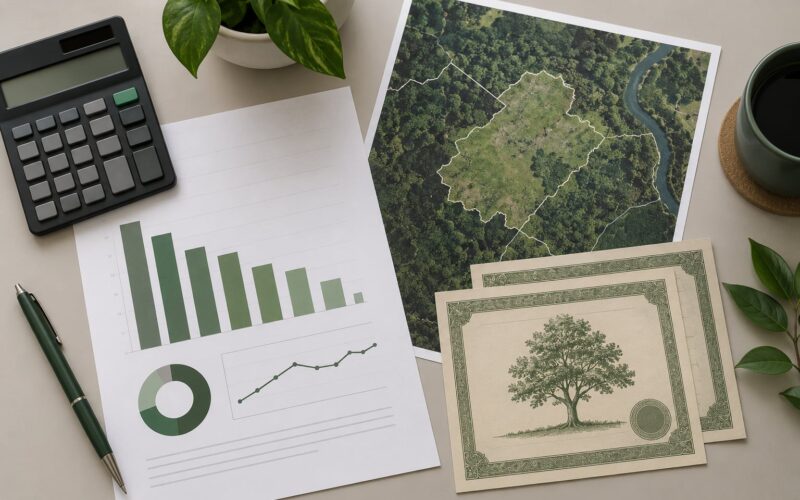
A carbon offset is a measurable, verified reduction in greenhouse gas emissions, or an increase in carbon stored, that is applied against emissions emitted somewhere else. One credit always represents one tonne of carbon dioxide equivalent (CO2e), and the same tonne can only be retired once. Carbon offsets work through a chain of measurement, independent verification, issuance, transfer and retirement. They fail when the baseline is inflated, the reduction would have happened anyway, or the stored carbon later reverses.
That two-part answer matters because the offset market is not one thing. Some credits fund genuine methane capture at a landfill, and some fund a forest protection scheme whose land was already protected. Both arrive with a serial number and a certificate. Only one of them changes the atmosphere in the way the paperwork claims.
Below is the mechanism first, then the specific points where it breaks down, then a way to check any offset claim you come across.
Table of Contents
- How Carbon Offsets Work: From Emission to Credit
- What an Offset Project Must Actually Do
- What Makes a Carbon Credit Credible?
- When Can an Offset Be a Legitimate Climate Action?
- How Carbon Offsets Work and When They Fail Across Project Types
- When Do Carbon Offsets Fail?
- When the baseline is inflated
- When the reduction would have happened anyway
- When credits are over-issued
- When emissions move rather than fall
- When stored carbon comes back
- When the same tonne is counted twice
- When verification is thin
- When offsets replace cuts that were available
- When timing is ignored
- Why a Good Offset Still May Not Deliver Climate Value
- How to Evaluate an Offset Before Supporting It
- Frequently Asked Questions
- Do carbon offsets actually reduce greenhouse gas emissions?
- Can a carbon offset replace reducing a company’s own emissions?
- How is the additionality of a carbon offset verified?
- Are certified or high-quality carbon credits guaranteed to work?
- Can the same carbon offset be sold or claimed more than once?
- Is buying a tree-planting offset better than supporting direct emission cuts?
- What to Do First
How Carbon Offsets Work: From Emission to Credit
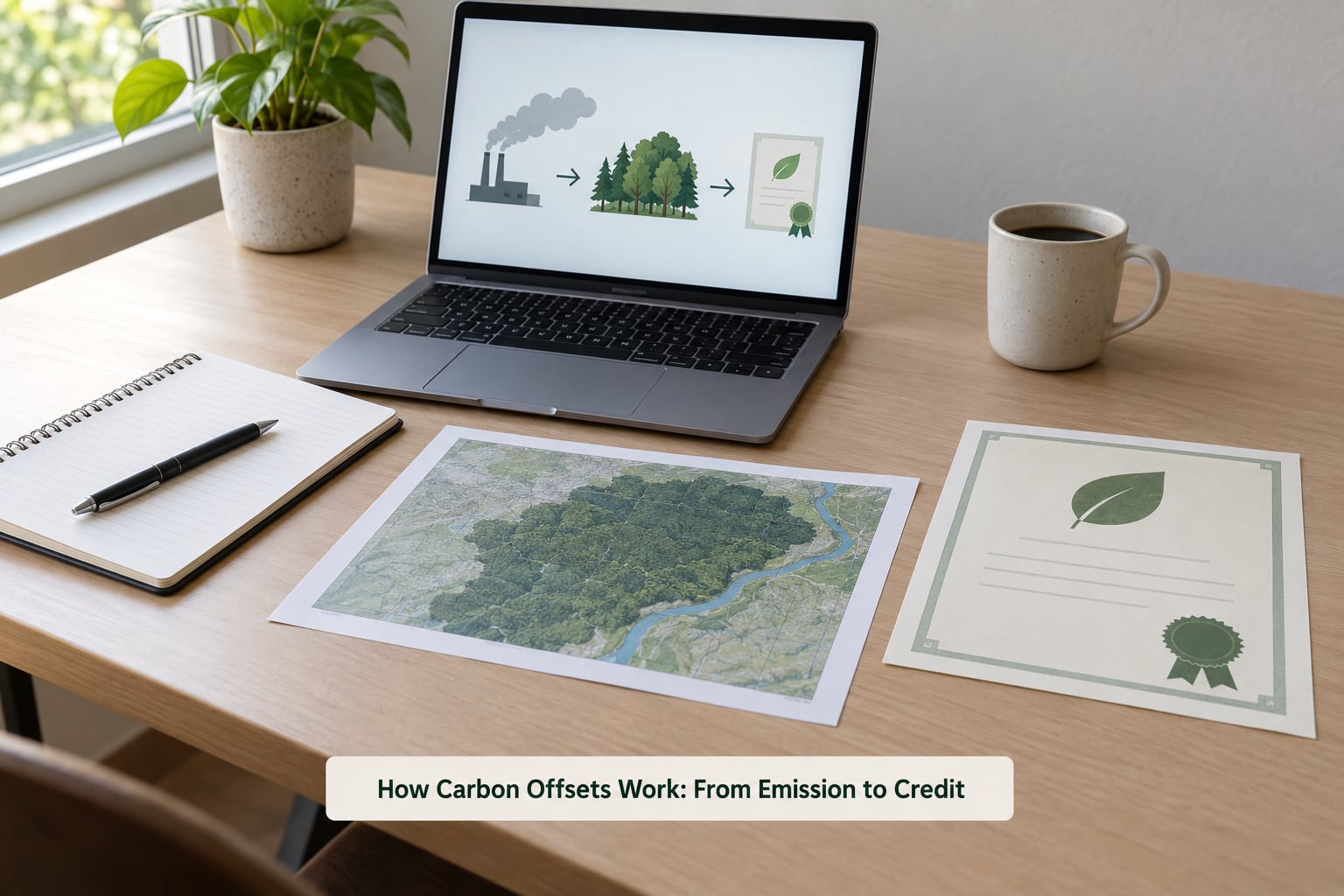
An offset does three things at once. It measures an emissions change, it checks that the change is real and would not have happened anyway, and it records the result in a public register so that one tonne cannot be sold twice.
It is worth clearing up three words first, because the vocabulary is where a lot of confusion starts. A carbon credit is the tradable certificate itself. A removal credit comes from taking carbon out of the atmosphere and storing it, such as biochar or direct air capture. An emission reduction credit comes from emitting less than a counterfactual would have, such as a cleaner cooking fuel displacing wood burning. The last two are called reduction credits in the registry, and they are not interchangeable for claims about removing carbon.
CO2e is the unit that makes them comparable. Methane and nitrous oxide are converted to carbon dioxide using a global warming potential multiplier, so a tonne of methane avoidance can count for many tonnes of CO2e. The multiplier depends on the time horizon used, which is one reason two projects can claim very different credit volumes from similar-looking reductions.
Here is the full chain, from measuring an emission to retiring a credit:
| Step | What happens | Who does it | What you get |
|---|---|---|---|
| 1. Measure | Your emissions are calculated from fuel use, energy data and activity records | You or your auditor | An emissions figure in tonnes of CO2e |
| 2. Project | A developer runs a project under a published methodology, using a baseline to define what would have happened otherwise | Project developer | A quantified expected reduction |
| 3. Validate | An independent body checks that the project fits the methodology and the baseline is defensible | Accredited validation body | A validation report on the registry |
| 4. Verify | After monitoring, an auditor checks the real measured outcome against the projection | Accredited verification body | A verification statement |
| 5. Issue | Verified reductions are minted as credits with unique serial numbers | Project registry | Tradable credits |
| 6. Retire | The holder transfers a credit to a retirement account so it cannot be resold or claimed again | Buyer, with the registry | A retirement certificate naming the serial numbers |
Retirement is the step most corporate claims skip, and it is the step that decides whether a claim is real. An unretired credit is inventory sitting on a balance sheet. A retired credit has been permanently withdrawn from circulation and counted against an emissions statement.
This mechanism is separate from two other things that get mixed up with it. A carbon tax is a price on emissions paid to a government, not a project credit. A cap-and-trade allowance is a tradable permit issued by a regulator inside a compliance market such as the EU ETS, where units come from the cap rather than from projects. Offsets can be used to meet a compliance obligation under some rules, including Article 6 of the Paris Agreement, but the offset itself is always a project outcome, never a permission to emit.
What an Offset Project Must Actually Do
A project has to carry real weight across seven roles, and each one can quietly break the chain.
The project developer designs the activity, finances it, runs the monitoring and sells the credits. The standard sets the rules, the methodology and the quality bar, whether that is the Verified Carbon Standard from Verra, Gold Standard, the Climate Action Reserve or the American Carbon Registry. The validator checks the design before the project starts producing credits.
The verification body is the one that matters most, because it is the only party that checks measured results against claims. A verifier who is not genuinely independent from the developer is the most common structural weakness in the whole chain. The registry then holds the serial numbers and records issuance and retirement.
The buyer either retires a credit for a claim or holds one as an asset. The host community and landholders carry the physical and social consequences of the project. In every good project they are participants with a stake, not an audience.
None of this means a certificate proves the outcome. A certificate proves that a serial number was issued, transferred and retired in a registry. Everything above that line, the actual atmosphere, is established by the methodology, the baseline and the verification report. That is the distinction to hold on to.
What Makes a Carbon Credit Credible?
Credible credits share a set of properties, and most of them are documented publicly. Check each one.
Additionality means the reduction would not have happened anyway. A forest that was already protected, a wind farm already built under a legal mandate, a stove programme people were already buying through other programmes all fail here. A carefully drawn baseline means the counterfactual is modelled conservatively, not set low so the project looks productive. Quantification means the measurement error is published, not buried. Leakage accounting asks whether the emissions simply moved somewhere else. Permanence terms say how long the carbon is expected to stay stored and what buffer covers a reversal.
Then there is monitoring, reporting and verification done by an accredited independent auditor, public methodology documents, real community consultation and consent, published retirement evidence with serial numbers, and a price that makes sense for the type of abatement claimed.
| Question to ask | Warning sign |
|---|---|
| Would this reduction have happened without the project? | No named financial or regulatory driver, or a baseline that assumes zero change |
| Who set the baseline and who verified the result? | The developer wrote the study and the verification was a short internal review |
| How many years of storage, and what happens on a reversal? | Permanence measured in decades for forest carbon, with no buffer pool described |
| Where do the serial numbers appear? | No serial numbers, no registry account, or an account the claimant controls |
| What share of the project’s finance reaches the host community? | Community benefit described as a benefit rather than a share |
| Is it a reduction or a removal? | A forest protection project marketed as removing carbon |
| Does the price fit the claim? | A very cheap credit described as delivering deep, durable abatement |
When Can an Offset Be a Legitimate Climate Action?
An offset is defensible when the emissions are genuinely residual and no available technology can remove them at acceptable cost, such as a share of aviation, shipping, cement or agricultural emissions. It is also defensible when it funds abatement that would not otherwise attract capital because the revenue is small, as with landfill methane, and when it is retired, independently verified and reported without replacing cuts the emitter could have made anyway.
The honest version of the argument, which you rarely hear in the loudest threads, is that well-located abatement in a grid with a lot of fossil generation can displace more emissions than an equivalent project in an already-clean grid. Offsetting is not fraud. It is a tool with narrow preconditions, sold by people who did not always apply those preconditions.
How Carbon Offsets Work and When They Fail Across Project Types
Different project types carry different failure risks, and the dominant risk moves as you move across project types.
| Project type | What the credit represents | Dominant failure risk |
|---|---|---|
| Forestry and land use | Avoided deforestation, reforestation or improved management | Reversal risk after wildfire or drought, plus a baseline that may already have been protected |
| Renewable energy | Displaced fossil generation or fuel switching | Additionality, since the project may be legally required or already economic |
| Clean cookstoves | Less fuelwood burned, so less deforestation | Usage monitoring: the model assumes continued use that does not happen |
| Methane capture | Landfill gas or manure captured instead of released | Measurement of captured volume, and how the gas is actually used |
| Blue carbon | Restored mangrove or seagrass soil carbon | Permanence under coastal development, and community tenure conflicts |
| Engineered removals | Carbon captured and stored, such as biochar or direct air capture | Net energy and supply-chain emissions, and long-term storage of the captured carbon |
Engineered removals are the newest category and usually the least contested on integrity, because the chemistry either captures carbon or it does not. They are expensive, though, and some rely on energy sources that carry their own emissions, so a removal credit is not automatically climate-positive once you count the full supply chain.
When Do Carbon Offsets Fail?
These are the specific points where the mechanism stops delivering what it promised.
When the baseline is inflated
The baseline is the estimate of what emissions would have been without the project. Set it low and the same physical outcome produces more credits. Some baselines are modelled on degraded land, weak regulation or a fuel price the country has never charged.
When the reduction would have happened anyway
This is the additionality failure, and it is the most common one. A renewable project in a country with a renewable mandate, or a stove programme funded by another donor, produces credits for something someone else was already paying for.
When credits are over-issued
Projects are paid by the volume of credits issued, so there is a structural incentive to model generously. A 2024 systematic assessment in Nature Communications examined carbon crediting projects across a range of sectors and found that only a small fraction of expected reductions in the most commonly used project types were achieved in the quantities claimed. Earlier work on the Kyoto-era Clean Development Mechanism and Joint Implementation found a majority of credits were over-estimated.
When emissions move rather than fall
Leakage is the displacement question. A cookstove programme can shift wood demand to a neighbouring district, and a forest protection scheme can push logging to the next concession. The credit stays valid while the net effect on the atmosphere disappears.
When stored carbon comes back
Forest carbon is a loan, not a gift. Wildfire, drought, disease and land clearance all reverse it, and forestry credits also accrue slowly, so a tonne credited today may take decades to accumulate. A reversal should draw down a buffer pool and replace the credits; how much buffer a project actually holds is worth asking about.
When the same tonne is counted twice
Double counting happens when a credit is sold to one party while the country or community that hosts the project also counts the reduction toward its own target. The registry system exists to prevent this, but only when authorisations are tracked, which is why Article 6 corresponding adjustments and host-country approvals now matter so much.
When verification is thin
If the verifier is not independent, or the monitoring data are self-reported and unaudited, or the verification statement is thin and generic, the credit is an assertion with a logo on it. This is where the 2023 Guardian and SourceMaterial investigation landed, documenting how offset companies used indigenous land and communities in the Global South.
When offsets replace cuts that were available
A cheap credit lets an emitter pay a fraction of the cost of actually changing its operations. Aviation fuel efficiency, insulation, process electrification and freight routing were all available before any credit existed, and buying credits instead is the mechanism working exactly as designed and exactly as intended by the seller.
When timing is ignored
Offsets are largely future-tense accounting. A tonne credited now from a forest that grows over decades, or from a removal facility that starts construction later, does not lower the stock of carbon in the atmosphere this decade. Atmospheric physics does not discount a credit’s delay, even though project economics do. That mismatch sits underneath every claim that offsets alone solve a net-zero target.
Why a Good Offset Still May Not Deliver Climate Value
A credit can be honest and still be the wrong tool, for reasons that live outside the project itself.
Scale. A verified tonne is real, but the volume of high-integrity abatement available is small compared with global emissions, so the arithmetic rarely changes much. Uncertainty. Every verified number carries error bars, and multiplying credits with error bars by a large claim multiplies the uncertainty with them.
Opportunity cost. Money spent on cheap offsets is money not spent on the reductions that would have happened anyway. Market incentives. When supply of low-quality credits outstrips demand, prices fall, which is a signal about the marginal credit, not an endorsement of any particular one. Neutralisation versus reduction. Retiring a credit neutralises a claim on paper. It does not remove the tonne that was emitted, and at a global level the atmospheric stock does not move.
The Integrity Council for the Voluntary Carbon Market exists because of this gap. Its Core Carbon Principles set a baseline for what a credit must demonstrate, and its assessments of which standards and methodologies meet them are the closest thing to an independent quality rating available to a buyer today.
How to Evaluate an Offset Before Supporting It
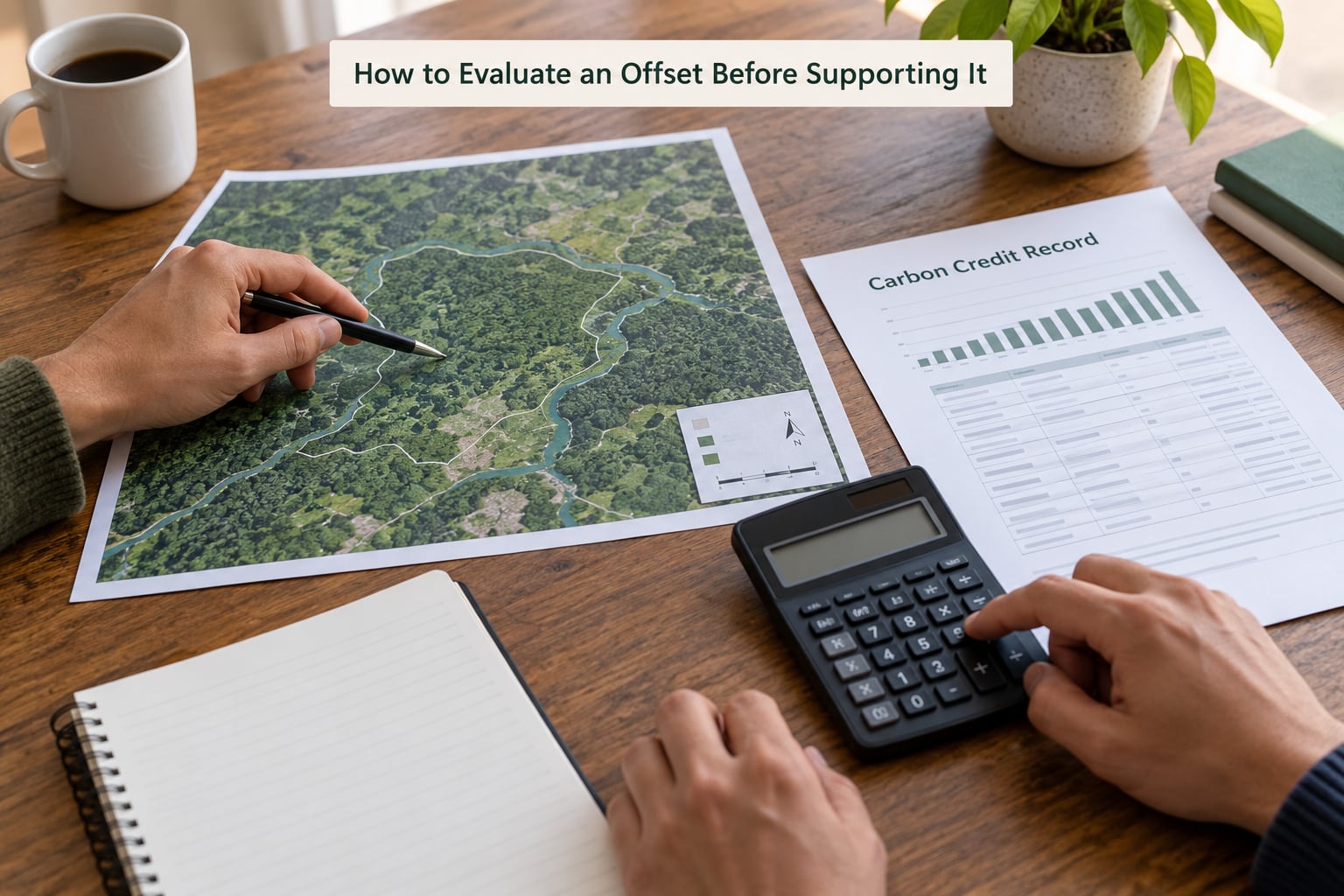
Any offset claim can be checked in about ten minutes if you know where to look. Work through this in order and stop at the first gap.
1. Find the methodology. Look for a public document describing what the project does and how the reduction is calculated. No public methodology is a serious warning sign.
2. Identify the registry. Credits issued by Verra, Gold Standard, the Climate Action Reserve or the American Carbon Registry sit on public registers with serial numbers. A credit you cannot trace to a register is not a credit.
3. Read the additionality section. This is the part most often thin. Ask what would have made the project happen without the credit.
4. Read the verification statement. Check that a named accredited body verified it, that the verification period matches the period you are claiming, and that the numbers reported are the numbers verified.
5. Check permanence and reversal terms. Look for a stated crediting period, a buffer pool, and what happens if carbon is released.
6. Look for host-country and community safeguards. Land rights, consent process, and benefit-sharing terms. Consent should be documented and free prior and informed where indigenous peoples are affected.
7. Confirm retirement. A retirement certificate with the serial numbers, dated, in your name. Anything less and the tonne can still be sold to someone else.
8. Sanity-check the price. Credit prices differ by project type and by year, and removals sit far above avoidance credits. A very cheap credit described as deep, durable abatement is telling you something about the project, not about your purchase.
9. Match the credit to the claim. A reduction credit justifies claiming fewer emissions. Only a removal credit can support a claim about taking carbon out.
10. Ask what it replaced. If the credit funded something that would otherwise have been financed, or permitted, or demanded anyway, you have not bought a reduction. You have bought a certificate.
Frequently Asked Questions
Do carbon offsets actually reduce greenhouse gas emissions?
Some do. Where a project generates a measurable reduction beyond a fair baseline, an independent body verifies it, and the credit is retired against a real emissions figure, it funds abatement that adds up. Where the baseline is inflated or the project would have happened anyway, the credit exists on paper and the atmosphere is unchanged. The mechanism is sound; the execution varies enormously by project, which is why a serial number alone tells you very little.
Can a carbon offset replace reducing a company’s own emissions?
No, and most credible standards say so. The mitigation hierarchy puts avoidance first, then direct reduction, then only the residual that no available technology can remove. Offsets are designed for that last slice, such as parts of aviation, cement or agriculture. When a company with a cheap technical fix for its emissions buys credits instead, the offset has not compensated for anything, because the reduction never had to happen.
How is the additionality of a carbon offset verified?
Verifiers apply the standard’s methodology, which typically requires documented legal requirements, financial viability and common practice in the host country to be shown, and then judged against the project. Financial tests at the project level are the usual tool, though they disagree with national-level analysis. Additionality is the weakest link in many methodologies, which is why the Integrity Council for the Voluntary Carbon Market treats it as a core principle rather than a technicality.
Are certified or high-quality carbon credits guaranteed to work?
No such guarantee exists. Certification means a standard and an accredited verifier reviewed the project against published rules, which is a meaningful floor but not a promise about the atmosphere. Credit quality also changes over time as a project matures and the field shifts: a wind project built when it was marginal can lose its additionality as grids decarbonise. Ask how the project performs now, not how it looked when the methodology was written.
Can the same carbon offset be sold or claimed more than once?
It should not be, and the serial numbering system exists to stop it. Each credit has a unique number recorded in a registry, and retirement removes it from circulation permanently. The failure mode is not forgery, it is authorisation: if the host country has already counted the reduction toward its own target, the same tonne can be counted twice unless corresponding adjustments are tracked. This is the double counting problem, and it is why host-country approval now matters as much as the registry.
Is buying a tree-planting offset better than supporting direct emission cuts?
Usually not. Tree planting is one of the least verifiable offset types: carbon accrues over decades, a young forest is vulnerable to wildfire, and a baseline may credit a forest that was going to regrow anyway. Direct cuts you control are measured, immediate and reversible. Tree planting does have a place in funding long-term removal and restoring land that was degraded, but it is a weak substitute for reducing emissions you produce yourself.
What to Do First
If you take one thing from this, take the order of operations. Avoid emissions where you can, then reduce what is left directly, then handle the residual, and only then look at offsets for that residual slice.
When you do, buy from a standard with published methodologies and public verification, check the additionality argument yourself, confirm host-country and community safeguards, verify the serial numbers, and make sure the credits are retired in your name with a certificate you can hand to anyone who asks. Every avoided tonne is still preferable when the reduction is credible and costs less than the alternative, and a well-chosen offset is a fine way to fund a good project. It is just a poor substitute for doing the work you could have done yourself.