Recyclable means something could be collected and remade into a new product. Recycled content means it already is, partly or fully, made from material that was recovered and reprocessed. One is a promise about the future, the other is a record of the past.
That single sentence resolves most of the confusion at the supermarket shelf, where the two words get swapped around constantly. If you have ever stood there turning a shampoo bottle over, wondering whether “recyclable” on the front was enough of a promise, this guide should save you the squinting.
Table of Contents
- Recycled Content vs Recyclable at a Glance
- What Does Recycled Content Mean?
- Pre-consumer versus post-consumer recycled content
- What Does Recyclable Mean?
- How the two claims combine
- Which Parts of a Package Should You Check?
- Why Do Recycling Rules Differ by Location?
- How Can You Tell Whether a Claim Is Credible?
- Which Should You Choose?
- Frequently Asked Questions
- Is something with recycled content always recyclable?
- Does recyclable mean a product will definitely be recycled?
- What does 50% recycled content mean?
- Are recycling symbols and labels regulated the same way everywhere?
- Should I put a recyclable plastic package in my recycling bin if it is marked recyclable?
- What to Do First When the Label Is Unclear
Recycled Content vs Recyclable at a Glance
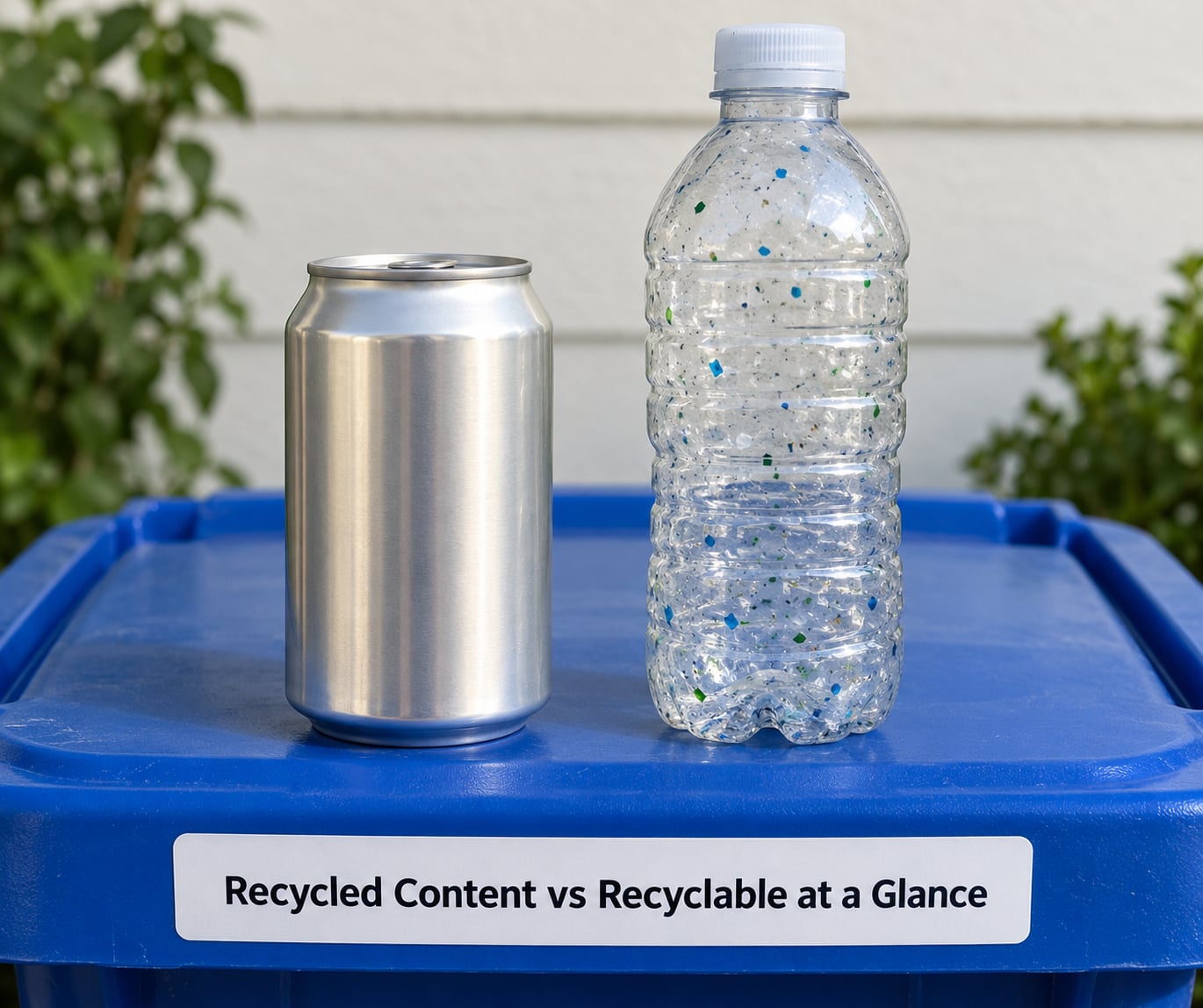
The two claims sit at different points in the same loop, which is why they never contradict each other.
| Point of comparison | Recyclable | Recycled content |
|---|---|---|
| What it describes | Potential: the item could be reprocessed in principle | Provenance: part of the item came from recovered material |
| Who makes the claim | The brand or converter | The brand or converter |
| When it is true | Before the item is thrown away | Before the item is made |
| What it guarantees | Technology exists to handle this material type | A stated share of the material was recovered and used |
| What it does not guarantee | That your local program accepts it, or that anyone recovers it | That the finished product can be recycled again |
| Common wording | Recycle me, recyclable, widely recyclable, check locally | Made from 60% post-consumer recycled plastic, recycled board, rPET |
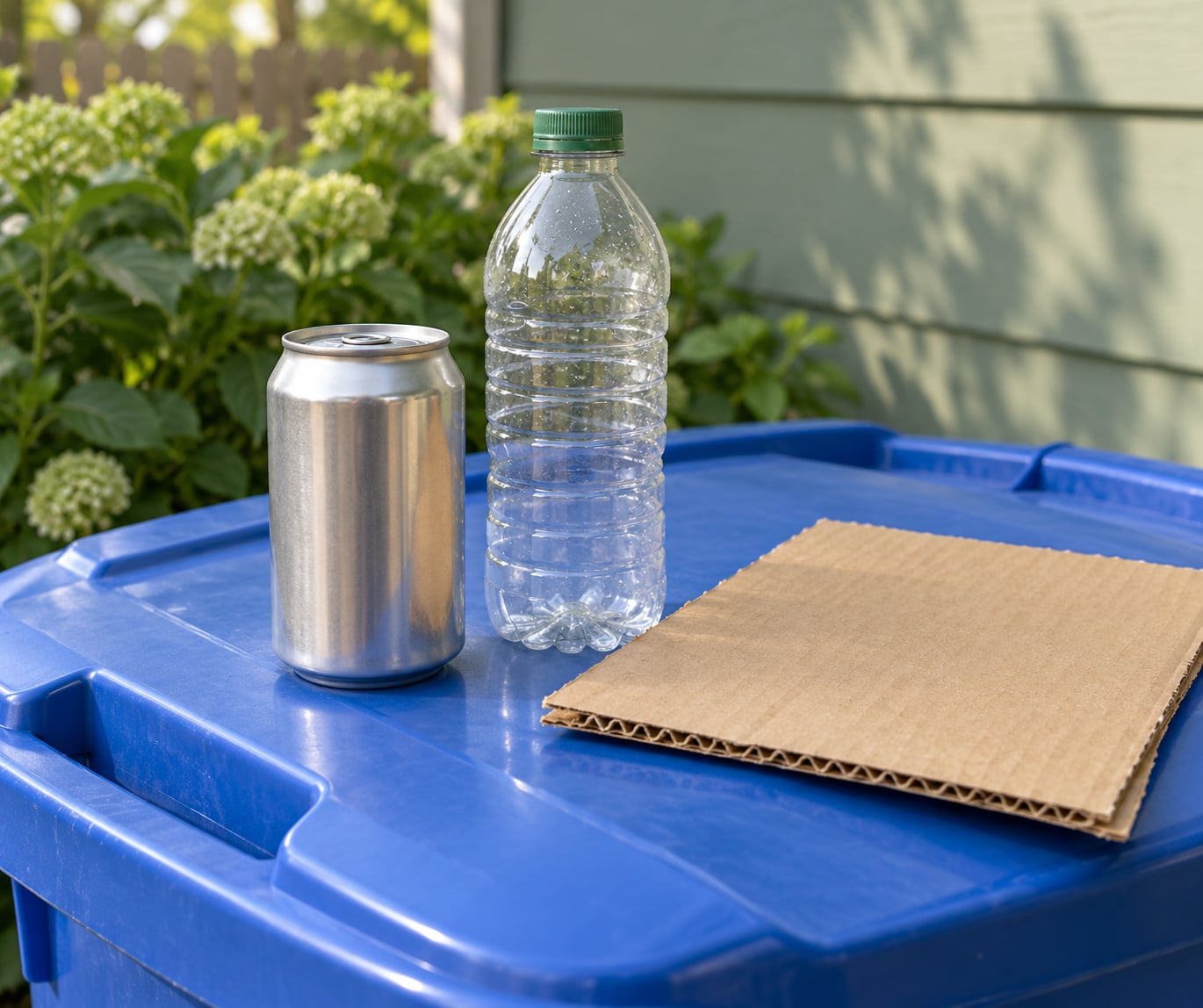
Consider an aluminum drink can. Almost every one is infinitely recyclable in metal terms, so a can is recyclable whether or not it contains any recycled metal. A plastic shampoo bottle made with 30% post-consumer recycled HDPE tells you something else: a third of the plastic in it was already used once. Both statements can be true about the same bottle, and plenty of bottles carry neither.
What Does Recycled Content Mean?
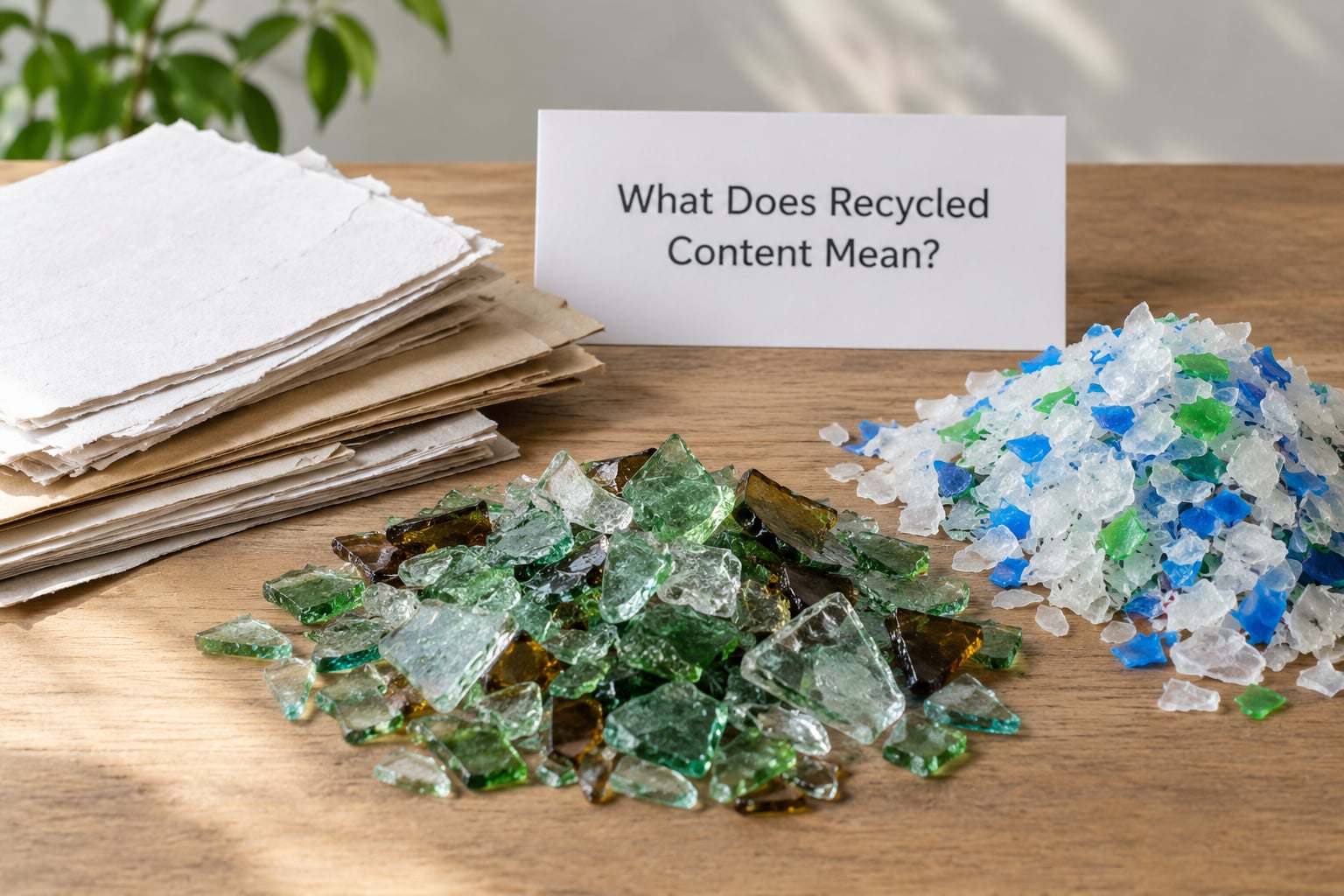
Recycled content describes the input, not the fate. It means a stated share of the material in a product was diverted from waste and reprocessed before reaching the shelf.
The distinction most people miss is between two sources of recovered material.
Pre-consumer versus post-consumer recycled content
Pre-consumer material is scrap generated inside manufacturing: offcuts, trim, rejected batches, and unused surplus that never left the factory floor. Post-consumer material, usually labelled PCR or rPET or simply “post-consumer”, comes from products that were used and thrown away by households and businesses.
Post-consumer is the stronger claim because it proves material completed a full consumption cycle. That is why recycled-content percentages on paper and board are read as the most credible labels on the shelf: a number attached to a claim is far harder to wave away than the word “eco” printed on a band.
A handful of practical details matter. In the US, the FTC Green Guides treat an unqualified “recycled content” claim as needing a reasonable basis and clear qualification when not all of the material is recycled, and broad terms such as “eco-friendly” do not qualify a claim at all. Many brands also use mass balance, an accounting method where certified recycled material entering a supply chain is credited across a larger output volume, rather than physically mixing it into your bottle. Look for a percentage plus a certification such as GRS or SCS, and you have something checkable. Look for “made with recycled materials” and you have a marketing sentence.
What Does Recyclable Mean?
Recyclable is a statement about technical possibility. The container can be collected, sorted and processed by equipment somewhere, at least on paper.
Whether that possibility becomes reality depends on five things: the material itself, the shape, its condition, what your collection system accepts, and whether the local mill has capacity and market demand for that grade. A container that satisfies all five rarely fails for a reader in another country.
How the two claims combine
Because they are independent, four combinations exist. Something can be recyclable and not recycled (most packaging in your bin), recyclable and made from recycled material (a rPET bottle your program accepts), already made from recycled material but no longer recyclable (a multilayer pouch, or paper that has been through too few cycles to keep its fibre length), or neither, which covers plenty of compostable films and mixed-material blister packs.
Contamination is the quiet killer. A grease-soaked pizza box, a plastic bag full of half the bin, or a lump of tangled film can drag down the value of an otherwise fine load. Sorting facilities reject whole batches rather than pick out offenders, so one careless item affects the fate of many clean ones.
Which Parts of a Package Should You Check?
Never assume the box and the product share one disposal route. A cereal box with a plastic window, a shampoo bottle with a metal pump, a yogurt pot with an aluminium foil lid, and a cardboard sleeve around a plastic cup all split into parts with different rules.
Work through it piece by piece: the cap and pump often contain a different, denser plastic than the body. Flexible films, wraps and vacuum bags jam sorting machinery and are accepted only through store drop-off points in most places. Sleeves, labels and adhesives count too, and pressure-sensitive labels plus dense ink coverage are exactly the details that can push a technically recyclable container over the line in practice. Composite packs layered with foil and plastic are usually the hardest of all.
The symbols on the pack are worth reading with care, because some of them do not mean what people assume.
| Symbol or mark | What it means | What it does not mean | Region |
|---|---|---|---|
| Chasing arrows or Mobius loop | Generic recyclable material identification | That your bin accepts it | Global |
| Number inside the arrows, 1 to 7 | Resin identification code for the polymer family | A grade of quality or a sorting promise | US and Canada mainly |
| Green Dot (Der Grüne Punkt) | Packaging participates in a producer-pays scheme | Any recyclability claim at all | Europe |
| Triman logo | Sort item into the bin shown beside it | That the material is collected anywhere | France |
| Tree, leaf or seedling | Renewable or responsibly sourced material | Recycled or recyclable | Global |
The resin code is a sorting hint, not a permission slip. In the US, kerbside programs most commonly accept 1 (PET), 2 (HDPE) and 5 (PP) in the right shape and condition. A 7 marks mixed or other plastics and often means no local route at all, and a 3 or 5 marked bottle can still be refused if it is the wrong size or dirty.
Why Do Recycling Rules Differ by Location?
Because collection is a local service and processing is a local business. A city may run one bin for everything, split food waste out, or only accept rigid containers at the kerb. Deposit return schemes add another layer, since a bottle under deposit is collected through retail channels rather than the general bin.
Markets change too. When recycled plastic has no buyer, mills stop buying, and collection programmes quietly narrow what they will take. Add the legal layer and the picture sharpens further. In the US, California rules under SB 343 link a recyclable claim on packaging to the state’s actual recycling rate, with tightening requirements arriving around October 2026. In Europe, the Packaging and Packaging Waste Regulation works through extended producer responsibility schemes, recycled-content targets for plastic packaging, and harmonised labelling, which is why Triman and the Green Dot show up on European packs and rarely on American ones.
So the label you read was written for a system that may not be yours.
How Can You Tell Whether a Claim Is Credible?
Look for specificity first. A percentage, a named certification, a defined stream like post-consumer, and a named polymer all narrow the room for exaggeration. Wording matters as much: “broadly recyclable” is an explicit hedge for a package that may not reach the mainstream stream, and reading it as a plain promise is the most common misreading on the shelf.
Check the components, not just the front panel. Then verify locally, because the honest test of a recyclability claim is whether your own programme accepts the item in the condition you would put it in. And note the asymmetry: a product with verified recycled content has already used material that would otherwise be wasted, whatever happens to its packaging later. That is a claim about a past action you can audit, not a prediction about a future bin.
Which Should You Choose?
For anything you buy and keep, recycled content is the more meaningful signal, because it points to material actually diverted from waste rather than to a theory about a future collection round.
For short-lived packaging where you have no recycling access at all, the material matters more than either label. Aluminium and glass travel well through almost any scheme. Rigid bottles in polymers your program accepts are usually fine. Flexible films are the weak spot, so if that is all your local service takes, store drop-off or a refill container beats the bin.
For packaging teams, both claims carry legal weight now, and the two are checked separately. A recyclability claim has to survive local acceptance and contamination realities; a recycled content claim has to survive an audit of chain of custody.
Frequently Asked Questions
Is something with recycled content always recyclable?
No, and this trips people up constantly. Recycled content describes what went into the product, while recyclability describes where it could go afterwards. A multilayer pouch can be built from recycled plastic and still be unrecyclable, and a virgin-plastic bottle can be perfectly recyclable. Check both labels separately, and check the components rather than assuming one answer covers the whole pack.
Does recyclable mean a product will definitely be recycled?
No. Recyclable is a statement of technical possibility, not a promise of collection. It means equipment exists somewhere that could process the material. Whether it happens depends on your local program, the item shape and condition, contamination levels, and whether a mill wants the material. If your recycling service does not list it, it does not get recycled no matter what the pack says.
What does 50% recycled content mean?
It means half the weight of the material in that product, measured by the material itself rather than the whole packaged item, came from recovered material. The recycled portion is usually broken down further as pre-consumer or post-consumer. Ask whether the figure is physically blended or accounted for under mass balance, and whether a certification body such as GRS or SCS verified it.
Are recycling symbols and labels regulated the same way everywhere?
No, and the same package can carry different marks in different markets. The US relies mainly on state rules, with California tying recyclable claims to real recycling rates under SB 343. Europe works through extended producer responsibility schemes, the Green Dot producer fee, Triman sorting marks in France and harmonised rules under the packaging regulation. That is why a European pack rarely tells you the resin code.
Should I put a recyclable plastic package in my recycling bin if it is marked recyclable?
Only if your local program accepts that material in that shape. The resin code, the number inside the chasing arrows, tells you the polymer family: 1, 2 and 5 are the usual kerbside candidates in the US. Flexible films, bags and wraps are almost always refused at the kerb and usually need store drop-off. Check your waste authority’s accepted list rather than trusting the pack.
What to Do First When the Label Is Unclear
Split the item into its materials first, because a package almost never has one. Then read the wording rather than the symbol alone, and treat “broadly recyclable” or “check locally” as a warning that this is not the mainstream stream.
Confirm the item against your local waste authority’s accepted list, and when it is not on that list, leave it out rather than wishing it into the bin. If uncertainty remains, reuse beats disposal every time, so keep the container, pick a refill option, or choose a product whose packaging your service actually takes.