Yes, compostable packaging really does break down — but only inside a hot, aerated industrial composting facility. Backyard piles, garden soil, landfill and most municipal green bins never get hot enough or stay wet enough for that to happen, so a certified compostable cup can sit in a landfill behaving exactly like ordinary plastic. The label is often technically true and practically misleading at the same time.
Here is the short version, updated for 2026:
- Certification tests look for around 90% biodegradation within about 12 weeks, under defined heat, moisture and oxygen levels.
- Most certified compostable packaging is engineered for industrial facilities, where windrows can reach about 160°F (71°C).
- A household pile rarely gets past roughly 100°F, so the same bag can survive years in soil essentially intact.
- Compost facilities sort material by look and shape. A compostable bag is often indistinguishable from a plastic one on the line, so it gets pulled out as contamination.
- Even compostable plastics that do break down can leave a residue of microplastic fragments behind in the finished compost.
- In landfill, compostable plastics generate methane, a greenhouse gas roughly 25 to 30 times more potent than carbon dioxide.
If you take one thing from this: read the certification mark, then check whether your local waste contractor actually accepts that specific material. Those two checks answer most of it.
Table of Contents
- Is Compostable Packaging Actually Compostable? What the Label Means
- How compostable packaging actually breaks down
- What Does Compostable Mean?
- Why Compostable Plastic Doesn’t Break Down at Home
- How to Tell If Packaging Is Genuinely Compostable
- Which Composting System Does It Need?
- What Can You Do with Compostable Packaging?
- Compostable Packaging and Common Problems
- Contamination in the compost stream
- Microplastic residue
- PFAS and coatings
- Mixed-material packs
- Cost and performance
- When compostable packaging is genuinely the right call
- How to Choose Better Packaging Without the Greenwashing
- Frequently Asked Questions
- Is compostable plastic actually compostable?
- Do compostable bags actually compost?
- What are the disadvantages of compostable packaging?
- How do I dispose of compostable packaging?
- Is compostable plastic recyclable?
- Is compostable plastic safe for soil if it breaks down?
- Conclusion
Is Compostable Packaging Actually Compostable? What the Label Means
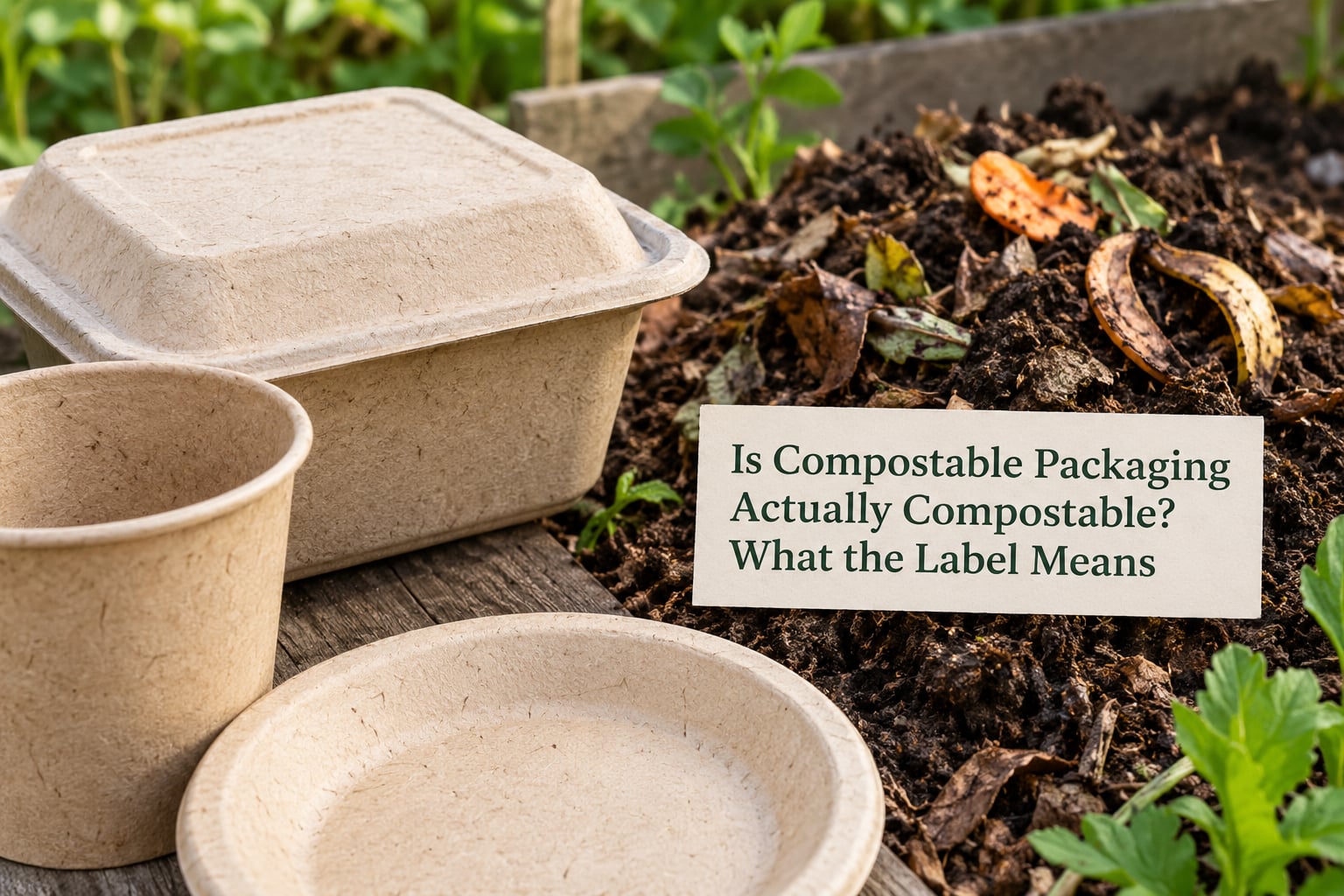
A compostable material is one that breaks down into carbon dioxide, water and biomass within a stated timeframe, in a composting environment, without leaving toxic residue. The test protocols that decide this — the US ASTM D6400 series, the European EN 13432 standard — specify the conditions precisely. A material passes under those conditions.
The gap is between a material passing a controlled test and a package reaching a place where those conditions exist. A compostable clamshell box can be fully certified and still end up in a wheelie bin, then a truck, then a landfill, because almost nobody checked whether the route it took was a composting route.
How compostable packaging actually breaks down
Composting is aerobic digestion by bacteria and fungi. Four conditions have to overlap, and all four at once:
- Heat. Industrial windrows are typically held near 160°F, well above what a backyard pile reaches.
- Moisture. The mass stays damp throughout, roughly like a wrung-out sponge.
- Oxygen. Turning keeps air moving through the pile. Seal the same material in a landfill and the process stalls.
- Time. Certification targets complete breakdown of about 90% of the material in roughly 12 weeks.
PLA, the plant-based polyester behind most clear compostable film and rigid ware, is the clearest example. It has a glass transition point that the compost bacteria need to exceed before they can work on it at a useful rate. Miss the temperature and the polymer simply persists.
What Does Compostable Mean?
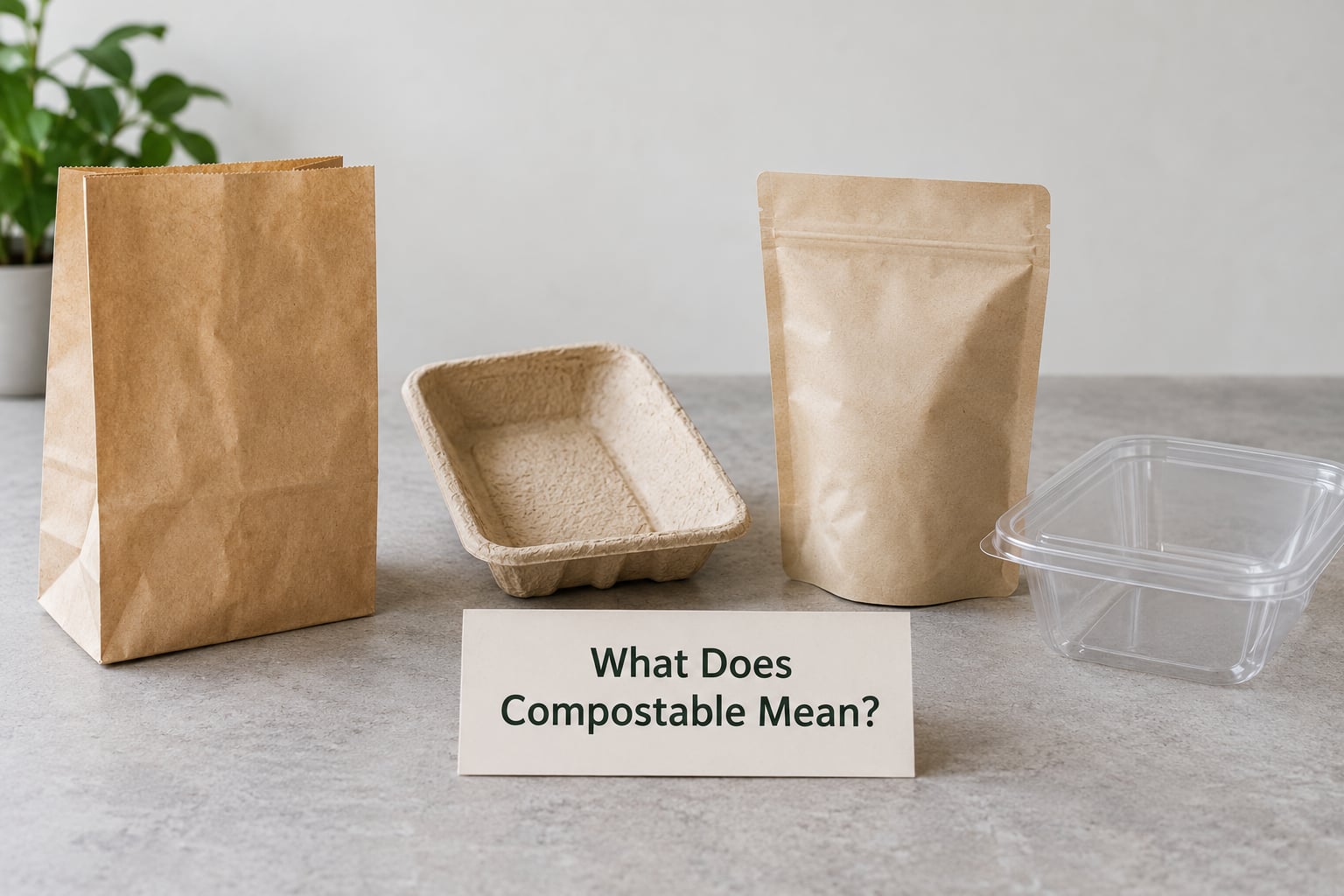
Plain-language version: compostable packaging is packaging designed to be eaten by microbes in a compost pile, on a schedule, leaving useful soil behind. Four other words get mixed into the same sentence, and they do not mean the same thing.
| Label | What it actually claims | Where it has to go | What it becomes |
|---|---|---|---|
| Compostable | Biodegrades in a composting system within a defined timeframe | Industrial facility, or a certified home-composting system if the mark says so | Carbon dioxide, water, biomass |
| Biodegradable | Breaks down under some conditions, often unspecified | Unclear — this is the problem | Varies widely by material and conditions |
| Plant-based / bio-based | Made partly or wholly from renewable feedstock such as corn starch or sugarcane | Depends entirely on the material | Depends entirely on the material |
| Recyclable | Can be reprocessed through a recycling stream | A facility that handles that specific resin | Secondary product, often lower grade |
| Conventional plastic | Nothing environmental; it is the fossil baseline | Landfill, incineration or recycling | Persists for centuries |
Bio-based and biodegradable are the two words that do the most damage. A material can be made from corn and still behave like conventional plastic for a century. Or be genuinely biodegradable in seawater and still not be accepted by your local facility. The feedstock and the breakdown conditions are separate questions, and most packaging copy answers only the first one.
Why Compostable Plastic Doesn’t Break Down at Home
A backyard pile is not a small industrial compost. It is a seasonal, partly anaerobic, unevenly moist heap that rarely exceeds about 100°F (38°C) and often sits far below that through winter. PLA needs sustained heat above roughly 140°F to degrade at a practical rate.
The experimental record on this is uncomfortable for the label. Compostable bags buried in soil have been reported still recognisable after three years. In one widely cited marine study, bags left in seawater for 428 days showed no meaningful degradation. That is not a failure of testing; it is a failure of environment matching.
The belief that a home pile is “basically an industrial compost” shows up constantly in composting forums, and it is the single most damaging misconception in this whole topic. It is not basically anything. It is a cooler, drier, less aerated, much slower system, and the difference is decisive for compostable plastic.
There is a second problem that catches people at the kitchen sink. Shredding a compostable bag to speed decomposition breaks it into small fragments, and those fragments do not disappear. They end up in the finished compost and then in the soil. That is how supposedly biodegradable packaging contributes microplastic residue.
How to Tell If Packaging Is Genuinely Compostable
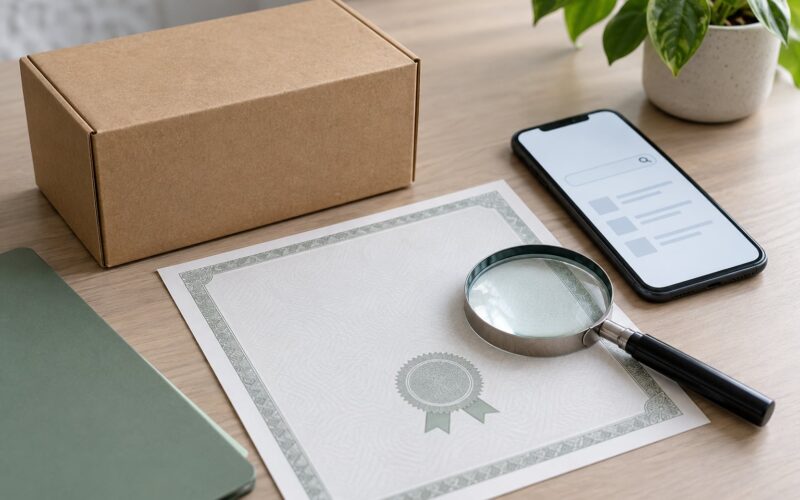
Certification marks with a licence number you can verify are the only reliable signal. Everything else — green colouring, leaf logos, brown kraft paper look, words like “eco”, “green”, “natural” — is decoration.
| Mark | Region | What it guarantees | Where to verify |
|---|---|---|---|
| BPI Certified | United States | Meets ASTM D6400 for industrial composting | Directory of certified products with licence numbers on the BPI site |
| TUV OK Compost Home | Global | Tested for a domestic home compost bin, which is harder than industrial | TUV Austria licence number search |
| TUV OK Compost Industrial | Global | Meets EN 13432 for industrial composting | TUV Austria licence number search |
| Seedling mark | European Union | EN 13432 compliance including disintegration and ecotoxicity | Mark must show a licence number alongside it |
| AS 5810 / ABA | Australia and New Zealand | Compostability including ecotoxicity and heavy metals thresholds | Australian Bioplastics Association member certification list |
A practical checklist for the shop:
- Look for a certification mark with a number attached, not just the word “compostable” printed on the back.
- Check the resin. PLA, PHA, bagasse, sugarcane fibre and paper with an aqueous coating are the common compostable families. Unclear resin, no answer from the seller.
- Read the disposal line, not the marketing line. It should name a system: “industrial composting facility” or “home compost”.
- Ask the manufacturer for the licence number and then look it up yourself.
- Check your own waste contractor’s accepted materials list before you buy, not after.
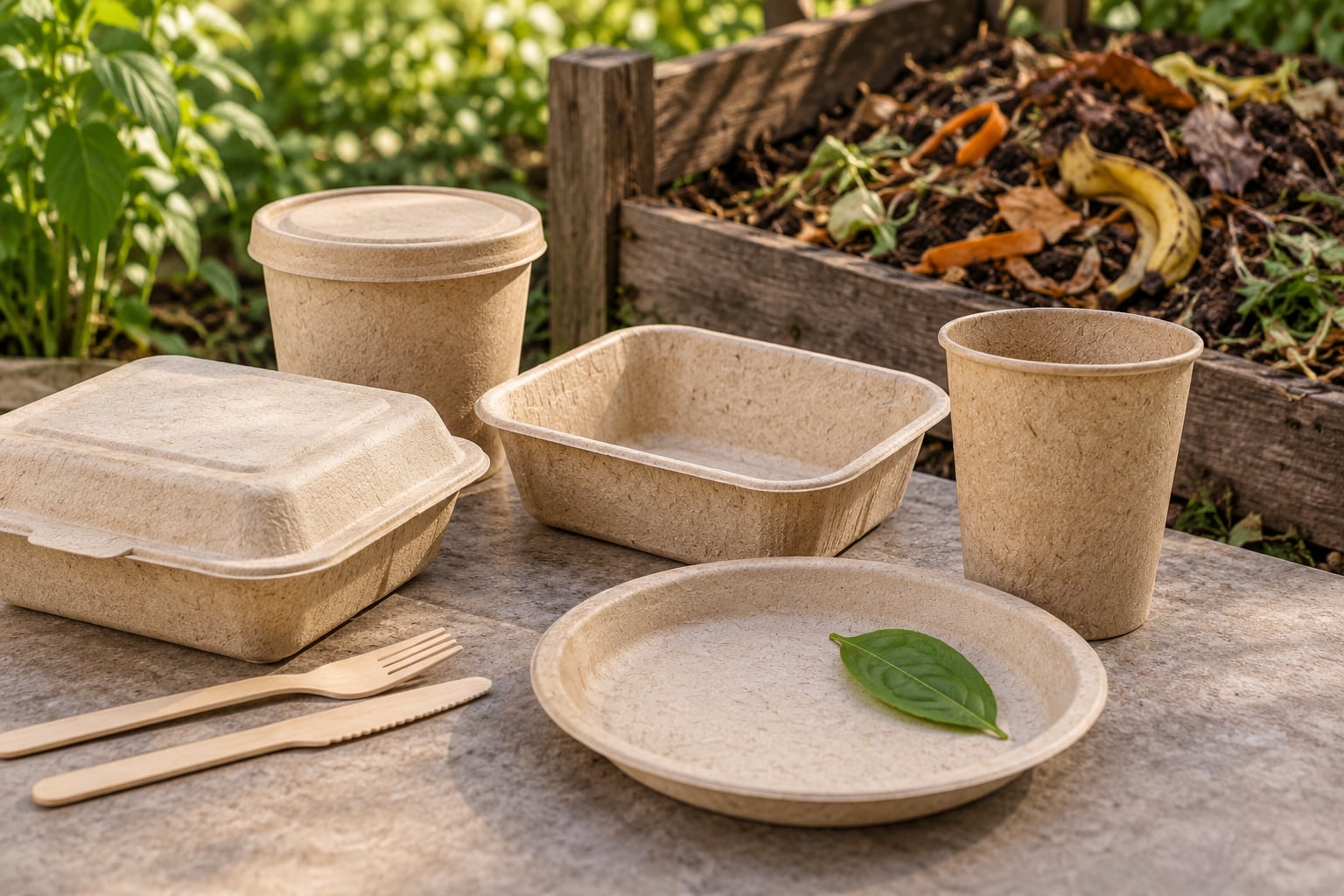
One warning about appearance. Compostable packaging is often tinted, printed or embossed to look like paper or kraft board, precisely so it cannot be told apart from conventional material. That works against you in a sorting line.
Which Composting System Does It Need?
Most compostable packaging names exactly one acceptable destination. Matching the package to the system is the whole job.
| System | Typical temperature | Time to digest | Usually accepts packaging? | Your job |
|---|---|---|---|---|
| Home composting | Around 100°F at best | Months to years, uneven | Only with a home-compostable certification mark | Tear or chop to size, keep damp, turn often |
| Municipal green-waste collection | Varies by plant | Weeks | In some places yes, in many no | Check the contractor’s accepted list first |
| Industrial composting facility | Up to about 160°F | About 12 weeks | Yes, if the material is certified for it | Deliver to a drop-off that handles packaging |
| Landfill | Ambient | Effectively never | Not a composting system | Nothing — the material behaves like plastic |
Municipal programmes are where the confusion is worst. Australian data is unusually clear: of 164 councils with food-organics and garden-organics schemes, only around 43 accepted compostable packaging. In the United States, only roughly three in five of the food-waste composting plants that exist will process packaging, and a substantial share of municipal organics programmes refuse it outright. Forum discussions in r/sustainability and r/composting repeat the same line from waste contractors: certified or not, it is not going in our green bin.
The reason is sorting. Facilities run materials recovery lines where objects are identified by shape and appearance, not by chemistry. A compostable bag looks like a plastic bag. Once a load is contaminated with film, the whole batch can be pulled out.
What Can You Do with Compostable Packaging?
Handle it in this order and you will rarely go wrong.
- Empty it. Scrape out food residue. Most facilities reject a package still loaded with organics, and it contaminates the batch.
- Rinse if the local rules ask for it. Some facilities accept clean items only.
- Pull off non-compostable parts. Plastic window films, adhesive labels, foil linings, rubber bands and metal staples all have to come off.
- Check the item against your local accepted list. Not the brand’s website — your waste contractor’s list.
- Use the named system. If the package says industrial composting facility, it goes to a facility. Your kitchen caddy is not that.
- Never put it in recycling. Compostable polymers contaminate the plastic recycling stream, and recyclers cannot sort them out again.
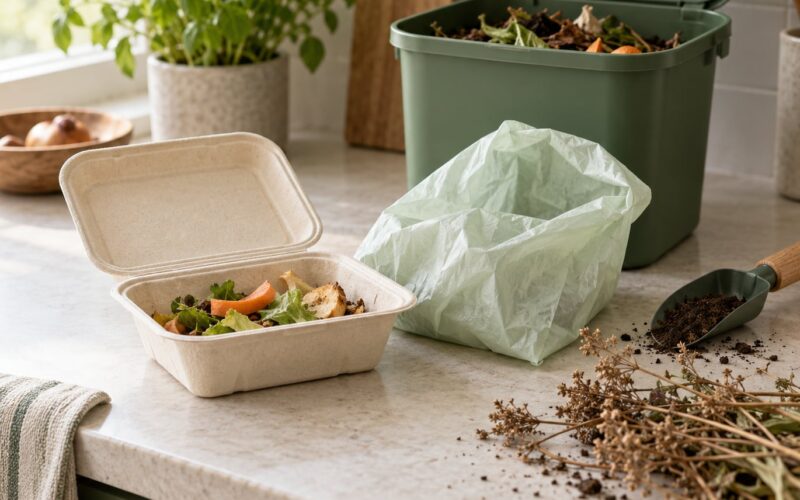
Often accepted: certified compostable takeaway containers in a programme that explicitly takes them, certified produce bags in councils that say so, certified compostable bin liners used as liners in systems designed for them.
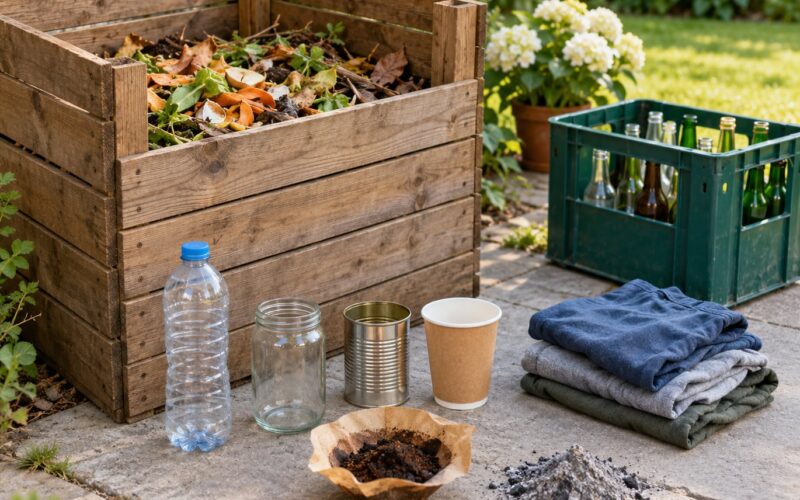
Usually refused: unverified “eco” packaging, black plastic, multilayer pouches, anything with a plastic liner or window, compostable items in a recycling stream, and anything you are unsure about. When in doubt, throw it in the general waste rather than risk a rejected load.
Compostable Packaging and Common Problems
Contamination in the compost stream
The most expensive problem is not the packaging itself. It is the food scraps that go with it. In systems where compostable liners are refused, residents put their organics in a bag, the bag comes out at the sorting facility, and now perfectly good food waste is landfilled alongside the packaging that caused the problem. You lose diversion twice.
Microplastic residue
Even certified materials that reach a working facility are not a perfect solution. Studies testing compostable plastics under industrial conditions have found roughly 90% mineralisation at the twelve-week mark, leaving around a tenth of the original mass behind as fragments below one millimetre. That is by design within the standard, and it is still microplastic entering finished compost.
PFAS and coatings
Grease-resistant compostable foodware often needs a fluorochemical coating to stop food sticking. New South Wales’ environmental regulator has moved against PFAS in disposable food packaging, and composters have pushed back hard, arguing compostable items coated with PFAS defeat the purpose of the system they are meant to enter. Whether PFAS in finished compost comes primarily from packaging or from biosolids and household dust is still genuinely contested, and anyone who tells you they know the answer with certainty is overselling it.
Mixed-material packs
A compostable coffee cup is often an PLA liner, a paper shell and a polyethylene lid. Certification covers the certified component. The lid is conventional plastic. This is why compostable packaging sometimes performs poorly on shelf life and barrier properties — you are stacking thin compostable films to do a job a single conventional plastic layer does better, and then paying more for it.
Cost and performance
A thousand compostable cups can run two to three times the cost of conventional ones. Cups tear, puncture and delaminate sooner in real foodservice use. None of that is fatal, but it means businesses adopting compostables are spending more for a benefit that depends entirely on downstream infrastructure they do not control.
When compostable packaging is genuinely the right call
I want to be fair here, because the case is real in a narrow band. On a campus or in a city with a single waste contractor, a foodservice operation whose whole waste stream goes to one industrial facility, certified compostable serviceware works and works well. It removes the sorting problem entirely and closes the loop on food waste. The material is also defensible where marine litter risk is high, since a certified item that does biodegrade is better than one that persists for centuries. The failure mode is assuming you are in that closed loop when you are not.
How to Choose Better Packaging Without the Greenwashing
If you are a shopper or a household, the impact ranking is boring and reliable:
- Refuse the packaging entirely. Buy loose produce, use a returnable crate, choose a shop that takes your own container.
- Reuse what you have. A glass jar used thirty times beats any compostable design used once.
- Reduce food waste. Packaging you throw away with nothing in it is the cheapest win available.
- Choose certified material only, and only when your local system takes it. Look up the licence number.
- Never pay a premium for the word compostable on its own. Without a mark, a number and a destination, you are buying marketing.
For businesses, the order of work matters more than the material choice. Audit what you actually send to landfill first, then set a destination for each waste stream, then choose packaging to match that destination. A certified compostable box in a region whose only composting facility rejects packaging is worse than a recyclable one, because you paid for the end-of-life story and never got it.
Frequently Asked Questions
Is compostable plastic actually compostable?
Yes, but only under specified conditions. Certified compostable plastics are tested to biodegrade about 90% within roughly 12 weeks in a hot, aerated composting environment near 160°F. A backyard pile, garden soil or landfill never reaches those conditions, so in most real-world settings the material persists and behaves like conventional plastic.
Do compostable bags actually compost?
Only if they reach a facility that accepts them and is hot enough. Certified bin liners can break down in industrial composting. In a home pile they usually persist, and if shredded they contribute fragments to finished compost. Many municipal green-waste contractors refuse compostable liners outright because sorting lines cannot tell them apart from ordinary plastic film.
What are the disadvantages of compostable packaging?
The main ones are cost, thin barrier performance and uncertain end of life. Most packaging never reaches a suitable facility, so it can end up in landfill generating methane. Facilities reject contaminated loads, which can send food scraps to landfill too. Even composted material can leave microplastic residue. Most facilities cannot visually distinguish compostable from conventional plastic on the sorting line.
How do I dispose of compostable packaging?
Check your waste contractor’s accepted materials list first, not the packaging. If packaging is accepted, empty it, remove any plastic liner, label, window or staple, and place it in the organics stream or an industrial drop-off. Never put compostable packaging in recycling. If your local programme refuses it, the only options are a commercial compost dropoff or general waste.
Is compostable plastic recyclable?
No, not in practice. Recycling lines identify material by shape and appearance, so compostable film is normally sorted as plastic and then rejected, or worse, accepted and contaminates the batch with degradable polymer that ruins the recycled output. Compostable packaging belongs in a composting stream or the general waste, never in a recycling bin.
Is compostable plastic safe for soil if it breaks down?
Certification includes ecotoxicity testing, so certified material that fully decomposes should leave a usable amendment. The caveats are fragments that never fully break down, coatings that were never certified, and PFAS sources that may come from packaging, biosolids or household dust. For garden use, home-compostable certification is a stronger guarantee than industrial-only certification.
Conclusion
Check the certification mark and the disposal instruction first, then use the system the package names — and if your local contractor refuses it, go to general waste rather than recycling. Is compostable packaging actually compostable? Usually the material is, and almost always the route is not. Cutting packaging you never needed, reusing what you have and keeping food out of the bin will do more for waste than any label on a takeaway box.