Why your compost smells bad and how to fix it comes down to one thing: air and water balance. A pile turns anaerobic when it is too wet, too compacted, or loaded with fresh nitrogen, and the bacteria that take over then produce hydrogen sulfide, ammonia and sour organic acids instead of the clean earthy smell of working compost. Most piles recover within a day or two of adding dry browns and turning them properly.
The good news is that a smelly pile is almost never ruined. It means decomposition stalled, not that you have to start again. Before you open the lid, put on gloves and turn it away from your face, because the trapped gas will come out in one concentrated waft.
Table of Contents
- What You Need
- Why Your Compost Smells Bad: Diagnose the Problem
- Step-by-Step: How to Fix a Smelly Compost Pile
- Why Your Compost Smells Bad: Check the Moisture Balance
- Why Your Compost Smells Bad: Restore Airflow and Balance
- Why Your Compost Smells Bad: Add Materials That Help
- Why Your Compost Smells Bad: Let the Pile Recover
- Common Mistakes
- How to Prevent Smells from Returning
- Frequently Asked Questions
- Is smelly compost safe to handle or put on my plants?
- How long does it take for the smell to go away after I fix it?
- Do lime or coffee grounds fix a smelly compost pile?
- How do I keep a small indoor bin from stinking up the kitchen?
- Why does my compost smell and have flies at the same time?
- Why is my compost pile not heating up?
What You Need
You can fix a smelly pile with a handful of things, and most of them are already in a shed or a kitchen drawer.
- Gloves plus a cloth mask or bandana for the moment you open the pile. The sharpest smell comes out at the moment of turning.
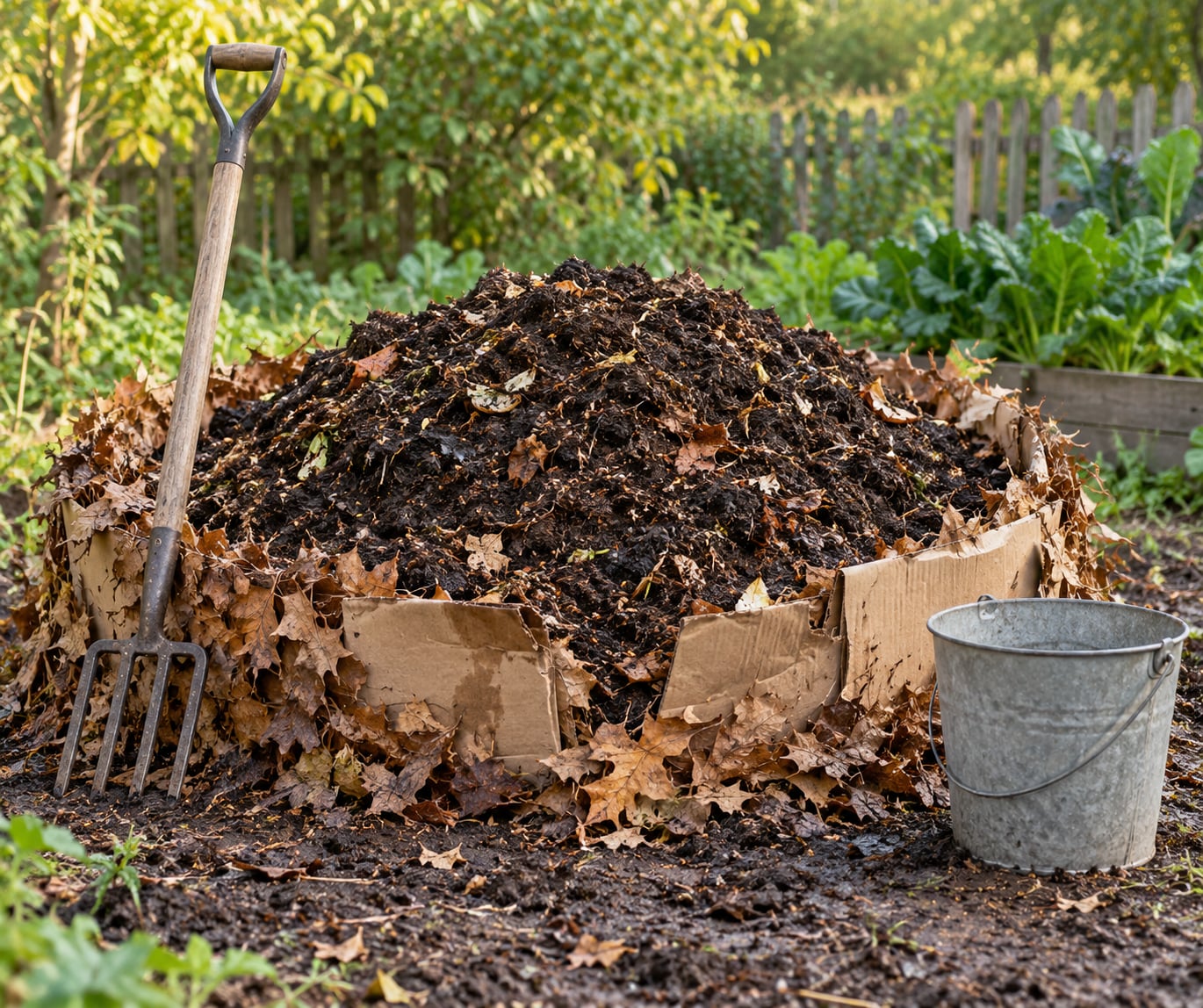
- A long-handled fork, pitchfork or trowel. You need to physically break apart compacted lumps, not just scoop from the top.
- A compost thermometer. Cheap dial models are enough, and they tell you in seconds whether the pile is working.
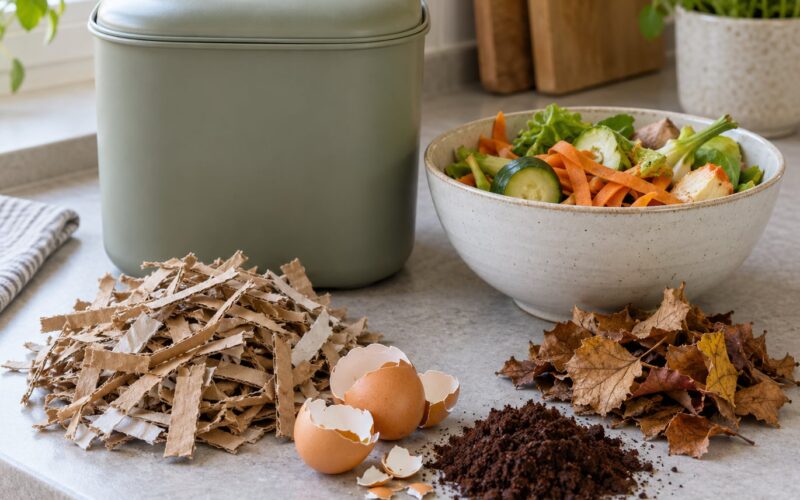
- A dry reserve of browns. Shredded cardboard, dry leaves, untreated sawdust or plain paper, kept somewhere dry.
- A tarp, lid or piece of plywood to cover fresh additions so rain does not soak the pile again.
- A bucket for any leachate that drains out of the bottom.
Why Your Compost Smells Bad: Diagnose the Problem
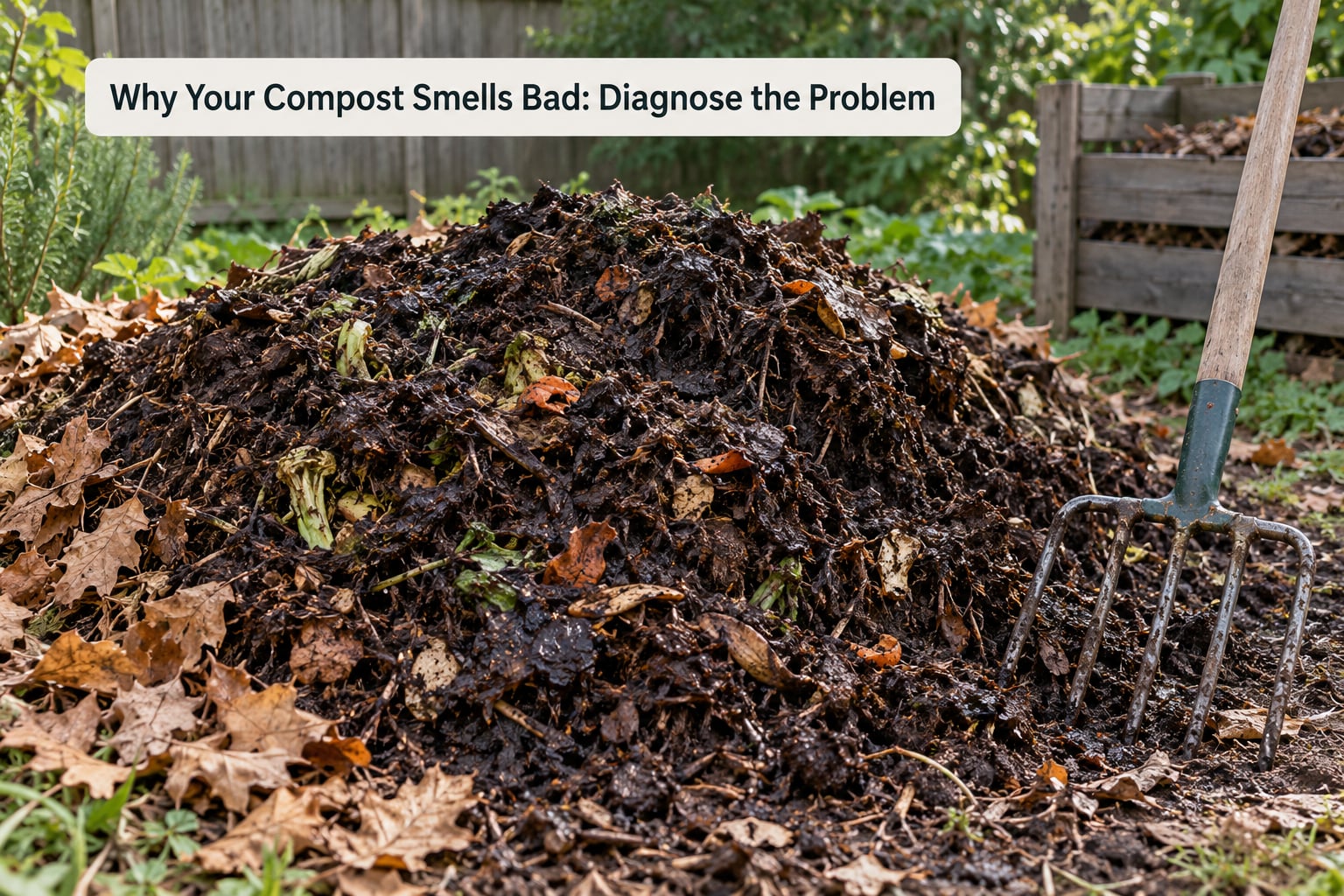
Healthy compost should smell like a forest floor: earthy, damp, faintly sweet. Anything sharper, sourer or more chemical than that tells you which of the four root causes you have. Read the pile, then read the smell, and you can usually name the problem in about ten seconds.
The four causes stack on each other. Too much moisture removes the air spaces, too little air stops the aerobic bacteria, too much nitrogen feeds the wrong bacteria, and the wrong materials do all three at once.
| What you smell | What it means | First move |
|---|---|---|
| Earthy, damp, like a forest floor | Healthy active decomposition | Leave it alone and turn it in a few days |
| Rotten eggs or sulphur | No oxygen at all; hydrogen sulfide from anaerobic bacteria | Open it up, break up clumps, add dry browns |
| Sharp, urine-like, ammonia | Too much nitrogen from grass clippings, food waste or pet urine | Mix in two to three buckets of dry browns per bucket of greens |
| Sour or vinegar-like | Saturated pile, often over-acid from wet plant material | Add cardboard and let it drain and dry |
| Sweet or musty | Compact anaerobic pockets in a large heap | Chop into the heap with a fork to break the clumps |
| Sewage-like after heavy rain | Standing water and leachate at the base | Stand the bin off the ground and add bulky browns |
Two of these overlap, so do not stop at the smell. Take a handful from the middle of the pile and squeeze it: if water runs out between your fingers, moisture is part of the problem no matter what your nose says.
Step-by-Step: How to Fix a Smelly Compost Pile
Work through these in order. Adding carbon to a pile that is compacted and flooded will not fix it, because the microbes still cannot breathe.
Why Your Compost Smells Bad: Check the Moisture Balance
Compost should feel like a wrung-out sponge: damp, cool, and just barely holding together. Squeeze it hard and if you get droplets, the pile is waterlogged. Microbes displace air with water, so a soaked pile suffocates no matter how much carbon you throw at it.
The fix is dry browns with structure. Shredded cardboard and dry leaves soak up free water and open up channels at the same time. Mix them through the wettest zones rather than layering them on top, and cover the pile with a tarp for a day or two if rain keeps falling.
Why Your Compost Smells Bad: Restore Airflow and Balance
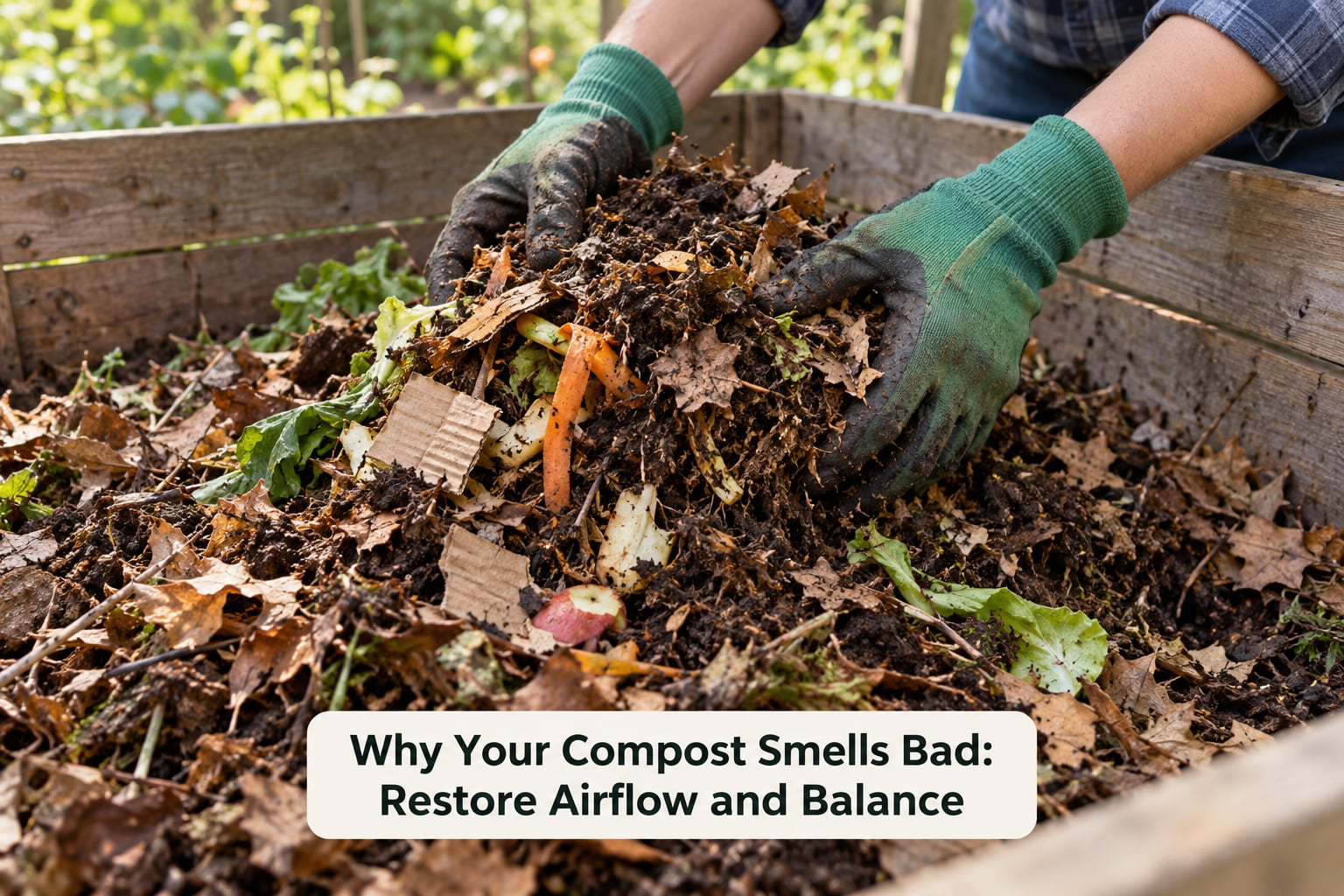
Turn the pile from the bottom up, in sections, and take the whole thing apart as you go. Forum consensus on this is blunt: turning alone is not enough, because the anaerobism lives inside compacted lumps that a fork only moves around.
Get in with a trowel or fork and physically break those clumps into pieces. Push a few hollow stems or a length of pipe down through the centre to create vertical airflow channels, then mix the material you lifted from the bottom through the fresh material you added.
If a section is slimy and grey, it is anaerobic sludge. Break it up, mix it into the drier parts, and let it re-aerate rather than bagging it out on the spot.
Why Your Compost Smells Bad: Add Materials That Help
The aim is to restore a carbon-to-nitrogen ratio near 30 parts carbon to one part nitrogen by volume, the figure Cornell Composting gives for a fast, odour-free pile. Below roughly 10:1 you are on borrowed time and the pile will smell no matter how well you turn it.
Browns that earn their place: shredded cardboard, plain paper, dry leaves, untreated sawdust, straw, pine needles and small twigs. Coffee grounds count as a green despite looking brown, so use them sparingly and cover them with real carbon.
Keep out anything that packs down or smells on its own: meat, fish, dairy, oily cooking leftovers, large amounts of cooked rice, and pet waste from a carnivore. Most of those rot slowly, smell loudly and attract pests.
Why Your Compost Smells Bad: Let the Pile Recover
After turning and balancing, expect the first change within 24 to 48 hours. The sour edge fades first, then the sharp ammonia note, and what is left should read as damp earth rather than a bin.
Check the pile again after a few days rather than immediately adding more material. Push the thermometer into the centre and the rebuild pile should climb back toward the 45-55C thermophilic range within days. If the temperature drops and stays down, you have gone too far the other way with browns.
Too much dry brown material is its own failure mode. A pile that never heats up, stays cool and looks unfinished usually needs a bucket of fresh greens and a drink of water rather than more cardboard.
Common Mistakes
Most smelly piles stay smelly because the same mistake gets repeated. Here are the ones that come up again and again, with the correction.
- Dumping kitchen scraps in bulk. A week’s worth of food at once overwhelms the carbon available. Bury it under a few inches of browns instead, layer by layer.
- Watering an already damp pile. Check the moisture first. Extra water on a pile that already fails the squeeze test pushes it further into anaerobic decay.
- Turning only the top layer. The smelly anaerobic pockets sit in the middle and at the bottom. Lift the whole pile and mix it through.
- Adding meat, dairy or dog waste. These smell on their own, compost slowly and draw animals. Keep them out of a pile you want to stay odour-free.
- Sealing a pile that has not heated up yet. A closed bin traps whatever is still off-gassing. Lids work for hot, balanced piles, not for a cold one.
- Judging it the same afternoon. Odour does not clear on contact. Give the correction two full days before deciding it failed.
- Overcorrecting with dry browns. Too much cardboard leaves a pile that never heats and never finishes. Balance the fix against a real handful of greens.
On pests: piles attract rats and mice mainly because of food scraps and fish or meat waste, not because compost itself is appealing to them. Remove those materials, bury scraps under browns, and secure the bin lid if animals are getting in. Flies and maggots are almost always a smell problem first, so fix the balance before reaching for anything else.
How to Prevent Smells from Returning
Prevention is less about technique than about ratios. Keep roughly two buckets of browns for every one bucket of greens, measured by volume, and you sidestep most of the problems above.
- Keep browns closer than greens. A lidded box or bag of dry shredded cardboard next to the bin is the single most useful habit.
- Add greens in small amounts and cover them completely with browns each time.
- Turn weekly in warm months and monthly in cool ones, always working from the bottom of the pile outward.
- Cover fresh additions so rain does not soak the top layer.
- Run the squeeze test weekly. It takes five seconds and catches a moisture problem before any smell appears.
- Stand the bin on legs or a pallet so drainage air can move under it.
Frequently Asked Questions
Is smelly compost safe to handle or put on my plants?
Yes. A pile that smells badly is usually anaerobic rather than dangerous, and once it is balanced and the odour clears it is safe to use around food gardens. Wear gloves and a cloth mask when you first open and turn it, because the trapped gas is more concentrated than the settled compost itself. If the material is grey, slimy and smells of sewage, mix it through with dry browns and let it finish properly before using it.
How long does it take for the smell to go away after I fix it?
Most people notice improvement within 24 to 48 hours of turning the pile and mixing in dry browns. The sour edge fades first, then the ammonia note, leaving a damp earthy smell. If the pile has been waterlogged for weeks, give it three to four days and check the temperature as your progress marker rather than your nose.
Do lime or coffee grounds fix a smelly compost pile?
Lime neutralises acidity and can knock back a sour smell briefly, but it does not fix the cause and repeated use can push the pile too alkaline, locking up nutrients. Coffee grounds are nitrogen-rich, so they add to the same over-nitrogen problem that causes ammonia smells in the first place. Both are surface tricks. Dry browns, air and moisture control do the actual work.
How do I keep a small indoor bin from stinking up the kitchen?
Use a carbon liner: a handful of shredded cardboard or paper towel in the bottom of the bin every time you add scraps, then bury the scraps under more of it. Empty the bin into the outdoor pile more often, since small amounts age badly. Keep a lid on it and keep it cool. If space is tight, freezing scraps before they go in slows decay noticeably.
Why does my compost smell and have flies at the same time?
The flies are a symptom, not a separate problem. Bacteria that are producing offensive gases are also telling every fly within a few hundred metres there is a meal, so the two always arrive together. Cut the exposed food by burying fresh scraps under browns, fix the carbon and moisture balance, and the flies usually disappear within a few days of the odour easing.
Why is my compost pile not heating up?
The usual causes are too much brown material, a pile too dry, or one that is too small to hold heat. A pile needs roughly a cubic metre of material to reach the thermophilic range of 45-55C, so small batches cool down quickly. Add fresh greens such as grass clippings or kitchen scraps, moisten dry spots with a little water, and compact the pile into one dense heap rather than spreading it thin.
Do this next: open the pile away from your face, squeeze a handful from the middle, and add dry shredded cardboard by the bucketful wherever it fails the test. Turn it through properly, break the lumps, and re-check in two days. Handling why your compost smells bad and how to fix it comes down to carbon, air and water in roughly that order every time.