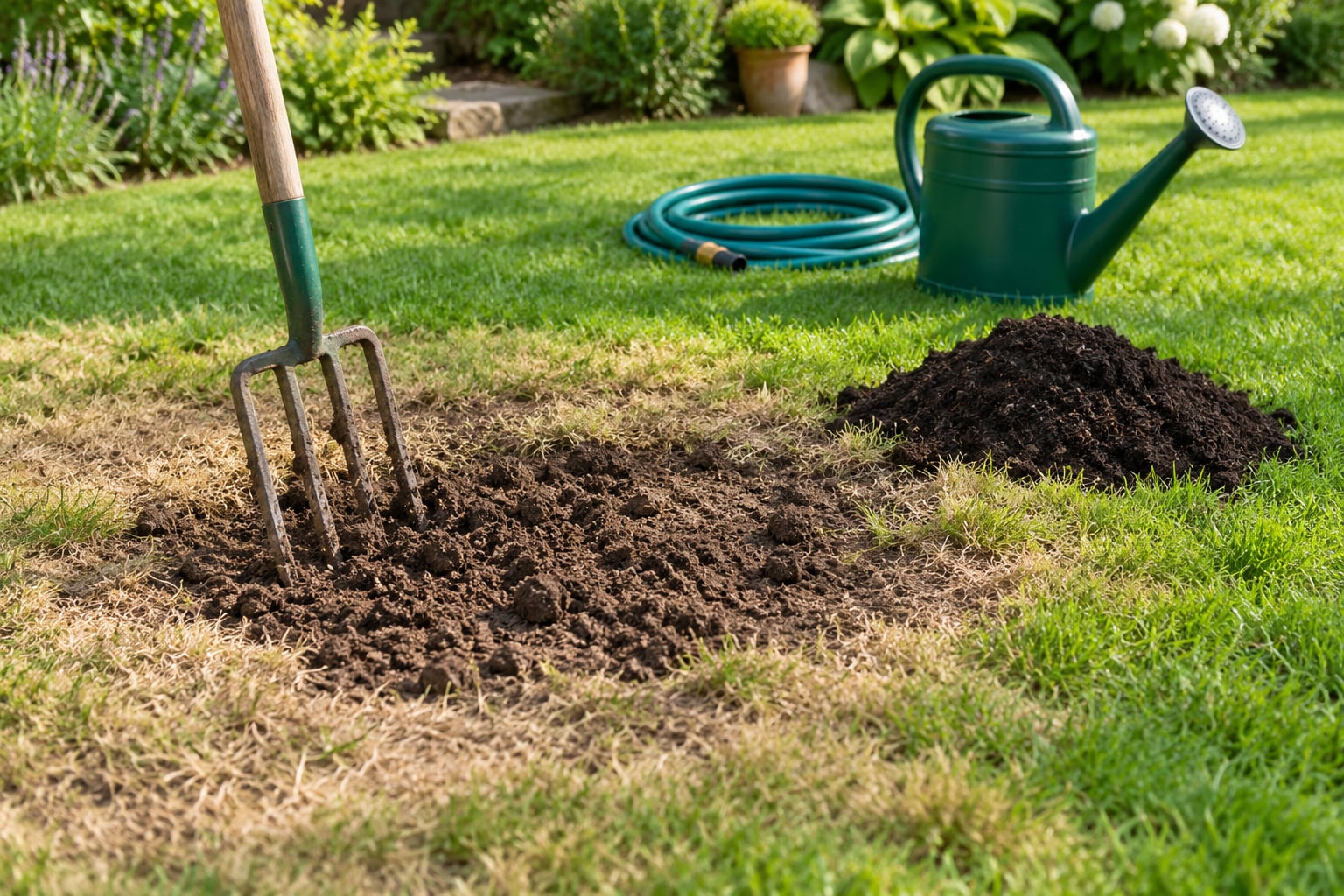
You can fix dry patchy grass without wasting water by fixing the cause first, improving the root zone, and then watering deeply two or three times a week instead of lightly every day. Most failed repairs come from seeding a patch that was never treated, so the seed dies and the whole job gets repeated next season.
A dry patch is a brown, straw-coloured area of dead or dormant turf that forms when water cannot reach the root zone. Soil in that spot has often gone water-repellent, a condition also called hydrophobic, meaning rain beads on the surface and runs off instead of soaking in. Roots stay shallow, the grass browns, and no amount of extra sprinkling fixes it.
Most of the job is a weekend’s work spread over a few weeks. The trick is diagnosing before seeding.
Table of Contents
- What You Need
- Step-by-Step
- 1. Diagnose Why the Grass Is Turning Brown
- 2. Test and Improve the Soil
- 3. Remove the Cause and Prepare the Patch
- 4. Reseed or Lay Sod Correctly
- 5. Water Deeply and Less Frequently
- 6. Keep the Repaired Lawn Healthy
- Common Mistakes
- Frequently Asked Questions
- Will patchy grass eventually fill in on its own?
- Should I rake up dead grass before seeding?
- Should I water my lawn 2 or 3 days a week?
- How many inches of water does 30 minutes of watering give?
- Is 20 minutes enough time to water grass?
- How long should you water your lawn during a drought?
- A Water-Wise Recovery Plan
What You Need
You do not need a lawn service or a bag of special treatment to start. A few tools and materials cover the whole repair.
- A soil test or pH kit to check whether the root zone is acidic or alkaline before you add anything.
- A soil moisture probe or a screwdriver you push into the ground to feel how deep the wetness goes.
- A garden fork or manual core aerator to relieve compaction. A hollow tine aerator is better because it pulls plugs out rather than just poking holes.
- A rake for thatch, debris and the crusted soil surface.
- Screened topsoil and compost for a thin top dressing. Peat-free compost is the usual choice.
- Grass seed suited to your sun and climate, or a small amount of turf sod if the patch is under about a square metre.
- A watering device with a controllable flow, plus a rain gauge or a straight-sided can for measuring.
- A shovel or hand trowel for checking what is happening below the surface.
Step-by-Step
1. Diagnose Why the Grass Is Turning Brown
Find the cause before you buy a single thing, because the fix is completely different for a dry dog patch and a compacted path. Pull up a square inch of turf in the middle of the bad area and look at the roots: white and fibrous means the grass is alive and probably dormant, while brown, mushy or absent roots mean that spot is genuinely dead.
| Cause | What you see | Water-saving fix |
|---|---|---|
| Drought stress | Whole lawn uniformly dull and brown, crisp underfoot, patch edges fading evenly | One deep watering session every 5 to 7 days, checked with the moisture probe |
| Compacted soil | Bare ground along the path from the gate, hard soil that rings when you dig | Core aerate, then top dress with compost so roots can reach moisture |
| Water-repellent soil | Rain pools or sheets off the patch while the ground 2 cm below stays dry | Break the crust, work in compost, and water in several short passes rather than one long one |
| Poor drainage or waterlogging | Yellowing grass, moss, soil that stays wet days after rain | Aerate for air, and stop adding water until the soil drains |
| Pet urine | Round dead spot with a narrow ring of dark green grass around it | Rinse the area, replace the soil in the centre, reseed with a tough wear-tolerant mix |
| Fungal disease | Pink or grey webbing on blades in warm wet weather, or brown rings spreading fast | Improve airflow by thinning the sward, water at the base only, cut nitrogen |
| Too much sun or shade | Patch sits under a fence or wall, or right out in the open with no cover | Overseed with a shade-tolerant mix, or accept grass and plant groundcover in deep shade |
| Overwatering | Soft, smelly soil, moss taking over, yellowing between the green clumps | Cut frequency in half and let the root zone dry between drinks |
| Fertiliser or herbicide burn | Sharp-edged dead area right after an application | Flush the soil with water and wait for new growth rather than feeding again |
One more check matters: how far the water actually goes. Set a straight-sided can or a shallow tray on the lawn, run the sprinkler or hose over it, and measure the depth of water collected. That is your per-session amount, and the measurement is worth repeating every few weeks through summer.
On Reddit’s r/lawncare, the most consistent advice across threads is the same order of operations: aerate and scarify, then overseed, then top dress with compost. People who seed first and fix the soil afterwards tend to end up redoing the patch the following year.
2. Test and Improve the Soil
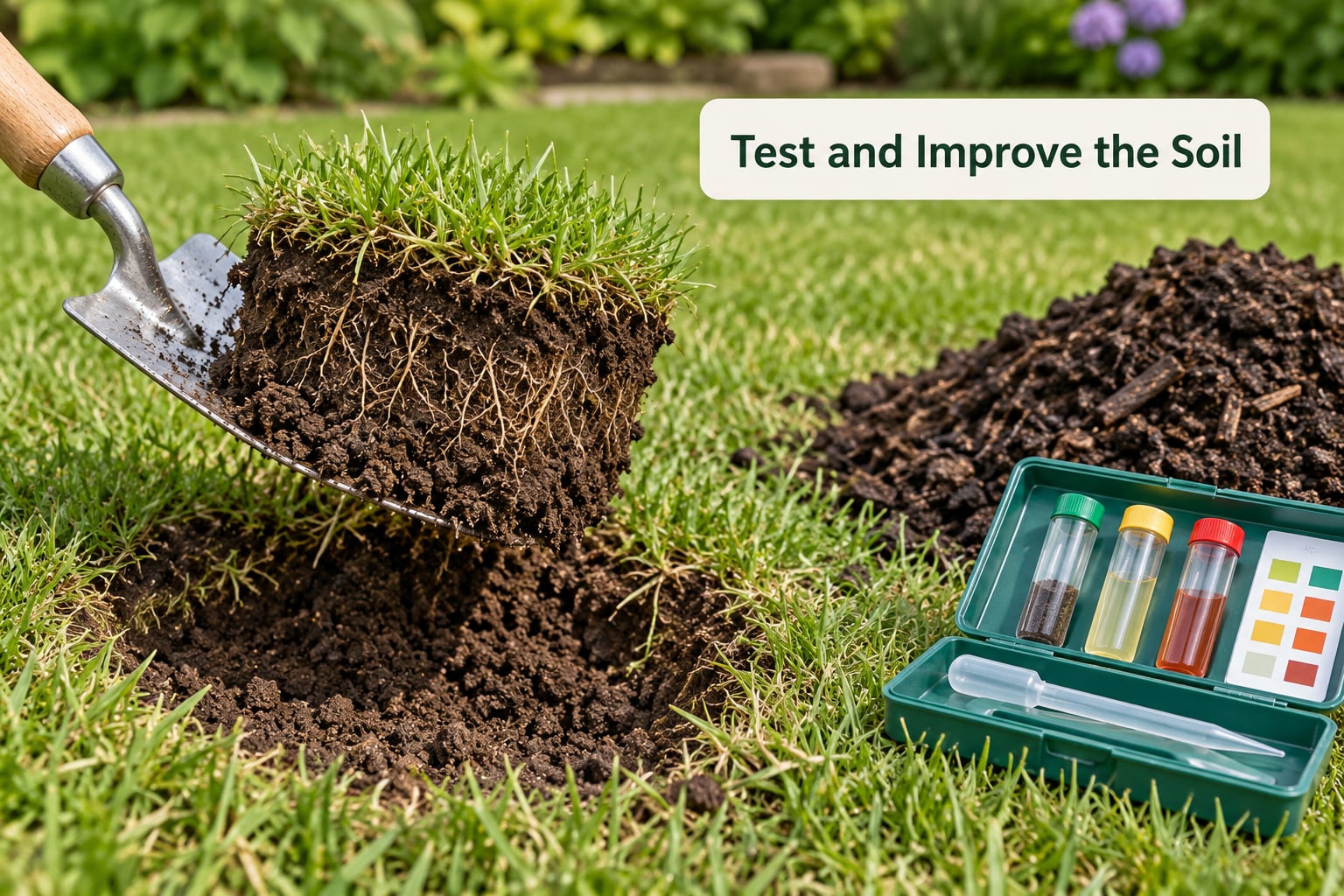
Three things decide whether water reaches the roots: how the soil drains, how deep the moisture goes, and the pH. Test all three before you add anything.
For moisture, push the probe in after a watering session. You want damp at 10 to 15 cm and only slightly damp deeper down. Dry all the way through means you are underwatering; wet for days means you are overwatering or the soil does not drain.
For drainage, dig a hole about 30 cm deep in the patch, fill it with water, let it drain, then fill it again. If the second fill has not drained within four hours, water is pooling around the roots and no amount of irrigation will fix it.
For pH, take samples from a few spots and mix them before testing. Most turf grass wants something between 6.0 and 7.0. Below 6.0 nutrients lock up and the grass cannot use what you apply; above 7.5 iron uptake fails and the leaf tips bleach.
Then improve the root zone with a thin top dressing, roughly 5 to 10 mm of screened compost spread over the patch and feathered onto the surrounding lawn. Do not build up a rich, loose layer on top. A deep blanket of compost creates a soft, airy seedbed that holds water at the surface and dries out fast, and it can also encourage weeds to germinate where your new grass is still thin.
3. Remove the Cause and Prepare the Patch
Clear the dead material first. Rake out loose dead grass, thatch and debris down to bare soil so you can see what you are dealing with, and bag it rather than leaving it to sit on the patch. That is the difference between genuine dead grass and grass that is merely dormant.
If the grass is dormant but the crowns are firm and green at the base, leave it alone. Stay off it, do not mow it and do not rake it. Dry, dormant turf is easily torn up, and walking on it or dragging a rake across it uproots crowns that would have recovered on their own once rain returned.
Once the dead material is gone, break up the crusted soil. Core aerate the whole area if the ground is hard, then rake or scarify the surface to create small holes for seed to fall into. Keep the work light where the surrounding turf is healthy, because bare soil that wide becomes a weed bed by midsummer.
4. Reseed or Lay Sod Correctly
Seed has to sit in contact with damp soil to germinate. Rake the seed across the prepared patch, cover it with a light 5 mm layer of sieved compost or the soil you just dug up, and press it down with the back of a rake head or a roller. Seed floating on a hard surface loses to the first dry week.
Match the mix to conditions rather than to the old lawn. Under trees, walls and fences, use a shade-tolerant blend. In a hot dry climate, pick drought-tolerant species that spread by stolons or rhizomes, so bare areas close over on their own in a good year. On a new-build site where turf was laid over compacted fill, expect the grass to struggle regardless of seed until the ground is opened up and rebuilt.
For patches under roughly a square metre, sod is faster and more certain than seed. Cut the sod to shape, lay it so the edges interlock, tamp it down, and water it in the same day.
Timing matters more than most people expect. Seed in spring once soil has warmed, or in early autumn while the ground is still warm and autumn rain is likely. Reseeding during the hottest part of summer usually fails, because the top inch of soil dries faster than young roots can draw moisture up from below it.
5. Water Deeply and Less Frequently
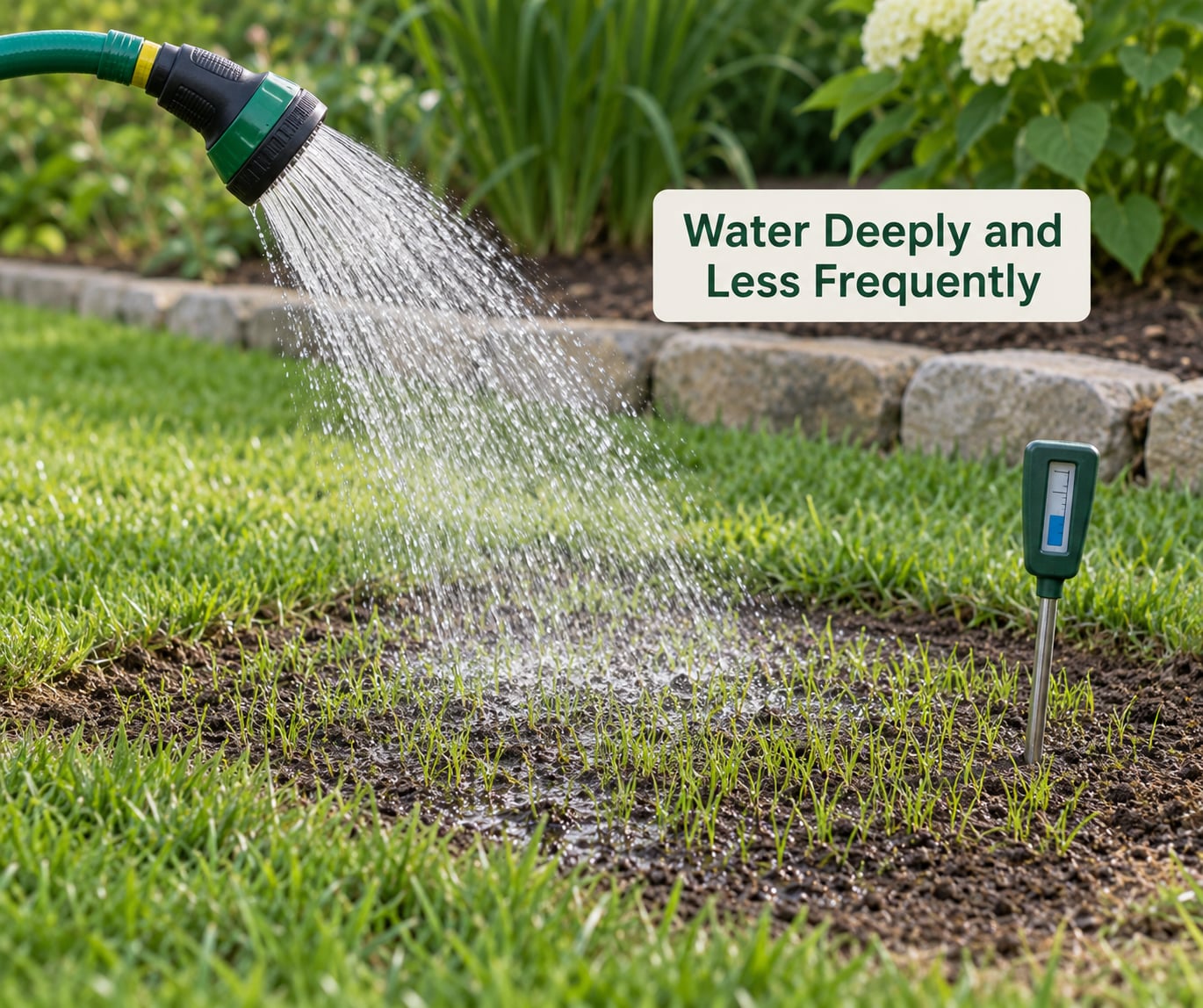
The target is 25 mm of water per week in total for established grass, including rain, spread over two or three watering days. During establishment, new seed needs light, frequent moisture for the first two weeks, then the schedule shifts toward fewer and deeper drinks.
Water between 4 am and 10 am. Cool air, low wind and no leaf wetness overnight mean more of what you apply reaches the roots and less of it evaporates. A midday watering loses far more to evaporation than the same volume applied in the morning.
If your soil is water-repellent, split one deep drink into three shorter passes with 20-minute gaps between them. Repellent soil takes the first pass on the surface, then the next two go in instead of running off the edge.
Track what you apply with the can test rather than the clock. Thirty minutes of sprinkler output can mean 10 mm on one head and 25 mm on another, and a part-timer left running through a windy afternoon may deliver less to the soil than a short morning session. Rain gauges measure what fell; irrigation auditors and smart controllers use those readings to skip cycles the week after a storm.
A quick reference for the depth you are aiming for:
| Depth applied per session | Water per square metre | What it looks like |
|---|---|---|
| 5 mm | 5 litres | Surface damp only, roots stay shallow |
| 10 mm | 10 litres | Damp through the top 5 cm, the minimum for drought-stressed turf |
| 25 mm | 25 litres | Wets the full root zone, the weekly target for established grass |
On a 100 square metre lawn, 25 litres per square metre once a week is 2,500 litres a week. Cutting that from three sessions of 10 mm to two sessions of 12 mm saves roughly 200 litres a week with no visible difference in the lawn.
6. Keep the Repaired Lawn Healthy
New grass needs a few weeks of protection before it can carry normal traffic. Keep children, pets and the mower off the repaired area until the blades are roughly 8 cm tall and the roots hold when you tug gently.
Mow less often and higher for the whole lawn, not just the patch. Leaving 6 to 8 cm of leaf shades the soil, slows evaporation and gives the lawn more root, and a taller sward copes better with heat than a close-cut one. Never take more than a third of the blade length in one pass, because cutting hard into drought-stressed turf turns a dry patch into a scalped, bare one.
Feed lightly. A slow-release feed at the start of the growing season keeps growth even without the spike that pushes roots outward. Avoid high-nitrogen products in hot weather, since new growth at the wrong time of year is easily scorched.
Water by soil moisture rather than by the calendar. Check the patch with the probe every few days, especially during a dry spell, and stop adding water the moment the root zone is damp to 10 cm. That habit alone cuts most lawn watering.
If drought restrictions apply where you live, work inside the permitted days rather than ignoring them. Watering established turf deeply and less often fits most published schedules better than a daily sprinkle, because fewer, longer sessions give the lawn more before the next permitted day arrives. Local water utility websites publish the current rules and the permitted hours.
Common Mistakes
Almost every failed lawn repair I have seen comes down to the same handful of mistakes.
Watering every day. Short daily sprinkles keep roots near the surface, where they dry out and die faster, and they encourage moss and shallow-rooted weeds. Two or three deep sessions a week is what a healthy lawn wants.
Seeding without fixing the cause. Seed thrown onto compacted, crusted or water-repellent soil germinates poorly, fails in the next dry spell, and costs you seed and water twice. Diagnose, improve the soil, then seed.
Raking dormant grass. Dormant crowns are alive. Raking, mowing or walking on them tears them out and turns a lawn that would have recovered into bare ground.
Feeding a scorched lawn. A stressed lawn cannot use extra nitrogen, and feeding during a drought causes chemical burn on top of drought stress. Repair the water problem first, then feed later in the season.
Mowing too short. Cutting drought-stressed grass low removes the leaf area that shades the soil and roots, and it exposes the crown to heat. Raise the mower and take off less.
Reseeding at the wrong time. Midsummer seed needs daily moisture to survive, and daily moisture in a dry spell is exactly the waste you are trying to avoid. Seed in spring or early autumn instead.
Frequently Asked Questions
Will patchy grass eventually fill in on its own?
It depends on whether the grass is dead or dormant. If the crowns are firm and green at the base, the lawn usually recovers on its own once water returns, often within two to four weeks of real rain. If the roots are brown, mushy or missing, the grass is dead and will not come back, so you need to reseed or lay sod. Pull up a small square in the middle of the patch to check before spending anything.
Should I rake up dead grass before seeding?
Rake out loose dead grass, thatch and debris so the seed reaches soil, then remove it from the patch rather than leaving it on top. But do not rake grass that is only dormant. Check the base of the blades first: firm and green means dormant and leave it alone, brittle and brown all the way down means dead and clear it away. Raking dormant turf uproots living crowns and turns a recovering lawn into bare ground.
Should I water my lawn 2 or 3 days a week?
Two or three days a week suits most established lawns, using one deep session on each permitted day rather than a light sprinkle. Aim for about 25 mm of water per week in total including rainfall, applied between 4 am and 10 am. Measure with a straight-sided can on the lawn rather than trusting the timer, and cut back automatically after rain so you are not watering a wet soil.
How many inches of water does 30 minutes of watering give?
There is no fixed answer, because output depends on the sprinkler head, wind and pressure. Place a straight-sided can or shallow tray on the lawn, run the sprinkler as you normally would, and measure the depth. One inch equals roughly 25 mm, or 25 litres per square metre. Repeat the test at the far corner of the lawn, because uneven coverage is one of the most common causes of patchy grass.
Is 20 minutes enough time to water grass?
It can be, but only if you have measured it. Twenty minutes from a sprinkler might apply 8 mm in one spot and 20 mm in another, so the number tells you very little. Run the can test, note the depth you got, and adjust the run time until you hit your weekly target. For new seed, shorter and more frequent passes are right for the first two weeks only.
How long should you water your lawn during a drought?
Long enough to wet the full root zone, then stop until the soil dries again. Put a can on the lawn and keep watering until you have collected about 25 mm, which is a normal weekly target for established grass. During a drought you can stretch that to every 10 to 14 days while growth is slow, because the priority is keeping crowns alive rather than pushing growth. Stay inside your local authority’s permitted watering days and hours.
A Water-Wise Recovery Plan
Find the cause before you spend anything: pull up a square of turf, check whether the crowns are alive, and read the shape of the patch.
Open the soil next. Core aerate compacted ground, work in a thin compost dressing, and break the crusted surface so water can reach the roots instead of running off them.
Reseed or lay sod once, in spring or early autumn, with a mix matched to the sun and soil your patch actually has.
Irrigate by soil moisture from then on: one deep morning session two or three times a week, measured with a can, cut back after rain and during drought restrictions.
Keep the sward taller than you are used to, keep traffic off the new grass while it knits, and check the patch with a moisture probe rather than with the calendar. That is how to fix dry patchy grass without wasting water, and it is why the same patch does not go bare again the following summer.