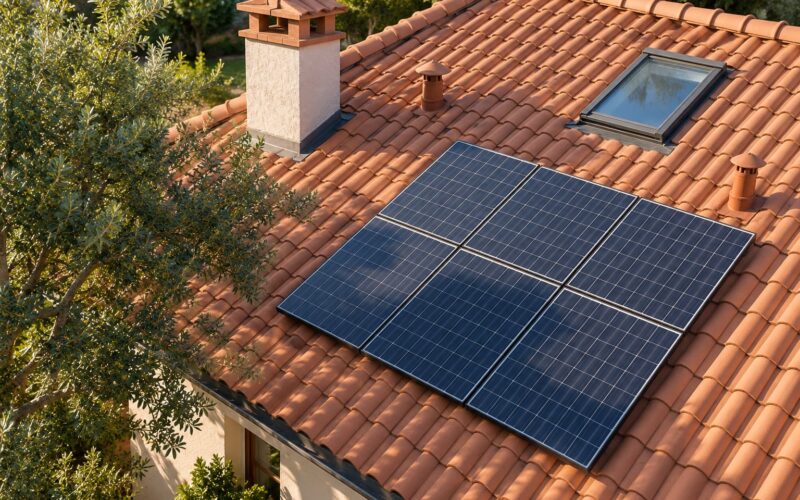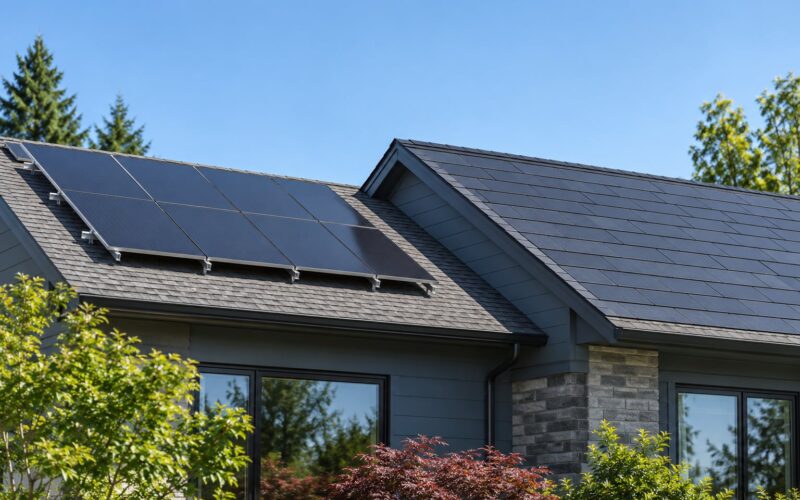
A solar battery backup is a rechargeable battery system that stores the electricity your solar panels make during the day, then releases it at night, during expensive peak-rate hours, or to keep circuits running when the grid goes down. Whether you need one depends almost entirely on how often your power fails, how long the failures last, and what you need to keep switched on.
That last part catches people out. Most households buying solar assume their panels will carry them through a storm. They will not. A standard grid-tied array shuts itself off the moment the grid fails, for safety reasons that nobody disputes.
The sections below work through what the system actually is, what it can realistically power, how to size it, and who gets real value from the money. Nothing here is a product recommendation, and no figure here should be treated as a quote for your home.
Table of Contents
- How Does a Solar Battery Backup Work?
- Why solar panels alone go dark in an outage
- What Does a Solar Battery Backup Provide During an Outage?
- Essential loads only
- Whole-home backup
- What usually works, and what usually does not
- What Is the Difference Between Solar Battery Backup and a Regular Battery?
- Solar battery backup and standby generator
- Solar battery backup and portable power station
- Solar battery backup and conventional standby battery
- How Much Solar Battery Capacity Do You Need?
- What Is the Difference Between Battery Power and Energy?
- How Do You Choose the Right Solar Battery Backup?
- Start with the outage profile
- Decide between essential loads and whole-home
- Check physical space and siting
- Check solar production and pairing
- Compare chemistry
- Compare the specification that actually matters
- Plan for expansion
- How Much Does a Solar Battery Backup Cost?
- Do You Need a Solar Battery Backup?
- What a solar battery cannot do
- Score it in thirty seconds
- How Is a Solar Battery Backup Installed and Maintained?
- The process
- Maintenance
- What Safety and Reliability Questions Should You Ask an Installer?
- Frequently Asked Questions
- Do solar panels work without a battery?
- Does a solar battery backup work at night?
- Can I add a battery to solar panels I already have?
- Can a solar battery replace a generator?
- How long does a solar battery backup installation take?
- How long do solar batteries last?
- Conclusion
How Does a Solar Battery Backup Work?
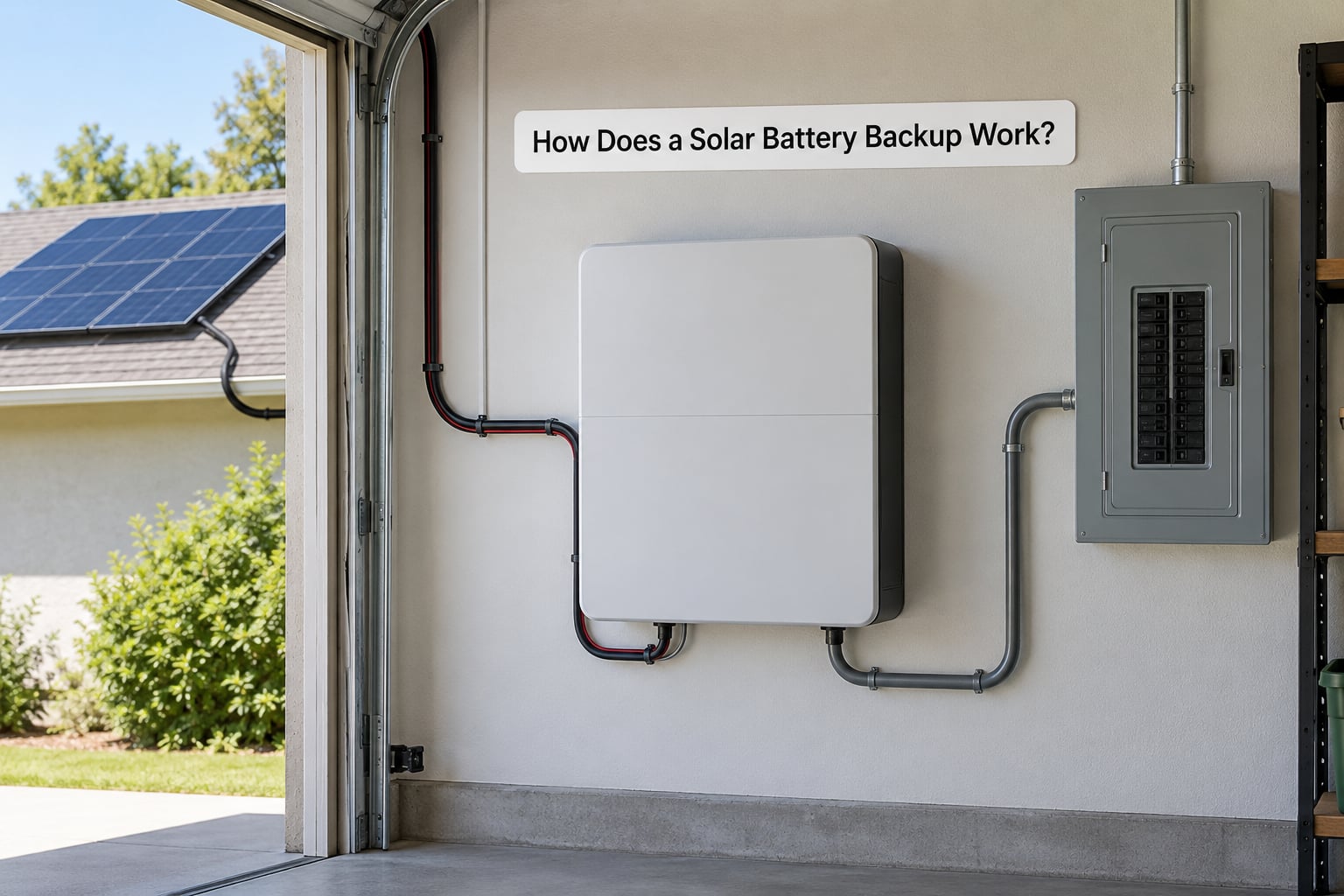
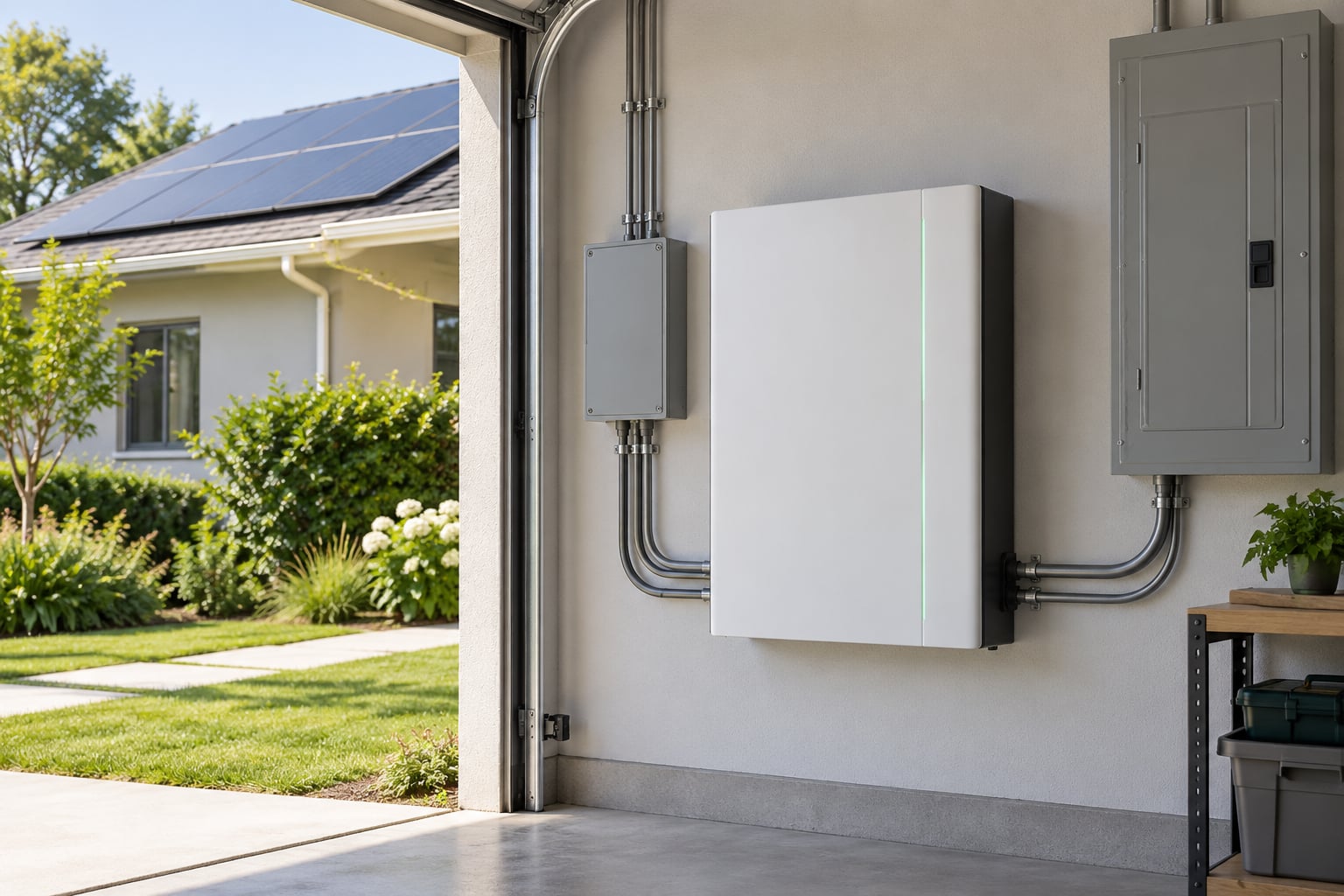
A solar battery backup sits between your panels, your inverter and your household circuits. Four components do the work.
- The solar array. Panels produce direct current (DC) electricity. Output follows the sun, so it peaks around midday and drops to nothing at night.
- The charge controller or hybrid inverter. This device decides where the energy goes: into the house, into the battery, or out to the grid.
- The battery. It holds surplus energy chemically rather than sending it to the utility. Most home systems use lithium iron phosphate, usually abbreviated LiFePO4.
- The energy management system. Software and hardware that prioritise loads, watch state of charge and switch the house over when the grid fails.
During a sunny afternoon with more generation than the house needs, the extra power charges the battery instead of being exported. Around dinnertime, when demand peaks and the panels have faded, the inverter draws from the battery first. If the battery empties and the grid is still up, the house runs on grid power as normal.
When the grid fails, the system detects the loss and opens the connection to the battery within a fraction of a second. Households running computers and network equipment report the switchover is barely noticeable. If solar production is strong during the outage, some systems can recharge the battery while still supplying the house.
Why solar panels alone go dark in an outage
Grid-tied inverters are required to stop producing when grid power stops. The rule is called anti-islanding, and it exists because a live array feeding power into a dead line can electrocute a lineworker who thinks the cable is safe.
So if your only source is a grid-tied array, the sun can be blazing overhead and your house stays black. A battery breaks that rule by creating its own island of local power, which is the entire reason the technology exists.
What Does a Solar Battery Backup Provide During an Outage?
What it provides depends on how the system was designed, not on the size of the battery alone. Two homes with identical 20 kWh batteries can behave completely differently if one was wired to a critical load sub-panel and the other to the main panel.
Essential loads only
An essential-loads system powers a selected sub-panel: typically the refrigerator, some lights, the internet router, a modem, maybe a medical device. Everything else stays off. This is the cheaper route and the most common starting point.
Whole-home backup
A whole-home system connects to the main panel, so lighting, outlets, washing machines and small appliances all work as usual. Heating, air conditioning, well pumps, ovens and electric vehicle charging usually need either a much larger battery bank, a generator, or both.
What usually works, and what usually does not
- Reliable for hours: refrigerators and freezers, internet and networking, lighting, phone charging, Wi-Fi routers, small medical monitors, televisions, laptops.
- Possible but short-lived: microwaves, kettles, hair dryers, power tools, washing machines. Fine for a single use, expensive in stored energy.
- Rough on capacity: electric space heaters, tumble dryers, dishwashers, dehumidifiers, air conditioning, well pumps and anything with a compressor.
- Roughly out of reach: electric vehicle charging, electric water heating for a full household, swimming pool pumps, whole-home heating on electric resistance.
When the battery runs flat, most grid-tied installations shut down cleanly rather than sending damaged power back to a grid that may still be unstable. Your house goes dark again until either the grid returns or enough sunlight arrives to restart the system. That behaviour is by design, and it is worth confirming in writing before you sign anything.
Medical equipment deserves its own conversation with your supplier and your care team. Battery runtime figures are averages, not guarantees, and continuity planning for powered medical devices should never rest on a single consumer system.
What Is the Difference Between Solar Battery Backup and a Regular Battery?
The phrase covers several different things, and the comparison that matters most is between a home battery system and the alternatives you would otherwise buy.
Solar battery backup and standby generator
A generator burns fuel, makes noise, produces exhaust and needs servicing. A battery is silent, has no moving parts, and needs no fuel deliveries. The generator wins on runtime: a tank of fuel lasts far longer than any battery, and it can be refuelled while it runs.
Solar battery backup and portable power station
A portable power station is a small lithium unit with sockets, usually a few kilowatt-hours of capacity. It is portable, needs no installation, and runs a laptop or a lamp for a day. It cannot run a refrigerator overnight very often, and plugging a house into it is not an option. Most households use them as a stopgap while deciding on a real system.
Solar battery backup and conventional standby battery
A conventional standby battery, usually lead-acid, sits on a standby power unit and starts when the grid fails. It needs no solar and no inverter changes, and it is a legitimate choice for critical circuits in a home with no array. It is bulky, has a shorter usable range, needs periodic maintenance, and degrades faster in warm conditions.
Where does the charging come from? That single question separates most of these options. Solar battery systems usually charge from solar first, then from the grid. Standby batteries charge from the grid only. Portable power stations charge from a wall outlet, a car, or a small portable panel.
How Much Solar Battery Capacity Do You Need?
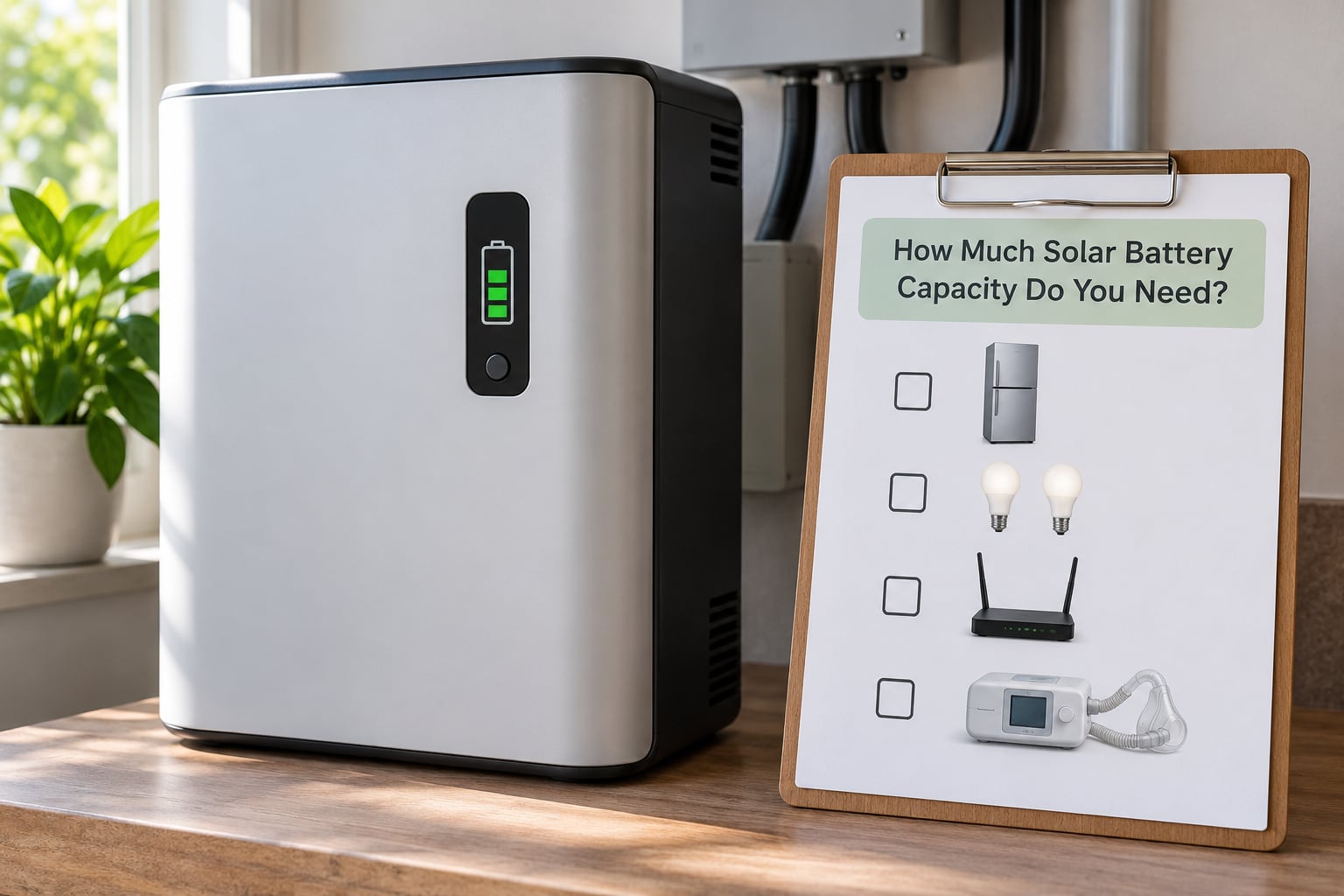
Work from what you need to keep running, not from a number you have seen advertised. The table below shows typical figures for an essential-loads household. Every row is an estimate for an average European or North American home, and your own numbers will differ.
| Load | Typical running power | Daily energy use | What it means for sizing |
|---|---|---|---|
| Refrigerator (cycling) | 60 to 200 W | about 1.5 kWh a day | Run for a day needs several kWh on its own |
| Freezer | 70 to 250 W | about 1 kWh a day | Add to the refrigerator figure for a full kitchen |
| Router and modem | 15 to 25 W | 0.4 to 0.6 kWh a day | Small, but essential for work and remote schooling |
| Lamps (LED, 5 bulbs) | 40 to 60 W | 0.5 kWh for a few hours | Cheap to run for long stretches |
| Wi-Fi and small home office | 150 to 400 W | 1 to 3 kWh a day | Pushes essential loads into the mid-single-digit kWh |
| Small medical device | 100 to 300 W | 2 to 5 kWh a day | Determines runtime; needs dedicated circuits |
| Electric shower or kettle | 2 to 3 kW | sporadic, high draw | Tests inverter power, not just capacity |
| Small pump or well pump | 350 to 750 W | 1 to 3 kWh a day | Check surge requirements before assuming it will start |
Add those rows up and multiply by the number of hours you realistically expect to be without power. A household running a refrigerator, a router and lighting through a twelve-hour overnight outage is looking at roughly 6 to 8 kWh of stored energy before any inefficiency losses. Add a medical device or a home office and the figure climbs.
Two rules of thumb help. First, you can never use the full nameplate capacity, because manufacturers reserve some charge for battery health. Usable capacity is typically around 80 to 90 percent of the label figure. Second, power and capacity are different things, which is the next section.
These are planning figures only. An accurate answer requires a load calculation and a site assessment from a qualified electrician or solar installer.
What Is the Difference Between Battery Power and Energy?
Power is how fast you can use energy at one moment. Energy is how much you have stored in total. The units are kilowatts (kW) and kilowatt-hours (kWh), and confusing them is the most common source of disappointment in this whole topic.
Think of a kettle. It draws around 2 to 3 kW while it runs, but only for three or four minutes. It uses a small amount of energy overall. A refrigerator draws under 200 W but stays connected for twelve hours a day. It uses very little power and a fair amount of energy.
Applying that to batteries: a unit rated 5 kW and 13.5 kWh can briefly support loads totalling 5 kW, and in total gives you 13.5 kWh of usable-after-losses energy. A small unit rated 2 kW and 2.5 kWh cannot start a refrigerator compressor or run a pump, no matter how good its charge.
That is why a household running a pump or a microwave needs to check the kW rating first, and a household running a refrigerator overnight needs the kWh figure. Many battery product claims quote only one of the two.
How Do You Choose the Right Solar Battery Backup?
Work through these in order. The first four decide the hardware; the rest decide whether you will still be happy with it in year ten.
Start with the outage profile
How long are outages where you live, and how often? Check your utility’s outage history or ask neighbours. A household with two short interruptions a year is solving a different problem from one that loses power for two days several times a summer.
Decide between essential loads and whole-home
Essential loads are cheaper, quieter and easier to size. Whole-home backup costs more and demands a bigger inverter, yet it removes the frustration of hunting for which breaker to keep switched on.
Check physical space and siting
Batteries are heavy, wall-mounted and need clearance for ventilation and service access. Local fire codes typically specify minimum distances from doors, windows and ignition sources, and some regions require fire-rated wallboard. Measure the wall before you choose the product, and tell your insurer about the installation.
Check solar production and pairing
A battery needs charge coming from somewhere. If your array is small or shaded, the battery may spend more time idle than you expect. Confirm that the battery is compatible with your existing inverter, or budget for a hybrid inverter replacement, which is a substantial part of the job.
Compare chemistry
- LiFePO4: the default for home storage. High usable depth of discharge, long cycle life, low maintenance, tolerant of heat. Costs more upfront.
- Lead-acid: cheaper per kilowatt-hour, but heavy, needs ventilation, tolerates roughly half the depth of discharge and needs more frequent replacement.
- Flow batteries: long cycle life and good for very frequent cycling. Bulky and rarely sized for a house.
- Nickel-cadmium: extremely durable and tolerant of harsh conditions, but uncommon in residential solar now.
Compare the specification that actually matters
Usable kWh, continuous and surge kW, depth of discharge, round-trip efficiency, cycle life and capacity retention over ten years, warranty on both the battery and the workmanship, and monitoring quality. Round-trip efficiency is simply the share of energy put in that comes back out; nothing reaches 100 percent, and anything above 90 percent is good.
Plan for expansion
Most systems are modular. Ask whether extra capacity can be added later, whether that requires a new inverter, and whether adding it later changes your eligibility for any support scheme.
How Much Does a Solar Battery Backup Cost?
Quotations vary a great deal by home, region and specification, so treat any figure you find online, including mine, as a starting point for your own research rather than an answer. The cost is made up of these parts.
- Battery equipment. Driven by usable kilowatt-hours, chemistry and power rating. This is usually the largest line.
- Inverter or hybrid inverter. If your existing inverter cannot handle storage, this becomes a second major cost, or part of a full system replacement.
- Electrical work. Transfer switch, critical load sub-panel, conduit, disconnects, meter changes, utility interconnection. Older homes need more of this than newer ones.
- Solar charging equipment. Charge controllers, additional panels or an upgraded array, if you do not already have surplus production.
- Permitting and inspection. Building and electrical permits, utility interconnection approval.
- Monitoring and commissioning. Setup, configuration and app access.
- Ongoing ownership. Monitoring subscriptions, inverter replacement later in the system life, and eventual battery replacement.
Do not forget the last one. Batteries lose capacity gradually, and most warranties cover throughput in cycles or a retention percentage at a stated year. Ask what replacement looks like at year twelve and whether it is guaranteed at a known price.
On incentives: rules change regularly, and the programmes that supported batteries two years ago may not apply to your project now. Federal or regional tax credits, utility rebates, self-generation programmes and time-limited grants all exist in some places. Rather than trusting any article’s numbers, including this one, check your national energy agency, your utility and your regional government directly, and confirm eligibility for your specific configuration before you sign.
One structural detail is worth knowing: adding a battery to an array you already own may qualify under different rules from installing storage at the same time as new panels. Ask about that early, because it can change the arithmetic considerably.
Do You Need a Solar Battery Backup?
You most likely need one if at least two of these are true.
- Your area has frequent outages, or outages that last more than a few hours.
- You run powered medical equipment, or someone in the household depends on electricity for health reasons.
- You work from home and lose money or productivity when power drops.
- You are on a time-of-use tariff where peak-rate hours cost several times your off-peak rate.
- Your export compensation has been reduced, so surplus solar earns far less than it used to.
- You live off-grid, or in a remote building, cabin, workshop or small business.
- You want to charge an electric vehicle or water heater from stored solar.
- Storms, heatwaves or wildfire smoke regularly disrupt your grid and you plan to stay put.
You can probably skip one if your grid has been reliable, your export credit is generous, your household uses little energy, and the only goal is the fastest financial return. Homeowners on forum boards are blunt about this: where outages run about an hour twice in three years, a battery is expensive insurance for a problem you rarely have.
What a solar battery cannot do
Honesty here is more useful than enthusiasm.
- It will not make your panels work during an outage if the battery and array are not wired for islanded operation.
- It will not carry a house through a multi-day outage with no sunlight unless it is very large.
- It will not run heavy loads continuously. Compressors, resistance heating and EV charging demand both power and volume.
- Its output drops in cold conditions in some designs. In a mild climate this barely matters; in a cold region it does.
- It does not remove the grid from your home. You still need a functioning connection and an agreement with your utility.
- It does not guarantee a specific runtime. Real figures depend on temperature, age, load and how much the battery was charged before the failure.
Score it in thirty seconds
Count one point for each yes: outages longer than four hours at least a few times a year; powered medical equipment; a home office that stops without power; a time-of-use tariff; reduced export compensation; a remote or off-grid building; a plan to charge a vehicle from stored solar. Six or more points is a reasonable case for a quotation. Three or fewer probably is not.
If you are still unsure, a portable power station covers short outages while you think, and a small essentials-only battery is a common first step. Neither commits you to a whole-home project.
How Is a Solar Battery Backup Installed and Maintained?
Installation is not a weekend job. It involves high-voltage DC wiring, grid interconnection and licensed electrical work.
The process
- Load assessment. An electrician identifies what you want to keep running during an outage and how much power it draws together.
- Equipment selection. Capacity and power are matched to that list, plus inverter compatibility and wall space.
- Design and permits. The installer produces a design, submits building and electrical permits, and applies for utility interconnection approval.
- Mounting and wiring. The battery goes on a suitable wall, then is connected to the inverter, the critical load sub-panel or main panel, and the array.
- Configuration and commissioning. The inverter, energy management system and monitoring app are set up, protective settings are verified, and the inspector signs off.
Timeline varies widely depending on permits, utility queue and whether your utility needs to replace the meter. Households report anywhere from a few weeks to many months, so ask for a realistic schedule before you commit, and confirm who handles the paperwork.
Maintenance
After that, a lithium system needs very little. Keep the app open occasionally and check state of charge and error messages. Keep the area around the unit clear, dry and unobstructed. Listen for anything unusual. Make sure vents are not blocked, and keep combustible items away from the enclosure.
Test the system the way a fire drill would: turn off your mains supply from the breaker, confirm the house stays on, and see how long the essential loads actually last. Homeowners who have run this test tend to be far less anxious during a real outage.
Agree in advance who to call when something fails, whether that is the manufacturer, the installer or both, and what response time the warranty carries.
What Safety and Reliability Questions Should You Ask an Installer?
Ask these before signing anything. A professional will answer them directly.
- What electrical qualifications and insurances do you hold, and who is doing the work in my home?
- What warranty covers the battery, the inverter and the workmanship, and for how long? Is there a separate workmanship warranty?
- What happens to my system when the grid returns, and what happens when the battery empties during an outage?
- How does the system behave at switchover, and does anything reboot or flicker?
- What grounding, surge protection and disconnects will be installed?
- Where will the battery be mounted, and what clearances and fire-rated materials does local code require?
- Does this installation need a permit, an inspection, utility interconnection approval or a meter change? Who applies?
- What is the realistic runtime for my essential loads, and is that measured or estimated?
- What does the monitoring tell me, and who gets alerted when something goes wrong?
- Do I need to tell my home insurer, and does this affect my policy?
- What does capacity look like at year ten, and what does replacement cost at that point?
- Can I add capacity later, and does adding it now affect what support schemes I qualify for?
Follow the manufacturer’s instructions, keep the unit within its stated temperature and ventilation limits, and use a qualified professional for any electrical work. Never open a battery enclosure yourself, and keep water and combustible materials away from it.
Frequently Asked Questions
Do solar panels work without a battery?
Yes. Most rooftop solar systems have no battery and still save money by exporting surplus energy to the grid. What they cannot do is keep running during an outage, because grid-tied inverters must shut down when grid power fails, a safety rule called anti-islanding. A battery creates a separate local supply so the house stays powered when the grid drops.
Does a solar battery backup work at night?
That is the main job. Surplus energy generated during the day is stored and released at night, on cloudy days and during expensive peak-rate hours. A battery holds charge without any input from the grid, though it loses a small amount to self-discharge and it delivers slightly less than it stored. If the battery empties, the home simply falls back to grid power.
Can I add a battery to solar panels I already have?
Usually yes, but check compatibility first. Your existing inverter may not be able to manage storage, in which case you need a hybrid inverter or a second inverter, and that is a meaningful part of the cost. Note also that adding storage later can qualify under different rules from installing panels and storage together, so check local support schemes before you commit.
Can a solar battery replace a generator?
For most households, partly. A battery runs silently, needs no fuel and starts instantly, which makes it better for short and frequent outages. A generator still wins on long runtimes, heavy loads and the ability to be refuelled while running. Many owners keep both, using the battery for daily essentials and the generator for heat, cooling and multi-day events.
How long does a solar battery backup installation take?
A straightforward essentials-only job can be finished within a few weeks, but permits, utility interconnection approval and meter changes set the real schedule. Households report anything from several weeks to many months depending on the region and the queue. If your inverter needs replacing, or your utility must service the meter, expect longer. Ask for a written schedule with dates.
How long do solar batteries last?
It depends on chemistry, usage and temperature. Lithium iron phosphate home batteries commonly carry warranties of ten years or around 6,000 to 10,000 cycles, and most lose capacity gradually rather than failing suddenly. Lead-acid units typically need replacing much sooner and need more maintenance. Ask what capacity retention is guaranteed at year ten and what replacement would cost.
Conclusion
Here is the first thing to do, before you look at any product: write down what you need to keep running during an outage, estimate how many hours that has to last, and turn both into kilowatt-hours and kilowatts. Then compare that number against what you are prepared to spend, and ask for a site-specific quotation from a qualified installer.
A solar battery backup earns its place when reliable electricity during outages genuinely matters to your household, and when the home can physically and electrically accommodate the equipment. It is not a good answer if the grid rarely fails, or if the only measure is getting the money back quickly. Work out which of those describes you before you spend anything.