Here is the short version of what happens to glass in curbside recycling: it is collected, dumped at a sorting plant, separated from everything else, sorted by colour, crushed into small pieces called cullet, and then melted with sand and other raw materials to make new bottles and jars, fiberglass insulation, or aggregate for roads and concrete. Where it ends up depends almost entirely on what your local facility accepts.
Table of Contents
- What Happens to Glass in Curbside Recycling?
- The full route, in eight steps
- At a glance
- Which Types of Glass Can Go in Curbside Recycling?
- How the Glass Is Collected and Sorted
- What happens to glass in curbside recycling once it reaches the sorting plant?
- Why Glass Contamination Matters
- What Happens to the Glass at the Recycling Facility?
- How Recycled Glass Becomes a New Product
- How to Recycle Glass Correctly in Your Area
- Frequently Asked Questions
- Can broken glass go in curbside recycling?
- Why is drinking glass not accepted in curbside recycling?
- How many times can glass be recycled?
- Does recycling glass really save energy?
- What should I do if my local curbside program does not accept glass?
- Are dish soap bottles recyclable?
- Conclusion
What Happens to Glass in Curbside Recycling?
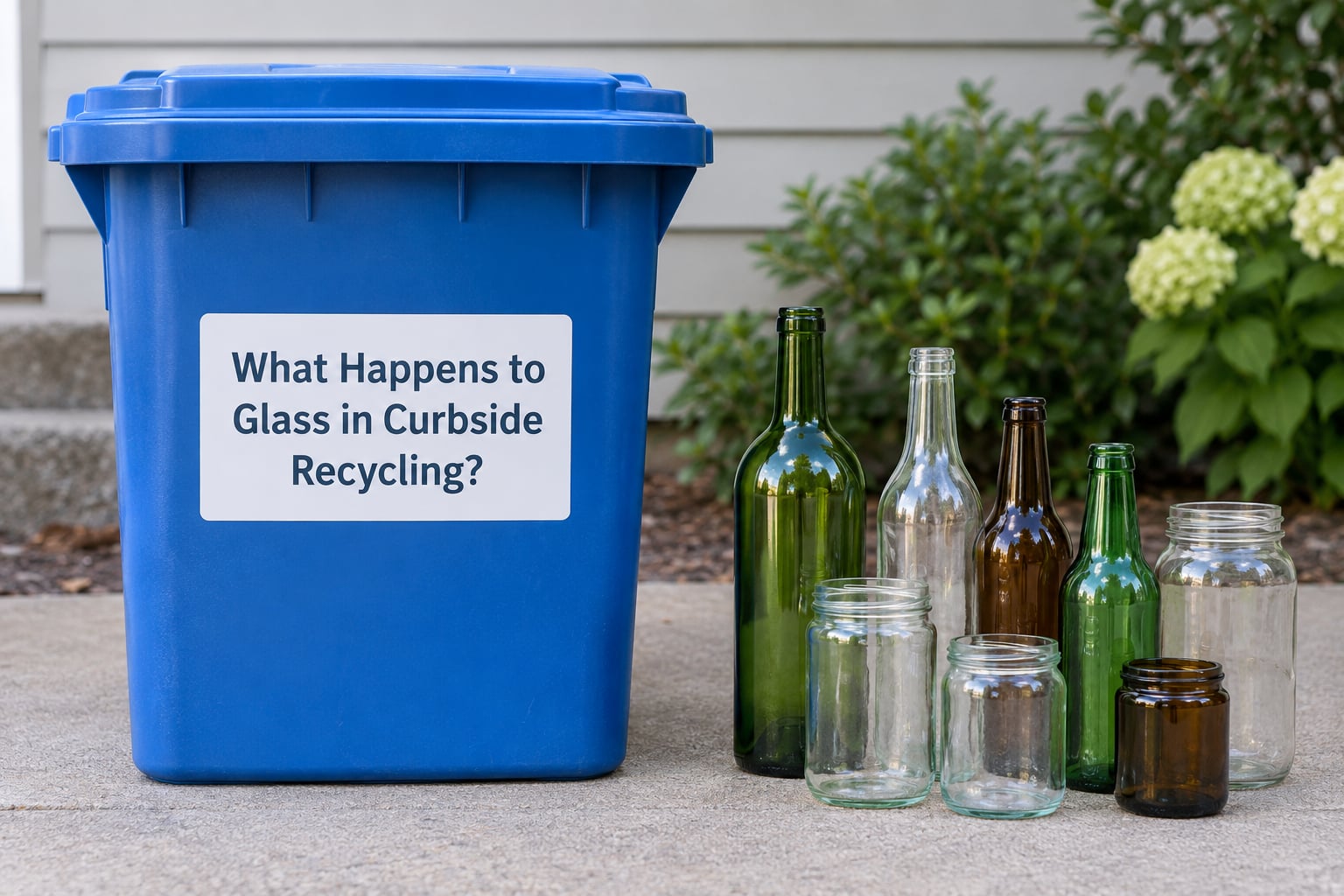
What happens to glass in curbside recycling is not complicated, but it is also not magic. Nothing is melted in the back of the truck. The glass travels as solid material until it reaches a plant built to sort it, and every stage after that is a mechanical and thermal process with predictable results.
The single biggest variable is your municipality. Some programs run a mixed single-stream line that handles glass. Many others have removed glass entirely and send households to a drop-off site or bottle bank instead.
The full route, in eight steps
- You prepare it at home. Containers get emptied, rinsed and, in most programs, dried. Lids and caps go on loose, labels stay on.
- The collection truck arrives. A side-loading or front-loading truck takes the bin and, on biweekly routes, mixes glass with paper, cardboard, metal and rigid plastics in one compartment.
- The load reaches a transfer station or sorting plant. Smaller trucks tip into a larger one, or the vehicle drives straight to the plant if the route allows it.
- Screens and magnets do the first separation. Screens shake out fines and small items. A magnet pulls steel and aluminium caps off the line.
- Staff and optical sorters remove the wrong material. Plastic, ceramics, paper, and non-container glass get picked off by hand or by colour-sensitive cameras before glass continues.
- Container glass gets colour sorted. Flint (clear), amber (brown) and green or emerald glass are separated where the plant runs that extra step. Other plants process mixed colour together.
- The clean glass is crushed into cullet. Cullet is the industry word for cleaned, broken recycled glass. It travels to a glass manufacturer by truck or rail.
- Cullet is melted into something new. It is blended with silica sand, soda ash and limestone, melted at roughly 1400 to 1600 degrees Celsius, then formed into new containers, fiber or aggregate.
At a glance
- Cullet: cleaned recycled glass crushed to a consistent size and ready to be melted.
- Material recovery facility (MRF): the plant where mixed curbside recyclables are pulled apart into separate material streams.
- Glass-to-glass recycling: closed-loop recycling where old containers become new containers of a similar type.
- Residue: the unrecoverable fraction that leaves the sorting line and goes to landfill or energy recovery.
Which Types of Glass Can Go in Curbside Recycling?
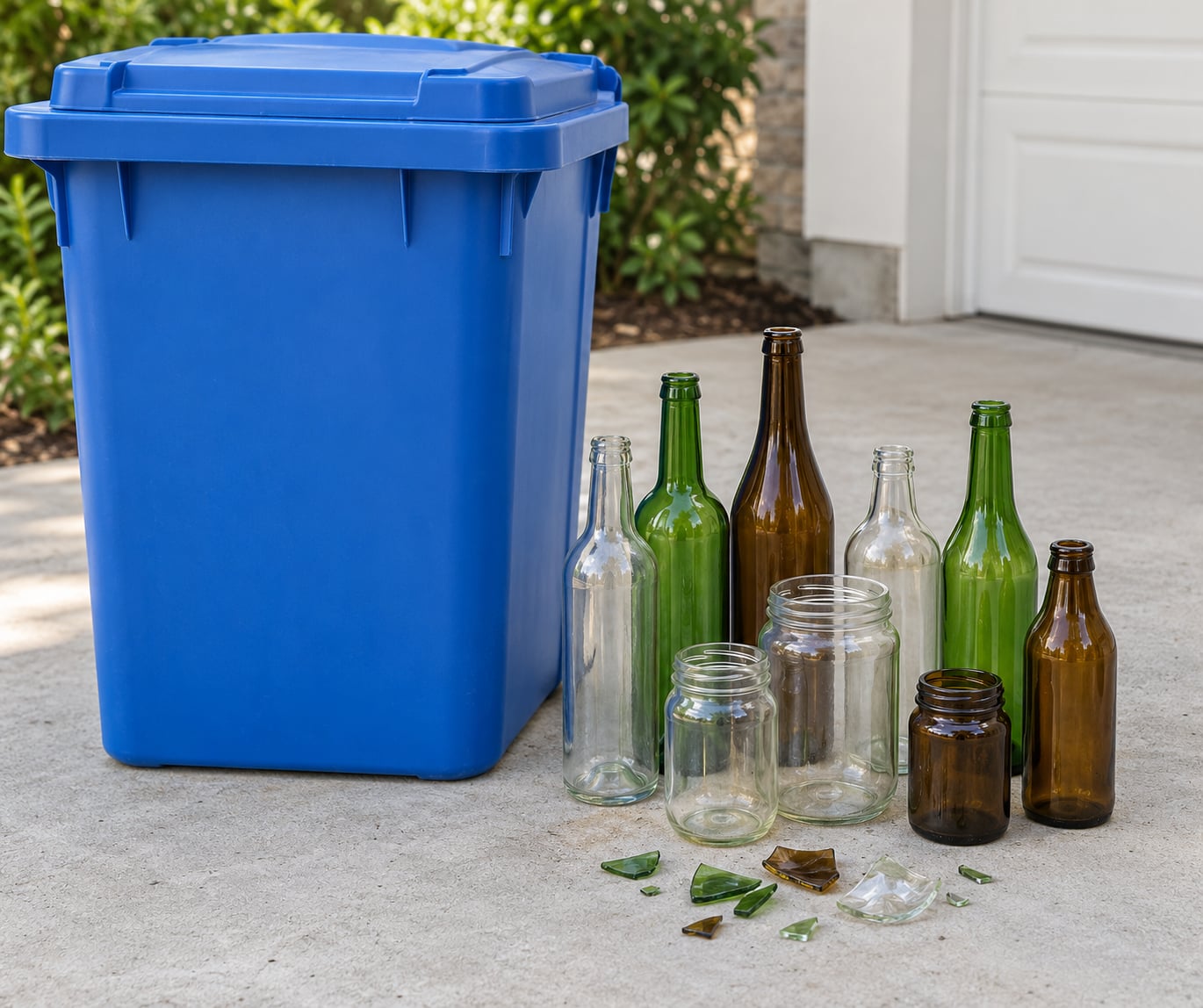
Container glass is the only category most curbside programs accept. That means bottles and jars made to hold food or drink: wine and beer bottles, soda and juice bottles, pickle and sauce jars, salad dressing bottles, and similar packaging.
| Glass item | Accepted curbside? | Where it usually goes instead |
|---|---|---|
| Glass food and beverage bottles | Usually yes, any colour | Curbside bin |
| Glass food jars and condiment bottles | Usually yes | Curbside bin |
| Broken container glass | Rarely | Drop-off site or heavy cardboard box |
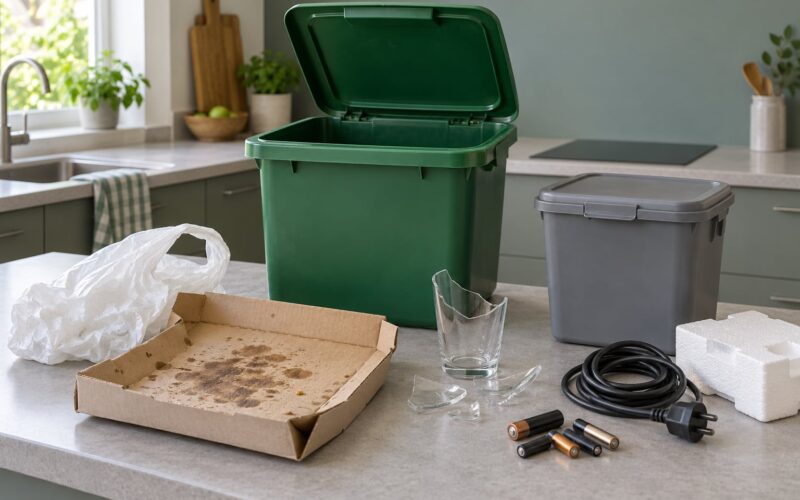
| Drinking glasses and stemware | No | Trash or a specialty drop-off |
| Ovenware and tempered glass | No | Trash or manufacturer take-back |
| Ceramic plates, mugs and planters | No | Trash |
| Window glass and mirrors | No | Trash, or a window recycler |
| Incandescent and compact fluorescent bulbs | No | Household hazardous waste drop-off |
| CRT television glass | No | Hazardous waste or electronics take-back |
| Crystal and leaded glass | No | Trash |
Container glass, drinking glass, ceramic and window glass all look identical in a bin, but they are chemically different. Only the container type belongs in the recycling stream.
Local rules decide the rest. One city takes any colour of container glass; the next takes only green. Some accept broken glass, most do not because of the safety risk to sorters. Your hauler’s published list or the service website for your municipality is the only authority worth trusting here.
How the Glass Is Collected and Sorted
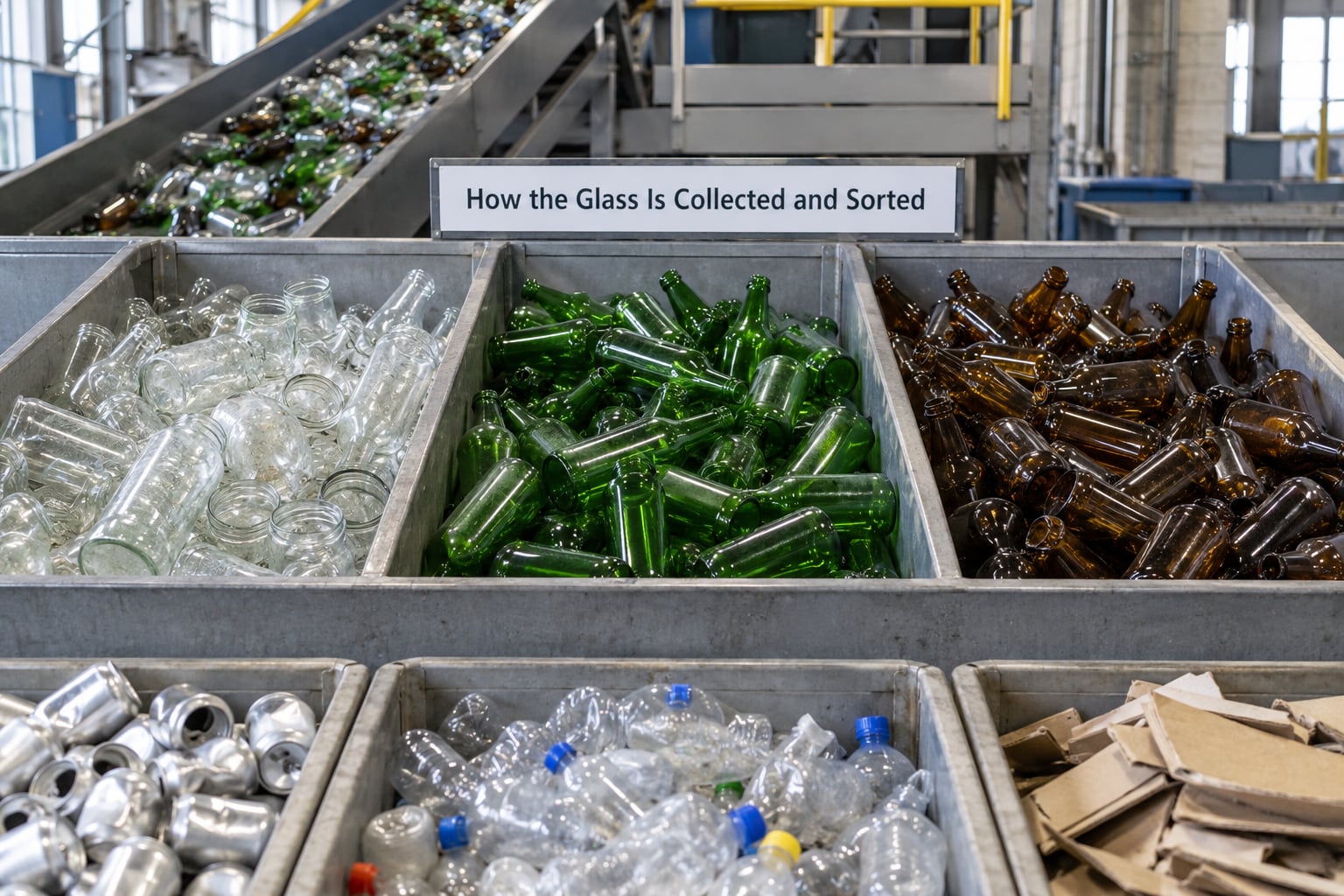
Collection is the least glamorous stage and the one most households see. A single-stream truck lifts the bin, tips it into a hopper with paper, cardboard, cans, cartons and plastic, and compacts the load. Two or three different materials sit in that hopper within seconds of each other.
What happens to glass in curbside recycling once it reaches the sorting plant?
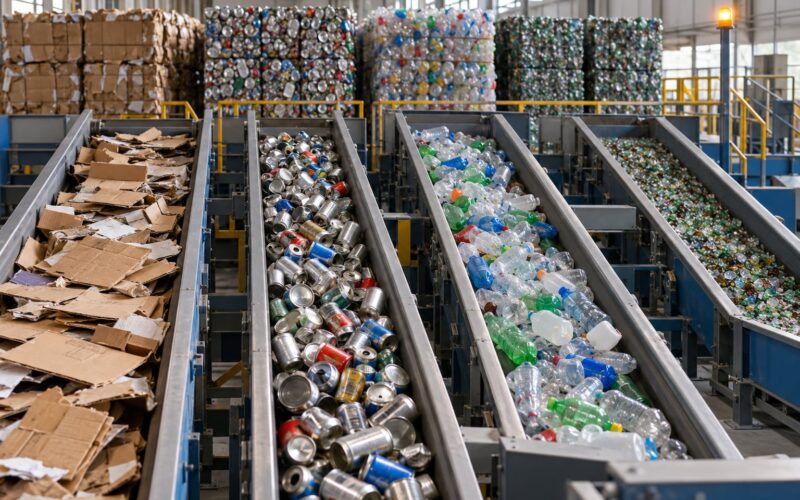
At the plant the material is metered onto a slow-moving conveyor belt and spread out so everything is visible and separated. The belt runs through a series of stations, each one removing something specific.
Rotary screens and trommels shake off small items like bottle caps, fragments and paper bits, and pull the flat rectangular material (cardboard, mixed paper) out of the mix. A magnetic separator takes ferrous metal, and an eddy current separator often follows for aluminium. Air jets and manual pickers handle the rest.
Glass usually needs its own dedicated section because it behaves differently from everything else on the line. It is heavy, brittle, abrasive and unaffected by magnets, so it is dropped out by gravity and gap screening rather than lifted out by a sorter.
Plastic and ceramic fragments are the problem. Plastic melts into the batch and ruins it. Ceramic has a much higher melting point than container glass, so a single mug or plate in the load stays as an unmelted lump and forms a defect known as a stone or nid in the finished bottle.
Colour sorting, where it happens, uses optical sensors with cameras that identify the colour of each piece as it passes. Flint goes to one bunker, amber to another, green to a third. Plants that lack that equipment run everything mixed, which is acceptable for some products such as fiberglass but restricts what container can be made.
Broken glass is the other issue people worry about. It does not stop the process; it accelerates it. Jars that shatter in the truck become fines, and those fines rub against paper fibre in the sorting hall, which is one of the strongest technical arguments for dropping glass from curbside service.
Why Glass Contamination Matters
Every gram of wrong material in the glass stream costs money or quality. Too much residue and the load is rejected; too little contamination tolerance and the plant cannot make a specification bottle.
Liquids and food residue are usually manageable because the glass is washed at the beneficiation line. What cannot be washed out is structural: ceramic, stone, metal closures, and heat-resistant glass with a different formulation that will not melt into the batch.
Paint is the exception people ask about most. As one commenter put it in an r/recycling thread, paint gets burned off during melting, so paint-coated containers are generally still processable. A thick ceramic glaze or a heat-proof dish is a different story.
This is where the economics show up. Glass is the heaviest common curbside recyclable by volume, it breaks into abrasive fines that damage equipment, and the material that cannot be recovered still has to be disposed of. Local reporting on facilities that have lost glass from curbside programs points to the same combination: contamination cost rising while the value of mixed glass stayed flat. In some regions the overall recycling rate sits near 40 percent, while glass by itself lands closer to 20 percent.
There is a second reason glass behaves differently from paper and metal, and it is physical. Glass does not decay and does not degrade in water or soil, so it stays in landfill indefinitely. Its recovery rate lags well behind cardboard and aluminium even in programs that collect it well.
Before recycling comes reuse, and readers on recycling forums make the point regularly: a jar reused five times never reaches the sorting line at all. Deposit-refund systems in states like Oregon, Michigan and Maine keep containers in circulation far longer than curbside collection does, and they pay a refund for the return.
What Happens to the Glass at the Recycling Facility?
Once glass has been separated from the sorting hall it goes to a dedicated glass processor, sometimes at the same site, often elsewhere. The line there is short and fairly mechanical.
Incoming material is inspected and screened. Loads with visible ceramics, plastics or excessive fines get downgraded or rejected, and rejected material is either cleaned further or sent out as residue. Acceptable glass is washed, often with a rotating drum washer that removes labels, adhesives and leftover food.
The clean glass is then broken down. Heavy machinery crushes it into pieces roughly 10 to 30 millimetres across. That crushed, cleaned material is cullet, and it is the actual product of the recycling stage. Any glass that stays too large to break well is a sign of a non-container item, and it comes off the line.
Cullet gets sampled for colour, density and contamination before it leaves. Material that passes becomes feedstock. Material that fails has already lost value, and it exits as residue to landfill or energy recovery.
The timeline from household bin to finished container is measured in weeks, not months. A Kansas City glass processing facility described in local reporting put the trip from the sorting floor to the storage silo at about 13 minutes, and reported that a beer bottle collected in one week can be back on a shelf in roughly 30 days.
How Recycled Glass Becomes a New Product
Cullet never travels alone. It is mixed with the same batch materials used for virgin glass, mainly silica sand, soda ash and limestone, plus small amounts of colorant and other additives. A typical bottle batch might be somewhere between 10 and 30 percent cullet, depending on the glass colour and what the furnace is making. Cullet melts at a lower temperature than the raw batch, which is the main energy argument for using it.
The mix goes into a regenerative furnace, where it melts around 1400 to 1600 degrees Celsius. The molten glass moves to a forming machine: an IS machine for narrow-mouth containers, a press-and-blow machine for wide-mouth jars. Bottles are then annealed in a lehr, a long tunnel oven that cools them slowly so the stresses in the glass relax.
Finished containers are inspected, hot end to hot end, for cracks, bubbles and other defects before packing. Anything rejected goes back as cullet. The accepted bottles and jars are shipped to fillers, breweries and food processors.
| End market | What it becomes | Recycling type |
|---|---|---|
| New bottles and jars | Beverage and food containers | Closed loop, glass-to-glass |
| Fiberglass insulation | Building batts and roofing | Downcycled |
| Glass fiber | Composite panels and plastics | Downcycled |
| Aggregate | Concrete, road base, drainage | Downcycled |
| Landfill cover | Daily cover material at landfills | Downcycled |
Closed loop matters because it keeps the material at container quality. Downcycling still diverts waste from landfill and displaces virgin raw material, but the glass never returns to the bottle.
How to Recycle Glass Correctly in Your Area
Start with the rules for your own service, because they are the only ones that apply. Municipalities disagree about colour, broken glass, lids and even whether glass is accepted at all.
- Confirm acceptance first. Search your hauler or city for a published materials list, or call and ask about glass specifically.
- Use containers only. Bottles and jars for food and drink. Nothing else in the glass stream.
- Empty and rinse. A quick rinse removes residue that would otherwise have to be cleaned off later.
- Leave labels on. Unless your local authority says otherwise, labels do not need to come off. They burn off in the furnace.
- Put metal lids on loose. They are sorted out by magnets and then recovered. Screwed on, they stay attached to the glass.
- Skip broken glass in the truck. Box it, tape it and take it to a drop-off site, or wrap shards in several layers of paper and place it in the trash.
- Reuse before recycling. A jar used for storage again is already a win.
If your municipality has removed glass from curbside service, the options are still reasonable. Look for a public drop-off site, often at a public works yard or transfer station. Bottle banks and reverse vending machines work in deposit states and in some high-traffic areas. Manufacturer take-back programmes cover ovenware and some window glass. In a few markets, community groups run their own collection for container glass, and a few have converted curbside bins to a separate glass-only pickup.
If you have accumulated a pile, do not put it in the trash bin in handfuls. Collect it in sturdy boxes or bins over a few weeks and make one drop-off trip.
Frequently Asked Questions
Can broken glass go in curbside recycling?
Most programs say no, because broken container glass shatters further in the truck and the resulting fines contaminate paper fibre and cut handlers. Some accept it, so check your local list. Where it is rejected, box the shards, tape them and take them to a glass drop-off site, or wrap them in several layers of paper and put them in the trash.
Why is drinking glass not accepted in curbside recycling?
Drinking glass has a different chemical composition and melting point from container glass. A single tumbler left in the batch stays as an unmelted lump that becomes a defect in the finished bottle. The same problem applies to ovenware, ceramics and crystal, which is why those items belong in the trash.
How many times can glass be recycled?
Chemically, glass can be melted and formed over and over without losing its properties, so the material itself is effectively infinitely recyclable. In practice each cycle loses a small share of the load as residue, and much recycled glass is downcycled into insulation or aggregate rather than returning to bottle quality. Closed-loop glass-to-glass recycling keeps the cycles going longer.
Does recycling glass really save energy?
Yes. Cullet melts at a lower temperature than the raw batch materials it replaces, so furnaces run hotter less often and use less fuel. Producing containers from recycled cullet is a net energy saving compared with making glass from sand, soda ash and limestone, which is one of the strongest arguments for collecting it well.
What should I do if my local curbside program does not accept glass?
Check for a public glass drop-off site at a transfer station or public works yard, and look for reverse vending machines or bottle banks in your area. Some manufacturers run take-back schemes for ovenware and window glass. Reuse first wherever possible, and gather glass in sturdy boxes so one trip covers months of accumulation.
Are dish soap bottles recyclable?
It depends on the material, not the label. Clear plastic bottles for dish soap are commonly high-density polyethylene, which most curbside programs accept. Bottles made of glass are usually accepted as container glass if your program takes glass at all. Check the bottle base for a resin code, and confirm with your hauler.
Conclusion
Glass in curbside recycling is sorted, colour separated, crushed into cullet and melted into new containers, fiberglass or aggregate. The route is straightforward, and the outcome depends on clean container glass and a local program that accepts it.
Check your collection rules first, then empty, rinse and sort your glass to match them. If your service does not take glass, find the nearest drop-off site before filling up another box in the garage.