To check your water meter for a leak, turn off every water source in and around the house, note the reading and the position of the leak indicator dial, then wait two hours and overnight before looking again. If the reading has moved with nothing running, water is going somewhere you have not found yet. The whole test takes about ten minutes of setup and one night of waiting, and no plumbing experience.
The meter is the earliest warning you get. A silent toilet flapper or an in-wall supply line can run for weeks with no puddle, no stain and no sound, and the first sign is usually a bill that jumped. The U.S. EPA estimates that around 10 percent of American homes lose 90 gallons or more a day to leaks, which is roughly the amount a family uses before breakfast.
Two things make this test reliable. One, you are looking for water that moves when nothing should be using water, which is a clean signal. Two, you do it overnight, because the only devices that quietly use water while you sleep run at night, and a daytime test hides them.
Table of Contents
- What You Need
- How to Check Your Water Meter for a Leak: Step-by-Step
- 1. Locate the meter and identify its type
- 2. Check for an active flow indicator
- 3. Record the starting meter reading
- 4. Turn off every water use
- 5. Wait, then check your water meter for a leak again
- 6. Work out how many gallons went missing
- 7. Isolate indoor, outdoor and utility-side plumbing
- 8. Confirm the leak and decide who to call
- Common Mistakes
- How to Confirm a Small or Hidden Leak
- Frequently Asked Questions
- Can a water meter show a small leak?
- Why is my water meter moving when nothing is on?
- Should I turn off the main water valve to test the meter?
- Whom should I contact if my meter shows unexplained water use?
- How long should I wait before deciding there is a leak?
- What to Do First
What You Need
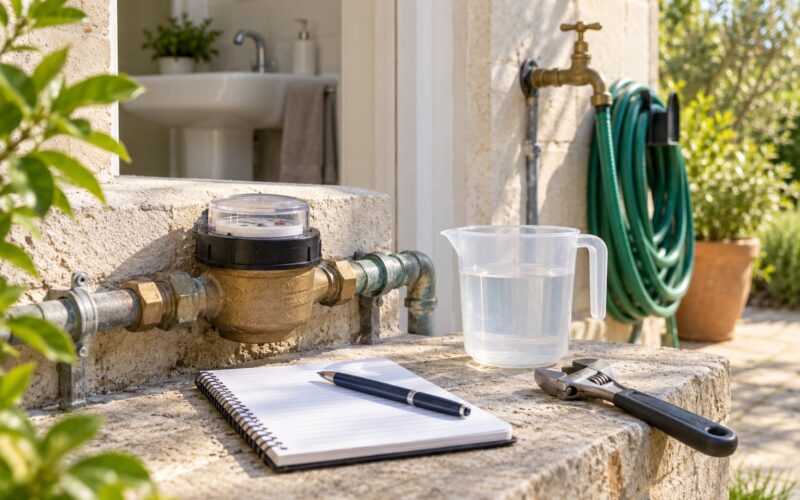
The kit is small. A flashlight, a pen, a piece of paper or a phone camera, and a calculator if you want to turn the reading into gallons are enough. Add a pair of gloves and, if your meter sits in a below-ground box, a meter key or a long screwdriver to lift the lid without dropping gravel down the hole.
Before you start, confirm you can reach the meter and the main shut-off valve. Some homes have the meter outside in a plastic box at the property line, some have it in a basement, garage or crawlspace, and apartment buildings often have one meter for the whole building rather than one per unit.
One caution worth stating plainly. Do not open a sealed utility meter, do not remove its register cover, and leave the curb stop valve alone. The curb stop is owned by the water utility and usually has a lock on it. Everything you need can be done from outside the case.
Also decide what you are watching for, so you can rule fixtures out quickly. A dripping faucet, running toilet or wet spigot is visible. A softener regeneration cycle, a furnace humidifier or a scheduled irrigation zone is not, and those are the usual reasons a meter moves during a daytime test that looked perfectly normal at first.
How to Check Your Water Meter for a Leak: Step-by-Step
Turn off all water use, record the reading and the leak indicator position, wait two hours and then overnight, compare, and isolate by closing the main shut-off valve. A reading that moves with nothing running means a leak. No movement means no leak.
1. Locate the meter and identify its type
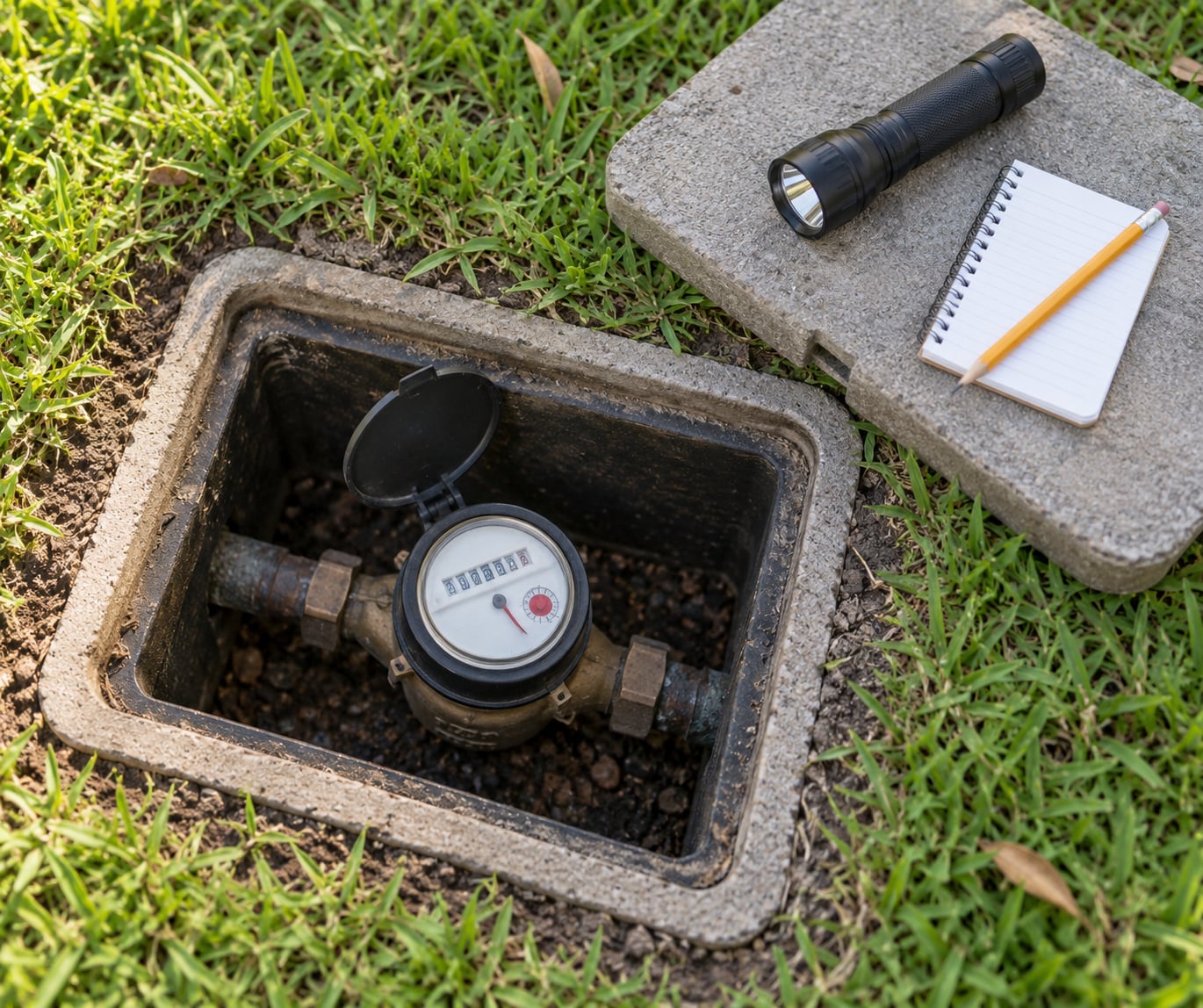
Walk the perimeter of the house and look for a round plastic or metal lid in the lawn, driveway or planting strip near the property line. Lift it and you should see a brass or composite meter in a gravel-filled pit. If there is no box outside, head to the basement, garage, crawlspace or an exterior wall cabinet, often under a staircase or in a utility closet.
Once you are looking at it, work out what you are dealing with. An analog meter has a dial face with a black or red leak indicator triangle and numbered wheels for cubic feet. A digital meter has a numeric LCD reading and often a flow rate display in gallons per minute. A smart or AMI meter looks like a digital meter but sends its reading to the utility remotely.
Result: you now know whether you will be reading numbers, watching a triangle, or both. If the meter is rusted shut or sits under a heavy concrete lid, arrange access before you go further.
2. Check for an active flow indicator
With every faucet closed and every appliance off, watch the meter for a minute before you touch anything. On an analog meter, the leak indicator is usually a small black or red triangle or a separate low-flow dial, and it spins when even a trickle is passing. On a digital meter, look for a rotating flow icon, a running display or a flow rate that is not zero.
If something is spinning right now, note the time, write down the digits, and come back later with the same test running. A meter that is already moving with nothing on is the strongest single clue you will get.
Result: a spinning triangle means water is moving now. A still meter means you need the overnight test in step 5, because small leaks only move the indicator for a moment at a time.
3. Record the starting meter reading
Photograph the meter face with your phone. On an analog meter, read the numbered wheels from left to right and write down exactly what you see, including which digit wheel sits between two numbers, since it may still be turning. Include the small leak indicator dial position, because a hand-drawn sketch of where the triangle points is worth more than a rounded-off number.
On a digital meter, write down every digit, not just the whole-number part. Those trailing digits are where a small leak shows up. Many digital meters also have a separate totalizer that never resets and a flow rate that returns to zero, so note which display you read from.
Result: you have a starting number and a photo, which means the comparison in step 5 will be exact rather than a guess.
4. Turn off every water use
Go through the house and finish what is running. Taps and shower valves closed and dry. Toilets flushed and not running. Washing machine and dishwasher emptied and switched off at the wall. Kitchen and bathroom taps tight. That covers the obvious indoor sources.
Then handle the quiet ones, because this is where the test usually fails. Turn off the water softener or put it on bypass. Switch off the furnace humidifier if you have a central one. Unplug the ice maker in the fridge. Most importantly, kill the irrigation: turn the controller off at the timer itself, not just off at the wall, because a controller with power can keep a valve open. Close outdoor spigots and any pool auto-fill valve too.
You do not need to shut the main valve off for this step. Leaving supply on lets you observe the meter, which is the whole point.
Result: if everything above is off and the indicator still moves, you have already found a continuous leak and you can stop at step 8.
5. Wait, then check your water meter for a leak again
The two-hour check is the quick version. Come back after two hours and compare. Any change at all means water was moving during a period when nothing should have been using it, and you should follow up with the overnight test before booking a plumber.
The overnight test is the one to trust. Go to bed with everything off, then look first thing in the morning before you touch a tap or flush. Overnight covers the whole regeneration cycle of a water softener, which typically starts in the small hours, plus any irrigation controller that was left on and any slow weep you would miss in a two-hour window.
One more thing to expect. If you shut the main valve off earlier in the day, the meter can keep ticking for a while as water trapped in the branch lines drains out. That is normal and it stops; it is not the leak.
Result: no change over the night means there is no continuous leak and you can stop worrying. Any change means water is moving, and step 6 tells you how much.
6. Work out how many gallons went missing
Subtract the starting reading from the ending reading. On an analog meter the number is in cubic feet, and one cubic foot is about 7.48 gallons, so multiply the difference by 7.48. A rise of 0.5 on a cubic foot meter is roughly 3.7 gallons. A rise of 20 is about 150 gallons, which for a family of four is a working day’s supply gone overnight.
On a digital meter the reading is often already in gallons, so just subtract. If the meter records in cubic meters, one cubic meter is about 264 gallons.
Do not treat the last digit on an analog meter as a complete unit. On most residential meters the final wheel is a fraction wheel counting tenths of a cubic foot, which is about three-quarters of a gallon, so treat it as a rough guide and trust the wheels above it.
Result: you now have a number to compare against your normal daily use, which is what tells you whether this is a drip or a real loss.
7. Isolate indoor, outdoor and utility-side plumbing
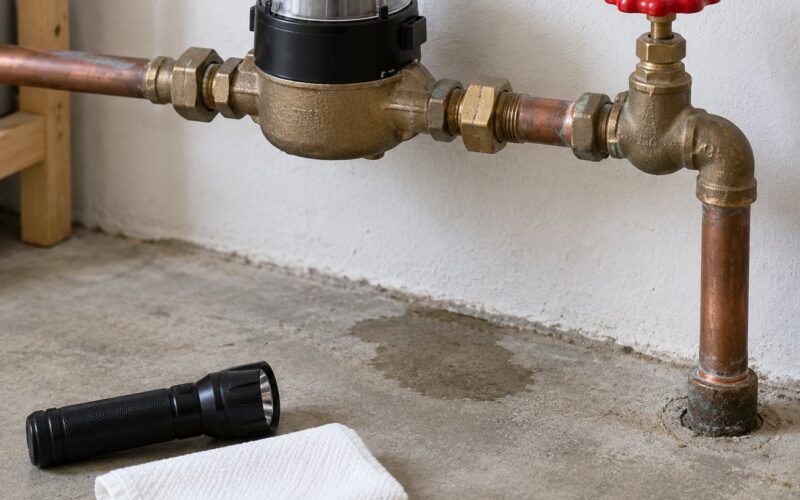
Close the main shut-off valve, the one on your side of the meter, and leave everything else alone. Open a tap, let it run briefly, then close it and wait ten minutes for the pipes to stop moving. Then watch the meter.
If it stops, the leak is on the house side of your valve. That narrows it to fixtures, irrigation, the softener, the humidifier, an outdoor spigot or a pool line, and step 8 sorts it out. If it keeps moving with the main closed, the water is coming from between the utility’s curb stop and your meter, or from a valve that will not seat properly, and that is the utility’s problem to investigate. Note that a small trickle may still show on the indicator for a few minutes, so give it a full ten before you decide.
Do not operate the curb stop valve at the property line to test this. It is utility property, it is often locked, and turning it can cause a pressure drop or a blowout.
Result: you have located the leak to one side of your valve, which is the single most useful piece of information you can hand to a plumber.
8. Confirm the leak and decide who to call
Before you report anything, gather the evidence: the two photos, the readings, the times, the calculated gallon loss, your last three bills, and the result of the main-valve isolation test. Utilities move much faster with dated readings than with a phone call saying the meter is running.
Call the water utility first if the meter keeps moving with your main shut-off closed, if you suspect the service line between the curb stop and the meter, or if you suspect the meter itself is faulty. Call a plumber if the meter stops when you close the main valve. Call your landlord instead if you rent.
Do not open the meter case yourself to look at the register or try to stop the dial. Meter repairs and anything on the utility side of the curb stop belong to the utility.
Result: you have a documented case and the right person to call, which is a much stronger position than a suspicion.
Common Mistakes
Most false results come from a handful of mistakes. Knowing them up front saves a wasted afternoon.
- Testing while the irrigation runs. A controller left on its schedule will show a big overnight jump that has nothing to do with a leak. Turn the controller off at the timer and confirm the zone valves have closed.
- Missing the softener. Regeneration cycles usually fall between 2 a.m. and 4 a.m., which is exactly the window a good overnight test covers. A meter that ticks only at night should be checked against the softener first. Bypassing it for one night settles the question quickly.
- Forgetting the fridge ice maker or the humidifier. Both draw water on their own schedule and both are routinely left out of the shut-down list.
- Rounding the reading. Writing 1,248 instead of 1,248.7 hides exactly the small loss you are looking for. Photograph the face.
- Judging the test too early. Twenty minutes of watching proves very little. Two hours is a quick screen; the night is the real test.
- Expecting the meter to stop instantly after a shut-off. Water still in the branch lines drains out and keeps the meter ticking for a few minutes. Wait the full ten.
- Opening a sealed meter. Utility meters are sealed for a reason. You get the same information from outside the case, and opening one is not a DIY job.
- Ignoring toilets and hose bibs. A weeping flapper and a dripping outdoor spigot are the two most common causes of a meter that moves with everything switched off inside. Check the tank for a thin trickle into the bowl and feel each hose connection for dampness.
How to Confirm a Small or Hidden Leak
When the meter moves a little and the indicator only twitches now and then, the leak is small and intermittent, and a two-hour test will keep missing it. Extend the observation instead of repeating it.
Run the overnight test three nights in a row and compare all three pairs of readings. A constant background loss that shows up on every night is a leak; a loss that appears only once is usually an appliance cycle you did not account for. If the numbers are small enough to argue about, several nights of data settles the argument.
Then work fixture by fixture. Turn each toilet off at its own supply line, or put a tablet of dye in the tank and let it sit overnight. Colour in the bowl without flushing means the flapper is passing. Listen at the wall behind each toilet for the faint hiss of a filling valve that never shuts off.
Check the less obvious places too. Open the appliance connection hoses under the sink, behind the washer and at the water heater for any rust, bulge or dampness. Look at the water heater’s pressure relief valve, which often weeps a few drops a minute, and check whether the drip is being caught by a pipe rather than a floor. Outdoors, walk the irrigation zones one at a time and watch whether the meter moves while that zone alone runs.
If you still cannot find it, take the readings and photos to the utility and ask whether they can check the meter itself and whether they offer a leak-detection service. Failing that, a plumber with acoustic or moisture detection equipment can find a leak inside a wall or under a slab in a way no meter test ever will. Homeowner water damage policies commonly exclude leaks that were left running, so the meter test doubles as the documentation a claim will later ask for.
Frequently Asked Questions
Can a water meter show a small leak?
Yes. A small leak often only moves the final digits of the meter or twitches the leak indicator for a moment at a time, which is why a quick check can miss it. Test overnight with toilets, appliances, taps, irrigation and the water softener off, then photograph the meter before and after. Repeat for several nights so a steady background loss stands out from a one-off appliance cycle. If the reading climbs a little every single night, water is moving somewhere.
Why is my water meter moving when nothing is on?
Because water is still reaching the meter. The usual suspects are a toilet that keeps running or keeps refilling, an outdoor hose connection, an irrigation valve left open, a water softener regenerating, or a pressure relief valve on the water heater dripping into a pipe. Check the automatic schedules first, then bypass the softener for a night and listen at the toilets. If closing your main shut-off valve stops the movement, the source is inside your plumbing.
Should I turn off the main water valve to test the meter?
Usually not. For the standard test, shut off appliances, fixtures and outdoor water sources and leave the meter supplied so you can watch it. You only need the main shut-off valve for the isolation step that tells you which side of the meter the leak is on. Operate your own property valve only, never the utility curb stop at the property line, which is usually locked and is the utility’s responsibility.
Whom should I contact if my meter shows unexplained water use?
Take photos and readings first. Contact the water utility if the meter keeps moving with your main shut-off valve closed, if you suspect a leak on the service line between the curb stop and the meter, or if you think the meter itself is faulty. For suspected leaks in household plumbing, irrigation or fixtures, call a licensed plumber. If you rent, contact your landlord, and keep your readings and dates, because utilities act much faster on documented evidence.
How long should I wait before deciding there is a leak?
Two hours is enough for a quick screen, but an overnight wait is what makes the test reliable. A slow leak may not move the dial noticeably in a short window, and some appliances only draw water at night, so a daytime test can look perfectly normal. If you already closed the main valve, wait a full ten minutes before judging, because water still in the branch lines drains out and keeps the meter ticking briefly.
What to Do First
Shut off every water source you can reach, including the irrigation controller and the water softener, and take a clear photo of the meter with every digit visible. Go to bed, and look at it first thing in the morning before you run any water at all.
If the reading has moved, work out the gallon loss and photograph the meter a second time. Then close your main shut-off valve, wait the full ten minutes and look again, because that single test tells you whether to call the utility or a plumber and saves both of them a wasted visit.
Keep the photos and the dates. They are the difference between reporting a suspicion and reporting a measurement, and they are what a landlord, a plumber or a water damage claim will ask for first.