Old lithium ion batteries are collected, sorted by chemistry, then given a second life as stationary energy storage if they still hold enough charge, or dismantled so their metals can be recovered. A recycler discharges, breaks down and refines the cells to recover nickel, cobalt, copper, aluminum, lithium and graphite, then returns those materials to battery-grade supply chains. The dangerous part is what happens when they skip that route entirely.
That last sentence is why this question matters more than it sounds. A lithium-ion cell that gets crushed in a garbage truck can enter thermal runaway, and once that happens the cell makes its own oxygen and heat. It is not a slow leak. It is a fire in a pile of paper and plastic.
Table of Contents
- What Happens to Old Lithium Ion Batteries at a Glance
- How to Collect and Transport Old Lithium Ion Batteries Safely
- What to do before you hand a battery over
- Damaged, swollen and leaking cells
- How the Recycling Process Handles Old Lithium Ion Batteries
- Can Old Batteries Be Reused or Remanufactured?
- Where second-life packs actually go
- Why You Should Not Put Lithium Ion Batteries in Household Waste
- How to Find a Battery Collection or Recycling Service
- Questions worth asking before you hand anything over
- What Environmental Benefits Come From Recycling Them?
- Frequently Asked Questions
- Can old lithium ion batteries be reused after several years?
- Are swollen lithium ion batteries safe to recycle at home?
- Can lithium ion batteries go in household recycling bins?
- What happens to lithium ion batteries that are too damaged to process?
- Do all lithium ion batteries contain the same recoverable metals?
- How long should a used battery be stored before collection?
- Conclusion
What Happens to Old Lithium Ion Batteries at a Glance
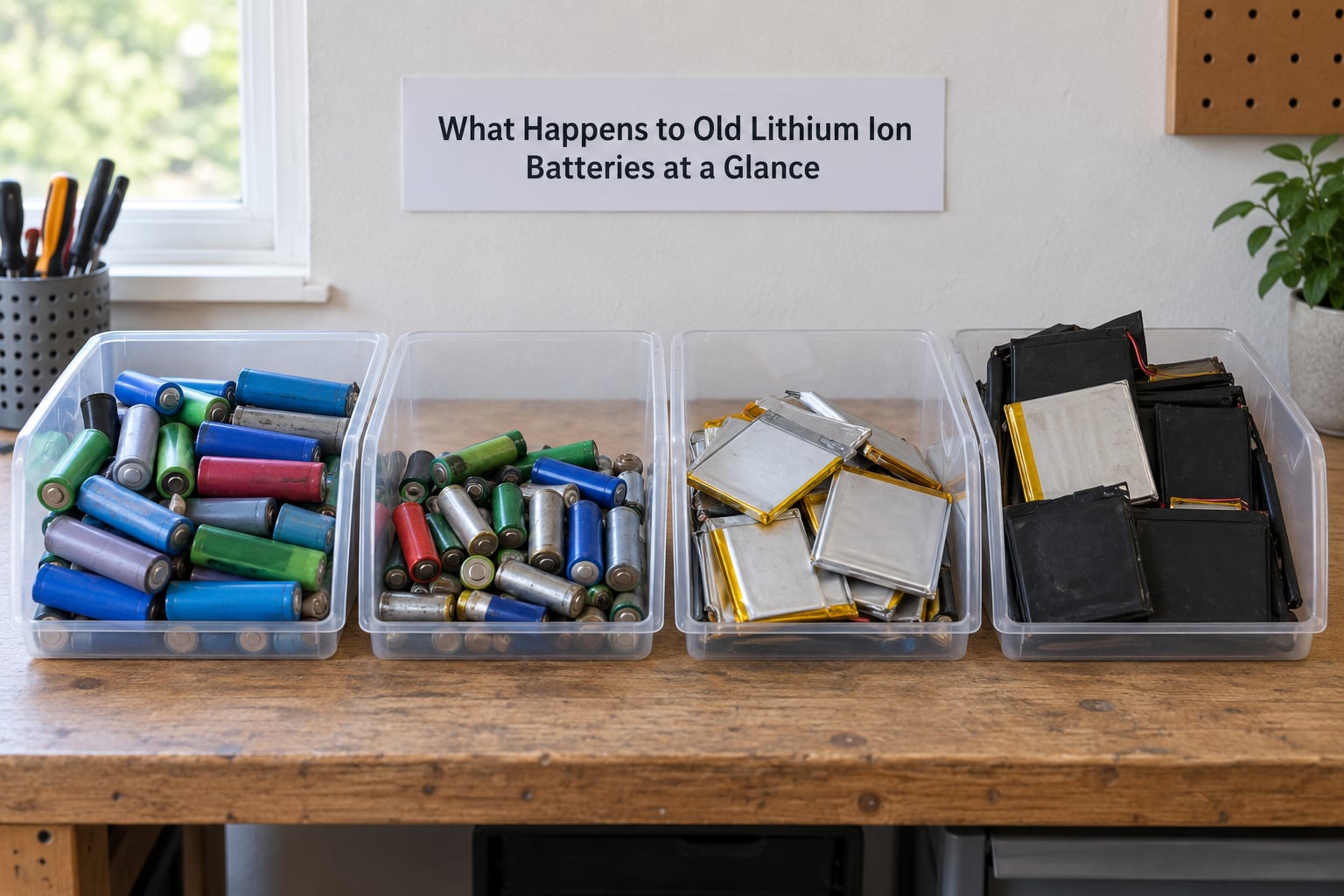
Here is the whole path in six steps, from the drawer to the refinery.
- Collection. The battery reaches a drop-off point, a retailer take-back program, a household hazardous waste site or a commercial collector.
- Sorting. Cells are grouped by chemistry and format, because a lithium-ion pack cannot enter the same stream as a nickel-cadmium one.
- Assessment. Diagnostic testing measures state of health, the share of original capacity a pack still holds.
- Triage. Packs healthy enough for a second job go to reuse or remanufacturing. Everything else moves to material recovery.
- Processing. The pack is discharged, dismantled and shredded, producing a black mass of metals, graphite and separator fragments.
- Refining. Hydrometallurgy, pyrometallurgy or direct recycling separates and purifies the materials back to battery-grade purity.
Which of those steps a battery actually reaches depends entirely on where it goes. The four end-of-life routes look like this.
| Route | What happens to the battery | Material recovery | Best fit for |
|---|---|---|---|
| Reuse | The pack keeps working in a lower-demand job | None yet, and that is the point | Packs above roughly 80% state of health |
| Remanufacturing | Modules are tested, replaced where worn and rebuilt into a new pack | Most of the original material stays in service | EV packs with a few weak modules |
| Material recycling | The pack is shredded and its metals refined back to battery grade | The highest share of any route | Degraded, mismatched or damaged packs |
| Safe disposal | Residual material goes to a permitted hazardous waste facility | Low, because nothing is recovered | Fraction the processors cannot handle |
Reuse sits at the top of that list on purpose. Every extra year a pack spends in service is a year nobody has to mine, refine and ship new material for.
How to Collect and Transport Old Lithium Ion Batteries Safely
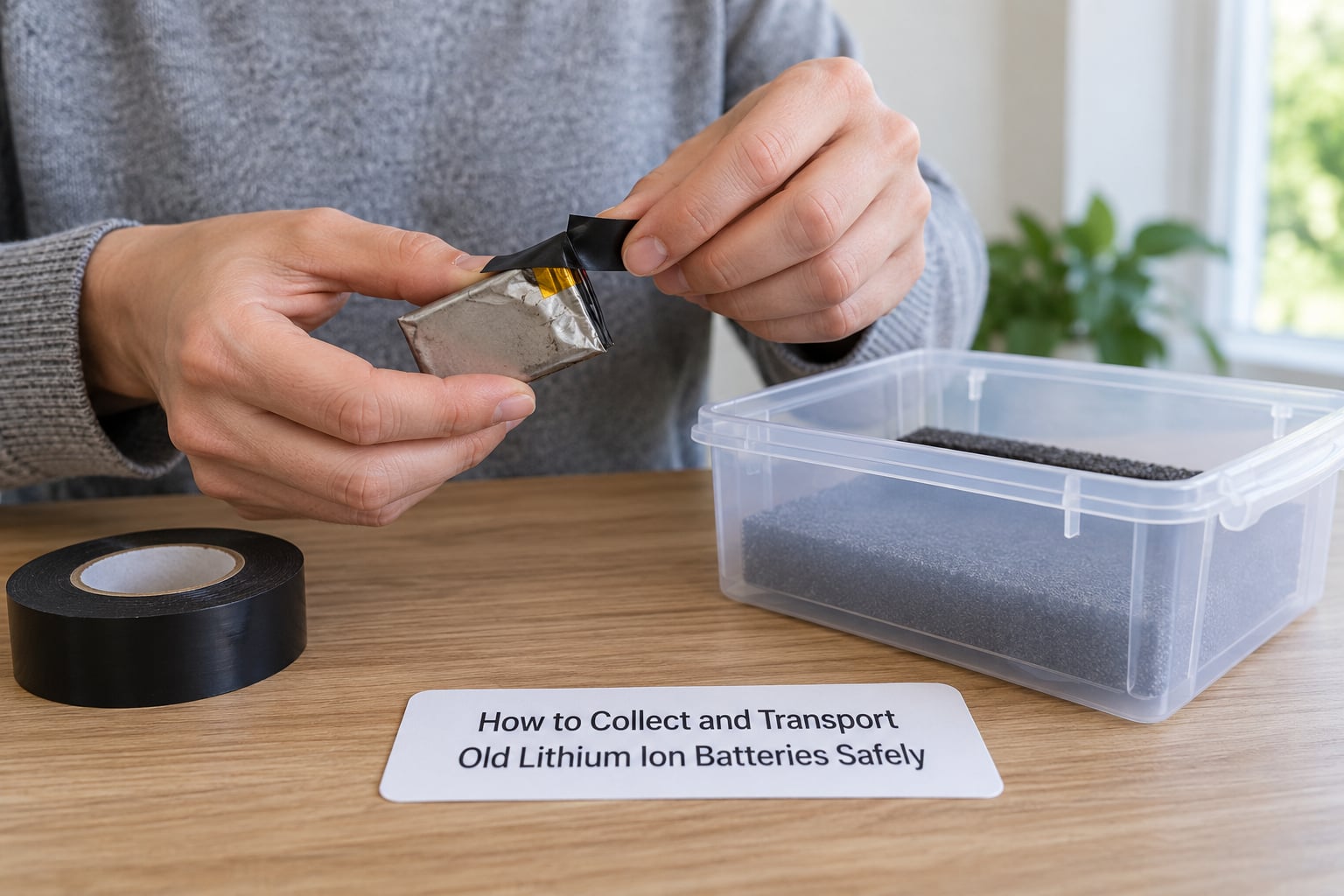
Start by looking at the battery rather than the bin. A cell that is flat, cool and free of dents goes straight to a drop-off point. One that is swollen, leaking, cracked, hot to the touch or smells sweet needs different handling, because those are the cells that will not survive being crushed in a pile of other waste.
What to do before you hand a battery over
- Stop using it. A swollen cell has no remaining service life, and continued use raises the pressure further.
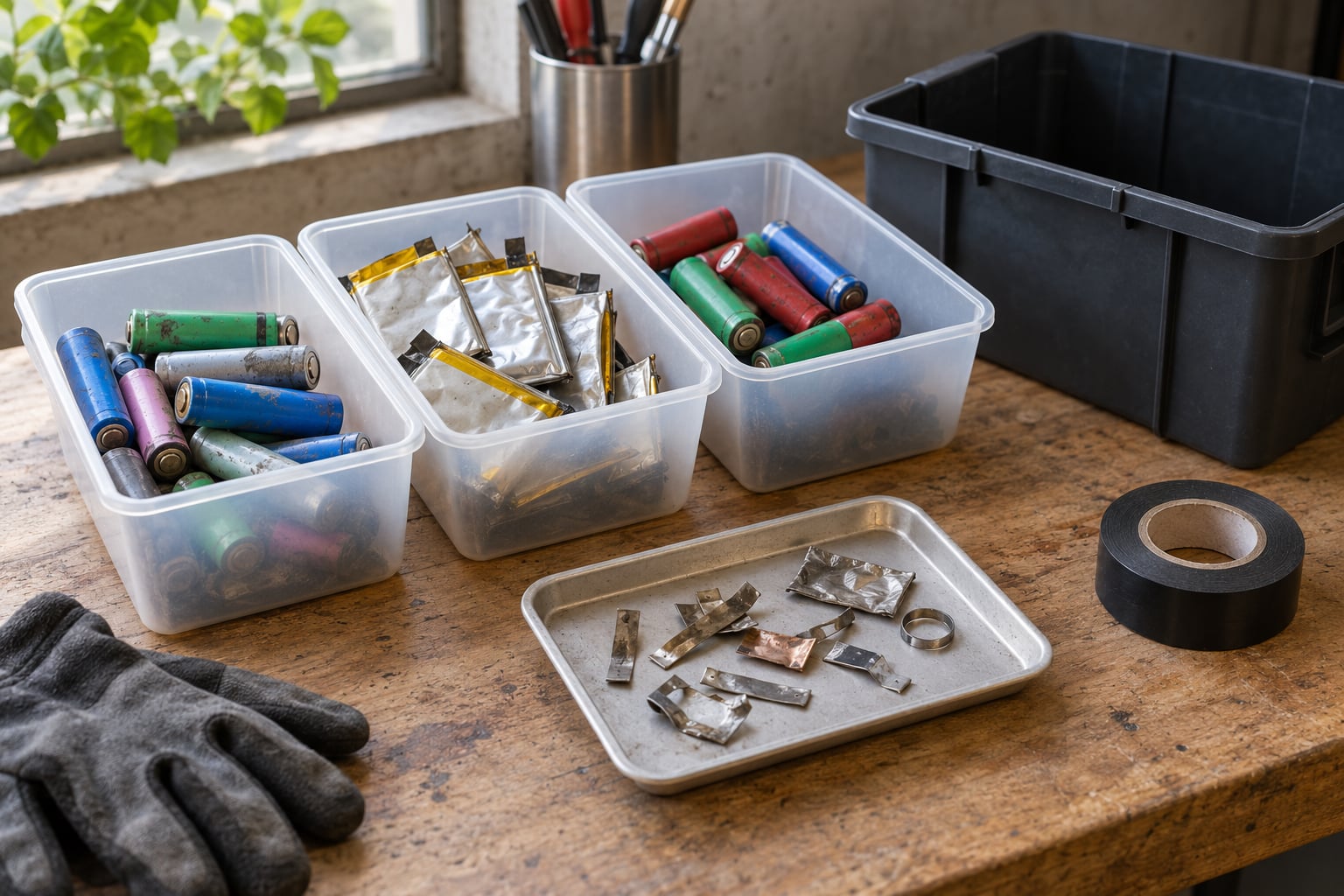
- Cover the terminals. Clear packing tape or electrical tape over every exposed contact stops the cell from shorting against metal or other batteries in the same container.
- Use compatible packaging. Keep each cell in its original packaging when you have it, or use a rigid non-conductive container with cushioning so cells cannot knock together in transit.
- Separate the chemistries. Lithium-ion, alkaline and lead-acid do not belong in the same bag, even when the drop-off point takes all of them.
- Skip the mail for damaged packs. Ordinary couriers are not equipped for a cell that may be actively failing.
Transport is where most accidental damage happens. A battery rattling loose in a toolbox is a battery that gets abraded until the separator fails.
Damaged, swollen and leaking cells
A swollen cell is already at the end of its story. Do not press it back into shape, do not charge it, and do not put it in a bag with anything else. Where local rules require it, place the cell in a rigid container with a lid and pass it directly to staff at the collection point so it can be isolated.
For a cell that is actively leaking or venting, leave the area, do not attempt to handle it further, and contact your local fire service or hazardous waste line for direction. That scenario is rare, and no amount of care in a kitchen fixes it.
How the Recycling Process Handles Old Lithium Ion Batteries
Recycling starts long before anything is melted. It starts with a sorting line, and sorting is the step that quietly decides how much value comes out the other end.
Packs arrive mixed. Some are laptop cells, some are tool battery packs, some are complete EV modules. Sorting separates them by chemistry and by construction, then diagnostics test each unit for remaining capacity and internal resistance. Units that fail the test never get dismantled as if they were healthy, because a weakened cell is a thermal risk to the equipment around it.
From there the route branches. Pack-level units are safely discharged to remove stored energy, then dismantled so cells, module housings, busbars, cooling hardware and the battery management system come apart as separate streams. The plastic housings and much of the steel and aluminium framing go to ordinary metal recycling. The cells themselves are shredded under controlled conditions, producing what the industry calls black mass: a black powder of cathode and anode material, graphite, binder and separator fragments.
| Material | Typical fate at a processor | Where it goes next |
|---|---|---|
| Nickel | Dissolved and precipitated to high purity | Cathode active material for new cells |
| Cobalt | Separated alongside nickel and lithium | Cathode active material for new cells |
| Copper | Recovered mechanically from windings and busbars | Wire, busbar and motor production |
| Aluminium | Separated by density and eddy current | New casings and foil |
| Lithium | Recovered from solution and refined to battery grade | Electrolyte salts and cathode material |
| Graphite | Separated and processed into recovered graphite | Anode material, or non-battery uses |
Black mass then goes to one of three refining routes. Pyrometallurgy uses heat to melt the material and drive off the less useful fractions, which is robust but historically loses lithium to slag. Hydrometallurgy leaches the powder in a chemical solution, and its newer versions recover lithium, nickel, cobalt and manganese in fewer steps than older designs. Direct recycling takes a different approach entirely, preserving the cathode’s crystal structure so the material can be reused more or less as it was.
One important caveat: those numbers are about what the technology can recover, not about what actually gets collected. Processors cite very high recovery rates for the material they receive. Far fewer batteries ever arrive at a processor in the first place, and the two figures get quoted as if they were the same statistic.
This is also why processors are careful about chemistry labels. The metals in black mass are the raw material, and its composition decides what a processor is willing to pay for a given load. A tidy batch of known lithium-ion cells is a genuinely valuable input. A mixed bag of unidentified batteries with tape, dirt and an unknown proportion of alkaline cells is not, and a collector may simply refuse it. When a facility tells you it only accepts certain formats, that is usually a processing limit rather than a policy choice.
Can Old Batteries Be Reused or Remanufactured?
Yes, and it is usually the better outcome, but only for a minority of packs. The usual test is state of health: the percentage of original capacity a pack still holds. Below roughly 80%, most operators stop treating it as a candidate for a second life, because a pack that needs constant attention is a liability in whatever it is installed in.
A pack above that line is often worth more continuing to work than its raw materials are worth. That is the whole logic of second life, and it is the strongest environmental argument in this entire topic.
Where second-life packs actually go
- Stationary storage. Retired EV modules go into home or commercial storage where weight and footprint do not matter.
- Portable power stations. Camping and backup units, where one weak cell does not take the whole product down.
- Solar and small commercial systems. Panels generate uneven power, so a pack with a flatter discharge curve still works well.
- Reuse in lighter mobility. E-bikes and carts tolerate a pack that no longer suits a car.
Remanufacturing sits between reuse and recycling. A pack that has lost a few modules can be opened, tested cell by cell, and rebuilt with replacements, keeping most of its original mass in service. That is more work than reuse and less work than shredding.
Three cases end the discussion. A cell with an unknown chemistry cannot be safely tested. A cell that is swollen, leaking or thermally damaged is not a candidate for anything except controlled processing. And a pack assembled from mixed cells of different ages and chemistries will behave unpredictably, so it goes to material recovery instead.
Why You Should Not Put Lithium Ion Batteries in Household Waste
Three separate problems, and people usually only think about the first one.
The first is fire. A damaged or crushed cell can enter thermal runaway, where the separator fails, the electrolyte decomposes and the cell releases oxygen that feeds its own combustion. Compaction in a collection truck is exactly the kind of crushing that starts it. Residents in one Auckland suburb described a recycling truck catching fire in its load after lithium batteries were mixed in, with the crew dumping the entire load onto the street.
Materials recovery facilities are the second problem. A sorting line designed for paper, plastic and glass has no way to pull a small cylindrical cell out of a fast-moving stream before it gets compressed with everything else. Fires at these facilities are a recognised, recurring industrial hazard, and batteries are a leading cause.
The third problem is the material itself. A battery in landfill does not disappear. It corrodes slowly, the casing degrades, and metals and electrolyte components can migrate into soil, groundwater and air over time.
This is also where the three disposal routes get confused, so it is worth separating them clearly.
- Curbside recycling means your household bin. Batteries never belong here, and most jurisdictions ban them outright.
- Electronics recycling is a designated e-waste stream. It is much better, but it still mixes batteries with other devices, so cells are not always caught intact.
- Battery recycling is a dedicated stream where cells are handled as the main material rather than as a contaminant.
How to Find a Battery Collection or Recycling Service
Start close to home and work outwards. Almost every city has at least one route, and the options below are worth checking in this order.
- Municipal hazardous waste and e-waste sites. Often free for residents, and the staff there handle damaged cells you would rather not transport yourself.
- Retailer take-back programs. Many electronics, hardware and mobility retailers host drop-off bins, sometimes with a small credit per item. This is the easiest option when one sits on your route home.
- Manufacturer and brand schemes. Some producers fund collection points for their own devices, particularly for larger packs.
- Certified e-waste recyclers. Look for a named certification scheme in your country rather than a vague claim of being green.
- Commercial collection services. For businesses and fleets with more than a drawer full, a scheduled pickup removes the storage problem entirely.
For anything large, an EV pack or a storage cabinet, a site that accepts walk-ins may not be the right destination. Ask whether they handle that format and whether they need it discharged or partially dismantled first.
Questions worth asking before you hand anything over
- Which battery chemistries do you accept, and which do you refuse?
- Do you take swollen, leaking or damaged cells, or only intact ones?
- Do you need the battery discharged to a particular level first?
- Where does the material go after it leaves your site?
- Can you tell me what fraction of your intake is actually processed rather than forwarded?
That last question is the one worth pushing on. Some collection points are genuine processors. Others are aggregation sites that ship material onward, sometimes across borders, and the battery never gets refined at all.
What Environmental Benefits Come From Recycling Them?
The core benefit is avoided extraction. Nickel, cobalt, copper and lithium all come from mining, and mining brings land disturbance, water use, tailings and energy demand along with it. Recovered material also competes with virgin supply, and because battery-grade material has tight purity specifications, a recycled stream is genuinely useful rather than a downgraded by-product.
It also keeps a high-energy material in circulation. Manufacturing cells is energy intensive, so extending the life of an existing pack avoids that energy entirely. This is the part reuse contributes that recycling cannot: a pack kept in service for eight extra years produces no new black mass at all.
Now the honest part. Recycling is not free of impact. Transporting batteries to a facility costs fuel, and the refining steps need real energy, water and reagents. Processors also do not recover 100% of every input, and the fractions that are hard to separate often end up as lower-grade product or permitted residual waste.
That is why the quality of the recycler matters more than the marketing language. A processor with closed-loop refining that returns material to cell makers captures far more of the benefit than one whose output has to be shipped onward and reprocessed. And the biggest environmental win of all is the least glamorous one, which is keeping the battery out of the bin and giving it to someone who will actually process it.
Frequently Asked Questions
Can old lithium ion batteries be reused after several years?
Often yes, if the pack still holds roughly 80% of its original capacity. That is the usual state-of-health threshold operators use before offering a pack a second life in stationary storage, portable power stations or solar systems. Below that line, or with cells of mixed ages and chemistries, the pack normally goes to remanufacturing or material recycling instead.
Are swollen lithium ion batteries safe to recycle at home?
No, and you should not try to open, flatten or charge a swollen cell. Internal pressure has already built up, and the cell is one puncture away from thermal runaway. Do not compress it or bag it with other batteries. Keep it away from heat and ignition sources, place it in a rigid container where it cannot be knocked, and take it directly to a collection point that accepts damaged batteries.
Can lithium ion batteries go in household recycling bins?
No. Curbside collection is banned for batteries in most jurisdictions, and there is a fire reason behind it. Compaction in a collection truck can crush a cell into thermal runaway, and sorting facilities cannot pull small cells out of a fast-moving stream. Use a household hazardous waste site, a retailer take-back point, a certified e-waste recycler or a dedicated battery collection service instead.
What happens to lithium ion batteries that are too damaged to process?
Heavily damaged or thermally abused cells are routed to processors with equipment built for unstable material, and from there to permitted hazardous waste facilities. The casing metals are usually recovered separately, and residual fractions that cannot be refined go to controlled disposal. A reputable recycler will tell you which part of your battery it can actually process and which part it will not accept.
Do all lithium ion batteries contain the same recoverable metals?
No. Nickel, cobalt, copper, aluminum and lithium appear in most modern cells, but the proportions differ sharply by chemistry, and older or lower-cost chemistries carry far less cobalt. Graphite content varies too, and some cells include other metals in small amounts. This is exactly why sorting happens before processing, and why a mixed batch of unidentified cells is worth much less than a known one.
How long should a used battery be stored before collection?
Not long. Store a used lithium-ion battery somewhere cool, dry and away from direct sun, with its terminals covered so it cannot short against anything metal, and out of reach of children. Avoid freezing conditions and high humidity. If a cell swells, leaks or gets hot, do not wait for a convenient trip to a collection point, because that cell will not improve on its own.
Conclusion
If you have one battery on your mind right now, do three things. Stop using it if it is swollen, leaking or hot. Cover the terminals with tape so it cannot short against anything metal. Then take it to a household hazardous waste site, a retailer take-back point or a dedicated battery collection service, and ask them what they actually do with it.
That is the whole story of what happens to old lithium ion batteries: sorted, tested, reused where there is life left in them, and refined back into new material where there is not. The technology handles almost any battery properly. The part that is still up to you is keeping it out of the household bin.