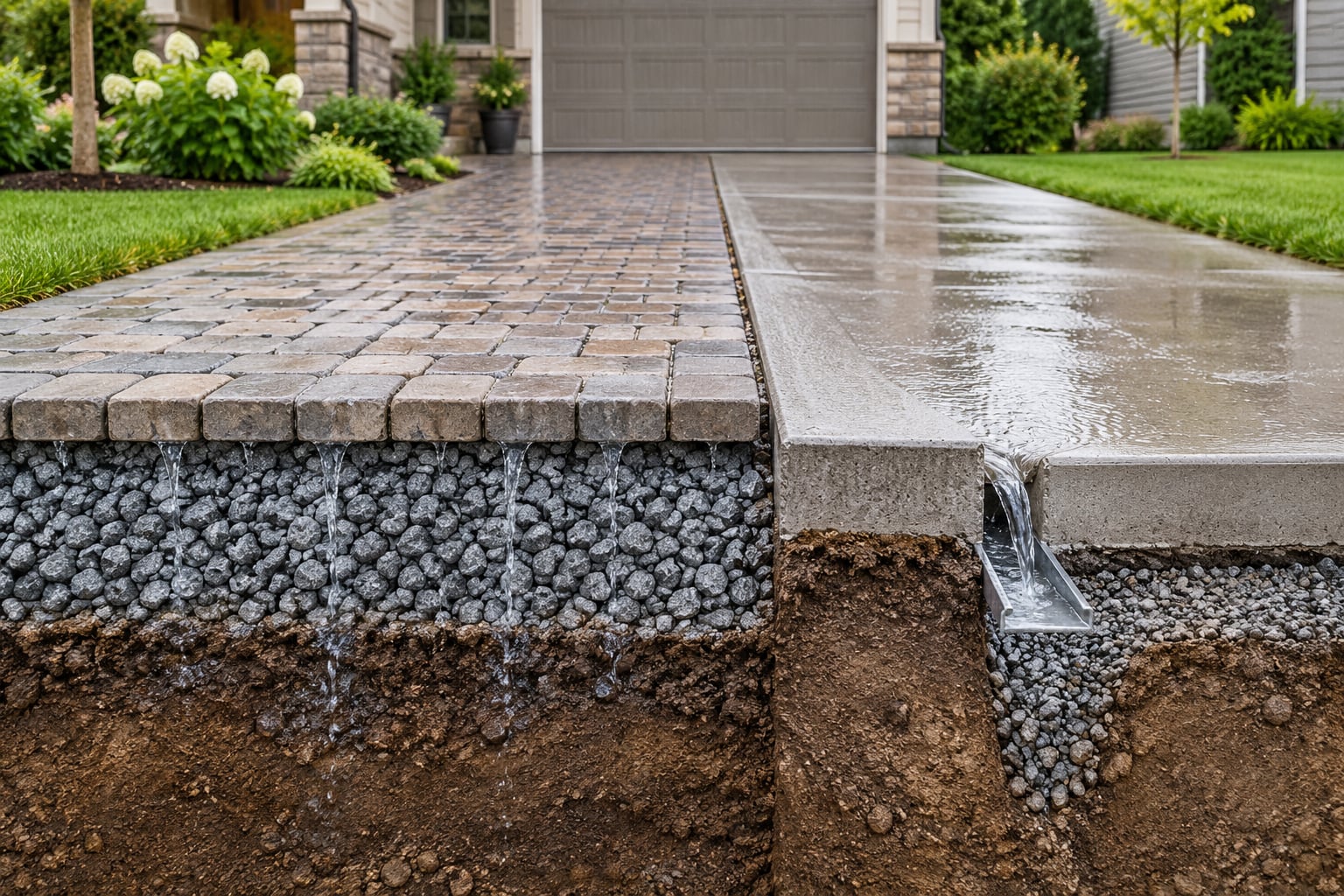
Permeable pavers handle stormwater better than a solid concrete driveway, because rain falls through the open joints into a stone reservoir instead of sheeting off the surface. That advantage only holds when the soil beneath drains, the base is built properly and somebody maintains the joints. On clay, on a steep slope, under a dump truck, or with a tight budget, concrete is still the sensible answer.
This guide was checked against municipal stormwater guidance in 2026, and it does not treat either material as a universal winner. Driveways are one of the most concentrated impervious surfaces on a residential lot, so the choice matters more than it looks. The rest of this article works through how each system handles rain, what actually sits underneath permeable pavers, and where the cost and the headaches land.
Table of Contents
- Permeable Pavers vs Concrete Driveways for Stormwater at a Glance
- How Each Driveway Handles Rain and Runoff
- How permeable pavers move water
- Where a concrete slab sends every drop
- Stormwater Performance Depends on the Ground Beneath It
- What goes under permeable pavers
- Run the infiltration test before you sign
- What Happens During Intense Rain
- Permeable Pavers vs Concrete Driveways for Stormwater: Real-World Trade-Offs
- Which Surface Is Easier to Maintain?
- Durability and Appearance
- Installation, Cost and Environmental Impact
- Questions to ask a permeable paver contractor
- Which Should You Choose?
- Frequently Asked Questions
- Do permeable pavers prevent driveway flooding during heavy rain?
- Are permeable pavers strong enough for everyday vehicles?
- Can an existing concrete driveway be made permeable?
- What soil is best for a permeable paver driveway?
- How often do permeable pavers need maintenance?
- Do I need permission to install a permeable driveway?
- Conclusion
Permeable Pavers vs Concrete Driveways for Stormwater at a Glance
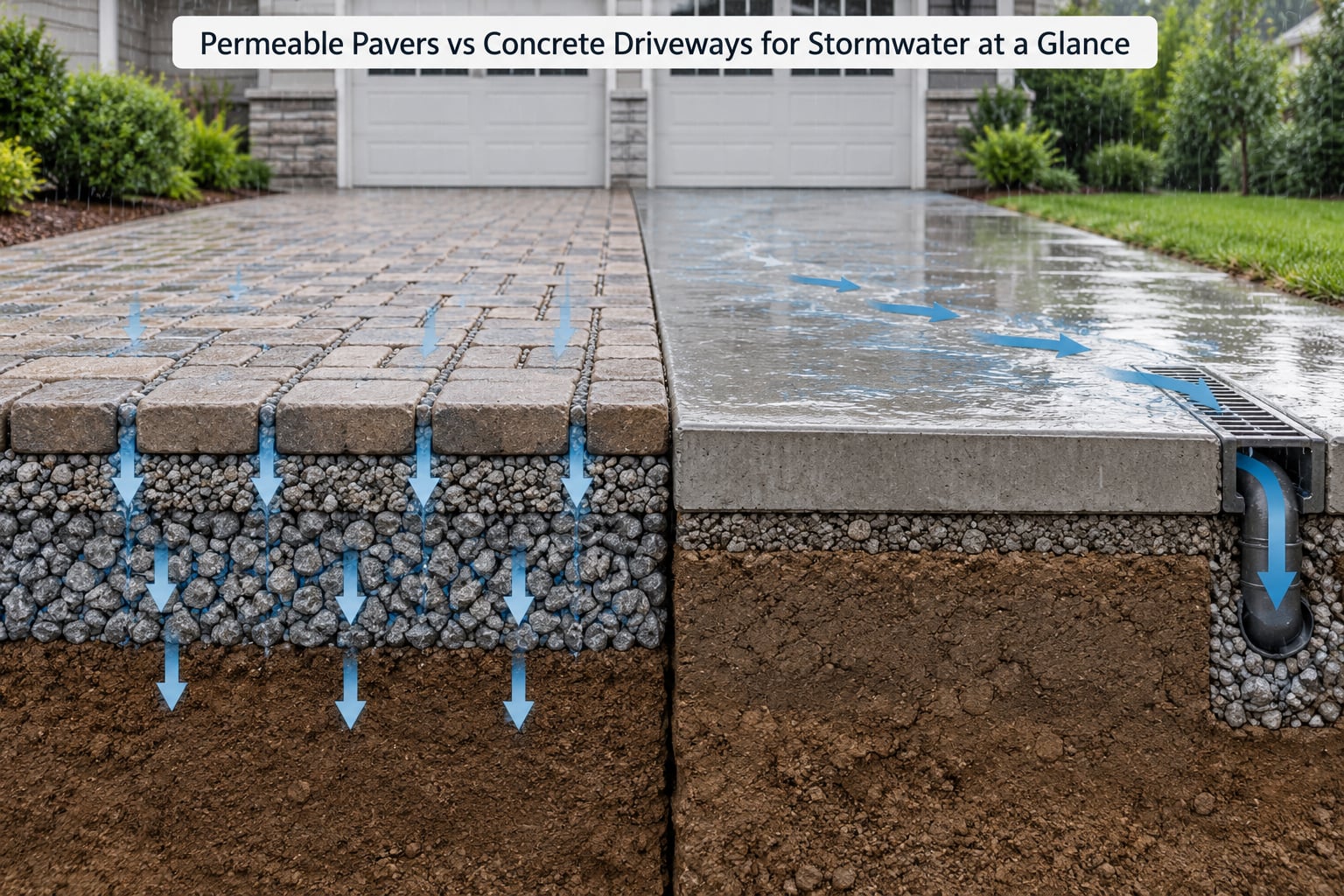
The table below is the honest version of this comparison, not a sales pitch for either side. Read the right-hand column carefully, because several of its entries are places where concrete genuinely wins.
| Criterion | Permeable pavers | Solid concrete driveway |
|---|---|---|
| How rain leaves the surface | Down through the joints into the aggregate base | Across the slab to a drain, channel or neighbouring lawn |
| Surface runoff in a normal storm | Very little once the joints and base are working | Close to the full rainfall volume, off the driveway and onto whatever is downhill |
| Ponding risk | Low, because the surface drains downward as well as across | Real, wherever grading is flat or a low point forms |
| Groundwater recharge | Yes, where the subgrade will accept the water | None. The slab is a barrier by design |
| Base build-up required | Deep open-graded stone, geotextile separation, careful compaction | Standard compacted base, far less excavation |
| Installation difficulty | High. Not a weekend job for most homeowners | Moderate, and widely available locally |
| Upfront material and labour cost | Noticeably higher, often a multiple of plain concrete | The cheaper of the two options |
| Annual maintenance | Vacuum sweeping, joint topping up, weed control | Sealing every few years, crack watching, patching |
| Clogging or sediment risk | Yes, if sweeping is skipped | Not applicable, since the surface does not infiltrate |
| Load capacity | Excellent for passenger vehicles and light vans | Excellent, and better suited to heavy trailers and refuse trucks |
| When it fails | Settling, joint loss, weed growth | Cracking, heaving, scaling, spalling |
| Repair method | Lift and reset the affected pavers, then re-bed | Cut out and patch, or a full replacement and regrade |
| Expected lifespan | Roughly 25 to 30 years or more with maintenance | Roughly 20 to 25 years before a major repair or replacement |
| Cold climate behaviour | Tolerates freeze-thaw well; salt and snow blades can damage it | Salt scaling is common; no snow blade damage |
| Appearance | Patterned, textured, individual blocks that shift colour over time | A single clean plane, which some prefer and some find plain |
| Permits and rebates | Often qualifies as a pervious surface for local stormwater rules | Standard driveway approval, sometimes with drainage conditions attached |
Neither material manages severe rainfall automatically. Performance depends on soil, slope, subbase, maintenance habits and local climate far more than on the surface you pick.
How Each Driveway Handles Rain and Runoff
How permeable pavers move water
Permeable interlocking concrete pavement, the formal name for most permeable paver systems, is built in layers. On top sit individual blocks with deliberately wide joints, often 3mm to 6mm, spaced far enough apart to let water through rather than seal shut.
Under the blocks sits a thin open-graded bedding course, then a deep reservoir of open-graded crushed stone. A professional installer described the minimum as around six inches of #57 stone with no fines, and cutting that depth is the single most common reason these systems fail.
Water passes through the joints, through the bedding, and into the voids between the aggregate pieces. The reservoir holds a volume of water temporarily, then releases it downward into the subgrade. The EPA treats this on-site infiltration and groundwater recharge as the core mechanism, and the same idea sits inside the Low Impact Development community and the International Stormwater BMP Database.
Where a concrete slab sends every drop
A conventional driveway is designed to be impermeable. The slab is compacted on a base, finished to a slope, and water leaves as surface runoff, collected by a channel drain at the edge or a pipe running to the street.
That is not a design flaw. A well-graded slab with a working channel drain moves water off the property quickly and predictably, which is exactly what you want in a place where the ground will not absorb rain.
The problem is the destination. All of that volume lands somewhere, and on a low-lying lot that somewhere may be the neighbour’s foundation, the municipal storm drain, or your own garage apron.
Stormwater Performance Depends on the Ground Beneath It
This is the part most sales pages skip. A permeable surface is only as permeable as the assembly underneath it, and a paver driveway sitting on heavy clay with a shallow stone base performs worse than a well-graded concrete slab.
What goes under permeable pavers
- Subgrade. Native soil, tested for infiltration and prepared to a uniform bearing condition. The subgrade is not compacted into a dense layer, because that is the layer you need water to move through.
- Geotextile separation fabric. A non-woven fabric between the soil and the stone, so fines from the subgrade cannot migrate up into the reservoir and clog it.
- Open-graded aggregate reservoir. Around six inches or more of washed crushed stone such as #57, with minimal fines. Void space is the whole point; pea gravel has the wrong shape and packs tight, so it silts up and stops draining.
- Edge restraint. A border that holds the pavers from migrating outward as vehicles roll over the joints. Without it the edge walks and the surface loses its interlock.
- Open-graded bedding course and open joints. A shallow bedding layer of the same washed stone, plus swept-in joint filler that lets water pass while resisting weed seed.
ASTM C1701 is the surface permeability test used to verify that the finished assembly performs. If a contractor cannot tell you the reservoir depth, the stone specification and the compaction procedure in their quote, you are comparing descriptions, not systems.
Run the infiltration test before you sign
Before anything is excavated, a soakaway or double-ring infiltrometer test tells you how fast the ground takes water. On a clay lot you may get a rate so low that infiltration alone is pointless, and a permeable install would need a lined reservoir with an underdrain or a connection to a rain garden.
High water tables and contaminated subgrade soil are two more stop signs. A city or county health department may restrict where infiltration is allowed at all.
What Happens During Intense Rain
In ordinary rain, a properly built permeable driveway does exactly what it is sold as doing. The joints take the water, the reservoir fills, and the subgrade takes over the rest. Very little reaches the surface flow path.
Extreme storms are the harder test. Joints can only accept so much water at once, and when rainfall intensity exceeds infiltration capacity, surface flow appears even over pavers. A driveway that is a low point on the lot will still collect water during a cloudburst, because the system was sized for routine events rather than a flood.
Several things quietly reduce performance. Compacted subbase and a clay subgrade shrink the infiltration rate. An underdrain that cannot discharge creates a saturated reservoir that backs up into the surface. Sediment, leaf litter and moss seal the joints, and a sealed joint accepts only what the paver bodies themselves let through, which is very little.
Concrete handles the reverse case better in one respect. A slab graded to a channel drain moves a large volume quickly, even if it means moving it onto someone else.
Permeable Pavers vs Concrete Driveways for Stormwater: Real-World Trade-Offs
Numbers make this concrete. Take a driveway of 1,500 square feet and one inch of rainfall, which is a modest but entirely ordinary storm.
One inch over 1,500 square feet is about 125 cubic feet, or roughly 935 gallons. A solid concrete driveway has a runoff coefficient near 0.9, so about 840 gallons leaves the property and lands somewhere else.
A permeable system designed to capture the first inch of rainfall on site would retain that same volume for infiltration and evaporation, leaving the neighbouring lawn and the municipal storm drain untouched. A system with a limited reservoir might manage a fraction of it and pass the remainder along, which is why the first-flush and long-term performance claims in rebate programmes are always stated in millimetres rather than in adjectives.
The takeaway is not that permeable wins by a set margin. It is that permeable pavers versus concrete driveways for stormwater is a site-by-site calculation, and the same driveway on two neighbouring lots can produce two different answers. Actual measurements beat a universal material verdict every time.
Which Surface Is Easier to Maintain?
Concrete is easier to maintain for the first five years and more expensive to own over thirty. That inversion is what surprises most homeowners who assumed a solid slab was the low-hassle option.
| Task | Permeable pavers | Solid concrete |
|---|---|---|
| Sweeping | Vacuum sweep 2 to 4 times a year, more under trees | Ordinary broom or leaf blowing |
| Joints | Top up with joint filler as it settles | Not applicable |
| Weeds and moss | Expect growth in the first couple of years, pull it early | Cracks and the slab edge instead |
| Sealing | Usually not required, and sealing can close the joints | Seal every few years to slow surface wear |
| Snow and ice | Snow blower with a polyurethane blade only; salt and metal blades are a problem | Salt works, but causes surface scaling over time |
| Repairs | Lift, re-bed and reset the affected area in a day or two | Cut and patch, or replace the whole slab |
| Typical annual attention | A few hours if you do it, or a small service call | Minimal, until something cracks |
Contractors who work with these systems say the top clogging culprits are sediment and organic debris, not dust. A driveway under a tree will need more attention than one in open sun.
Snow is worth its own note if you are in a cold region. A snow blower with a plastic or polyurethane blade is fine. A metal blade, and salted pavement that gets repeatedly wet and refrozen, will damage paver faces and the joint filler that keeps the system permeable.
Durability and Appearance
Well-installed permeable pavers do not crack like concrete, because the surface is made of individual blocks on a flexible stone base rather than a continuous slab. A small section that settles can be lifted, re-levelled and put back, which no concrete repair can match.
That flexibility is also the reason settlements happen at all. A paver surface tolerates movement and then records it as unevenness, while a slab either spans a void or breaks across it. The bigger risk on a permeable install is a poorly graded bedding layer or a base that was not properly compacted, and both produce the same result.
Concrete wins on appearance for some people and loses for others. Pavers offer pattern, colour blend and texture, and a mature installation slowly picks up a soft, variegated look. Colours fade unevenly at first, which unsettles buyers who expect uniformity.
Concrete stays a single clean plane, which suits a formal frontage, and it handles the highest loads, from a loaded trailer to a refuse truck, without special provisions. The joints on a paver driveway are also a genuine trip hazard once they lose their filler, and some people find the textured surface uncomfortable underfoot in bare feet or hard for a wheelchair.
Installation, Cost and Environmental Impact
Permeable paving usually costs more, and the gap is not a rounding error. The reasons are structural: deeper excavation, more stone hauled to site, a geotextile layer, edge restraint, slower placement of individual blocks, and contractors who are fewer and more specialised.
Ask any two contractors for a per-square-foot figure and confirm exactly what is included. The number that matters is the installed figure including base, fabric, edge restraint and labour, because a quote for pavers alone tells you almost nothing. Cost per square foot also differs sharply by region, so a local number is worth more than any national average you read online.
On the environmental side, the case is more balanced than the marketing suggests. Pavers weigh less in embodied energy than a full concrete slab, they can be lifted and reused rather than demolished, and reducing runoff and erosion on your own lot is a real local benefit. Against that, open-graded stone is not cheap in transport, and pervious concrete carries a high cement content, which is hard to ignore on carbon.
Life-cycle thinking also changes the comparison. If your alternative to a permeable driveway is not plain concrete but concrete plus a new drainage system, a drywell or an undersized culvert, the totals move again. Compare whole-life drainage cost, not the paving line item on its own.
Questions to ask a permeable paver contractor
- What depth and specification of open-graded aggregate is in the price?
- Is a geotextile separation layer included?
- Has an infiltration test been done on this lot, and who did it?
- Is there an underdrain, and where does it discharge?
- What edge restraint detail is included at the sides and at the garage threshold?
- What compaction spec will be used for the subgrade and each lift?
- Do you install these regularly, or is this a first project for your crew?
- What maintenance and joint refill are included in the warranty?
Base compaction is the biggest failure driver, and contractor scarcity is a real problem. Multiple homeowner forums describe asking for a permeable paver recommendation and getting very few replies.
Two other permeable options exist, and both are worth a look. Pervious, or no-fines, concrete gives up the paver look but keeps a concrete-like surface, and it carries roughly a double premium over plain concrete per square foot. Porous asphalt is cheaper to install in many regions, softer underfoot and easier to plough, but it oxidises faster and cannot be patched invisibly.
Which Should You Choose?
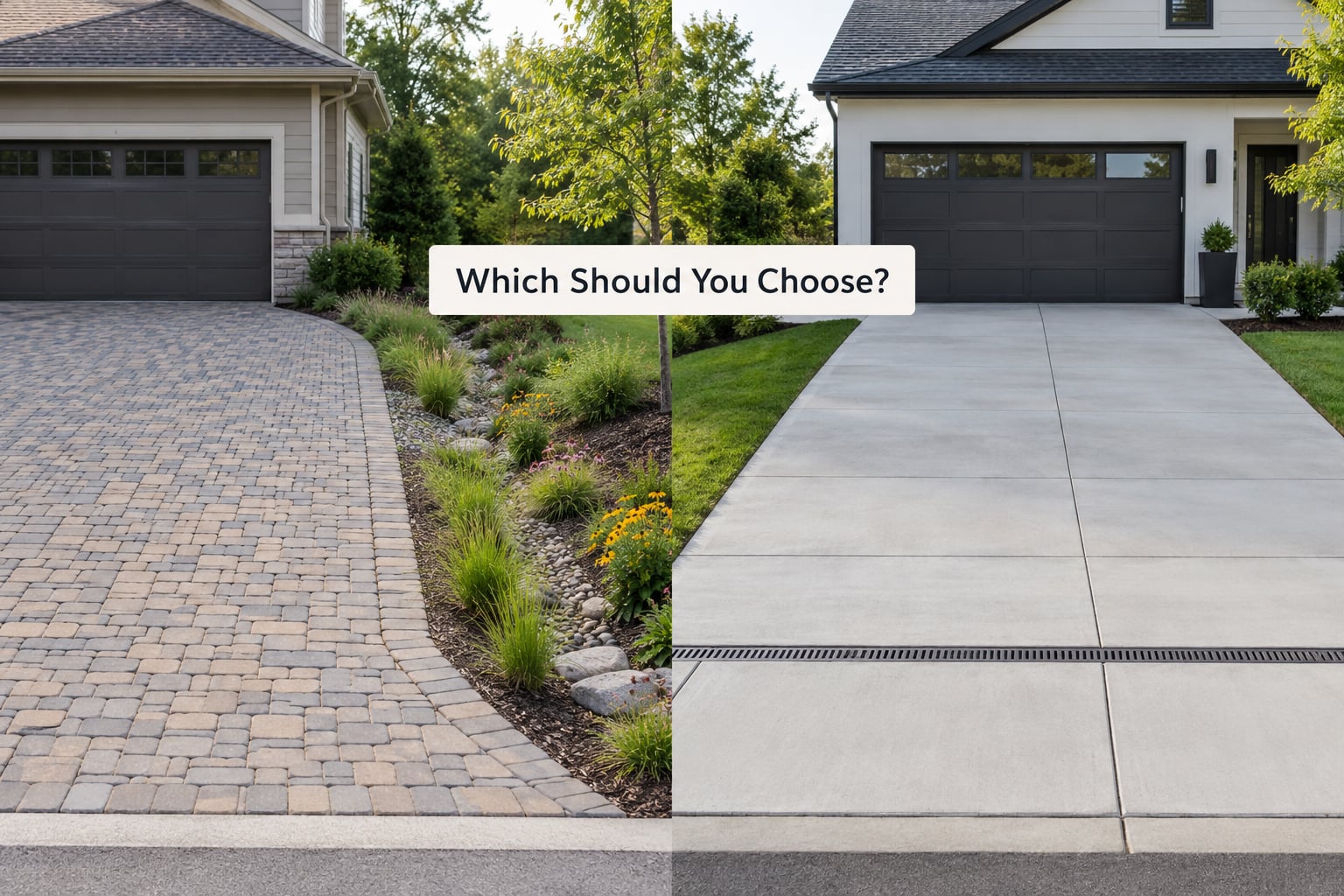
Choose permeable pavers when the soil infiltrates, the lot is low or flat, rain is frequent, runoff is a genuine problem, and you will commit to sweeping it. Add a rain garden or underdrain tie-in if infiltration alone will not carry the volume.
Choose concrete when heavy loads matter, the slope is severe, the subgrade is clay or the water table is high, you want the simplest possible appearance, or the lower upfront cost decides it. A concrete slab graded properly to a channel drain is a legitimate, cheaper partial answer to a drainage problem, and it is worth pricing before you commit to a full permeable rebuild.
Before either, talk to a local permeable-paving contractor or a drainage professional. Ask them to run the infiltration test, size the reservoir for your actual rainfall, and tell you honestly whether your lot can support infiltration at all. A home inspector has already flagged lifted pavers, poor grading and standing water on real installs, and none of that is visible in a sales photo.
Frequently Asked Questions
Do permeable pavers prevent driveway flooding during heavy rain?
No. A permeable driveway handles routine rainfall well, but a cloudburst can still exceed what the joints and stone reservoir can accept, especially if the driveway sits in a low point. Design the system for a realistic storm, or for a defined local rainfall intensity, and consider a rain garden or underdrain for the overflow. A permeable surface reduces runoff volume; it does not make a lot flood-proof.
Are permeable pavers strong enough for everyday vehicles?
Yes. Permeable interlocking concrete pavement is rated for passenger vehicles, SUVs and light vans, and it handles repeated loading well when installed to spec. The limitation is not the surface but the base, which is why the reservoir depth and compaction matter more than the block. For a dump truck, a moving container or a heavy trailer on every trip, plain concrete is the safer specification.
Can an existing concrete driveway be made permeable?
Rarely in place. Sawcutting joints into a slab lets a little water through but does not create a storage reservoir beneath the concrete, so the performance gain is minimal. The practical routes are to remove the slab and rebuild as permeable pavers, or to keep the existing slab and solve the drainage separately with grading, a channel drain or a rain garden. Replacing a failing slab with a permeable parking pad is often the smartest middle option.
What soil is best for a permeable paver driveway?
Sandy loam and gravelly soils that drain freely are ideal. Heavy clay, high water tables and subgrade soil that smears when you dig are the situations that make infiltration difficult, and you may need a lined reservoir with an underdrain instead. Test before you commit: a soakaway or double-ring infiltrometer test in the driest part of the season tells you more than any brochure number.
How often do permeable pavers need maintenance?
Vacuum sweep two to four times a year, more often under trees, and top up the joints with filler as it settles. Pull weeds and moss early in the first couple of years. Do not seal the surface, since a sealer can close the joints and destroy the permeability. A few hours twice a year is enough for most residential drives, and owners who skip it are the ones who end up with a clogged driveway.
Do I need permission to install a permeable driveway?
Usually yes, because driveways touch street rights-of-way, setbacks and sometimes drainage rules. Some municipalities count a permeable surface toward stormwater requirements or offer a rebate, and HOA rules can be stricter than the city code. Check your local stormwater or public works department before signing anything, since retrofitting a driveway that already fails the specification is expensive.
Conclusion
Permeable pavers offer the stronger stormwater performance only when the whole below-ground system suits the site: infiltrating soil, a properly built open-graded reservoir, and an owner willing to sweep it. Concrete remains the practical choice for heavy loads, steep slopes, poor-draining ground, plain looks and lower upfront cost.
Start before you start shopping. Get the infiltration test done, note your rainfall pattern, check the slope and loading, then look at local permit and rebate rules. Once those four answers are in your hand, the material choice makes itself.