A heat pump water heater costs more to buy and install and much less to run. If you are replacing an electric tank, the extra upfront cost usually pays back in roughly four years. If you are replacing a gas tank, payback runs about seven years and stretches past the life of the heater where gas is cheap.
That is the short version of the heat pump water heater vs tank water heater cost comparison. Everything below breaks the two systems down by installed price, running cost, upkeep and lifespan, using typical US ranges that vary a lot by region, fuel type and how much electrical work your panel needs.
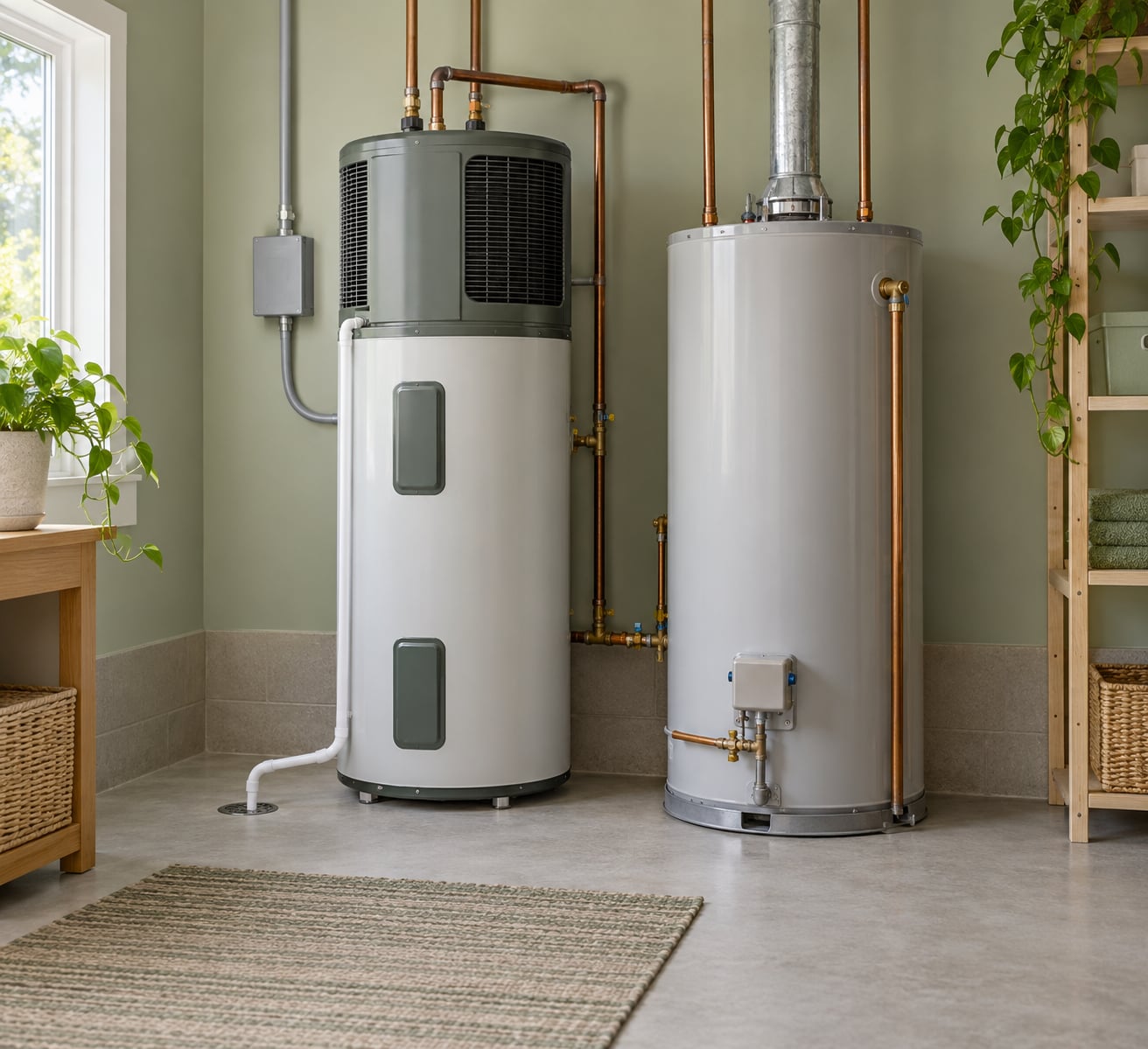
One definition first, because it matters for the rest of the article. A conventional tank water heater generates heat directly with a gas burner or electric elements. A heat pump water heater — often called a hybrid water heater — moves heat from the surrounding air into the same kind of storage tank using a refrigerant cycle, and keeps electric backup elements for peak demand.
Table of Contents
- Heat Pump Water Heater vs Tank Water Heater Cost Comparison at a Glance
- Upfront and Installation Costs
- The electrical work
- Space, venting and drainage
- The sizing trap nobody mentions
- Operating Costs and Energy Efficiency
- What really drives heat pump water heater vs tank water heater cost: the fuel rate
- When a heat pump falls back to electric
- Maintenance, Lifespan, and Reliability
- Payback Period and Total Cost of Ownership
- Which Should You Choose?
- Frequently Asked Questions
- Is a heat pump water heater cheaper to run than a tank water heater?
- How much does a heat pump water heater cost to install compared with a tank model?
- Are heat pump water heaters worth the higher purchase price?
- Do heat pump water heaters work in cold climates?
- Can a heat pump water heater replace a conventional tank water heater?
Heat Pump Water Heater vs Tank Water Heater Cost Comparison at a Glance
| Criterion | Heat pump (hybrid) | Conventional gas tank | Conventional electric tank |
|---|---|---|---|
| Typical unit price, 50 gallon | USD 1,400 to 3,000 | USD 700 to 1,300 | USD 500 to 900 |
| Typical installed price, 50 gallon | USD 2,800 to 5,000 | USD 1,400 to 2,600 | USD 1,100 to 1,800 |
| Fuel | Electricity plus backup elements | Natural gas or propane | Electricity |
| Efficiency (UEF) | 1.8 to 2.6 | 0.60 to 0.82 | 0.90 to 0.98 |
| Annual energy use, family of four | About 500 to 700 kWh | About 250 to 350 therms | About 3,200 to 4,200 kWh |
| Annual energy cost at 20 cents per kWh and USD 1.20 per therm | About USD 110 to 140 | About USD 300 to 420 | About USD 640 to 840 |
| Installation needs | 240V circuit, condensate drain, unconditioned space | Gas line and flue venting | 240V circuit |
| Annual upkeep | Low: anode rod, air filter, condensate tray | Low: anode rod, pilot and venting | Low: anode rod, element sediment |
| Expected lifespan | 13 to 15 years | 8 to 12 years | 10 to 14 years |
| 10-year total cost of ownership, mid-range install | About USD 4,700 | About USD 5,400 | About USD 8,200 |
| Best fit | Moderate climates, electric service, unconditioned space nearby | Cheap gas, cold basements, no space to relocate | Tight budgets, small spaces, simplest install |
Those figures are typical national ranges for 2026, not quotes. Labour in a rural county can double a heat pump install, and electricity rates from the Gulf Coast to San Francisco differ by more than a factor of two.
Upfront and Installation Costs
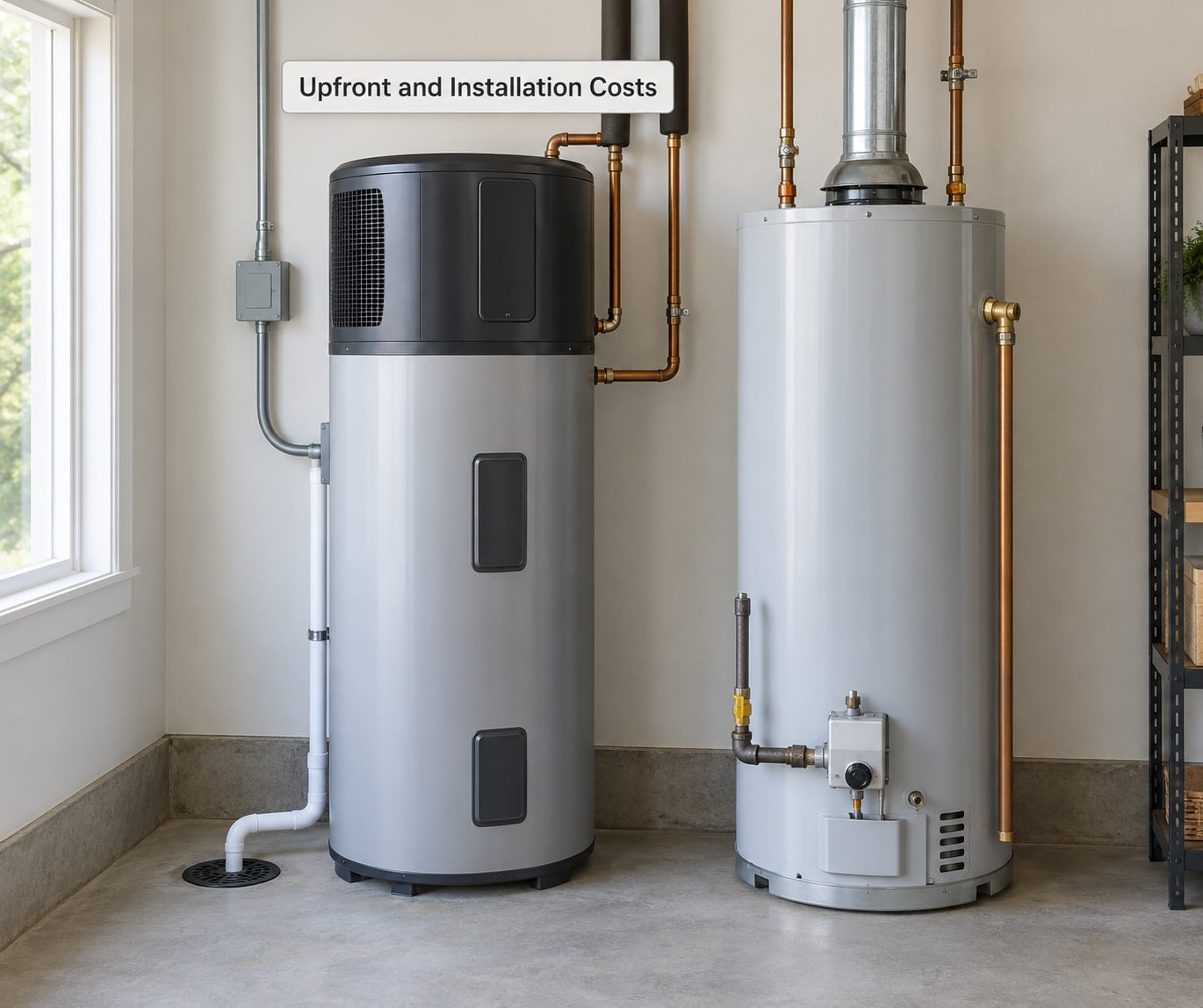
On paper the heat pump looks expensive. In practice the gap narrows once you count the electrical work a gas tank does not need — and widens again if you have to move the unit.
Equipment alone is fairly predictable. A 40 gallon heat pump lands near USD 1,000 to 1,700, a 50 gallon between USD 1,400 and 3,000, and 65 and 80 gallon models between USD 1,800 and 4,000 depending on tank material, brand tier and compressor type. Standard gas tanks run roughly USD 700 to 1,300, and electric tanks about USD 500 to 900.
| Tank size | Heat pump installed | Gas tank installed | Electric tank installed |
|---|---|---|---|
| 40 gallon | USD 2,400 to 3,600 | USD 1,200 to 1,900 | USD 900 to 1,400 |
| 50 gallon | USD 2,800 to 5,000 | USD 1,400 to 2,600 | USD 1,100 to 1,800 |
| 65 gallon | USD 3,300 to 5,600 | USD 1,700 to 3,000 | USD 1,300 to 2,100 |
| 80 gallon | USD 4,000 to 6,500 | USD 2,100 to 3,600 | USD 1,600 to 2,600 |
The line items that push a heat pump install above its quoted range are worth knowing before you sign anything.
The electrical work
A heat pump water heater needs a dedicated 240V circuit with a breaker sized for the unit, often 30 or 40 amps. Panels in homes built before the 1990s sometimes need a sub-panel or an upgrade. Homeowners on plumbing forums report paying around USD 800 for an electrician to run a new 240V outlet where one did not exist, on top of roughly USD 475 in plumbing labour and about USD 200 in parts.
Space, venting and drainage
Heat pumps pull air from the room, so makers want roughly 700 square feet of space and a floor that can take condensation. A basement, garage or utility room works; a small closet in a cold climate does not. You also need somewhere for the condensate drain, and you no longer need a gas flue — capping or abandoning the existing vent line adds a small line item that some installers leave out of the first quote.
The sizing trap nobody mentions
A heat pump recovers slowly compared with a gas burner. The advice that repeats across forums is to step up one size: swap a 40 gallon gas tank for a 65 gallon heat pump. That larger tank, the 240V circuit and the unconditioned space it needs are the three reasons the cheapest-looking quote so often becomes the most expensive invoice. One homeowner estimated an extra USD 3,000 to relocate a heater into the garage and step up to a 65 gallon unit.
Nobody in my circles has regretted buying the bigger tank. Several have regretted buying the smaller one.
Operating Costs and Energy Efficiency
This is where the comparison tilts hard, and the tilt is driven almost entirely by your utility rates rather than by the appliance.
What really drives heat pump water heater vs tank water heater cost: the fuel rate
A 90 percent efficient gas tank burns roughly 250 to 350 therms a year for a family of four. A heat pump with a UEF of about 2.0 uses roughly 500 to 700 kWh for the same household. Divide the gas bill by the electric bill and the break-even electricity rate falls out: at USD 1.20 per therm, a heat pump stops being cheaper to run only if electricity costs more than about USD 0.65 per kilowatt-hour. No US residential rate is anywhere near that.
Against an electric tank the threshold is far lower, around 10 cents per kilowatt-hour. Every US rate clears that too, which is why replacing an electric tank is the clear-cut case and replacing a gas tank is where the arguments start.
| Electricity rate per kWh | Heat pump annual cost | Electric tank annual cost | Gas tank annual cost at USD 1.20 per therm |
|---|---|---|---|
| 11 cents (Gulf Coast, rural Midwest) | About USD 55 to 77 | About USD 350 to 460 | About USD 300 to 420 |
| 17 cents (national median) | About USD 85 to 120 | About USD 545 to 715 | About USD 300 to 420 |
| 24 cents (dense Northeast, upper Midwest) | About USD 120 to 170 | About USD 770 to 1,010 | About USD 300 to 420 |
| 28 cents (California, New York) | About USD 140 to 195 | About USD 900 to 1,175 | About USD 300 to 420 |
Note the last two columns. In high-rate states, a heat pump cuts roughly a third off what a gas tank costs, and in cheap-rate states it cuts a lot more. The reason installers push back on heat pumps is rarely the energy bill. It is the install complexity and the recovery speed.
When a heat pump falls back to electric
Every hybrid has backup elements, and high-demand mode runs them when several large draws hit at once. That is where the loudest complaint comes from: my electric bill went up. Electric-only heating elements are close to resistance heating, so an hour in high-demand mode can cost roughly USD 1 to 3 depending on your rate.
Three things push a unit into fallback more often: a tank sized too small for the household, heavy use in a household of four or more, and a garage or crawl space in winter when the compressor is below its operating range of about 40 to 90 degrees. Owners on forums commonly report six hours to recover a full tank in heat pump mode, which is fine for a couple and tight for a family.
If you expect frequent fallback, the savings math changes. Sixty hours a year of electric elements at 20 cents adds about USD 120, which is enough to erase the advantage over a gas tank in a cheap-gas region.
Maintenance, Lifespan, and Reliability
Neither type is high maintenance, but the failure modes are different in ways that matter at replacement time.
A gas tank has moving parts you can hear: a burner, a thermostat, a pilot or electronic ignition, and a flue that has to stay clear. Venting is the usual emergency call. Sediment and anode rod depletion are the usual slow decline.
A heat pump adds an air filter to rinse or replace every few months and a condensate tray that can clog or grow biofilm, plus a compressor and a fan motor that conventional tanks do not have. In exchange you skip combustion, so there is no gas valve to fail and no vent to clean. Repair parts for the compressor are pricier and older models can be hard to source, which is the argument for buying a 10-year limited warranty rather than the shortest one available.
On lifespan, most manufacturers rate heat pump water heaters at 13 to 15 years and conventional tanks at 8 to 12 for gas and 10 to 14 for electric. Placed in a damp basement with a soft water supply, a tank can fail sooner, so the anode inspection every year or two is the cheapest insurance either way.
Payback Period and Total Cost of Ownership
Here is a worked example with the assumptions stated so you can change them. Family of four, 50 gallon tank, mid-range install, 15 years of ownership, gas at USD 1.20 per therm and electricity at 20 cents per kilowatt-hour.
| Line item | Gas tank | Electric tank | Heat pump |
|---|---|---|---|
| Installed price | USD 1,800 | USD 1,400 | USD 3,600 |
| Annual energy cost | USD 360 | USD 680 | USD 110 |
| 10-year total | USD 5,400 | USD 8,200 | USD 4,700 |
| 15-year total including one replacement | USD 9,000 | USD 11,600 | USD 5,250 |
| Extra upfront vs gas tank | — | — | USD 1,800 |
| Simple payback | — | — | About 7 years |
Read that bottom row carefully, because it hides where the debate actually comes from. Against an electric tank the heat pump pays back in roughly four years, which is a straightforward win. Against a gas tank it pays back in about seven years at USD 1.20 per therm — and at 80 cents per therm, which plenty of regions still see, annual savings drop to about USD 130 and payback stretches past 14 years.
That is the honest answer to the question. The heat pump almost always wins on energy dollars; whether it wins on total cost depends on your gas rate, your installed price and how long you keep the unit. Simple payback ignores that the gas tank needs replacing around year twelve and the heat pump usually does not, which is where lifecycle value pulls further in the heat pump’s favour.
Incentives change the math, and one frequently repeated number is now out of date. The 30 percent federal residential clean energy credit of up to USD 2,000 expired on December 31, 2025. What remains is a patchwork of state and utility programs: ENERGY Star certification, Mass Save in Massachusetts, California single-family incentives, New York state programs, and utility rebates that commonly run from a few hundred to around USD 1,000 depending on the unit and your meter. Check your utility before you sign, because several rebate programs require the qualified contractor to submit the paperwork.
Which Should You Choose?
Choose a heat pump water heater when you are replacing an electric tank, when your panel can take the load or the circuit is straightforward, when a basement or garage is available, and when you plan to keep the heater for 13 years or more. It also suits anyone running a whole-home electrification plan, since the gas line is going away eventually anyway.
Stay with a conventional tank when gas is cheap in your area, the panel is full, the only space is a tight unconditioned closet in a cold climate, or your household runs more hot water than a 65 gallon tank can hold without constant fallback. Rental properties and seasonal cottages are usually simpler as a standard tank too.
A third option deserves a mention. A high-efficiency gas tank at around 90 percent UEF narrows the gap considerably, and a tankless unit avoids the standby losses of any tank entirely. Neither makes the heat pump wrong, but both change the payback math enough to be worth pricing before you commit.
Frequently Asked Questions
Is a heat pump water heater cheaper to run than a tank water heater?
Usually yes. A heat pump with a UEF near 2.0 uses roughly 500 to 700 kWh a year for a family of four, while a gas tank burns about 250 to 350 therms and an electric tank uses roughly 3,200 to 4,200 kWh. Break-even against gas is about USD 0.65 per kWh at USD 1.20 per therm, which is far above typical US rates.
How much does a heat pump water heater cost to install compared with a tank model?
A 50 gallon heat pump typically installs at USD 2,800 to 5,000 against USD 1,400 to 2,600 for a gas tank and USD 1,100 to 1,800 for an electric tank. The gap widens fast if the install needs a new 240V circuit, a panel upgrade, a condensate drain, or relocation to a basement or garage.
Are heat pump water heaters worth the higher purchase price?
Replacing an electric tank, yes: payback is typically around four years. Replacing a gas tank, it depends on your gas rate, reaching about seven years at USD 1.20 per therm and stretching beyond the heater’s life at 80 cents per therm. The 30 percent federal credit expired December 31, 2025, so check state and utility rebates instead.
Do heat pump water heaters work in cold climates?
They work, with limits. Most operate between about 40 and 90 degrees of surrounding air, so an unheated garage or crawl space in winter reduces output and forces more backup element use. Cold-climate models and a large enough tank help, and plumbers in very cold regions often steer buyers toward a gas tank or a condensing unit.
Can a heat pump water heater replace a conventional tank water heater?
In most homes, yes. The tank, drain and hot water lines stay the same. What changes is the fuel: you need a dedicated 240V circuit, a condensate drain and about 700 square feet of space with airflow, and the old gas line and flue need to be capped or removed. Sizing up one tank size is common because recovery is slower.
Start by pulling twelve months of your gas and electricity bills and comparing the cost per therm with the cost per kilowatt-hour. Then get an itemised installed quote that names the electrical work, the condensate drain and the tank size in writing. If that quote shows a dedicated 240V circuit and a basement or garage nearby, a heat pump is very likely the cheaper heater to own for the next decade and a half.