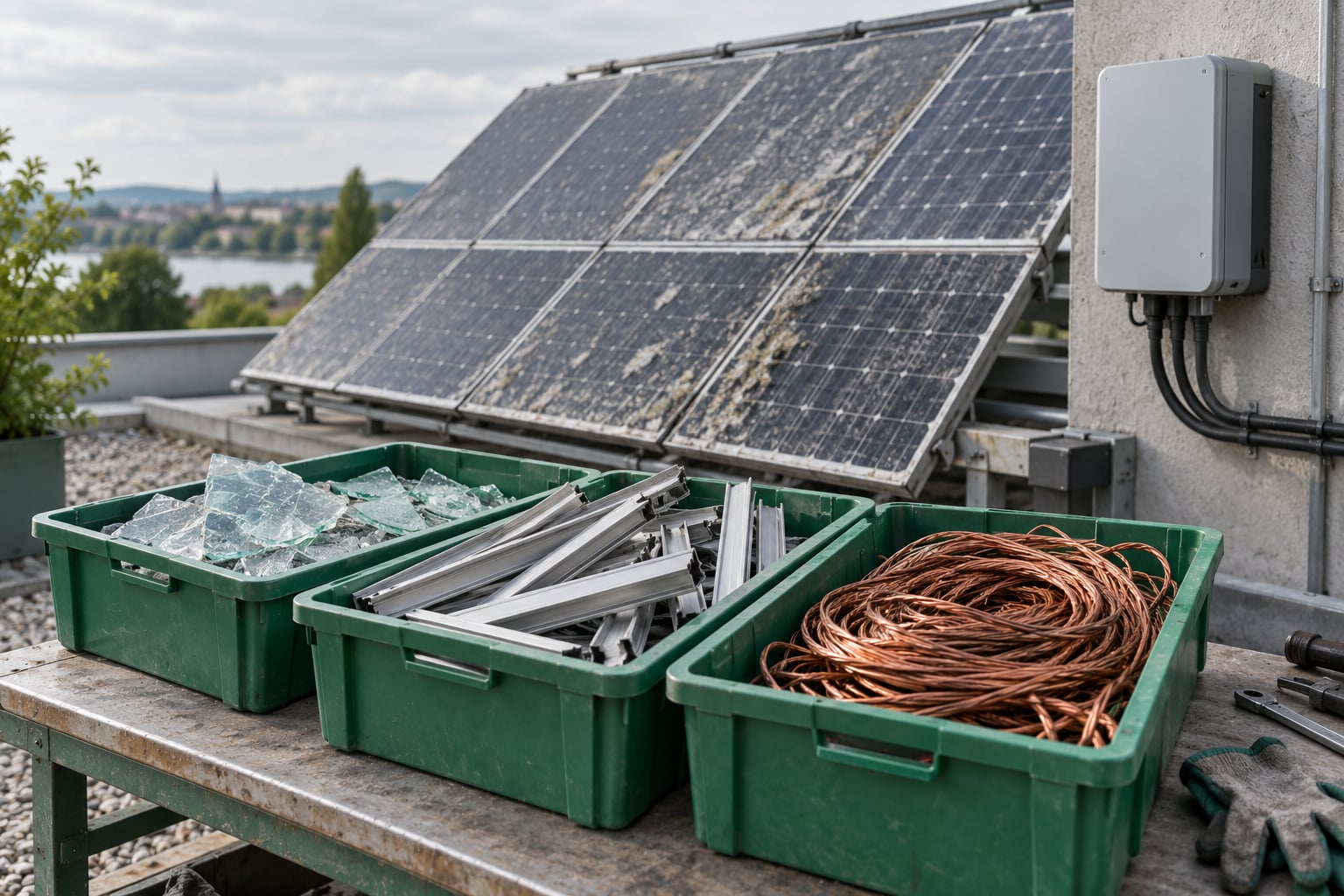
Solar panels usually run for 25 to 30 years, then they do not switch off. They lose a small share of their output every year, and once output falls far enough, or the glass, mountings or wiring fail, the array is disconnected and taken down. What happens next is one of four things: the panels are recycled for their materials, reused as-is, repurposed for a low-power job, or — in most countries today — landfilled. There is no single global answer, because collection routes and rules differ enormously from one place to the next.
That gap between what a panel is worth and what it costs to process is the whole story of solar panel end of life. The materials inside a module are almost all recyclable, and specialist plants can recover up to roughly 95% of them by weight. Getting a damaged panel to one of those plants is the expensive part, and in most markets nobody is required to pay for it.
Table of Contents
- When Do Solar Panels Reach the End of Their Life?
- What Happens to Solar Panels at the End of Their Life?
- How Are Retired Panels Collected and Transported?
- Can Old Solar Panels Be Reused Instead of Recycled?
- What Materials Can Be Recovered?
- Are Solar Panels Hazardous Waste?
- Why Is Recycling Capacity Still Limited?
- What Should Solar Panel Owners Do Next?
- Frequently Asked Questions
- Conclusion
When Do Solar Panels Reach the End of Their Life?
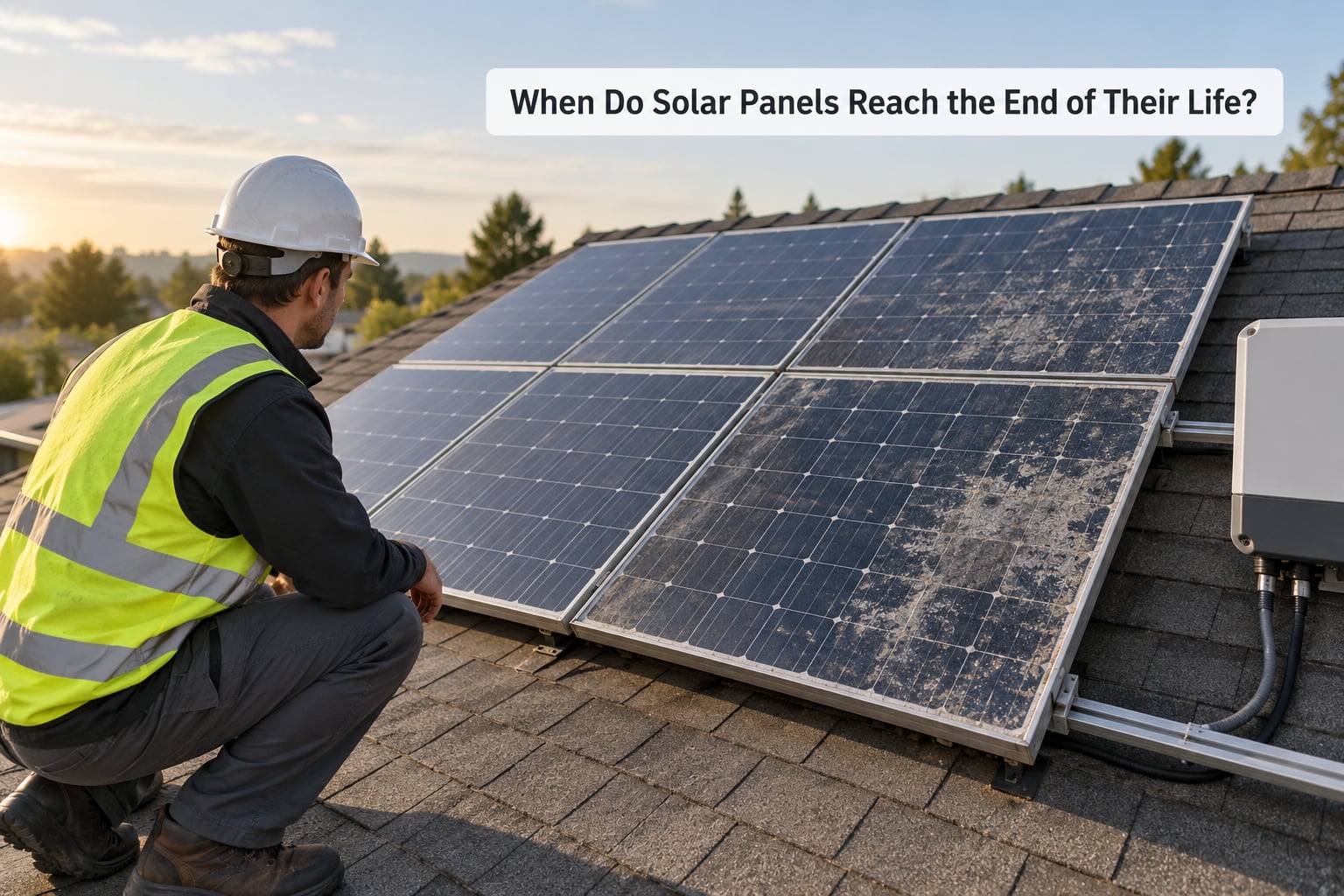
Manufacturers typically warrant panel output for 25 years, and most arrays keep producing well past that mark. A good crystalline silicon module loses on the order of half a percent to one percent of its output per year in the first couple of decades, so a panel that started at 400 watts may be producing somewhere around 300 to 350 watts at year 25. Homeowners on the forums routinely report running systems 30 to 35 years, well after the warranty lapsed, because the power is still worth having.
Actual service life varies far more than the datasheet suggests. Climate matters, shading matters, the quality of the original installation matters, and so does what sits on the roof afterwards. A panel in a hot, coastal, hail-prone spot can fail sooner than one in a mild inland installation.
What makes panels fail early
- Micro-cracks and broken cells. Hail, falling branches and thermal cycling fracture individual silicon cells. Small cracks barely matter; clusters of them do.
- Hot spots. A shaded or cracked cell pulls current through its neighbours, which get hot enough to cook themselves. Infrared thermography finds these long before output visibly drops.
- Delamination. The encapsulant that seals the layers can yellow, bubble or let go, letting moisture in. Corrosion follows.
- Potential induced degradation. A grounding fault or high voltage with imperfect sealing can quietly erode cell performance across the whole module.
- Interconnection and junction box failure. Solder joints crack, junction boxes corrode, cables degrade. This is often a wiring fix rather than a panel replacement.
- Roof and structural obsolescence. The panels are fine but the roof underneath is being replaced, or the racking has corroded, or the inverter is obsolete.
Notice how many of those are building problems rather than panel problems. That is why the installer matters so much when a system comes off a roof.
What Happens to Solar Panels at the End of Their Life?
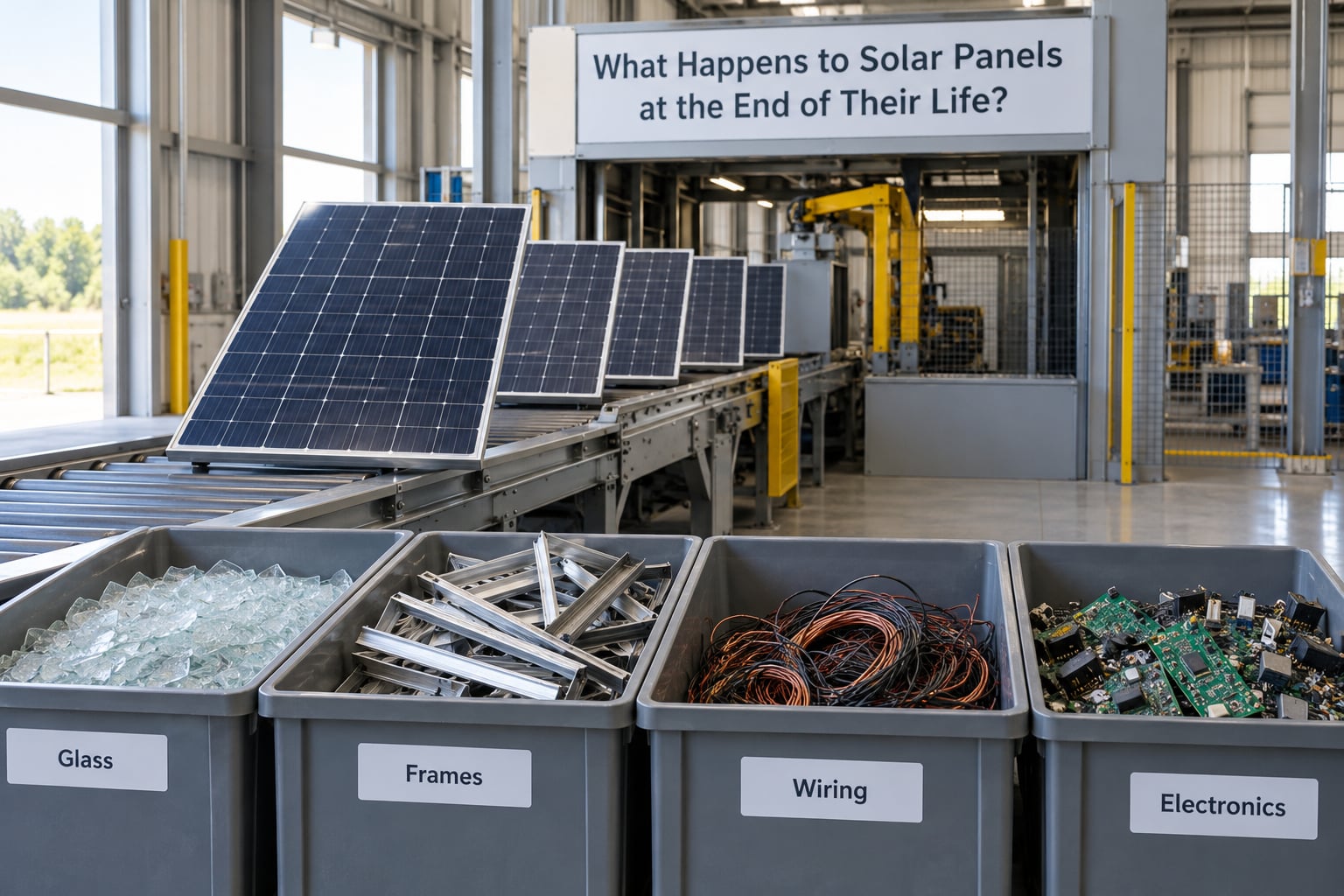
Here is the route a panel takes once somebody decides it is finished, in the order those steps actually happen.
- 1. Assessment. Output data, thermal imaging and an inspection decide whether the array is repowered, repaired, retired in place or removed. Sometimes the honest answer is “leave it and stop looking at it”.
- 2. Disconnection. A qualified technician shuts down the inverter, disconnects the DC wiring, racks and ground-fault equipment, and confirms the array is dead before anything is touched.
- 3. Removal. Modules come off the rails, cables and racking come out of the roof, and the roof gets patched. Mounting penetration points are the slow part.
- 4. Sorting. Intact modules are separated from cracked, delaminated or contaminated ones. Good modules may go to resale or a second life; damaged glass goes down a controlled route.
- 5. Transport. Panels travel upright and secured on a closed or curtained vehicle. Broken glass is a load hazard, so damaged modules get boxed and labelled before they move.
- 6. Processing. At an authorised facility the module is dismantled: the frame is stripped, the junction box and cabling are removed, the laminate is delaminated or heated, and the silicon cells are separated from the glass.
- 7. Material recovery. Glass goes to glass cullet streams, aluminium and steel to metal reprocessors, copper and silver to smelters, polymers to plastics recovery. High-value silicon and silver are the economics that make modern plants work.
That is the ideal pathway. In practice, in markets with no collection mandate, steps 4 to 7 are often skipped.
How Are Retired Panels Collected and Transported?
Collection is where the system usually falls apart. A few kilograms of glass and aluminium wrapped in an encapsulant that nobody has a route for is not a collection problem on its own — but a suburban street with four panels on it is.
Most retired modules arrive at a facility through one of four channels. Manufacturer and installer take-back programmes accept panels from their own customers and pass them to a contracted recycler. Municipal programs run occasional drop-off events, often in partnership with a recycler, because household quantities do not justify a dedicated route. Utility-scale sites move material in bulk through a decommissioning contractor that handles hundreds of thousands of modules at a time. And there is a grey channel: brokers who buy up retired panels, sort them by condition somewhere, and send the good ones to a market and the rest to whatever outlet will take them.
Handling damaged modules
A cracked panel is treated as a load that can cut, not as a broken household object. Gloves, eye protection and long sleeves are the minimum, panels are carried one at a time rather than in a loose stack, and anything with a broken back is boxed so the shards stay contained. Panels showing evidence of a sustained electrical fault are kept apart from clean stock so the whole pallet is not downgraded.
Paperwork travels with the load. Recyclers typically want a manifest or transfer note naming the generator, the technology type and the quantity. That note is the only reliable trace that the material reached a permitted facility rather than a gap in a fence, so ask for a copy.
Can Old Solar Panels Be Reused Instead of Recycled?
Yes, and for panels that are merely old rather than broken, reuse beats recycling on every measure. The embedded manufacturing energy is by far the largest part of a panel’s footprint, so keeping a functioning module in service defers emissions that no recycling process recovers.
There are three flavours of reuse.
- Direct reuse. The module goes onto another roof, often with a re-tested string, a new inverter and a smaller array. Certified reused panels are sold at a discount and the marketplace is growing, though documentation quality varies wildly.
- Repowering. Existing racking, cabling and inverter are kept and the modules are swapped for higher-output ones. On a roof that is otherwise fine, this is usually the cheapest way to add a decade of life.
- Second life. Modules that are past useful service on a house end up on small DC loads: garden and fence lighting, shed and fence electrification, small pumps, off-grid cabins, monitoring kits. This is genuinely common among DIYers, and it works because the low-power demand matches a module with reduced output.
The catch is testing. A module that looks fine can have invisible micro-cracks that fail a string in the first hot week. Second-life panels need insulation and continuity checks, and a proper review of the junction box and cabling. Poor-quality or heavily cracked modules should skip all of this and go straight to recycling.
What Materials Can Be Recovered?
Glass makes up roughly 65 to 80 percent of a crystalline silicon module by weight, so it dominates the recovery stream. Aluminium frames and mounting hardware account for around 10 to 15 percent. Silicon cells and wafers are about 3 to 5 percent, with polymers, adhesives, backsheets and encapsulants close to 10 percent, plus copper cabling, silver paste in the cell metallisation, tin and lead from solder, and steel.
Specialist plants using thermal, mechanical or laser-assisted separation can recover close to 95 percent of module mass. But mass recovery and value recovery are different things, and that distinction explains a lot of confusion.
- Routinely recovered: glass cullet, aluminium, steel, copper, and the polymer fraction where a plastics processor can take it.
- Technically recoverable but variable: silicon wafers, which carry the silver paste and often a small amount of lead in the cell metallisation. Silver is what makes high-value processing worth doing at scale.
- Difficult or uneconomic to extract: the last traces of silver in used cells, and the fluorine-based backsheets found in some older fluoropolymer designs. Both need process conditions that most plants do not run.
- Recovered by the smelter, not by the PV plant: metals like lead, tin and copper in the wiring and solder, which leave the site inside the residual fraction and are handled by ordinary metal recycling.
Two named programmes show what the ceiling looks like. PV Cycle in Europe runs producer take-back under the EU WEEE framework and processes collected modules at scale. First Solar, which builds cadmium telluride thin film rather than crystalline silicon, reports roughly 90 percent recovery by mass of its own modules. Both operate inside producer responsibility systems, which is exactly why they exist.
Are Solar Panels Hazardous Waste?
Usually not, in the way a battery or an asbestos sheet would be. A sealed, intact crystalline silicon module is inert glass and metal. The risk is concentrated in three places: broken glass, a specific set of chemistries, and illegal dumping.
Cadmium telluride is the headline case. CdTe thin film panels contain cadmium, a toxic heavy metal, in a chemically bonded compound that is stable while the module is sealed. Breaking a CdTe panel into pieces releases cadmium-containing dust, which is why several jurisdictions treat those panels as controlled or hazardous waste. No mainstream CdTe recycling facility in Europe or North America currently accepts walk-in consumer drop-offs, so the modules must go back through a commercial route.
Lead appears in three other places: solder inside the junction box, lead in some cell metallisation pastes, and the lead-based solder used in early thin film and some crystalline modules. Encapsulated inside an intact module this is not an everyday exposure. Crushed into a landfill mixed with general refuse, it is a different conversation.
Broken glass is the everyday hazard, and it is a mechanical one. Sharp laminate fragments cut skin and eyes, and large shards are awkward to handle.
Rules vary by jurisdiction and by material. The US EPA does not classify panels as hazardous waste, though it flags cadmium telluride modules for careful handling and several states impose their own end-of-life conditions. The EU WEEE Directive treats panels as producer responsibility, with lead and cadmium content reported and cadmium modules routed separately. India runs a dedicated guideline for crystalline silicon module end-of-life through MNRE. Australia and Japan handle panels mainly through state-level landfill and extended producer responsibility rules. In Spain, the route is the WEEE-derived collection point and a certified authorised handler.
Why Is Recycling Capacity Still Limited?
Nothing about the material makes this difficult in principle. The obstacles are boring and entirely practical.
- Collection gaps. There is no single pickup point for a household with two panels in most of the world, and nobody is obliged to arrange it for them.
- Transport economics. Broken glass is heavy, fragile and awkward. Moving low-value material a long way costs more than the recovered value justifies, so panels travel as little as possible.
- Fragmented ownership. After twenty-five years, the installer may be gone, the manufacturer may have changed hands, and the homeowner may not have any paperwork.
- No standardised design. Every manufacturer builds modules differently, and some very old panels contain polymers and laminates with no good recovery route.
- Broken glass handling. Pane-cleaning and furnace processes that work with intact glass struggle with modules that shatter in the feed.
- Low material value at small volumes. Glass and aluminium have real commodity value, but a single module does not carry enough of it to fund the logistics. It works at utility scale and mostly fails at household scale.
Historically, roughly nine in ten retired panels went to landfill or were exported rather than formally recycled. The exception is wherever a landfill ban or producer take-back obligation exists. That is the pattern worth knowing: recycling follows regulation, and where there is no rule, panels still get generated.
The volumes are rising quickly. Installations from the early 2000s boom are all reaching retirement at once, and IRENA and IEA PVPS work points to cumulative PV waste in the region of 60 million tonnes by 2050, with recoverable material value in the billions. One widely cited IRENA estimate puts the annual recovered-material value near 450 million by 2030 and climbing past 15 billion by 2050.
What Should Solar Panel Owners Do Next?
If you own an ageing array, work through this in order rather than calling a scrap buyer first.
- Pull the performance record. Pull the production history from the inverter portal or monitoring account and compare it against what the same system produced in its first full year. A steady slide means degradation; a sudden step down means a fault, and it may be wiring rather than the modules.
- Read the warranty terms, not just the date. A 25-year performance warranty is a floor on output, not a countdown to disposal. Find the guaranteed percentage at year 25 and compare it with what you are actually producing.
- Contact the original installer. Ask for an end-of-life quote, whether they still run a take-back programme, and whether they can confirm repowering is cheaper than removal on your roof.
- Check whether your authority runs a collection route. Municipal waste authorities, and in some regions the photovoltaic recycling network operators they fund, list drop-off points and scheduled events. A certified authorised handler for your area is the thing to look for.
- Ask for the destination before you hand anything over. A legitimate handler can name the facility or network the material goes to and issue a certificate. If they cannot, they are a broker or worse.
- Separate by condition. Working modules go to resale, repowering or a second-life buyer. Cracked, delaminated or cadmium telluride modules go to a facility licensed for that stream. Never put a broken module into household waste.
- Plan the transport. Upright, secured, and covered. Anything with broken glass boxed and labelled. Ask whether the removal contractor handles transport, since most do.
- Keep the paperwork. The removal record, the transfer note and the recycling certificate are your evidence that the material was handled properly, and you may need them for roof work or a property sale later.
One more thing worth doing early: photograph the array and label the inverter, and find the serial numbers while they are still easy to read. That record saves a lot of guessing in twenty years.
Frequently Asked Questions
Can old solar panels be recycled?
Yes. Specialist plants dismantle panels and recover most of the mass: glass, aluminium frames, steel, copper wiring, polymers and the silicon cells that carry the silver. Advanced lines using thermal, mechanical or laser separation reach close to 95% recovery. The catch is logistics rather than chemistry, so panels only reach those plants where a collection route, a landfill ban or a producer take-back obligation exists.
Are broken solar panels dangerous to throw away?
Do not put broken panels in household waste. The main risk is mechanical: sharp laminate shards cut hands and eyes. Cadmium telluride modules are the exception that matters most, because breaking one can release cadmium-containing dust, and many facilities refuse consumer drop-offs for that chemistry. Sealed intact crystalline silicon panels are generally not hazardous waste, so check what your local rules require for damaged or thin-film modules.
Who should remove solar panels when a roof is replaced?
A licensed solar installer or roofer, not the roofing crew alone. The array has to be shut down, disconnected at the inverter and confirmed dead before anyone lifts a module or cuts a cable, and the mounting penetration points need sealing afterwards. Removing panels yourself risks energised conductors, damaged cells you then have to dispose of, and roof leaks that show up months later.
Can retired solar panels be installed on another building?
Often yes, if the modules still perform. A panel running at 80 to 90 percent of its original output can power a garage, workshop or small off-grid load for years. Check that the frames, junction boxes and cabling are sound, have the strings tested for insulation and continuity, and match the array to a controller designed for degraded input. Cracked, delaminated or corroded modules should not be reused.
What should a homeowner do with solar panels they no longer want?
Start with the production data, then ask the original installer whether repowering beats removal. If removal is the answer, find a certified authorised handler or a municipal collection point before buying a scrap buyer, and ask in writing where the material will go. Keep working modules separate from damaged ones, and ask for a certificate at the end. Never mix broken panels into general waste.
Conclusion
The responsible route for a retired panel runs from assessment, through safe disconnection and removal, to an authorised handler that can name its destination and hand you a certificate. Reuse or repowering beats recycling whenever the modules still work, because it keeps the manufacturing energy in service. Where no collection rule exists, panels end up landfilled, and that is why the rules matter as much as the technology.
Start where the panel does: with your installation records and a call to the original installer, or to a verified local collection programme if that company no longer trades.