Learning how to dispose of household batteries safely takes about five minutes and almost no equipment. Tape both terminals of every cell, keep each chemistry in its own bag, and hand the lot to a household hazardous waste point or an approved collection point — never to the blue recycling container, and never to the grey bin while cells are loose.
The part people get wrong is chemistry. Single-use alkaline batteries and rechargeable or lithium-ion cells are not the same material and they do not belong in the same stream, even though they look identical in a drawer. Rechargeable, lithium-ion, button cells and car batteries go to a proper collection point every time.
One more thing before you start: rules differ from town to town in Andalusia, and again from one participating shop to the next. Your ayuntamiento decides what it accepts, so check its page before you load the car. Last reviewed for 2026.
Table of Contents
- What You Need
- Step-by-Step
- Step 1: Know How to Dispose of Household Batteries Safely
- Step 2: Check for Damage Before Moving the Battery
- Step 3: Protect the Terminals and Package Intact Batteries
- Step 4: Use the Correct Collection Point
- Step 5: Handle Leaking, Swollen or Heated Batteries Differently
- Step 6: Confirm Handoff and Clean the Work Area
- Common Mistakes
- Frequently Asked Questions
- Where can I take household batteries in Spain?
- Can I put household batteries in the recycling bin?
- What should I do with a leaking, swollen or overheated battery?
- What if a button battery may have been swallowed?
- How should I store collected batteries until drop-off day?
- Conclusion: Tape the Terminals and Find a Collection Point
What You Need
Nearly everything on this list is already in a kitchen drawer. Gather it before you start collecting, not halfway through.
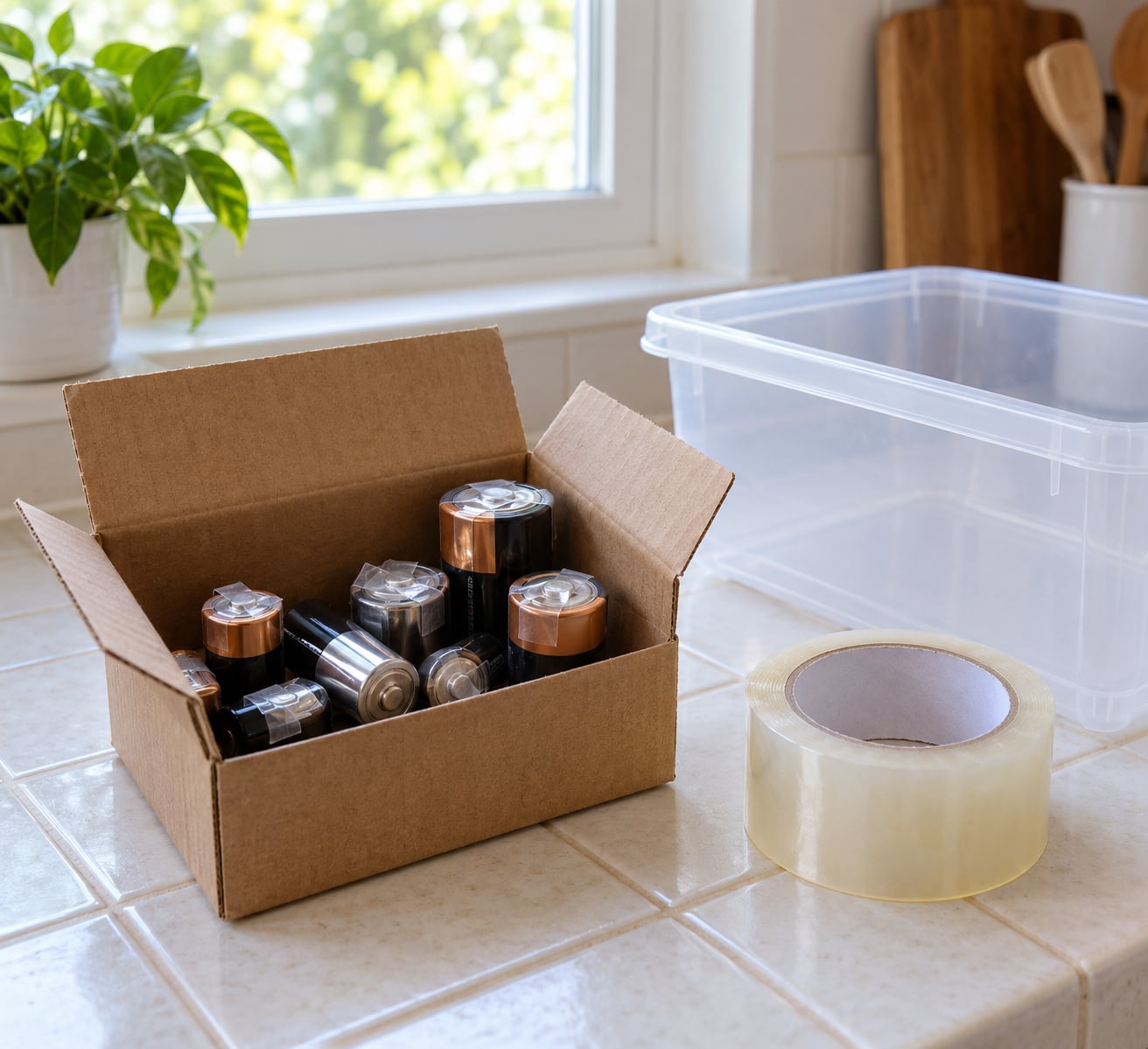
- Clear packing tape or electrical tape — enough to cover both ends of every battery, in small separate pieces.
- A permanent marker — useful if a cell has lost its wrapper and the chemistry is not obvious.
- A rigid, non-conductive container — a small plastic tub, a sturdy cardboard box or a padded envelope for transport. Never a soft bag that shifts in the car.
- Separate bags or compartments — one per chemistry, so alkaline, lithium-ion, NiMH, button cells and lead-acid do not touch.
- Disposable gloves and an old cloth — for batteries with visible residue or dampness on the casing.
- Local confirmation — what your nearest collection point accepts, when it opens and whether you need an appointment or a quantity limit.
I keep one small tub and a roll of tape next to the hall cupboard. Batteries go in as they die, so there is no drawer of them to sort six months later. That single habit removes most of the risk this guide is about.
Step-by-Step
Step 1: Know How to Dispose of Household Batteries Safely
Every route starts with reading the label, because the label tells you which stream the cell belongs to.
Look for these markings:
- Alkaline — AA, AAA, C, D, LR44. Often nothing but the size and the plus sign, but the wrapper may say alkaline or zinc-carbon.
- Nickel-metal hydride (NiMH) — AA or AAA marked rechargeable or NiMH. These have a visible charge indicator on some models.
- Lithium-ion — marked Li-ion, or the cylindrical and pouch cells used in cameras, cordless tools, e-bikes, laptops and phones.
- Coin or button cells — CR2032, CR2025, SR626 and similar watch and hearing-aid cells. Thin, flat, and the easiest to lose.
- Lead-acid — the 12V battery in a car or motorbike, and small sealed lead-acid units in alarms and emergency lights.
An intact battery can still have a different collection route from another of the same type, because your municipality sets its own acceptance list. Follow what your local point tells you rather than assuming every chemistry shares one container.
Step 2: Check for Damage Before Moving the Battery
A damaged battery is a different problem from a dead one, and it needs different handling. Before you pick it up, look at it in place.
- Swelling — a bulge in the casing, a seam that has lifted, or a phone screen that no longer sits flat.
- Leakage — white crust, dampness, staining or a sticky residue around the ends.
- Rust or impact marks — corrosion, a dent or a crack from being dropped.
- A loose or missing wrapper — the label has come off and the chemistry is now a guess.
- Heat — unusual warmth, or a casing that is hot to the touch near other batteries.
If the cell is warm, hissing, venting or gives off a sharp chemical smell, do not handle it. Move people and pets away, avoid touching it, and skip to the guidance further down on damaged batteries.
Step 3: Protect the Terminals and Package Intact Batteries
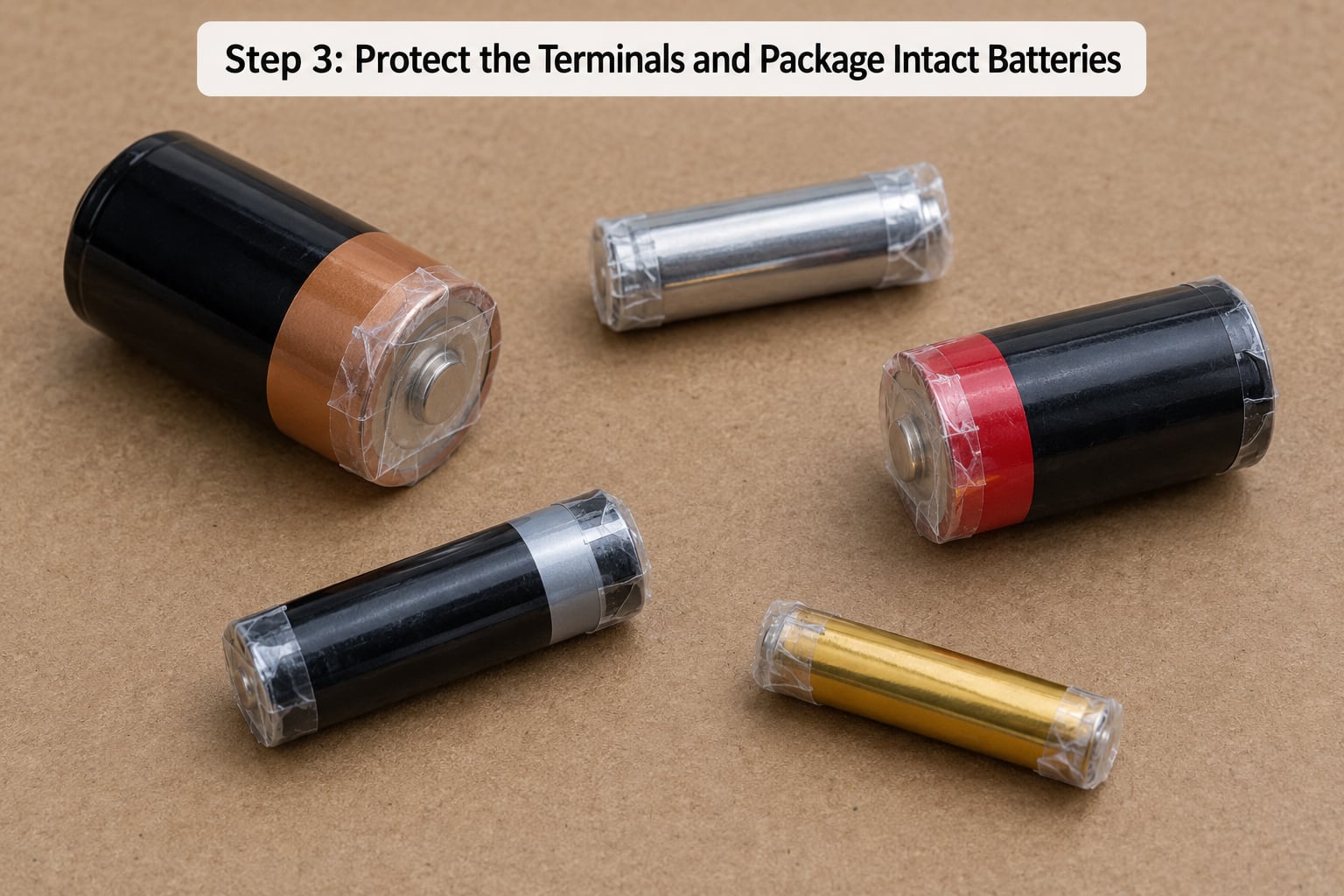
Taping the terminals is the single most useful thing you can do. A loose AA can bounce against a key or a coin in a truck and short-circuit, which is how most battery fires in waste facilities start.
- Cut one small piece of tape per terminal. Cover the flat positive end and the raised negative end separately.
- Do not wrap the whole battery in one spiral. Separate pieces on each end are what stop a stray contact.
- Place batteries so nothing metal can reach a terminal and no two cells can touch each other end to end.
- Put each chemistry in its own sealed bag or its own section of the container.
- Write the chemistry on the bag with the marker if the wrapper is gone or if the local point asks you to separate them.
Never carry loose batteries in a handbag, a coat pocket or a plastic shopping bag. They shift, and a short circuit in a bag of keys is not worth the convenience.
Step 4: Use the Correct Collection Point
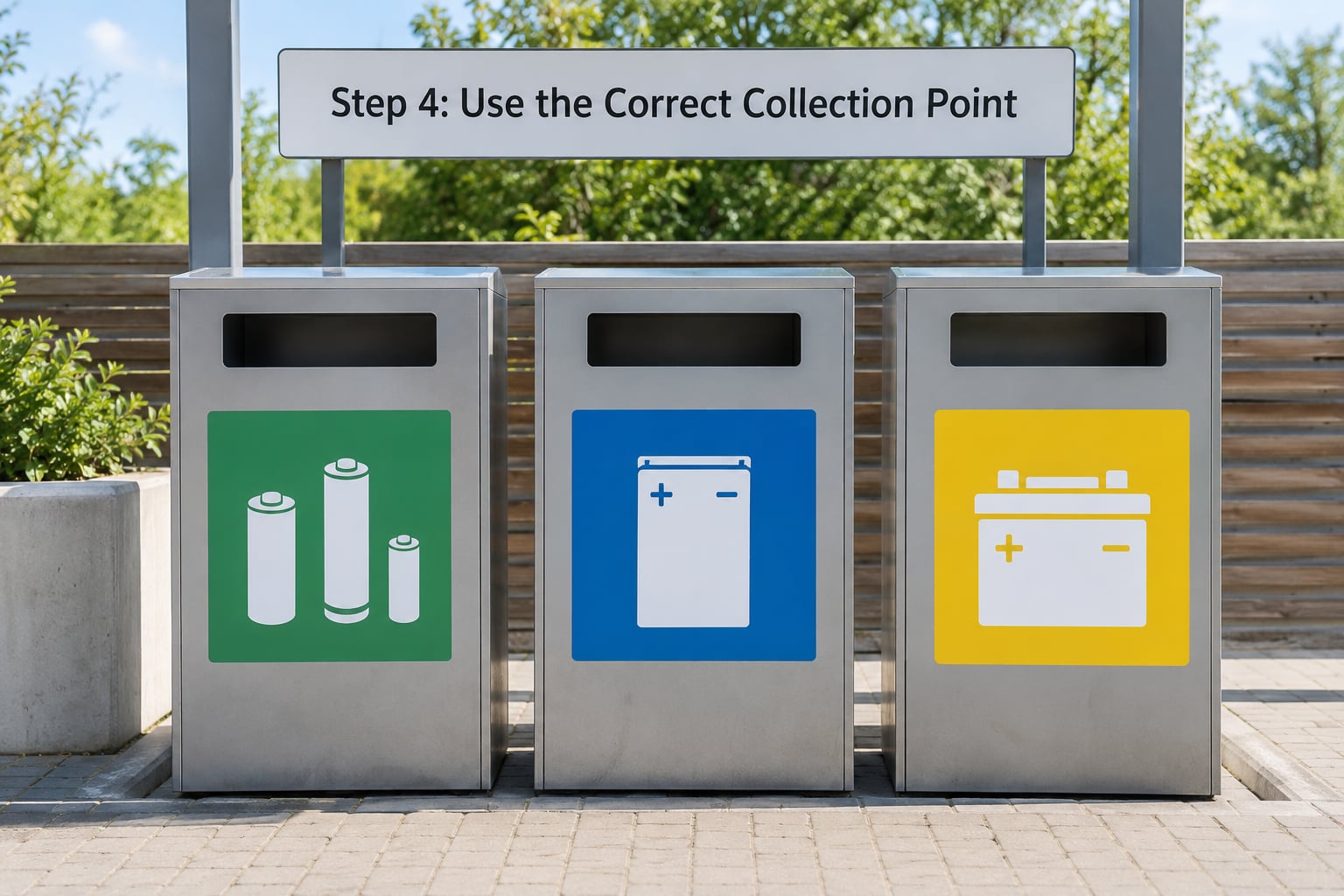
In Spain, batteries go to a household hazardous waste point at the municipal level, an approved public collection point, a retailer taking part in a take-back scheme, or another local battery collection service your municipality names.
Before you travel, confirm four things: that the site accepts your chemistry, when it is open, whether an appointment is needed, and whether there is a quantity limit. Municipal points often run appointment-only windows, and a retailer collection point usually has to be the one registered for that shop rather than any bin in the store.
Collection rules are not identical across Andalusian municipalities, so treat your own ayuntamiento’s guidance as the version that applies to you. Where a take-back scheme and a municipal point both exist, the municipal point is the safer bet for car batteries, e-bike packs and anything swollen.
Step 5: Handle Leaking, Swollen or Heated Batteries Differently
A damaged cell does not get packaged, transported and dropped off. It gets isolated and reported.
- Do not squeeze, crush, puncture, open or charge it.
- Do not put it in household trash, in a recycling bin, in water, or in a fridge or freezer.
- Move people and pets away and avoid direct contact with any residue. Ventilate the room if you can do so safely.
- Keep combustible material away from it without touching the cell itself.
- Contact your municipality, the fire service or the local emergency number for instructions on that specific cell.
Do not improvise. Baking soda, sand, oil and water are all widely repeated online and none of them is a safe general answer for an unknown cell. There is no neutralising formula that works across chemistries, and getting it wrong spreads the problem. Ask an authority and follow what they tell you.
Step 6: Confirm Handoff and Clean the Work Area
At the site, hand the batteries to staff if staff are on hand, or place them in the container marked for that battery category. Where the facility asks you to separate chemistries, do not mix them in one container even if several categories share a wall.
Then close the loop at home: wash your hands after handling any cell with residue on it, wipe the surface where it sat with a damp cloth, and keep gloves out of the way of the laundry. If residue has touched skin or eyes, get advice from a doctor or a poison information service rather than from the internet.
Finally, check that no dead device still hides a cell. Flashlights, cameras, remote controls and alarm sensors each keep a battery somewhere you will not think to look until the drawer is empty.
Common Mistakes
- Putting batteries in the blue recycling container. Sorting machinery crushes and punctures cells, which can ignite a fire in the sorting line. The blue container is for paper, cardboard, glass, plastic and metal only.
- Leaving terminals exposed. An untaped AA in a bin or a box can short against metal and overheat. Two small pieces of tape fix it in seconds.
- Mixing chemistries when local rules ask for separation. Alkaline, lithium-ion and button cells often travel to different processors. Ask at the point and label the bags if you are unsure.
- Crushing or opening a damaged battery. The casing on a swollen cell is already under pressure. Opening it releases electrolyte and can start a fire.
- Using water or household chemicals on a leak. A lithium-ion cell and water are a bad combination, and neutralising chemicals can add a second reaction. Ventilate, keep clear, call for guidance.
- Storing collected batteries indefinitely. A box of taped cells in a hot car or a damp garage ages badly. Set a date for the drop-off when you fill the container.
- Assuming every retailer accepts every battery. Store acceptance is inconsistent and often poorly signposted. Check first, so you do not stand at a desk holding a bag for nothing.
One habit closes most of these at once: check your municipality’s current collection guidance whenever rules change, and never use a battery that has leaked, swollen or been punctured again. If it already failed once, it is not a battery any more.
Frequently Asked Questions
Where can I take household batteries in Spain?
Most municipalities run a household hazardous waste point, usually called a punto limpio, that accepts batteries alongside paints, oils and small chemicals. Some supermarkets, electronics shops and hardware stores also operate a collection point under a take-back scheme. Check your ayuntamiento’s website before travelling, because opening hours, accepted chemistries and quantity limits differ between towns.
Can I put household batteries in the recycling bin?
No. The blue container takes paper, cardboard, glass, plastic and metal, and batteries are excluded because loose cells get crushed by sorting equipment. The grey residual bin is only an option for intact single-use alkaline batteries where your local rules allow it, and only with the terminals taped. Rechargeable, lithium-ion, button cells and car batteries never belong in household waste.
What should I do with a leaking, swollen or overheated battery?
Move people and pets away, do not touch it, and do not squeeze, puncture, charge or bin it. Ventilate the room, keep anything combustible at a distance without making contact, and call the local emergency number, 112 in Spain, or ask the fire service how to proceed. There is no safe home fix for a damaged cell.
What if a button battery may have been swallowed?
Treat it as an emergency and do not wait to see whether it passes. Call 112 in Spain or a poison information service immediately and say a coin or button battery may have been swallowed. Button cells can burn through tissue in a matter of hours, and food or drink makes the outcome worse. Keep the battery packaging, because it carries the chemistry and size.
How should I store collected batteries until drop-off day?
Keep taped batteries in a rigid, non-conductive container such as a small plastic tub or a padded envelope, with each chemistry in its own sealed bag or compartment. Somewhere cool, dry and out of reach of children and pets is best. Never keep them loose in a handbag, drawer or glovebox, and never store a damaged cell at all.
Conclusion: Tape the Terminals and Find a Collection Point
Two actions, in this order. First, read the label so you know which chemistry each cell is. Second, cover both terminals with tape and separate the batteries by type, so nothing can touch a bare contact.
Then use the collection route your municipality actually offers, and check that it accepts your battery type before you travel. Damaged, leaking, swollen or heated cells need separate guidance from a local authority, and they never go into household waste or a normal recycling container.