Stormwater runoff is rain that cannot soak into the ground and instead flows off your roof, driveway and other hard surfaces, carrying silt, oil, fertilizer and litter into soil, storm drains and nearby waterways. To reduce runoff from your driveway and roof, you need to do three things: watch where the water actually goes, get roof water off paved surfaces, and give it somewhere slow and planted to soak in.
Most of the work is a Saturday’s worth of observation plus a day of digging, and the cheapest fixes come before the expensive ones. Start by watching your property in a real storm, then fix the roof downspouts, then look at the driveway surface.
Table of Contents
- What You Need
- How to pick a solution without overspending
- Step-by-Step: How to Reduce Runoff From Your Driveway and Roof
- Map Where Water Goes
- Slow and Spread Roof Runoff
- Improve Driveway Infiltration to Reduce Driveway Runoff
- Add a Rain Garden or Drainage Swale
- Check, Maintain, and Adjust
- Common Mistakes
- Frequently Asked Questions
- What is the best way to divert water away from my driveway?
- What are five ways to reduce runoff from a roof and driveway?
- How far from the foundation should a downspout discharge?
- How do I stop water pooling around my foundation?
- Do rain barrels actually reduce runoff?
- Are permeable pavers better than asphalt for drainage?
- Conclusion
What You Need
You do not need drainage hardware to start. The first tool is a notebook and a rainy afternoon.
- Observation gear: a raincoat, a notebook or phone, and a pencil. Watch the yard during the first heavy storm after you read this.
- Basic site tools: a level, a tape measure, a marked shovel, a wheelbarrow and a garden fork.
- Drainage materials: downspout extensions or splash blocks, flexible downspout elbows, a leaf strainer, pipe wrench, and sections of rigid or flexible drain pipe.
- Infiltration materials: pea gravel, river rock, geotextile fabric, planting soil amendment, mulch, and native plants suited to wet ground.
- Surface materials: permeable pavers, stabilised gravel, turf blocks or porous concrete if you are redoing part of the driveway.
- Optional professional help: a licensed roofer for anything at height, and a licensed contractor or engineer for regrading, retaining walls, large earthworks or anything touching a foundation drain.
How to pick a solution without overspending
Relative cost, effort and upkeep vary a lot more than people expect. The table below ranks the options so you can start at the top and stop as soon as the problem stops.
| Solution | Relative cost | DIY effort | Runoff reduction | Maintenance |
|---|---|---|---|---|
| Clean gutters, clear downspout outlets | Low | Low | Stops overflow that bypasses your system | Twice a year |
| Downspout extension or splash block onto planted ground | Low | Low | High for the roof half | Once, then occasional |
| Rain barrel or cistern on the downspout | Low to moderate | Low | Moderate, and only if you use the water | Annual servicing |
| Rock-lined swale or dry creek bed | Moderate | Moderate | High, slows and spreads flow | Twice a year clearing silt |
| Rain garden | Moderate | Moderate | High if the soil drains | Weeding and mulch yearly |
| Permeable pavers or stabilised gravel strip | Moderate to high | Moderate to high | High on the driveway itself | Weeds and joint sand |
| Regrading or a French drain | High | Call a pro | Definitive on sloped sites | Occasional clearing |
Step-by-Step: How to Reduce Runoff From Your Driveway and Roof
Map Where Water Goes
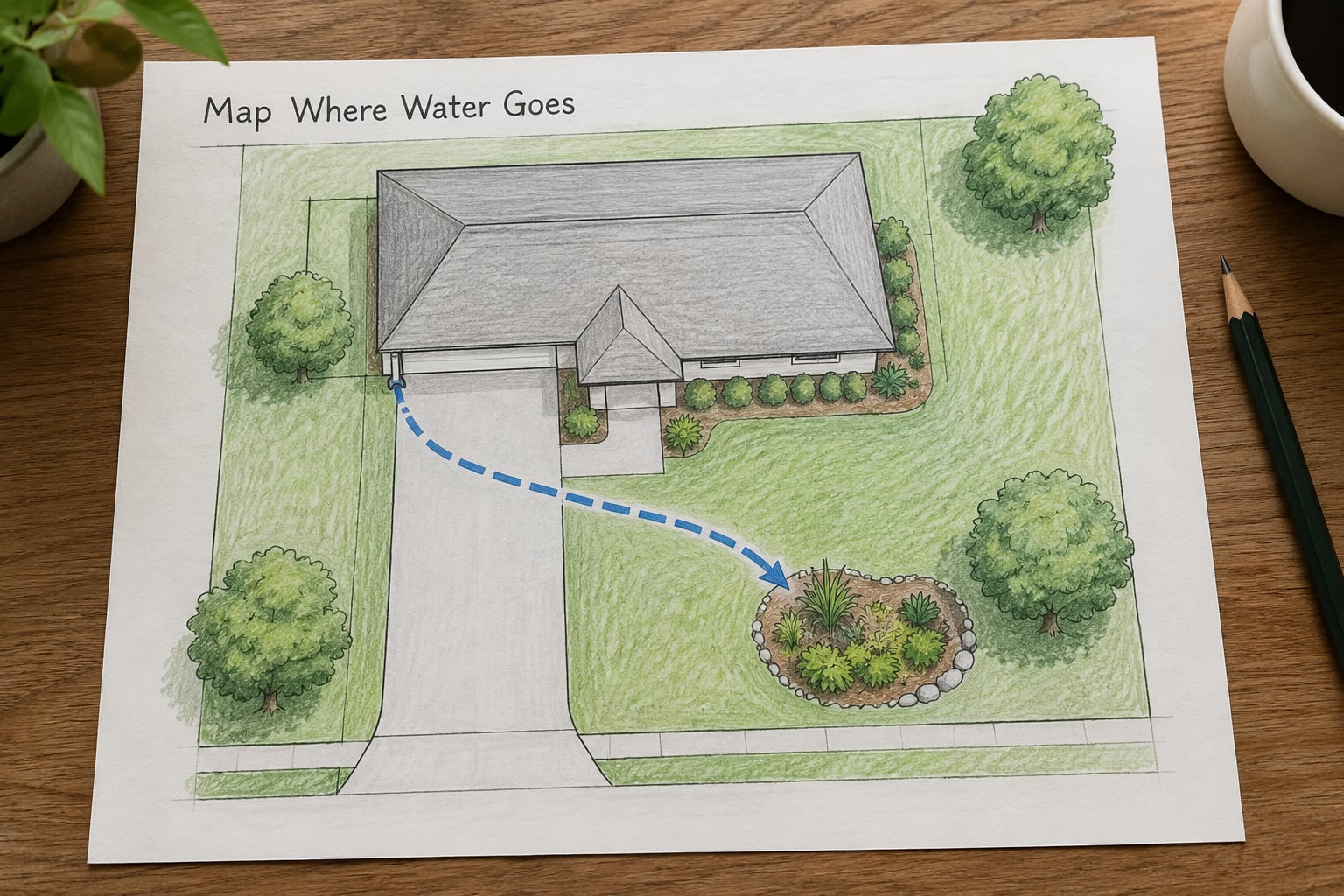
The first hour of work saves the most money, because almost every expensive mistake on this list starts with building something in the wrong place. Watch a real storm, not a drizzle. Note roughly twenty minutes after the rain peaks, when the ground is saturated and flows are at their widest.
Sketch what you see. Mark every downspout and where it discharges, whether it lands on paving, grass or bare soil. Mark the driveway crown, any low spot, where water crosses a walk or path, and where it finally leaves the property. Take a photo from the same two angles each time so you can compare later.
Look for four symptoms: water sheeting off the driveway edge and cutting a channel in the soil, a soggy lawn that stays wet days later, water backing up against the foundation, and gutter overflow or a downspout that spills out of its elbow. Those four point at different fixes, and mixing them up is what makes people install a beautiful rain garden that never fills and never drains.
Call your local utility locating service before any digging. Downspout work right against the house is exactly where buried utilities tend to sit.
Slow and Spread Roof Runoff
A useful piece of arithmetic before you shop for barrels: one inch of rain on a 1,000 square foot roof produces roughly 600 gallons. A 2,000 square foot roof sheds about 1,200 gallons per inch of rain. That number is why a single 50-gallon barrel feels helpful and then stops caring, and why barrels work best when the captured water is actually used on plants rather than left standing.
Work down this list in order.
- Clean the gutters and every outlet. Overflowing gutters dump concentrated water at the worst point on the property, which is usually the foundation corner. Twice a year is the usual rhythm: after leaf drop and before the wet season.
- Check that the downspouts are sized for the roof. Two downspouts serving a large roof will simply back up in a burst storm. Adding outlets is cheaper than a wet basement.
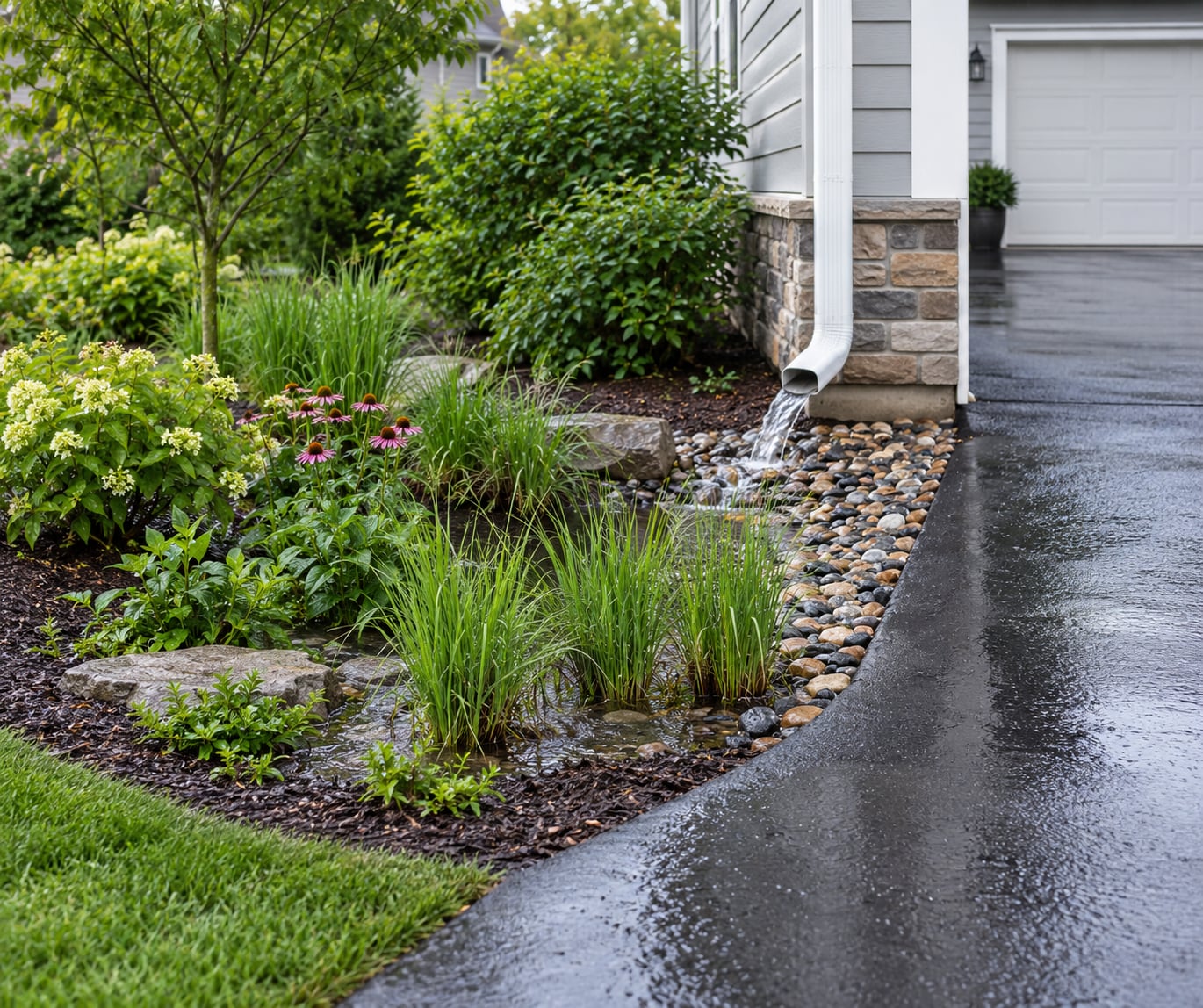
- Move the discharge point. Extend each downspout at least 6 to 10 feet from the foundation and aim it at planted ground, not paving. Rigid pipe laid on the surface can be a trip hazard; bury it shallow and cover it, or use a low-profile extension.
- Add a splash block or a short rock apron at the outlet so the water cannot cut a hole in the soil.
- Disconnect it from the foundation drain. Downspouts piped into foundation drains overload a system that was never sized for whole-roof flow. This one change has been reported by several homeowners as the fix for long-standing damp.
- Add a rain barrel or cistern only where you have a plan for the water, and put a first-flush diverter on it so the film of roof dust does not end up in your vegetable bed.
Every one of those steps needs an overflow path. A buried pipe or a pop-up emitter that has nowhere to go when it is exceeded will simply discharge at the weakest point, and that point is often the place you were trying to fix.
Improve Driveway Infiltration to Reduce Driveway Runoff
A driveway is the largest impervious surface most homes have, and every inch that runs off it arrives at one edge as concentrated flow. Replacing or splitting that surface fixes the problem at the source rather than treating the symptom.
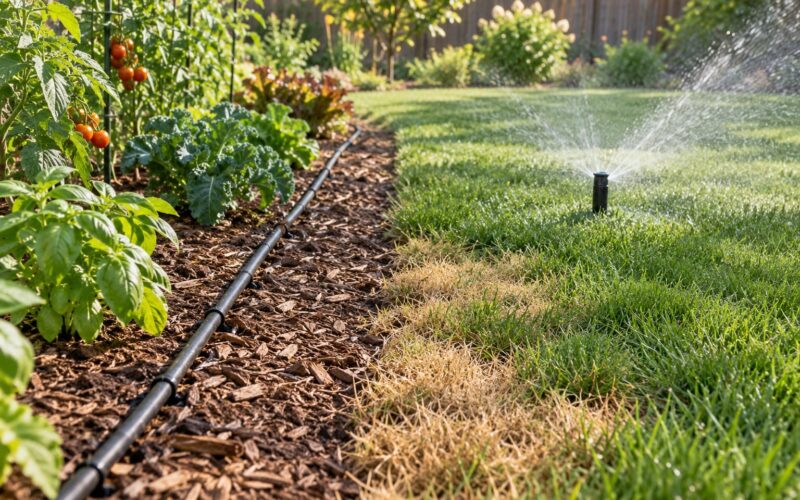
Start at the edges, where the damage actually happens. A 3 to 4 foot strip of open-graded gravel between the driveway and the lawn gives water a place to slow down, filter and soak in. It is the least expensive change on this list and it kills most erosion complaints.
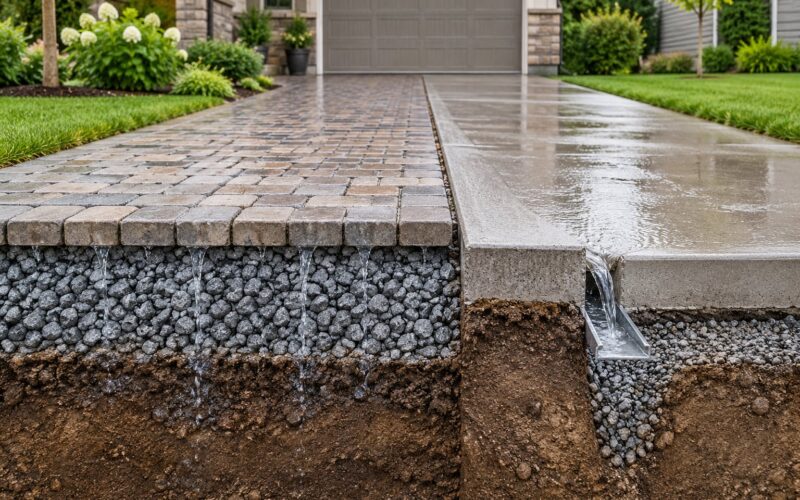
If you are resurfacing, permeable pavers laid on an open-graded base let water pass through the joints into a stone reservoir below. Turf blocks and porous concrete work on lower-traffic areas such as parking bays and paths rather than the driving lane. Avoid the common trap of “permeable pavers” installed on a compacted sand base, which drains almost nothing and costs you the full price of a driveway that still floods.
Know when infiltration will not work. Compacted fill from years of vehicles, heavy clay, a high water table, a steep slope, or a required fire and vehicle setback will all defeat a permeable surface. If the driveway is the lowest thing on the lot and water has nowhere else to go, you need a swale or a drain, not a different paver.
Add a Rain Garden or Drainage Swale
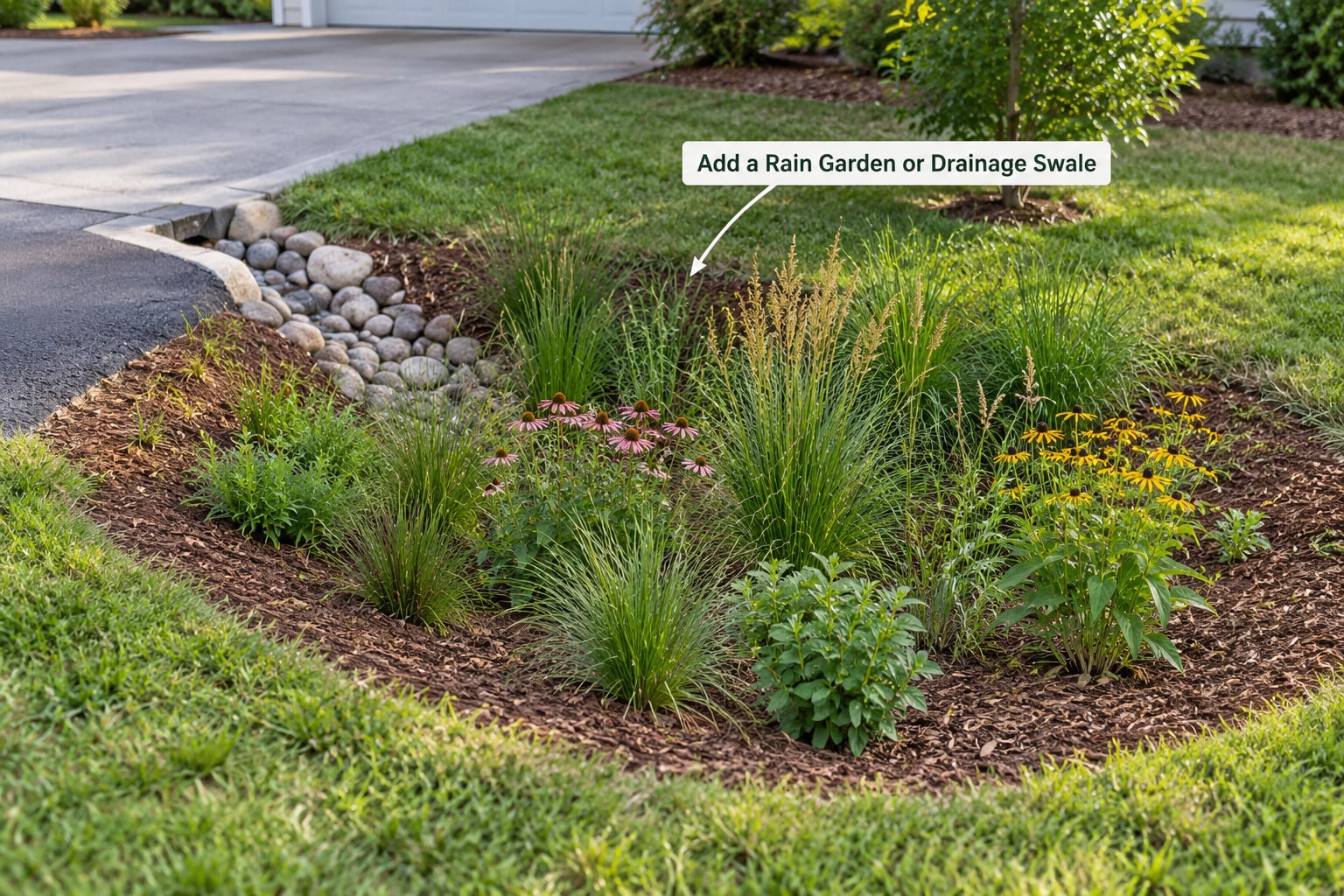
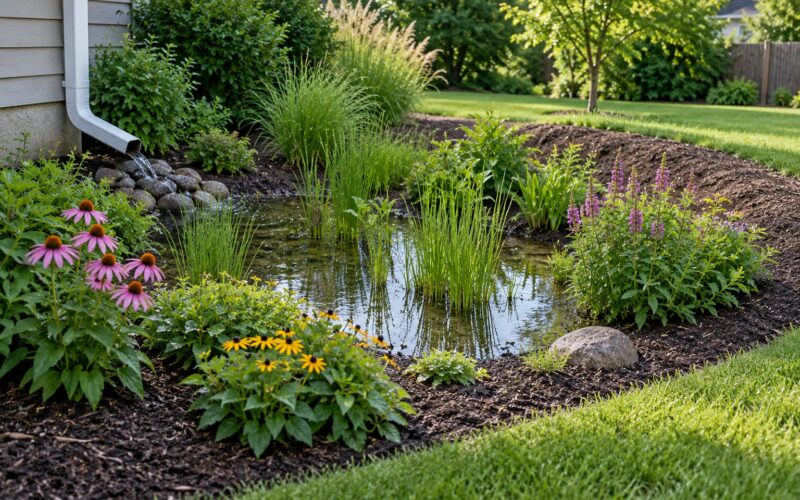
A rain garden is a shallow, planted depression that receives clean roof water, holds it briefly and lets it soak into the ground. A swale is the gentle cousin: a shallow channel built to carry flow slowly along the contour of the land rather than down a slope at speed. Both work by buying time, which is what lets soil absorb water and filter out sediment.
Test before you dig. Dig a hole about 30 cm deep, fill it with water, let it sit an hour, then fill it again and time how long the second fill takes. If it drains within a few hours you have workable soil. If the water is still sitting after a day, you are dealing with clay and you should build a lined swale with an underdrain instead of a rain garden.
Place the garden at least 10 feet from the foundation, at least 5 feet from a property line, and where it can overflow safely without reaching a neighbour. Direct only clean roof water into it. Parking lot runoff, driveway runoff with oil and tire residue, and anything with grass fertilizer should be kept out or pre-filtered through gravel.
Prepare the soil by breaking up the compaction and amending with compost and a sand-to-topsoil blend. Plant species that tolerate both wet and dry periods, since a rain garden floods in winter and bakes in summer. Mulch the surface and lay an overflow route from the low point of the garden to somewhere safe, because an unoverflowing rain garden is a bathtub.
For driveway-edge water specifically, a rock-lined swale or dry creek bed running along the driveway is often the better tool. Forum homeowners consistently describe it as the cheapest first move, and it doubles as a walkable path if you lay it wide and level.
Check, Maintain, and Adjust
Walk the property right after the next serious storm and compare it to your sketch. Water should enter the garden or swale, spread out, and soak in. It should not pond against the foundation, cross a walkway, or leave your property in a new place.
Then set a light maintenance rhythm. Clear debris and leaf litter from gutters twice a year and flush downspouts and any emitters after storms, since a blocked emitter is the single most common cause of a new puddle. Top up mulch in the garden each spring so bare soil does not crust over and shed water. Watch for erosion cuts at the driveway edge and repair them with rock or coir matting before they widen. Re-sketch the site twice a year; finished systems need adjusting after a few seasons as soil settles and plants grow.
Expect that a completed setup still needs occasional attention. The installs that fail are the ones nobody looks at again after the first winter.
Common Mistakes
Six errors account for most of the disappointing results people report, and each has a straightforward fix.
- Discharging onto the neighbour’s lot. Redirecting a downspout across a property line creates a problem you do not own and may be liable for. Put the outlet inside your own line, at least a few feet from the boundary, and keep the flow moving away from the shared edge.
- Burying pipe or an emitter with no overflow. When the design capacity is exceeded, water finds its own exit, usually at the foundation corner you were trying to protect. Plan the overflow route before you backfill, and size the pipe for a burst storm rather than an average one.
- Building a rain garden on ground that does not drain. A garden on clay or a compacted fill becomes a standing-water mosquito pit. Do the simple fill test first, and if the soil fails, use a lined swale with an underdrain.
- Ignoring compaction and the base layer. Permeable pavers on sand, or gravel driven into hardpan by years of parking, barely infiltrate anything. Excavate to open-graded material and keep vehicles off the surface while it settles.
- Installing a roof system and forgetting it. Uncleaned gutters, a cracked barrel diverter, a cistern that has not been flushed in a year, and a filter that has sealed shut all return you to the original problem within about eighteen months.
- Creating a trip or fall hazard. Pipe laid across a path, a barrel on a slope, an open excavation left uncovered, or an extension that sticks into the walkway. Route around walking surfaces, cap any exposed ends, and backfill trenches properly.
Two more situations come up often. If runoff arrives from an up-gradient neighbour, your own grading changes will not stop it, and building anything low makes it worse, so document the flow with dated photos and talk to your local public works department about what it can enforce. In arid and Mediterranean climates, rain arrives as short violent bursts rather than steady soaking rain, so storage and overflow capacity matter more than slow absorption, and stored water usually falls under local usage restrictions, so check before you plan a watering scheme around it.
Frequently Asked Questions
What is the best way to divert water away from my driveway?
The best fix depends on where the water is coming from. If a downspout discharges onto paving, extend it to planted ground at least 6 to 10 feet from the foundation. If water runs off the driveway surface itself, add a 3 to 4 foot strip of open-graded gravel along the edge, or a rock-lined swale, so flow slows before it reaches bare soil. Permeable pavers or a stabilised gravel strip help further upstream by letting the surface absorb rain directly.
What are five ways to reduce runoff from a roof and driveway?
Five proven moves: keep gutters clean and downspout outlets clear; extend or redirect downspouts onto planted ground away from the foundation; capture roof water in a rain barrel or cistern and use it on plants; replace or split impervious paving with permeable pavers, turf blocks or a gravel infiltration strip; and add a rain garden or rock-lined swale that holds water briefly and lets it filter into the soil. Add a swale or drain if the grade pushes everything to one low corner.
How far from the foundation should a downspout discharge?
Aim for at least 6 to 10 feet from the foundation, and further where the grade allows, discharging onto planted ground or a designed infiltration area rather than onto paving. The discharge point should sit where water can soak in and travel away from the house, never in a low pocket that holds water against the wall. Avoid discharging close to a property line, where the flow can cross onto a neighbouring lot.
How do I stop water pooling around my foundation?
Start by finding the source rather than mopping the floor. Clean the gutters, add downspout outlets if the roof is over-served, and move every discharge point at least 6 to 10 feet from the wall onto ground that drains. Then regrade the soil so it slopes gently away from the foundation, and fill sunken pockets that trap water against the wall. If you have foundation drains, disconnect the downspouts that feed them so the system is not overwhelmed.
Do rain barrels actually reduce runoff?
They do, but only as part of a system, and only if you use the water. One inch of rain on a 1,000 square foot roof produces roughly 600 gallons, so a single 50-gallon barrel fills quickly and stops diverting anything. Barrels work best on a small catchment, with an overflow path in the storm drain or a soakaway, and with the stored water used on the garden instead of left standing. A first-flush diverter keeps roof dust out of it.
Are permeable pavers better than asphalt for drainage?
Yes for water, at the cost of surface performance. Permeable pavers and porous concrete let rainfall pass into an open-graded base so it can soak into the soil, where asphalt sheds every drop. They only work when installed correctly: an excavated base of open-graded stone, no compacted sand, and no vehicles parked on them while it settles. On heavy clay, a high water table or a steep slope, infiltration is poor and you will need a swale or underdrain instead.
Conclusion
If you do one thing, spend an hour in the rain watching where your water goes, because every fix after that becomes obvious. Then keep roof water off the driveway and away from the foundation, add a gravel strip, swale or rain garden wherever the soil will absorb it, and design an overflow route for everything you install.
Check the result after the next big storm and twice a year after that. Systems fail quietly, and ten minutes of attention in spring is cheaper than any repair you will be tempted to make later.