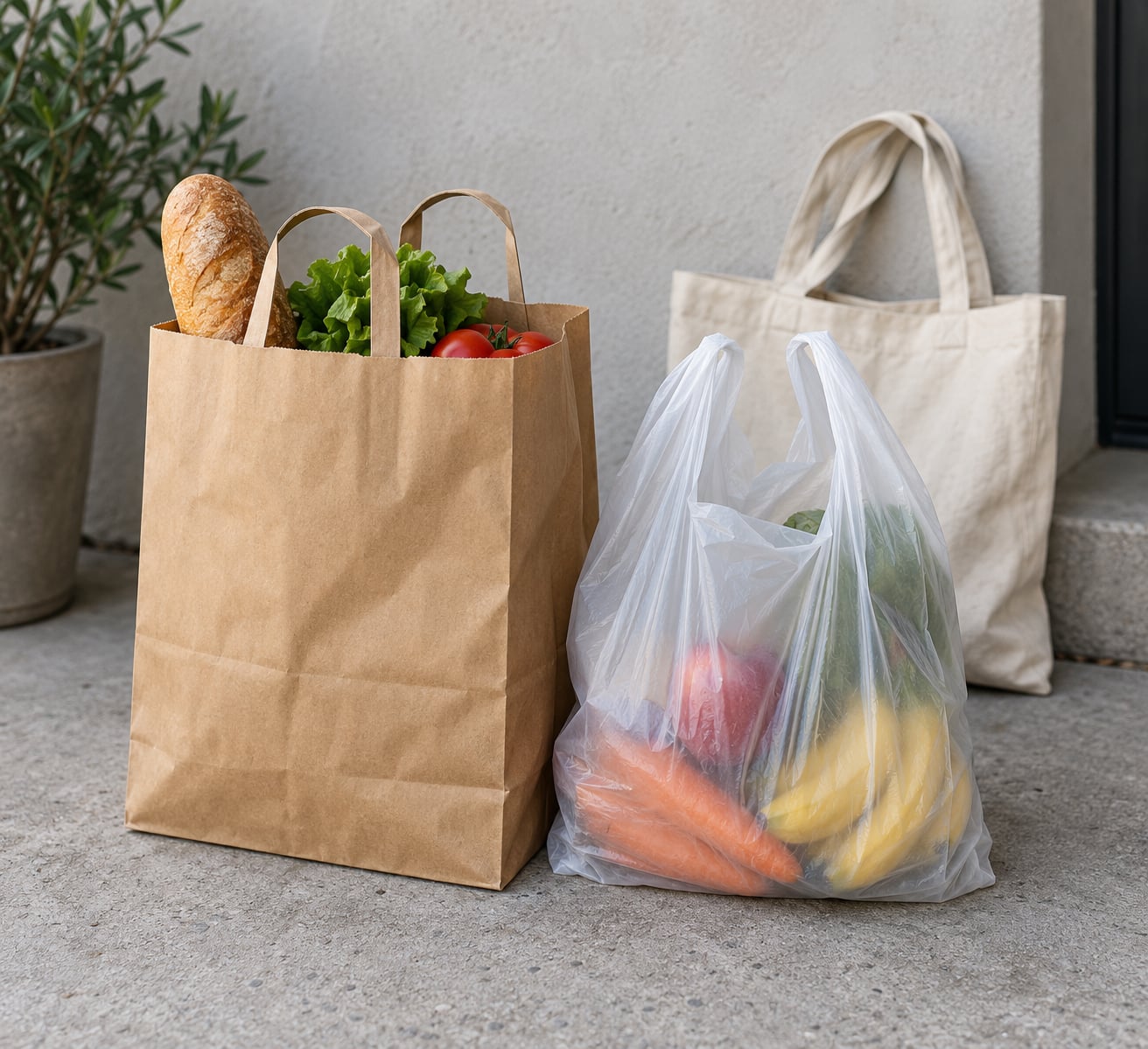
Neither material wins outright in the paper bags vs plastic bags environmental impact debate. Paper bags cost more energy and water to make and are far heavier to transport, while plastic bags persist for centuries, escape into litter and are rejected by most kerbside recycling systems. The decision that actually matters is not the label on a single bag but how many trips it survives and what happens to it afterwards.
That is an uncomfortable answer, because people want a winner. The single-use bag has become a test case for whether bans and levies reduce environmental impact or simply move it from one material to another, and the honest position is that the published life cycle assessments genuinely disagree.
So this is a comparison built on the numbers that researchers and regulators actually publish: energy and water in production, weight on the road, recycling rates as they are really collected, and the number of reuses each material needs before it pays back its own footprint. Figures are attributed where the research files name a study, and where studies conflict I explain what each one assumed.
If you only read one section, read the at-a-glance table below. If you only act on one thing, carry a bag you already own instead of taking a new one at the till.
Table of Contents
- Paper Bags vs Plastic Bags Environmental Impact at a Glance
- What Is the Environmental Impact of Making Each Bag?
- Paper Bags vs Plastic Bags Environmental Impact: What Happens After Production?
- Which Type of Bag Uses Less Energy and Produces Less Waste?
- Why the Studies Disagree About Which Bag Wins
- Reusable Bags and the Break-Even Maths
- Where Paper Bags Work Best
- Where Plastic Bags Work Best
- Microplastics, Compostable Bags and the Catch Nobody Mentions
- Which Should You Choose?
- What the Rules in Spain and the EU Change
- What to Do With Each Bag in Practice
- Frequently Asked Questions
- Are paper bags better than plastic bags for the environment?
- Are paper bags really better than plastic bags?
- Can paper bags be recycled?
- Do paper bags decompose more easily than plastic bags?
- Are reusable bags actually better for the environment?
- What should I do with a plastic bag I already have?
- Conclusion
Paper Bags vs Plastic Bags Environmental Impact at a Glance
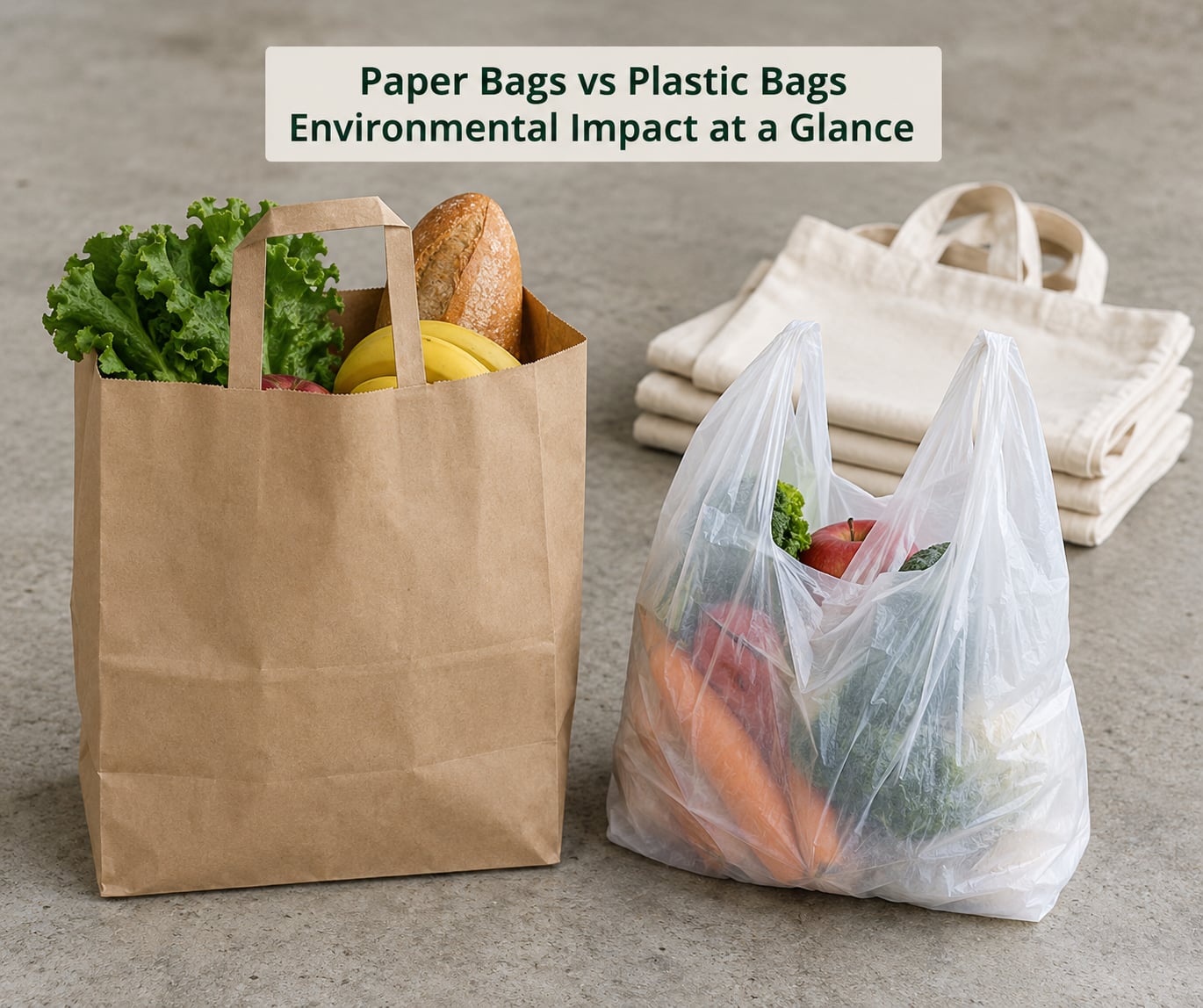
Here is the short version, criterion by criterion. The numbers come from the studies named further down, and the caveats matter as much as the figures.
| Criterion | Paper bag | Plastic bag |
|---|---|---|
| Raw material | Wood pulp from managed forestry, plus energy from fossil fuels at the mill | Polyethylene made from naphtha cracked from crude oil or natural gas |
| Energy to produce | Higher than plastic; kraft pulping, drying and converting are energy-hungry | Around 40 percent less energy than paper, per EPA production figures |
| Pollution from production | About 50 times more water pollutants and 70 percent more air pollutants | Lower pollutant output, offset by fossil feedstock |
| Weight per bag | Five to seven times heavier than an equivalent plastic bag | Extremely light; 2,000 bags weigh under 14 kg against roughly 127 kg in paper |
| Reuse | Reasonable for dry goods, but handles tear when wet and bag bottoms give out | Performs well when lightly loaded, soaks up wet produce without failing |
| Recycling as collected | Clean paper is accepted by most kerbside paper schemes in Europe and North America | Rejected by most kerbside schemes; typically gathered at supermarket drop-off points instead |
| Recycling rate in practice | Roughly 65 to 80 percent in many municipalities | About 3 percent globally |
| In a sealed landfill | Does not biodegrade. Paper needs oxygen, moisture and warmth, none of which exist underground | Does not biodegrade either, and fragments into microplastics over decades |
| Litter and wildlife | Soft, breaks down visually, low risk of entanglement | Carried by wind, hard to retrieve, a serious entanglement and ingestion hazard |
| Best fit | Dry groceries, bakery goods, takeout that must stay dry, shops with paper collection | Wet produce, fish, meat, heavy or bulky items where the bag will be reused several times |
Read that table twice before deciding anything, because the answer flips depending on the row you care about most. Manufacturing favours plastic. Persistence and litter favour paper. End-of-life depends entirely on the collection system you actually live in.
What Is the Environmental Impact of Making Each Bag?
A kraft paper bag begins as a tree. Logs are debarked, chipped and cooked in a digester to loosen lignin, the fibres are bleached or left unbleached brown, screened, washed and dried on a heated belt. That belt is where a lot of the energy goes, along with the chemicals consumed in pulping and the water returned to the river.
A plastic bag begins as crude oil or natural gas. Naphtha is cracked into ethane and propane, the ethane is polymerised into polyethylene, and the resin is melted and blown into thin film. The chemistry is simpler and the energy demand is lower, but the feedstock is fossil, and the material it produces was designed to survive for a very long time.
That asymmetry drives almost every number people quote. Paper borrows its carbon from the atmosphere for a few months, in a tree, and returns it when the tree regrows. Plastic moves carbon from underground rock into the atmosphere and holds it there as part of the bag.
Paper Bags vs Plastic Bags Environmental Impact: What Happens After Production?
Transport is where paper’s weight penalty bites. The commonly cited comparison is 2,000 paper bags at roughly 127 kg against 2,000 plastic bags at under 14 kg, and a separate estimate puts paper at five to seven times heavier per bag. More trucks, more fuel, more emissions, and more warehouse space: paper occupies around seven to ten times the volume of an equivalent stack of plastic.
Recycling reverses part of that logic in an unexpected way. Recycling a pound of plastic takes about 91 percent less energy than recycling a pound of paper, because paper has to be pulped, bleached and dried again while plastic can be melted and remoulded. Recycled content also changes the picture, since recycled paper still carries the mill’s energy demand, and some mills burn wood byproducts for heat.
End-of-life is where the two materials separate most sharply, and where good intentions meet physical reality. Paper is accepted by most kerbside paper collections, giving recycling rates of roughly 65 to 80 percent in many municipalities. Plastic film is a contaminant: it snags on screens, wraps around sorting equipment and has to be cut free by hand. In Portland, Oregon, crews reported spending around 30 percent of their time cutting plastic shopping bags out of sorting machinery.
There is a second problem that gets repeated badly online. Paper is called biodegradable, and under composting conditions it genuinely breaks down fairly quickly. A sealed landfill is not a composting facility. Without light, moisture and oxygen, a paper bag in landfill can sit for decades without visibly changing, so biodegradable describes a potential, not a schedule.
Plastic film is not accepted curbside anywhere in most European and North American systems, and globally only around 3 percent is recycled. Almost all of it goes to landfill, incineration or the environment, and what escapes becomes litter that fragments into microplastics.
Which Type of Bag Uses Less Energy and Produces Less Waste?
Counted across the whole life cycle, the answer is that neither single-use material is efficient, and the reuse count decides the winner in the paper bags vs plastic bags environmental impact question. A life cycle assessment, or LCA, sums the impacts of every stage from raw material to end of life, and once you add the use stage into the equation the ranking can flip completely.
Here is the sequence that decides it. First, manufacturing, where plastic holds the advantage on energy and pollutant output. Second, transport, where the light weight of plastic wins again. Third, use and reuse, where paper has the edge for anything dry because it survives several trips without splitting. Fourth, end of life, where paper wins on collection rates and plastic wins on nothing.
That third stage is the hinge. A paper bag used once loses, on energy and weight. The same bag used three or four times starts to claw its production impact back, and the figure varies by study because the studies model different bag sizes, different load conditions and different assumptions about how many trips a shopper actually manages. The widely circulated claim that a paper bag needs 34 reuses comes from a specific model with its own assumptions, not from a law of physics. Treat 3 to 7 as a reasonable range and understand why.
Why the Studies Disagree About Which Bag Wins
When you see four credible studies reach four different conclusions, the studies are not necessarily wrong. They are measuring different things. Here is what each one actually set up.
| Study | What it assumed | What it concluded |
|---|---|---|
| Franklin Associates (2007), widely cited in policy debate | Compares lightweight polyethylene bags against standard kraft paper bags, single use, US energy mix | Lightweight plastic scores better on greenhouse gas output per bag |
| Clemson University LCA (2014), commissioned for industry | Includes paper bags in a recovery scenario and credits recycled content | Paper becomes competitive when high recovery rates are assumed |
| Muthu et al. (2012), peer reviewed | Full cradle-to-grave comparison of plastic and paper shopping bags | Plastic bags are only slightly better than paper across the impacts measured |
| Tuomi et al. (2017), University of Minnesota | Ranks paper, plastic and reusable bags by the number of times they are reused | Used once, plastic has the lower impact; reusables win clearly only when used many times |
The pattern behind the disagreement is simple. Studies funded or shaped by an industry tend to weight the use stage and the recovery rate of paper more heavily. Studies weighting virgin production energy tend to land on plastic. And nearly all of them agree on the same last point, which is that the reusable bag beats both.
Reusable Bags and the Break-Even Maths
The break-even number is how many times a reusable bag must go round before its total footprint matches a single-use plastic bag. Those numbers are large, and that is exactly why a tote gathering dust in a cupboard is worse than nothing.
| Reusable bag type | Typical uses needed to break even | Honest read |
|---|---|---|
| Heavy cotton or canvas tote | 131 or more uses | Highest production impact of the lot. Worth it only if it becomes your default bag |
| Non-woven polypropylene shopper | 11 or more uses | The sweet spot. Foldable, tough, breaks even in a few months of regular shopping |
| Recycled polyester (rPET) bag | 8 or more uses | Lowest bar of the three, and it starts life from recycled plastic |
| Paper shopping bag | 3 to 7 uses | Modest, but wet loads cut it short well before then |
| Cotton tote bought in a drawer and never used | Never | A production cost with no return at all |
A common objection from readers is that manufacturing a cotton tote pollutes more than making a plastic bag, and it is true for the first trip. It is also why the number is 131 rather than 11. The objection mistakes the first use for the whole life, and a bag you never reach for again is the worst case in the entire debate.
Where Paper Bags Work Best
Paper earns its place in a few specific situations, and they are real rather than marketing. Dry, light, single-decker grocery shopping is the classic case: bread, tinned goods, cereal, a bunch of herbs. The bag folds flat, holds its shape long enough to load onto a counter, and flat-packs into a pocket afterwards.
Bakery and confectionery packaging is the other genuine win. Grease-resistant paper exists specifically to keep pastry from steaming itself into a soggy lid, which a plastic bag cannot do without a second layer, and a second layer is a second piece of waste.
Takeout that must stay dry is where a heavy kraft bag beats a thin film bag, because the paper does not tear when the base takes the weight of a stack of containers. For a restaurant handing over two heavy orders, one paper bag replaced two plastic ones.
Where paper is genuinely weak is moisture and repetition. A paper bag that has met a leaking bottle or a wet fish box is finished. The bottom gives out, the handles stretch, and if the contents were wet, the whole bag usually ends up in the general waste bin anyway rather than the paper collection.
E-commerce and mail-order is worth separating out. Paper void fill and cardboard shippers protect items well and, in most systems, recycle cleanly. Thin plastic film mailers are the ones that jam equipment and get rejected, so the paper-versus-plastic framing does not map neatly onto online retail.
Where Plastic Bags Work Best
Plastic is the better material for wet, heavy or awkward loads, and pretending otherwise is not useful. Wet produce, fish, meat, flowers, hardware and bulky multipacks are the situations where a thin plastic bag holds together and a paper bag gives up halfway through the load. This is exactly the reuse that makes a single-use plastic bag defensible.
It is also the case that people quietly rely on. Households report using shopping bags as bin liners, freezer bags and storage sacks long after the shopping trip, which stretches a single bag’s useful life well past the till. In wet-food and food-waste situations there is no paper equivalent that performs the same job.
The problem is not the trip, it is the ones that never happen. Plastic bags are light enough for wind to carry, and once they leave a bin or a lorry they are effectively uncollectable. They wrap around wildlife, are swallowed by animals that cannot tell the difference between a bag and a jellyfish, and break down into microplastics rather than into anything a cleanup crew can catch.
The perverse part is that a thin polyethylene bag uses less energy to make than paper, so a widely loved single-use bag that ends up in a river has done well on production and badly on everything after it. The material choice and the disposal outcome have to be judged together, which is why single-use bans target the item and not just the polymer.
Microplastics, Compostable Bags and the Catch Nobody Mentions
Compostable and biodegradable plastic bags are the most confusing category on the shelf. Many are plant-based and can be genuinely broken down in an industrial composting facility, but most home compost bins never get hot enough, and a compostable bag that ends up in a kerbside recycling batch is a contaminant that behaves exactly like ordinary plastic film. Buyers often cannot identify the resin from the packaging, and a partly degraded bag fragments into microplastics, the same microplastics a conventional bag would produce.
The same question comes up about zip bags and similar plastic storage bags. Washing them releases microplastics, so keeping one for a decade of leftovers is not a neutral act, and recycling them curbside is generally not accepted. For storage, a glass or stainless container is a better answer, even though it is a bigger object to buy.
Which Should You Choose?
Work from the trip, not from the label. The choice is easy once you stop treating it as a single question about which material is greener and start treating it as a set of small decisions.
- Every trip you can cover with a bag you own: bring it. A non-woven or rPET bag used eleven times is past break-even, and a cotton tote used a hundred times is far past it.
- Dry groceries when you have nothing reusable: a paper bag is the lesser of the two single-use options, provided it gets a second and third trip and its base holds up.
- Wet produce, fish, meat or heavy items: use a plastic bag, use it for what it is good at, then reuse it for bin liners or wash it out for storage rather than adding it to a single-use habit.
- Food waste and household storage: plastic has no paper equivalent that does the job. Reuse the bag or switch the container, because no bag debate fixes a storage problem.
- Any single-use bag, always: refuse it if you are not buying anything, and reuse a light one rather than taking a second new one.
If you want the shortest possible version: the lowest-impact bag is the one you own, the most-used bag is the one in your hand, and the second-best choice between paper and plastic depends on what you are carrying and what your local collection accepts.
What the Rules in Spain and the EU Change
Regulation has moved faster than the research. The European Union’s single-use plastics rules restrict a list of disposable plastic items and push member states towards separate collection of plastic waste, and several countries, Spain among them, require large retailers to charge a small amount for single-use carrier bags, with the amount set regionally. Levies like Ireland’s bag charge, first introduced in 2002, did change behaviour, and the evidence on litter is mixed, which is why bans and levies are not a substitute for reuse.
What matters most for the paper-versus-plastic decision is the collection system rather than the law. Check what your municipality actually accepts. In most of Andalusia, as across most of Spain, clean paper goes in the paper container and thin plastic film does not belong in the yellow recycling container, because it contaminates the sorted paper and cardboard stream. Supermarket drop-off points and large recycling points are the usual route for film plastic, if there is one within reach of you.
For a small retailer or a takeaway business, the arithmetic runs on volume rather than principle. Paper costs several times more per bag and takes up far more storage space, which is real money for a business with limited back room. Non-woven reusable bags or a cardboard box for takeout cut the per-order waste more than the material debate usually does.
What to Do With Each Bag in Practice
Sort it out before you reach the bin, and the whole debate becomes manageable.
- Paper bag, clean and dry, no food or plastic handles: into the paper recycling container. Tear off handles and any liner first.
- Paper bag with food, grease or a wet base: general waste. Contamination is the main reason otherwise-good paper is rejected at the mill.
- Thin plastic bag, clean and dry: keep for bin liners or reuse, or take it to a store drop-off point or a large recycling point if one exists near you. Not the kerbside container.
- Thin plastic bag with food or liquid in it: general waste, and wash it out first if you intend to reuse it.
- Compostable bag: only for an industrial composting stream that accepts it. In a home bin or a normal kerbside collection it behaves like plastic film.
- Any bag that is torn, muddy or full of unknown residue: general waste. This is where most bags in a household actually end up, and it is the number that decides the environmental outcome.
One last piece of proportion. The share of a household’s footprint attributable to carrier bags is very small next to transport, food waste and energy use. Bag swaps are worth doing because they are cheap and quick, not because they are the biggest thing you can do this year.
Frequently Asked Questions
Are paper bags better than plastic bags for the environment?
It depends on how they are used. Paper has lower persistence and is accepted by most kerbside paper schemes, but its production needs more energy, water and transportation weight. Plastic is lighter and cheaper to make, yet almost none of it is recycled and it fragments into microplastics. If you compare a paper bag used once against a plastic bag used once, plastic is usually ahead. If you compare a paper bag used four times with a plastic bag that ends up in a river, paper wins. Reuse beats material choice in almost every scenario.
Are paper bags really better than plastic bags?
Sometimes, and the studies disagree for identifiable reasons. Franklin Associates (2007) weighted virgin production energy and found lightweight plastic ahead. The Clemson LCA (2014) credited paper with high recovery rates and reached a different result. Muthu et al. (2012) found plastic only slightly better. Tuomi et al. (2017) showed the ranking flips with reuse. No study has found paper universally better, and none has found plastic universally better. The deciding variables are reuses, bag size, and the local recycling system.
Can paper bags be recycled?
Yes, when they are clean. Clean paper bags are accepted by most kerbside paper collection schemes, which is one reason paper recycling rates reach roughly 65 to 80 percent in many municipalities. Remove food, grease, plastic handles, ribbon and any liner before putting one in. A greasy or wet bag is treated as contamination and is usually rejected with the rest of the paper. Flatten it, and if it is torn beyond recognition, general waste is the honest bin for it.
Do paper bags decompose more easily than plastic bags?
Under the right conditions, yes. Paper breaks down in a compost heap or an industrial composting facility within months when it has moisture, warmth and oxygen. Conventional plastic is designed to resist that. The important caveat is a sealed landfill, which offers none of those conditions, so a paper bag buried there can sit for decades without visibly changing. Biodegradable describes a potential that requires conditions, not a guaranteed timetable in the bin your waste actually goes to.
Are reusable bags actually better for the environment?
Only once you use them enough times. A non-woven polypropylene shopper needs around 11 uses to match a single-use plastic bag, a recycled polyester bag around 8, and a heavy cotton tote more than 130. The production cost is paid at the point of purchase, so a tote gathering dust in a cupboard is worse than nothing. The lowest-impact bag is the one you actually keep in the car and reach for every time.
What should I do with a plastic bag I already have?
Most kerbside schemes reject thin film plastic because it jams sorting equipment, so the recycling container is not the answer. Look for a supermarket drop-off point or a large recycling point near you, and use one if there is a practical route. Failing that, the lowest-impact use is often reuse at home: bin liners, freezer bags, covering a food tray. A bag with food or liquid in it should be washed for reuse or binned as general waste.
Conclusion
Paper bags vs plastic bags has no winner that holds up in every situation. Plastic is lighter, cheaper to make and wins on production energy; paper is heavier but collects and recycles far more often, and it does not persist the way a film bag does in open air.
So start with the part that is not a trade-off. Keep a bag by the door and use it until it fails. Beyond that, choose paper for dry, light shopping where reuse is likely, choose plastic for wet and heavy loads where a paper bag would fail, and give both a second life before either becomes waste.
Last, check what your own collection accepts rather than what the label promises. That single habit does more for the outcome of both materials than any change of brand.