Clothes recycling rarely works because there is almost no textile-to-textile recycling operating at scale anywhere in the world. Your clothes get collected, graded and sorted, and then almost all of them are resold, exported as bulk bales, shredded into rag-grade material or incinerated. The obstacle is not effort or goodwill, it is that fibre cannot be recycled indefinitely and no closed loop exists yet.
I used to think the container at the bottom of my street was the end of the story. It is not. It is the middle of a chain with at least six decision points, and four of the six outcomes are not recycling. Once you can picture that chain, the disappointment stops being personal. The system was never built to do what its signage implies.
Here is the short version, as five reasons:
- The loop does not close. A garment that becomes a cleaning cloth cannot become a garment again, so material leaves the apparel loop permanently.
- Fibre degrades. Cut fibres get shorter and weaker each cycle, which caps how many times a fibre can be spun into wearable fabric.
- Blends and finishes block the process. Elastane, coatings, laminates, prints and glues contaminate the stream and stop a garment being sorted into one clean fibre.
- Sorting makes money from resale, not from fibre. Facilities earn from selling good second-hand clothing, which is why the profitable fraction never reaches a shredder.
- Cheap virgin fibre outcompetes recycled fibre. New polyester costs less than the cost of sorting and processing the used equivalent, so demand for recycled material stays thin.
None of that means you should keep unworn jumpers in the back of a wardrobe for a decade. It means the most useful thing is to understand the routes, in order of real impact, and use recycling last. That is the rest of this article.
Table of Contents
- Why Clothes Recycling Rarely Works
- How Do Clothes Collection and Sorting Work?
- Why Do Fiber Blends and Finishes Make Clothes Recycling Difficult?
- What Happens to Common Types of Clothing?
- Why Don’t More Textiles Become New Clothes?
- What Happens to Clothes That Cannot Be Recycled?
- Can Clothes Recycling Still Reduce Environmental Impact?
- What Can Consumers Do to Reduce Textile Waste?
- What Can Brands and Local Authorities Do Better?
- Frequently Asked Questions
- Does clothes recycling actually work?
- Where do donated clothes really go?
- Why doesn’t my local clothing recycling bin accept every fabric?
- Are natural fabrics always easier to recycle than synthetic ones?
- Why does clothes recycling rarely work in practice?
- What to Do First
Why Clothes Recycling Rarely Works
Clothes recycling can divert waste and it does recover some material value, but it rarely returns discarded textiles to comparable new garments. The reason is cumulative rather than dramatic. Collection is incomplete, sorting is shallow, fibre has a finite useful life, contamination is high, and the market for recovered fibre is thin.
It also helps to separate five words that get used as if they were one thing:
- Reuse means the garment is worn again, by someone, in a garment. Second-hand resale is the best outcome by a wide margin.
- Repair and resale extend the life of a garment that already exists, which is the cheapest environmental win available.
- Recycling means the garment itself is broken down into material: fibre, then yarn, then fabric.
- Downcycling is material recovery where the output cannot go back into apparel, such as shredded fibre for insulation, mops or stuffing.
- Disposal covers incineration with energy recovery and landfill. Neither recovers material.
Downcycling is real and it beats landfill, but calling it textile-to-textile recycling is where a lot of the public confusion lives.
How Do Clothes Collection and Sorting Work?
It starts at your house, then runs through a fairly fixed sequence. A household donation, a take-back bag or a municipal textile container is collected by a charity or a contracted waste firm, then baled and sent to a sorting facility, then graded by hand or machine, then routed to one of several destinations.
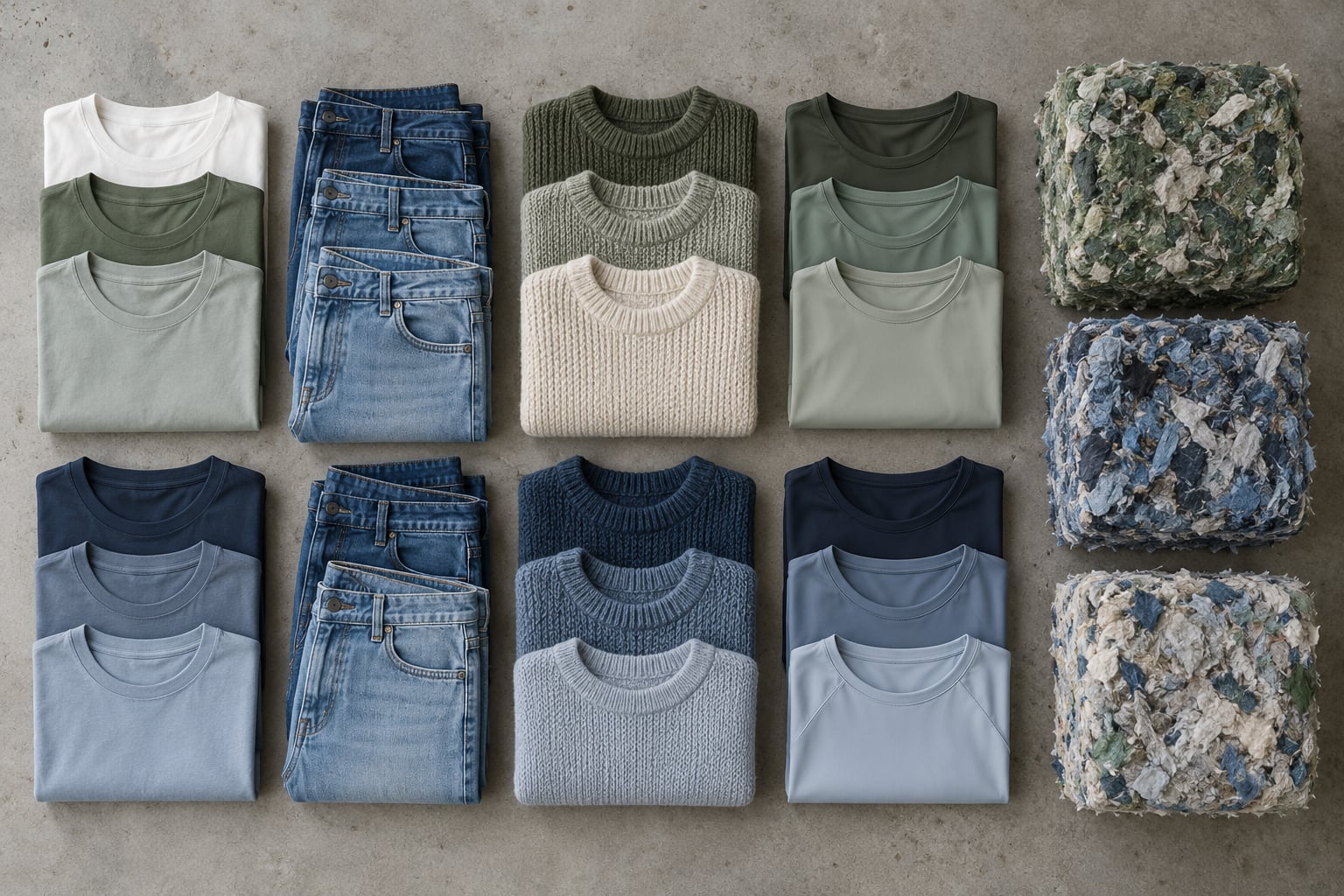
The grading is the part nobody sees. Good wearable stock, usually called A grade, goes to resale channels. Sound but lower-grade clothing goes to bulk export. Damaged and unwearable material becomes rag-grade feedstock or wiping cloth. Contaminated and worthless material is refused or incinerated.
The numbers from WRAP’s UK textile flow work make the gap obvious. Of roughly 1,452 kilotonnes of post-consumer textiles tracked, about 469 kilotonnes went through sorters, and 421 of those kilotonnes were exported rather than recycled in the UK. Only around 34 kilotonnes reached UK recyclers, while 638 kilotonnes were incinerated and 83 kilotonnes went to landfill. Those are UK figures for a recent measurement year, and other countries publish different splits, but the shape is consistent.
So the headline collection figures you see on council and charity bins measure intake, not recycling. Intake and outcome are separated by a grading step that filters out most of what was collected.
Why Do Fiber Blends and Finishes Make Clothes Recycling Difficult?
A mechanical fibre recycler needs a reasonably pure, single-fibre stream. A cotton t-shirt works. A cotton and elastane camisole does not, because the elastane gums up the shredding and spinning process and cannot simply be filtered out.
Polyester-cotton blends pose the same problem in reverse. The two fibres need separating before either can be re-spun, and no cheap mechanical method exists for that at scale. Add a waterproof membrane, a laminated panel, a printed graphic, a zip, a lining and a plastic-dome button, and you have a garment that is no longer one material at all.
Chemical recycling, which breaks polyester back down to its building blocks through depolymerisation, is the technical answer. It is also expensive, needs a reliable clean feedstock, and no facility operates it at anything like the volume the headlines imply. Mechanical shredding dominates because it is cheaper, and shredding produces shorter fibre with lower strength.
What Happens to Common Types of Clothing?
Different fabrics behave very differently, and the honest answer for most is that they are reused rather than recycled.
| Material | Likely recovery route | Main obstacle | Common destination |
|---|---|---|---|
| Cotton | Reuse, then mechanical fibre recycling | Shortened fibre after shredding | Secondhand sale, yarn or rag-grade fibre |
| Wool | Reuse, then mechanical fibre recycling | Shrinkage and blended fibres in knitwear | Secondhand sale, insulation fibre |
| Linen | Reuse, then mechanical fibre recycling | Low volumes, mixed batches | Secondhand sale, blended yarn |
| Polyester | Reuse, then chemical recycling in principle | Cost of depolymerisation at scale | Secondhand sale, downcycled fibre |
| Nylon | Reuse, limited chemical recycling | Contamination and low supply | Secondhand sale, downcycled fibre |
| Elastane blends | Reuse where wearable, rarely recycled | Cannot be separated cheaply | Secondhand sale, rag-grade material |
| Coated or multilayer garments | Almost no material recovery | Laminates and membranes bonded to fabric | Downcycling or disposal |
Two caveats matter here. Local facilities and accepted items differ widely, so check the guidance on your own collection service before assuming any fabric is accepted. And a second-hand sale is only a genuine environmental gain if that garment does not get replaced by a new purchase.
Why Don’t More Textiles Become New Clothes?
Because it is not usually worth it financially. Virgin polyester and virgin cotton are cheap, abundant and consistent. The used equivalent arrives mixed, damp, dyed in several colours, stapled, zippered and often dirty. Separating and processing it costs more than the recovered material is worth.
That arithmetic shapes every decision in the chain. A sorter facing a bale of clothing has three realistic choices: sell it for reuse, shred it for rag-grade material at a low price, or pay to have it destroyed. Only the first is comfortably profitable, so good clothing leaves the system as clothing.
Some of this is supply, not choice. Collection points overflow. Charity shops report unsold B-grade stock they must clear cheaply or dispose of. Items that arrive stained, wet, mouldy or wrongly bagged are rejected at the door, so a small contamination rate can spoil a whole load.
Then there is the number that gets quoted most often. The widely cited estimate that around one percent of garments are recycled into new clothing comes from the Ellen MacArthur Foundation’s work and dates from around 2017. It is a real finding, but it is not a live measurement, and it counts only fibre-to-fibre recycling. Figures for landfill shares, waste shares and recycling rates vary by country, by programme and by definition, so treat any single percentage as a snapshot with a year attached.
What Happens to Clothes That Cannot Be Recycled?
Whatever survives sorting leaves through one of four routes, and only one of them is material recovery.
Reuse exports. Large volumes of sorted second-hand clothing are sold in bulk to markets in Africa, South Asia and elsewhere. Much of it is genuinely worn. A portion arrives unusable and has no onward resale route, so it gets handled locally, sometimes by informal waste picking, which shifts a disposal problem across borders rather than solving it.
Downcycling. Shredded textiles become insulation, acoustic panels, wiping cloth, mattress filling and stuffing. Useful, but the material has left the clothing loop.
Incineration with energy recovery. This is where the largest single share of collected textiles goes in several European countries. Some energy is recovered, but the fibre is gone for good.
Landfill. A smaller share, and the one most often overstated. The famous claim that 85 percent of all textiles end up in landfill comes from a 2017 estimate for global clothing waste and has been repeated far beyond what it supports. UK measured data from WRAP, cited above, puts landfill at a small single-digit share of post-consumer textiles with incineration far higher. Importing and exporting countries also publish very different waste shares for the same traded bales, which tells you how much the number depends on the definition.
You will also see fibre-to-fibre recycling described as a solved problem, so it is worth knowing the recent commercial record. Textile Recycling International entered administration and Renewcell went bankrupt, both reported around 2024. Those are not isolated bad actors; they are what happens when a process depends on a commodity price nobody will pay.
Can Clothes Recycling Still Reduce Environmental Impact?
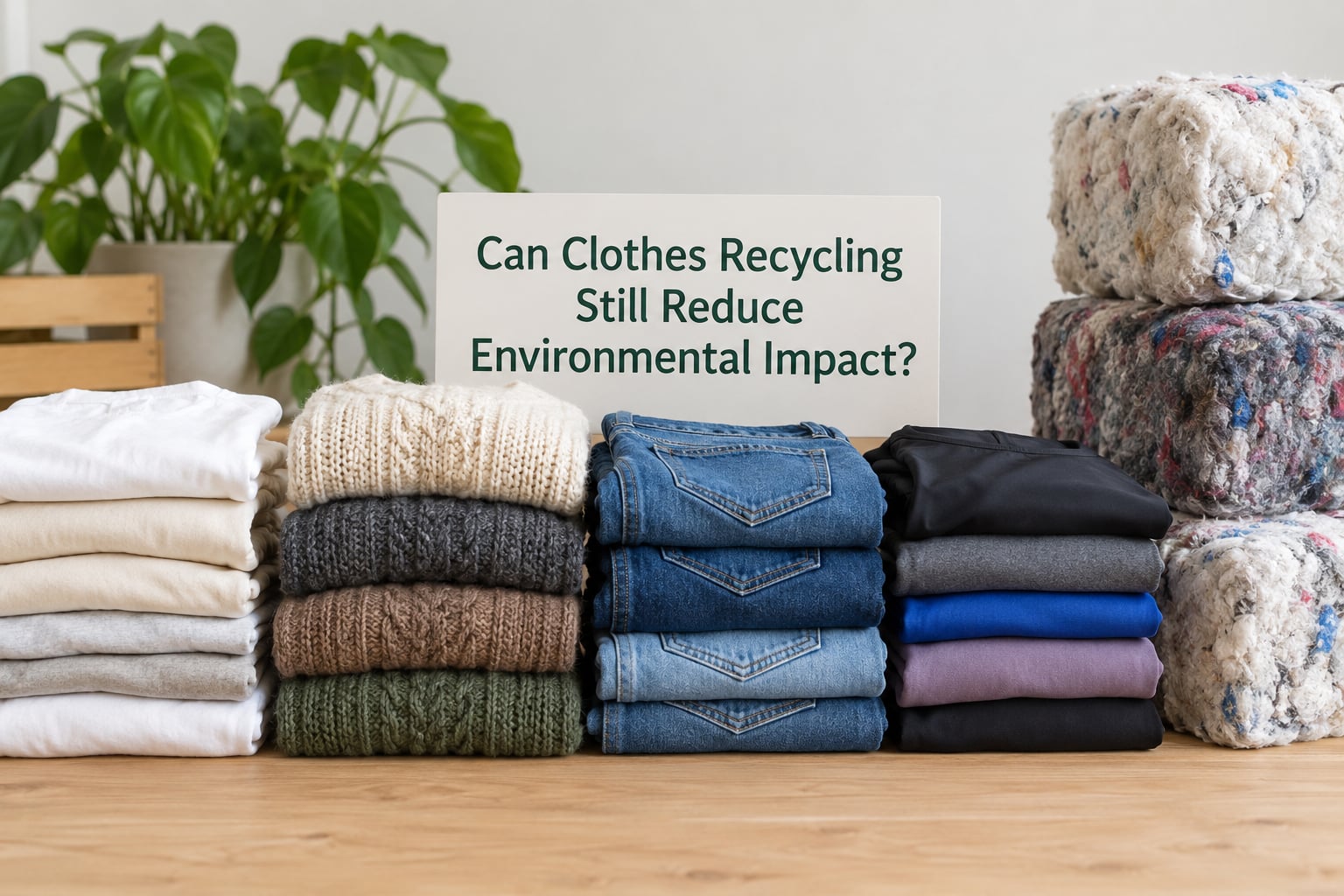
Yes, with conditions. Recycling sits at the bottom of the waste hierarchy for a reason: keeping a garment in use beats recovering its fibre, and recovering its fibre beats destroying it. The measurable benefit comes from avoided new production, avoided landfill and avoided incineration, and it depends on honest accounting rather than on good intentions.
Downcycling still counts as an improvement over disposal, even when it does not close the loop. What it does not do is offset the impact of buying a replacement garment, which is why resale and repair sit well above recycling in the hierarchy.
For the EU and Spain, the regulatory direction has moved faster than the infrastructure. The Waste Framework Directive required separate textile collection across member states from 1 January 2025 and introduced extended producer responsibility for textiles, which makes brands responsible for funding the end-of-life handling of what they sell. Collection is expanding faster than sorting and fibre-recovery capacity, which is one reason bins overflow.
What Can Consumers Do to Reduce Textile Waste?
Work down this order rather than starting at the recycling bin.
- Buy fewer pieces. Volume is the root problem, and no bin scheme changes how many garments enter your wardrobe.
- Choose repairable, durable items. A garment that can be taken apart and reworked survives longer than one bonded together with glue and printed trim.
- Wear what you own longer. Extending a few years of use beats any recycling scheme, and laundry care does most of that work in practice.
- Repair before you replace. Patching a knee, rehemming a sleeve or replacing elastic is usually cheap and almost always beats buying new.
- Resell or donate anything wearable. This is the highest-value outcome in the whole chain, so it sits above everything recycling-related.
- Recycle last, and locally. Use a service that tells you where the material actually goes.
To judge whether a service is worth trusting, ask three questions: does it publish which materials it accepts, does it state the actual destination of collected bags, and does it report what proportion ends up as recycled material rather than resale? A recycler that cannot answer those is a logistics company for charity donations, not a recycling programme.
For the awkward items, the honest answer is that no formal route exists in most places. Underwear, bras, shoes and heavily elasticated clothing are usually refused because they have no resale value and contaminate other loads. Repair them, pass them on locally, cut them into cleaning rags, or take them to a textile collection point that accepts them and say plainly in your own head that they will probably be downcycled.
What Can Brands and Local Authorities Do Better?
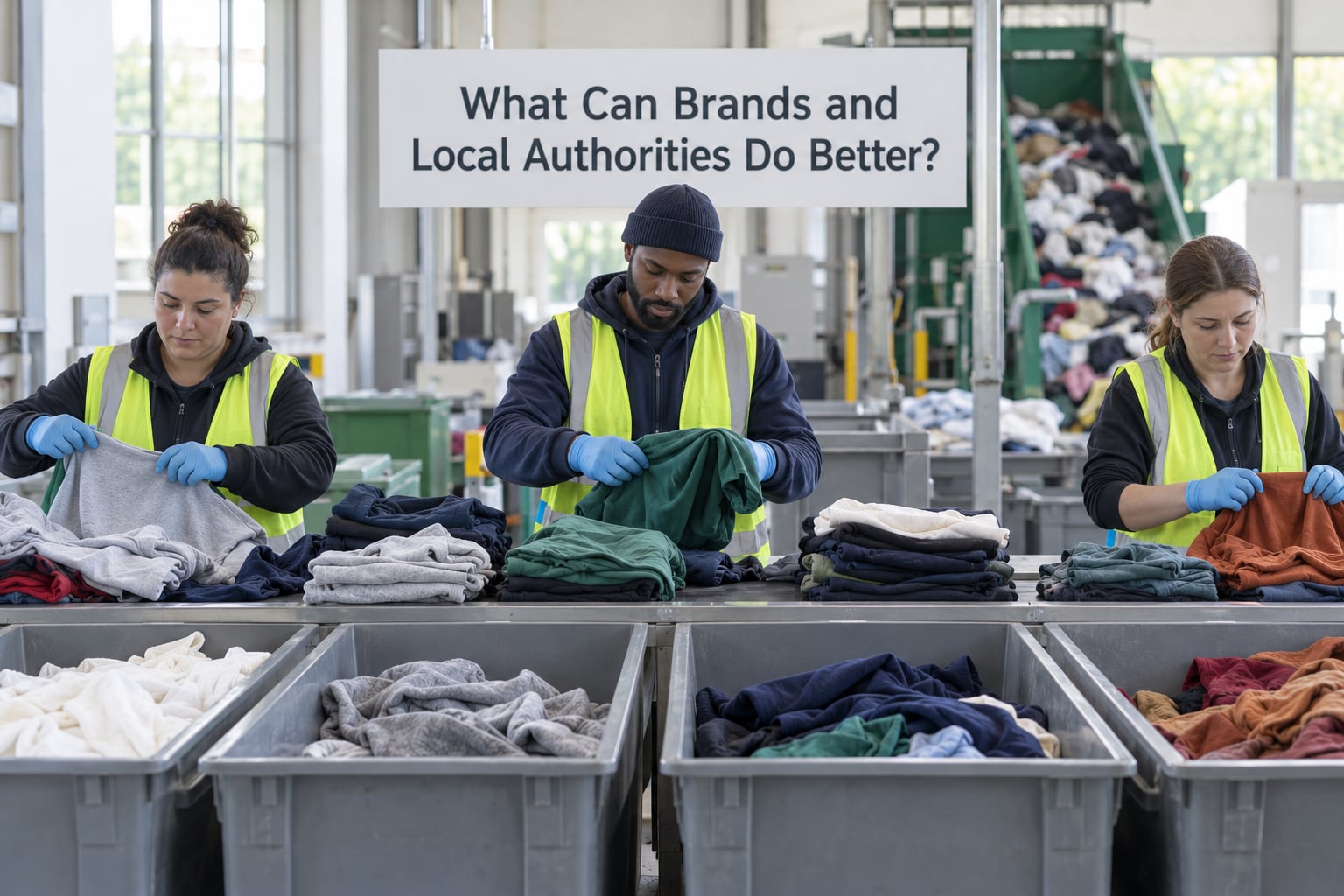
The fixes sit upstream of the bin. Durable design that allows disassembly, mono-material construction, fewer elastane blends, and standardised fibre labelling would give sorters something they can actually process. A garment that says exactly what it is made of, in a consistent format, is worth more than a vague recycled-content claim.
Extended producer responsibility turns that from a request into a budget line. Fees that are modulated by how recyclable a product is, rather than flat, give brands a financial reason to design for recovery, and the digital product passport under EU ecodesign rules is meant to make fibre content machine-readable at scale.
On the ground, the unglamorous investment is sorting capacity. Municipal textile collection schemes that publish where bags go, train sorters on manual grading, and buy shredding equipment local to the region do more for the real recycling rate than any take-back campaign. A take-back scheme that ships your old coat overseas and shreds it in another country is disposal with better branding, and it should be judged on its destination data, not its logo.
Frequently Asked Questions
Does clothes recycling actually work?
Partly. It works best as reuse and downcycling, where most collected textiles end up. True fibre-to-fibre recycling, where a garment becomes new clothing, remains a small share and the widely quoted one percent figure comes from around 2017. Sorting, blends, coatings and the cost of processing used fibre all limit the rest.
Where do donated clothes really go?
To a sorting facility, not straight to a shop. Wearable clothing is graded and sold second-hand, lower-grade stock is exported in bulk bales, damaged items become shredded rag-grade material, and contaminated loads are refused or incinerated. Which share applies depends on the sorter and the country, so the only way to know is to ask the operator directly.
Why doesn’t my local clothing recycling bin accept every fabric?
Underwear, shoes, elasticated items and anything with coatings or laminates are usually refused. They have little resale value and they contaminate the loads that can be processed for resale or shredding. Accepted lists vary by operator, so check your local service’s guidance rather than assuming a whole wardrobe is fine.
Are natural fabrics always easier to recycle than synthetic ones?
No. Pure cotton or linen is mechanically simpler to shred than a polyester-cotton blend, but elastane, coatings and laminates still block recovery. Polyester has a chemical recycling route in principle, though it is costly and not yet operating at scale. The blend and the finish matter more than the label.
Why does clothes recycling rarely work in practice?
Because the economics fail. Used garments compete with cheap virgin fibre, opening and processing blended textiles costs more than the recovered fibre is worth, and facilities make more money reselling good clothing than shredding it. Collection figures also measure intake, not outcome, so tonnes collected are routinely mistaken for tonnes recycled.
What to Do First
Start with what you already own. Wear it longer, repair what fails, and pass on anything still wearable before you think about recycling. Buy fewer and more durable items, because the volume coming in is what makes every downstream route overflow. Use a collection service last, and only when it tells you where the material goes.
None of this fixes the underlying problem. Clothes recycling rarely works because production volumes outrun the systems built to handle them, and no individual bin changes that. But sorting what you have well, buying less, and demanding honest destination data from brands and local schemes all push in the right direction.