If you are standing at the edge of a wetland trying to name it, the answer is usually decided by two things: how deep the water sits and whether trees are growing in it. A marsh is mostly shallow water and grasses, a swamp is saturated ground carrying trees, and a bog is rain-fed, acidic and built on peat. Those three clues separate almost any site you are likely to visit.
Most people never need more than this. But the vocabulary gets muddy fast, because authorities group wetlands slightly differently and local names drift. This guide gives you an ordered field method, then breaks down what each type actually looks like and where the categories overlap.
Table of Contents
- How to Tell a Marsh from a Swamp from a Bog at a Glance
- The Quick Field Test
- What Makes a Marsh Recognizable?
- What Makes a Swamp Recognizable?
- What Makes a Bog Recognizable?
- Why Do Wetland Boundaries Look Unclear?
- How to Check Soil, Water, and Plant Clues in the Field
- Which Wetland Type Fits What You Saw?
- Frequently Asked Questions
- Are marshes and swamps the same thing?
- Do bogs always have standing water?
- What is the difference between a bog and a fen?
- Can a wetland contain both marsh and swamp habitats?
- What plants are most useful for identifying a marsh?
How to Tell a Marsh from a Swamp from a Bog at a Glance
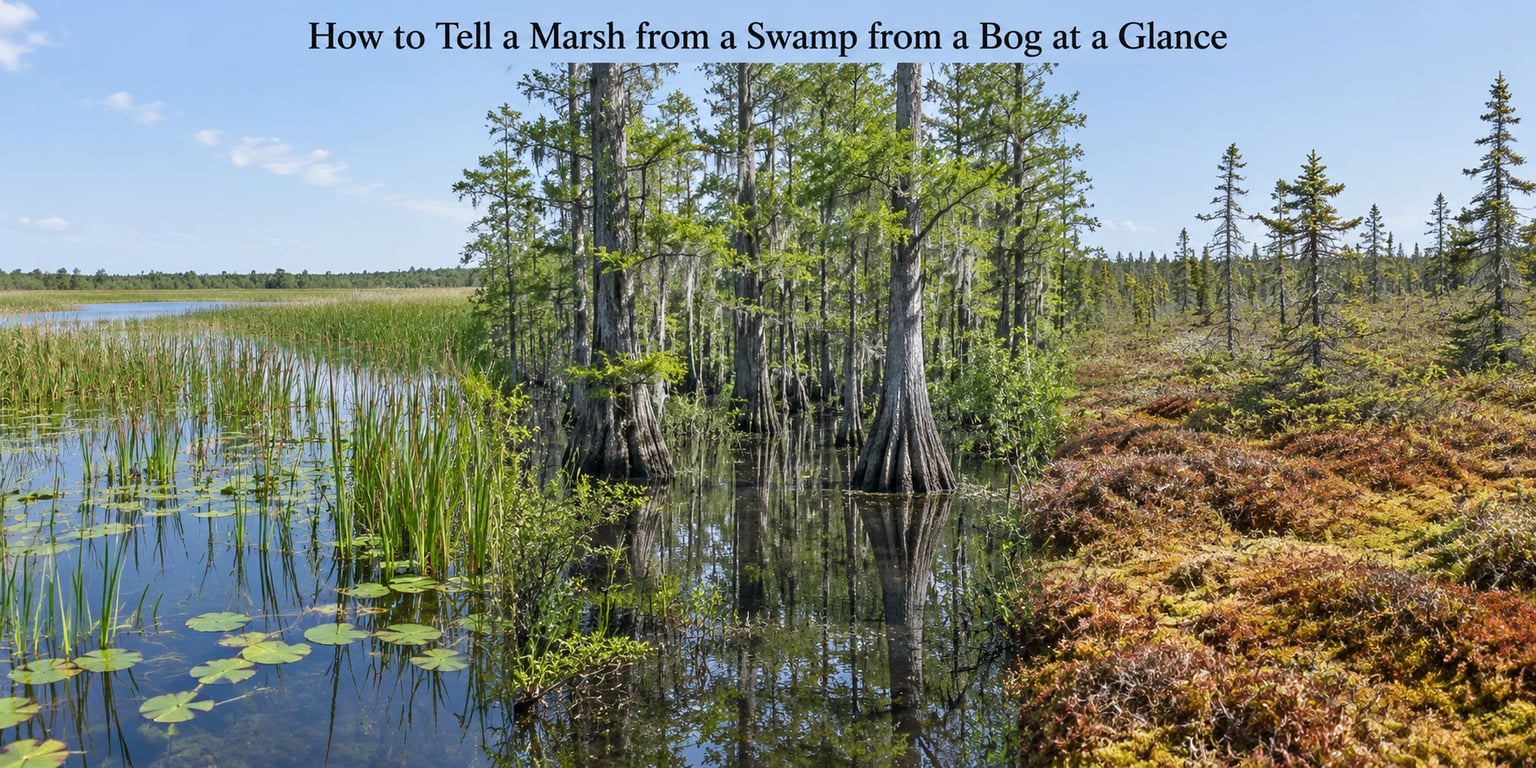
Read the table left to right and the difference becomes obvious. Water depth and tree cover do most of the work; soil type and water chemistry settle the argument.
| Clue | Marsh | Swamp | Bog |
|---|---|---|---|
| Water depth | Shallow, often only a few centimetres to knee deep | Shallow to deep standing water, or soil saturated below the surface | Often saturated but with little or no standing water; where water sits, it pools in hollows |
| Soil | Muddy mineral soil, silt or sand | Mineral mud, often deep and anaerobic | Dark, fibrous peat built from decaying plant material |
| Dominant vegetation | Grasses, sedges, reeds, rushes, cattails, wild rice | Trees and shrubs, plus vines, palms or lianas | Sphagnum moss, heather, cottongrass, cranberry, carnivorous plants |
| Climate setting | Coastal tidal flats, river deltas, lake edges, floodplains | River floodplains, coastal plains, estuaries | Cold, wet uplands and northern lowlands |
| Typical wildlife | Wading birds, ducks, frogs, insects | Herons, otters, turtles, amphibians, songbirds | Breeding waders such as snipe and plover, insects, bog butterflies |
| Strongest clue | Open, treeless water with grass-like plants | Standing water or saturated ground under a canopy | Sphagnum moss, peat, and tea-brown acidic water |
The Quick Field Test
How to tell a marsh from a swamp from a bog takes about a minute if you check in the right order.
- Look up first. Mature trees or woody scrub growing in the wet ground points to a swamp. A treeless expanse with grass-like plants points to a marsh or a bog.
- Estimate the water depth. Walk the edge or find a marker you recognise. Shallow water that wades easily is typical of marsh and swamp; a bog may hold no water at all while the ground stays saturated.
- Feel the ground. Scoop a handful and squeeze it. Grey-brown sticky mud means mineral soil, so marsh or swamp. Dark, fibrous, spongey material that leaves brown water in your palm means peat, which pushes you toward a bog.
Stay on firm ground. Peat crust can look solid and then give way, and a saturated site may hide deep channels, so use proper footwear or a pole and do not enter water you cannot see the bottom of.
What Makes a Marsh Recognizable?
A marsh is a wetland of mostly mineral soil, usually waterlogged or shallowly flooded for part of the year, with plant life dominated by grasses, sedges, reeds and rushes rather than trees. The water is typically shallow enough to see the bottom in places, and the ground is soft mud you would sink into.
Salinity splits marshes into useful groups. A salt marsh sits on tidal flats and coastal estuaries, flooded twice daily by seawater, with salt-tolerant grasses and glasswort covering the mud. A freshwater marsh takes water from rivers, lakes, groundwater or rain, and supports cattails, bulrushes, wild rice and sedges. Some authorities recognise brackish or estuarine marshes in between, where seawater and river water mix.
Marsh edges often carry scattered trees, shrubs or a fringe of woodland. That does not make the site a swamp. If the interior stays open and grassy, most people would still call the whole thing a marsh.
What Makes a Swamp Recognizable?
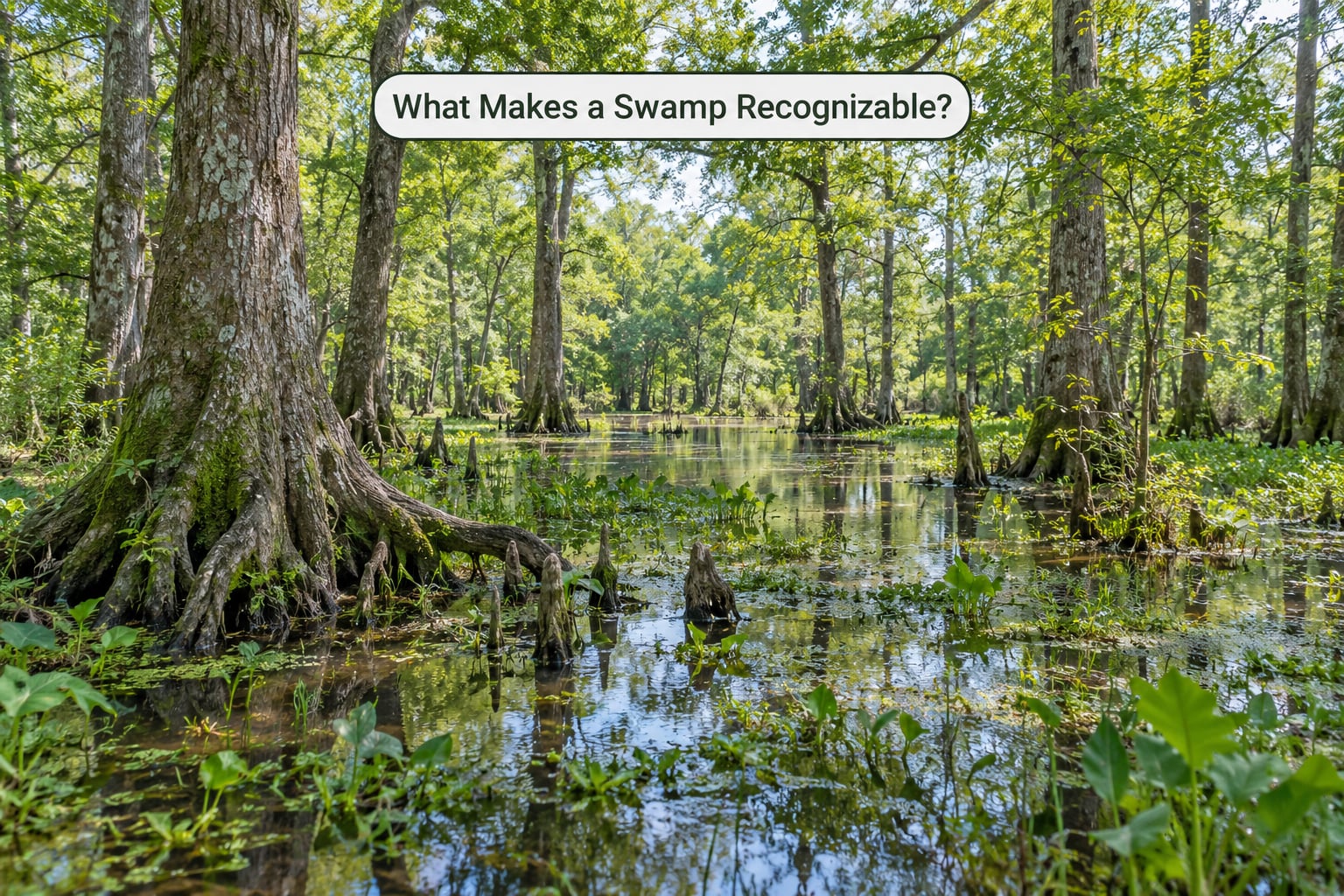
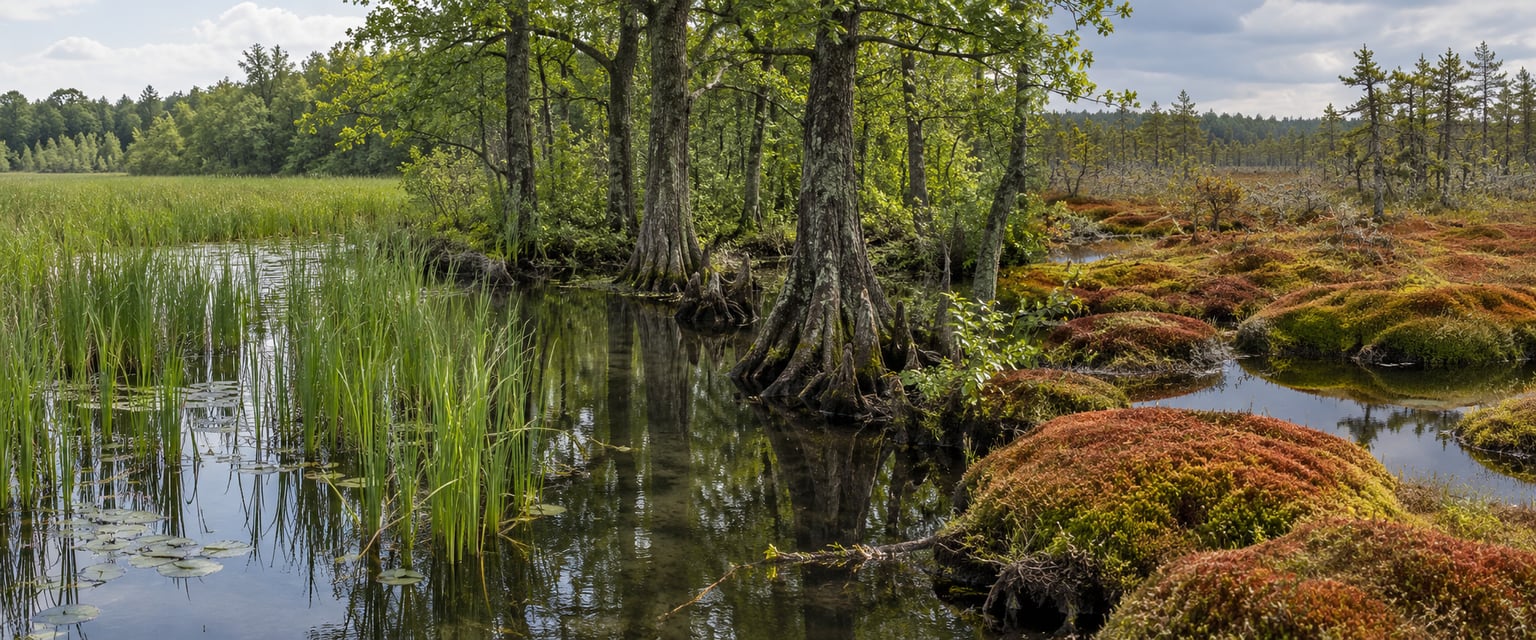
A swamp is a wetland where shallow water or saturated soil sits beneath trees, shrubs, vines or palms. The canopy is the giveaway, and it is why people describe swamps as the forested version of a marsh. In North America you may see bald cypress with flared knees rising out of black water, red maple and swamp white oak on northern floodplains, and palm or mangrove stands along warm coasts.
Other clues support it. Tree roots often flare upward where the soil has been stripped away, the ground is soft and deep rather than firm, and water may hold a brownish tint from dissolved organic material. Anaerobic mud smells strongly of rotten eggs when you disturb it, because oxygen is absent below the surface.
Regional naming makes this the most slippery of the three. Some communities use swamp for any wet wooded ground, while others call the same place a hardwood bottomland, a bayou or a wooded marsh. The physical description is more reliable than the label.
What Makes a Bog Recognizable?
A bog is a peat-forming wetland fed almost entirely by rainfall, sitting in a cold, wet climate where evaporation is low. Because there is little mineral input, the water is acidic, dark brown and nutrient-poor, and sphagnum moss dominates the ground.
The plant list is diagnostic. Alongside sphagnum you will find heather, cottongrass, cranberry, bog bilberry, round-leaved sundew and the pitcher plant, with stunted black spruce or tamarack growing where the peat is deeper. Pools of tea-coloured water are usually dark and clear rather than cloudy.
A bog does not need standing water. Much of the year the surface looks like a damp lawn of moss and heather, with the water table sitting just below the moss. If you squeeze a handful of sphagnum, it springs back slowly and leaves a cold, saturated wad rather than a firm ball.
Walking onto a bog is genuinely risky. Peat and moss hide hollows and unstable crust, and a person can sink and suffocate. Stay on boardwalks and never trust the surface by appearance alone.
Why Do Wetland Boundaries Look Unclear?
Real sites rarely fit one box. Water levels rise and fall with the seasons and with rainfall, so a marsh can flood and dry enough to look like upland meadow in late summer. One wetland can hold a marsh in the middle, a swamp along its river edge and a bog on the wettest ground beside it.
Then there is the fourth category. A fen is a peat-forming wetland like a bog, but fed by groundwater rather than rain, which makes it alkaline and nutrient-richer. Fens and bogs are the two halves of the peatland family, with marsh and swamp sitting alongside them in most wetland classification systems.
Names also travel badly. Common names regularly mislead: bog bilberry grows in dry heath, the salt marsh moth has nothing to do with tidal salt marshes, and a reed swamp in some regions means an open marsh. Where classification gets serious, people use the National Wetlands Inventory maintained by the US Fish and Wildlife Service, which codes wetland types systematically instead of by local nickname.
How to Check Soil, Water, and Plant Clues in the Field
Work the clues in the same order every time and the label almost falls out of the site.
Depth. Use a fence post, a boot or your own body for scale. Most marshes and swamps are shallow enough to wade, sometimes to mid-thigh in channels. Deeper open water with submerged beds of aquatic plants is still usually classified as a marsh.
Soil. The squeeze test settles mineral soil against peat. Mud that forms a sticky grey ball and smells of sulphur is mineral, so marsh or swamp. Material that comes away fibrous, stains your hand brown and holds air like a sponge is peat, so bog or fen.
Plants. Distinguish emergent stems rooted in the ground from floating leaves on the surface, because emergents mean standing water. Grasses and sedges suggest marsh; woody shrubs suggest swamp; sphagnum mats with carnivorous plants suggest bog. Cattails, bulrushes and reed beds usually mean a marsh, though they turn up on swamp edges too.
Water. Tea-brown water points to peat and organic staining, which fits a bog or a tannin-stained swamp. Cloudy grey-brown water in a broad open flat fits a marsh carrying silt.
Chemistry, if you have it. A universal indicator strip settles acidic against alkaline. Bog water usually reads well under neutral. Fens and many marshes read neutral to alkaline.
Wildlife, as support only. Wading birds work both open marsh and bog, so birds point to wetland habitat rather than a specific type. Frogs and insect noise carry further, and a whole community of them will keep you upright in your attention on the plants instead.
If you want to check your call, look up the site on the National Wetlands Inventory map or ask a local naturalist. The United States Environmental Protection Agency and the US Geological Survey both publish plain-language wetland identification guides that cover the same tests in more detail.
Which Wetland Type Fits What You Saw?
Start where you landed and move to the answer.
- Shallow water, no trees, grass-like plants, mineral mud? That is a marsh. If the water is salty and twice-tidal, it is a salt marsh.
- Saturated ground or standing water under trees? That is a swamp, whatever the local people call it.
- Sphagnum, peat, dark acidic water, cold and nutrient-poor? That is a bog.
- Peat and moss, but alkaline water and sedges with many herbs? That is a fen, the bog’s groundwater-fed opposite.
- Wood over wet grass with no clear split? Say forested marsh or wooded swamp and note both, because that is what the site honestly is.
Field checklist: canopy yes or no, water depth, soil in your hand, colour of the water, pH if you carry strips, and one plant you can name. Answering how to tell a marsh from a swamp from a bog is really just stacking those three core checks — depth, trees, soil — and using the rest to confirm.
Frequently Asked Questions
Are marshes and swamps the same thing?
No, though they overlap and some regions use the words interchangeably. A marsh is a wetland whose plant life is dominated by grasses, sedges and reeds on mineral soil. A swamp is a wetland with the water or saturated soil beneath trees. Britannica draws the same line: grass-dominated marsh versus tree-dominated swamp. Where a site has both, forested marsh and wooded swamp are the honest descriptions.
Do bogs always have standing water?
No. A bog is defined by how water and nutrients reach it and what grows there, not by visible water. Rain-fed bogs in cool climates are often saturated but surface-dry, reading as a damp lawn of sphagnum moss, heather and cottongrass. Water does pool in hollows and channels, where it looks tea-brown and acidic. If you are standing on mossy ground with no water in sight, that is not a reason to rule out a bog.
What is the difference between a bog and a fen?
Both are peat-forming wetlands built from dead plant material, and the dividing line is water source. A bog is fed mainly by rainfall, so it is acidic, nutrient-poor and dominated by sphagnum moss. A fen is fed by groundwater carrying dissolved minerals, so it is alkaline, richer in nutrients and dominated by sedges and many flowering plants. Forum consensus often reduces it to bog acidic, fen alkaline, which is a fair shorthand for the field.
Can a wetland contain both marsh and swamp habitats?
Yes, and most large ones do. Rivers and lakes cut across wetlands, so the same site can have open grassy marsh in the middle, wooded swamp along the flooded edge and bog on the wettest ground beside it. Water level also shifts with the seasons, which moves the boundary between open and wooded ground year to year. Wetland ecologists describe these as a wetland-upland gradient rather than fixed edges, so name each patch you actually observe.
What plants are most useful for identifying a marsh?
Grasses, sedges, rushes and reeds are the core marsh plants, because they dominate the mineral-soil wetlands and mark the type when combined with shallow standing water. Look for cattails, bulrushes, reed canary grass, wild rice, softstem bulrush and sawgrass, plus salt-tolerant glasswort and cordgrass on tidal flats. By contrast sphagnum moss points to a bog and woody shrubs point to a swamp, so the herbaceous emergents are what separate a marsh from both.
Next time you are at a wetland, look across it before you look closely at anything. Note the depth, whether trees are standing in it, and what a handful of ground feels like between your fingers. Those three checks answer most of how to tell a marsh from a swamp from a bog, and a field guide or wetland map can confirm the rest.