Sizing a home battery system for power outages comes down to two numbers: how much energy you need to store (kWh) and how much power the system must deliver at any moment (kW). Work out your essential loads, multiply by the days of autonomy you want, divide by the battery’s usable depth of discharge and its efficiency, then add a margin. A rough worksheet takes an hour. The hardware decision takes weeks, because a licensed installer has to check your panel, your service and local rules.
That distinction matters more than any brand on a spec sheet. A household running a fridge, freezer, router and a few lights burns roughly 2.5 to 4 kWh a day. Someone running heat pumps, a well pump, an EV charger and a water heater burns twenty times that. One of them needs a small, carefully sized system. The other needs a design conversation, not a purchase.
Table of Contents
- What You Need
- Step-by-Step: How to Size a Home Battery System for Power Outages
- 1. List the loads you need to keep running
- 2. Estimate how long each load must run
- 3. Calculate usable battery capacity – where home battery sizing usually goes wrong
- 4. Check inverter and electrical-system limits
- 5. Add solar and utility operating considerations
- 6. Validate the design with a qualified installer
- Common Mistakes
- Frequently Asked Questions
- How many kWh battery do I need for my home?
- How long will a 10kWh battery power a house?
- How long will a 15kWh battery power a house?
- Is a 20 kW battery enough to run a house?
- What is the formula for calculating battery sizing?
- What is the depth of discharge of a lithium battery?
- Conclusion
What You Need
You can start with nothing but a notebook. Everything below improves the accuracy of the estimate.
- Your real outage history. Ask your utility or check national outage maps for how long outages last where you live, and how often. A grid that drops out for 40 minutes once a year needs a very different system from one that goes dark for three days in a storm season.
- Appliance wattages. Nameplate labels on the back or side of each appliance give running watts. The manual or the manufacturer’s specifications sheet gives the starting or surge figure, usually several times the running wattage.
- A load list. Every circuit and appliance you want powered during an outage, with an honest note on whether it truly matters.
- Your solar production figures if you have panels: kWh per day in summer and in winter, not the panel wattage.
- Inverter specifications: continuous output in kW, peak or surge output in kW, battery voltage window, and whether it accepts an AC-coupled battery.
- Your electrical service details: main breaker rating, panel brand and age, and whether there is space for a critical-loads subpanel or a service upgrade.
- Local rules. Permitting, inspection and utility interconnection requirements differ by region. A battery on a backup circuit is a permanently installed electrical system, and the work needs a qualified, licensed installer.
If you can get a clamp meter and walk your house for a week, you will replace every guess on that list with a measurement. That is an afternoon well spent.
Step-by-Step: How to Size a Home Battery System for Power Outages
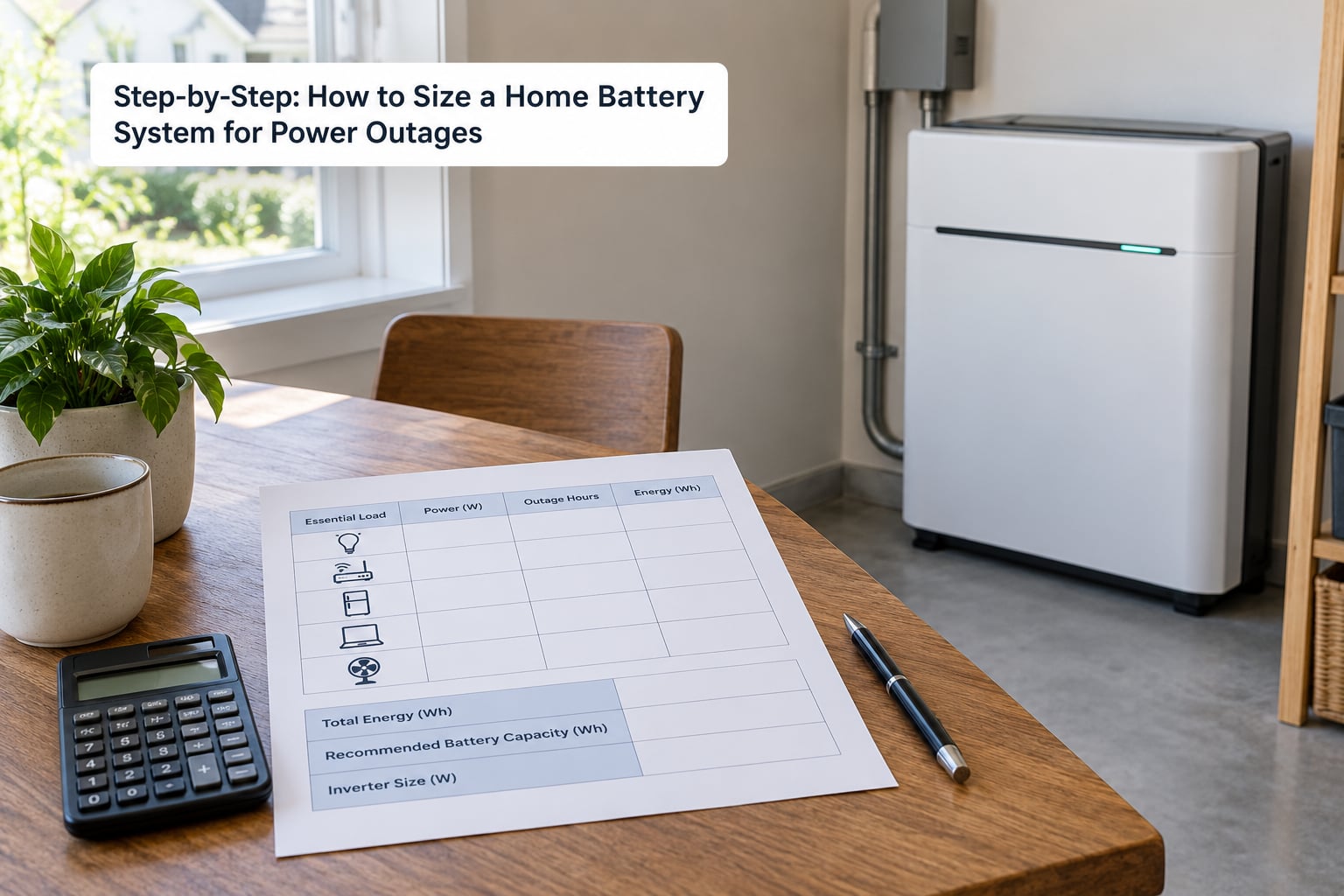
1. List the loads you need to keep running
Split your circuits into essentials and everything else before you touch a calculator. Essentials are the loads whose failure causes real damage or risk: refrigeration, medical equipment, a sump pump in a flood-prone basement, a well pump, internet access for remote work, lighting, and a freezer if you have one.
Everything else – the air conditioner, the EV charger, the electric water heater, the washer and dryer, the second fridge in the garage – goes on the discretionary list. It is not off-limits. It is simply not part of the first sizing pass, which keeps the number honest.
For each load, record three figures: running watts, starting watts and hours per day in the worst season of the year. Winter is usually the honest season for heating, summer for cooling, and the shoulder months for anything else.
2. Estimate how long each load must run
Convert each load into watt-hours by multiplying watts by hours. That gives you the daily energy draw, and it is the only number that feeds the capacity calculation.
Here is a worked example for a three-bedroom home with a fridge, freezer, a 1/3 hp sump pump and a CPAP machine, all sized for a summer outage:
| Load | Running watts | Hours per day | Watt-hours per day |
|---|---|---|---|
| Refrigerator | 150 W | 8 | 1,200 Wh |
| Chest freezer | 100 W | 8 | 800 Wh |
| LED lighting (10 bulbs) | 100 W | 5 | 500 Wh |
| Router and modem | 20 W | 24 | 480 Wh |
| Phone and laptop charging | 80 W | 3 | 240 Wh |
| Sump pump, duty cycle | 300 W | 1 | 300 Wh |
| CPAP machine | 40 W | 10 | 400 Wh |
| Total | 790 W continuous | – | 3,920 Wh = 3.9 kWh |
Two hours of laptop use folded into three hours of charging is fine for a sizing estimate. Be tougher with the loads you care about most, and generous with the ones you can live without.
3. Calculate usable battery capacity – where home battery sizing usually goes wrong
A battery marketed as 10 kWh does not deliver 10 kWh. It delivers its nameplate capacity multiplied by three losses and one margin, and this is the step most online sizing calculators skip.
Required capacity (kWh) = (daily load in kWh x days of autonomy) / (depth of discharge x round-trip efficiency x inverter efficiency), then add 10 to 20%.
Typical values to plug in:
- Depth of discharge (DoD): the share of stored energy the chemistry will reliably give up. Lithium chemistries, LFP and NMC alike, are typically 80 to 90%. Lead-acid – AGM, gel and tubular alike – sits near 50%.
- Round-trip efficiency: charge plus discharge losses. Modern lithium systems run 90 to 97%; lead-acid is closer to 75 to 85%.
- Inverter efficiency: 94 to 97% for a good hybrid inverter.
- Design margin: 10 to 20% for real-world variance in how hard your home actually runs.
Note the 20% rule some installers use: it is a sizing buffer, not a chemistry limit. A 30% DoD would mean drawing only 30% of the nameplate capacity per cycle – roughly a quarter of the usable energy a lithium battery offers, which is why lithium systems need far less capacity for the same job.
Running the numbers on the example above for one day of autonomy: 3.9 kWh / (0.90 x 0.90 x 0.95) = 5.06 kWh of nameplate capacity. Add a 15% margin and you land at roughly 5.8 kWh. For three days of autonomy the same formula gives 3.9 x 3 = 11.7 kWh of load, about 15.2 kWh before margin, so a 17 to 18 kWh installation.
Two practical caveats. First, capacity falls as the state of charge drops, so a battery you are relying on at the end of day three delivers less than its nameplate. Second, if your loads grow – a new freezer, an electric vehicle, a heat pump replacing a gas unit – the whole worksheet needs redoing.
4. Check inverter and electrical-system limits
Energy capacity is only half the test. The inverter has to start motors, and plenty of systems with plenty of stored energy still shut down because the inverter cannot deliver the peak.
| Appliance | Typical running watts | Typical starting or surge watts |
|---|---|---|
| Refrigerator compressor | 100-200 W | 500-900 W |
| Chest freezer | 80-150 W | 400-600 W |
| 1/2 hp well pump | 350-500 W | 1,500-2,500 W |
| 3/4 hp well pump | 750 W | 2,500-3,500 W |
| 1/3 hp sump pump | 250-350 W | 900-1,400 W |
| Central air conditioner (3 ton) | 1,200-3,500 W | 3,000-5,000 W |
| Mini-split heat pump | 900-1,500 W | 2,000-3,000 W |
| Washing machine | 300-500 W | 700-1,000 W |
| Microwave (1,200 W setting) | 1,200 W | 1,200 W (no motor start) |
| Gas furnace blower and inducer | 300-600 W | 1,400-1,800 W |
Add the surge of any two motors that might start at the same moment, and require the inverter’s peak rating to exceed that figure with headroom. The continuous rating must exceed your essential-load running total with the margin applied. If either fails, more battery capacity does not help – you need a different inverter.
Then check the house. The inverter’s output has to fit within the limits of the electrical panel, or you need a panel upgrade, a load-shedding device or a critical-loads subpanel that isolates a smaller set of circuits. A critical-loads panel makes a modest battery practical, but it also means the loads outside that panel genuinely do not run during an outage.
One load surprises nearly everyone: a gas furnace. The flames come from gas, but the blower motor, the control board and the igniter are electric, and during a winter outage they become your largest continuous load by a wide margin. If your heating is gas with electric accessories, budget for it as if it were a heat pump.
5. Add solar and utility operating considerations
Solar changes the sizing arithmetic only if it can run during the outage. Standard grid-tied inverters shut down when grid power fails – that anti-islanding protection exists so a crew working on a downed line is not electrocuted. A hybrid inverter, or a battery system with an islanding-capable design, lets the solar charge the battery and serve loads independently.
Once solar can run, size the array to refill what you spend. As a working figure, a 400 W panel produces around 1.6 to 2.0 kWh on a clear summer day in a sunny region, and closer to 1.0 to 1.4 kWh in midwinter or under overcast skies. Two panels barely replace one day of essential consumption; a properly sized array replaces the day’s draw and slowly restores a depleted battery.
For cloudy weather, apply a haircut. Overcast output can fall to a fraction of full-sun production, so if your outage risk is a multi-day storm, plan for two to three days of autonomy or plan on a generator. Grid-charging through the outage is not an option – that is the whole point of the outage.
Check the charge temperature limits too. Many LFP batteries refuse to charge below freezing unless a heater is fitted, and a garage or unheated utility room in winter is exactly where they get installed. Ask how the system behaves at 0 degrees Celsius and below.
Cheap tricks stretch a small system further: keep the freezer closed and rely on thermal mass (a full freezer holds safe temperature roughly twice as long as a half-full one), run the dishwasher only when solar is generating, and set the water heater to a lower temperature.
6. Validate the design with a qualified installer
Hand the finished worksheet to a licensed electrician or a qualified battery or solar-storage designer. They will verify the numbers against your panel, your service rating and your local electrical code – none of which a worksheet can check.
Ask them to confirm, in writing: the calculated daily load, the days of autonomy assumed, the nameplate and usable capacity of the proposed battery, the inverter’s continuous and peak ratings against your largest motor loads, the solar array’s production estimate for the worst month, the permitting and interconnection steps, and what the system will not be able to run.
Then compare your figure against what the installer is proposing. Whole-home systems for moderate loads typically land in the 20 to 30 kWh range; essentials-only systems for a few kWh a day are a fraction of that. If the proposed design comes back far above your calculation, ask which assumption it is based on.
| Household profile | Realistic daily load | Nameplate capacity for one day of autonomy |
|---|---|---|
| Apartment, essential loads only | 1.5-3 kWh | 3-4 kWh |
| Three-bedroom home, essentials plus sump pump | 3-5 kWh | 5-8 kWh |
| Home with a well pump and medical equipment | 5-8 kWh | 9-13 kWh |
| Large home, whole-home including HVAC and water heating | 20-30 kWh | 35-50 kWh |
Those nameplate figures already include the derating chain and a margin, which is why they sit so much higher than the raw daily load.
Common Mistakes
Treating nameplate kWh as usable kWh. A 10 kWh battery typically holds 7 to 8 kWh you can actually draw, after depth of discharge and efficiency. Homeowners consistently expect double the runtime they get.
Sizing on energy and forgetting power. A large battery with a small inverter cannot start a well pump or a compressor, so the load trips out even at full charge. Check continuous and surge ratings as carefully as capacity.
Assuming every circuit can be backed up. Without a critical-loads subpanel or a service upgrade, some circuits stay dead. Decide which circuits those are before the installer does.
Skipping winter electrical loads. The furnace blower, control board and igniter, the sump pump in a wet season, the well pump – these appear on nobody’s sales sheet and often dominate a cold-weather outage.
Forgetting multi-day weather. A storm that knocks out power usually kills the solar too. If you are sizing for three cloudy days, size for three cloudy days, not for clear-sky production.
Ignoring degradation. Capacity falls year over year and, within a single event, falls as the state of charge falls. A battery you plan to empty to 5% on day three delivers less than its spec sheet says.
Leaving solar out of the plan entirely. If the inverter cannot island, your battery refills only from the grid – which means it never refills during the outage.
Buying without a load audit. One-size-fits-all quotes are the norm and they are rarely right for your house. A one-hour audit is what separates a system that works from one that does not.
Frequently Asked Questions
How many kWh battery do I need for my home?
For essential loads only, most households need 3 to 5 kWh of nameplate capacity, because typical essentials run 2.5 to 4 kWh a day and only about 70 to 80% of nameplate capacity is usable. A whole-home system running heating, water heating and appliances needs roughly 35 to 50 kWh for a single day of autonomy. Add capacity for each extra day you want to ride out.
How long will a 10kWh battery power a house?
It depends entirely on your load. A 10 kWh LFP battery gives you about 7 to 8 kWh usable after depth of discharge and efficiency losses. At a 500 W essential load that is roughly 15 hours; at 1 kW, about 7 hours; at 1.5 kW, around 5 hours; at 2 kW, under 4 hours. Divide your own continuous load in watts into 8,000 usable watt-hours to get your answer.
How long will a 15kWh battery power a house?
A 15 kWh battery usually yields 11 to 12 kWh usable once depth of discharge, round-trip efficiency and inverter losses are applied. That covers a 750 W essentials load for about 15 hours, a 1 kW load for roughly 11 hours, and a 2 kW load for around 6 hours. With solar able to recharge during the outage and clear weather, many households cover multiple days from the same installation.
Is a 20 kW battery enough to run a house?
20 kW is a power rating, not a capacity figure, and it describes how much the system can deliver at one instant rather than how long it lasts. Whether it is enough depends on your surge loads and on how many kWh sit behind it. It comfortably starts a compressor, a well pump or a central air unit, but the runtime still comes down to your measured daily load and your days of autonomy.
What is the formula for calculating battery sizing?
Divide your daily load in kWh by the product of depth of discharge, round-trip efficiency and inverter efficiency, then multiply by your days of autonomy and add a 10 to 20% margin. Written out: required capacity = (daily load x days of autonomy) / (DoD x round-trip efficiency x inverter efficiency). The margin covers real-world variation, not chemistry limits.
What is the depth of discharge of a lithium battery?
Depth of discharge is the share of rated capacity a battery will reliably give up before it should be recharged. LiFePO4 and NMC lithium systems typically rate 80 to 90% DoD; lead-acid sits near 50%. A battery labelled 10 kWh with 90% DoD and 90% round-trip efficiency therefore delivers about 8 kWh of usable energy to the house, not 10.
Conclusion
To size a home battery system for power outages, write down the loads you truly need, measure each one’s running and starting watts, convert them to watt-hours per day, choose how many days of autonomy your grid reliability justifies, then divide by depth of discharge and the efficiency chain before adding a 10 to 20% margin. Check the inverter’s continuous and peak ratings against your largest motors, and remember that a 10 kWh nameplate is closer to 8 kWh usable.
Start tonight with the essential-load inventory. Take that finished list, and the surge numbers, to a licensed installer for an electrical design review before anything is ordered or connected.