Community solar lets you buy a share of a solar installation somewhere else and get a credit on your electricity bill, without owning panels, touching a roof or paying anything up front. If you rent, that removes the three things — a roof you control, the money to install, and permission to mount hardware — that normally rule solar out. This guide walks through how the credit actually reaches your bill, who signs what, what it costs, and what to check before you sign anything.
Table of Contents
- What Is Community Solar?
- How Does Community Solar Work?
- Can Apartment Renters Join Community Solar?
- What Do You Need to Qualify?
- How Does Community Solar Work If You Rent an Apartment?
- What Does It Cost?
- What Are the Benefits for Renters?
- What Are the Risks and Limitations?
- How to Choose a Community Solar Subscription
- Frequently Asked Questions
- Can I join community solar if I rent an apartment?
- Do I need solar panels installed on my rental apartment?
- Will community solar reduce my electricity bill automatically?
- How do I know if I am eligible for a community solar project?
- Can I use community solar if I move to another apartment?
- Can I cancel a community solar subscription?
- A Simple Place to Start
What Is Community Solar?
Community solar is shared solar. A developer builds a large array — often a ground-mounted solar farm or a big commercial roof — and subscribers buy a slice of its output. Your slice is measured in kilowatt-hours, credited to your electricity account, and subtracted from what your utility charges you.
The reason it exists is simple: rooftop solar rewards people who already own buildings. A tenant in a third-floor flat with a shaded balcony has no way to capture that resource, so the model routes the generation through the grid instead of through your property.
There are two broad versions. In the subscription model, a company or co-op develops the project and sells you a monthly share; the project operator handles everything and takes a fee. In collective self-consumption, known in Spain as autoconsumo colectivo, a group of consumers on nearby meters signs an agreement to share one installation, with each member’s portion fixed by allocation percentages called coeficientes de reparto.
How Does Community Solar Work?
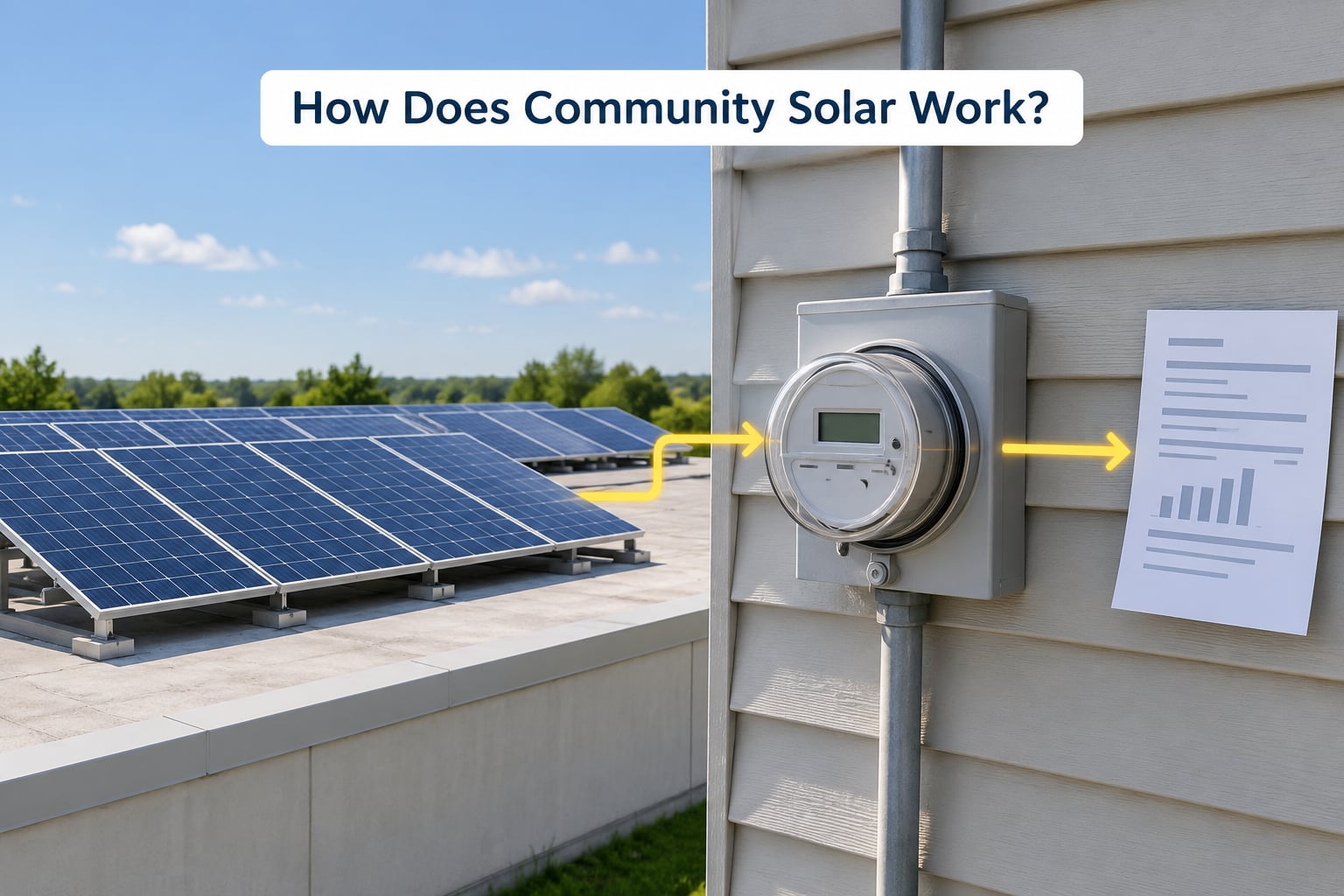
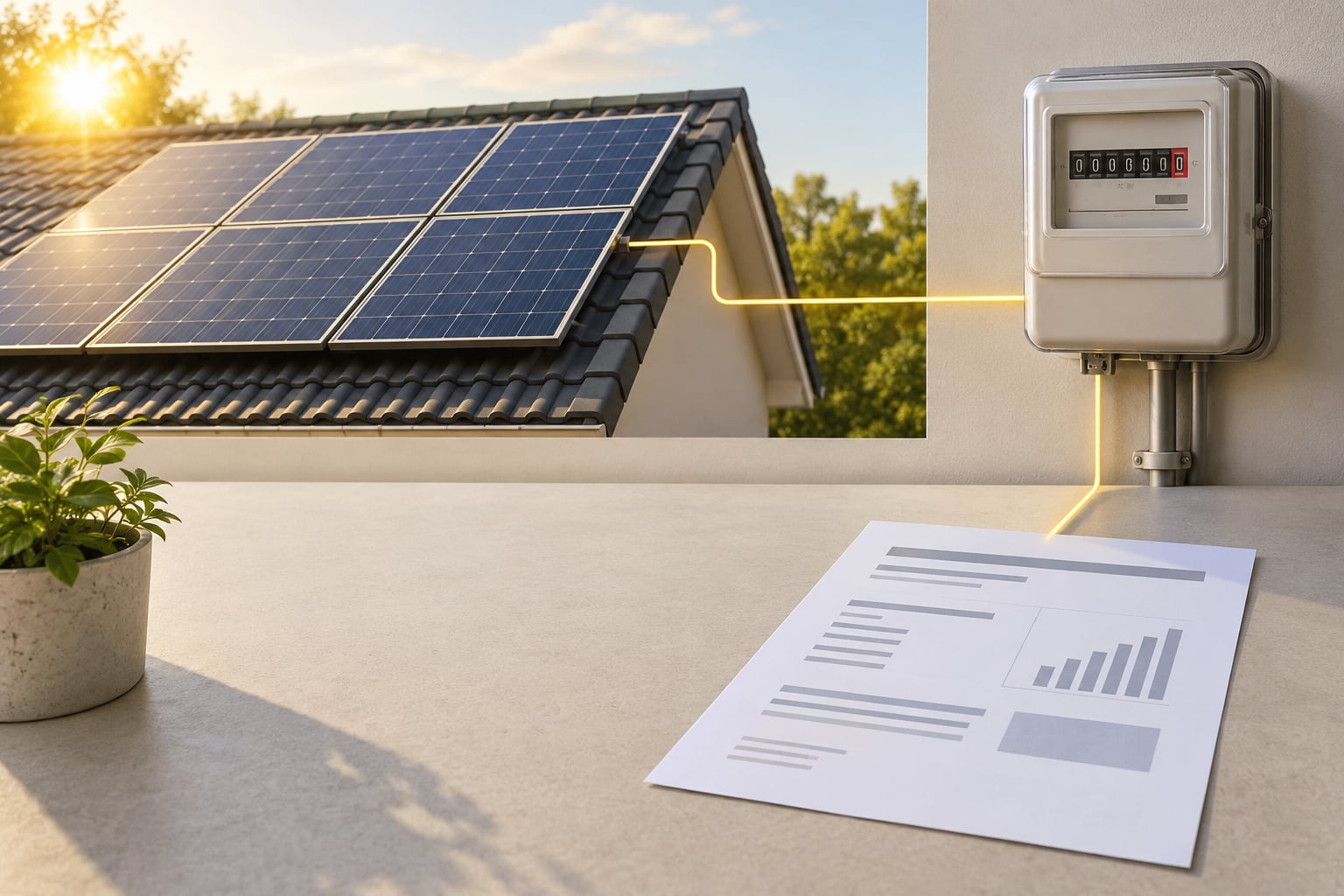
Nothing physical changes about your apartment. You keep your existing retailer, your meter and your supply. Here is the chain, step by step.
- The panels generate. Sunlight becomes electricity at the shared array, whether that’s a solar farm or a rooftop several streets away.
- The output is measured. In most markets a net meter records what the array produces, and in some cases what the array sends back to the grid. This metering is what makes “virtual” possible — your share is accounted for without a wire running to your flat.
- Your share is calculated. The project is split between subscribers using agreed percentages or kilowatt-hour allocations. A 100 kWh subscription means up to 100 kWh of your project’s monthly generation is credited to you.
- The utility applies the credit. Generation is fed into the grid and drawn back out as normal supply, so your bill shows consumption minus the solar credit.
- You pay the difference. What remains, after the credit, is billed as usual, plus any subscription fee for the share itself.
A worked example makes it concrete. Say a project produces 60,000 kWh in a sunny month and you subscribed to 200 kWh of it. On a cloudy month the project might produce only half that, so your 200 kWh subscription delivers roughly 100 kWh of credit instead.
Virtual net metering is the term for this arrangement: the utility treats your subscription as a generator behind your meter without a physical connection. In Spain the same idea runs through the distribuidora and your comercializadora, with the CUPS (supply point) acting as the anchor for your credits.
Can Apartment Renters Join Community Solar?
Yes. This model was built with renters in mind. You do not need to own the flat, install anything on the building, or sign a roof lease, because there is no equipment at your address at all.
Two distinct groups can join. Individual subscribers sign directly with a project operator or energy community using their own name and utility account. Community subscribers join through a residents’ association, a tenants’ group or an energy community that pools several households; individual members may never read the contract, which sits with the association.
The paperwork is signed by the leaseholder, not the property owner, because the subscriber is the person who holds the electricity account and receives the bill.
What Do You Need to Qualify?
Requirements vary by program and by country, but the checklist is short. Most providers ask for the same handful of things.
- An active electricity account in your name at an eligible utility.
- A service address inside the utility’s or project’s service territory.
- Enough recent consumption for a subscription to be worth something — very low usage can leave credit unused.
- Identity verification and, in many programs, a credit or payment-history check.
- A share size that fits your typical monthly usage.
- Capacity in the project. Sells out in popular regions, and waiting lists are common.
Roughly a third to two-fifths of people in most countries rent their home, and rooftop solar reaches almost none of them. Community solar is the workaround, which is why supply is expanding unevenly: strong in a handful of US states and growing fast in Spain and other parts of Europe, thin or absent in others.
How Does Community Solar Work If You Rent an Apartment?
Six steps, and none of them involve your landlord.
- Find a project serving your address. Most operators have a postcode or postcode-plus-county lookup that shows which arrays you can subscribe to.
- Check your eligibility. Confirm your utility, your address and your consumption are in scope before you read anything else.
- Size your subscription. Match the share to your usage so the credit gets used rather than wasted.
- Sign the subscription or participation agreement. This is where the credit rate, the term, the exit fee and who the counterparty is actually are.
- Authorise the credit on your account. You give consent for the utility to apply the solar credit to your supply point.
- Read the first bill line by line. Confirm the credit arrived, check the rate applied and check the fee. This is the step most people skip and the one that catches errors fastest.
Renewable generation then flows to you in the background, month after month, without another form to sign.
What Does It Cost?
There is no single price, because the model is a subscription rather than a product. What you need is the structure: how the rate is set, what it is charged on, and what leaving costs. Structures vary by region and change over time, so treat the figures a provider gives you as specific to that project.
| Cost element | What it usually looks like | What to confirm |
|---|---|---|
| Subscription fee | A fixed monthly amount per subscribed block of energy | Is it flat, or indexed and rising each year? |
| Credit rate | A per-kWh offset, often a percentage of your utility’s rate | Is it locked for the whole term or reviewable? |
| Upfront payment | Often nothing in the subscription model; possible in buy-a-share models | Any deposit, and is it refundable? |
| Exit or cancellation fee | A fixed amount, a per-month remainder, or nothing | How many months’ notice, and how is the remainder calculated? |
| Tax and duty treatment | Varies by country and by whether you are a business or a household | Do you claim anything, or does the operator handle it? |
What you are really comparing is the credit rate against your utility’s rate. If the credit is worth 90% of what your electricity costs and it applies to your consumption, the arithmetic works in your favour; if it is a lower share, or if it only offsets the portion of your bill you did not already have covered, the benefit shrinks. In Spain, collective self-consumption setups can also carry a tax deduction for participating households, and some regions offer reductions on construction taxes — availability changes, so verify the current position with a gestor before relying on it.
What Are the Benefits for Renters?
The first benefit is that you get solar without owning anything. No panels, no inverter, no maintenance, no roof access and no visual impact on the building. Renters describe the convenience, not the ideology, as the main draw.
Second, there is no capital outlay. The subscription converts a purchase into an operating cost, which is the difference between a barrier and a line item for households without spare cash.
Third, you can usually keep your current retailer and your tariff. You are not being pushed into a new supplier, and you can leave the electricity market entirely and still use your solar share, depending on the program.
Fourth, the share is portable in a way a rooftop system never is. If your building gets a new roof, or your association decides against it, your subscription is unaffected.
Fifth, generation is bought in bulk by a developer who negotiated the equipment and land cost, which is part of why the credit can be set below retail rate.
Be careful about the sixth claim, though. A credit is not a discount on what you buy. You still pay for the energy you use, and you pay the subscription fee on top. People on community solar commonly report savings in the single digits to the low twenties as a percentage of the bill, but that figure is an outcome, not a promise — yours depends on your rate, your usage and the month’s weather.
What Are the Risks and Limitations?
Generation is variable. Cloud cover, seasonal output and soiling all move your monthly credit, and a low-production month is exactly when a bill is highest.
Unused credits are a real trap. Subscribe to 300 kWh of generation when you only use 120 and the remainder is simply not useful to you. Some programs let you carry a balance forward or donate it; many do not.
Availability is thin in places. A handful of regions have waiting lists or nothing at all, and rural addresses are the hardest to serve.
Terms can lock you in. Longer subscriptions often carry a better credit rate and a bigger exit fee. That trade is fine if you stay put and painful if you do not.
Moving needs planning. Most providers will transfer or cancel a subscription, but you have to initiate it, and if you forget, credits can keep accruing against a closed account.
Counterparty risk is underrated. You are signing a long contract with an organisation most people have never heard of. A project that misses a payment to a project operator, or an operator with a poor payment history, is not abstract — check reviews and check whether a third-party guarantee exists.
Landlord and building issues are usually a non-issue for subscriptions and a genuine issue for anything bolted to the property. Balcony kits and plug-in equipment may need a simple permit form from the utility, but a subscription needs no permission at all.
Finally, in some states a subscription is treated more like a long-term solar lease than a month-to-month service, and that treatment transfers poorly when a home is sold. As a renter this matters less, but it is worth asking about in writing.
How to Choose a Community Solar Subscription
Run this list before you sign anything.
- Location. Confirm the project is on the utility network that serves your flat, and how far away it is. Spain’s collective self-consumption rules allow participation in installations within a five-kilometre radius.
- Who you sign with. Get the legal entity name and check it has been trading, has a physical address and publishes annual figures where your country requires it.
- Credit rate and what it applies to. Confirm the rate, whether it is fixed or reviewed, and that it offsets your consumption rather than something else on the bill.
- Term and exit. Ask for the term length, the notice period and the exact exit fee in writing. No long-term lease and no lock-in is the cleanest signal.
- Move-out handling. Ask exactly what happens on moving: transfer, pause or cancellation, how long the transfer takes, and whether the fee applies.
- Payment history. Look for reviews that mention billing accuracy and credit rollovers specifically, not just the sign-up experience.
- Support. Can you reach a person who can read your utility bill and explain the credit line? If not, walk away.
- Alignment. Does the project produce more than the subscribers take, and what happens to the surplus — compensation scheme, virtual battery, or market sale?
On virtual batteries specifically: a collective setup can allocate a share of a battery to each member as a credit rather than physical stored energy. It is worth asking whether your share uses a fixed or a dynamic allocation, because a dynamic one produces different results depending on when you actually consume.
Frequently Asked Questions
Can I join community solar if I rent an apartment?
Yes. Subscribers sign using their own name and their own electricity account, so being a tenant is not a barrier. You do not need to own the property, install equipment, or get permission to use the roof, because nothing is mounted on your building. The one thing to check is capacity in the project, since popular arrays fill up and wait.
Do I need solar panels installed on my rental apartment?
No. That is the whole point of the model. The panels sit on a solar farm or a shared commercial roof, and your utility credits your share of their output to your bill through virtual net metering. Nothing is drilled, wired or bolted to your flat, and your landlord is not part of the arrangement unless you separately install a balcony kit or plug-in equipment.
Will community solar reduce my electricity bill automatically?
It reduces your bill through a credit rather than a lower tariff. Once you authorise the credit on your supply point, the utility applies your share of generation to your account each cycle and you are billed for the remainder plus the subscription fee. Check the first bill carefully. If the credit or the rate looks wrong, catching it early is far easier than disputing it months later.
How do I know if I am eligible for a community solar project?
Eligibility usually depends on four things: an active electricity account in your name, a service address inside the project’s utility territory, enough recent usage for a subscription to be worthwhile, and spare capacity in the array. Many programs also run identity and payment-history checks. Requirements differ by program and location, so start with the provider’s address lookup tool.
Can I use community solar if I move to another apartment?
Usually yes, but start the process before you hand back the keys. Most providers will either transfer the subscription to a new address on the same utility or cancel it, and some let you pause it. The catch is timing: if nobody is told, credits can keep accruing against a closed account, and the exit fee may apply. Ask for the move-out procedure in writing before you commit.
Can I cancel a community solar subscription?
It depends entirely on the contract. Subscription models with no lock-in let you leave with a month’s notice, while longer terms often carry an exit fee or a charge for the remaining term. That fee is sometimes the price of a better credit rate, which is a legitimate trade-off but only if you expect to stay. Read the cancellation clause before signing, not after moving out.
A Simple Place to Start
Open your latest electricity bill and write down two numbers: your utility and your average monthly consumption in kilowatt-hours. Everything else follows from those.
Then run a postcode lookup for community solar projects, compare the credit rate and term on the two or three that serve your address, and read the cancellation clause before you read the marketing. Do not sign anything until you can answer one question in plain words: what does it cost me if I leave after six months?
If the numbers work, you get solar you never installed. If they don’t, you have lost an afternoon.