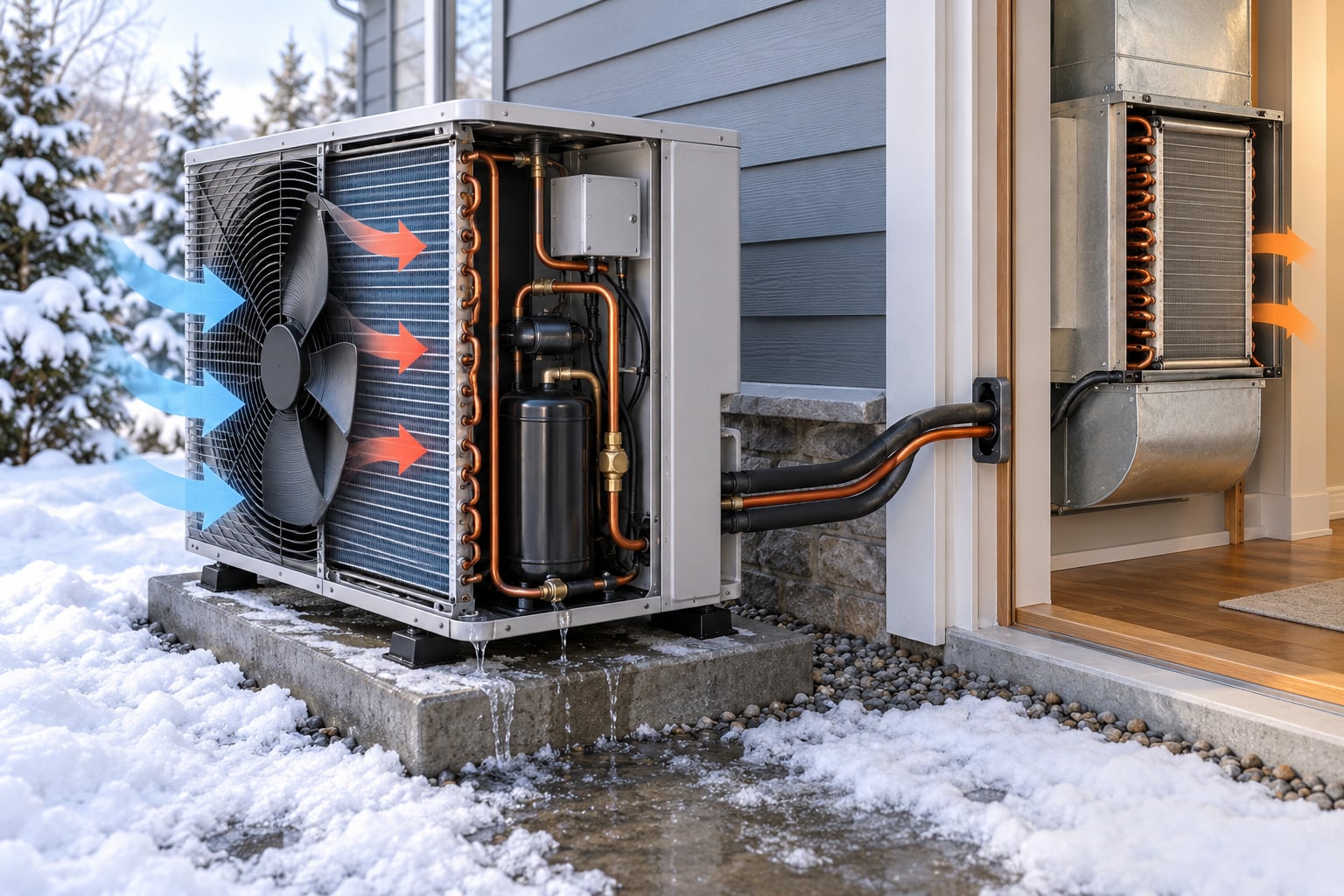
A heat pump works in cold weather by moving heat rather than making it: it pulls thermal energy from outdoor air through a refrigerant cycle, compresses that refrigerant to raise its temperature, and releases the heat indoors, even when the outdoor air is below freezing. Cold air holds less energy, so the pump simply runs harder and more often, and it pauses briefly now and then to defrost its outdoor coil.
That single idea explains almost every winter surprise people hit. A heat pump blowing cool air for ten minutes is usually a defrost cycle, not a breakdown. Warm air that feels gentle rather than scorching is normal. And the thing that declines as the temperature falls is efficiency, not the ability to heat.
Below, I’ll walk through the parts, the refrigerant cycle, what happens at each temperature band, and how to tell normal winter behaviour from a fault that needs a technician.
Table of Contents
- How Do Heat Pumps Work in Cold Weather? Quick Guide
- How the Refrigerant Cycle Heats a Home
- How Do Heat Pumps Work in Cold Weather During Defrost?
- Why Heat Pumps May Struggle at Very Low Temperatures
- What Changes on a Cold Day?
- What Is a Cold-Climate Heat Pump?
- How the Heat Pump System Gets Its Heat
- Do Heat Pumps Need Backup Heat in Cold Weather?
- What Affects Cold-Weather Performance?
- How to Keep Cold-Weather Performance Reliable
- When Should a Homeowner Ask for a Load Assessment?
- Frequently Asked Questions
- Are heat pumps efficient when temperatures drop below freezing?
- Why does my heat pump briefly stop heating or run the fan during defrost?
- How much electricity does a heat pump use in cold weather?
- What efficiency rating should I look for in a cold climate?
- Can an older home with poor insulation use a heat pump?
- What to Check First
How Do Heat Pumps Work in Cold Weather? Quick Guide
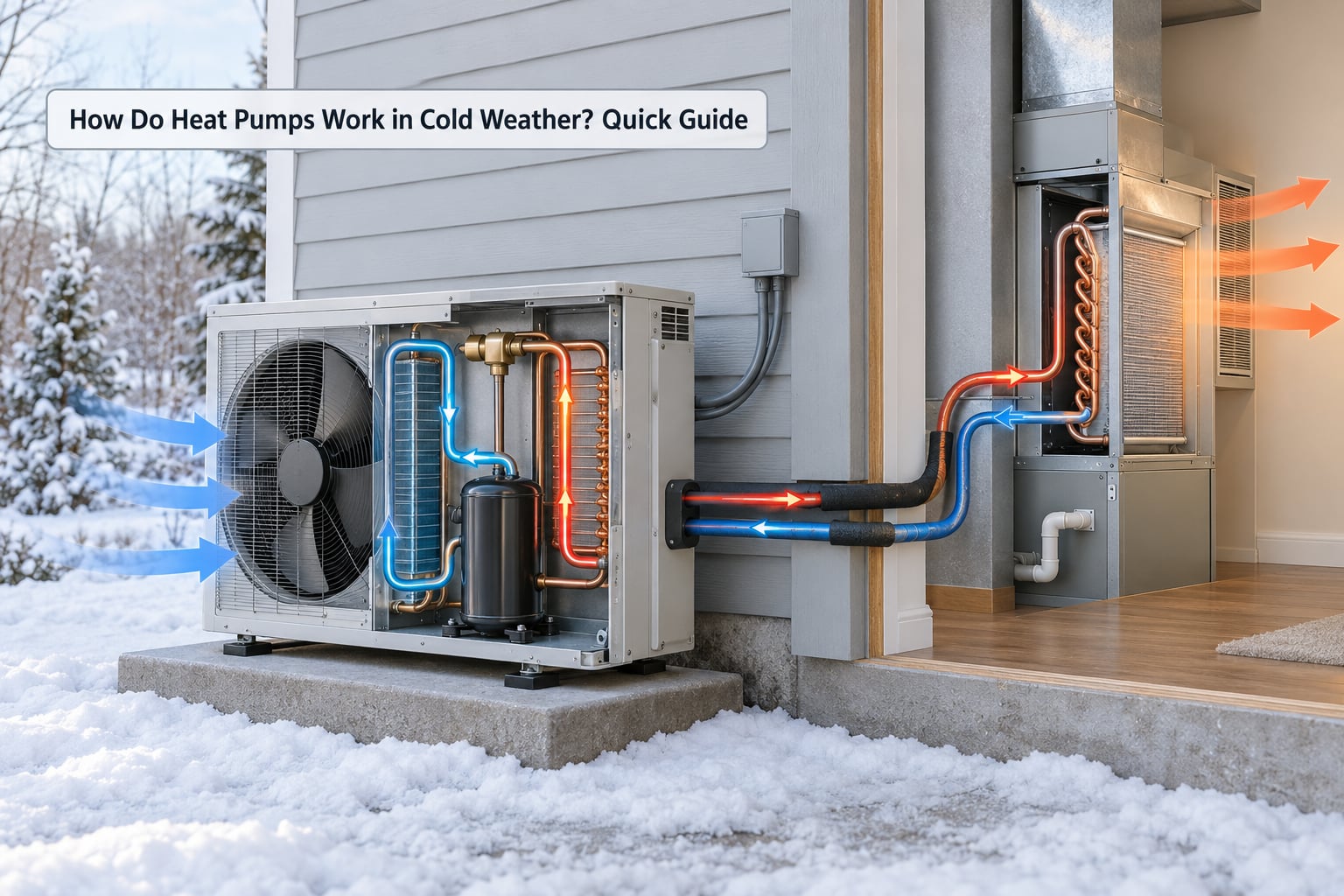
The table below lists the parts of a system and the job each one does once the outdoor temperature drops.
| Component | What it is | Role in cold weather |
|---|---|---|
| Outdoor unit | The fan-and-coil box outside the house | Its fan pulls in outdoor air and pushes it across the coil where refrigerant absorbs heat. Cold, humid air frosts this coil, which is what triggers defrost. |
| Refrigerant loop | Sealed copper piping with refrigerant circulating through it | Carries heat from one coil to the other. It is the part that actually does the transferring. |
| Compressor | The pump that squeezes refrigerant vapour | Raises the refrigerant’s pressure and temperature so it can give up heat indoors. In an inverter unit it speeds up and slows down rather than switching fully on and off. |
| Indoor unit | Air handler, or a wall-mounted unit in a ductless mini split | Contains the coil that releases heat into the room and the blower that moves the air. |
| Reversing valve | A valve inside the outdoor unit | Flips the direction of refrigerant flow so the same equipment heats in winter and cools in summer. During defrost it sends hot refrigerant to the outdoor coil to melt ice. |
| Defrost controls | A circuit board, sensors and timers | Measures coil temperature and outdoor conditions, then starts a defrost cycle at the right time rather than on a fixed timer alone. |
| Air or ground loops | Ductwork, or buried water loops for a ground-source system | Deliver heat where you want it. Ducts can lose heat and be starved of airflow; hydronic radiators respond more slowly. |
How the Refrigerant Cycle Heats a Home
Step one: outdoor air passes over the outdoor coil, and cold liquid refrigerant evaporating inside it absorbs that heat. The refrigerant leaves as a vapour.
Step two: the compressor compresses that vapour. Squeezing a gas raises its temperature, which is why a heat pump can deliver air that feels warmer than the outdoor weather.
Step three: the hot refrigerant travels to the indoor coil and releases its heat into the house, cooling back down to a liquid as it does.
Step four: the expansion valve drops the pressure, and the refrigerant returns to the outdoor coil cold and ready to start over. The loop runs continuously, and the same hardware handles cooling in summer with the reversing valve flipped.
None of this creates heat. Every unit of warmth indoors is heat taken from somewhere outdoors, and the electricity only drives the process. The ratio of heat delivered to electricity used is called the coefficient of performance, or CoP. A CoP of 3 means three units of heat for every unit of electricity.
Why does it work at all when air feels cold? Because cold air still carries energy. Air at 20°F (-7°C) is far from heatless, and heat flows toward colder surfaces as readily as it flows away from hot ones. The pump just needs a wider temperature gap to push heat across.
How Do Heat Pumps Work in Cold Weather During Defrost?
When the outdoor coil drops below about 32°F (0°C), moisture in the air freezes onto its fins. Left alone, that ice becomes an insulator and cuts capacity sharply.
The defrost board detects this and reverses the cycle, sending hot refrigerant to the outdoor coil to melt the buildup. Warm air at the vents stops or drops while the unit works on the coil, and the indoor fan often pauses too. A cycle typically lasts several minutes.
Afterwards, the valve flips back and heating resumes. If ice keeps building and never fully melts across a whole cold snap, the defrost circuit is more likely at fault than the cold itself.
Why Heat Pumps May Struggle at Very Low Temperatures
Cold air holds less heat than warm air, so the outdoor coil has less to give. Capacity drops gradually as the thermometer falls, and the compressor works longer to compensate.
Two things follow. Output falls, which can mean the thermostat calls for backup heat sooner. And efficiency falls, because each unit of electricity buys less heat than it did in October.
What does not happen is a sudden shutdown. A correctly sized system does not stop working at some magic number, it just leans harder on supplemental heat. A unit with a low-temperature cut-off will switch off to protect itself, but that setting is well below the temperature where most homes notice anything.
What Changes on a Cold Day?
The bands below describe typical behaviour for a common residential system. Your model’s certified capacity and range govern, so check the specification sheet rather than any general table, including this one.
| Outdoor temperature (approx.) | What the outdoor coil does | Output and efficiency | Backup heat |
|---|---|---|---|
| Above 40°F (4°C) | Stays clear of frost | Near full capacity, best efficiency of the season | Rarely runs |
| 32-40°F (0-4°C) | Light frost, occasional defrost | Small efficiency dip, capacity close to rated | Rarely runs |
| 25-32°F (-4-0°C) | Frosts regularly, defrost cycles several times a day | Noticeable capacity and efficiency loss | May run in short bursts |
| 15-25°F (-9 to -4°C) | Frosts heavily, longer defrost cycles | Substantial loss on standard units, better on cold-climate models | Runs regularly on most systems |
| Below 15°F (-9°C) | Heavy frost, frequent defrost | Highest heating demand of the year, lowest efficiency | Carries much of the load unless the unit is cold-climate rated |
Homeowners often read that table as a cliff. It is a slope. A system rated to deliver most of its capacity at 15°F (-9°C) behaves very differently from one that has lost half its output by then, even though both are technically “working.”
What Is a Cold-Climate Heat Pump?
A cold-climate heat pump is one built to hold a high share of its rated capacity at low outdoor temperatures, using an inverter or variable-speed compressor, two-stage compression and often a larger coil and pan heater.
The label itself means little on its own. What matters is the certified low-temperature capacity, usually published at 0°F (-18°C) or 5°F (-15°C), and the heating efficiency rating for that condition. A model that lists strong numbers there will keep working as the temperature falls instead of leaning on backup heat.
These units cost more and can be hard to justify in a mild climate, where a standard system already stays above its balance point most of the winter. Ask for the certified figures, not the badge.
How the Heat Pump System Gets Its Heat
Where the heat comes from changes the winter picture more than anything inside the unit.
An air-source heat pump draws from outdoor air, so its performance tracks the weather exactly as described above. It is the most common type and the cheapest to install, and it is also the most exposed to a cold snap.
A ground-source heat pump draws from buried water loops, where soil temperature stays far steadier than the air. In deep winter the source may sit near 50°F (10°C), which is mild by air-source standards, so capacity and efficiency change very little.
A water-source heat pump takes heat from an existing source such as a lake or a well, again with a stable temperature. Its winter behaviour depends on that source temperature rather than the forecast.
The pattern is simple: the steadier and warmer the source, the less the system struggles in cold weather, and the more the cost moves up front.
Do Heat Pumps Need Backup Heat in Cold Weather?
Most homes do keep a second source of heat, and a thermostat is what decides when it runs. The switchover point is called the balance point: the outdoor temperature where the heat pump’s available capacity exactly matches the house’s heat loss. Above it, the pump handles everything. Below it, backup heat takes over until the pump catches up.
Backup heat is usually electric resistance strips built into the air handler, which cost roughly three times as much per hour as the same amount of heat from the heat pump. Some homes pair the pump with a gas furnace instead, which burns fuel and costs far less to run but produces combustion emissions.
Sizing decides how often that happens. A unit oversized for the house cycles on and off, struggles to match its output to demand, and tends to call for backup heat more than it needs to. An undersized unit is quiet and steady but may need backup heat on every cold night.
Setpoint discipline matters too. Every degree you raise the thermostat adds roughly one percent to heating demand, which in a cold week can be enough to push a marginal system into backup heat all day.
Homeowners also talk about a 20-degree rule of thumb: keep the thermostat setpoint within about 20°F (11°C) of the coldest expected outdoor temperature, so the building can lose heat without a big temperature gap forming. It is a rough industry heuristic, not a specification, and it assumes the ductwork can deliver the heat at low airflow.
What Affects Cold-Weather Performance?
Seven things move the needle more than the outdoor unit’s badge does.
Outdoor temperature sets the ceiling on available heat. Every degree colder costs efficiency.
Sizing and design decide how gracefully the system degrades. A properly sized unit with a wide operating range runs at moderate capacity for long stretches and rarely touches backup heat.
Insulation and air leakage decide how much heat the house needs in the first place. A 1970s bungalow leaking cold air through the attic can outrun any heat pump, and the equipment will look inefficient when the real problem is the envelope.
Duct and hydronic design decide how well heat arrives. Undersized ducts starve the coil of airflow and can freeze a line in a cold attic; undersized radiators on a hydronic system simply cannot release enough heat at low water temperatures.
Defrost behaviour decides how much capacity you lose to ice. A unit that defrosts too rarely frosts over; one that defrosts too often spends its life melting its own coil.
Maintenance decides the rest. A clogged filter or a dirty coil cuts airflow, which cuts heat delivery, and it forces the compressor to run longer for less.
Climate and thermostat setup wrap it up. A mild coastal winter barely tests a system, while a sustained cold snap in a northern inland area will push any design to its limits within hours.
How to Keep Cold-Weather Performance Reliable
Check the filter every month through the heating season and replace it when it is dirty. A restricted filter is the most common cause of a heat pump that heats weakly and runs constantly.
Keep eighteen inches (46 cm) of clearance around the outdoor unit so it can pull in air and shed frost, and clear snow that has drifted against it after a storm.
Look at the base of the outdoor unit in winter. A pool of melted water that drains away is normal during and after defrost; water that keeps standing points to a frozen or blocked drain line, which needs a technician.
Set the thermostat to fan auto rather than continuous in winter, so air moves only when heat is being delivered. Keep the thermostat where it can read room temperature, not on a sunny wall or near a supply vent.
Schedule annual service before the first cold month. Anything involving refrigerant, electrical connections, the defrost circuit or sizing decisions belongs with a licensed HVAC professional, not a weekend project. Replacing refrigerant or opening refrigerant lines requires certification.
When Should a Homeowner Ask for a Load Assessment?
Ask for a professional heat-loss calculation when the online estimate clearly will not do. The warning signs are familiar: the backup heat runs so often that the winter bill doubles, one side of the house stays cold, the system cannot recover the temperature after an overnight setback, or the previous unit was replaced without anyone measuring the load.
A load assessment sizes the house against its design outdoor temperature, the coldest condition it must actually carry, not the seasonal average. It also checks duct sizing, insulation levels and window area.
It is worth the visit in northern inland regions with sustained extreme cold, in large homes with high ceilings or lots of glass, and in any house with a known insulation problem. A calculator on the internet uses square footage and a region. An assessment measures what the building actually loses.
Frequently Asked Questions
Are heat pumps efficient when temperatures drop below freezing?
Yes, though less efficiently than in mild weather. A typical system delivers roughly three units of heat per unit of electricity around 40°F (4°C) and closer to two units per unit of electricity near 20°F (-7°C). Cold-climate models hold a higher ratio at low temperatures. The loss is gradual, so a correctly sized cold-climate unit still works well below freezing.
Why does my heat pump briefly stop heating or run the fan during defrost?
That pause is the defrost cycle clearing frost from the outdoor coil. The refrigerant reverses direction and sends hot refrigerant to the outdoor coil to melt ice, which stops heat delivery to the indoor coil for several minutes. The fan may keep running, or stop with the compressor, depending on the design. Heating resumes automatically once the coil clears.
How much electricity does a heat pump use in cold weather?
It depends on your heat pump’s efficiency, the outdoor temperature, your home’s heat loss and how long backup heat runs. Resistance backup strips cost roughly three times more per hour than the heat pump, so the main lever is how often they run. Raising the thermostat setpoint raises demand and makes that crossover happen sooner.
What efficiency rating should I look for in a cold climate?
Look at certified heating efficiency at low temperatures, not a single seasonal headline number. A cold-climate unit should publish heating capacity and efficiency at 0°F (-18°C) or 5°F (-15°C), and local programs may certify a minimum at a specific temperature. Ask for those figures in writing, because they predict winter behaviour far better than a general efficiency rating.
Can an older home with poor insulation use a heat pump?
It can, but the heat pump will work much harder and use more electricity than in a tight, well-insulated house. Before installing one, measure the heat loss and address air sealing and attic insulation first, since those fixes pay off in any heating system. A load assessment will tell you whether the system can meet the design condition or how much backup heat the house needs.
What to Check First
Before choosing any equipment, get one number in writing: the manufacturer’s certified heating capacity at your area’s design temperature, such as 0°F (-18°C) or 5°F (-15°C). Then compare it with a measured heat loss for your home, and ask at what outdoor temperature the installer expects backup heat to take over.
If the capacity comfortably exceeds the heat loss, you will run the heat pump all winter. If it does not, the question becomes how much backup heat you will run, and how often. Those two figures together tell you far more than any efficiency label on the front of the unit.
Everything else in winter performance follows from that comparison, and it is the one number worth getting right before 2026 and every winter after.