Anyone who has watched a buck hesitate at a motorway fence wants to know how wildlife corridors and crossings save animals. The short answer is that they are two halves of one system: corridors are connected strips of habitat that let animals move between separated areas, and crossings are the built structures — overpasses, underpasses, culverts and amphibian tunnels — that carry them over or under a road. Together they cut vehicle collisions, restore access to food, water and mates, and keep shrinking populations genetically connected. Most animals that die on roads never reach a crossing at all, so both halves only work when they are planned together.
The idea is unglamorous and old: animals need to move, and the ground between one habitat patch and the next has to let them. What changed in the last fifty years is how much of that ground is now asphalt, fence and farmland. This guide walks through what each piece does, what makes a crossing succeed, and what you can actually do about it where you live.
Table of Contents
- What Are Wildlife Corridors and Crossings?
- How Do Corridors and Crossings Reduce Animal Deaths?
- How wildlife corridors and crossings save animals, step by step
- What Makes a Wildlife Crossing Work?
- Why Are Wildlife Corridors Important for Conservation?
- How wildlife corridors and crossings save animals at regional scale
- How Are Corridors and Crossings Different?
- What Maintenance and Monitoring Are Needed?
- How Can People Support Wildlife Connectivity?
- Frequently Asked Questions
- What is the difference between a wildlife crossing and a wildlife corridor?
- Do animals actually use wildlife bridges and tunnels?
- How effective are wildlife overpasses at reducing collisions?
- How much does a wildlife crossing cost to build?
- Can corridors spread disease between wildlife populations?
- What can I do to support wildlife connectivity where I live?
- Conclusion
What Are Wildlife Corridors and Crossings?
A wildlife corridor is habitat, not a structure. It is a strip of native vegetation — a riverbank, a hedgerow, a forest edge, a restored field — that an animal can walk, forage and shelter along while moving from one patch of habitat to the next.
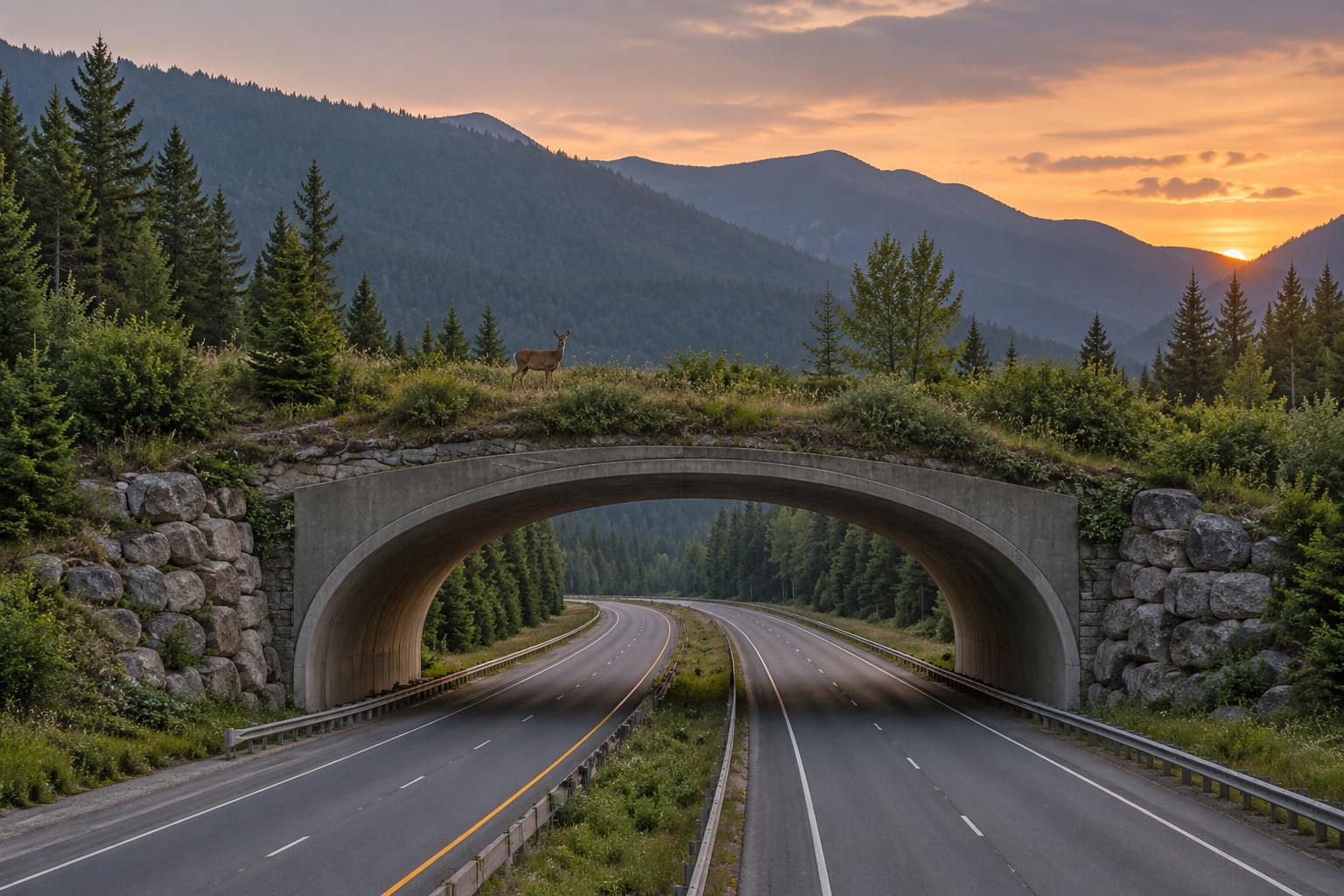
A wildlife crossing is the opposite: a piece of infrastructure built into a barrier. It may be a landscaped bridge deck over a motorway, a wide underpass beneath an embankment, a box culvert sized for the species that uses it, or a rope bridge slung between two trees for an arboreal animal.
Corridors remove the barrier. Crossings punch a hole in it. A crossing with no connected habitat on either side is a tunnel to nowhere; a corridor that ends at a four-lane motorway is a roadkill generator. Good programs treat them as one connected system.
| Feature | Wildlife corridor | Wildlife crossing |
|---|---|---|
| What it is | Living habitat: vegetation, water, soil | A built structure spanning or tunnelling under a barrier |
| Where it sits | Between habitat patches, often along natural features | At a specific road, rail line, fence or dam |
| Who benefits most | Everything using the strip: mammals, birds, pollinators, people | The species the structure was designed for, plus compatible ones |
| Main job | Make movement possible and habitat continuous | Make movement possible without a collision |
| Typical example | Restored riverbank vegetation | Earthen overpass with funnel fencing on both approaches |
| Main ongoing need | Land kept open and undeveloped | Inspection, vegetation control, monitoring and repair |
How Do Corridors and Crossings Reduce Animal Deaths?
Reported wildlife-vehicle collisions in the United States run past a million a year, and most of those animals were moving between habitat, water or a mate. Understanding how wildlife corridors and crossings save animals comes down to two mechanisms: they steer animals onto a safe path, and they make crossing on foot feel safer than crossing on the road.
How wildlife corridors and crossings save animals, step by step
- Funnel fencing guides animals to the structure. Fencing along the road edge blocks the direct line and pushes animals toward the nearest opening. A crossing without the approach fencing rarely works.
- Escape ramps and jump-outs give trapped animals a way out. Where the fence itself is the hazard, earthen ramps let a panicked deer or pronghorn climb out instead of running back into traffic.
- Continuous habitat removes the reason for the dash. When cover, forage and shelter continue right up to the crossing, animals move slowly instead of sprinting at the last second.
- Speed and lighting changes cut the danger at the source. Lower speed limits, wildlife-activated warning signs, animal detection systems and shielded lighting reduce the number of vehicles and the darkness animals face at the crossing point.
- Escape routes on the far side prevent the second collision. Animals forced to emerge into a wall of traffic often die on the opposite shoulder. Good designs put habitat and a landing zone beyond the structure.
The results are measurable. Vermont amphibian underpasses recorded roughly an 80% overall drop in road mortality, with a 94% decrease for one species over seven years of monitoring. On Colorado Highway 9, about 650 animals were hit over ten years in a ten-mile stretch; after crossings and fencing went in, two animals were struck.
What Makes a Wildlife Crossing Work?
Most failed crossings fail for boring, fixable reasons. The structure was built for a species that was never actually using the road, it sits where the collision data says animals do not cross, or the fencing and approach habitat were treated as an afterthought.
Siting comes first. Agencies now map collision records and animal movement with cameras before deciding where to spend money, because a crossing in the wrong place is an expensive monument. Connectivity modelling goes further, ranking routes by how likely an animal is to move through a given patch of ground.
Design follows the species. Large mammals need wide decks, steep earthen banks and sightlines through the approach. Deer and elk often prefer underpasses; black bears and cougars use overpasses and wide openings; frogs and salamanders need short, shaded tunnels with moist substrate and no long drop; arboreal animals need rope bridges or canopy connections between trees. A structure built to generic dimensions serves everyone poorly.
Details that quietly decide the outcome include soil and vegetation on the crossing surface rather than concrete, sound barriers on busy motorways, minimal artificial lighting, a planted buffer that hides the road from the animal’s side of the deck, and fencing long enough that an animal meets the guide fence well before the carriageway. Widened shoulders and low, gradual escape ramps extend the same logic.
Why Are Wildlife Corridors Important for Conservation?
Connected habitat is what keeps a population a population rather than a cluster of shrinking groups. Small, isolated populations lose genetic diversity, which brings inbreeding problems, lower fertility and weaker disease resistance. Corridors let animals find unrelated mates and new territories instead of breeding in the same few hundred hectares year after year.
They also restore access to resources. A deer herd that cannot reach a wintering ground because of a fence will overuse its summer range until the forage fails. A fish blocked by a dam loses years of upstream habitat. Corridors also support pollinators and seed dispersal, which is why a planted strip along a road can improve the farmland on both sides of it.
How wildlife corridors and crossings save animals at regional scale
Climate change makes connection more valuable, not less. As ranges shift uphill, poleward or northward, a population with somewhere to go survives; one sealed in by roads and fences does not. The Yellowstone to Yukon corridor, running from the greater Yellowstone area into Canada’s Yukon, is the most ambitious attempt yet to keep a connected route of open habitat across an entire region, and comparable efforts run from the Terai Arc along the India-Nepal border to projects in Kenya.
A peer-reviewed assessment of the contiguous United States found that roughly 41% of natural land is still connected. That number is a measure of how much room wildlife has left to move, and it is falling.
How Are Corridors and Crossings Different?
The practical difference is land versus structure. Corridors need acreage protected from development in perpetuity and depend on private and public landowners staying on board. Crossings need engineering budget, a road authority willing to change signage and speed limits, and someone responsible for maintenance afterwards.
Corridors work best for movement that happens gradually — daily foraging trips, dispersal of young, seasonal migration along a valley or ridge. Crossings work best where a barrier is unavoidable, which in practice means roads, railways, canals, fences and city edges.
For a landscape with scattered collision hotspots, teams often debate whether to build several small crossings or one large one. The evidence favours the spread: a network of modest crossings across many locations catches more animals than a single showpiece structure, because a structure only helps the animals that reach it. Several small crossings also cost less to inspect and replace if they fail. Ultimately, how wildlife corridors and crossings save animals is a question of coverage rather than grandeur.
What Maintenance and Monitoring Are Needed?
A crossing is not finished when the concrete cures. Vegetation grows over the guide fence, erosion exposes the deck, snow blocks an underpass, and a culvert silts up. Maintenance budgets that stop at construction are the most common reason a working crossing degrades quietly.
Monitoring is what turns opinion into evidence, and there are three standard approaches:
- Camera traps on the approaches and inside the structure record which species use it, how often, and at what time of day.
- Roadkill surveys run before and after construction, on a fixed route and schedule, to measure whether collisions actually fell.
- Genetic sampling from scat, hair or saliva shows whether individuals are moving between populations, which is the outcome corridors exist to produce.
Newer sites add traffic sensors and automated video classification, so a crossing reports its usage without anyone walking the fence line. Monitoring data also changes the next round of decisions: a crossing nobody uses can be re-engineered, and a quiet stretch of road with no collisions may not need one.
How Can People Support Wildlife Connectivity?
Corridor planning happens in public meetings, land-use hearings, highway budgets and mitigation agreements, which means ordinary residents can affect it. A few routes that work:
- Follow a project through the planning stage. Road and rail projects that close or realign a highway go through public review, and crossing requirements are cheapest to add before the design is fixed.
- Ask your highway authority for collision data. Where animals are hit most often is the public evidence used to justify new structures.
- Support the funding mechanisms. National infrastructure legislation in the United States dedicated roughly 350 million dollars to wildlife crossings, and state programmes plus developer mitigation fees cover much of the rest.
- Keep corridors on your own land open. Hedgerows, native planting along fences, ungated gaps in stock fencing and undisturbed creek lines all function as corridor on a working farm.
- Join citizen science projects. Roadkill recording apps, bird counts and amphibian surveys feed real data into the maps agencies use.
Cost is the objection that comes up most often, and it deserves a straight answer. The Wallis Annenberg crossing over Agoura Road in California ran to roughly 114 million dollars because it closed an entire arterial for years and spanned a very wide corridor. That figure is not typical. Culvert retrofits and highway widening mitigation cost a small fraction of it, and the comparison that matters is against the continuing cost of collisions — human injury, vehicle damage, livestock losses and the loss of the animals themselves.
Two practical habits help animals on their own. Do not feed wildlife near a crossing or anywhere else; fed animals lose their wariness of traffic, and fed animals cluster unnaturally. And slow down at dusk and in the seasons when crossings are busiest, because the animals are crossing whether or not anyone is expecting them.
Frequently Asked Questions
What is the difference between a wildlife crossing and a wildlife corridor?
A corridor is living habitat, such as a restored riverbank or hedgerow, that keeps ground usable for movement between two habitat patches. A crossing is a built structure, such as an overpass, underpass or culvert, that lets animals pass over or under a road or rail line. Corridors remove the barrier; crossings punch a hole in the barrier that is already there.
Do animals actually use wildlife bridges and tunnels?
Yes, when the structure is sited, sized and fenced correctly. Camera monitoring at crossings in Banff National Park shows regular use by elk, deer, black bears, cougars and smaller mammals, and collisions on those roads fell by more than 80 percent. Vermont amphibian underpasses cut road mortality by about 80 percent overall, and 94 percent for one species.
How effective are wildlife overpasses at reducing collisions?
Effective designs consistently deliver large reductions. On Colorado Highway 9, roughly 650 animals were hit over ten years in a ten-mile stretch; after crossings and funnel fencing were installed, two animals were struck. The gains come mostly from funnel fencing and approach habitat, so a crossing without those surrounding elements performs far worse.
How much does a wildlife crossing cost to build?
There is no single figure. Culvert retrofits and highway mitigation crossings cost a small fraction of what a major new overpass costs, and the Wallis Annenberg crossing over Agoura Road in California came to roughly 114 million dollars because it closed a wide arterial for years. Costs vary by span, soil conditions, whether the road must be closed during construction, and how much fencing and planting is included.
Can corridors spread disease between wildlife populations?
This is a real and studied risk, not a reason to avoid corridors. Managers monitor for disease at crossing sites and in connected populations, and designs that concentrate animals can be adjusted if a pathogen appears. Most conservation scientists weigh that small, manageable risk against the far larger harm of isolated populations losing genetic diversity and failing to recover.
What can I do to support wildlife connectivity where I live?
Comment on road and rail projects while they are still in design, request collision data from your highway authority, and support state crossing programmes and federal grant funds. On your own land, keep hedgerows, creek lines and fence gaps open. Contribute roadkill and amphibian records to citizen science projects, which feed directly into the maps agencies use to site new crossings.
Conclusion
That is how wildlife corridors and crossings save animals in practice: habitat that stays usable, and crossings that make the other side safe to reach. Corridors keep habitat usable and crossings keep that habitat safe to cross, and neither works well without the other. The proof is in the numbers: collisions falling by more than 80 percent on roads through Banff, amphibian mortality dropping by 80 to 94 percent in Vermont, and 650 animals struck on a Colorado highway stretch reduced to two.
Start where you have some influence. Find out whether a road project near you is still in design, ask for the local collision data, and support the agency or group already arguing for a crossing. That is where connectivity gets decided, and it is decided long before any animal is seen on the structure.