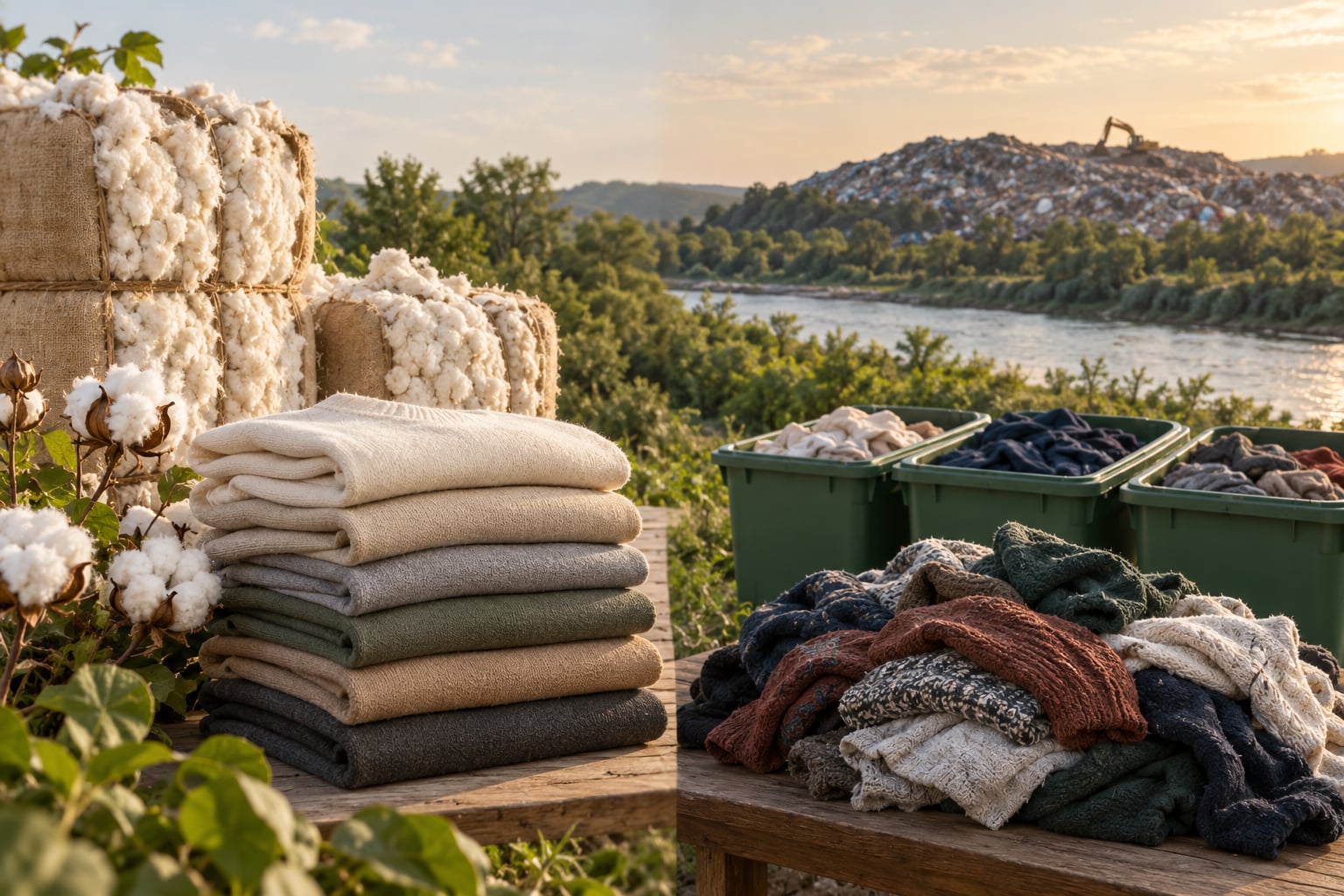
Fast fashion affects the environment at nearly every stage of a garment’s life, from the farm that grows the fibre to the landfill that receives it. The clothing industry generates roughly 10% of global greenhouse gas emissions and about a fifth of the world’s industrial wastewater, while around 92 million tonnes of textiles end up as waste each year. Most of that damage traces back to one thing: a business model built on making more clothes, more often, and wearing them for less time than ever.
Table of Contents
- How Fast Fashion Affects the Environment at a Glance
- What Is Fast Fashion and Why Is Its Environmental Impact So High?
- Volume is the multiplier
- Short lifespans waste the impact already spent
- How Fast Fashion Affects the Environment Through Climate Emissions
- How Much Water Does the Clothing Industry Use?
- How Fast Fashion Contributes to Water Pollution
- What Happens to Clothes After They Are Thrown Away?
- Why about 60% of clothing is thrown away within a year
- Why blended fabrics are hard to recycle
- Do Washing and Wearing Synthetic Clothes Harm the Environment?
- What washing-machine filters do
- What care habits do
- Why Do Some Fabrics Have a Higher Environmental Footprint?
- What Environmental Problems Come with Fast-Fashion Discounts?
- How Can Consumers Reduce Fast Fashion’s Impact?
- Start with what you already own
- Repair instead of replacing
- Buy fewer things, chosen for jobs
- Use secondhand, resale and rental
- Care for what you keep
- Ignore claims you cannot verify
- What Should Brands and Policymakers Change?
- Frequently Asked Questions
- Is fast fashion worse for the environment than regular clothing?
- How many clothes does the average person throw away each year?
- Is organic cotton better for the environment than conventional cotton?
- What can I do with clothes I no longer wear?
- Does recycling fast-fashion clothes solve the environmental problem?
- Conclusion: Start by Buying Fewer Clothes and Keeping Them Longer
How Fast Fashion Affects the Environment at a Glance
The table below maps the main impact areas to the life-cycle stage where the harm happens and to the part of the fast-fashion model that makes it worse.
| Impact area | Where it happens | Why fast fashion amplifies it |
|---|---|---|
| Greenhouse gas emissions | Fibre growing, spinning, dyeing, sewing, shipping, retail, care and disposal | Production volumes are enormous, most garments travel long distances by road, air and sea, and most are worn only a handful of times before becoming waste |
| Water consumption | Cotton irrigation, wet processing, dyeing, finishing, consumer laundry | Synthetic blends and frequent new purchases mean a growing share of demand for cotton, the thirstiest mainstream fibre |
| Water pollution | Dyeing and finishing effluent discharged to rivers and coastal waters | Fast, cheap orders push mills to cut treatment corners, and oversight is weakest exactly where effluent is heaviest |
| Microplastic pollution | Washing and everyday wear of polyester, nylon and acrylic | Synthetic fibres make up a large and growing share of what is produced, so shed fibres accumulate in oceans and soils |
| Textile waste | Overproduction, unsold inventory, returns, discarded wardrobes, landfill and incineration | Trend cycles and constant discounting encourage overbuying, and low-cost blends are hard to recycle |
None of these stages exists on its own. A cheap polyester top is cheap partly because it skips natural-fibre growing costs, and it becomes waste partly because a trend cycle made it unfashionable in eight weeks. That link between volume, price and lifespan is what makes the whole system more damaging than the sum of its parts.
What Is Fast Fashion and Why Is Its Environmental Impact So High?
Fast fashion is a production and retail model built on rapid trend replication, low prices and high sales volume. Styles that once took a season to reach a shop now appear within weeks, produced in small runs and replenished constantly based on what is selling.
Volume is the multiplier
Environmental harm scales with quantity. When a brand orders twelve million units of a single style instead of two million, every input multiplies: the cotton acreage, the dyed water, the shipping emissions, the packaging, the returned parcels, the landfill volume.
Low prices are what make that volume possible, because cost savings come from thin materials, short sewing times and compressed supplier timelines. A garment made to be worn a dozen times does not need to last a decade.
Short lifespans waste the impact already spent
Producing a garment spends most of its carbon and water before anyone wears it. When it is discarded after a handful of wears, all of that upstream impact gets divided by a tiny number of uses, which is why per-wear impact matters more than per-garment impact.
This is the core problem. No amount of efficient manufacturing fixes a system that produces garments far faster than people wear them out.
How Fast Fashion Affects the Environment Through Climate Emissions
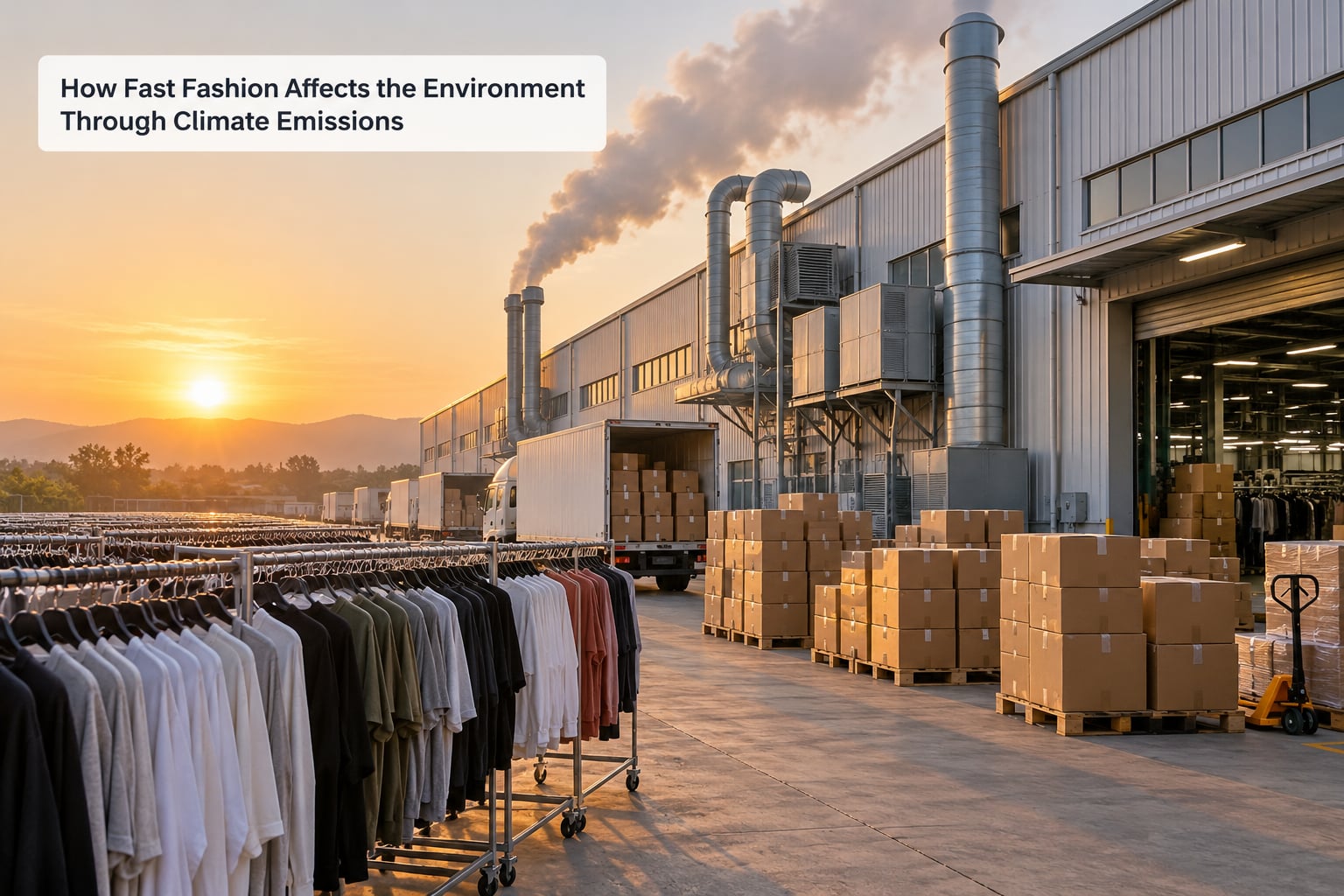
Fashion’s roughly 10% share of global emissions is spread across the full life cycle rather than concentrated at a single point.
- Raw materials: cotton cultivation depends on irrigation, fertiliser and land clearing, each with its own methane, nitrous oxide and carbon emissions.
- Spinning and weaving: these stages are electricity-hungry, especially where mills run on coal-heavy grids.
- Dyeing and finishing: dyeing, bleaching and washing at temperature are among the most energy-intensive steps, and much of that heat comes from fossil fuels.
- Manufacturing: sewing and assembly are modest by comparison, but the sheer volume of units makes even small per-garment figures add up.
- Shipping: finished garments travel from factory to distribution centre to warehouse to shop or to your door, mostly by road, rail and container ship, with air freight used for the most urgent lines.
- Retail and use: store energy, heating, ironing and machine washing all sit inside the boundary in most lifecycle studies.
- Disposal: landfill methane and incineration emissions close the loop.
Treat these as lifecycle estimates for the sector rather than precise measurements of any one garment. Numbers for a single t-shirt or pair of jeans vary widely with fabric weight, mill efficiency, grid mix, shipping distance and how long the item is worn, which is exactly why headline figures get quoted carelessly.
The direction of travel matters too. If current trends hold, clothing and textile production is on track to add roughly 1.3 billion tonnes of carbon dioxide equivalent a year by 2030, pushing total emissions from the sector above its current level. Efficiency gains in mills have not been enough to offset the growth in units produced.
How Much Water Does the Clothing Industry Use?
Clothing is thirsty at both ends of the pipeline, and the totals depend enormously on the fibre.
Cotton growing is the largest single share. Irrigation-heavy regions can use several thousand litres of freshwater per kilogram of cotton, with the figure rising steeply where water comes from stressed basins. Cotton also competes with food crops and drinking water supplies in exactly those regions.
The often-quoted figure of about 7,500 litres for a pair of jeans refers to cotton plus the water used across growing, processing, dyeing and finishing in a water-stressed supply chain. A 2,700-litre figure for a cotton T-shirt reflects the same logic at a smaller scale. Neither is a universal constant: an efficient mill reusing water on a well-supplied river can sit well below those figures, and a poorly managed one can exceed them.
Man-made fibres shift the burden rather than removing it. Polyester and nylon skip irrigation but create demand for petroleum, and their dyeing and finishing stages still consume water.
Then there is the consumer end. Washing synthetic and cotton loads uses hot water, and a typical household can easily run into thousands of litres of water a year for laundry alone. Cold washes cut both the water heating energy and a meaningful share of the water used, which is one of the few impact reductions available to any household with no budget at all.
How Fast Fashion Contributes to Water Pollution
Consuming water is only half the problem. What goes into it matters as much.
Textile effluent carries dyes and finishing chemicals that do not stay in the water. Common culprits include azo dyes that can break down into carcinogenic aromatic amines, formaldehyde used in wrinkle-resistant finishes, heavy metals in some pigments and metallic mordants, and PFAS in water-repellent treatments that are intentionally designed not to break down.
Dyeing baths also carry high salinity, suspended solids and variable pH. When this water is discharged without adequate treatment, it affects rivers, estuaries and coastal systems, smothering aquatic habitats and reducing oxygen levels in the water column.
Modern mills can treat effluent well, and strict regulation does force that in some regions. The unevenness is the issue. Enforcement is weakest where capacity is weakest, and a fast-fashion order that arrives with a two-week deadline gives a mill little room to slow down and treat properly. Weak factory monitoring is also a well-documented gap, so reported compliance and actual practice do not always match.
What Happens to Clothes After They Are Thrown Away?
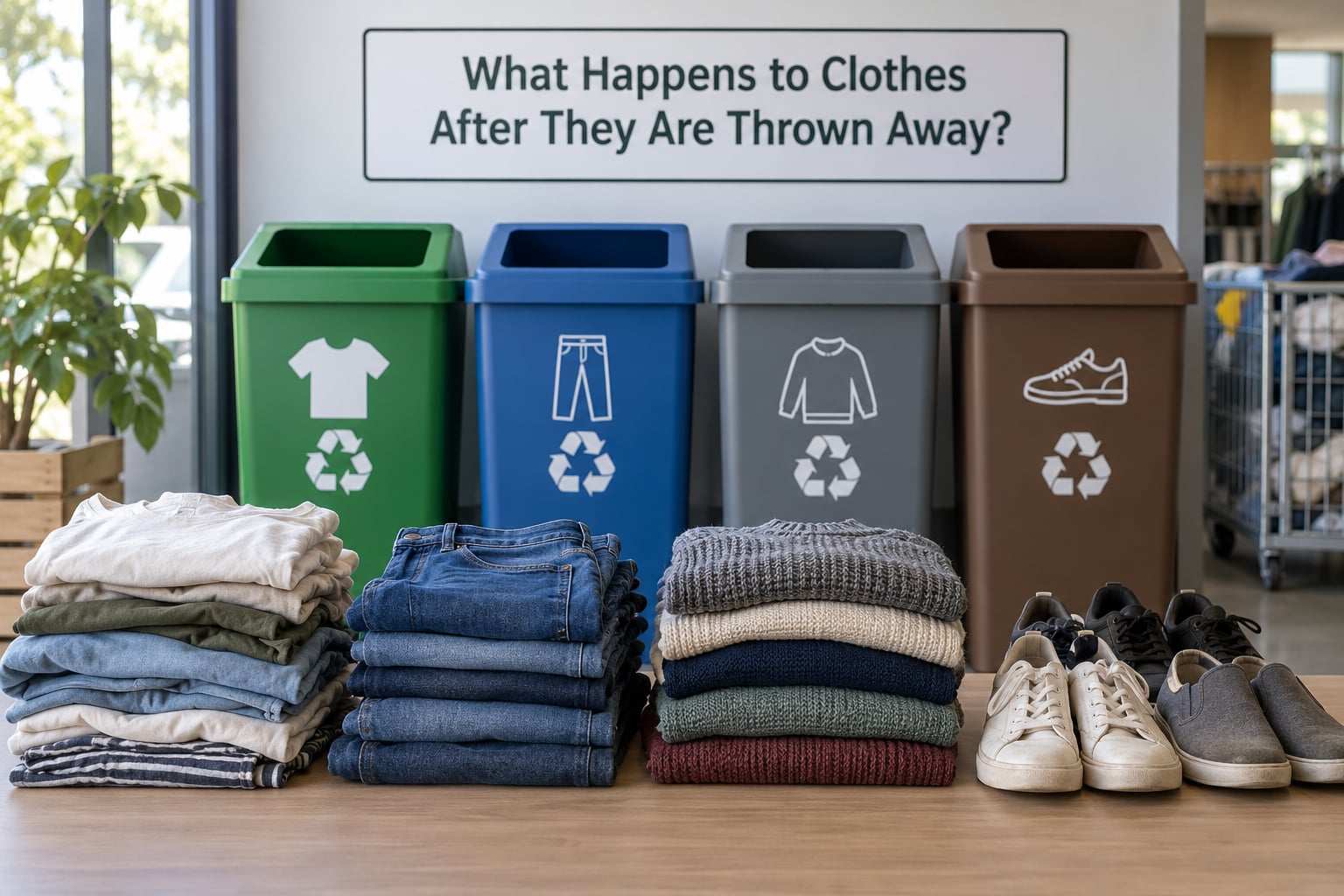
Around 92 million tonnes of textiles become waste globally each year, and only a small fraction of that is recovered. The rest is landfilled, incinerated or exported to other countries, where it lands on the same landfill a few years later.
Why about 60% of clothing is thrown away within a year
Two forces drive that figure. Cheap clothing costs so little that replacing it feels normal, and trend cycles make styles feel wrong almost immediately. A garment bought to be worn eight times falls out of rotation faster than a garment that cost more and needs to last.
The waste also starts before the customer ever sees the item. Brands routinely order more than they sell, and that surplus either sits as unsold inventory, is discounted so hard it trains shoppers to wait for reductions, or is destroyed outright. In the United States roughly 11 million tonnes of textiles reach landfill each year, with returned and unsold goods making up a meaningful share.
Why blended fabrics are hard to recycle
Recycling is complicated by what modern clothing is made of. Mechanical recycling needs clean, single-fibre feedstock, and elastane stretches, coatings, prints and trims all contaminate a batch.
Polyester blends resist chemical recycling too, which uses energy and produces its own chemical load. In practice, most collected clothing is downcycled into wiping cloths, insulation or stuffing rather than back into wearable fibre. Charitable donation also has limits: the useful life of a garment is limited, and once a worn item has reached the end of its first life, its next one is often not clothing at all.
Do Washing and Wearing Synthetic Clothes Harm the Environment?
Yes, mainly through microplastic shedding. Every polyester, nylon or acrylic garment loses fibres during washing and wear, and a single machine cycle can release hundreds of thousands of microscopic plastic fibres.
Those fibres pass through standard wastewater treatment, which is not built to catch them, and travel through rivers to the ocean. Estimates attribute somewhere around a third of microplastic pollution in the world’s oceans to synthetic textile fibres, making clothing one of the largest diffuse sources rather than a minor one.
What washing-machine filters do
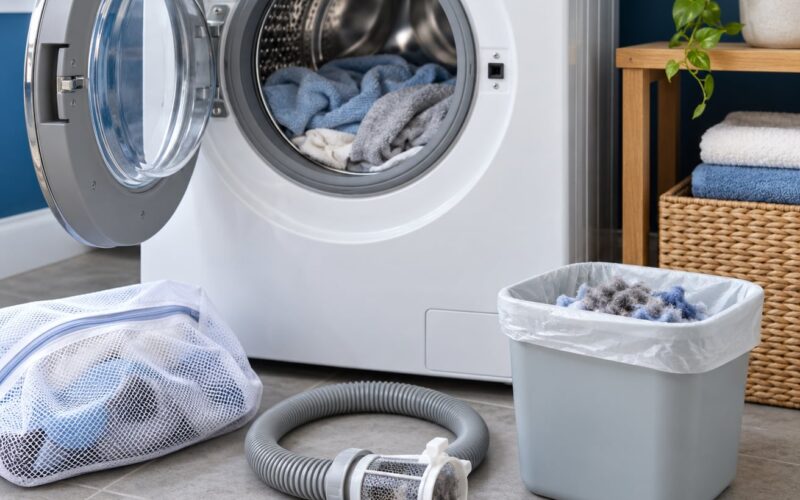
Filter bags and in-machine filters collect shed fibres before they reach the drain, and microfiber capture laundry bags work the same way. They genuinely reduce what goes down the pipe, but they are a partial measure: filters need emptying and washing, and the captured fibre still has to be disposed of responsibly.
What care habits do
Washing less often, filling the machine properly, choosing cold cycles and hand-washing synthetics all reduce shedding. Air-drying avoids the heat that weakens many synthetic fibres. Turning garments inside out and using a gentler cycle lowers abrasion, and buying synthetics with longer expected lifespans cuts the annual total even if each garment sheds a similar amount.
None of this is a substitute for producing less. It is a way to reduce the harm from the synthetics already in your wardrobe while you replace them more slowly.
Why Do Some Fabrics Have a Higher Environmental Footprint?
No fibre is impact-free, and the honest answer is that the ranking shifts depending on which impact you are measuring. That is worth saying plainly, because confident single-winner claims rarely survive a lifecycle assessment.
Cotton carries the heaviest water and land footprint, and conventional cotton also involves significant pesticide and fertiliser use. Linen and hemp need far less water and no irrigation in many growing regions, though their processing still consumes energy.
Polyester, nylon and acrylic are petroleum-derived and energy-intensive to make, but they need no irrigation and often need less dye chemistry than natural fibres. Viscose and other man-made cellulosics come from wood pulp and use less water than cotton, though the chemistry is chemically intensive and the sourcing of the pulp matters.
Wool and silk carry their own burdens in land use, water and, for silk, the treatment of silkworms.
The variable that consistently changes the ranking is durability. A durable garment that is worn 150 times divides its production impact across all of them. A cheap garment worn eight times multiplies that same impact by eighteen. Fibre choice is a secondary concern next to how long you keep something and how well it is made.
What Environmental Problems Come with Fast-Fashion Discounts?
Discounts are where the model’s incentives become visible. When prices are low enough that a person buys a top they had no intention of keeping, the environmental cost of that garment is not in the price.
Constant promotions also encourage overproduction. Brands discount heavily to clear inventory, which signals over-ordering, which means more of that stock eventually reaches landfill or incineration. The US returns system makes this worse: online orders are returned at high rates, and returned garments that cannot be resold end up in disposal streams alongside the unsold inventory.
There is a knock-on effect on labour too. Compressed timelines and low margins push pressure onto the people sewing the garments, often in countries where enforcement is thin. Consumers on tight budgets, who face the least choice and the fewest local alternatives, end up carrying the heaviest share of that pressure.
The environmental result is a cost shifted to the public: water, air and landfill capacity are paid for by communities rather than by the retailer.
How Can Consumers Reduce Fast Fashion’s Impact?
None of this requires a large budget or a perfect wardrobe. The biggest gains come from volume and lifespan, not from swapping one brand for another.
Start with what you already own
Take an hour and work out what you actually wear. Most wardrobes are roughly half redundant, which means the cheapest garment in your life is often the one you have not bought yet. Buying less of anything comes before buying better of something.
Repair instead of replacing
Replacing a zip, rehemming a trouser leg or sewing a small tear costs a fraction of a new garment. It also buys years of life from something whose impact is already paid for. Community repair groups and visible mending have made this easier to learn than it used to be.
Buy fewer things, chosen for jobs
When you do buy, pick pieces that fill a gap you can name, that fit your actual life, and that you will still wear next year. A jacket you wear every week for five years beats five trend jackets at the same total cost.
Use secondhand, resale and rental
Buying a used garment avoids nearly all of the production impact of a new one. Reselling or donating what you no longer wear extends the life of something already made, and rental works well for occasional occasions where one wear would leave a garment sitting in a cupboard.
Care for what you keep
Wash less often, wash cold, wash full loads, and skip the dryer where you can. Repair before replacing, store knitwear folded rather than hung, and clean shoes before binning them.
Ignore claims you cannot verify
Watch for vague language such as eco-friendly, conscious, green or made with love, with no numbers attached. Look for third-party certification such as GOTS for organic textiles, Fair Trade for labour standards, or B Corp certification for the company as a whole. A specific claim with a standard attached can be checked; a feeling cannot.
What Should Brands and Policymakers Change?
Consumer behaviour is one lever, but the scale of the problem sits mostly with producers and regulators.
Extended producer responsibility shifts the cost of managing waste onto the companies that put products on the market. France was the first country to legislate a national scheme, penalising producers per item placed on the market and forcing them to fund collection and recycling. The direction has spread across Europe through the EU Strategy for Sustainable and Circular Textiles and proposed ecodesign rules that would set durability, repairability and recycled-content requirements before a garment can be sold.
Accurate disclosure matters as much as the rules. Scope 3 emissions reporting, published fibre composition and real repair and take-back services are what let outsiders judge a claim rather than take it on faith.
Production planning is the quieter lever. Better forecasting reduces overproduction, and unsold stock that is never made wastes nothing at all. Longer design cycles, smaller drops and clearer quality standards all attack the same problem.
Durability standards would force a minimum expectation of construction. A garment that survives 40 washes instead of eight spreads its production impact five times further.
Wastewater enforcement and collection are unglamorous and decisive. Regulations only work if they are inspected, and collection only works if every household can reach a textile bin.
Frequently Asked Questions
Is fast fashion worse for the environment than regular clothing?
Fast fashion is worse mainly because of volume and speed rather than because a single garment is dirtier. One discounted shirt made in an efficient mill on a clean grid has a modest footprint, and cheaper basics are often hard to tell apart technically. The damage comes from producing vastly more garments, replacing them after a few wears, and shipping them across long distances. Slow fashion produces fewer, better-made items that are worn far more often.
How many clothes does the average person throw away each year?
Estimates vary by country and method, but surveys commonly put it at around 68 kilograms of clothing per person per year in higher-consuming countries, which works out to roughly 30 to 40 items. Globally, about 60% of clothing is reported as unused within a year of purchase. The figures come from surveys and waste tracking rather than weighing individual wardrobes, so treat them as a useful order of magnitude rather than a precise household average.
Is organic cotton better for the environment than conventional cotton?
Organic cotton usually avoids synthetic pesticides and fertilisers, and it can score better on water use and soil health in some regions. It is not automatically better everywhere, and it remains a thirsty crop grown in the same basins that supply drinking water. Certification matters, and so does durability: an organic garment worn for years beats a cheaper one worn eight times, and linen or hemp often beats both on water use per kilogram.
What can I do with clothes I no longer wear?
Work down this list in order: reuse or repair them, swap or sell them for something you will wear, donate them if they are still in good condition, then take them to a local textile collection point. Many retailers run take-back schemes, and some chemist or supermarket drop-off points collect fabric for recycling. If the collection point sorts by material, separate synthetics from cotton and wool, since mixed loads are much harder to process.
Does recycling fast-fashion clothes solve the environmental problem?
No, and it cannot on its own. Most clothing is never collected, blended fabrics contaminate recycling batches, and what is recovered is usually downcycled into industrial material rather than back into wearable fibre. Recycling only helps when it displaces new production, and most of the environmental gain comes from preventing overproduction and extending garment life instead. Treat recycling as the end of a longer chain, not as the chain itself.
Conclusion: Start by Buying Fewer Clothes and Keeping Them Longer
The impacts are well documented and they stack up: around a tenth of global greenhouse gas emissions, a fifth of industrial wastewater, a large share of ocean microplastic pollution, and roughly 92 million tonnes of textile waste a year. What makes the answer hard is that the largest share of the damage was committed before a garment reached your wardrobe.
One action moves the number more than any other: work out what you already own, repair what is worth repairing, wear it more often, and let replacement happen when something is actually gone rather than when it is merely out of fashion. Buying less is not a compromise. It is the part of the problem you control most directly.