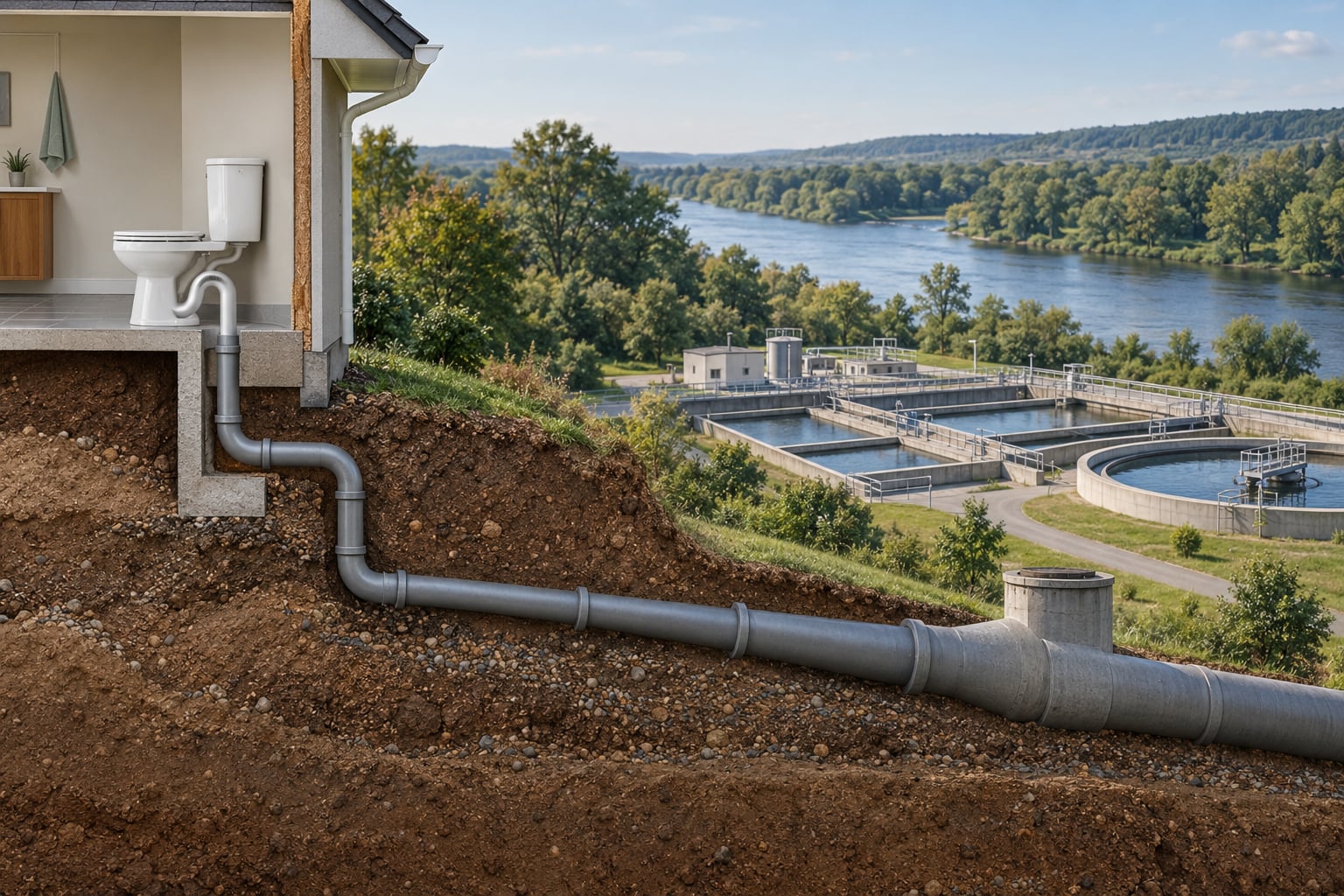
Water you flush leaves the bowl through a curved trap, runs down a gently sloped pipe, and ends up in one of two places: a municipal sewer network that delivers it to a wastewater treatment plant, or a septic tank on the property itself. From there it is screened, settled, biologically cleaned and disinfected before being released to a river, an estuary or a reuse system. It never simply disappears.
Most of this is invisible infrastructure, which is exactly why people find it hard to picture. Nobody is taught it, and it only becomes interesting when something backs up. Here is the whole route, from the ceramic bowl to the receiving water.
Table of Contents
- Where Does Flushed Water Go First?
- What happens to water after you flush it, step by step inside the house
- What Happens in the Sewer System?
- How Is Wastewater Treated?
- What Happens at a Septic Tank Instead?
- What Happens to the Solids and Sludge?
- Is the Treated Water Safe to Drink?
- What Can Readers Do to Protect Water Quality?
- Frequently Asked Questions
- Does toilet paper really have to break down in the pipes?
- Why do some sewer systems handle rain better than others?
- What causes a septic tank to smell, and when should it be inspected?
- Can treated wastewater be used as drinking water?
- How do treatment plants affect the environment?
- What to Remember First
Where Does Flushed Water Go First?
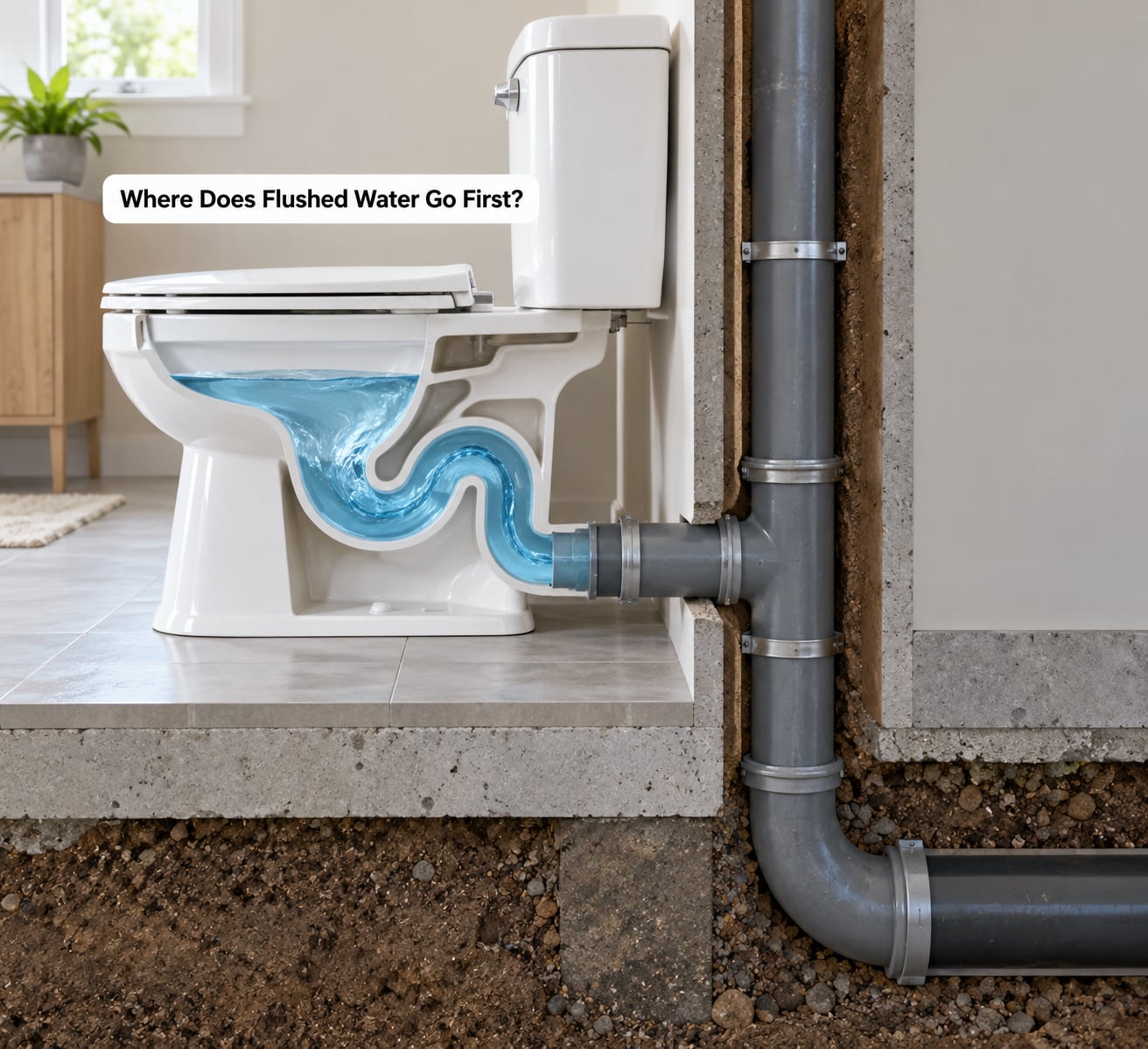
It leaves through the bowl and the trap, then joins a branch pipe that slopes steadily downhill into a larger pipe, and from there it travels to whichever system serves your property. That is the whole first step, and the destination depends on where you live rather than on anything you did.
What happens to water after you flush it, step by step inside the house
The tank releases water into the bowl, and the bowl is shaped so the flush pushes waste past the bend of the trap. That bend, called the trap or trapway, always holds a small plug of water. The plug is the reason sewer gas does not come back up into the bathroom, and it is also why the water does not sit still in the pipe.
From the trap, the flow enters a horizontal branch pipe that runs to a vertical stack, or soil stack, which collects wastewater from the toilet and any nearby bathroom sinks or showers. Every toilet, sink, bath and shower in a building feeds the same stack, so almost all of the water you use indoors ends up in the same wastewater stream.
The branch pipe is not level. Building codes require a fall of roughly 1 to 2 centimetres per metre, enough for gravity to do the work without the pipe emptying completely. A blockage in a branch line shows up as a slow drain, because there is no pressure behind it.
At the bottom of the stack, the wastewater enters a horizontal sewer lateral, which joins a public sewer under the street or a septic tank on the property. Which one you have is easy to check: look for a manhole cover in the street near your house, or ask your utility, and if neither exists you are almost certainly on a septic system.
What Happens in the Sewer System?
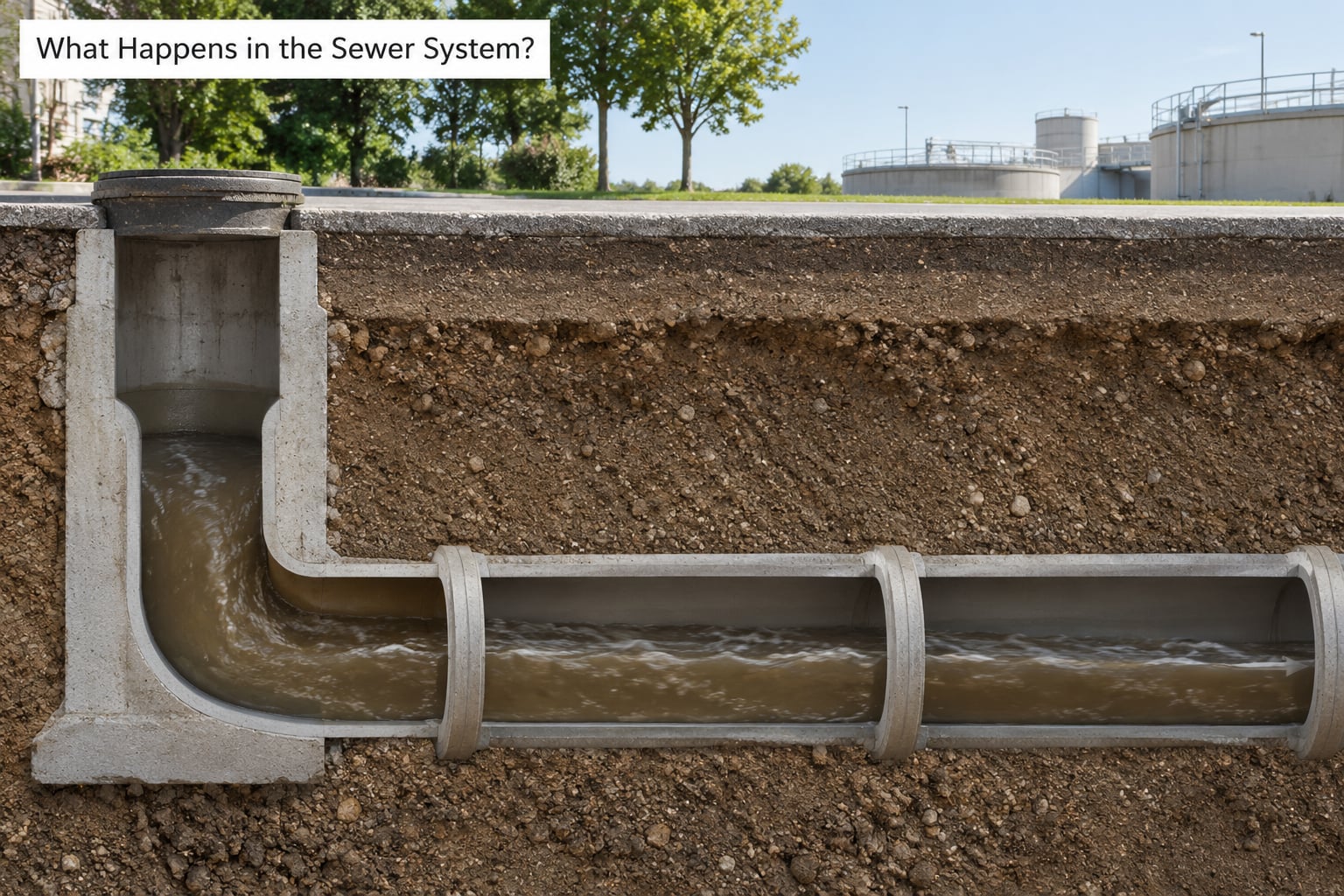
It travels through underground mains to a treatment facility, usually downhill the whole way, with pumps taking over only where the ground or the elevation makes gravity impossible. Pipes get wider as they collect more flow from more branches, and access shafts called manholes let crews inspect them.
Two things about this network cause more confusion than anything else. First, storm water and household sewage are usually separate systems. The drain in the middle of the street carries rain from roofs and roads, and it typically goes straight to a river without passing through a treatment plant.
Second, in older combined systems, one pipe carries both. When a heavy storm fills that pipe beyond its capacity, the excess is released untreated through what regulators call a combined sewer overflow. That is the real reason people see news reports about sewage reaching rivers or coasts, and it is also why a cloudy plume at an outfall after heavy rain is not automatically a sign that a plant has failed.
Where a city is hilly, or where the treatment plant sits below the level of the pipes feeding it, lift stations or pump stations push the flow forward instead. Skyscrapers use the same idea in miniature: sewage falls to a basement wet well and is pumped up the building.
How Is Wastewater Treated?
It is cleaned in stages: screens and grit chambers remove the objects and grit, tanks let solids settle, bacteria break down dissolved organic matter, and a disinfectant kills the remaining pathogens before discharge. Sludge is handled on a separate line throughout.
- Screening and grit removal. Mechanical bar screens catch tampons, wipes, sanitary products, plastics and other debris so pumps and tanks are not damaged. Grit chambers then drop out sand, coffee grounds and small stones.
- Primary sedimentation. The water slows down in large clarifiers and the heavy, floatable and settleable solids separate. Much of the suspended material becomes primary sludge, and a layer of grease and light solids forms as scum.
- Secondary biological treatment. Aeration tanks hold the water with a large population of bacteria. Air is pumped through the mixture, and the microbes consume the dissolved organic matter measured as biochemical oxygen demand, or BOD. Activated sludge, where settled microbes are returned to keep the population dense, is the most common version of this stage.
- Secondary settling. The aeration tank settles again and the biological solids are separated from the clearer water. Most of the sludge is recycled back into the aeration stage and only the excess is removed.
- Advanced or tertiary treatment. Filters, biological reactors and chemical dosing take out more phosphorus and nitrogen so the discharged water does not over-enrich rivers and trigger algal growth. This stage varies widely between utilities.
- Disinfection and release. Ultraviolet light or chemicals such as chlorine kill remaining pathogens, and the treated effluent leaves through a monitored outfall or feeds a reuse system. Permits set the permitted concentrations of specific indicators, and utilities sample and report against them.
| Stage | Method | What it does not do |
|---|---|---|
| Screening and grit removal | Bar screens and grit chambers | Removes objects and grit, not dissolved contaminants or microbes |
| Primary sedimentation | Slowing down in clarifiers so solids settle or float | Removes only part of the suspended and organic load |
| Secondary treatment | Aeration with bacteria, or biofilters and trickling filters | Leaves nutrients such as nitrogen and phosphorus in the water |
| Secondary settling | Settling, with sludge returned to aeration | Is a separator, not a purification step in itself |
| Advanced treatment | Filtration and nutrient removal | Is not installed at every plant, so nutrient reduction varies |
| Disinfection | Ultraviolet light or chemical dosing | Does not remove contaminants that resist the process, including microplastics and traces of some medicines |
Retention time across a plant is commonly measured in hours, and every stage adds to it. The whole sequence is designed so that solids, organic matter and microbes are dealt with separately, because a single process cannot do all three well.
What Happens at a Septic Tank Instead?
Where there is no public sewer, the solids settle in a buried tank and the partly treated liquid seeps into a drainfield, where soil organisms finish the job. It works, and it works well, provided the tank is maintained and the soil can drain.
Inside the tank, heavy solids sink to form a sludge layer, light solids and grease float to form a scum layer, and the clearer liquid sits between them. That middle layer is what leaves the tank through the outlet pipe and enters the drainfield or soak-away, where it spreads over a wide area of soil and percolates downward.
In the soil, bacteria continue breaking down what the tank could not, and the soil itself filters the remaining particles. Because that filtering depends on air and on volume, a heavy clay soil or a high water table limits how much a system can handle. Pumping removes the accumulated sludge so the tank keeps its working volume, and inspections check the baffles, the inlet and outlet and the condition of the drainfield.
Grease, wipes, oil-based products, strong chemicals and excess water all work against a septic system. Pumping, repair and troubleshooting are jobs for a qualified local professional who knows the local rules, and they are not things to attempt on your own.
What Happens to the Solids and Sludge?
They are separated early and often, and they end up on a different route from the water. Screenings and grit are removed at the start, sludge is settled out through the middle stages, and the remaining sludge is treated before it can be used or disposed of.
Sludge goes through thickening to remove water, then digestion. Anaerobic digestion, which runs without air, is common: bacteria break down the organic material and give off biogas, a gas that can be used to generate heat or electricity on site, which is one of the few genuinely positive energy stories in the sector. The treated solids are then dewatered on large presses or belts.
Some biosolids are applied to land as a soil amendment, subject to permits covering where, when and how much, and to testing for contaminants. That is a regulated practice under specific conditions, not a way of turning sewage into ordinary garden soil. Where land application is not permitted or not practical, the solids are incinerated, landfilled or used in other approved ways. What happens to them depends on local regulation, so the honest answer is that there is no single global destination for sludge.
Is the Treated Water Safe to Drink?
No, and the assumption that a treatment plant turns sewage into tap water is the most common misunderstanding on this topic. Treatment plants usually release treated effluent to a river, an estuary or the sea, or send it to a reuse scheme, while drinking water comes from its own sources through a separate set of processes.
A drinking water plant works differently. It takes fresh water from a reservoir, aquifer, river or well and treats it to drinking water standards, so the two systems meet only where a utility deliberately reconnects them.
That deliberate reconnection does exist in a small number of places, where advanced treatment, several barrier steps and continuous monitoring turn reclaimed water into drinking water for a city. It is unusual, heavily regulated and not the normal destination of your toilet flush.
Monitoring is what makes the difference. Utilities sample effluent continuously and report against permit limits, and unusual events such as a spill or a process upset are investigated and sometimes published. That is also why the honest answer to any single incident is more careful than either alarm or dismissal.
What Can Readers Do to Protect Water Quality?
You cannot treat a sewer network from home, but the things you put down the drain and the habits you keep make a measurable difference to the water that leaves your street. None of it replaces the utility and the regulator, and all of it works alongside them.
- Take unused and expired medicines to an approved collection point, such as a pharmacy take-back scheme, rather than the toilet. Drugs pass through treatment largely unchanged.
- Keep wet wipes, dental floss, cotton buds, nappies, sanitary products and plastic items out of the sewer and out of the toilet. Wipes are a leading cause of blockages, and most products labelled flushable are not designed to break down in pipes.
- Never pour cooking oil, paint, solvents, motor oil or cleaning chemicals down a sink. Solidify used oil and take it to a recycling point.
- Follow local flushing rules where they exist, especially in areas with sensitive receiving waters or restrictions on what may be discharged.
- Have a septic system pumped and inspected on the schedule a qualified local professional recommends, and keep grease, wipes and chemicals out of it.
- Report spills, blockages and illegal discharges to the correct local authority rather than to a general enquiry line, so the right team responds.
Frequently Asked Questions
Does toilet paper really have to break down in the pipes?
Yes. Standard toilet paper is designed to disintegrate into fibres within a short distance of travel in a sewer, which is why plain, unscented, unbodied paper is the safe choice. Wipes, paper towels and thicker tissues do not break down the same way and are the most common cause of fatbergs in household branch pipes. If you are ever unsure what happens to water after you flush it, the short answer is that only paper that dissolves quickly belongs there.
Why do some sewer systems handle rain better than others?
Because some cities keep storm water and sewage in separate pipes. Where the two systems are separate, heavy rain fills only the storm drains and the treatment plant carries a normal flow. In a combined system, one pipe carries both, so a large storm can push the flow above the pipe’s capacity and force an untreated discharge through a combined sewer overflow.
What causes a septic tank to smell, and when should it be inspected?
A smell usually means the trap has dried out, a vent is blocked, or solids and grease have built up past the point the tank can handle. An empty toilet after a holiday, a blocked vent pipe and an overdue pump are the usual suspects. Inspect and pump on the interval a qualified local professional recommends for your tank size and household, and never open or pump a septic tank yourself.
Can treated wastewater be used as drinking water?
Usually not directly. Treatment plants normally release effluent to rivers, estuaries or the sea, or to systems that reuse it for irrigation and industry. Direct potable reuse exists in a few places, but it requires extra treatment steps, continuous monitoring and permission from the health authority, and it is not the normal destination of a household flush.
How do treatment plants affect the environment?
Mostly positively, because they remove pathogens and nutrients from water before it reaches rivers and coasts. They also use a lot of energy for aeration and pumping, and can release nutrients where advanced treatment is not installed, which contributes to algal growth in slow-moving water. Sludge management and the receiving water both matter, so the effect depends on the plant and its permit.
What to Remember First
Flushed water normally enters a sewer or a septic system, passes through physical and biological treatment, and is then released to a river or coast or reused under local controls. Find out which system serves your property, because a manhole in the street means a public sewer and its absence usually means a septic tank, and follow the local guidance for what goes down the drain.