If you are asking how many times you need to reuse a tote bag to break even, the short answer is about 131 shopping trips for a conventional cotton canvas bag. That figure comes from the UK Environment Agency’s 2011 assessment of supermarket carrier bags and is repeated in the Danish Environmental Protection Agency’s 2018 life cycle study.
Lightweight non-woven polypropylene needs far fewer trips to reach the same point, while organic cotton needs far more. The gap between those numbers is not a contradiction. It is the result of studies measuring different things, and it is worth understanding before you decide whether the tote in your cupboard has done any good.
All figures below were checked against the Danish EPA’s 2018 report and the UNEP Life Cycle Initiative meta-study in October 2026.
Table of Contents
- How Many Times You Need to Reuse a Tote Bag to Break Even
- How Tote Bag Break-Even Is Calculated
- Break-Even Assumptions and Variables
- Typical Break-Even Ranges by Tote Bag Type
- How Many Times You Need to Reuse a Tote Bag in Real Life
- Cotton, Canvas, and Recycled-Plastic Totes Compared
- What Counts as One Reuse
- Do Households Actually Reach the Break-Even Number?
- Does Washing a Reusable Tote Affect Break-Even?
- Financial Break-Even vs Environmental Break-Even
- Is a Cotton Tote Actually Better Than a Plastic Bag?
- Why Published Tote Bag Studies Differ
- Five Questions to Ask Before You Buy an Eco Tote
- What to Do When a Tote Reaches End of Life
- Frequently Asked Questions
- How many times do you generally need to use a tote bag to break even?
- Do cotton tote bags need more uses to break even?
- Can replacing one single-use bag per trip count as using a reusable tote?
- Does washing a tote bag change its environmental break-even point?
- How can I calculate the break-even point for my own tote bag?
- Conclusion
How Many Times You Need to Reuse a Tote Bag to Break Even
There is no single number, because the answer depends on what the tote is made of, how much it replaced, and what you count as a fair comparison. The most-cited range, drawn from the life cycle assessments that dominate this topic, looks roughly like this.
A conventional cotton canvas tote sits near 131 uses. The UNEP Life Cycle Initiative meta-study, which pooled 70-odd life cycle assessments, puts reusable cotton bags in a 50 to 150 use band once the bag is reused and then recycled or incinerated at end of life. Thin non-woven polypropylene folds up to around 11 to 52 uses, depending entirely on which study and scenario you read.
Recycled PET polyester totes land somewhere around 28 to 50 uses. Organic cotton is the outlier that shocks people: the Danish study put it at 7,100 uses for conventional cotton and 20,000 for organic, in a climate-change-only scenario. A heavy jute or hemp bag falls somewhere in the middle, closer to canvas than to polypropylene.
What none of these studies do is model your kitchen drawer. In a thread on r/ZeroWaste, one shopper described going from a couple of bags to nine or twelve in three years. The maths fails when you spread 200 trips across ten bags, because every new bag restarts the payback period from zero.
How Tote Bag Break-Even Is Calculated
Break-even for a reusable bag is the number of trips it needs before its total production impact equals the combined impact of the single-use bags it replaced. In plain terms, the tote is made once, so its entire manufacturing footprint gets paid off on the first trip and spread thinner with every trip after.
The calculation is a single division. Take the climate impact of producing one tote, then divide it by the climate impact of producing the single-use bags it displaces on a typical trip. The result is the number of uses needed to break even.
Two different answers hide behind that word. Financial break-even asks when you have recovered what you paid for the bag. Environmental break-even asks when you have recovered the resources and emissions spent making it. The second is almost always much slower than the first.
Break-Even Assumptions and Variables
Before the formula means anything, six inputs have to be fixed, and each one moves the result a long way.
- Purchase price for the financial calculation, usually compared against what you would have spent on disposable bags instead.
- Production impact of the tote, in CO2-equivalent per bag, covering raw material, manufacturing, transport and distribution.
- Bag weight and material, since a 4 oz cotton bag and a 12 oz canvas bag are not the same product.
- Lifetime assumption, meaning how many uses the study assumes you will get before replacing it.
- Washing, which adds water and energy per use in some studies and is ignored in others.
- What the tote replaces per trip, which for a full shop is usually two or three single-use bags rather than one.
Change any one of those and the headline number moves. That is why the same study is often quoted as 11 uses and 52 uses in different places.
Typical Break-Even Ranges by Tote Bag Type
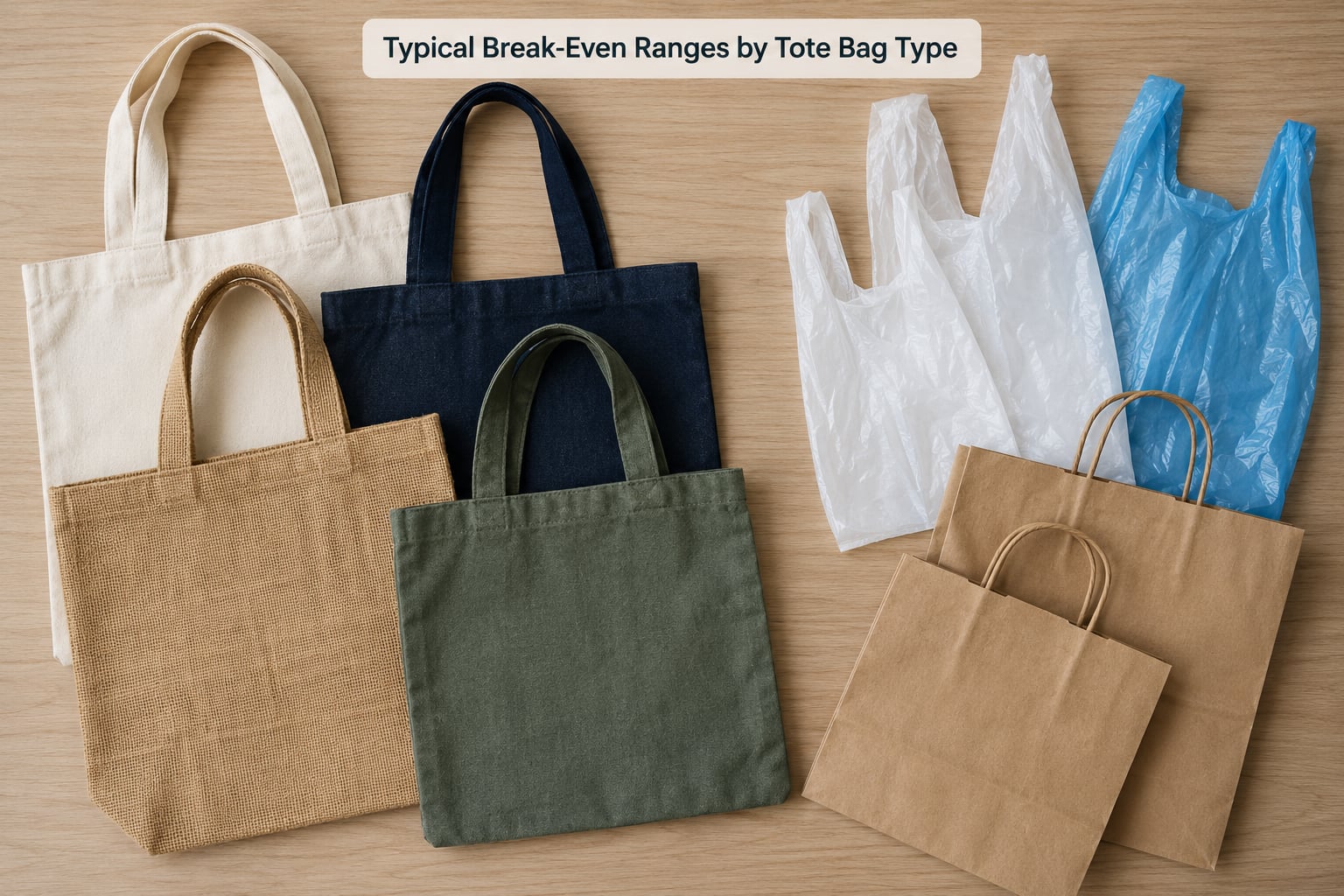
These ranges are illustrative rather than universal. They combine the figures most consistently reported by the Danish EPA, the UK Environment Agency and the UNEP meta-study, and they assume the tote displaces a comparable load of single-use carrier bags on each trip.
| Tote type | Estimated uses to break even | What the figure covers |
|---|---|---|
| Lightweight polypropylene tote | About 11 to 52 uses | Climate impact only, narrow range across sources |
| Recycled PET polyester tote | About 28 to 50 uses | Climate impact, recycled input credited |
| Paper carrier bag (for comparison) | About 43 uses | Danish study, climate impact |
| Conventional cotton canvas tote | About 131 uses | UK Environment Agency climate basis |
| Reusable cotton, full multi-impact LCA | About 50 to 150 uses | UNEP meta-study, reuse then recycle or incinerate |
| Conventional cotton, climate-only scenario | About 7,100 uses | Danish EPA 2018, narrow system boundary |
| Organic cotton, climate-only scenario | About 20,000 uses | Danish EPA 2018, narrow system boundary |
Read the table as a range, not a verdict. The two cotton rows are not competing answers to the same question: one is a broad multi-impact comparison that credits recycling at end of life, the other counts greenhouse gas emissions only and stops the analysis at the point the cotton bag becomes better than plastic on that one measure.
How Many Times You Need to Reuse a Tote Bag in Real Life
Use counts are abstract, so here is the same target converted into calendar time. The multiplier is trips per week multiplied by 52 weeks.
| Shopping trips per week | Trips to reach 11 uses | Trips to reach 131 uses | Time to reach 131 uses |
|---|---|---|---|
| One trip a week | About 3 months | 131 trips | About 2 years and 6 months |
| Two trips a week | About 6 weeks | 131 trips | About 1 year and 3 months |
| Three trips a week | About 8 weeks | 131 trips | About 10 months |
| Five trips a week | About 5 weeks | 131 trips | About 6 months |
A weekly shopper therefore needs well over two years to repay a cotton tote in environmental terms, while someone who shops five times a week clears it in half a year. Neither number is unreasonable. What matters is that you pick a bag you will still be carrying in two years, which is an argument for the sturdiest tote in your cupboard rather than a new thin one.
Cotton, Canvas, and Recycled-Plastic Totes Compared
Cotton and canvas carry a heavy production footprint: irrigated, fertilised, pesticide-treated fibre, then a long dyeing and weaving process. A single tote can carry the climate impact of dozens of thin plastic bags before you have used it once, which is the entire reason the 131 figure exists.
Non-woven polypropylene and rPET skip the agricultural stage and start from a fraction of the impact, so they pay back quickly even at low use counts. The trade-off is that these fabrics shed microplastics as they abrade, and a heavy nylon bag is reported on r/solarpunk as needing somewhere between 35 and 84 uses just to match one LDPE bag.
On a community thread in r/singapore, shoppers concluded that the non-woven polypropylene bag produced the least overall negative impact once reuse hits about 50 trips. That is the honest summary of the whole field: at realistic use counts, plastic fabrics win on speed of payback, and cotton wins on what happens at end of life.
What Counts as One Reuse
One meaningful use means carrying a comparable load in place of a single-use carrier bag, not keeping the tote in a cupboard. A trip to the supermarket where one bag holds the shopping, instead of three plastic ones at the till, counts once. So does a farmers market run with produce, or a clothes shop where the tote replaces a thin poly bag.
These count too: carrying hardware store purchases, books from the library, a gym kit, or a load of donations for a charity shop. Using the tote as a trash liner or storage pouch does not count toward the shopping break-even, though it does keep the bag in use longer.
Counting honestly is easier than people expect. People on r/unpopularopinion report using a canvas bag on every shop trip without ever tracking it, which tells you the habit is the easy part and the counting is the annoying part.
Do Households Actually Reach the Break-Even Number?
Rarely, if you rotate between several bags. Break-even is measured per bag, and the moment you start a fresh tote for the farmers market and keep the supermarket one for groceries, both need to cover their own production cost. A household with four totes, each used to 40 trips, has repaid none of them.
That is the trap behind the accumulation problem. The fix is simple and slightly boring: pick one bag per job, put the others somewhere you will forget them, and stop buying a replacement every time you turn up at the till without one. A forgotten tote followed by a panic purchase is a net loss twice over, since you used the disposable bags and made a new item.
Track it without a spreadsheet. A pen mark or a knot in the handle is enough, and a monthly tally of trips is as good as a dedicated app. What you need is a sense of whether you are at trip 30 or trip 300, because the answer changes what you should do next.
Does Washing a Reusable Tote Affect Break-Even?
Washing adds water and energy to every use, and whether a study counts it is one of the biggest reasons two sources give you different numbers. The studies that reach a low cotton break-even usually assume the bag is washed rarely; the ones that reach a high number assume the full laundry burden of cotton on every cycle.
You rarely need to wash a tote for environmental reasons. Spot cleaning with a damp cloth and a little soap handles most marks, and it costs almost nothing in water and energy. A full machine wash earns its place after raw meat, dairy or a spill that has soaked through the fabric.
Cotton and canvas tolerate a cold cycle, no bleach and a line dry without complaint. Non-woven polypropylene and rPET are a different story: heat can distort them and washing accelerates the shedding of microplastics, so a damp wipe and airing out is usually the better option.
If a bag is torn beyond repair, replacing it is cleaner than laundering it repeatedly. One r/ZeroWaste user put it plainly: they have never binned a cotton bag because the good ones simply do not break, and one person’s mother still uses totes from the nineties.
Financial Break-Even vs Environmental Break-Even
Money pays back much faster than carbon. If a tote costs about the same as eight single-use carrier bags, it has paid for itself in money after eight trips, which is well under a year for most households. The same bag may need well over a hundred trips before it pays back its manufacturing footprint.
That gap is why the price of a bag is a poor guide to its environmental value. A more expensive bag is not automatically greener, and the cheapest tote in the drawer is not automatically a bargain if it sits unused. Do not buy a second tote just to be doing more; the money and the emissions are both better spent making the one you already own last longer.
Carrier bag fees shift the financial side. Where a disposable bag costs something per trip, the money break-even for a reusable bag shortens considerably, and the environmental break-even does not move at all. Two calculations, two different answers.
Regional rules matter too, and they move. A number of countries and a growing list of US states now restrict or charge for disposable carrier bags, which pushes more shoppers toward reusables and lifts the average number of trips per reusable bag. None of that changes what a bag costs the climate to make.
Is a Cotton Tote Actually Better Than a Plastic Bag?
Eventually, yes, and the “eventually” is the whole question. A thin LDPE bag is cheap and light to make, but it takes around 20 grams of CO2-equivalent to produce one, and it does not break down for centuries in most conditions. A cotton tote makes many thin bags worth of emissions before its first trip, and then stops making anything new for as long as it lasts.
Two honest caveats sit under that. Cotton production is water- and pesticide-intensive, which matters far more in water-stressed regions than a European climate figure suggests. And the thousands-of-uses figures apply to climate only; on aquatic toxicity and marine litter, plastic performs badly at every use count, which is why multi-impact assessments put cotton break-even in the far lower 50 to 150 band.
The practical answer depends on the alternative, not on the bag in isolation. A cotton tote is clearly ahead of buying a new plastic bag every trip. Against nothing at all, in a region where plastic bags are banned and you were already using whatever bag you had, the gap narrows.
Why Published Tote Bag Studies Differ
When two credible reports give you 11 uses and 52 uses for the same bag, one of them is not simply wrong. The difference comes from assumptions, and the main ones are these.
- System boundary, meaning which stages of the life cycle are counted. This is the whole story behind 131 versus 7,100.
- Impact category. The Danish cotton figures measure climate change only and ignore marine litter, microplastic shedding and aquatic toxicity, all of which count against plastic and help cotton.
- Allocation rules for shared production processes, which penalise cotton because so much of the chemical industry’s output goes into fertiliser and pesticide manufacture.
- Bag weight and transport. A heavier tote shipped from overseas carries a production and freight impact that a flat-folded local one does not.
- Reuse rate and end of life, which differ between a bag reused 50 times and then recycled and a bag reused 50 times and landfilled.
- Washing, counted in some models and ignored in others.
One more caution on the popular version. A manufacturer blog in this space states that a cotton reusable bag saves resources after 30 or more uses. The primary studies do not support that, and quoting it would understate how many trips a cotton tote actually needs.
Five Questions to Ask Before You Buy an Eco Tote
Most disappointing totes never reach break-even because they are cheap, thin and destined for one promotional trip. On r/solarpunk, people describe conference swag as hardcore greenwashing, and the maths backs them up: a bag made for a single event may never get 50 trips, however sincere the intention behind it.
- What is it made of, and how heavy is it? A 4 oz cotton bag and a 12 oz canvas bag have very different footprints, and many listings never say.
- Is the fabric certified? GOTS for organic cotton, GRS for recycled content, OEKO-TEX for harmful substances in the finished fabric.
- Does it have a gusset base and cross-stitched handles? These are the parts that fail first, and a bag without them rarely reaches 100 trips.
- Will I lose it? A folded design that fits in a coat pocket beats a beautiful tote that lives in a cupboard.
- What is the printed ink? Plastisol screen printing adds plastics to a bag you are meant to be avoiding. Water-based inks are better.
If a bag fails two or more of those, it is very unlikely to reach break-even, and buying it anyway is the version of green spending that changes nothing.
What to Do When a Tote Reaches End of Life
A bag that has genuinely been used for years has different options from one that never left a conference lanyard. Clean cotton and canvas totes can go to industrial composting where that facility exists, or to textile recycling, which handles blended fabrics better than most people expect. Many hardware and garden shops take woven plastic sacks for recycling, which is the usual home for a non-woven polypropylene tote.
Before any of that, the honest first step is another use. A sturdy tote that has stopped being a shopping bag still works as a storage sack, a moving-day carrier, a laundry bag, a car boot organiser, or a gift bag. Posters on r/ZeroWaste describe keeping bags in the car permanently for exactly this reason, which is also how they stop forgetting them.
Surplus totes that have never been used are a different problem. Give them away rather than binning them, since somebody else restarting a bag’s payback period is not the same as you restarting it. r/ZeroWaste threads keep circling this, and the consensus advice is blunt: do not buy a tenth tote, donate two.
Frequently Asked Questions
How many times do you generally need to use a tote bag to break even?
For a conventional cotton canvas tote, about 131 shopping trips, based on the UK Environment Agency’s 2011 carrier bag assessment and the Danish EPA’s 2018 life cycle study. Thin non-woven polypropylene needs far fewer, often 11 to 52 uses, while recycled PET sits around 28 to 50. Organic cotton figures of 7,100 and 20,000 uses come from a climate-change-only scenario with a very narrow system boundary.
Do cotton tote bags need more uses to break even?
Yes, considerably more than plastic-fabric bags. Cotton carries a heavy production footprint because of irrigation, fertilisers, pesticides, dyeing and long-distance shipping, so the impact has to be spread over many trips. Thin non-woven polypropylene and recycled PET begin from a fraction of that impact. A thinner, lighter cotton bag pays back faster than a heavy 12 oz canvas one, because weight drives a lot of the footprint.
Can replacing one single-use bag per trip count as using a reusable tote?
Only if you actually replace one bag. A full supermarket shop usually consumes two or three thin carrier bags, so one tote trip that replaces all of them counts once, not three times. The counting error that matters most is including trips where the tote stays at home, because the disposable bags were still used and the tote gained nothing.
Does washing a tote bag change its environmental break-even point?
It can push the break-even point higher, because every cycle adds water and energy to the per-use figure. This is one reason two studies give different answers for the same bag. Spot cleaning with a damp cloth and a little soap avoids the issue entirely and is enough for most marks. Reserve full washes for contamination you cannot clean locally, and use a cold cycle with no bleach.
How can I calculate the break-even point for my own tote bag?
Divide the tote’s total production impact by the impact of the single-use bags it replaces per trip. In practice, use the published figure for the material and multiply your trip count by the number of disposable bags you would otherwise have taken. Then compare that with how many trips you realistically make per week, because a bag that needs 131 uses at one trip a week takes two and a half years, while the same bag at three trips a week takes about ten months.
Conclusion
About 131 trips for a conventional cotton canvas tote, closer to 11 to 52 for a thin non-woven polypropylene one, and much longer for organic cotton under a climate-only reading. At three shopping trips a week, 131 trips is roughly ten months; at one a week, closer to two and a half years. Money pays back far sooner than carbon, so the two break-even points will never match.
The first thing to do is pick the most durable tote you already own and use it until the fabric, stitching or handles actually give out. Buying a new one to replace a forgotten one restarts the payback period, and the real failure mode is forgetting the bag at the door, not owning too few of them.